Downloaded 23 times
![3
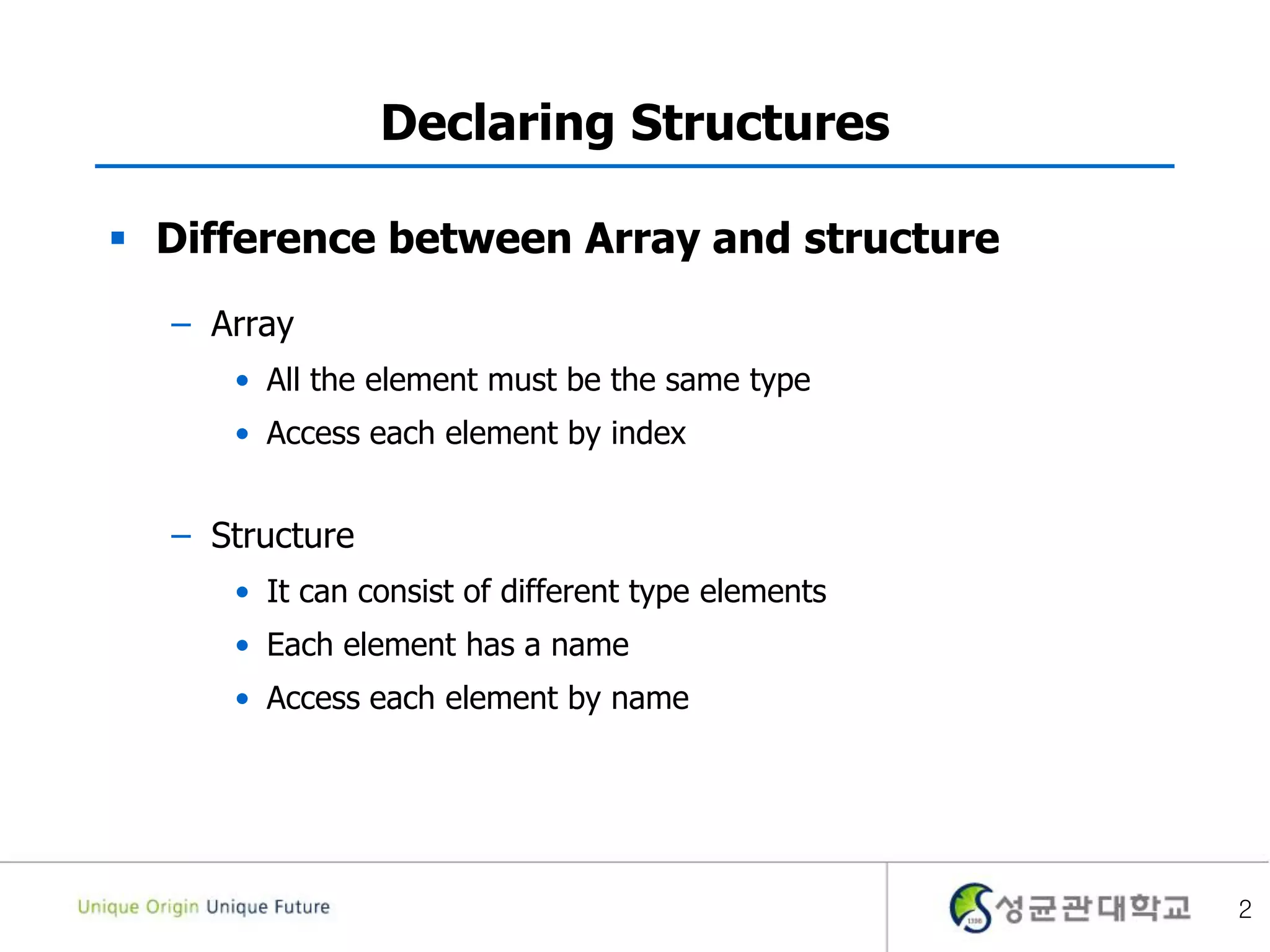
Declaring Structures
struct declaration
– Collection of members (elements)
[Ex] struct student { /* structure consists of 2 elements */
int std_id;
char name [20] ;
} ;](https://image.slidesharecdn.com/12-2-structure-130524022232-phpapp02/75/12-2-structure-3-2048.jpg)
![4
Declaring Structures
struct declaration
- struct tag: Name of structure
- You can declare variables in the structure type
[Ex] struct student {
int std_id;
char name [20] ;
};
[Ex] struct student p1, p2 ; /* correct declaration */
student p1, p2; /* wrong declaration */
struct tag:
It can be omitted.](https://image.slidesharecdn.com/12-2-structure-130524022232-phpapp02/75/12-2-structure-4-2048.jpg)
![5
Accessing a Member
Struct member operator ‘.’
– Access for a member of structure using ‘.’
struct student {
int std_id;
char name[20];
} ;
void main() {
struct student p ;
p.std_id = 1 ;
strcpy( p.name, “Monica” ) ;
}
1
Monica
p
std_id
name](https://image.slidesharecdn.com/12-2-structure-130524022232-phpapp02/75/12-2-structure-5-2048.jpg)
![6
Accessing a Member
Member operation
struct student {
int std_id;
char name[20];
} ;
void main() {
struct student p ;
scanf(“%s”, p.name);
p.std_id = 258; /* assignment */
p.std_id++; /* increment */
}](https://image.slidesharecdn.com/12-2-structure-130524022232-phpapp02/75/12-2-structure-6-2048.jpg)
![typedef of struct
Example
7
struct student {
char name[20] ;
int id ;
} ;
void main() {
struct student std1 ;
struct student std2 ;
…
}
struct student {
char name[20] ;
int id ;
} ;
typedef struct student Student ;
void main() {
Student std1 ;
Student std2 ;
…
}](https://image.slidesharecdn.com/12-2-structure-130524022232-phpapp02/75/12-2-structure-7-2048.jpg)
![typedef of struct
Example
8
typedef struct student {
char name[20] ;
int id ;
} Student;
struct student {
char name[20] ;
int id ;
} ;
typedef struct student Student ;
void main()
{
Student p ;
scanf( “%d”, &p.std_id ) ;
scanf( “%s”, p.name ) ;
printf( “%d ”, p.std_id ) ;
printf( “%sn”, p.name ) ;
}](https://image.slidesharecdn.com/12-2-structure-130524022232-phpapp02/75/12-2-structure-8-2048.jpg)
![9
Initializing Structures
Example
typedef struct student {
int std_id;
char name [20] ;
} Student ;
void main() {
Student person1 = {1, “Gil Dong”} ;
Student person2 = { 2, “Sun Shin” } ;
}
person1
person1.number person1.name
1 Gil Dong person2
person2.number person2.name
2 Sun Shin](https://image.slidesharecdn.com/12-2-structure-130524022232-phpapp02/75/12-2-structure-9-2048.jpg)
![10
Structure Pointer
Pointer Declaration
typedef struct student {
int std_id;
char name[20];
} Student;
void main() {
Student s={1, “Gil Dong”};
Student *p = &s ;
}
s
1 Gil Dong
p](https://image.slidesharecdn.com/12-2-structure-130524022232-phpapp02/75/12-2-structure-10-2048.jpg)
![11
Structure Pointer
Member access through pointer
typedef struct student {
int std_id;
char name[20];
} Student;
Student s, *p = &s ;
(*p).std_id = 10 ;
strcpy( (*p).name, “Sun Shin” ) ;
Student s, *p = &s ;
p->std_id = 10 ;
strcpy( p->name, “Sun Shin” ) ;](https://image.slidesharecdn.com/12-2-structure-130524022232-phpapp02/75/12-2-structure-11-2048.jpg)
![12
Structure Pointer
typedef struct shape {
int x, y ;
char name[10] ;
} Shape;
void main() {
Shape s, *p = &s;
scanf (“%d %d %s”, &p->x , &p->y, p->name ) ;
p->x *= 2;
p->y %= 5;
printf (“%d %d %sn”, p->x , p->y, p->name ) ;
}](https://image.slidesharecdn.com/12-2-structure-130524022232-phpapp02/75/12-2-structure-12-2048.jpg)
![13
Structure Pointer
typedef struct shape {
int x, y ;
char name[10] ;
} Shape;
void main() {
Shape s, *p = &s;
scanf (“%d %d %s”, &(*p).x , &(*p).y, (*p).name ) ;
(*p).x *= 2;
(*p).y %= 5;
printf (“%d %d %sn”, (*p).x , (*p). y, (*p). name ) ;
}](https://image.slidesharecdn.com/12-2-structure-130524022232-phpapp02/75/12-2-structure-13-2048.jpg)
![14
Precedence and Associativity of Operators
( ) [ ] . -> ++(postfix) --(postfix) left to right
++(prefix) --(prefix) ! ~ sizeof(type)
+(unary) -(unary) &(address) *(dereference)
right to left
* / % left to right
+ - left to right
<< >> left to right
< <= > >= left to right
== != left to right
& left to right
^ left to right
| left to right
&& left to right
|| left to right
? : right to left
= += -= *= /= %= >>= <<= &= ^= |= right to left](https://image.slidesharecdn.com/12-2-structure-130524022232-phpapp02/75/12-2-structure-14-2048.jpg)
![15
Functions and Assignment
Assignment into struct variables
typedef struct student {
int std_id;
char name[20];
} Student;
void main() {
Student p1 = { 1, “Gil Dong”}, p2 ;
p2 = p1 ; // OK???
}
1
Gil Dong
p1
?
?
p2](https://image.slidesharecdn.com/12-2-structure-130524022232-phpapp02/75/12-2-structure-15-2048.jpg)
![16
Functions and Assignment
Assignment into struct variables
typedef struct student {
int std_id;
char name[20];
} Student;
void main() {
Student p1 = { 1, “Gil Dong”}, p2 ;
copy_student( p1, p2 ) ;
}
void copy_student( Student p1,
Student p2 )
{
p1.std_id = p2.std_id ;
strcpy( p1.name, p2.name ) ;
}
Are the values of p2 in main() changed or not?](https://image.slidesharecdn.com/12-2-structure-130524022232-phpapp02/75/12-2-structure-16-2048.jpg)
![17
Functions and Assignment
Assignment into struct variables
typedef struct student {
int std_id;
char name[20];
} Student;
void main() {
Student p1 = { 1, “Gil Dong”}, p2 ;
copy_student( &p1, &p2 ) ;
}
void copy_student( Student *p1,
Student *p2 )
{
p1->std_id = p2->std_id ;
strcpy( p1->name, p2->name ) ;
}
Are the values of p2 in main() changed or not?](https://image.slidesharecdn.com/12-2-structure-130524022232-phpapp02/75/12-2-structure-17-2048.jpg)
![18
Arrays of Structure
Definition
typedef struct student {
int std_id;
char name[20];
} Student;
Student my_student[100] ;
my_student[0]
1 Gil Dong
my_student[1]
5 Sun Shin ………](https://image.slidesharecdn.com/12-2-structure-130524022232-phpapp02/75/12-2-structure-18-2048.jpg)
![19
Initialization of Structures
Initializing an Array of Structures
Student my_student[20] =
{ {1, “Gil Dong”},
{2, “Sun Sin”},
{3, “Kuk Jung”},
:
} ;](https://image.slidesharecdn.com/12-2-structure-130524022232-phpapp02/75/12-2-structure-19-2048.jpg)

1. The document discusses structures in C programming. A structure allows grouping of different data types under a single name and can contain elements of different data types. 2. Structures are declared using the struct keyword and elements are accessed using the dot operator. Arrays of structures can be defined to store multiple structure objects. Pointers to structures can also be declared. 3. Functions can be used to pass structures by value or by reference and copy structure elements. Arrays of structures allow initializing and storing multiple structure objects in contiguous memory locations.


