What CareComcan do by CEO Jacob Boye Hansen &Project Manager Annika Sonne Hansen
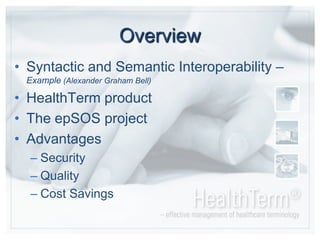
OverviewSyntactic and Semantic Interoperability –Example (Alexander Graham Bell)HealthTerm productThe epSOS projectAdvantagesSecurityQualityCost Savings
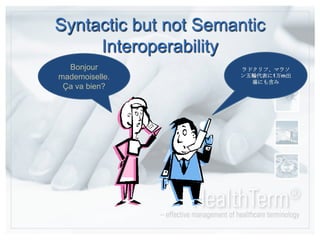
Syntactic but not Semantic Interoperabilityラドクリフ、マラソン五輪代表に1万m出場にも含みBonjour mademoiselle. Ça va bien?
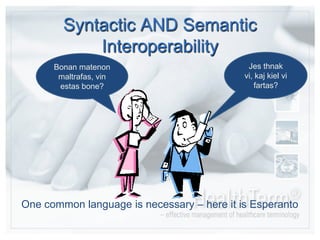
Syntactic AND Semantic InteroperabilityJes thnak vi, kaj kiel vi fartas? Bonan matenon maltrafas, vin estas bone? One common language is necessary – here it is Esperanto
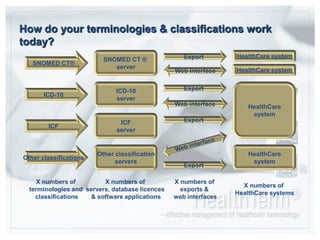
How do your terminologies & classifications work today?SNOMED CT®ExportSNOMED CT ® serverHealthCare systemHealthCare systemWeb interfaceICD-10ICD-10serverExportHealthCaresystemWeb interfaceICFICFserverExportWeb interfaceOther classificationsOther classificationserversHealthCaresystemExportX numbers of terminologies and classificationsX numbers of servers, database licences & software applicationsX numbers of exports & web interfacesX numbers of HealthCare systems
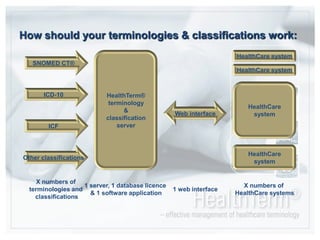
How should your terminologies & classifications work:SNOMED CT®HealthTerm®terminology&classificationserverHealthCare systemHealthCare systemICD-10HealthCaresystemWeb interfaceICFOther classificationsHealthCaresystemX numbers of terminologies and classifications1 server, 1 database licence & 1 software application1 web interfaceX numbers of HealthCare systems
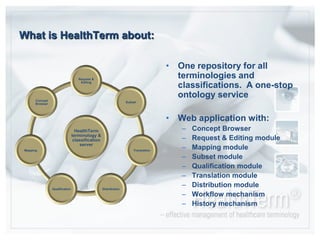
What is HealthTerm about:One repository for all terminologies and classifications.  A one-stop ontology serviceWeb application with:Concept BrowserRequest & Editing module Mapping moduleSubset moduleQualification moduleTranslation moduleDistribution moduleWorkflow mechanismHistory mechanism
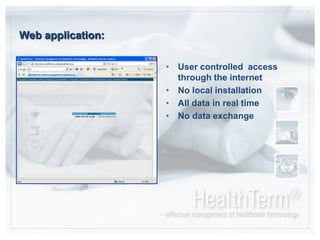
Web application:User controlled  access through the internetNo local installationAll data in real timeNo data exchange
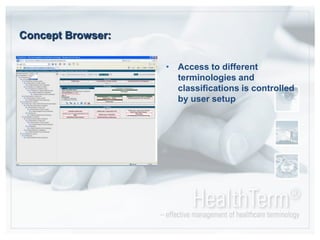
Concept Browser:Access to different terminologies and classifications is controlled by user setup
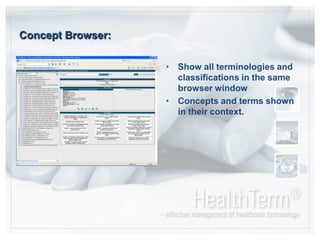
Concept Browser:Show all terminologies and classifications in the same browser windowConcepts and terms shown in their context.
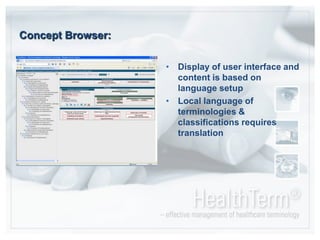
Concept Browser:Display of user interface and content is based on language setupLocal language of terminologies & classifications requires translation
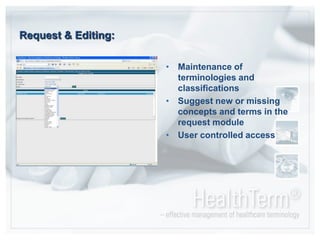
Request & Editing:Maintenance of terminologies and classificationsSuggest new or missing concepts and terms in the request moduleUser controlled access
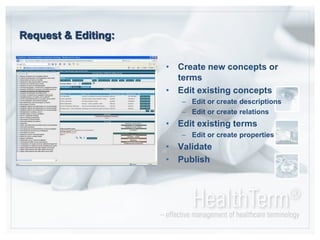
Request & Editing:Create new concepts or termsEdit existing conceptsEdit or create descriptionsEdit or create relationsEdit existing termsEdit or create propertiesValidatePublish
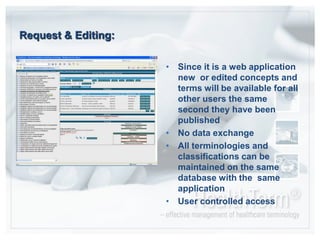
Request & Editing:Since it is a web application new  or edited concepts and terms will be available for all other users the same second they have been publishedNo data exchangeAll terminologies and classifications can be maintained on the same database with the  same applicationUser controlled access
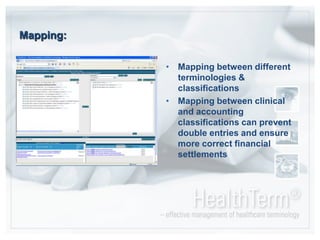
Mapping: Mapping between different terminologies & classificationsMapping between clinical and accounting classifications can prevent double entries and ensure more correct financial settlements
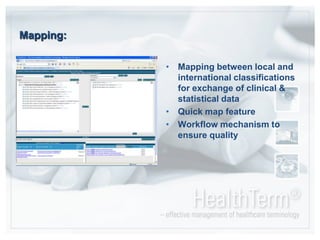
Mapping: Mapping between local and international classifications for exchange of clinical & statistical dataQuick map featureWorkflow mechanism to ensure quality
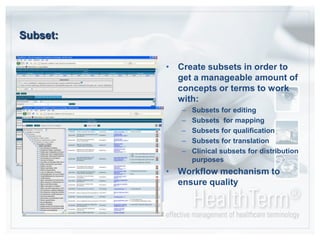
Subset:Create subsets in order to get a manageable amount of concepts or terms to work with:Subsets for editing Subsets  for mappingSubsets for qualificationSubsets for translationClinical subsets for distribution purposesWorkflow mechanism to ensure quality
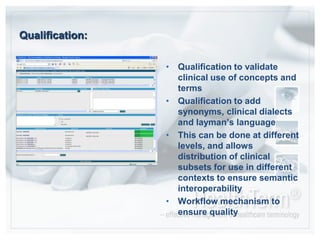
Qualification:Qualification to validate clinical use of concepts and termsQualification to add synonyms, clinical dialects and layman’s languageThis can be done at different levels, and allows distribution of clinical subsets for use in different contexts to ensure semantic interoperabilityWorkflow mechanism to ensure quality
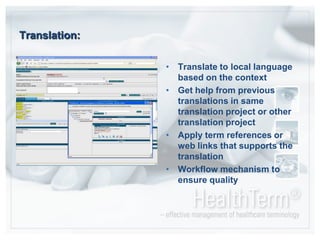
Translation:Translate to local language based on the context Get help from previous translations in same translation project or other translation projectApply term references or web links that supports the translationWorkflow mechanism to ensure quality
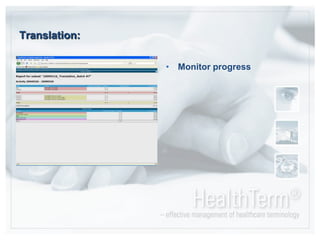
Translation:Monitor progress
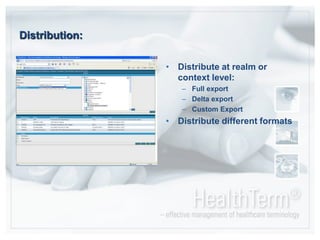
Distribution:Distribute at realm or context level:Full exportDelta exportCustom ExportDistribute different formats
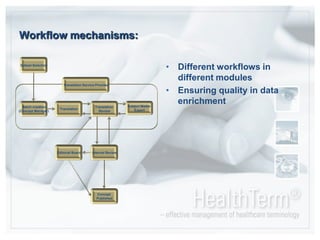
Workflow mechanisms:Different workflows in different modulesEnsuring quality in data enrichmentSubset SelectionTranslation Service ProviderBatch creation(Concept Manager)TranslationTranslation ReviewSubject Matter ExpertEditorial BoardInternal ReviewConcept Published
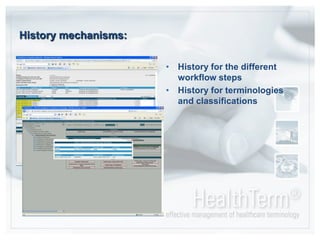
History mechanisms:History for the different workflow stepsHistory for terminologies and classifications
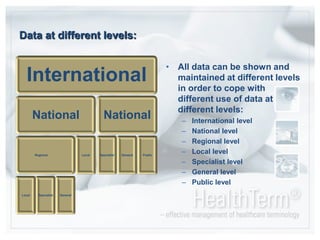
Data at different levels:All data can be shown and maintained at different levels in order to cope with different use of data at different levels:International levelNational levelRegional levelLocal levelSpecialist levelGeneral levelPublic level
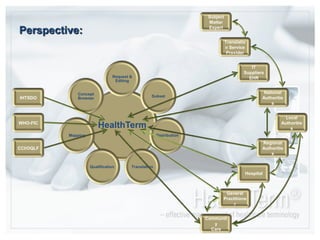
Perspective:Subject Matter ExpertTranslation Service ProviderIT Suppliers EHRIHTSDONational AuthoritiesWHO-FICLocal AuthoritiesCCI/OQLFRegional AuthoritiesHospitalGeneral PractitionerCommunityCare
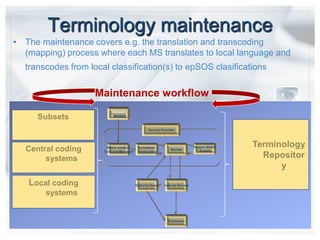
The maintenance covers e.g. the translation and transcoding (mapping) process where each MS translates to local language and transcodes from local classification(s) to epSOSclasificationsPage 26Terminology maintenanceValuesetselectionService ProviderBatch creation(Concept Manager)Translation /transcodingReviewSubject Matter ExpertMaintenance workflowSubsetsTerminology RepositoryEditorial BoardInternal ReviewCentral codingsystemsLocal codingsystemsPublished
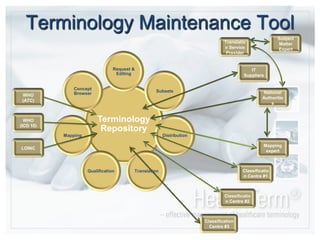
Terminology Maintenance ToolSubject Matter ExpertTranslation Service ProviderIT Suppliers WHO(ATC)National AuthoritiesWHO(ICD 10)LOINCMappingexpertClassification Centre #1Classification Centre #2Classification Centre #3
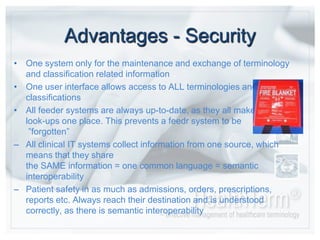
Advantages - SecurityOne system only for the maintenance and exchange of terminology and classificationrelated informationOne user interface allowsaccess to ALL terminologies and classificationsAll feeder systems arealways up-to-date, as they all make the look-ups oneplace. This prevents a feedr system to be ”forgotten”All clinical IT systems collect information from one source, whichmeansthattheysharethe SAME information = onecommonlanguage = semanticinteroperability
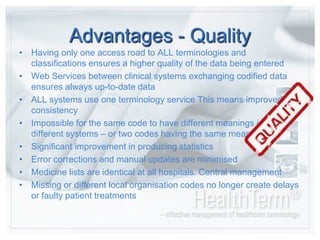
Patient safety in as much as admissions, orders, prescriptions, reports etc. Alwaysreachtheir destination and is understoodcorrectly, as there is semanticinteroperabilityAdvantages - QualityHavingonlyoneaccessroad to ALL terminologies and classificationsensures a higherquality of the data beingenteredWeb Services betweenclinical systems exchangingcodified data ensuresalways up-to-date dataALL systems useoneterminology service This meansimprovedconsistencyImpossible for the same code to have differentmeanings in different systems – or twocodeshaving the same meaningSignificantimprovement in producingstatisticsErrorcorrections and manual updatesareminimisedMedicine lists areidentical at all hospitals. Central managementMissing or differentlocal organisation codesno longer createdelays or faulty patient treatments
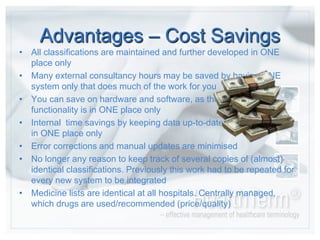
Advantages – CostSavingsAll classifications are maintained and further developed in ONE place onlyMany external consultancy hours may be saved by having ONE system only that does much of the work for youYou can save on hardware and software, as thefunctionality is in ONE place onlyInternal  time savings by keeping data up-to-date in ONE place onlyError corrections and manual updates are minimisedNo longer any reason to keep track of several copies of (almost) identical classifications. Previously this work had to be repeated for every new system to be integratedMedicine lists are identical at all hospitals. Centrally managed, which drugs are used/recommended (price/quality)
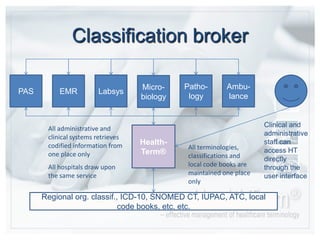
Classification brokerPASEMRLabsysPatho-logyAmbu-lanceMicro-biologyClinical and administrative staff can access HT directly through the user interfaceAll administrative and clinical systems retrieves codified information from one place onlyHealth-Term®All terminologies, classifications and local code books are maintained one place onlyAll hospitals draw upon the same serviceRegional org. classif., ICD-10, SNOMED CT, IUPAC, ATC, local code books, etc. etc.

110210 care com presentation for poland v2

  • 1.
    What CareComcan doby CEO Jacob Boye Hansen &Project Manager Annika Sonne Hansen
  • 2.
    OverviewSyntactic and SemanticInteroperability –Example (Alexander Graham Bell)HealthTerm productThe epSOS projectAdvantagesSecurityQualityCost Savings
  • 3.
    Syntactic but notSemantic Interoperabilityラドクリフ、マラソン五輪代表に1万m出場にも含みBonjour mademoiselle. Ça va bien?
  • 4.
    Syntactic AND SemanticInteroperabilityJes thnak vi, kaj kiel vi fartas? Bonan matenon maltrafas, vin estas bone? One common language is necessary – here it is Esperanto
  • 5.
    How do yourterminologies & classifications work today?SNOMED CT®ExportSNOMED CT ® serverHealthCare systemHealthCare systemWeb interfaceICD-10ICD-10serverExportHealthCaresystemWeb interfaceICFICFserverExportWeb interfaceOther classificationsOther classificationserversHealthCaresystemExportX numbers of terminologies and classificationsX numbers of servers, database licences & software applicationsX numbers of exports & web interfacesX numbers of HealthCare systems
  • 6.
    How should yourterminologies & classifications work:SNOMED CT®HealthTerm®terminology&classificationserverHealthCare systemHealthCare systemICD-10HealthCaresystemWeb interfaceICFOther classificationsHealthCaresystemX numbers of terminologies and classifications1 server, 1 database licence & 1 software application1 web interfaceX numbers of HealthCare systems
  • 7.
    What is HealthTermabout:One repository for all terminologies and classifications. A one-stop ontology serviceWeb application with:Concept BrowserRequest & Editing module Mapping moduleSubset moduleQualification moduleTranslation moduleDistribution moduleWorkflow mechanismHistory mechanism
  • 8.
    Web application:User controlled access through the internetNo local installationAll data in real timeNo data exchange
  • 9.
    Concept Browser:Access todifferent terminologies and classifications is controlled by user setup
  • 10.
    Concept Browser:Show allterminologies and classifications in the same browser windowConcepts and terms shown in their context.
  • 11.
    Concept Browser:Display ofuser interface and content is based on language setupLocal language of terminologies & classifications requires translation
  • 12.
    Request & Editing:Maintenanceof terminologies and classificationsSuggest new or missing concepts and terms in the request moduleUser controlled access
  • 13.
    Request & Editing:Createnew concepts or termsEdit existing conceptsEdit or create descriptionsEdit or create relationsEdit existing termsEdit or create propertiesValidatePublish
  • 14.
    Request & Editing:Sinceit is a web application new or edited concepts and terms will be available for all other users the same second they have been publishedNo data exchangeAll terminologies and classifications can be maintained on the same database with the same applicationUser controlled access
  • 15.
    Mapping: Mapping betweendifferent terminologies & classificationsMapping between clinical and accounting classifications can prevent double entries and ensure more correct financial settlements
  • 16.
    Mapping: Mapping betweenlocal and international classifications for exchange of clinical & statistical dataQuick map featureWorkflow mechanism to ensure quality
  • 17.
    Subset:Create subsets inorder to get a manageable amount of concepts or terms to work with:Subsets for editing Subsets for mappingSubsets for qualificationSubsets for translationClinical subsets for distribution purposesWorkflow mechanism to ensure quality
  • 18.
    Qualification:Qualification to validateclinical use of concepts and termsQualification to add synonyms, clinical dialects and layman’s languageThis can be done at different levels, and allows distribution of clinical subsets for use in different contexts to ensure semantic interoperabilityWorkflow mechanism to ensure quality
  • 19.
    Translation:Translate to locallanguage based on the context Get help from previous translations in same translation project or other translation projectApply term references or web links that supports the translationWorkflow mechanism to ensure quality
  • 20.
  • 21.
    Distribution:Distribute at realmor context level:Full exportDelta exportCustom ExportDistribute different formats
  • 22.
    Workflow mechanisms:Different workflowsin different modulesEnsuring quality in data enrichmentSubset SelectionTranslation Service ProviderBatch creation(Concept Manager)TranslationTranslation ReviewSubject Matter ExpertEditorial BoardInternal ReviewConcept Published
  • 23.
    History mechanisms:History forthe different workflow stepsHistory for terminologies and classifications
  • 24.
    Data at differentlevels:All data can be shown and maintained at different levels in order to cope with different use of data at different levels:International levelNational levelRegional levelLocal levelSpecialist levelGeneral levelPublic level
  • 25.
    Perspective:Subject Matter ExpertTranslationService ProviderIT Suppliers EHRIHTSDONational AuthoritiesWHO-FICLocal AuthoritiesCCI/OQLFRegional AuthoritiesHospitalGeneral PractitionerCommunityCare
  • 26.
    The maintenance coverse.g. the translation and transcoding (mapping) process where each MS translates to local language and transcodes from local classification(s) to epSOSclasificationsPage 26Terminology maintenanceValuesetselectionService ProviderBatch creation(Concept Manager)Translation /transcodingReviewSubject Matter ExpertMaintenance workflowSubsetsTerminology RepositoryEditorial BoardInternal ReviewCentral codingsystemsLocal codingsystemsPublished
  • 27.
    Terminology Maintenance ToolSubjectMatter ExpertTranslation Service ProviderIT Suppliers WHO(ATC)National AuthoritiesWHO(ICD 10)LOINCMappingexpertClassification Centre #1Classification Centre #2Classification Centre #3
  • 28.
    Advantages - SecurityOnesystem only for the maintenance and exchange of terminology and classificationrelated informationOne user interface allowsaccess to ALL terminologies and classificationsAll feeder systems arealways up-to-date, as they all make the look-ups oneplace. This prevents a feedr system to be ”forgotten”All clinical IT systems collect information from one source, whichmeansthattheysharethe SAME information = onecommonlanguage = semanticinteroperability
  • 29.
    Patient safety inas much as admissions, orders, prescriptions, reports etc. Alwaysreachtheir destination and is understoodcorrectly, as there is semanticinteroperabilityAdvantages - QualityHavingonlyoneaccessroad to ALL terminologies and classificationsensures a higherquality of the data beingenteredWeb Services betweenclinical systems exchangingcodified data ensuresalways up-to-date dataALL systems useoneterminology service This meansimprovedconsistencyImpossible for the same code to have differentmeanings in different systems – or twocodeshaving the same meaningSignificantimprovement in producingstatisticsErrorcorrections and manual updatesareminimisedMedicine lists areidentical at all hospitals. Central managementMissing or differentlocal organisation codesno longer createdelays or faulty patient treatments
  • 30.
    Advantages – CostSavingsAllclassifications are maintained and further developed in ONE place onlyMany external consultancy hours may be saved by having ONE system only that does much of the work for youYou can save on hardware and software, as thefunctionality is in ONE place onlyInternal time savings by keeping data up-to-date in ONE place onlyError corrections and manual updates are minimisedNo longer any reason to keep track of several copies of (almost) identical classifications. Previously this work had to be repeated for every new system to be integratedMedicine lists are identical at all hospitals. Centrally managed, which drugs are used/recommended (price/quality)
  • 31.
    Classification brokerPASEMRLabsysPatho-logyAmbu-lanceMicro-biologyClinical andadministrative staff can access HT directly through the user interfaceAll administrative and clinical systems retrieves codified information from one place onlyHealth-Term®All terminologies, classifications and local code books are maintained one place onlyAll hospitals draw upon the same serviceRegional org. classif., ICD-10, SNOMED CT, IUPAC, ATC, local code books, etc. etc.