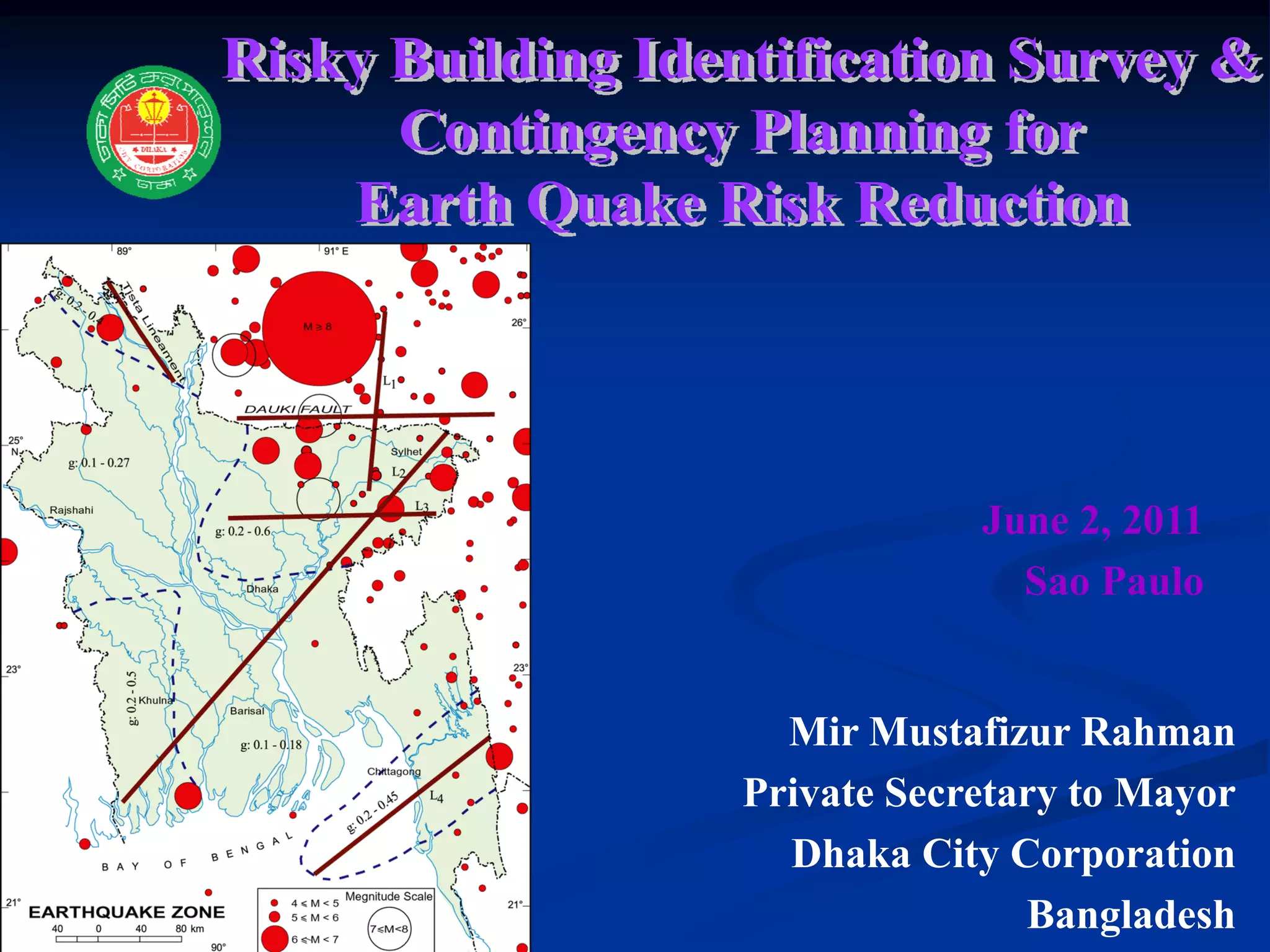
June 2, 2011
Sao Paulo

Mir Mustafizur Rahman
Private Secretary to Mayor
Dhaka City Corporation
Bangladesh
Population :
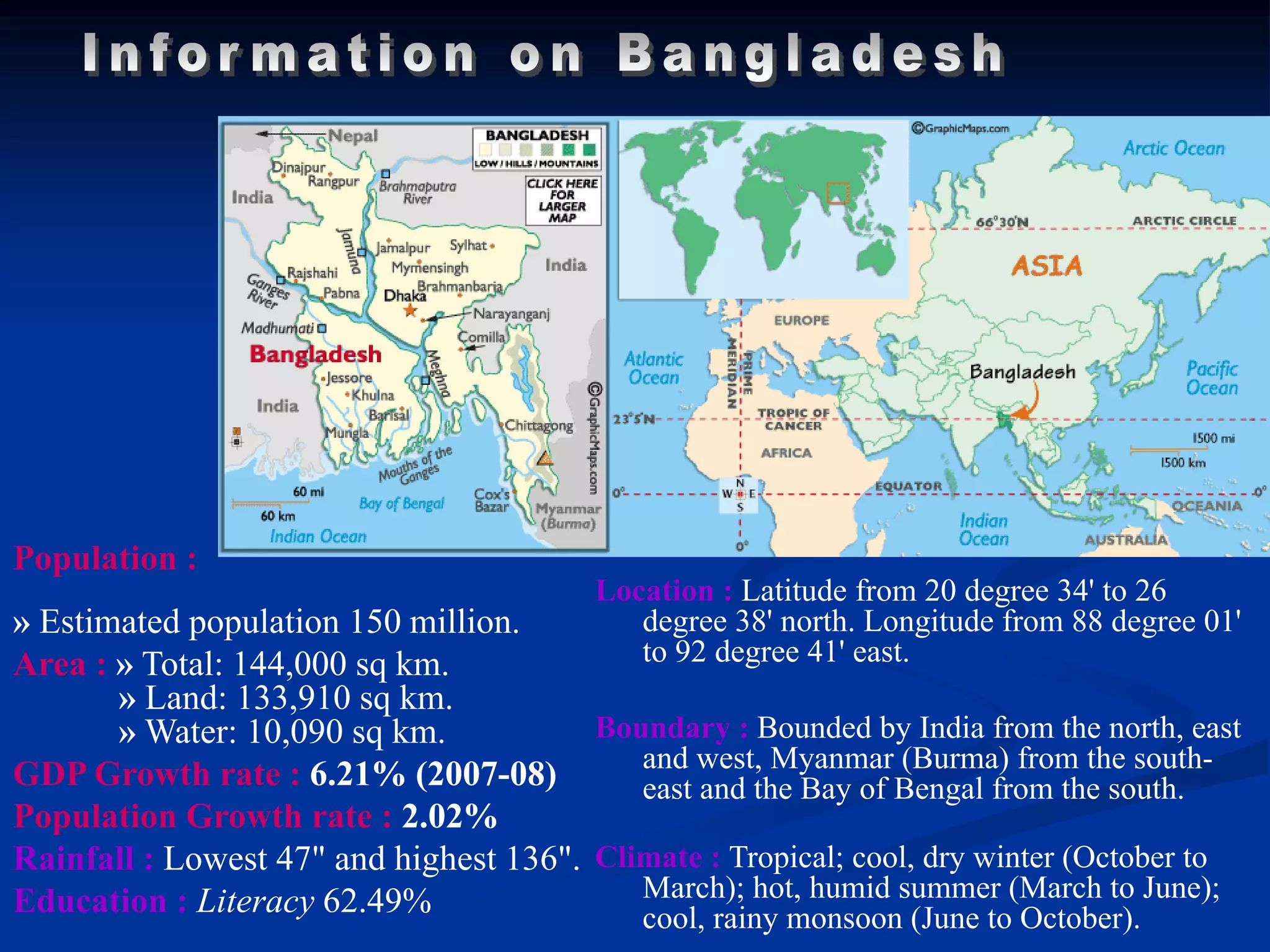
Location : Latitude from 20 degree 34' to 26
degree 38' north. Longitude from 88 degree 01'
to 92 degree 41' east.

» Estimated population 150 million.
Area : » Total: 144,000 sq km.
» Land: 133,910 sq km.
Boundary : Bounded by India from the north, east
» Water: 10,090 sq km.
and west, Myanmar (Burma) from the southGDP Growth rate : 6.21% (2007-08)
east and the Bay of Bengal from the south.
Population Growth rate : 2.02%
Rainfall : Lowest 47" and highest 136". Climate : Tropical; cool, dry winter (October to
March); hot, humid summer (March to June);
Education : Literacy 62.49%
cool, rainy monsoon (June to October).
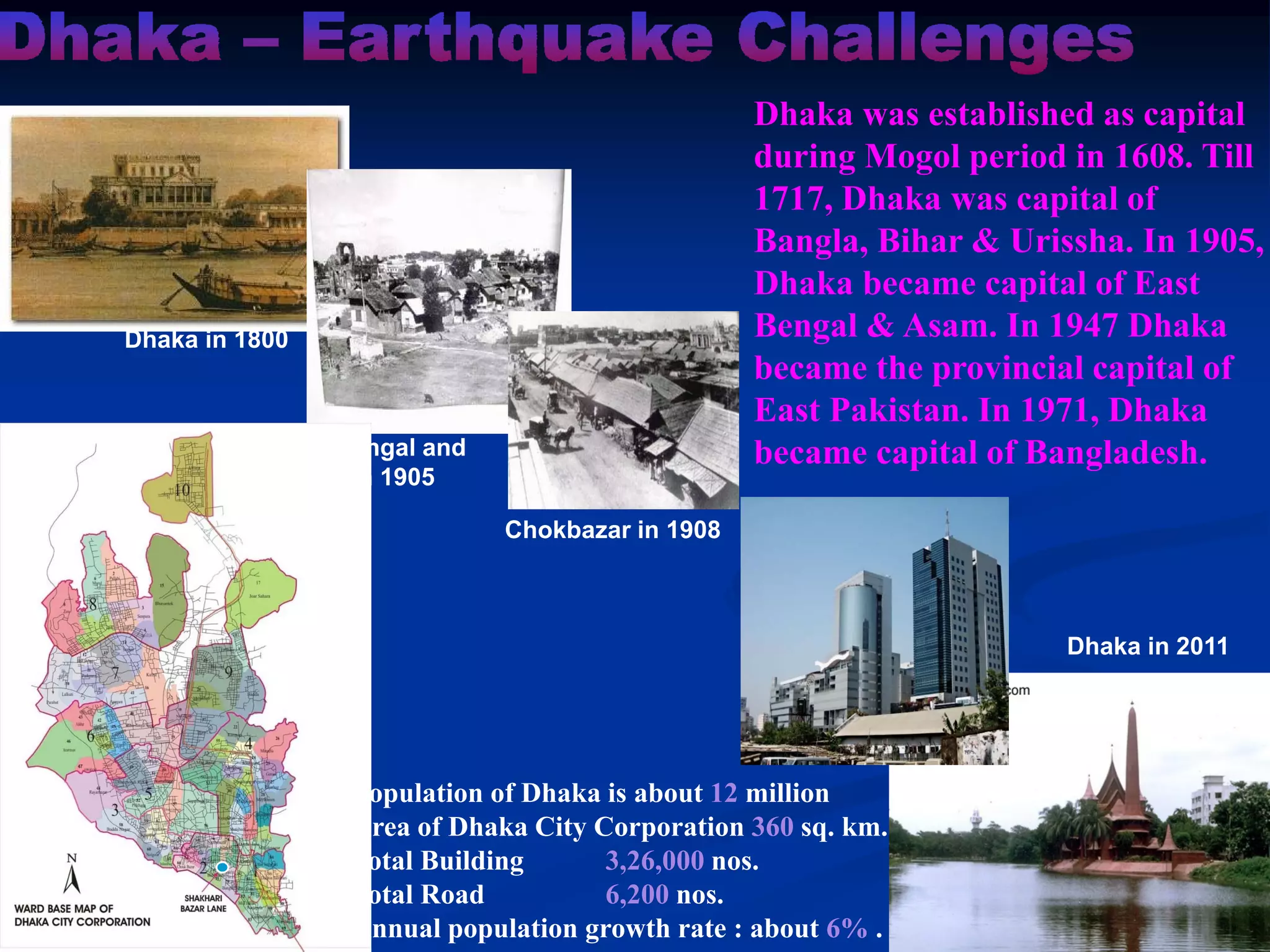
Dhaka was established as capital
during Mogol period in 1608. Till
1717, Dhaka was capital of
Bangla, Bihar & Urissha. In 1905,
Dhaka became capital of East
Bengal & Asam. In 1947 Dhaka
became the provincial capital of
East Pakistan. In 1971, Dhaka
became capital of Bangladesh.

Dhaka in 1800

East Bengal and
Asam 1905
Chokbazar in 1908

Dhaka in 2011

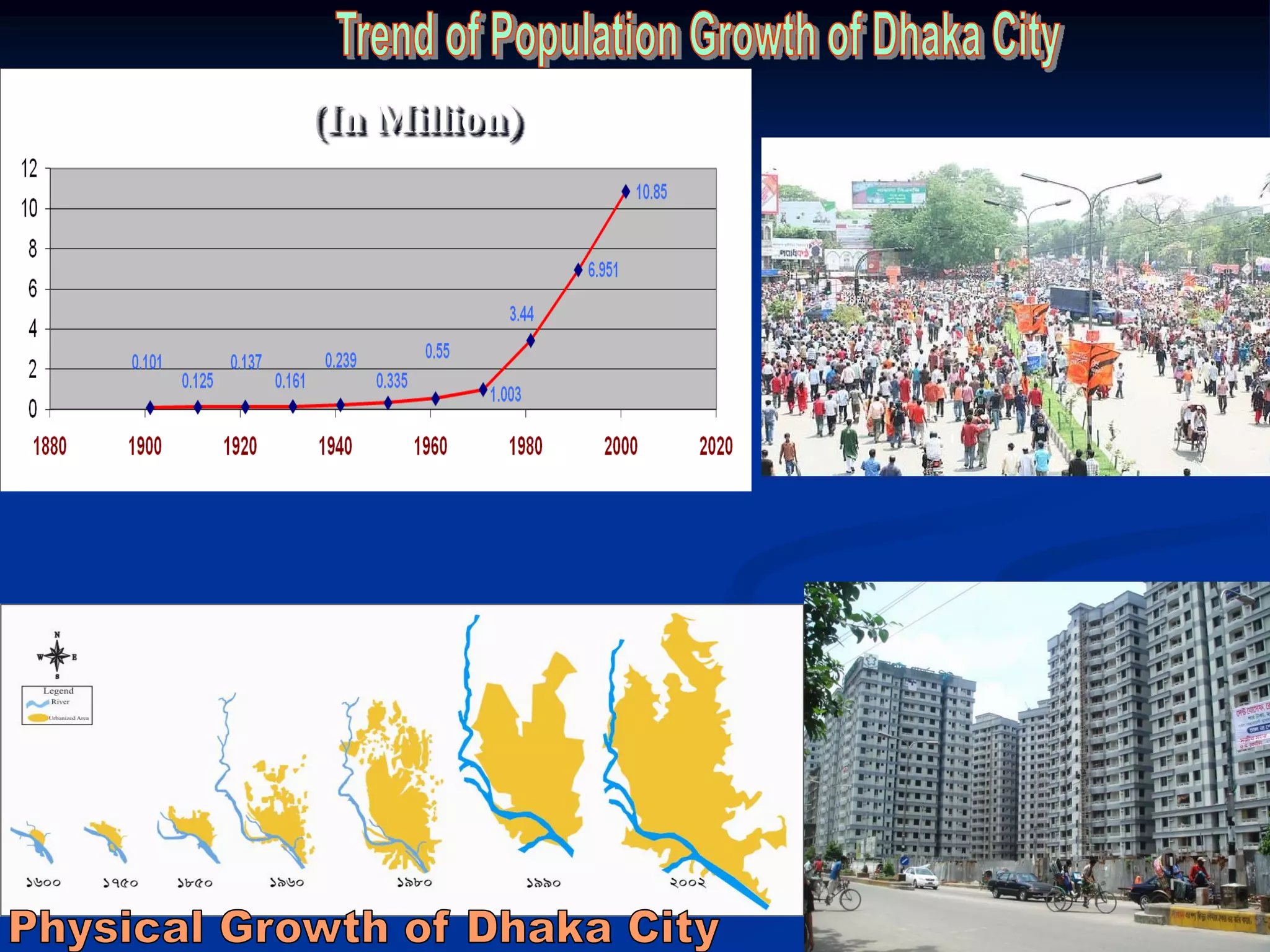
Population of Dhaka is about 12 million
Area of Dhaka City Corporation 360 sq. km.
Total Building
3,26,000 nos.
Total Road
6,200 nos.
Annual population growth rate : about 6% .
Hazards of Bangladesh
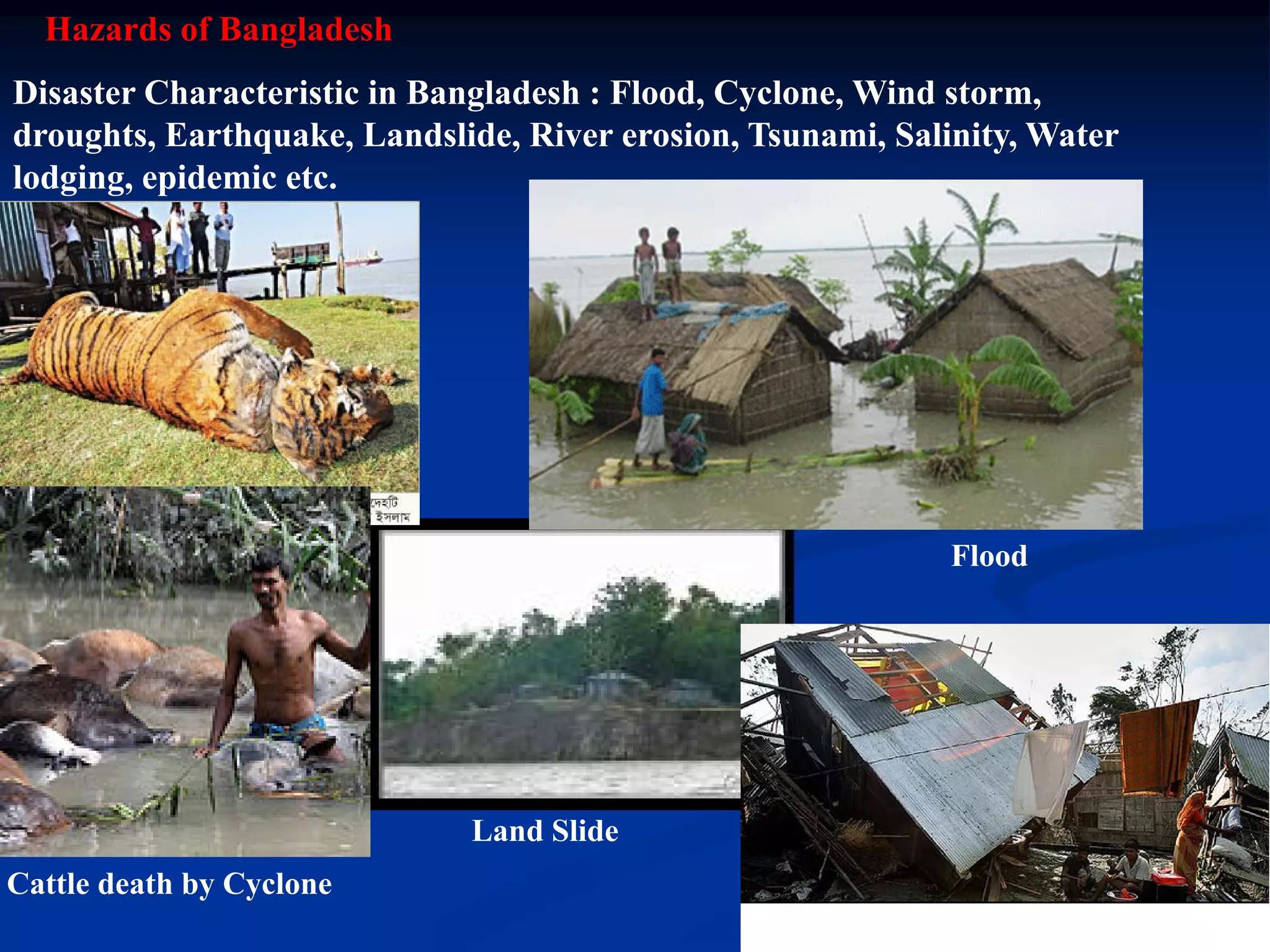
Disaster Characteristic in Bangladesh : Flood, Cyclone, Wind storm,
droughts, Earthquake, Landslide, River erosion, Tsunami, Salinity, Water
lodging, epidemic etc.

Flood

Land Slide
Cattle death by Cyclone
Tornado
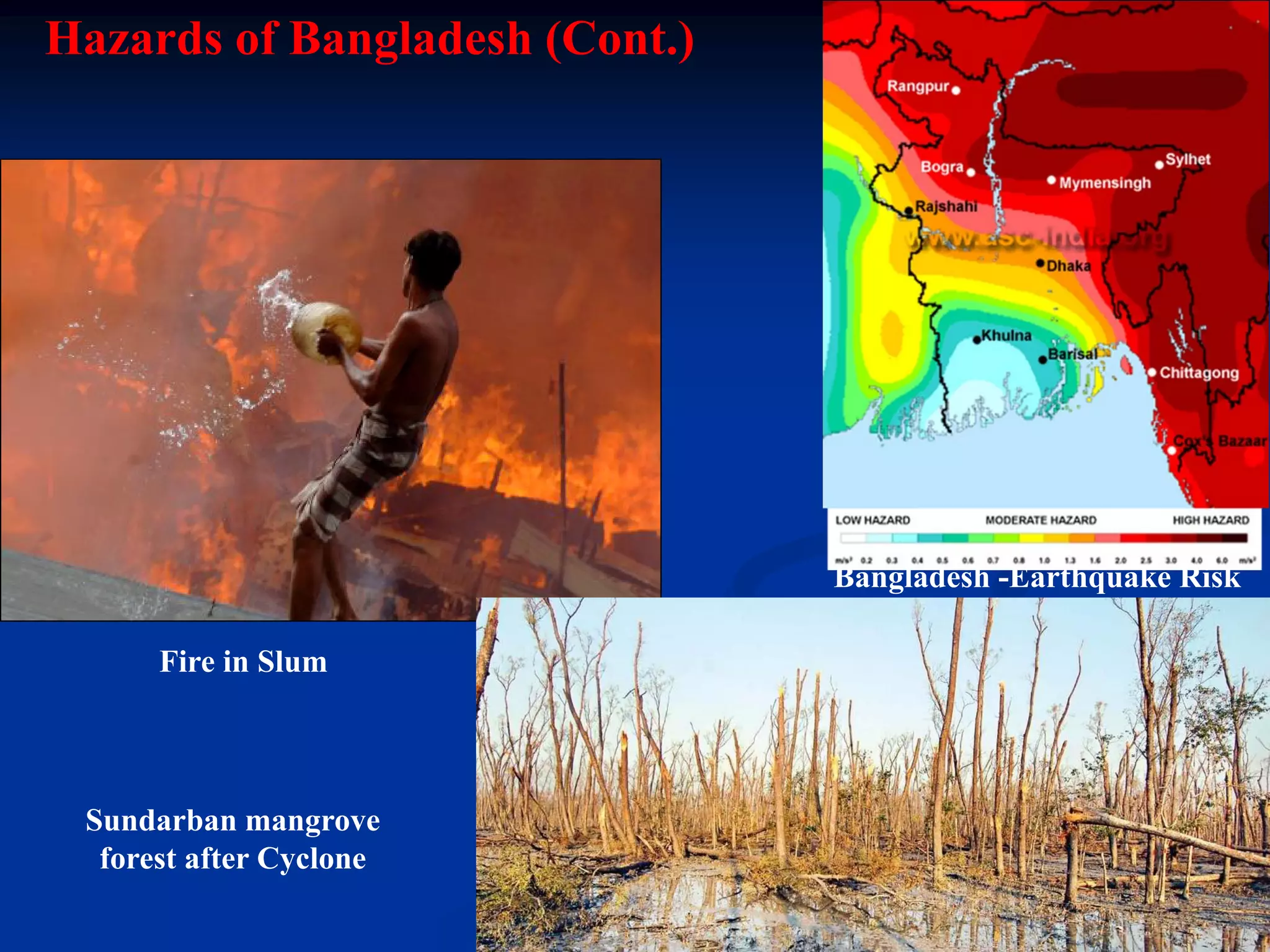
Hazards of Bangladesh (Cont.)

Bangladesh -Earthquake Risk
Fire in Slum

Sundarban mangrove
forest after Cyclone
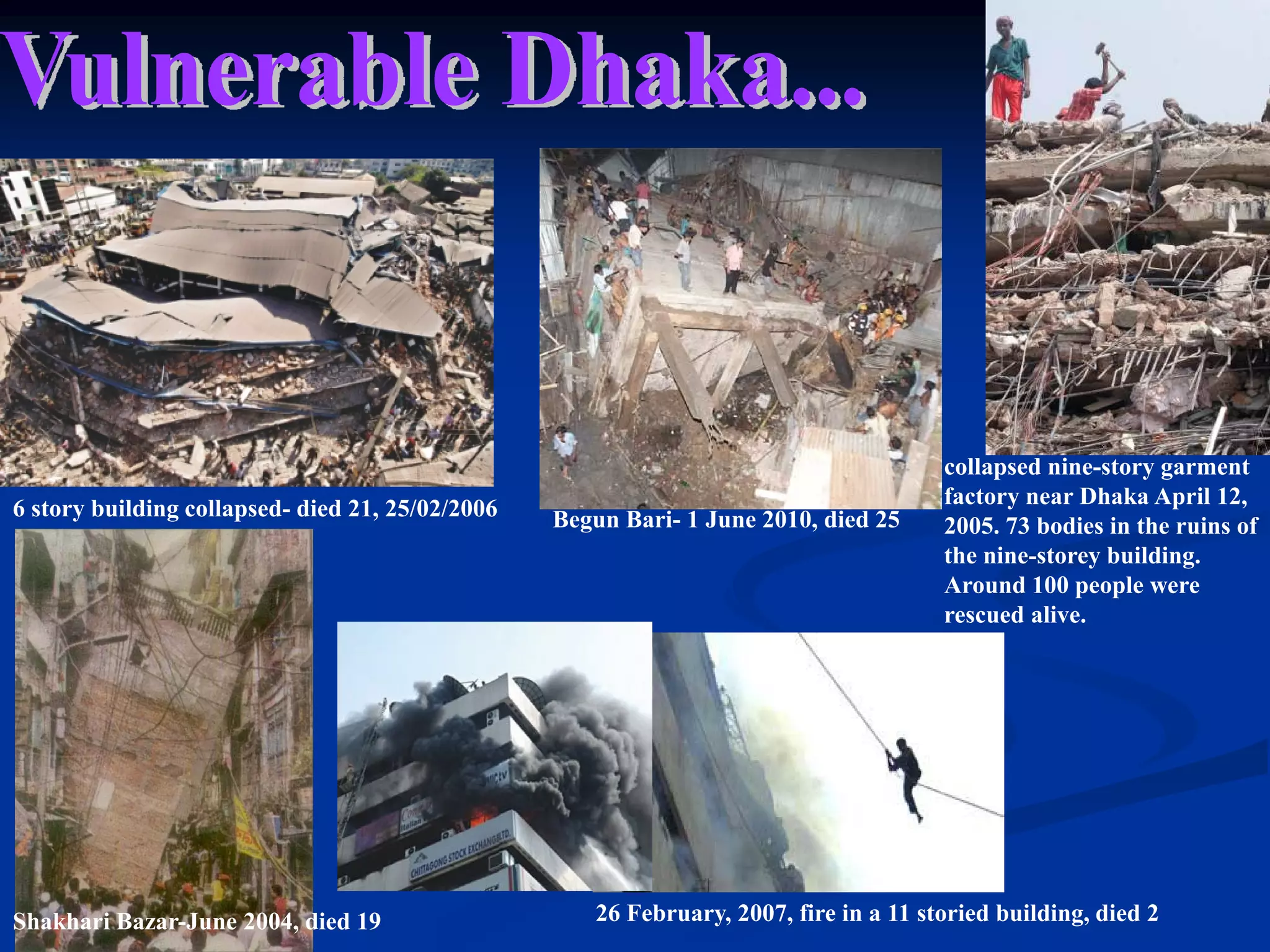
6 story building collapsed- died 21, 25/02/2006

Shakhari Bazar-June 2004, died 19

Begun Bari- 1 June 2010, died 25

collapsed nine-story garment
factory near Dhaka April 12,
2005. 73 bodies in the ruins of
the nine-storey building.
Around 100 people were
rescued alive.

26 February, 2007, fire in a 11 storied building, died 2
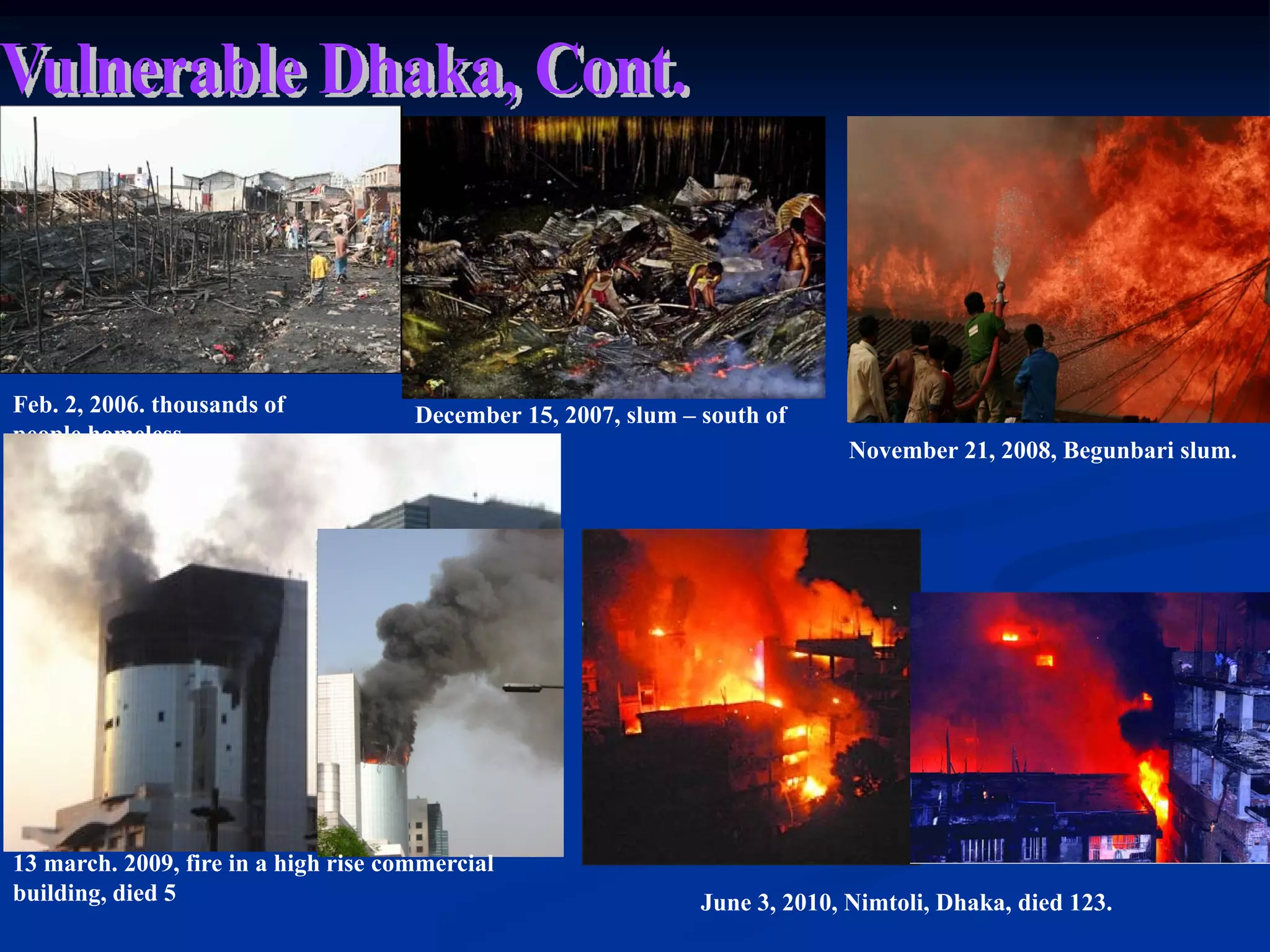
Feb. 2, 2006. thousands of
people homeless

December 15, 2007, slum – south of
Dhaka

13 march. 2009, fire in a high rise commercial
building, died 5

November 21, 2008, Begunbari slum.

June 3, 2010, Nimtoli, Dhaka, died 123.
(In Million)
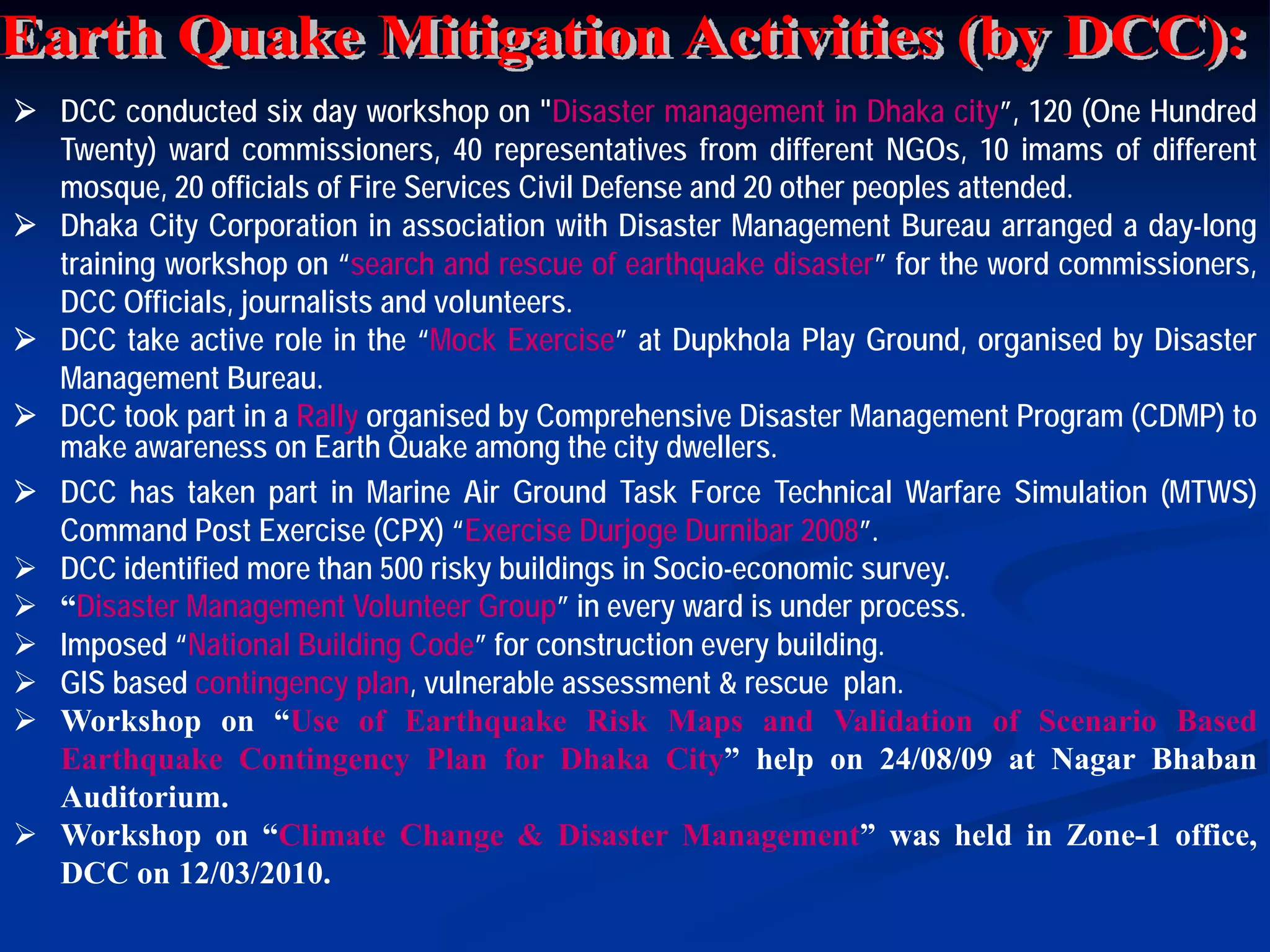
DCC conducted six day workshop on "Disaster management in Dhaka city”, 120 (One Hundred
Twenty) ward commissioners, 40 representatives from different NGOs, 10 imams of different
mosque, 20 officials of Fire Services Civil Defense and 20 other peoples attended.
Dhaka City Corporation in association with Disaster Management Bureau arranged a day-long
training workshop on “search and rescue of earthquake disaster” for the word commissioners,
DCC Officials, journalists and volunteers.
DCC take active role in the “Mock Exercise” at Dupkhola Play Ground, organised by Disaster
Management Bureau.
DCC took part in a Rally organised by Comprehensive Disaster Management Program (CDMP) to
make awareness on Earth Quake among the city dwellers.
DCC has taken part in Marine Air Ground Task Force Technical Warfare Simulation (MTWS)
Command Post Exercise (CPX) “Exercise Durjoge Durnibar 2008”.
DCC identified more than 500 risky buildings in Socio-economic survey.
“Disaster Management Volunteer Group” in every ward is under process.
Imposed “National Building Code” for construction every building.
GIS based contingency plan, vulnerable assessment & rescue plan.
Workshop on “Use of Earthquake Risk Maps and Validation of Scenario Based
Earthquake Contingency Plan for Dhaka City” help on 24/08/09 at Nagar Bhaban
Auditorium.
Workshop on “Climate Change & Disaster Management” was held in Zone-1 office,
DCC on 12/03/2010.
“Technical survey for identification of
vulnerable and risky 113 buildings in heritage
and non-heritage areas of Dhaka City”
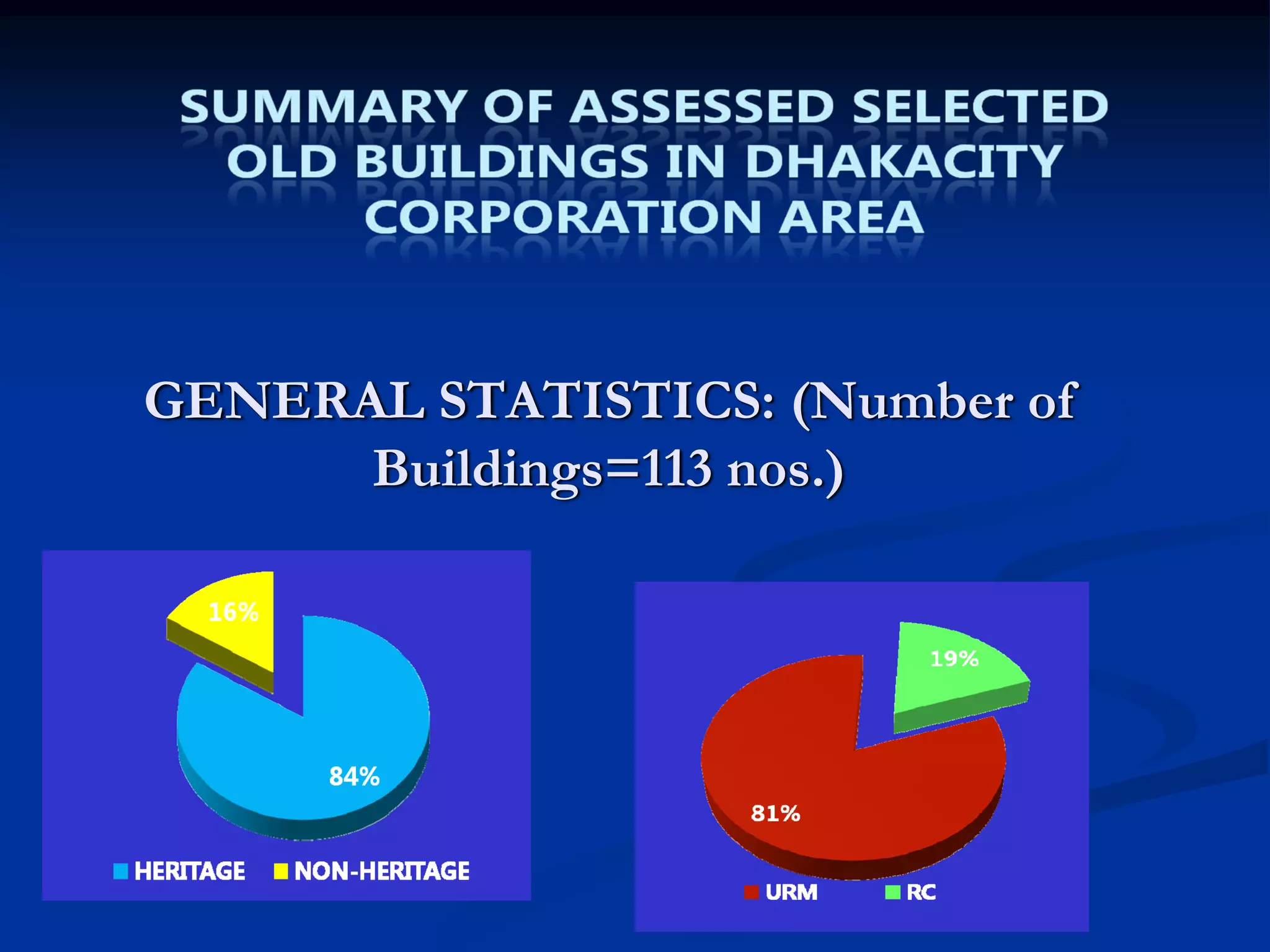
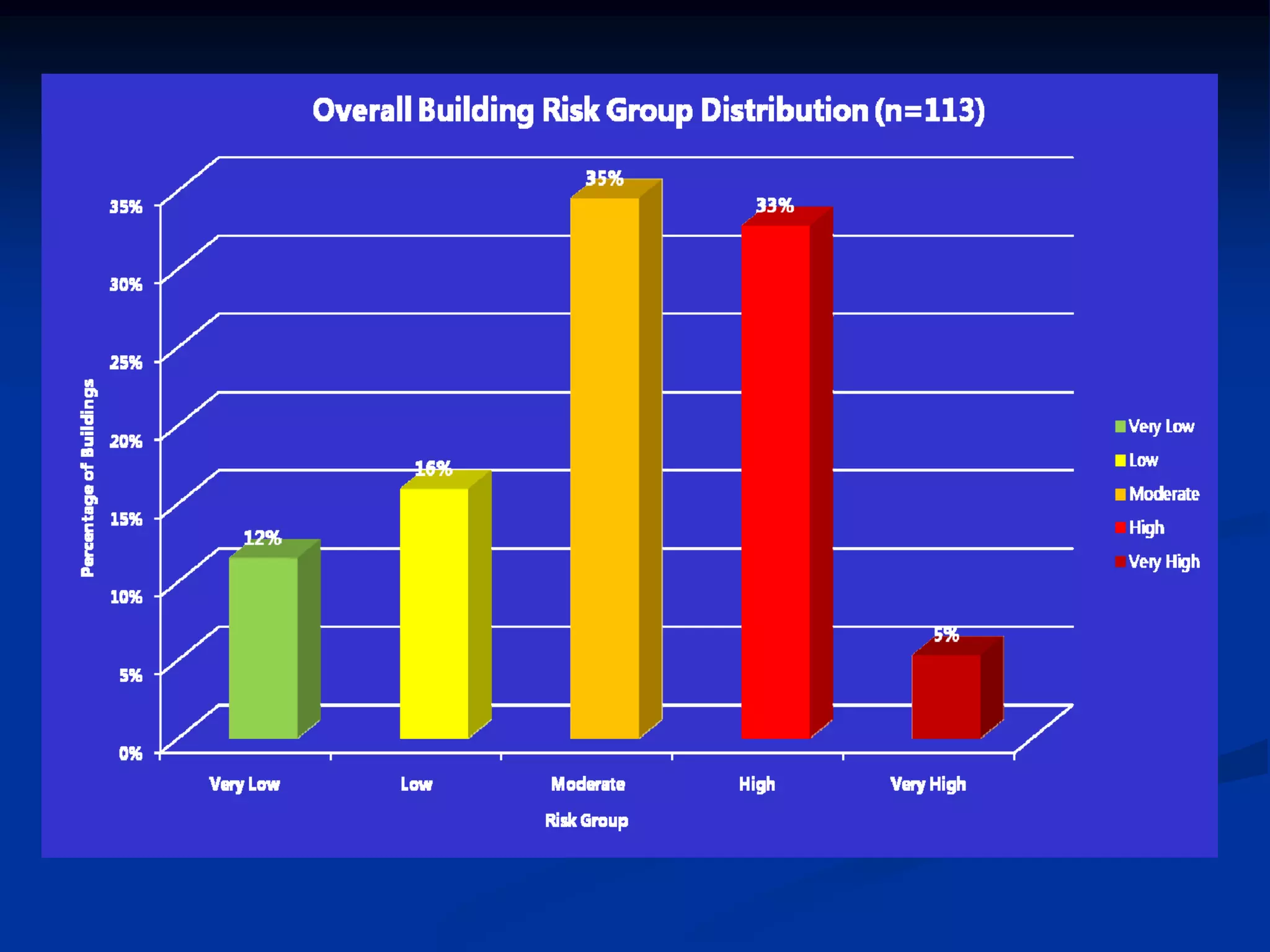
GENERAL STATISTICS: (Number of
Buildings=113 nos.)
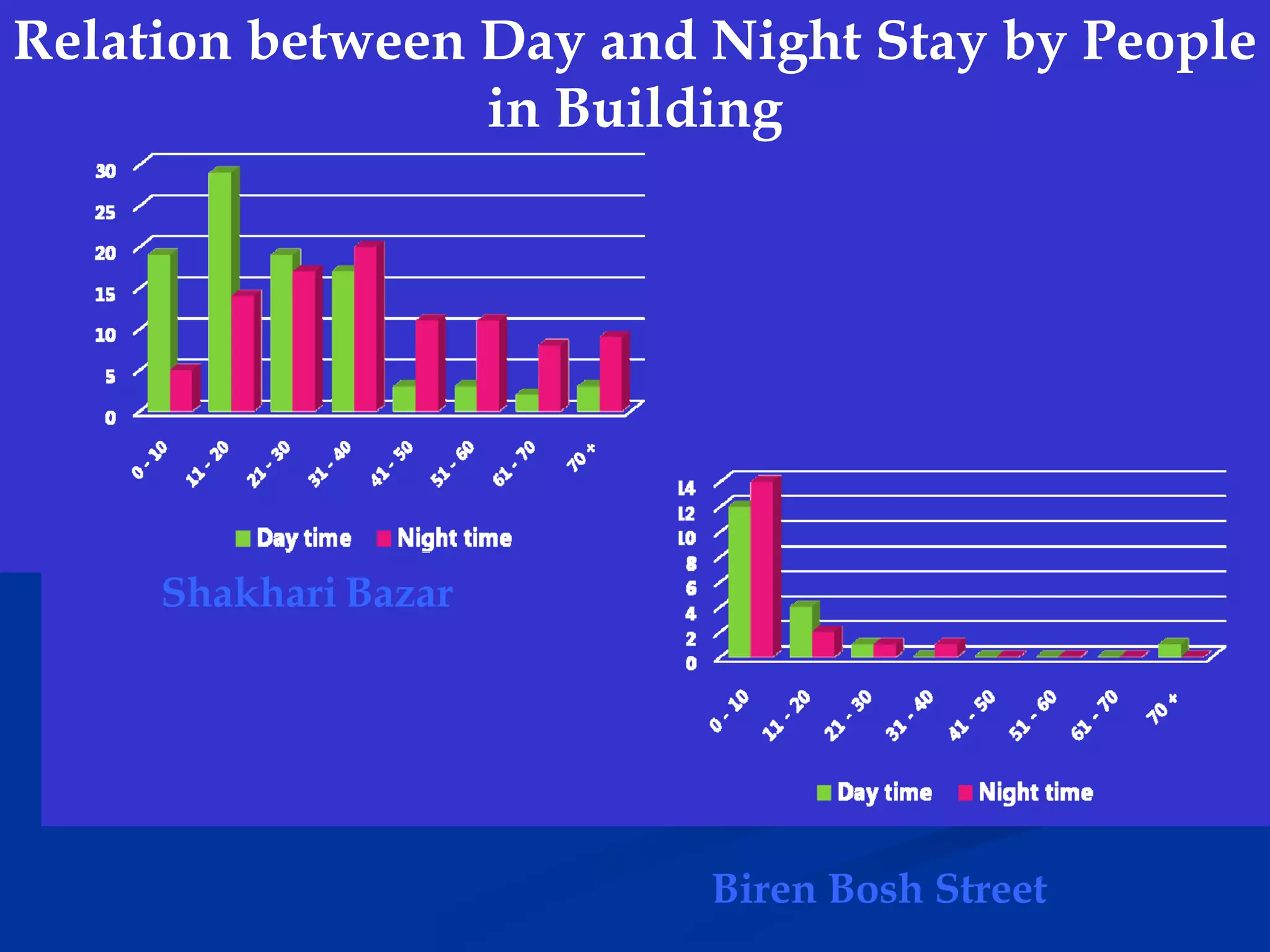
Relation between Day and Night Stay by People
in Building

Shakhari Bazar

Biren Bosh Street
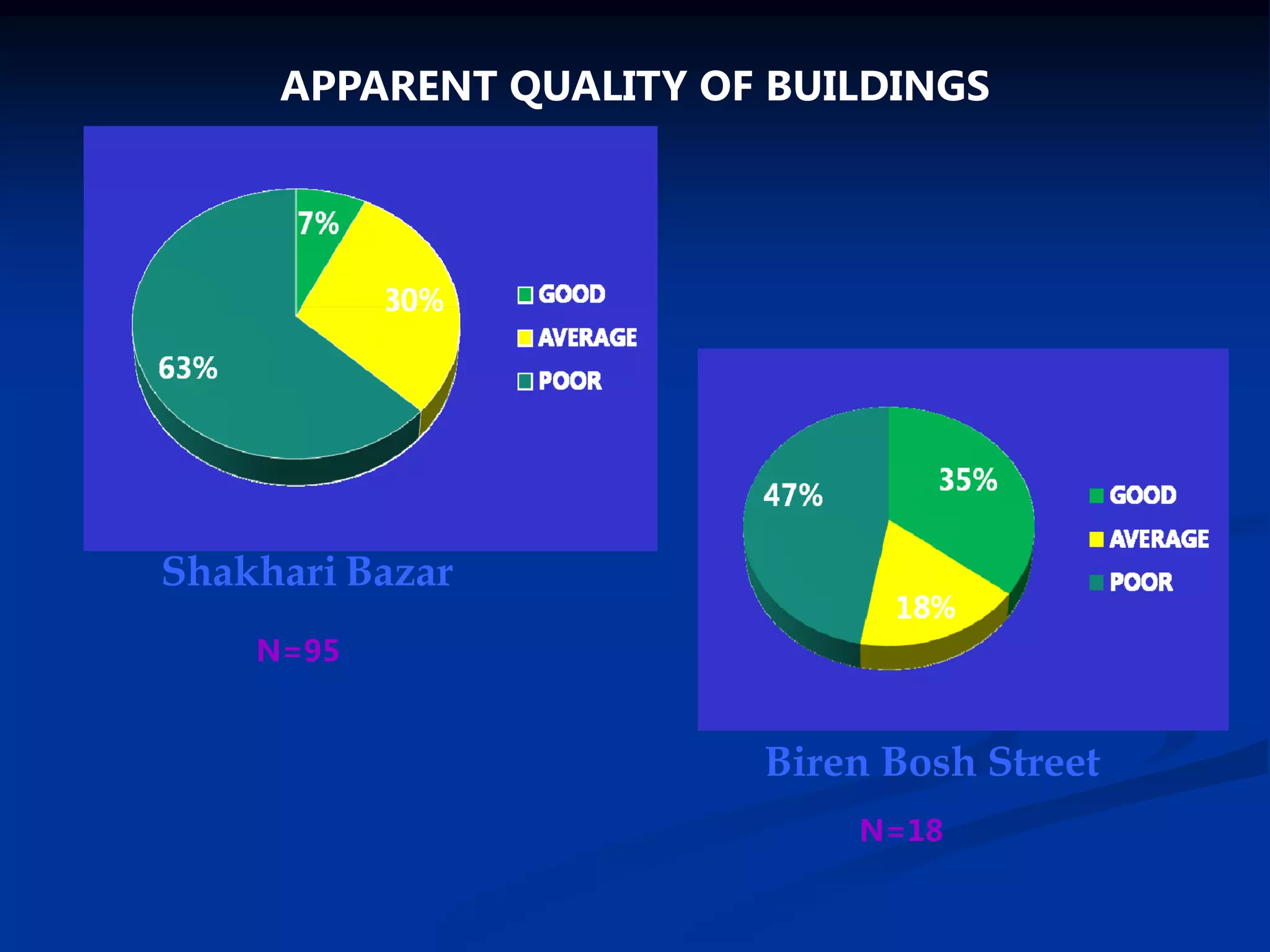
APPARENT QUALITY OF BUILDINGS

Shakhari Bazar
N=95

Biren Bosh Street
N=18
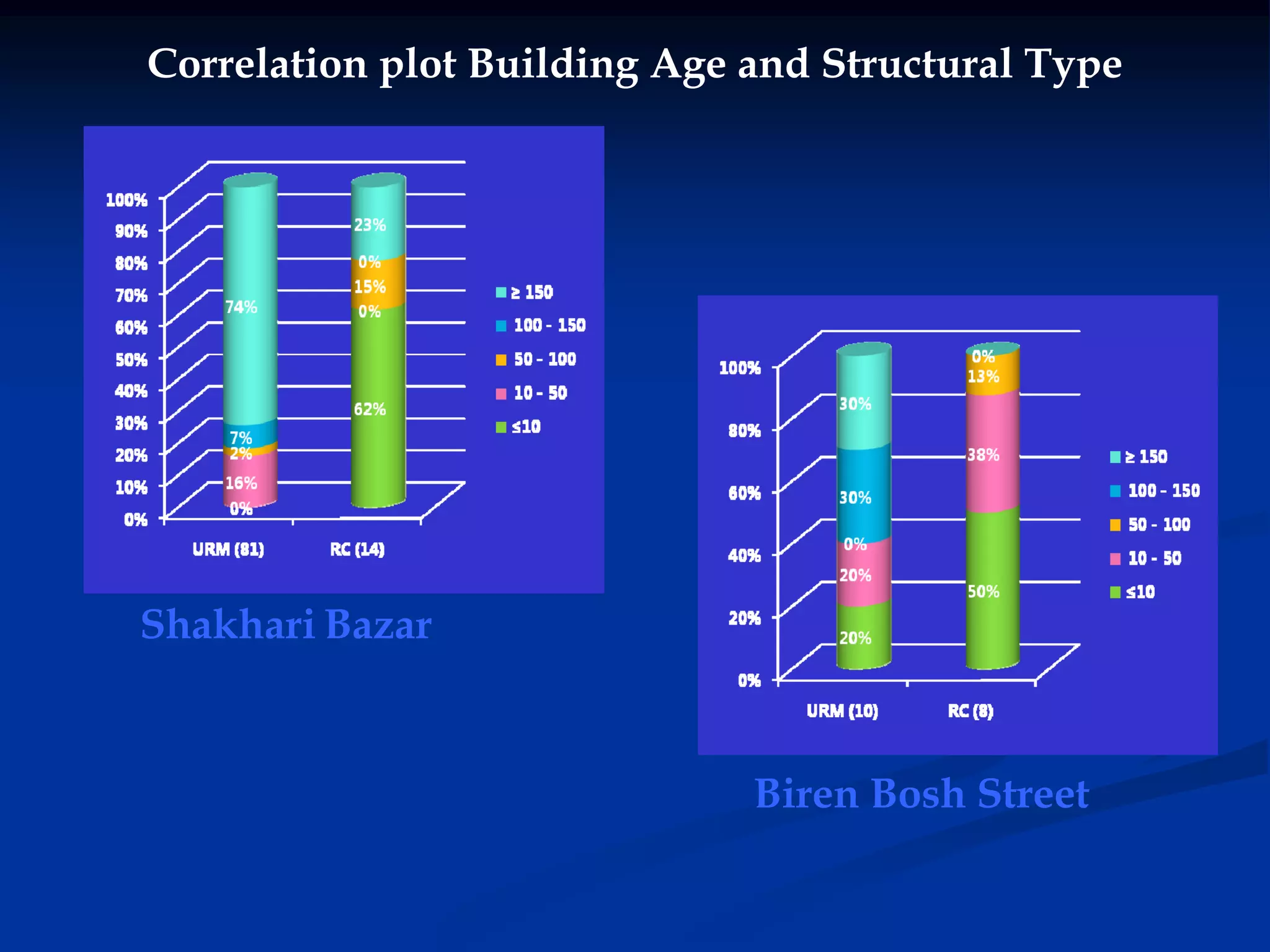
Correlation plot Building Age and Structural Type

Shakhari Bazar

Biren Bosh Street
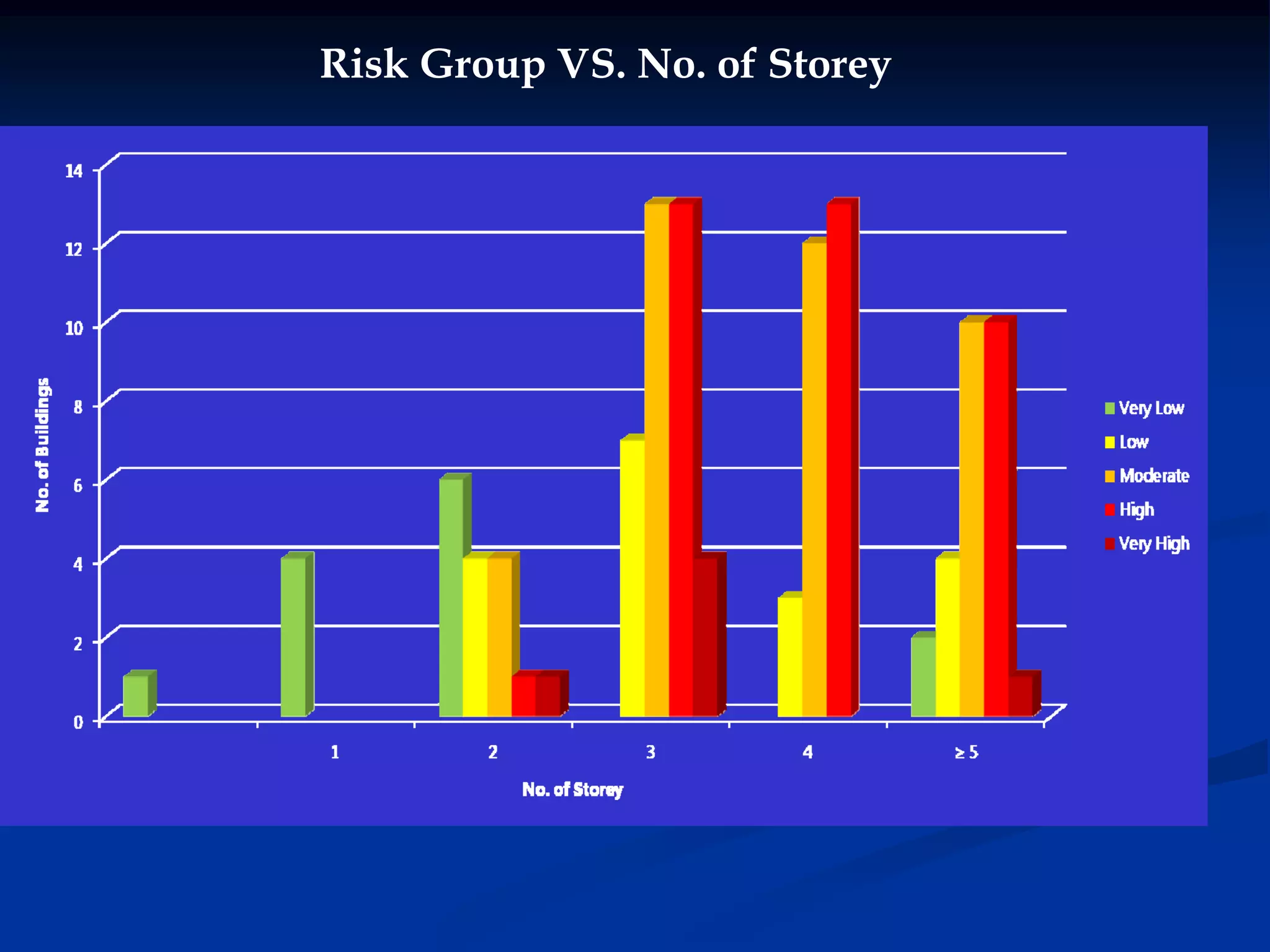
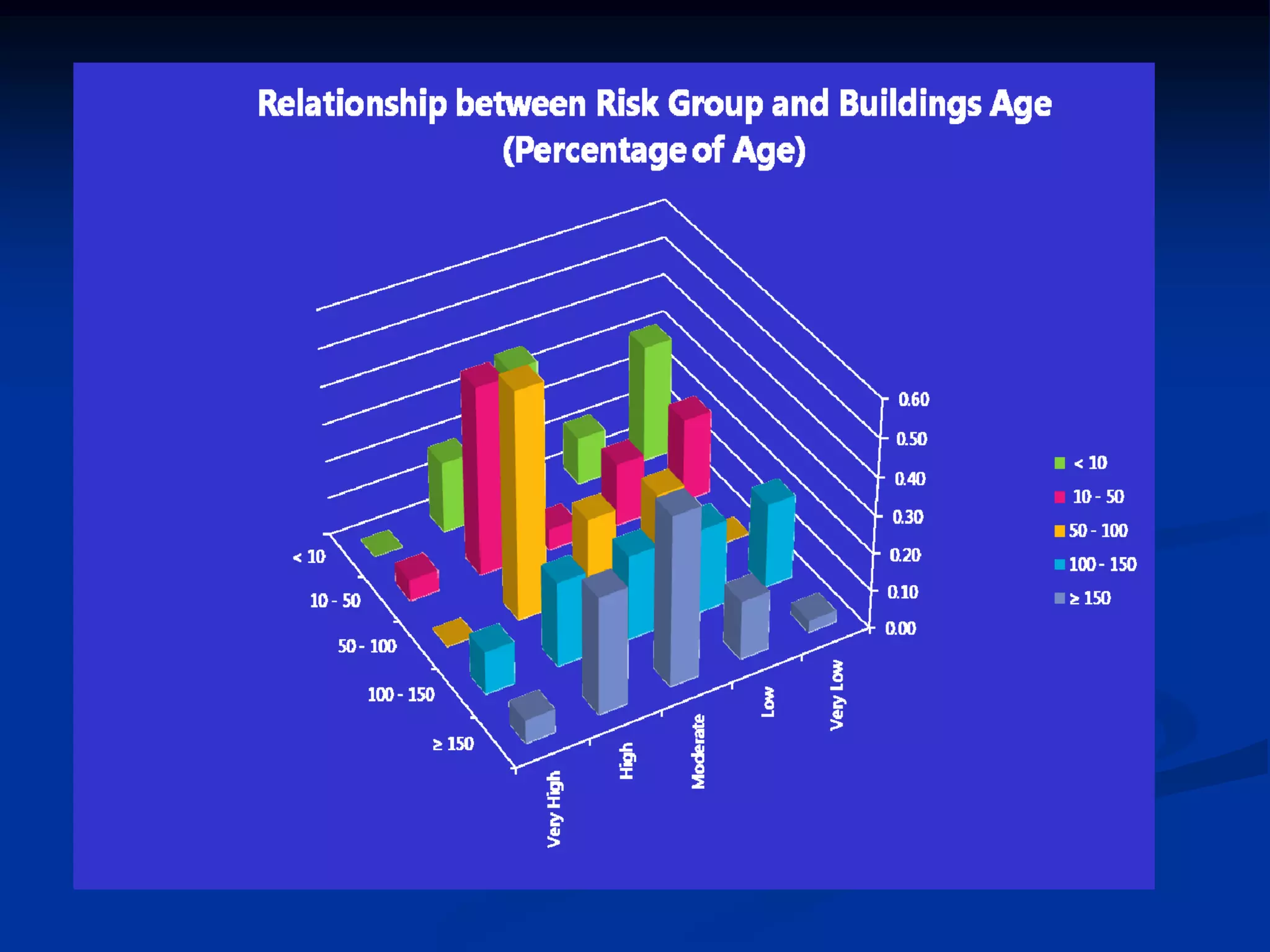
Risk Group VS. No. of Storey
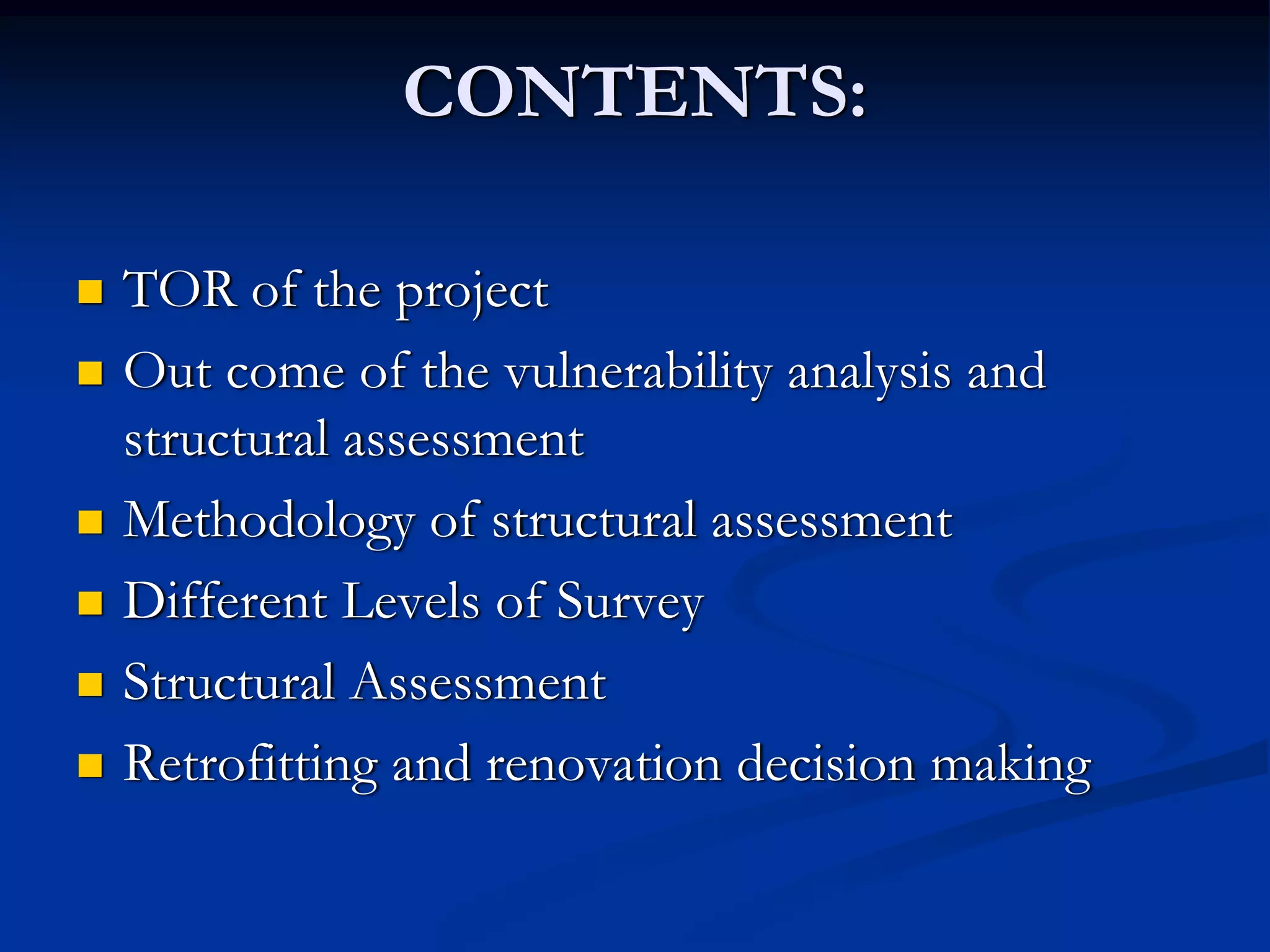
CONTENTS:
TOR of the project
Out come of the vulnerability analysis and
structural assessment
Methodology of structural assessment
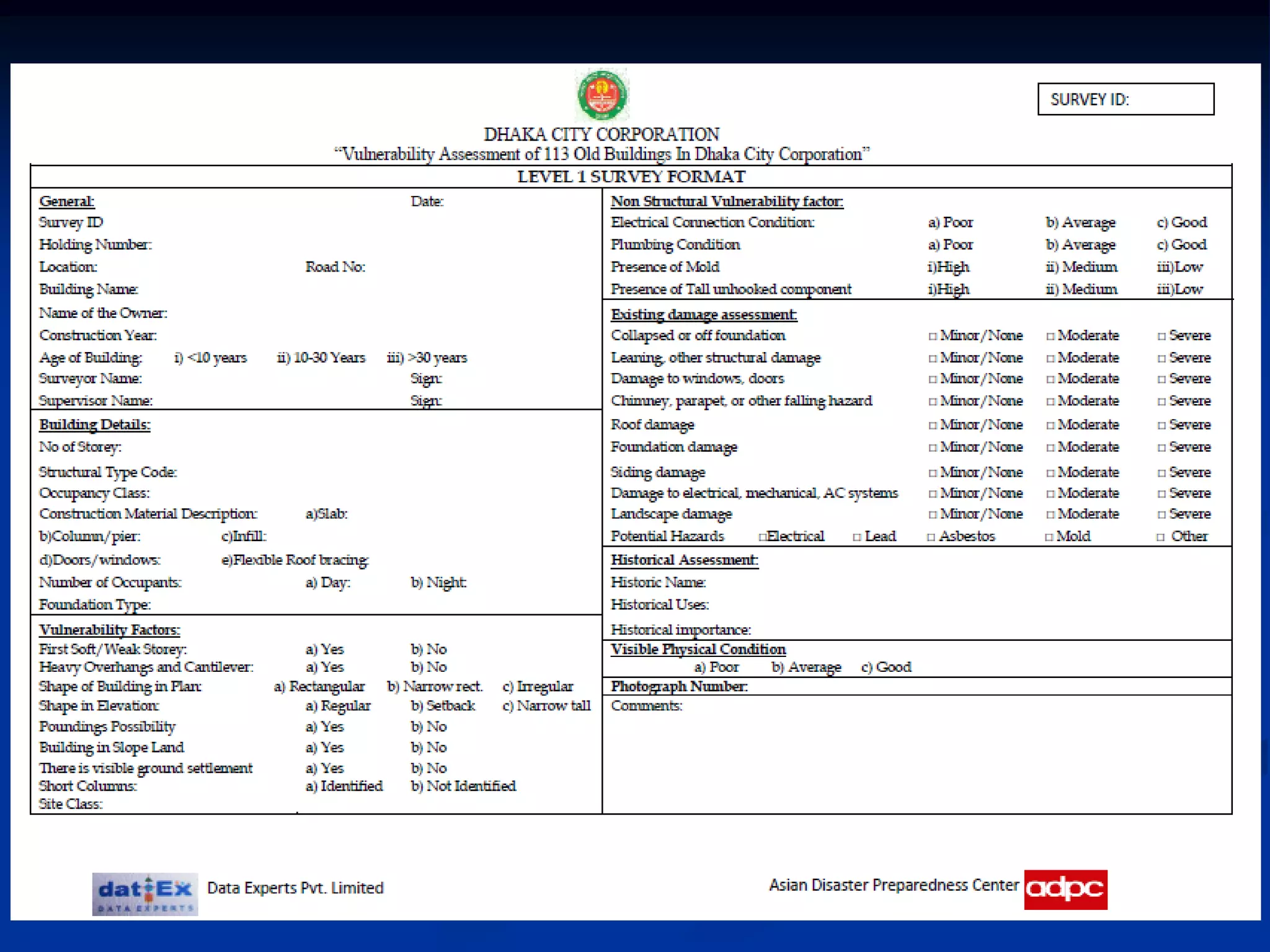
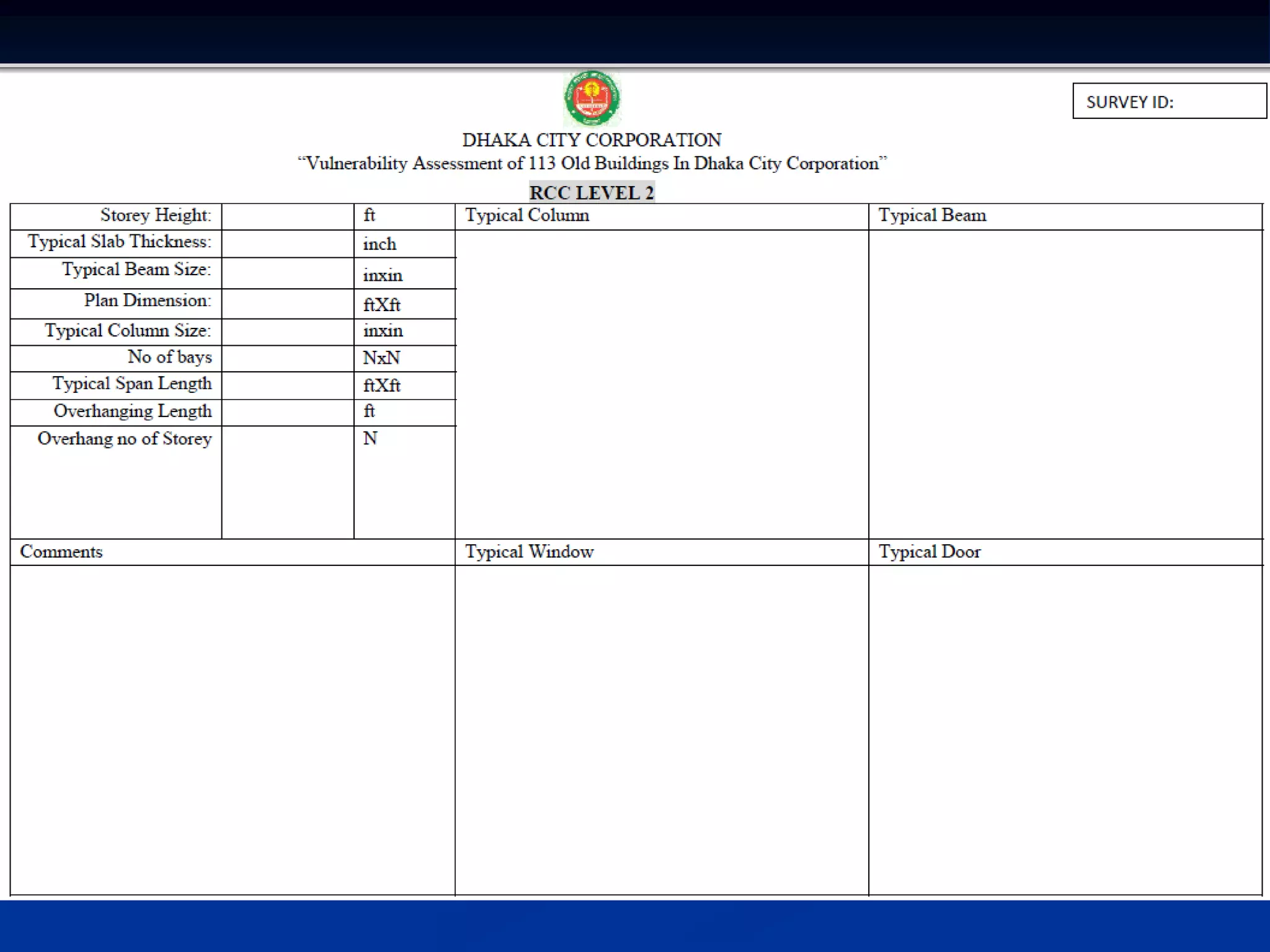
Different Levels of Survey
Structural Assessment
Retrofitting and renovation decision making
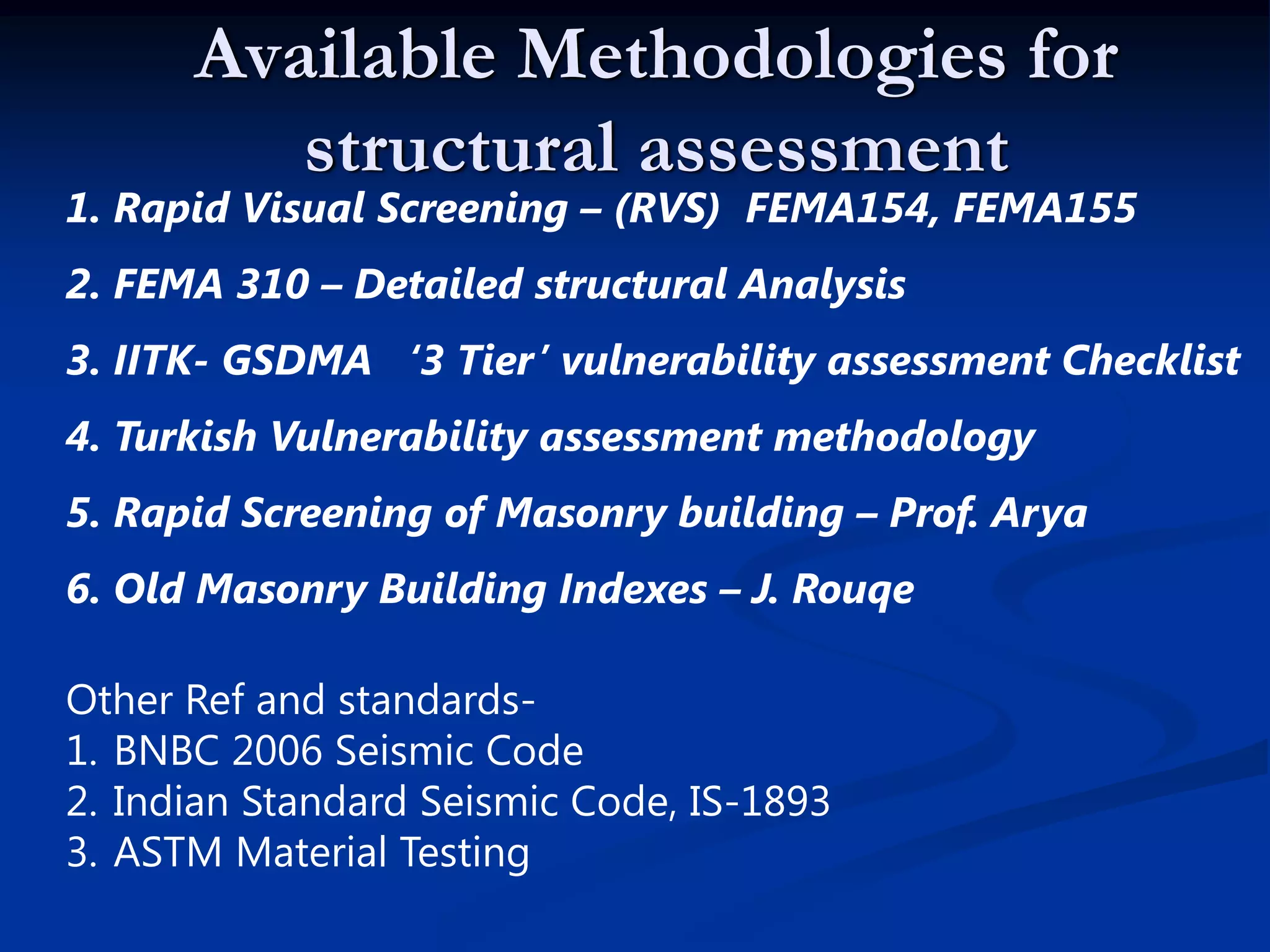
Available Methodologies for
structural assessment

1. Rapid Visual Screening – (RVS) FEMA154, FEMA155
2. FEMA 310 – Detailed structural Analysis
3. IITK- GSDMA ‘3 Tier’ vulnerability assessment Checklist
4. Turkish Vulnerability assessment methodology
5. Rapid Screening of Masonry building – Prof. Arya
6. Old Masonry Building Indexes – J. Rouqe
Other Ref and standards1. BNBC 2006 Seismic Code
2. Indian Standard Seismic Code, IS-1893
3. ASTM Material Testing
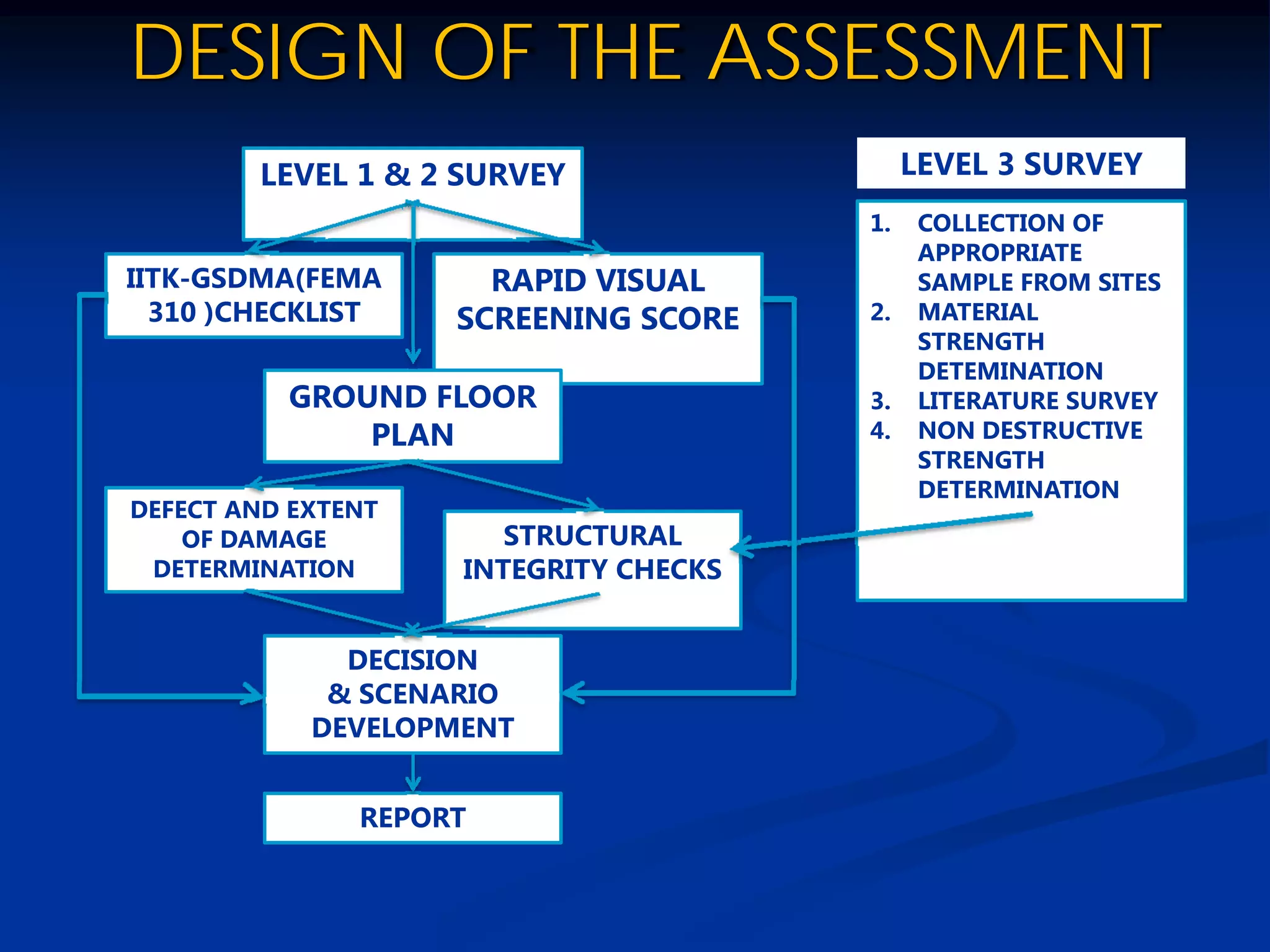
DESIGN OF THE ASSESSMENT
LEVEL 3 SURVEY

LEVEL 1 & 2 SURVEY
1.

IITK-GSDMA(FEMA
310 )CHECKLIST

RAPID VISUAL
SCREENING SCORE

GROUND FLOOR
PLAN
DEFECT AND EXTENT
OF DAMAGE
DETERMINATION

STRUCTURAL
INTEGRITY CHECKS

DECISION
& SCENARIO
DEVELOPMENT
REPORT

2.
3.
4.

COLLECTION OF
APPROPRIATE
SAMPLE FROM SITES
MATERIAL
STRENGTH
DETEMINATION
LITERATURE SURVEY
NON DESTRUCTIVE
STRENGTH
DETERMINATION
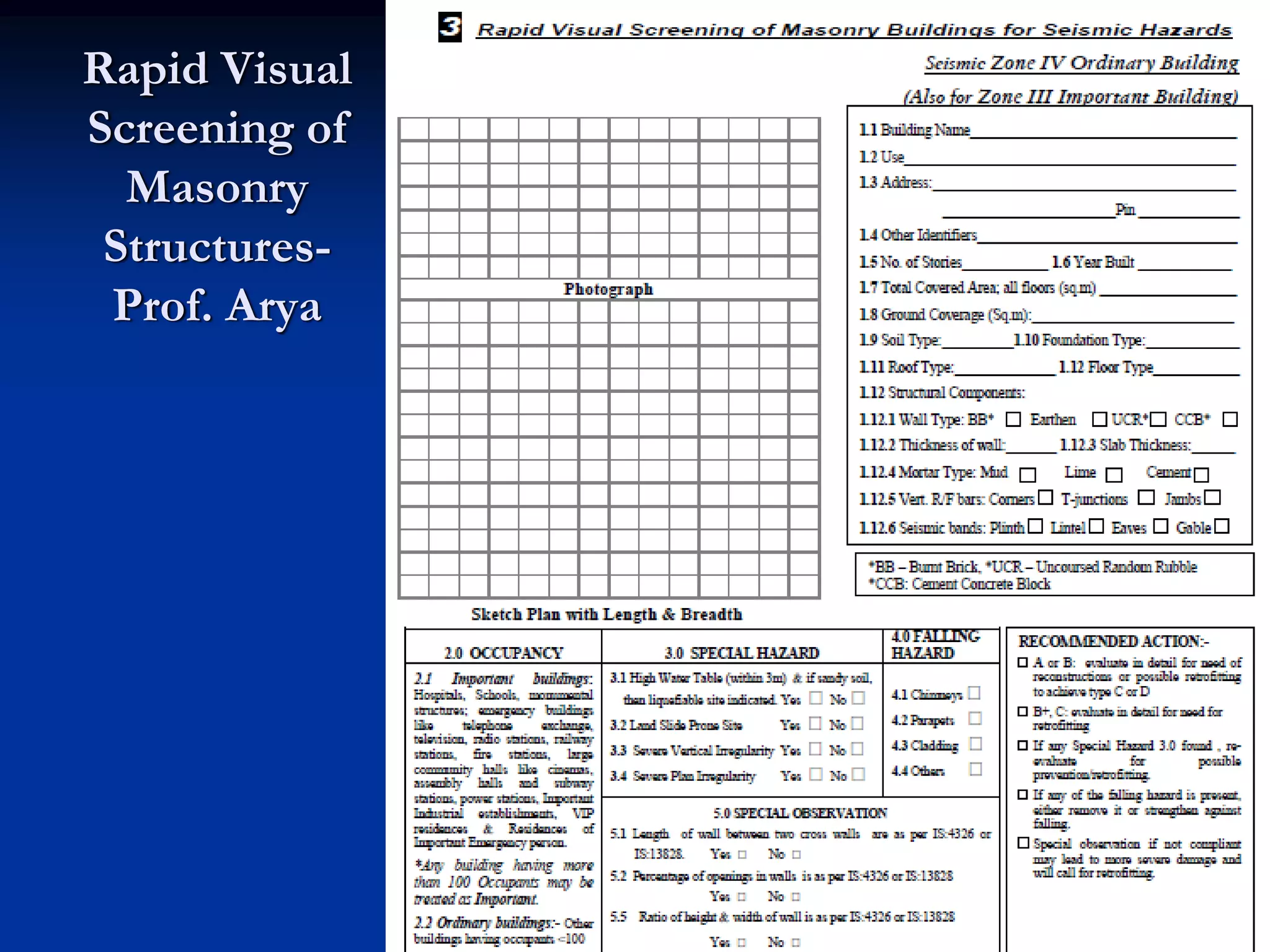
Rapid Visual
Screening of
Masonry
StructuresProf. Arya
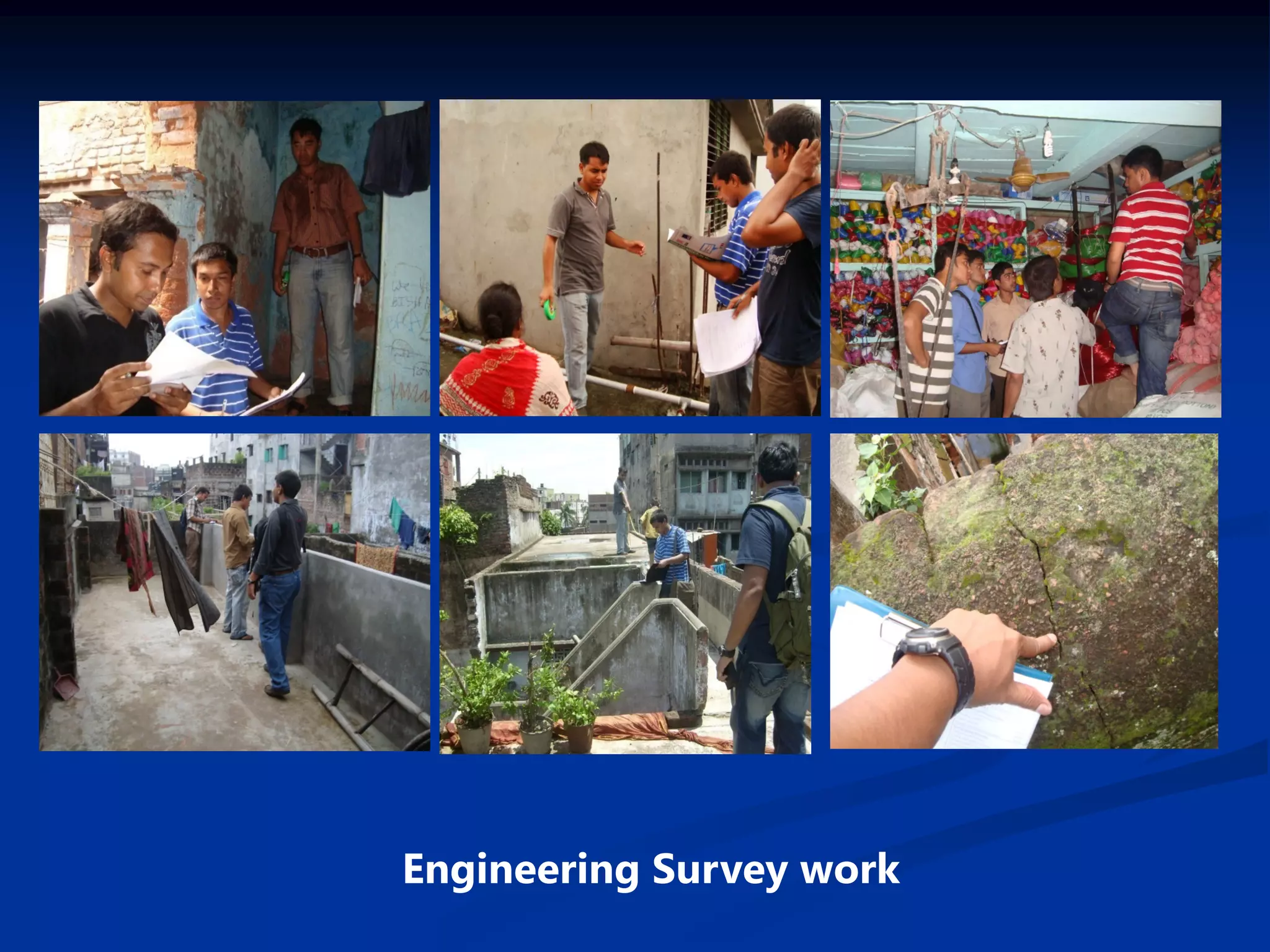
FIELD SURVEY
Engineering Survey work
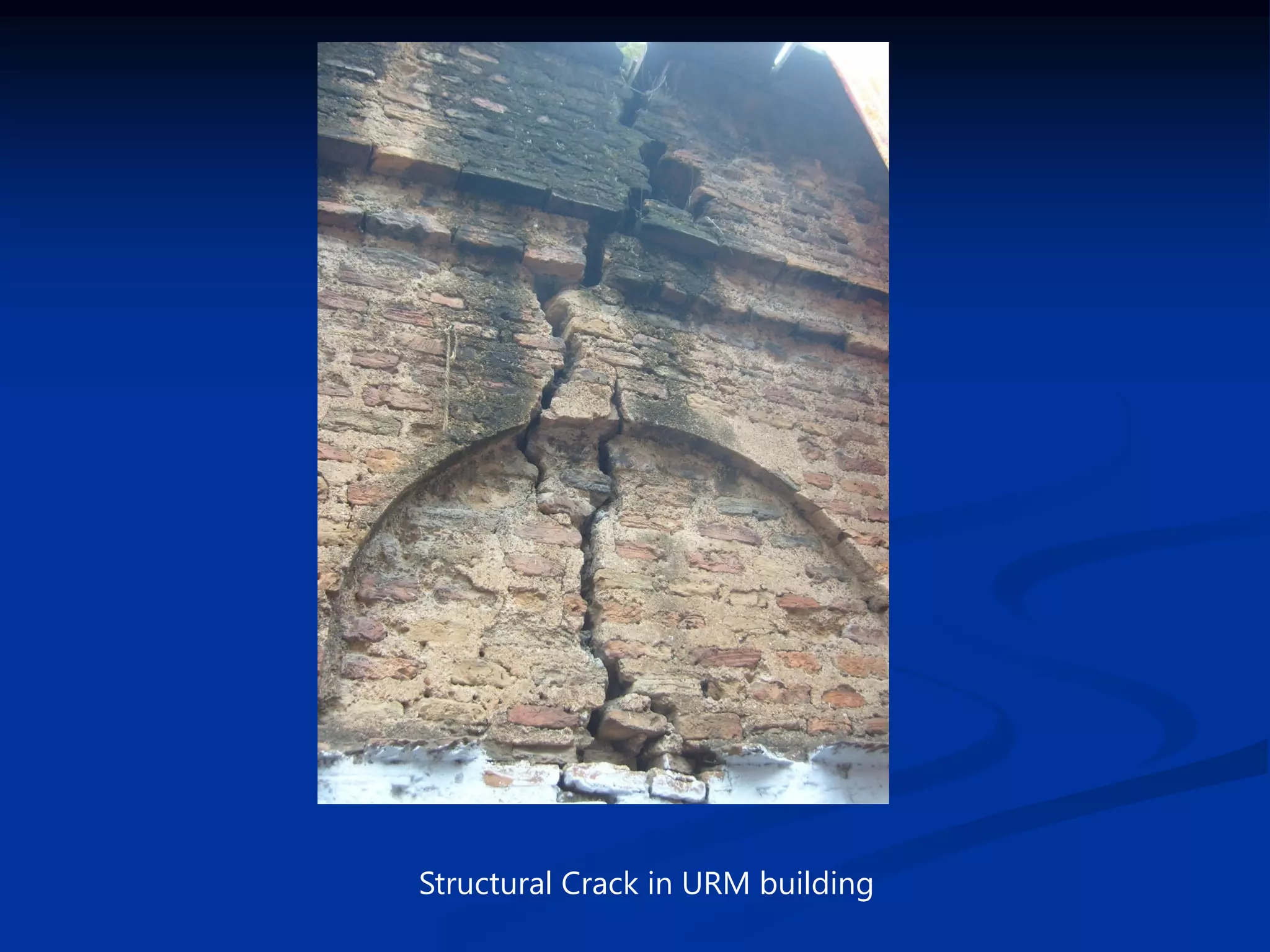
Structural Crack in URM building
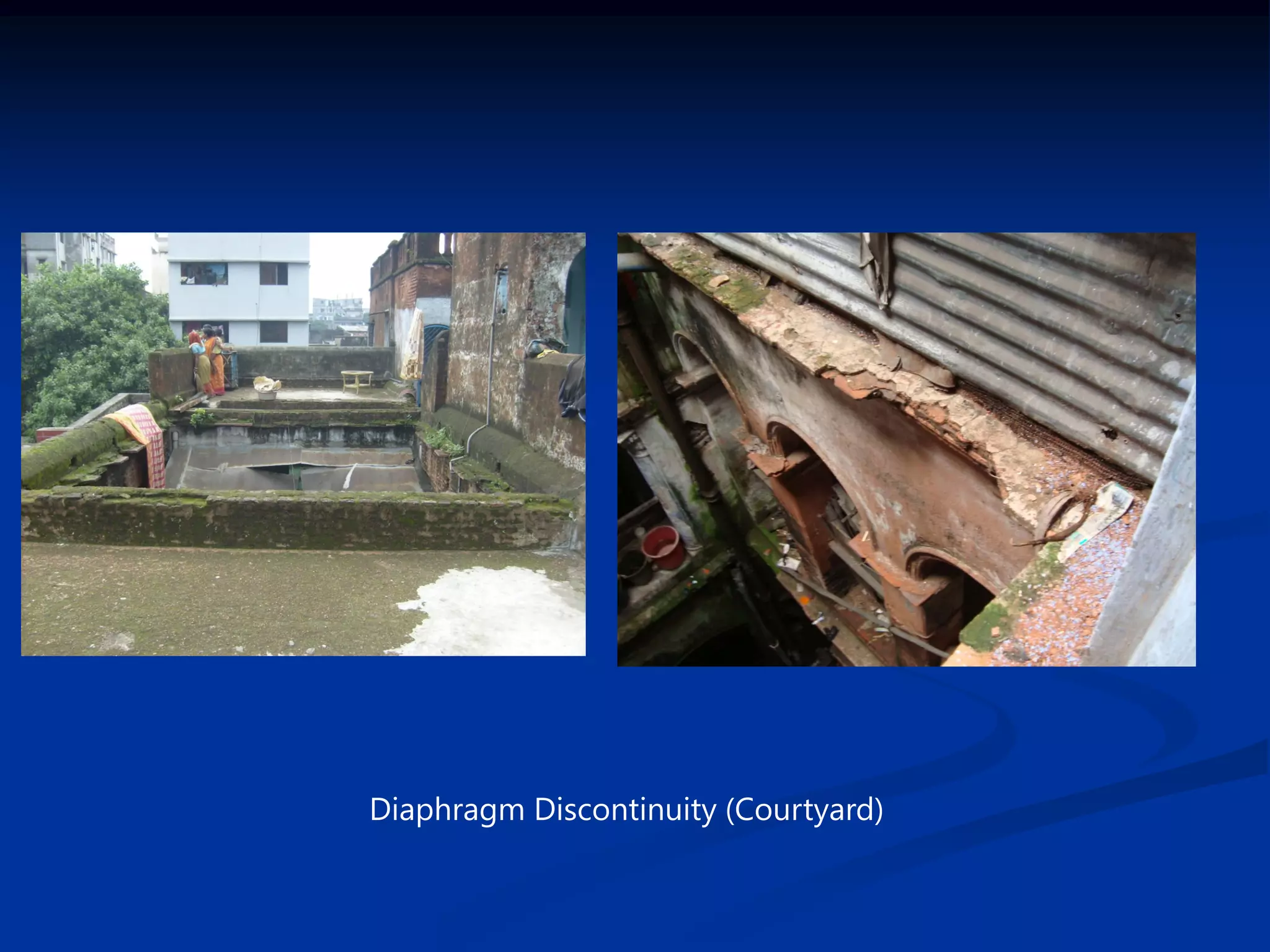
Diaphragm Discontinuity (Courtyard)
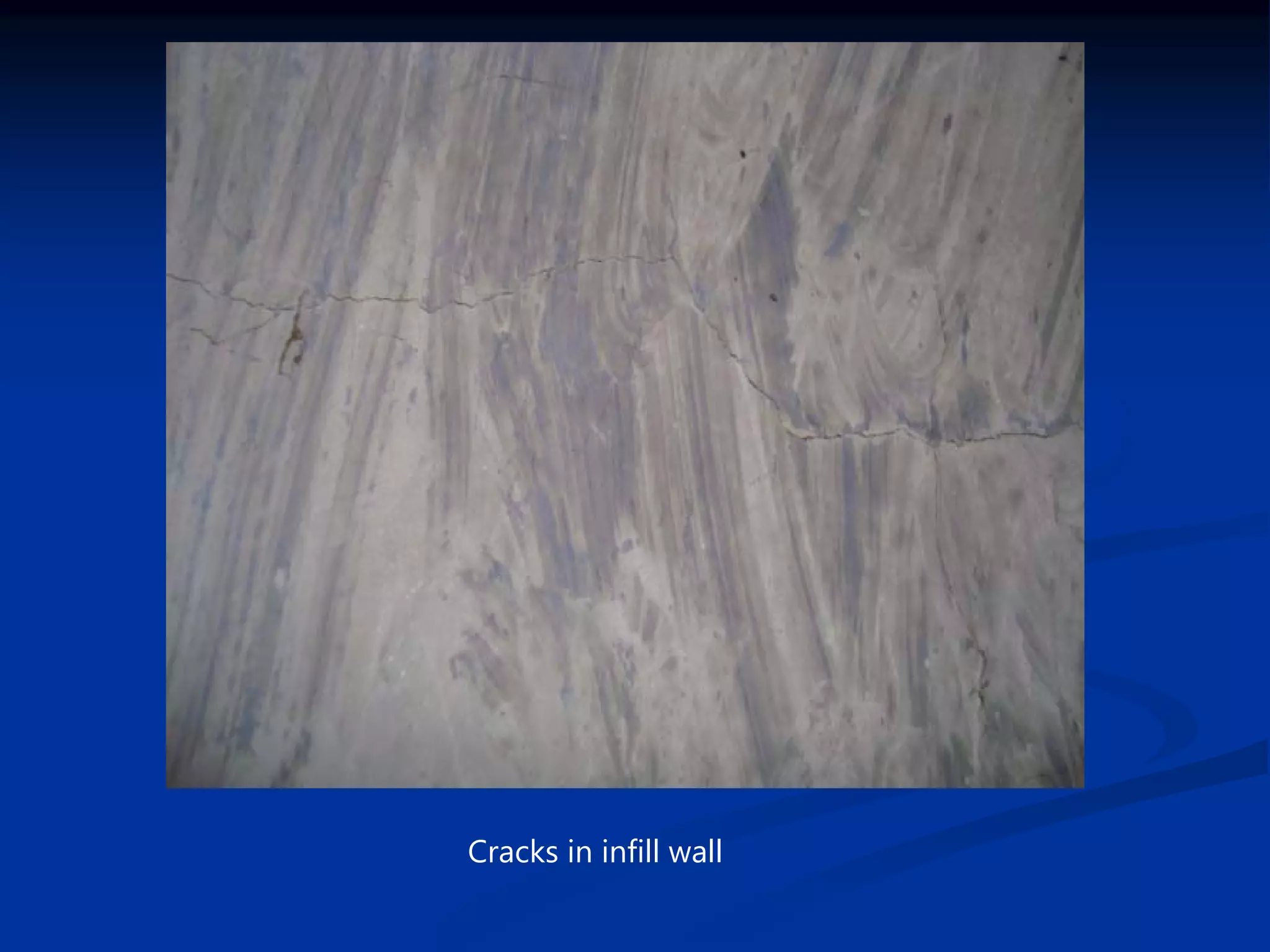
Cracks in infill wall
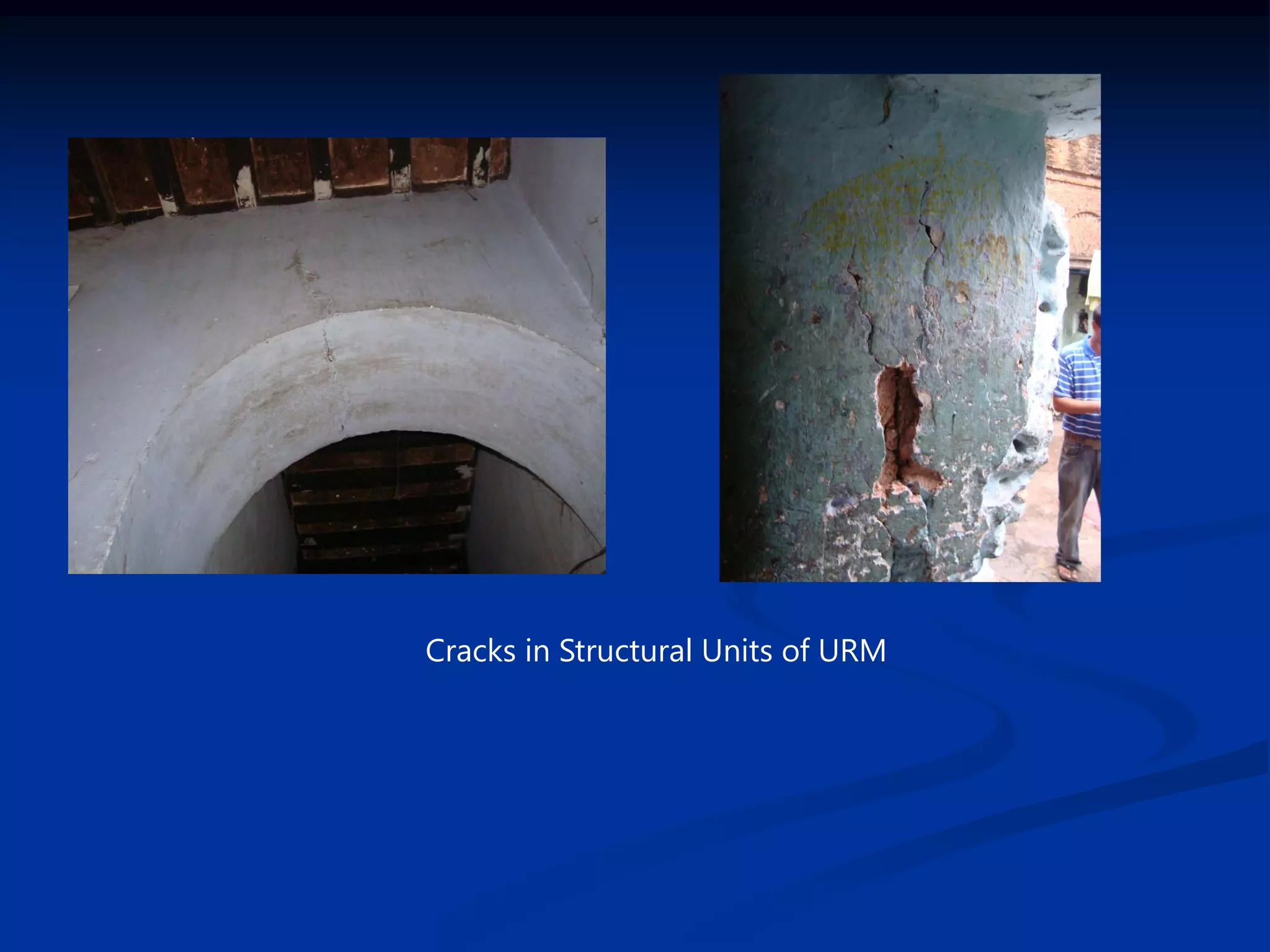
Cracks in Structural Units of URM
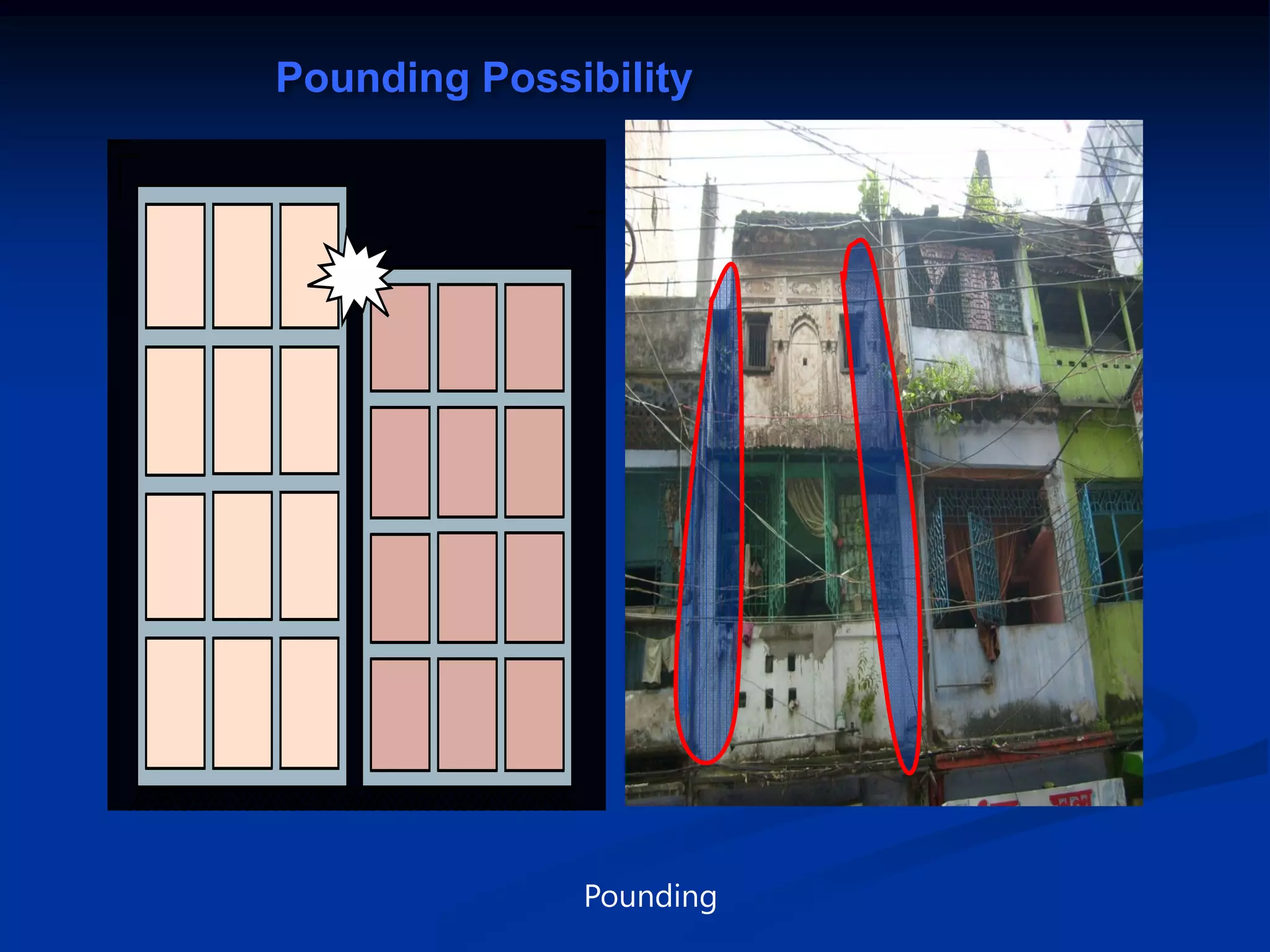
Pounding Possibility

Pounding
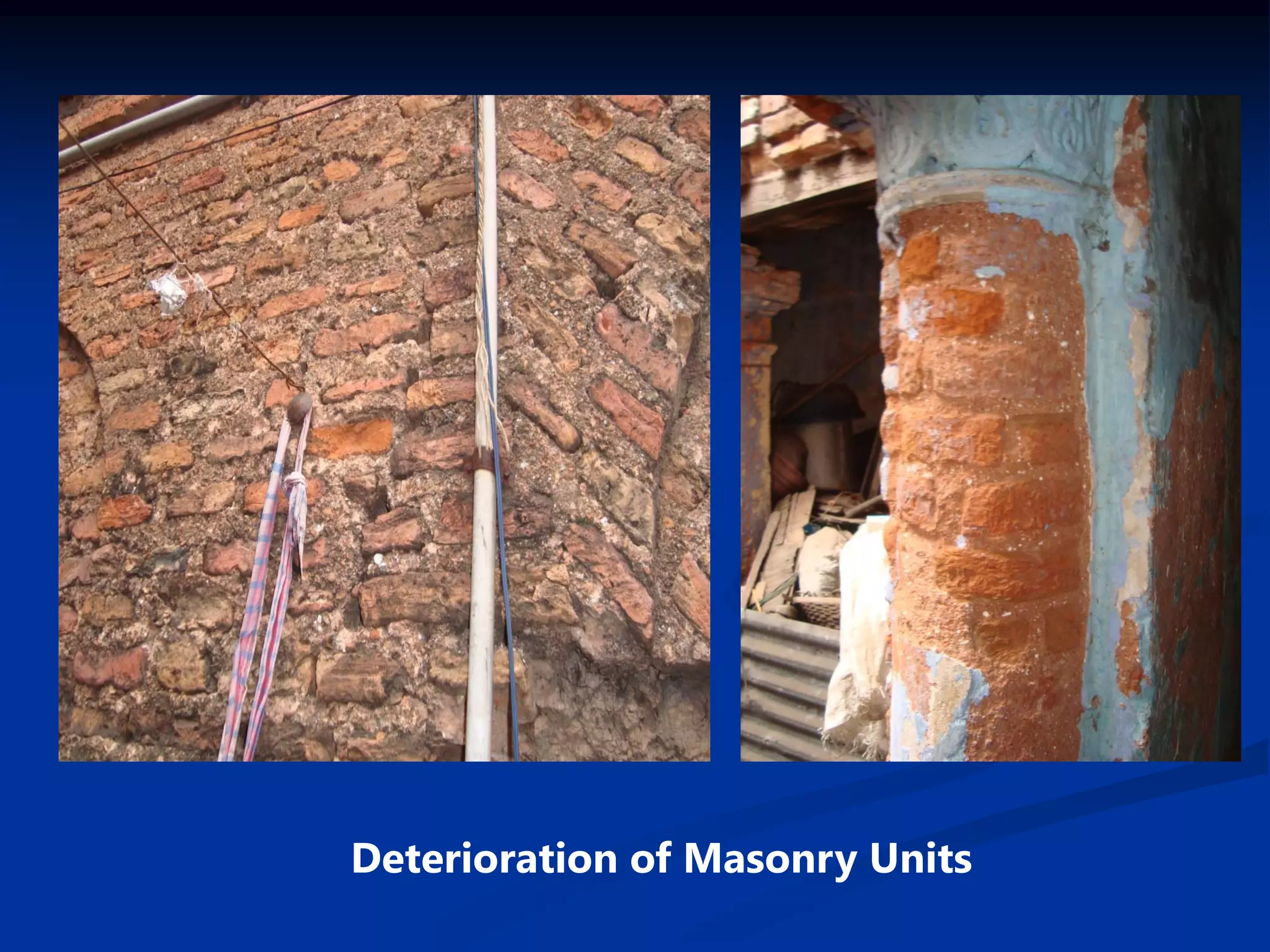
Deterioration of Masonry Units
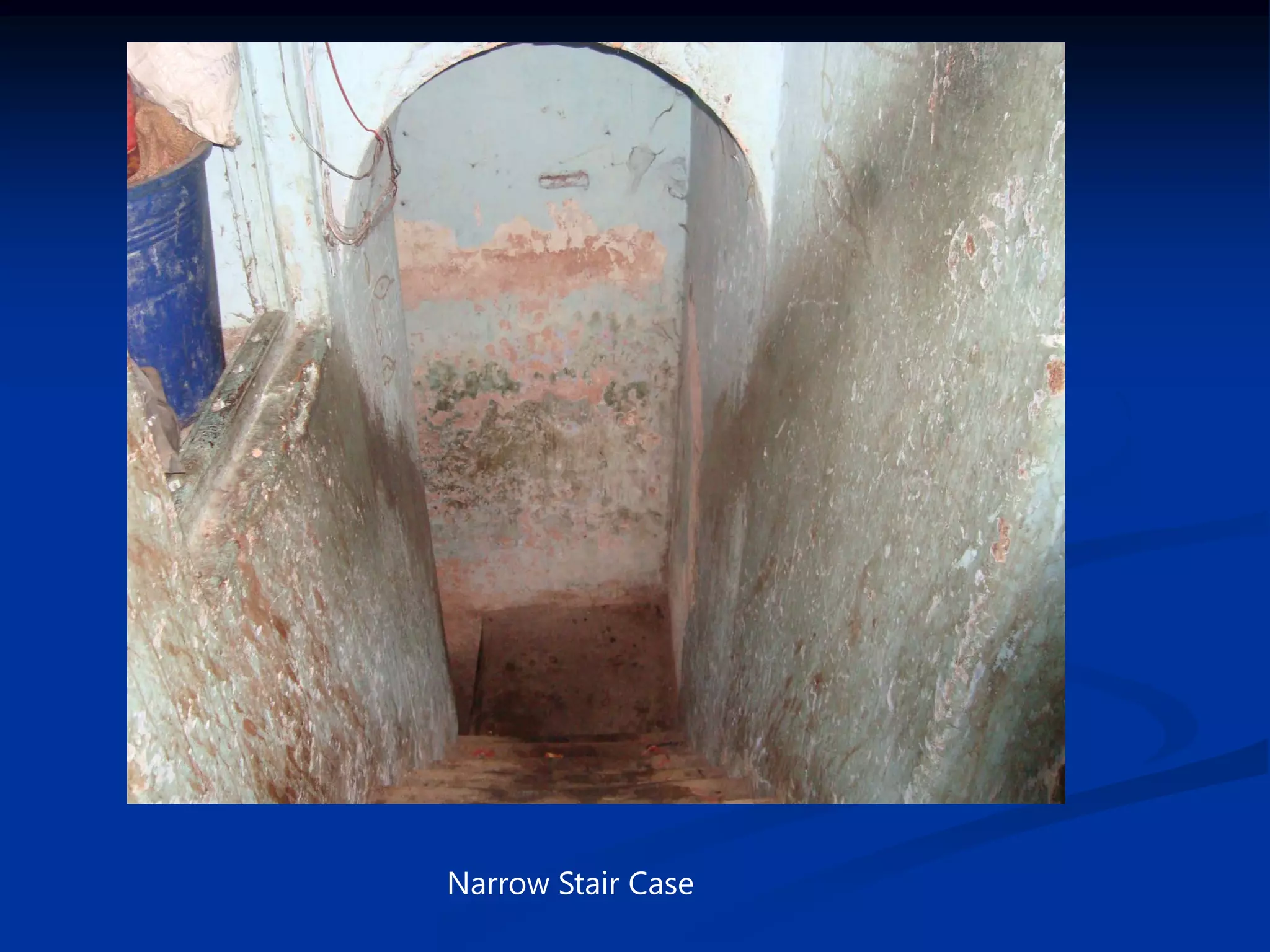
Narrow Stair Case
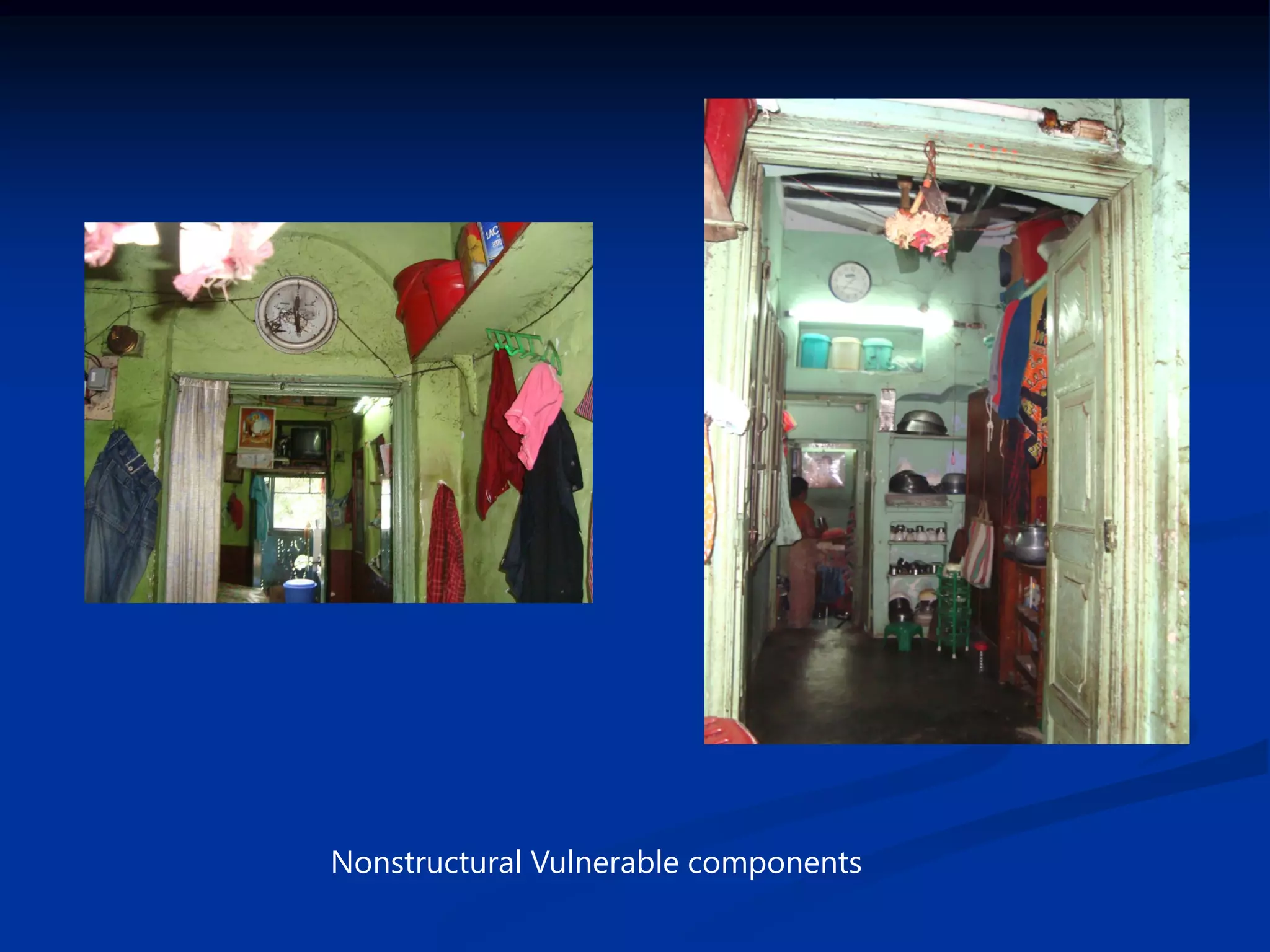
Nonstructural Vulnerable components
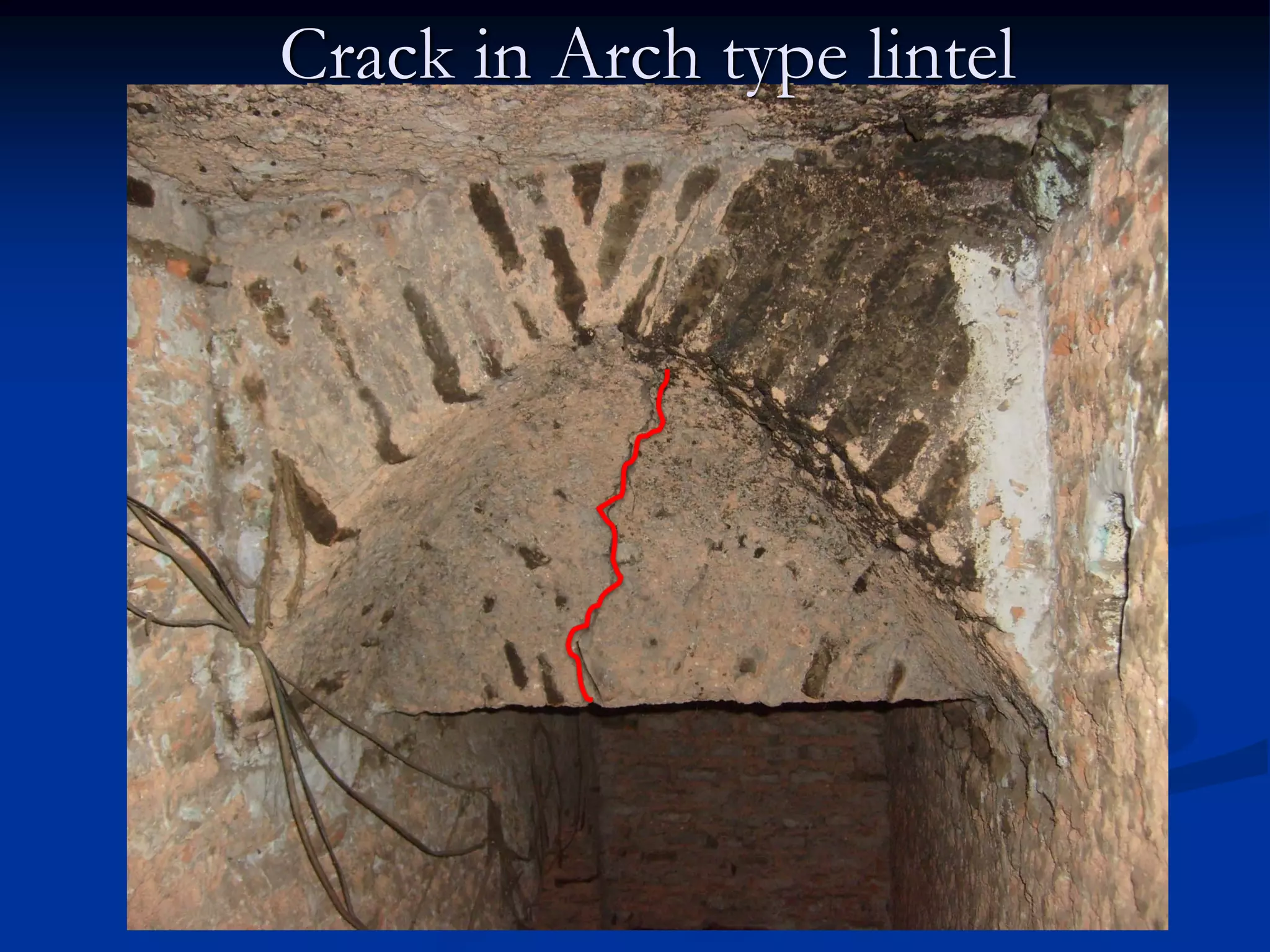
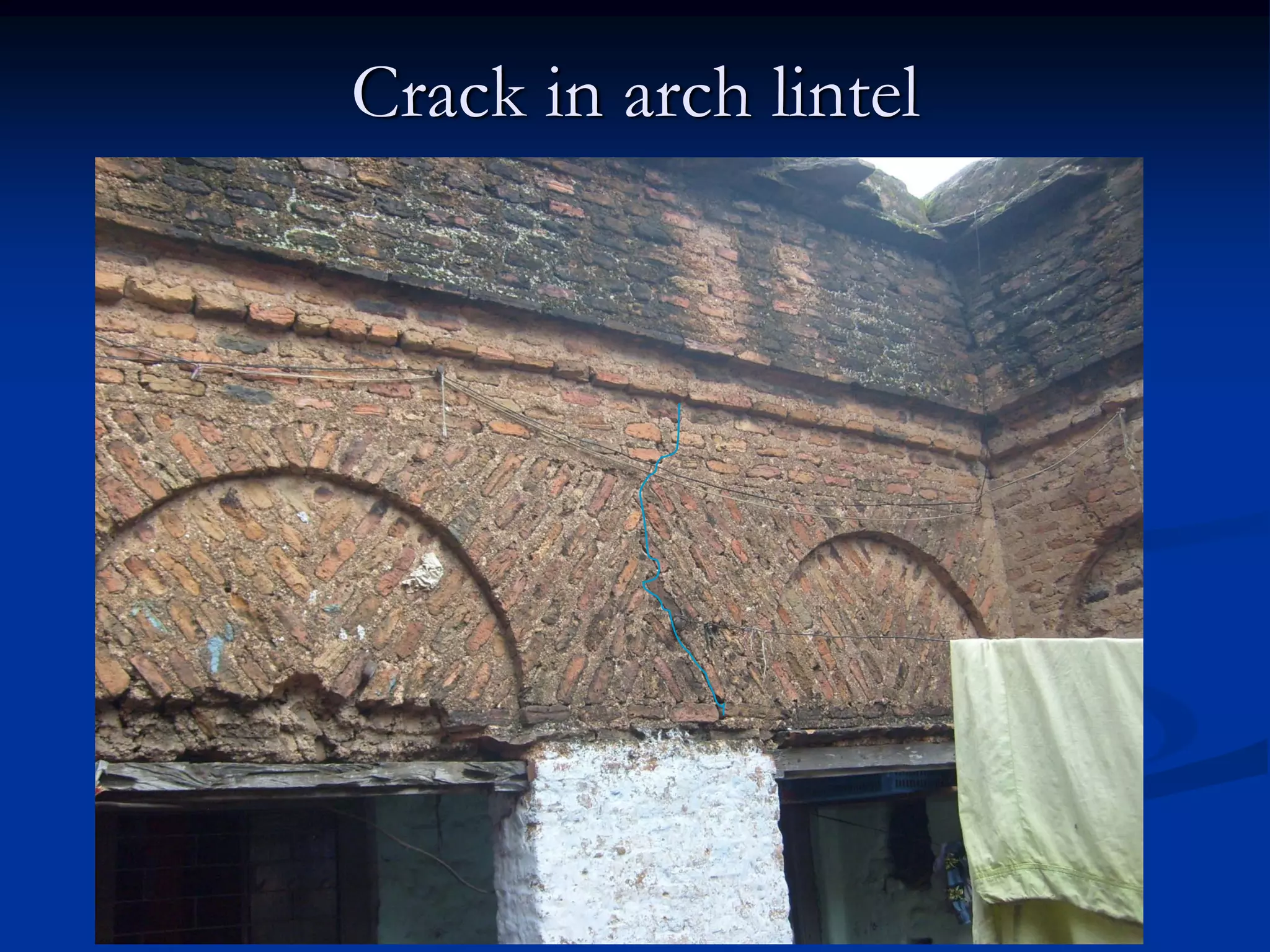
Crack in Arch type lintel
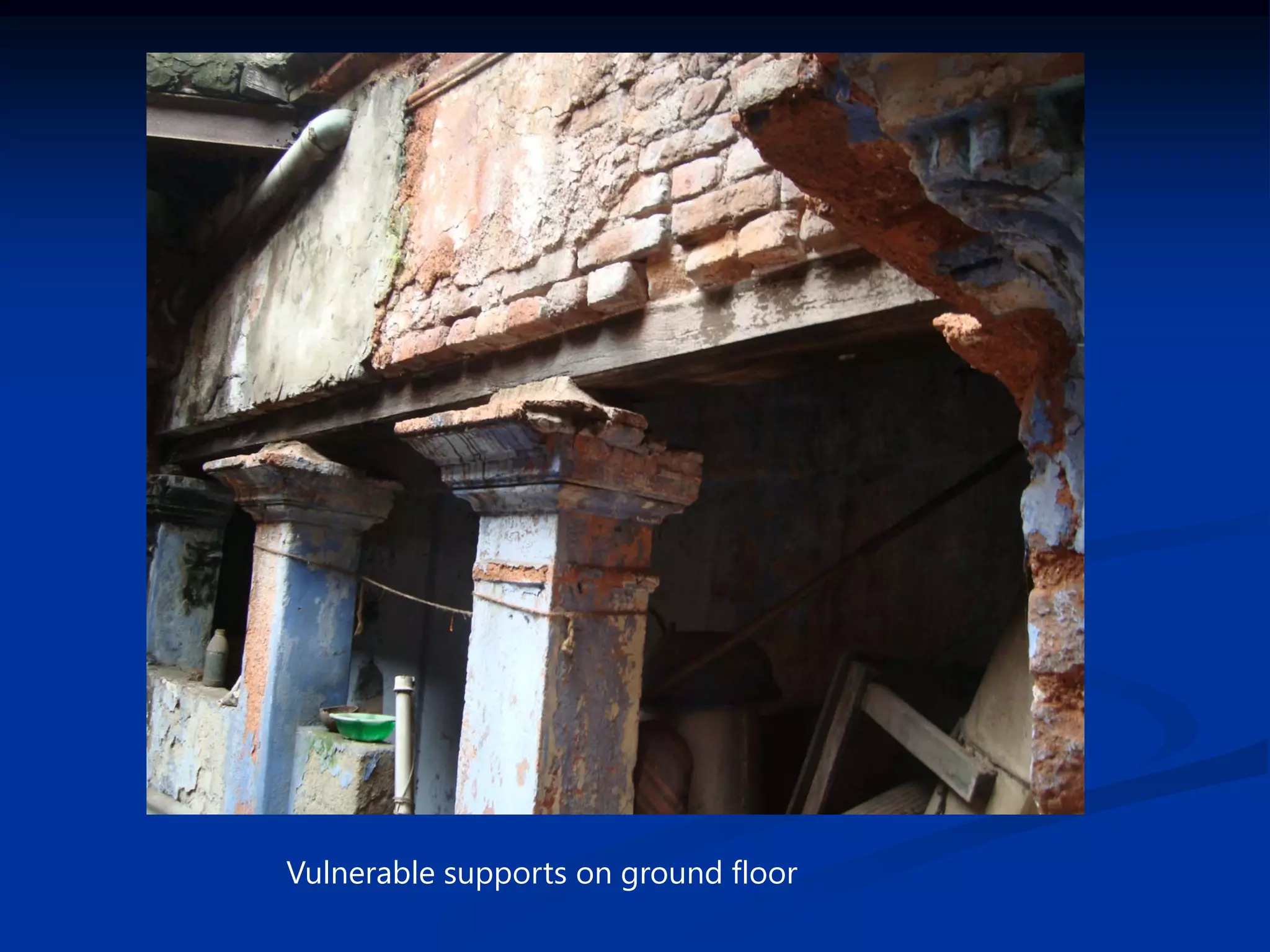
Vulnerable supports on ground floor
Settlement of inclined brick
foundation

FORCE BALANCE IN
FOUNDATION
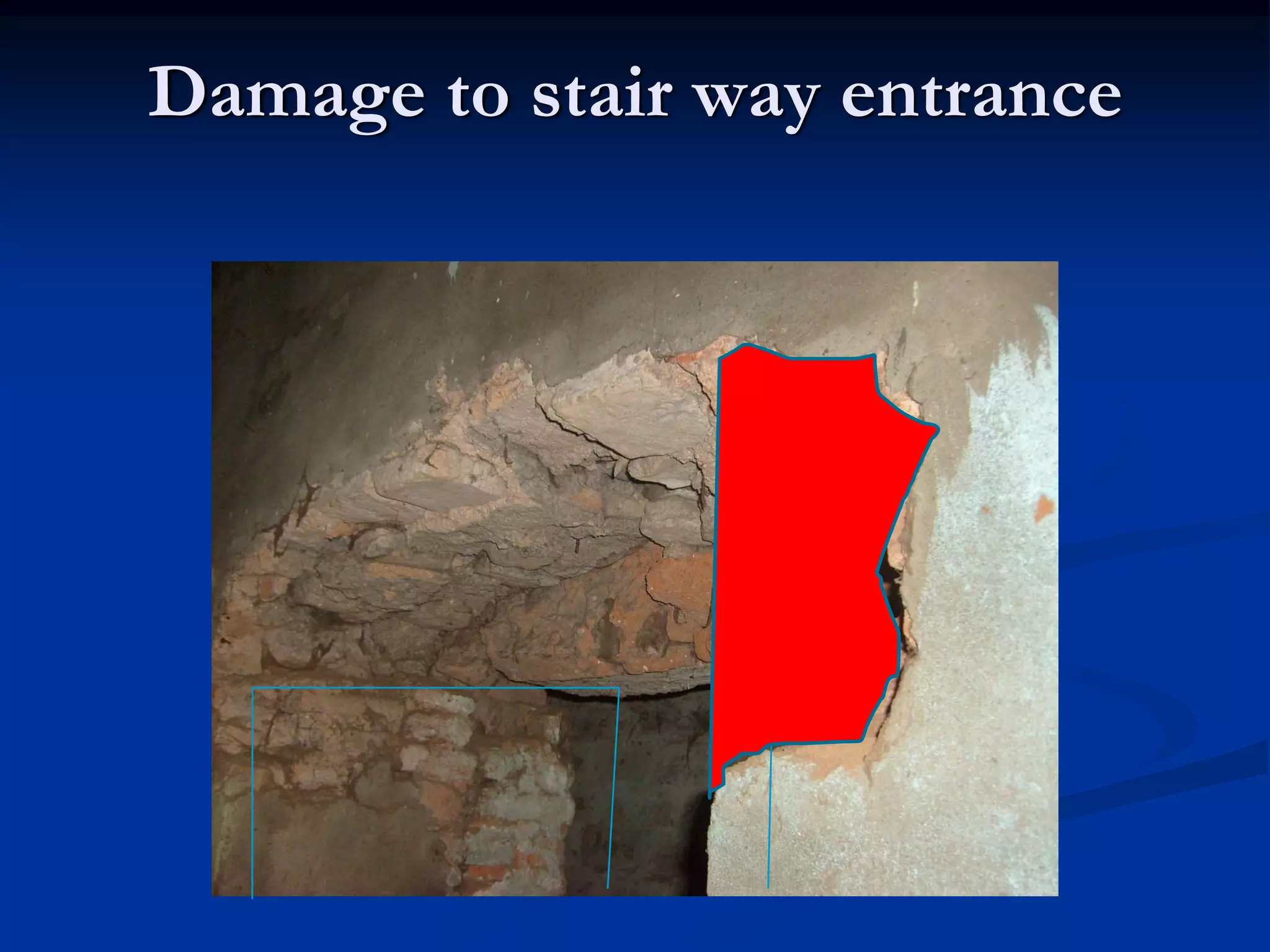
Damage to stair way entrance
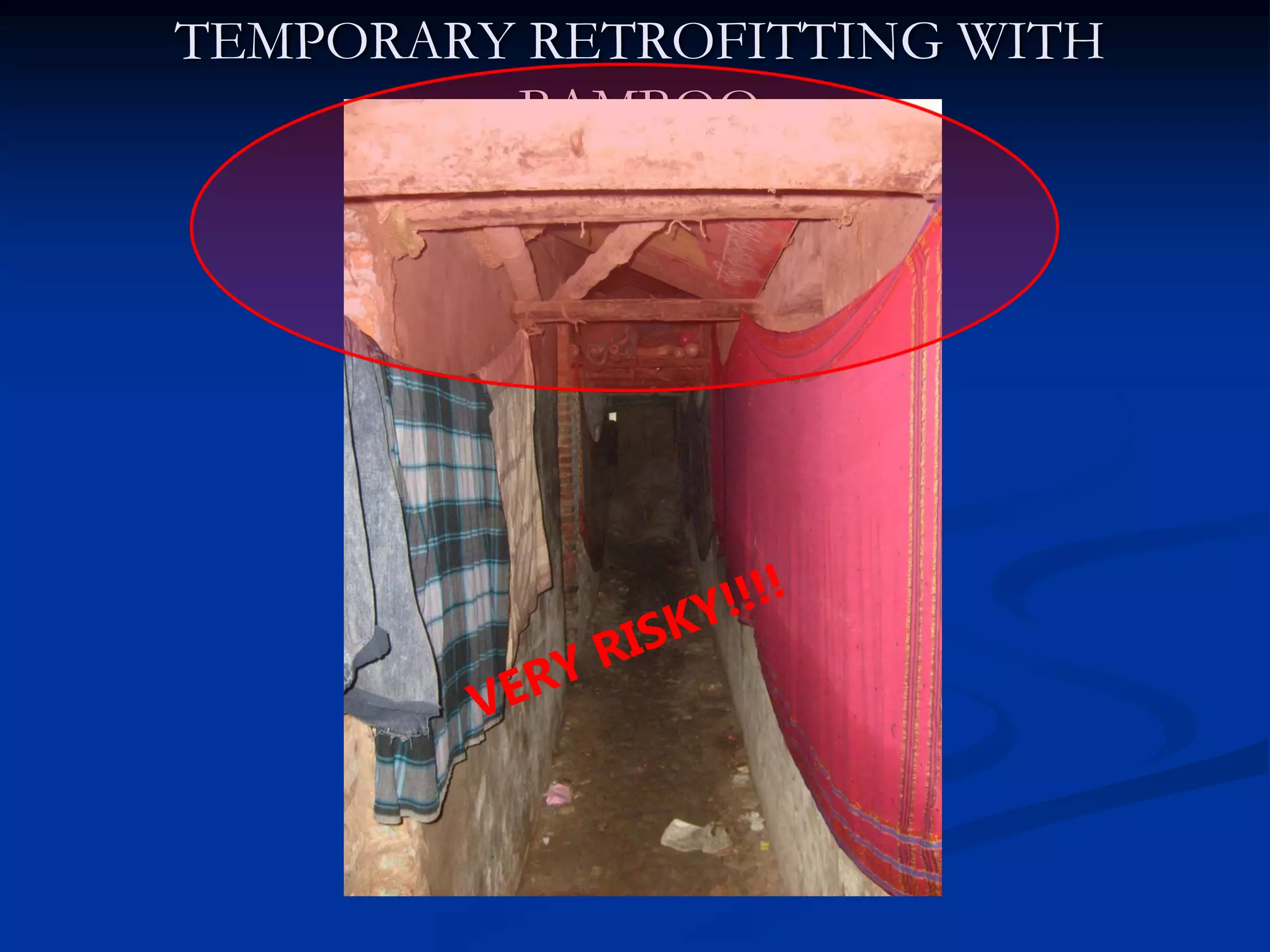
TEMPORARY RETROFITTING WITH
BAMBOO
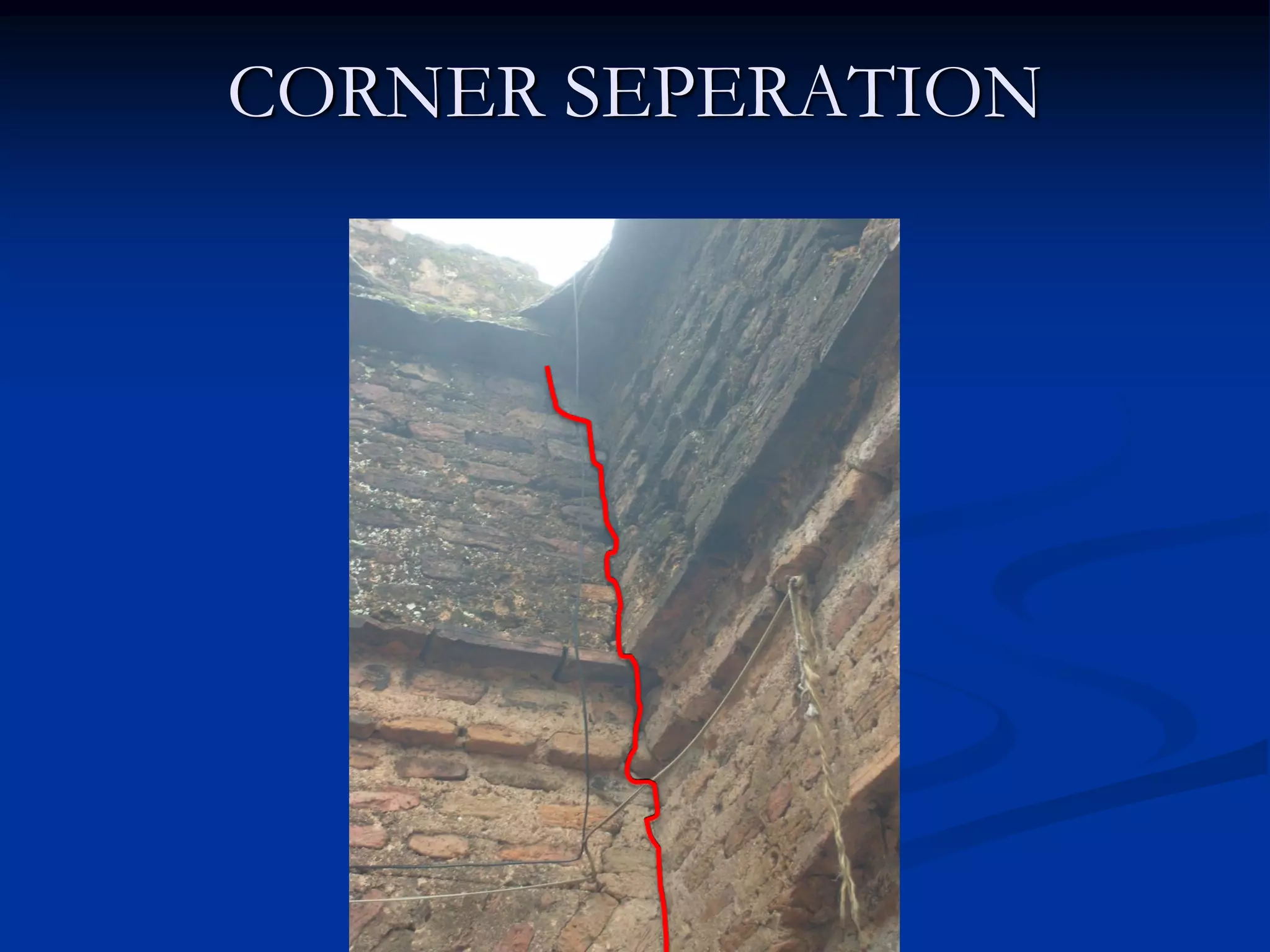
CORNER SEPERATION
Crack in arch lintel
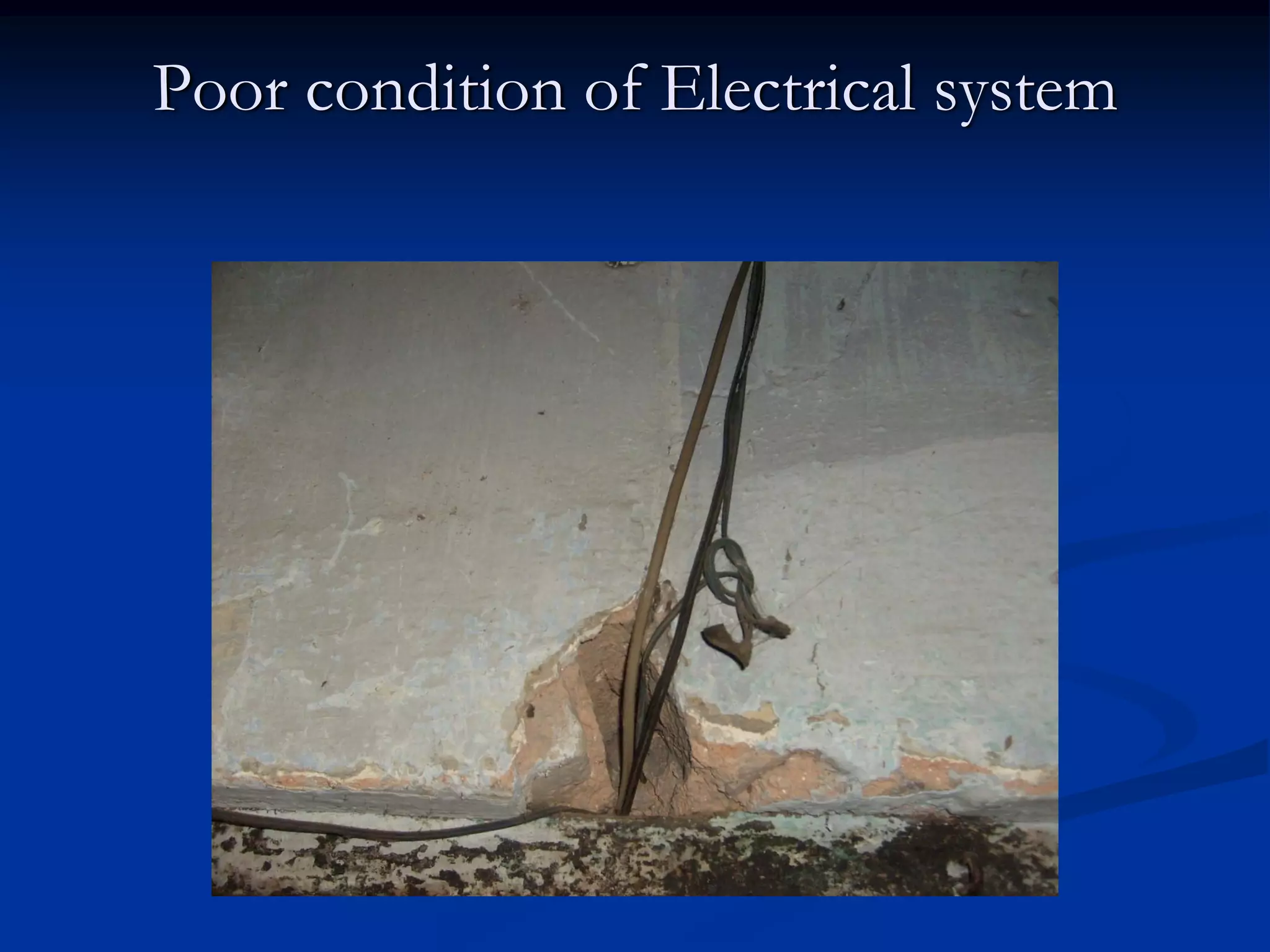
Poor condition of Electrical system
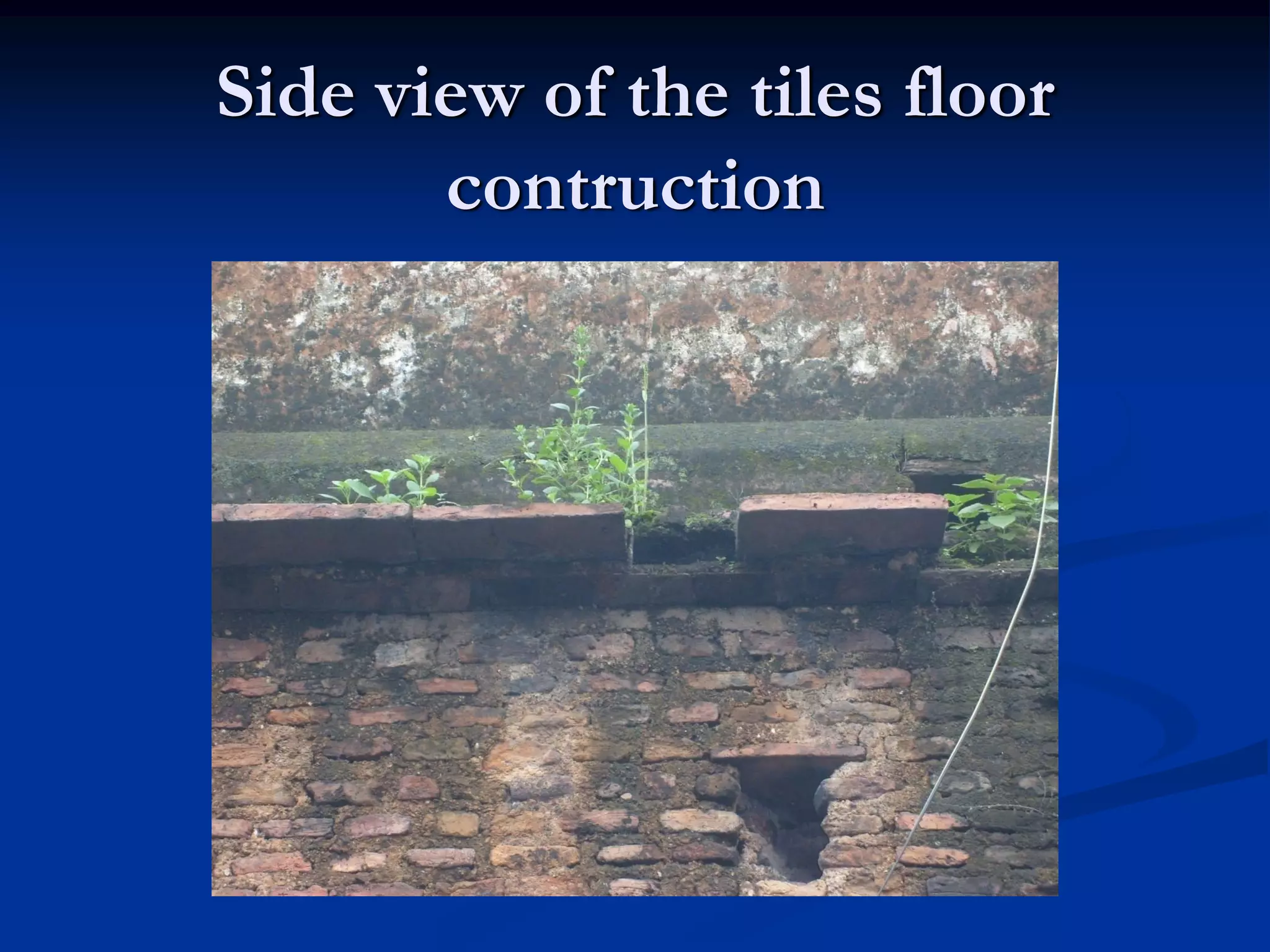
Side view of the tiles floor
contruction
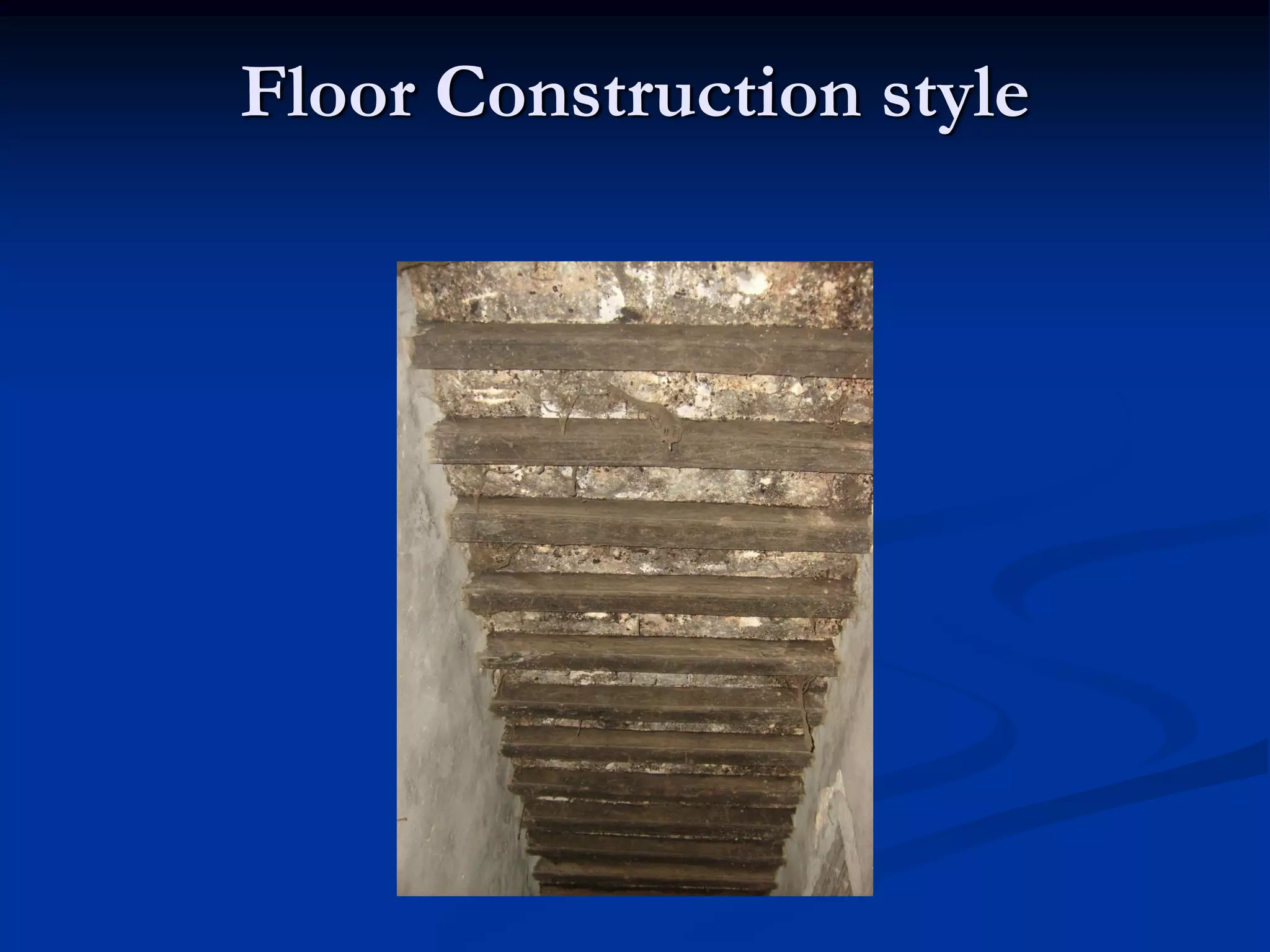
Floor Construction style
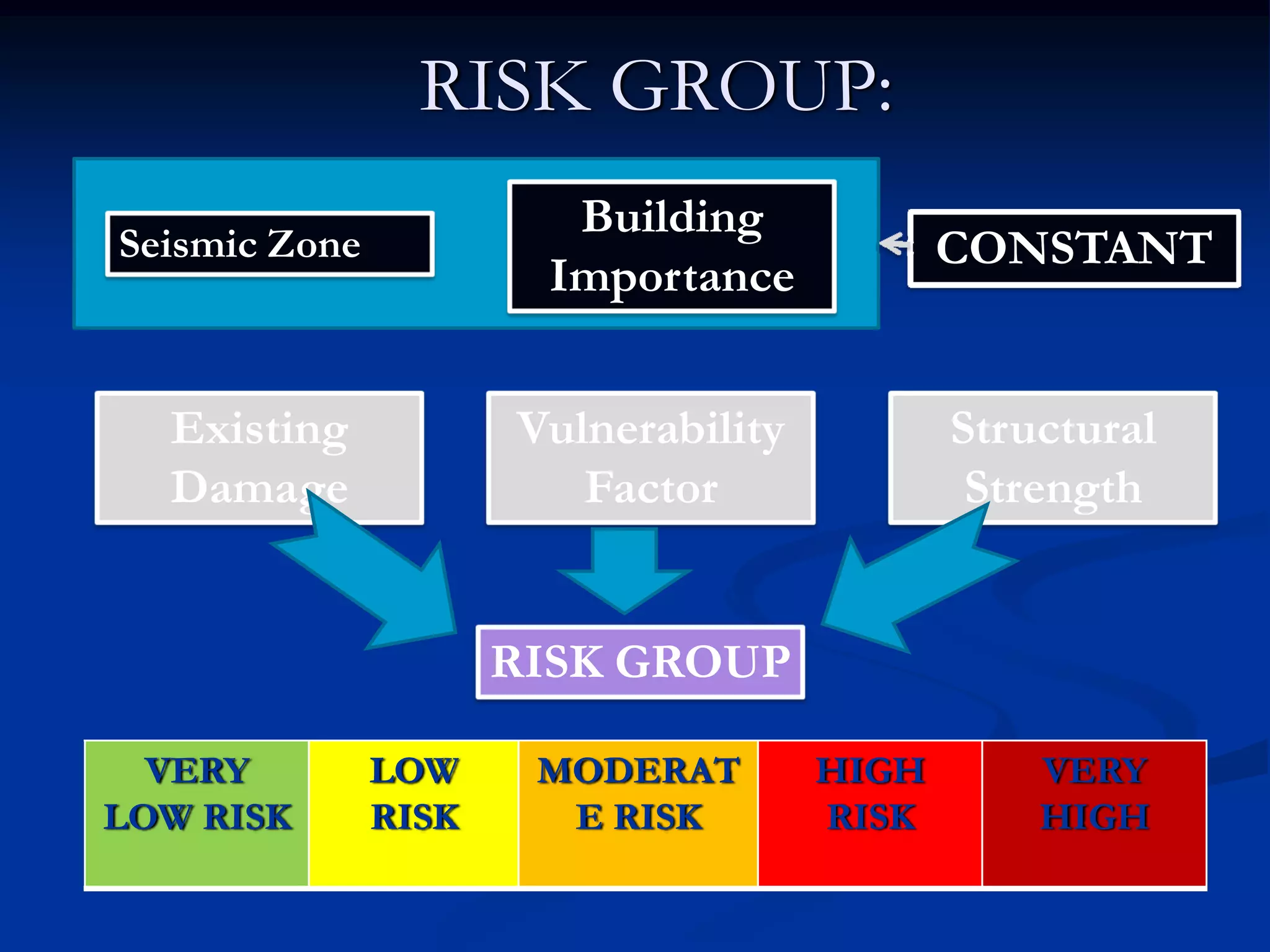
RISK GROUP:
Seismic Zone

Building
Importance

Existing
Damage

Vulnerability
Factor

CONSTANT

Structural
Strength

RISK GROUP
VERY
LOW RISK

LOW
RISK

MODERAT
E RISK

HIGH
RISK

VERY
HIGH
• Water bodies, Water hydrant
• Emergency Responses
• Fire Service
• Rescue activities
• Disaster supply kits
• Medical services
• Evacuation center (Temporary Shelter)
• Water & Food Delivery
• Temporary housing
• Recovery Plan (Infrastructure & Housing Reconstruction, Urban Planning,
Economic Vitalization, Life Recovery)
• Land Readjustment
• Community participation
• Safety precautions, Awareness, School Level Education
General Recommendations
Removal of the extended portion on old
structures and restraining the owner from
further construction on old structures
Retrofitting of the failed masonry arches
Supporting Heavy Overhang with Columns
Prepare Action Plan for City Corporation
Disaster Management Committee (CCDMC)
where Mayor is the Chairperson of the
Committee.
Conclusion
Experts say that 72 thousand buildings will be distorted if earthquake
occurs with rector scale 6.6 or 7 in Dhaka. 70 thousand people will die if it
happens at night. 800 educational institutes will be collapsed.
Earthquake can’t predict and can’t prevent. By managing we can
minimize our loses. Pre-earthquake phase, preparedness, mitigation and
prevention are concepts to work on. Post-disaster, immediate rescue and
relief measures including temporary sheltering soon after an earthquake
until about 3 months later and re-construction and re-habilitation
measures for a period of about six months to three years need to follow.
To summarize, the most effective measures of risk reduction are predisaster mitigation, preparedness and preventive measures to reduce
vulnerability and expeditious, effective rescue and relief actions
immediately after the occurrence of the earthquake.
It is not the earthquake rather it is the building that kills people.

Disaster preparedness for Safer Communities Safer Communities for Sustainable Development
11 dhaka adaptation  vulnerability

11 dhaka adaptation vulnerability

  • 1.
    June 2, 2011 SaoPaulo Mir Mustafizur Rahman Private Secretary to Mayor Dhaka City Corporation Bangladesh
  • 2.
    Population : Location :Latitude from 20 degree 34' to 26 degree 38' north. Longitude from 88 degree 01' to 92 degree 41' east. » Estimated population 150 million. Area : » Total: 144,000 sq km. » Land: 133,910 sq km. Boundary : Bounded by India from the north, east » Water: 10,090 sq km. and west, Myanmar (Burma) from the southGDP Growth rate : 6.21% (2007-08) east and the Bay of Bengal from the south. Population Growth rate : 2.02% Rainfall : Lowest 47" and highest 136". Climate : Tropical; cool, dry winter (October to March); hot, humid summer (March to June); Education : Literacy 62.49% cool, rainy monsoon (June to October).
  • 3.
    Dhaka was establishedas capital during Mogol period in 1608. Till 1717, Dhaka was capital of Bangla, Bihar & Urissha. In 1905, Dhaka became capital of East Bengal & Asam. In 1947 Dhaka became the provincial capital of East Pakistan. In 1971, Dhaka became capital of Bangladesh. Dhaka in 1800 East Bengal and Asam 1905 Chokbazar in 1908 Dhaka in 2011 Population of Dhaka is about 12 million Area of Dhaka City Corporation 360 sq. km. Total Building 3,26,000 nos. Total Road 6,200 nos. Annual population growth rate : about 6% .
  • 4.
    Hazards of Bangladesh DisasterCharacteristic in Bangladesh : Flood, Cyclone, Wind storm, droughts, Earthquake, Landslide, River erosion, Tsunami, Salinity, Water lodging, epidemic etc. Flood Land Slide Cattle death by Cyclone Tornado
  • 5.
    Hazards of Bangladesh(Cont.) Bangladesh -Earthquake Risk Fire in Slum Sundarban mangrove forest after Cyclone
  • 6.
    6 story buildingcollapsed- died 21, 25/02/2006 Shakhari Bazar-June 2004, died 19 Begun Bari- 1 June 2010, died 25 collapsed nine-story garment factory near Dhaka April 12, 2005. 73 bodies in the ruins of the nine-storey building. Around 100 people were rescued alive. 26 February, 2007, fire in a 11 storied building, died 2
  • 7.
    Feb. 2, 2006.thousands of people homeless December 15, 2007, slum – south of Dhaka 13 march. 2009, fire in a high rise commercial building, died 5 November 21, 2008, Begunbari slum. June 3, 2010, Nimtoli, Dhaka, died 123.
  • 8.
  • 9.
    DCC conducted sixday workshop on "Disaster management in Dhaka city”, 120 (One Hundred Twenty) ward commissioners, 40 representatives from different NGOs, 10 imams of different mosque, 20 officials of Fire Services Civil Defense and 20 other peoples attended. Dhaka City Corporation in association with Disaster Management Bureau arranged a day-long training workshop on “search and rescue of earthquake disaster” for the word commissioners, DCC Officials, journalists and volunteers. DCC take active role in the “Mock Exercise” at Dupkhola Play Ground, organised by Disaster Management Bureau. DCC took part in a Rally organised by Comprehensive Disaster Management Program (CDMP) to make awareness on Earth Quake among the city dwellers. DCC has taken part in Marine Air Ground Task Force Technical Warfare Simulation (MTWS) Command Post Exercise (CPX) “Exercise Durjoge Durnibar 2008”. DCC identified more than 500 risky buildings in Socio-economic survey. “Disaster Management Volunteer Group” in every ward is under process. Imposed “National Building Code” for construction every building. GIS based contingency plan, vulnerable assessment & rescue plan. Workshop on “Use of Earthquake Risk Maps and Validation of Scenario Based Earthquake Contingency Plan for Dhaka City” help on 24/08/09 at Nagar Bhaban Auditorium. Workshop on “Climate Change & Disaster Management” was held in Zone-1 office, DCC on 12/03/2010.
  • 10.
    “Technical survey foridentification of vulnerable and risky 113 buildings in heritage and non-heritage areas of Dhaka City”
  • 11.
    GENERAL STATISTICS: (Numberof Buildings=113 nos.)
  • 12.
    Relation between Dayand Night Stay by People in Building Shakhari Bazar Biren Bosh Street
  • 13.
    APPARENT QUALITY OFBUILDINGS Shakhari Bazar N=95 Biren Bosh Street N=18
  • 14.
    Correlation plot BuildingAge and Structural Type Shakhari Bazar Biren Bosh Street
  • 16.
    Risk Group VS.No. of Storey
  • 19.
    CONTENTS: TOR of theproject Out come of the vulnerability analysis and structural assessment Methodology of structural assessment Different Levels of Survey Structural Assessment Retrofitting and renovation decision making
  • 20.
    Available Methodologies for structuralassessment 1. Rapid Visual Screening – (RVS) FEMA154, FEMA155 2. FEMA 310 – Detailed structural Analysis 3. IITK- GSDMA ‘3 Tier’ vulnerability assessment Checklist 4. Turkish Vulnerability assessment methodology 5. Rapid Screening of Masonry building – Prof. Arya 6. Old Masonry Building Indexes – J. Rouqe Other Ref and standards1. BNBC 2006 Seismic Code 2. Indian Standard Seismic Code, IS-1893 3. ASTM Material Testing
  • 21.
    DESIGN OF THEASSESSMENT LEVEL 3 SURVEY LEVEL 1 & 2 SURVEY 1. IITK-GSDMA(FEMA 310 )CHECKLIST RAPID VISUAL SCREENING SCORE GROUND FLOOR PLAN DEFECT AND EXTENT OF DAMAGE DETERMINATION STRUCTURAL INTEGRITY CHECKS DECISION & SCENARIO DEVELOPMENT REPORT 2. 3. 4. COLLECTION OF APPROPRIATE SAMPLE FROM SITES MATERIAL STRENGTH DETEMINATION LITERATURE SURVEY NON DESTRUCTIVE STRENGTH DETERMINATION
  • 22.
  • 25.
  • 26.
  • 27.
    Structural Crack inURM building
  • 28.
  • 29.
  • 30.
  • 31.
  • 32.
  • 33.
  • 34.
  • 35.
    Crack in Archtype lintel
  • 36.
  • 37.
    Settlement of inclinedbrick foundation FORCE BALANCE IN FOUNDATION
  • 38.
    Damage to stairway entrance
  • 39.
  • 40.
  • 41.
  • 42.
    Poor condition ofElectrical system
  • 43.
    Side view ofthe tiles floor contruction
  • 44.
  • 45.
  • 46.
    • Water bodies,Water hydrant • Emergency Responses • Fire Service • Rescue activities • Disaster supply kits • Medical services • Evacuation center (Temporary Shelter) • Water & Food Delivery • Temporary housing • Recovery Plan (Infrastructure & Housing Reconstruction, Urban Planning, Economic Vitalization, Life Recovery) • Land Readjustment • Community participation • Safety precautions, Awareness, School Level Education
  • 47.
    General Recommendations Removal ofthe extended portion on old structures and restraining the owner from further construction on old structures Retrofitting of the failed masonry arches Supporting Heavy Overhang with Columns Prepare Action Plan for City Corporation Disaster Management Committee (CCDMC) where Mayor is the Chairperson of the Committee.
  • 48.
    Conclusion Experts say that72 thousand buildings will be distorted if earthquake occurs with rector scale 6.6 or 7 in Dhaka. 70 thousand people will die if it happens at night. 800 educational institutes will be collapsed. Earthquake can’t predict and can’t prevent. By managing we can minimize our loses. Pre-earthquake phase, preparedness, mitigation and prevention are concepts to work on. Post-disaster, immediate rescue and relief measures including temporary sheltering soon after an earthquake until about 3 months later and re-construction and re-habilitation measures for a period of about six months to three years need to follow. To summarize, the most effective measures of risk reduction are predisaster mitigation, preparedness and preventive measures to reduce vulnerability and expeditious, effective rescue and relief actions immediately after the occurrence of the earthquake. It is not the earthquake rather it is the building that kills people. Disaster preparedness for Safer Communities Safer Communities for Sustainable Development