OSH Management System
Risk Assessment Based on
Occupational Health & Safety Assessment Series 18001
Ar. Mohd Jamil Bin Mohd Hamberi
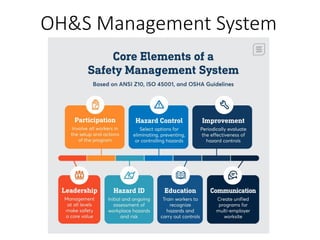
OH&S Management System
Organizations are responsible for risk that arises
out of their own workplaces.
* Management need to be committed to OH&S:-
- The old assumption that workers are
responsible for causing accidents are not
entirely valid.
* Self-regulated
* Proactive management approach
THE NEW APPROACH TO OH&S
MANAGEMENT SYSTEM
1. Identify regulatory requirements –
compliance to local and national laws.
2. Identify hazards and risks – pertinent to
current work activities.
3. Manage risks – introduce controls to
manage risks to as low as reasonably
practicable (ALARP).
PURPOSE OF
MANAGEMENT SYSTEM 1
1. Establish a policy and objectives –
introduce plans to manage the risks that
has been identified. Implement the plans.
2. Monitor performance – obtain feedback
and make the necessary changes to the
policy or objectives if required.
PURPOSE OF
MANAGEMENT SYSTEM 2
1. Voluntary management system
2. Integrates OH&S hazards into business process
3. Identify, assess and control hazards relating to
business
4. Anticipates and meets OH&S performance
expectations (national / international level)
5. Applicable to any organization, regardless of size,
type, or level of maturity
1. Plan
Assess risk, identify applicable regulations
2. Do
Identify responsibility and accountability, training, communicate,
control and prepare for emergencies.
3. Check
Monitor, Record, Audit (Check, Examination, Review,Assessment).
4. Act to improve
PDCA IN OH&S
MANAGEMENT SYSTEM
Planning for hazard identification, risk
assessment and risk control.
•The organization shall establish and maintain
procedures for the ongoing identification of
hazards, assessment of risks and the
implementation of the necessary control
measures.
PLANNING 1
(One of the elements of OHSAS 18001)
•Activities shall include routine and non-
routine of all personnel having access to work
place or it facilities including subcontractors
and visitors.
•Results of assessments must be documented
and kept up to date ( in the event of new
equipment or change of process).
PLANNING 2
1. Relevant to job activity.
2. Proactive rather than reactive. Need to
uncover hazards.
3. Able to classify risks.
4. Risks can be identified, controlled or
eliminated.
5. Control measures need to be specified.
Methodology For Hazard Identification And
Risk Assessment
1. Set up sub-committees in each individual
work section.
2. Get them to make a list of all current work
activities ( routine and non-routine).
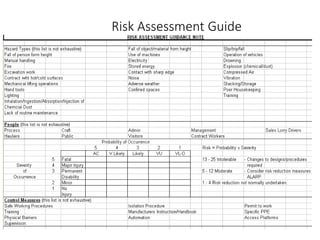
3. Use a Risk Assessment Matrix to conduct an
initial assessment to determine activities that
constitute highest risk to employees,
subcontractors or visitors.
How do we do it ?
4. From the initial assessment, conduct a detailed
risk assessment on the highest risk activity by
breaking the activity into the basic job
sequence.
5. From basic job sequence, determine the
inherent hazards (with current controls in
place) and the controls required to mitigate
them.
How do we do it ?
6. Plan and allocate resources to ensure controls
are effective. Place priority on activity with
highest risk to safety.
7. Person responsible to be nominated to
administer controls effectively in the agreed
time frame.
How do we do it ?
How can we succeed ?
1. Management must give endorsement.
2. Set performance standards – use industry and current legal
standards.
3. Education and Training – provide training to the risk
assessment sub-committee members.
How can we succeed ?
4. Task selection (prioritize) – Take action on job activities
with the highest risks.
5. Group involvement – Risk assessment sub-committee is to
submit their findings to the OSH Committee. OSH
Committee to submit to management for approval.
6. Documented, acted upon and reviewed.
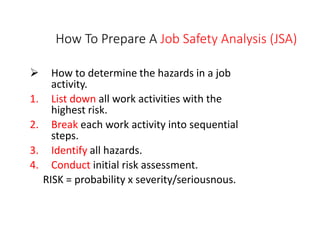
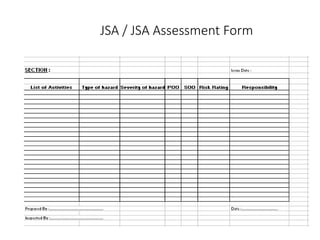
How To Prepare A Job Safety Analysis (JSA)
 How to determine the hazards in a job
activity.
1. List down all work activities with the
highest risk.
2. Break each work activity into sequential
steps.
3. Identify all hazards.
4. Conduct initial risk assessment.
RISK = probability x severity/seriousnous.
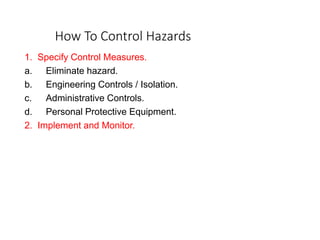
How To Control Hazards
1. Specify Control Measures.
a. Eliminate hazard.
b. Engineering Controls / Isolation.
c. Administrative Controls.
d. Personal Protective Equipment.
2. Implement and Monitor.
JSA / JSA Assessment Form
Risk Assessment Guide
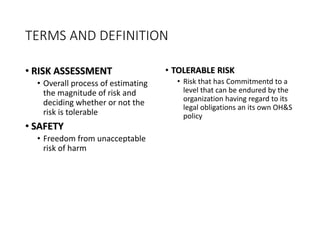
TERMS AND DEFINITION
• RISK ASSESSMENT
• Overall process of estimating
the magnitude of risk and
deciding whether or not the
risk is tolerable
• SAFETY
• Freedom from unacceptable
risk of harm
• TOLERABLE RISK
• Risk that has Commitmentd to a
level that can be endured by the
organization having regard to its
legal obligations an its own OH&S
policy
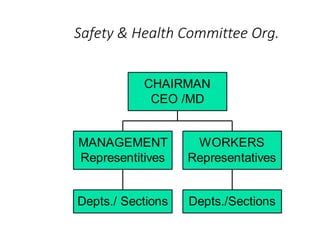
Safety & Health Committee Org.
Depts./ Sections
MANAGEMENT
Representitives
Depts./Sections
WORKERS
Representatives
CHAIRMAN
CEO /MD
The Need For OSH. Committee
Section 30, OSH Act 1994
Establishment of a safety & health
committee is mandatory for places of
work employing more than 40 workers.
Gazetted on 1 January 1997
Composition Of Committee
OSH Committee consists of :
 Chairman
 Secretary
 Representatives of employer
 Representatives of employees
Representatives
This Regulation Requires that :
 Less than 100 employees - 2 from management.
- 2 from employees.
 More than 100 employees - 4 from management.
- 4 from employees.
OSH Committee’s Commitment
 Assist in the development of safety and health
rules and safe systems of work.
 Review the effectiveness of safety and health
program.
 Carry out studies on trends of incident & report
to management.
 Review & make recommendations on Safety &
Health Policy.
Workplace Inspection
 Inspect the workplace at least once in 3 months.
 Develop programs for corrective actions.
 Evaluate effectiveness of corrective actions.
 uReport & record nsafe acts and conditions.
 Advise management on improvement of safety.
Accident Investigation
 Assist the Safety Officer when he is conducting
accident investigation.
 Obtain additional shop floor information
pertaining to the cause of the accident.
 Provide recommendations to prevent recurrence.
Accident Investigation cont’d.
 Communicate cause of accident and recommended actions to
prevent recurrence of the accident to his/her colleagues once
results are made public.
 Follow up on the implementation of corrective measures.
Investigate Into Complaints
 Committee members must maintain an open
communication system for employees to report
on OSH issues.
 Members will then take immediate action to
look into any complaints or suggestions.
 Members can refer to the safety & health
committee if immediate management is
incapable of taking any action.
Complaints & Committee
 If the Committee receives any complaints, they must;
- investigate immediately
- make a report
- Make a recommendation to eliminate or reduce the risk.
Complaints & Employer
 Employer must implement the recommended
actions immediately after receiving report from
the committee.
 Reasons must be given if management cannot
implement the recommended actions.
 If the committee does not agree with the
reasons given by the management, they can
refer the case to DG DOSH for further
investigation.
Other Activities Involving OSH Committee
 The OSH committee should assist management
in activities pertaining to OSH;
- Safety and Health Awareness Campaign
- Safety and Health awards
- Safety and Health exhibition
- Conduct Safety and Health Surveys
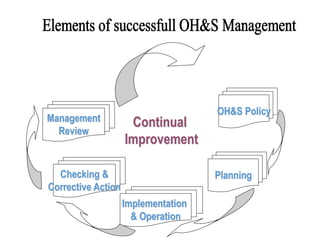
OH&S Policy
Planning
Implementation
& Operation
Checking &
Corrective Action
Management
Review
Continual
Improvement
11. CHAPTER 2.0  OHS MANAGEMENT SYSTEM.pdf

11. CHAPTER 2.0 OHS MANAGEMENT SYSTEM.pdf

  • 1.
    OSH Management System RiskAssessment Based on Occupational Health & Safety Assessment Series 18001 Ar. Mohd Jamil Bin Mohd Hamberi
  • 2.
  • 3.
    Organizations are responsiblefor risk that arises out of their own workplaces. * Management need to be committed to OH&S:- - The old assumption that workers are responsible for causing accidents are not entirely valid. * Self-regulated * Proactive management approach THE NEW APPROACH TO OH&S MANAGEMENT SYSTEM
  • 4.
    1. Identify regulatoryrequirements – compliance to local and national laws. 2. Identify hazards and risks – pertinent to current work activities. 3. Manage risks – introduce controls to manage risks to as low as reasonably practicable (ALARP). PURPOSE OF MANAGEMENT SYSTEM 1
  • 5.
    1. Establish apolicy and objectives – introduce plans to manage the risks that has been identified. Implement the plans. 2. Monitor performance – obtain feedback and make the necessary changes to the policy or objectives if required. PURPOSE OF MANAGEMENT SYSTEM 2
  • 6.
    1. Voluntary managementsystem 2. Integrates OH&S hazards into business process 3. Identify, assess and control hazards relating to business 4. Anticipates and meets OH&S performance expectations (national / international level) 5. Applicable to any organization, regardless of size, type, or level of maturity
  • 7.
    1. Plan Assess risk,identify applicable regulations 2. Do Identify responsibility and accountability, training, communicate, control and prepare for emergencies. 3. Check Monitor, Record, Audit (Check, Examination, Review,Assessment). 4. Act to improve PDCA IN OH&S MANAGEMENT SYSTEM
  • 8.
    Planning for hazardidentification, risk assessment and risk control. •The organization shall establish and maintain procedures for the ongoing identification of hazards, assessment of risks and the implementation of the necessary control measures. PLANNING 1 (One of the elements of OHSAS 18001)
  • 9.
    •Activities shall includeroutine and non- routine of all personnel having access to work place or it facilities including subcontractors and visitors. •Results of assessments must be documented and kept up to date ( in the event of new equipment or change of process). PLANNING 2
  • 10.
    1. Relevant tojob activity. 2. Proactive rather than reactive. Need to uncover hazards. 3. Able to classify risks. 4. Risks can be identified, controlled or eliminated. 5. Control measures need to be specified. Methodology For Hazard Identification And Risk Assessment
  • 11.
    1. Set upsub-committees in each individual work section. 2. Get them to make a list of all current work activities ( routine and non-routine). 3. Use a Risk Assessment Matrix to conduct an initial assessment to determine activities that constitute highest risk to employees, subcontractors or visitors. How do we do it ?
  • 12.
    4. From theinitial assessment, conduct a detailed risk assessment on the highest risk activity by breaking the activity into the basic job sequence. 5. From basic job sequence, determine the inherent hazards (with current controls in place) and the controls required to mitigate them. How do we do it ?
  • 13.
    6. Plan andallocate resources to ensure controls are effective. Place priority on activity with highest risk to safety. 7. Person responsible to be nominated to administer controls effectively in the agreed time frame. How do we do it ?
  • 14.
    How can wesucceed ? 1. Management must give endorsement. 2. Set performance standards – use industry and current legal standards. 3. Education and Training – provide training to the risk assessment sub-committee members.
  • 15.
    How can wesucceed ? 4. Task selection (prioritize) – Take action on job activities with the highest risks. 5. Group involvement – Risk assessment sub-committee is to submit their findings to the OSH Committee. OSH Committee to submit to management for approval. 6. Documented, acted upon and reviewed.
  • 16.
    How To PrepareA Job Safety Analysis (JSA)  How to determine the hazards in a job activity. 1. List down all work activities with the highest risk. 2. Break each work activity into sequential steps. 3. Identify all hazards. 4. Conduct initial risk assessment. RISK = probability x severity/seriousnous.
  • 17.
    How To ControlHazards 1. Specify Control Measures. a. Eliminate hazard. b. Engineering Controls / Isolation. c. Administrative Controls. d. Personal Protective Equipment. 2. Implement and Monitor.
  • 18.
    JSA / JSAAssessment Form
  • 19.
  • 20.
    TERMS AND DEFINITION •RISK ASSESSMENT • Overall process of estimating the magnitude of risk and deciding whether or not the risk is tolerable • SAFETY • Freedom from unacceptable risk of harm • TOLERABLE RISK • Risk that has Commitmentd to a level that can be endured by the organization having regard to its legal obligations an its own OH&S policy
  • 21.
    Safety & HealthCommittee Org. Depts./ Sections MANAGEMENT Representitives Depts./Sections WORKERS Representatives CHAIRMAN CEO /MD
  • 22.
    The Need ForOSH. Committee Section 30, OSH Act 1994 Establishment of a safety & health committee is mandatory for places of work employing more than 40 workers. Gazetted on 1 January 1997
  • 23.
    Composition Of Committee OSHCommittee consists of :  Chairman  Secretary  Representatives of employer  Representatives of employees
  • 24.
    Representatives This Regulation Requiresthat :  Less than 100 employees - 2 from management. - 2 from employees.  More than 100 employees - 4 from management. - 4 from employees.
  • 25.
    OSH Committee’s Commitment Assist in the development of safety and health rules and safe systems of work.  Review the effectiveness of safety and health program.  Carry out studies on trends of incident & report to management.  Review & make recommendations on Safety & Health Policy.
  • 26.
    Workplace Inspection  Inspectthe workplace at least once in 3 months.  Develop programs for corrective actions.  Evaluate effectiveness of corrective actions.  uReport & record nsafe acts and conditions.  Advise management on improvement of safety.
  • 27.
    Accident Investigation  Assistthe Safety Officer when he is conducting accident investigation.  Obtain additional shop floor information pertaining to the cause of the accident.  Provide recommendations to prevent recurrence.
  • 28.
    Accident Investigation cont’d. Communicate cause of accident and recommended actions to prevent recurrence of the accident to his/her colleagues once results are made public.  Follow up on the implementation of corrective measures.
  • 29.
    Investigate Into Complaints Committee members must maintain an open communication system for employees to report on OSH issues.  Members will then take immediate action to look into any complaints or suggestions.  Members can refer to the safety & health committee if immediate management is incapable of taking any action.
  • 30.
    Complaints & Committee If the Committee receives any complaints, they must; - investigate immediately - make a report - Make a recommendation to eliminate or reduce the risk.
  • 31.
    Complaints & Employer Employer must implement the recommended actions immediately after receiving report from the committee.  Reasons must be given if management cannot implement the recommended actions.  If the committee does not agree with the reasons given by the management, they can refer the case to DG DOSH for further investigation.
  • 32.
    Other Activities InvolvingOSH Committee  The OSH committee should assist management in activities pertaining to OSH; - Safety and Health Awareness Campaign - Safety and Health awards - Safety and Health exhibition - Conduct Safety and Health Surveys
  • 33.
    OH&S Policy Planning Implementation & Operation Checking& Corrective Action Management Review Continual Improvement