3
COVERSTORY
JANUARY 10, 2016 NEW SUNDAY TIMES
LEARNING CURVE
ers can immediately get and provide
feedback, create groups, whatever.”
Salcito cautioned that schools
should aim to deliver on a long-term
vision rather than short-term aca-
demicresultsthatmaygeneratesome
buzz but are unlikely to change edu-
cational outcomes.
“Schools will buy technology
and distribute devices, but these are
steps. Don’t make them the journey,”
he said.
“I would caution against building
a strategy based on a series of imple-
mentationstepsthatarenotconnect-
ed, or even understood by teachers,
parents and pupils.”
ToSalcito,itisnotallaboutachiev-
ing high test scores.
City and school leaders need to
build a technology roadmap to sup-
port a vision, and not the other way
round.
“A vision of ever higher pass rates
is unlikely to equip students with
the skills they need to prosper in an
economy which looks very different
to the past,” he said.
“Therealityisthattheworkforceis
fundamentally shifting, and that the
fastest-growing industries require
skills that are not being taught in the
classroom.”
When jobs go unfilled, it is “not
down to a shortage of people, but to a
shortage of skills”.
With economies now much more
technology- and services-oriented,
there is a need to think differently
about classroom teaching, and to
make collaboration and creativity
central to the learning experience.
“Alltoooften,studentslearnmate-
rial ‘because it is in the test’. If educa-
tion leaders develop a proper vision,
then students will be able to connect
thedotsbetweenwhattheyarelearn-
ing, and why they are learning it,” he
said.
Salcitoaddedthatteachersshould
understand that the introduction of
technology into the classroom is to
helpthembeevenmoreeffective,and
not meant to replace their role.
“When teachers get technology,
they might fear that they will be dis-
placed. Actually the opposite is true
-technologygivesteachersaplatform
to share their insights and to reach
more students,” he said.
THEOUTSIDEWORLDASCLASSROOM
Finland’s Saku Tuominen, creative
director and a founder of SCOOL,
sharedonhowthecompanycombines
creative format business know-how
with educational expertise.
“Our mission is to bring the out-
sideworldintotheclassroom.Wehelp
schools change by creating innova-
tive concepts that enhance creativ-
ity, curiosity and co-operation” said
Tuominen.
SCOOL helps schools change by
developing innovative formats like
Campus Seminar and Dreamdo
Schools that bridge the gap between
schools and the outside world. The
company’s existing formats include
Campus and Dreamdo Schools.
Campus Seminar, organised suc-
cessfully in Finland since 2011, helps
teachers understand how the world
outside is changing, “from climate to
robotics,fromEbolatoeconomy”,and
gives them the tools they need to use
this information in their classrooms.
DreamdoSchoolsisaneducational
programme and a digital platform in
whichschoolclassesallovertheworld
commit to doing student-led projects
withinonesemesterandshareitwith
the world.
Lucia S Lin, the Political Deputy
MinisterofTaiwan’sMinistryofEdu-
cation, shared on how reforms in her
countryaregivingschoolsautonomy
in implementing the curriculum.
She cited an example of how chil-
dren in different grades at Hua-Nan
Primary School learn about coffee
cultivation under integration of
school-based curriculum.
BE PREPARED FOR NEW JOB SCENES
Like traditional classroom educa-
tion, the traditional workplace and
career for life have been flipped by
the digital revolution.
Malaysia’s Education Ministry
hasacknowledgedtheneedtotrans-
formlocalgraduatesfrombeingcon-
sumers to creators of technology,
and from being job hunters to being
job creators.
At the BETT Asia Leadership
Summit, Bruce Thompson, Micro-
soft Worldwide Education’s Asia
director, spoke on the skills today’s
educators and leaders need to learn
to stay ahead of the disruptive tech-
nologies curve.
He shared on how the world of
work has changed, from top-down
hierarchies to networks and rela-
tionships; from competing for mar-
ket share to creating new markets;
from function-based work in silos to
project-based works; from organisa-
tion-centric to people-centric; from
work-lifebalancetothatoflife-work;
and from spending 30 years in one
career to having 10-plus careers by
age 40.
Those who stay ahead of the
curve will command the new jobs
scene.
The next BETT Asia Leadership
SummitwillbeheldinMalaysialater
this year. MDeC has been involved
with this event since its inception in
this part of the world in 2014.
“It’s an ideal platform to learn
about cutting-edge TechEd initia-
tives,” said Sumitra, who has been
MDeC’s representative at the event.
“MDeCisespeciallysupportiveof
any initiative which helps to build
the TechEd eco-system in Malaysia,
and given BETT’s rich experience in
this arena, we are delighted that it
has decided on Kuala Lumpur as its
2016 venue.
“It further reinforces Malaysia’s
position as a regional leader with
regards to education technology.”
Sumitra Nair Adrian Lim Saku Tuominen Lucia S Lin Bruce Thompson
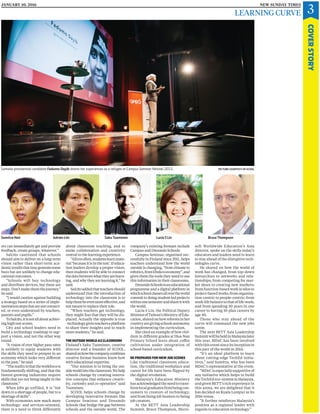
Somalia presidential candidate Fadumo Dayib shares her experiences as a refugee at Campus Seminar Helsinki 2015. PICTURE COURTESY OF SCOOL

10LC003A1

  • 1.
    3 COVERSTORY JANUARY 10, 2016NEW SUNDAY TIMES LEARNING CURVE ers can immediately get and provide feedback, create groups, whatever.” Salcito cautioned that schools should aim to deliver on a long-term vision rather than short-term aca- demicresultsthatmaygeneratesome buzz but are unlikely to change edu- cational outcomes. “Schools will buy technology and distribute devices, but these are steps. Don’t make them the journey,” he said. “I would caution against building a strategy based on a series of imple- mentationstepsthatarenotconnect- ed, or even understood by teachers, parents and pupils.” ToSalcito,itisnotallaboutachiev- ing high test scores. City and school leaders need to build a technology roadmap to sup- port a vision, and not the other way round. “A vision of ever higher pass rates is unlikely to equip students with the skills they need to prosper in an economy which looks very different to the past,” he said. “Therealityisthattheworkforceis fundamentally shifting, and that the fastest-growing industries require skills that are not being taught in the classroom.” When jobs go unfilled, it is “not down to a shortage of people, but to a shortage of skills”. With economies now much more technology- and services-oriented, there is a need to think differently about classroom teaching, and to make collaboration and creativity central to the learning experience. “Alltoooften,studentslearnmate- rial ‘because it is in the test’. If educa- tion leaders develop a proper vision, then students will be able to connect thedotsbetweenwhattheyarelearn- ing, and why they are learning it,” he said. Salcitoaddedthatteachersshould understand that the introduction of technology into the classroom is to helpthembeevenmoreeffective,and not meant to replace their role. “When teachers get technology, they might fear that they will be dis- placed. Actually the opposite is true -technologygivesteachersaplatform to share their insights and to reach more students,” he said. THEOUTSIDEWORLDASCLASSROOM Finland’s Saku Tuominen, creative director and a founder of SCOOL, sharedonhowthecompanycombines creative format business know-how with educational expertise. “Our mission is to bring the out- sideworldintotheclassroom.Wehelp schools change by creating innova- tive concepts that enhance creativ- ity, curiosity and co-operation” said Tuominen. SCOOL helps schools change by developing innovative formats like Campus Seminar and Dreamdo Schools that bridge the gap between schools and the outside world. The company’s existing formats include Campus and Dreamdo Schools. Campus Seminar, organised suc- cessfully in Finland since 2011, helps teachers understand how the world outside is changing, “from climate to robotics,fromEbolatoeconomy”,and gives them the tools they need to use this information in their classrooms. DreamdoSchoolsisaneducational programme and a digital platform in whichschoolclassesallovertheworld commit to doing student-led projects withinonesemesterandshareitwith the world. Lucia S Lin, the Political Deputy MinisterofTaiwan’sMinistryofEdu- cation, shared on how reforms in her countryaregivingschoolsautonomy in implementing the curriculum. She cited an example of how chil- dren in different grades at Hua-Nan Primary School learn about coffee cultivation under integration of school-based curriculum. BE PREPARED FOR NEW JOB SCENES Like traditional classroom educa- tion, the traditional workplace and career for life have been flipped by the digital revolution. Malaysia’s Education Ministry hasacknowledgedtheneedtotrans- formlocalgraduatesfrombeingcon- sumers to creators of technology, and from being job hunters to being job creators. At the BETT Asia Leadership Summit, Bruce Thompson, Micro- soft Worldwide Education’s Asia director, spoke on the skills today’s educators and leaders need to learn to stay ahead of the disruptive tech- nologies curve. He shared on how the world of work has changed, from top-down hierarchies to networks and rela- tionships; from competing for mar- ket share to creating new markets; from function-based work in silos to project-based works; from organisa- tion-centric to people-centric; from work-lifebalancetothatoflife-work; and from spending 30 years in one career to having 10-plus careers by age 40. Those who stay ahead of the curve will command the new jobs scene. The next BETT Asia Leadership SummitwillbeheldinMalaysialater this year. MDeC has been involved with this event since its inception in this part of the world in 2014. “It’s an ideal platform to learn about cutting-edge TechEd initia- tives,” said Sumitra, who has been MDeC’s representative at the event. “MDeCisespeciallysupportiveof any initiative which helps to build the TechEd eco-system in Malaysia, and given BETT’s rich experience in this arena, we are delighted that it has decided on Kuala Lumpur as its 2016 venue. “It further reinforces Malaysia’s position as a regional leader with regards to education technology.” Sumitra Nair Adrian Lim Saku Tuominen Lucia S Lin Bruce Thompson Somalia presidential candidate Fadumo Dayib shares her experiences as a refugee at Campus Seminar Helsinki 2015. PICTURE COURTESY OF SCOOL