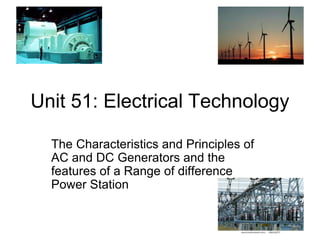
Unit 51: Electrical Technology
The Characteristics and Principles of
AC and DC Generators and the
features of a Range of difference
Power Station
Course Aims
• At the end of this course the learner will be
able to…
1. Know the methods used to produce electrical
energy
2. Know the properties and applications of conductors,
insulators and magnetic materials
3. Know the physical arrangements of supply,
transmission and distribution equipment
4. Know how electrical energy is used to support
applications of electrical technology
NDG TA
Agenda
• At the end of the session the learner will
be able to…
– Describe the principle of operation of
alternating current (AC) generators
NDG TA
Electromagnetic
Induction
• Electromagnetic induction describes the
phenomenon in which electricity is
produced in a conductor by a changing
magnetic field.
• It’s the relative movement of the magnetic
flux and the coil that causes an e.m.f. and
thus current to be induced in the coil. This
is electromagnetic induction
NDG TA
Electromagnetic
Induction
NDG TA
Electromagnetic
Induction
• (a) When the magnet is moved at constant
speed towards the coil, a deflection is noted on
the galvanometer showing that a current has
been produced in the coil
• (b) When the magnet is moved at the same
speed as in (a) but away from the coil, the same
deflection is noted but is in the opposite direction
• (c) When the magnet is held stationary, even
within the coil, no deflection is recorded
NDG TA
Electromagnetic
Induction
• (d) When the coil is moved at the same speed
as in (a) and the magnet held stationary the
same galvanometer deflection is noted.
• (e) When the relative speed is, say, doubled the
galvanometer deflection is doubled.
• (f) When a stronger magnet is used, a greater
galvanometer deflection is noted
• (g) When the number of turns of wire of the coil
is increased, a greater galvanometer deflection
is noted.
NDG TA
The Laws of
Electromagnetic Induction
• Faraday’s Laws of electromagnetic
induction state…
– An induced e.m.f. is set up whenever the
magnetic field linking that circuit changes
– The magnitude of the induced e.m.f. in any
circuit is proportional to the rate of change of
magnetic flux linking the circuit.
NDG TA
The Laws of
Electromagnetic Induction
• Lenz’s Law of electromagnetic induction
state…
– The direction of an induced e.m.f. is always
such that it tends to set up a current opposing
the motion or the change of flux responsible
for inducing that e.m.f..
• (An alternative method to Lenz’s Law of
determining relative directions is given by
Fleming’s Right-hand Rule – often called
the geneRator rule)
NDG TA
Fleming’s Right-Hand
Rule
• Let the thumb, first finger and second finger of the right hand be
extended such that they are all at right angles to each other.
• If the first finger points in the direction of the magnetic field and the
thumb points in the direction of motion of the conductor relative to
the magnetic field, then the second finger will point in the direction of
the induced e.m.f.
NDG TA
Electrical
Generators
• Generators used to produce electrical
power require some form of mechanical
energy.
• The mechanical energy is used to move
electrical conductors through the magnetic
field of the generator
NDG TA
Electrical
Generators
NDG TA
Electrical
Generators
NDG TA
• The turning of a coil in a magnetic field produces
motional emfs in both sides of the coil which
add. Since the component of the velocity
perpendicular to the magnetic field changes
sinusoidally with the rotation, the generated
voltage is sinusoidal or AC. This process can be
described in terms of Faraday's law when you
see that the rotation of the coil continually
changes the magnetic flux through the coil and
therefore generates a voltage.
A.C. Generation
NDG TA
• Ac Generator – YouTube
• The Three-Phase AC Generator

10419906.ppt

  • 1.
    Unit 51: ElectricalTechnology The Characteristics and Principles of AC and DC Generators and the features of a Range of difference Power Station
  • 2.
    Course Aims • Atthe end of this course the learner will be able to… 1. Know the methods used to produce electrical energy 2. Know the properties and applications of conductors, insulators and magnetic materials 3. Know the physical arrangements of supply, transmission and distribution equipment 4. Know how electrical energy is used to support applications of electrical technology NDG TA
  • 3.
    Agenda • At theend of the session the learner will be able to… – Describe the principle of operation of alternating current (AC) generators NDG TA
  • 4.
    Electromagnetic Induction • Electromagnetic inductiondescribes the phenomenon in which electricity is produced in a conductor by a changing magnetic field. • It’s the relative movement of the magnetic flux and the coil that causes an e.m.f. and thus current to be induced in the coil. This is electromagnetic induction NDG TA
  • 5.
  • 6.
    Electromagnetic Induction • (a) Whenthe magnet is moved at constant speed towards the coil, a deflection is noted on the galvanometer showing that a current has been produced in the coil • (b) When the magnet is moved at the same speed as in (a) but away from the coil, the same deflection is noted but is in the opposite direction • (c) When the magnet is held stationary, even within the coil, no deflection is recorded NDG TA
  • 7.
    Electromagnetic Induction • (d) Whenthe coil is moved at the same speed as in (a) and the magnet held stationary the same galvanometer deflection is noted. • (e) When the relative speed is, say, doubled the galvanometer deflection is doubled. • (f) When a stronger magnet is used, a greater galvanometer deflection is noted • (g) When the number of turns of wire of the coil is increased, a greater galvanometer deflection is noted. NDG TA
  • 8.
    The Laws of ElectromagneticInduction • Faraday’s Laws of electromagnetic induction state… – An induced e.m.f. is set up whenever the magnetic field linking that circuit changes – The magnitude of the induced e.m.f. in any circuit is proportional to the rate of change of magnetic flux linking the circuit. NDG TA
  • 9.
    The Laws of ElectromagneticInduction • Lenz’s Law of electromagnetic induction state… – The direction of an induced e.m.f. is always such that it tends to set up a current opposing the motion or the change of flux responsible for inducing that e.m.f.. • (An alternative method to Lenz’s Law of determining relative directions is given by Fleming’s Right-hand Rule – often called the geneRator rule) NDG TA
  • 10.
    Fleming’s Right-Hand Rule • Letthe thumb, first finger and second finger of the right hand be extended such that they are all at right angles to each other. • If the first finger points in the direction of the magnetic field and the thumb points in the direction of motion of the conductor relative to the magnetic field, then the second finger will point in the direction of the induced e.m.f. NDG TA
  • 11.
    Electrical Generators • Generators usedto produce electrical power require some form of mechanical energy. • The mechanical energy is used to move electrical conductors through the magnetic field of the generator NDG TA
  • 12.
  • 13.
    Electrical Generators NDG TA • Theturning of a coil in a magnetic field produces motional emfs in both sides of the coil which add. Since the component of the velocity perpendicular to the magnetic field changes sinusoidally with the rotation, the generated voltage is sinusoidal or AC. This process can be described in terms of Faraday's law when you see that the rotation of the coil continually changes the magnetic flux through the coil and therefore generates a voltage.
  • 14.
    A.C. Generation NDG TA •Ac Generator – YouTube • The Three-Phase AC Generator