COMMERCIAL AND
ISLAMIC BANKING
Presenting by: The Spectaculars
What is Bank ?
A Business that keeps and lends money
and provides other financial services,
Such as wealth.
"A Bank is a place
where they lend an umbrella in
fair weather and ask for it back
when it begins to rain"
-Robert Frost
THROWBACK
 As history follows it wasn`t name as bank in
that time.
 One view is that it is derived from an Italian
word ‘banque’ which means a ‘bench’.
 The other point of view is that it has originated
from the German word ‘banc’ which means a
‘joint stock firm’.
WHAT IS COMMECIAL BANK?
Commercial bank accepts deposits
from individuals, firms and companies at a lower
rate of interest and gives it at higher rate of
interest to those who need them.
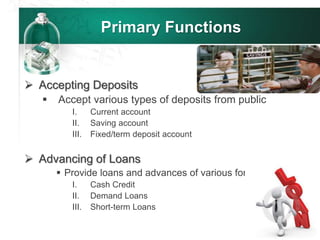
Primary Functions
 Accepting Deposits
 Accept various types of deposits from public
I. Current account
II. Saving account
III. Fixed/term deposit account
 Advancing of Loans
 Provide loans and advances of various forms
I. Cash Credit
II. Demand Loans
III. Short-term Loans
Secondary Functions
 Special financial services
I. Currency exchange
II. Letters of credit
III. Money transfer
 Agency functions
I. Collection of Checks
II. Collection of Dividends
III. Purchase or sale of Securities
IV. Acting as trustee or executors
ISLAMIC BANK
lets invest in our beliefs, enjoy a full
range of Shariah Compliant solutions
ISLAMIC BANKING
 Based on the principles of Islamic law
 Prohibition of the collection and payment of
interest by lenders and investors
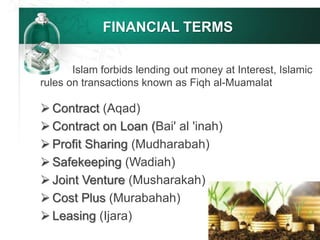
FINANCIAL TERMS
 Contract (Aqad)
 Contract on Loan (Bai' al 'inah)
 Profit Sharing (Mudharabah)
 Safekeeping (Wadiah)
 Joint Venture (Musharakah)
 Cost Plus (Murabahah)
 Leasing (Ijara)
Islam forbids lending out money at Interest, Islamic
rules on transactions known as Fiqh al-Muamalat
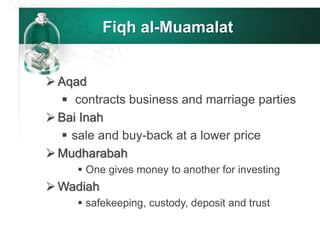
Fiqh al-Muamalat
 Aqad
 contracts business and marriage parties
 Bai Inah
 sale and buy-back at a lower price
 Mudharabah
 One gives money to another for investing
 Wadiah
 safekeeping, custody, deposit and trust
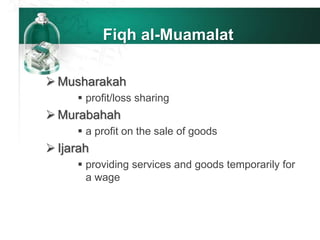
 Musharakah
 profit/loss sharing
 Murabahah
 a profit on the sale of goods
 Ijarah
 providing services and goods temporarily for
a wage
Fiqh al-Muamalat
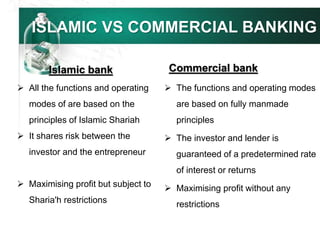
ISLAMIC VS COMMERCIAL BANKING
Islamic bank Commercial bank
 All the functions and operating
modes of are based on the
principles of Islamic Shariah
 It shares risk between the
investor and the entrepreneur
 Maximising profit but subject to
Sharia'h restrictions
 The functions and operating modes
are based on fully manmade
principles
 The investor and lender is
guaranteed of a predetermined rate
of interest or returns
 Maximising profit without any
restrictions
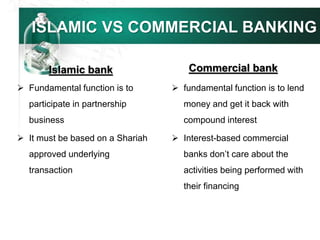
 Fundamental function is to
participate in partnership
business
 It must be based on a Shariah
approved underlying
transaction
 fundamental function is to lend
money and get it back with
compound interest
 Interest-based commercial
banks don’t care about the
activities being performed with
their financing
Islamic bank Commercial bank
ISLAMIC VS COMMERCIAL BANKING
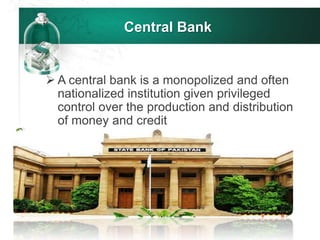
Central Bank
 A central bank is a monopolized and often
nationalized institution given privileged
control over the production and distribution
of money and credit
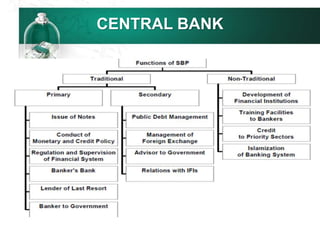
CENTRAL BANK
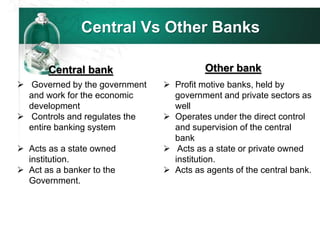
 Governed by the government
and work for the economic
development
 Controls and regulates the
entire banking system
 Acts as a state owned
institution.
 Act as a banker to the
Government.
 Profit motive banks, held by
government and private sectors as
well
 Operates under the direct control
and supervision of the central
bank
 Acts as a state or private owned
institution.
 Acts as agents of the central bank.
Central bank Other bank
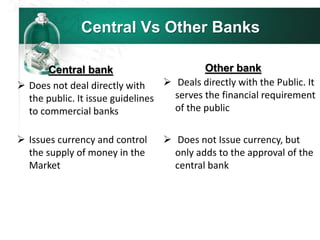
Central Vs Other Banks
 Does not deal directly with
the public. It issue guidelines
to commercial banks
 Deals directly with the Public. It
serves the financial requirement
of the public
 Issues currency and control
the supply of money in the
Market
 Does not Issue currency, but
only adds to the approval of the
central bank
Central bank Other bank
Central Vs Other Banks
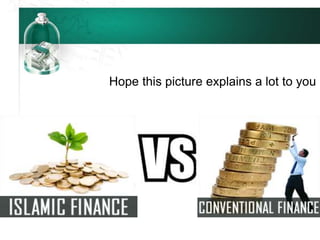
Hope this picture explains a lot to you
commercial and islamic banking

commercial and islamic banking

  • 1.
  • 2.
    What is Bank? A Business that keeps and lends money and provides other financial services, Such as wealth.
  • 3.
    "A Bank isa place where they lend an umbrella in fair weather and ask for it back when it begins to rain" -Robert Frost
  • 4.
    THROWBACK  As historyfollows it wasn`t name as bank in that time.  One view is that it is derived from an Italian word ‘banque’ which means a ‘bench’.  The other point of view is that it has originated from the German word ‘banc’ which means a ‘joint stock firm’.
  • 5.
    WHAT IS COMMECIALBANK? Commercial bank accepts deposits from individuals, firms and companies at a lower rate of interest and gives it at higher rate of interest to those who need them.
  • 6.
    Primary Functions  AcceptingDeposits  Accept various types of deposits from public I. Current account II. Saving account III. Fixed/term deposit account  Advancing of Loans  Provide loans and advances of various forms I. Cash Credit II. Demand Loans III. Short-term Loans
  • 7.
    Secondary Functions  Specialfinancial services I. Currency exchange II. Letters of credit III. Money transfer  Agency functions I. Collection of Checks II. Collection of Dividends III. Purchase or sale of Securities IV. Acting as trustee or executors
  • 8.
    ISLAMIC BANK lets investin our beliefs, enjoy a full range of Shariah Compliant solutions
  • 9.
    ISLAMIC BANKING  Basedon the principles of Islamic law  Prohibition of the collection and payment of interest by lenders and investors
  • 10.
    FINANCIAL TERMS  Contract(Aqad)  Contract on Loan (Bai' al 'inah)  Profit Sharing (Mudharabah)  Safekeeping (Wadiah)  Joint Venture (Musharakah)  Cost Plus (Murabahah)  Leasing (Ijara) Islam forbids lending out money at Interest, Islamic rules on transactions known as Fiqh al-Muamalat
  • 11.
    Fiqh al-Muamalat  Aqad contracts business and marriage parties  Bai Inah  sale and buy-back at a lower price  Mudharabah  One gives money to another for investing  Wadiah  safekeeping, custody, deposit and trust
  • 12.
     Musharakah  profit/losssharing  Murabahah  a profit on the sale of goods  Ijarah  providing services and goods temporarily for a wage Fiqh al-Muamalat
  • 13.
    ISLAMIC VS COMMERCIALBANKING Islamic bank Commercial bank  All the functions and operating modes of are based on the principles of Islamic Shariah  It shares risk between the investor and the entrepreneur  Maximising profit but subject to Sharia'h restrictions  The functions and operating modes are based on fully manmade principles  The investor and lender is guaranteed of a predetermined rate of interest or returns  Maximising profit without any restrictions
  • 14.
     Fundamental functionis to participate in partnership business  It must be based on a Shariah approved underlying transaction  fundamental function is to lend money and get it back with compound interest  Interest-based commercial banks don’t care about the activities being performed with their financing Islamic bank Commercial bank ISLAMIC VS COMMERCIAL BANKING
  • 15.
    Central Bank  Acentral bank is a monopolized and often nationalized institution given privileged control over the production and distribution of money and credit
  • 16.
  • 17.
     Governed bythe government and work for the economic development  Controls and regulates the entire banking system  Acts as a state owned institution.  Act as a banker to the Government.  Profit motive banks, held by government and private sectors as well  Operates under the direct control and supervision of the central bank  Acts as a state or private owned institution.  Acts as agents of the central bank. Central bank Other bank Central Vs Other Banks
  • 18.
     Does notdeal directly with the public. It issue guidelines to commercial banks  Deals directly with the Public. It serves the financial requirement of the public  Issues currency and control the supply of money in the Market  Does not Issue currency, but only adds to the approval of the central bank Central bank Other bank Central Vs Other Banks
  • 19.
    Hope this pictureexplains a lot to you