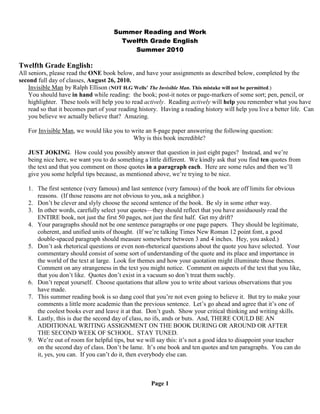
Summer Reading and Work
                                        Twelfth Grade English
                                           Summer 2010

Twelfth Grade English:
All seniors, please read the ONE book below, and have your assignments as described below, completed by the
second full day of classes, August 26, 2010.
    Invisible Man by Ralph Ellison (NOT H.G Wells’ The Invisible Man. This mistake will not be permitted.)
    You should have in hand while reading: the book; post-it notes or page-markers of some sort; pen, pencil, or
    highlighter. These tools will help you to read actively. Reading actively will help you remember what you have
    read so that it becomes part of your reading history. Having a reading history will help you live a better life. Can
    you believe we actually believe that? Amazing.

   For Invisible Man, we would like you to write an 8-page paper answering the following question:
                                           Why is this book incredible?

   JUST JOKING. How could you possibly answer that question in just eight pages? Instead, and we’re
   being nice here, we want you to do something a little different. We kindly ask that you find ten quotes from
   the text and that you comment on those quotes in a paragraph each. Here are some rules and then we’ll
   give you some helpful tips because, as mentioned above, we’re trying to be nice.

   1. The first sentence (very famous) and last sentence (very famous) of the book are off limits for obvious
      reasons. (If those reasons are not obvious to you, ask a neighbor.)
   2. Don’t be clever and slyly choose the second sentence of the book. Be sly in some other way.
   3. In other words, carefully select your quotes—they should reflect that you have assiduously read the
      ENTIRE book, not just the first 50 pages, not just the first half. Get my drift?
   4. Your paragraphs should not be one sentence paragraphs or one page papers. They should be legitimate,
      coherent, and unified units of thought. (If we’re talking Times New Roman 12 point font, a good
      double-spaced paragraph should measure somewhere between 3 and 4 inches. Hey, you asked.)
   5. Don’t ask rhetorical questions or even non-rhetorical questions about the quote you have selected. Your
      commentary should consist of some sort of understanding of the quote and its place and importance in
      the world of the text at large. Look for themes and how your quotation might illuminate those themes.
      Comment on any strangeness in the text you might notice. Comment on aspects of the text that you like,
      that you don’t like. Quotes don’t exist in a vacuum so don’t treat them suchly.
   6. Don’t repeat yourself. Choose quotations that allow you to write about various observations that you
      have made.
   7. This summer reading book is so dang cool that you’re not even going to believe it. But try to make your
      comments a little more academic than the previous sentence. Let’s go ahead and agree that it’s one of
      the coolest books ever and leave it at that. Don’t gush. Show your critical thinking and writing skills.
   8. Lastly, this is due the second day of class, no ifs, ands or buts. And, THERE COULD BE AN
      ADDITIONAL WRITING ASSIGNMENT ON THE BOOK DURING OR AROUND OR AFTER
      THE SECOND WEEK OF SCHOOL. STAY TUNED.
   9. We’re out of room for helpful tips, but we will say this: it’s not a good idea to disappoint your teacher
      on the second day of class. Don’t be lame. It’s one book and ten quotes and ten paragraphs. You can do
      it, yes, you can. If you can’t do it, then everybody else can.


                                                     Page 1
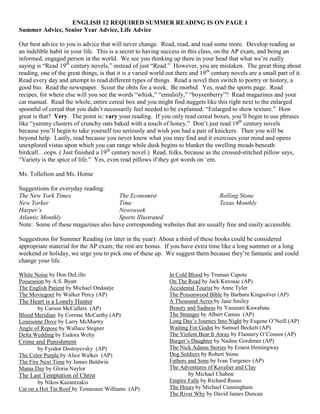
ENGLISH 12 REQUIRED SUMMER READING IS ON PAGE 1
Summer Advice, Senior Year Advice, Life Advice

Our best advice to you is advice that will never change. Read, read, and read some more. Develop reading as
an indelible habit in your life. This is a secret to having success in this class, on the AP exam, and being an
informed, engaged person in the world. We see you thinking up there in your head that what we’re really
saying is “Read 19th century novels,” instead of just “Read.” However, you are mistaken. The great thing about
reading, one of the great things, is that it is a varied world out there and 19th century novels are a small part of it.
Read every day and attempt to read different types of things. Read a novel then switch to poetry or history, a
good bio. Read the newspaper. Scout the obits for a week. Be morbid. Yes, read the sports page. Read
recipes, for where else will you see the words “whisk,” “emulsify,” “boysenberry”? Read magazines and your
car manual. Read the whole, entire cereal box and you might find nuggets like this right next to the enlarged
spoonful of cereal that you didn’t necessarily feel needed to be explained: “Enlarged to show texture.” How
great is that? Very. The point is: vary your reading. If you only read cereal boxes, you’ll begin to use phrases
like “yummy clusters of crunchy oats baked with a touch of honey.” Don’t just read 19th century novels
because you’ll begin to take yourself too seriously and wish you had a pair of knickers. Then you will be
beyond help. Lastly, read because you never know what you may find and it exercises your mind and opens
unexplored vistas upon which you can range while dusk begins to blanket the swelling meads beneath
birdcall…oops. ( Just finished a 19th century novel.) Read, folks, because as the crossed-stitched pillow says,
“Variety is the spice of life.” Yes, even read pillows if they got words on ‘em.

Ms. Tollefson and Ms. Horne

Suggestions for everyday reading:
The New York Times                   The Economist                           Rolling Stone
New Yorker                           Time                                    Texas Monthly
Harper’s                             Newsweek
Atlantic Monthly                     Sports Illustrated
Note: Some of these magazines also have corresponding websites that are usually free and easily accessible.

Suggestions for Summer Reading (or later in the year): About a third of these books could be considered
appropriate material for the AP exam; the rest are bonus. If you have extra time like a long summer or a long
weekend or holiday, we urge you to pick one of these up. We suggest them because they’re fantastic and could
change your life.

White Noise by Don DeLillo                                      In Cold Blood by Truman Capote
Possession by A.S. Byatt                                        On The Road by Jack Kerouac (AP)
The English Patient by Michael Ondaatje                         Accidental Tourist by Anne Tyler
The Moviegoer by Walker Percy (AP)                              The Poisonwood Bible by Barbara Kingsolver (AP)
The Heart is a Lonely Hunter                                    A Thousand Acres by Jane Smiley
       by Carson McCullers (AP)                                 Beauty and Sadness by Yasunari Kawabata
Blood Meridian by Cormac McCarthy (AP)                          The Stranger by Albert Camus (AP)
Lonesome Dove by Larry McMurtry                                 Long Day’s Journey Into Night by Eugene O’Neill (AP)
Angle of Repose by Wallace Stegner                              Waiting For Godot by Samuel Beckett (AP)
Delta Wedding by Eudora Welty                                   The Violent Bear It Away by Flannery O’Connor (AP)
Crime and Punishment                                            Burger’s Daughter by Nadine Gordimer (AP)
        by Fyodor Dostoyevsky (AP)                              The Nick Adams Stories by Ernest Hemingway
The Color Purple by Alice Walker (AP)                           Dog Soldiers by Robert Stone
The Fire Next Time by James Baldwin                             Fathers and Sons by Ivan Turgenev (AP)
Mama Day by Gloria Naylor                                       The Adventures of Kavalier and Clay
The Last Temptation of Christ                                           by Michael Chabon
        by Nikos Kazantzakis                                    Empire Falls by Richard Russo
Cat on a Hot Tin Roof by Tennessee Williams (AP)                The Hours by Michael Cunningham
                                                                The River Why by David James Duncan

10 summer rdg eng 12

  • 1.
    Summer Reading andWork Twelfth Grade English Summer 2010 Twelfth Grade English: All seniors, please read the ONE book below, and have your assignments as described below, completed by the second full day of classes, August 26, 2010. Invisible Man by Ralph Ellison (NOT H.G Wells’ The Invisible Man. This mistake will not be permitted.) You should have in hand while reading: the book; post-it notes or page-markers of some sort; pen, pencil, or highlighter. These tools will help you to read actively. Reading actively will help you remember what you have read so that it becomes part of your reading history. Having a reading history will help you live a better life. Can you believe we actually believe that? Amazing. For Invisible Man, we would like you to write an 8-page paper answering the following question: Why is this book incredible? JUST JOKING. How could you possibly answer that question in just eight pages? Instead, and we’re being nice here, we want you to do something a little different. We kindly ask that you find ten quotes from the text and that you comment on those quotes in a paragraph each. Here are some rules and then we’ll give you some helpful tips because, as mentioned above, we’re trying to be nice. 1. The first sentence (very famous) and last sentence (very famous) of the book are off limits for obvious reasons. (If those reasons are not obvious to you, ask a neighbor.) 2. Don’t be clever and slyly choose the second sentence of the book. Be sly in some other way. 3. In other words, carefully select your quotes—they should reflect that you have assiduously read the ENTIRE book, not just the first 50 pages, not just the first half. Get my drift? 4. Your paragraphs should not be one sentence paragraphs or one page papers. They should be legitimate, coherent, and unified units of thought. (If we’re talking Times New Roman 12 point font, a good double-spaced paragraph should measure somewhere between 3 and 4 inches. Hey, you asked.) 5. Don’t ask rhetorical questions or even non-rhetorical questions about the quote you have selected. Your commentary should consist of some sort of understanding of the quote and its place and importance in the world of the text at large. Look for themes and how your quotation might illuminate those themes. Comment on any strangeness in the text you might notice. Comment on aspects of the text that you like, that you don’t like. Quotes don’t exist in a vacuum so don’t treat them suchly. 6. Don’t repeat yourself. Choose quotations that allow you to write about various observations that you have made. 7. This summer reading book is so dang cool that you’re not even going to believe it. But try to make your comments a little more academic than the previous sentence. Let’s go ahead and agree that it’s one of the coolest books ever and leave it at that. Don’t gush. Show your critical thinking and writing skills. 8. Lastly, this is due the second day of class, no ifs, ands or buts. And, THERE COULD BE AN ADDITIONAL WRITING ASSIGNMENT ON THE BOOK DURING OR AROUND OR AFTER THE SECOND WEEK OF SCHOOL. STAY TUNED. 9. We’re out of room for helpful tips, but we will say this: it’s not a good idea to disappoint your teacher on the second day of class. Don’t be lame. It’s one book and ten quotes and ten paragraphs. You can do it, yes, you can. If you can’t do it, then everybody else can. Page 1
  • 2.
    ENGLISH 12 REQUIREDSUMMER READING IS ON PAGE 1 Summer Advice, Senior Year Advice, Life Advice Our best advice to you is advice that will never change. Read, read, and read some more. Develop reading as an indelible habit in your life. This is a secret to having success in this class, on the AP exam, and being an informed, engaged person in the world. We see you thinking up there in your head that what we’re really saying is “Read 19th century novels,” instead of just “Read.” However, you are mistaken. The great thing about reading, one of the great things, is that it is a varied world out there and 19th century novels are a small part of it. Read every day and attempt to read different types of things. Read a novel then switch to poetry or history, a good bio. Read the newspaper. Scout the obits for a week. Be morbid. Yes, read the sports page. Read recipes, for where else will you see the words “whisk,” “emulsify,” “boysenberry”? Read magazines and your car manual. Read the whole, entire cereal box and you might find nuggets like this right next to the enlarged spoonful of cereal that you didn’t necessarily feel needed to be explained: “Enlarged to show texture.” How great is that? Very. The point is: vary your reading. If you only read cereal boxes, you’ll begin to use phrases like “yummy clusters of crunchy oats baked with a touch of honey.” Don’t just read 19th century novels because you’ll begin to take yourself too seriously and wish you had a pair of knickers. Then you will be beyond help. Lastly, read because you never know what you may find and it exercises your mind and opens unexplored vistas upon which you can range while dusk begins to blanket the swelling meads beneath birdcall…oops. ( Just finished a 19th century novel.) Read, folks, because as the crossed-stitched pillow says, “Variety is the spice of life.” Yes, even read pillows if they got words on ‘em. Ms. Tollefson and Ms. Horne Suggestions for everyday reading: The New York Times The Economist Rolling Stone New Yorker Time Texas Monthly Harper’s Newsweek Atlantic Monthly Sports Illustrated Note: Some of these magazines also have corresponding websites that are usually free and easily accessible. Suggestions for Summer Reading (or later in the year): About a third of these books could be considered appropriate material for the AP exam; the rest are bonus. If you have extra time like a long summer or a long weekend or holiday, we urge you to pick one of these up. We suggest them because they’re fantastic and could change your life. White Noise by Don DeLillo In Cold Blood by Truman Capote Possession by A.S. Byatt On The Road by Jack Kerouac (AP) The English Patient by Michael Ondaatje Accidental Tourist by Anne Tyler The Moviegoer by Walker Percy (AP) The Poisonwood Bible by Barbara Kingsolver (AP) The Heart is a Lonely Hunter A Thousand Acres by Jane Smiley by Carson McCullers (AP) Beauty and Sadness by Yasunari Kawabata Blood Meridian by Cormac McCarthy (AP) The Stranger by Albert Camus (AP) Lonesome Dove by Larry McMurtry Long Day’s Journey Into Night by Eugene O’Neill (AP) Angle of Repose by Wallace Stegner Waiting For Godot by Samuel Beckett (AP) Delta Wedding by Eudora Welty The Violent Bear It Away by Flannery O’Connor (AP) Crime and Punishment Burger’s Daughter by Nadine Gordimer (AP) by Fyodor Dostoyevsky (AP) The Nick Adams Stories by Ernest Hemingway The Color Purple by Alice Walker (AP) Dog Soldiers by Robert Stone The Fire Next Time by James Baldwin Fathers and Sons by Ivan Turgenev (AP) Mama Day by Gloria Naylor The Adventures of Kavalier and Clay The Last Temptation of Christ by Michael Chabon by Nikos Kazantzakis Empire Falls by Richard Russo Cat on a Hot Tin Roof by Tennessee Williams (AP) The Hours by Michael Cunningham The River Why by David James Duncan