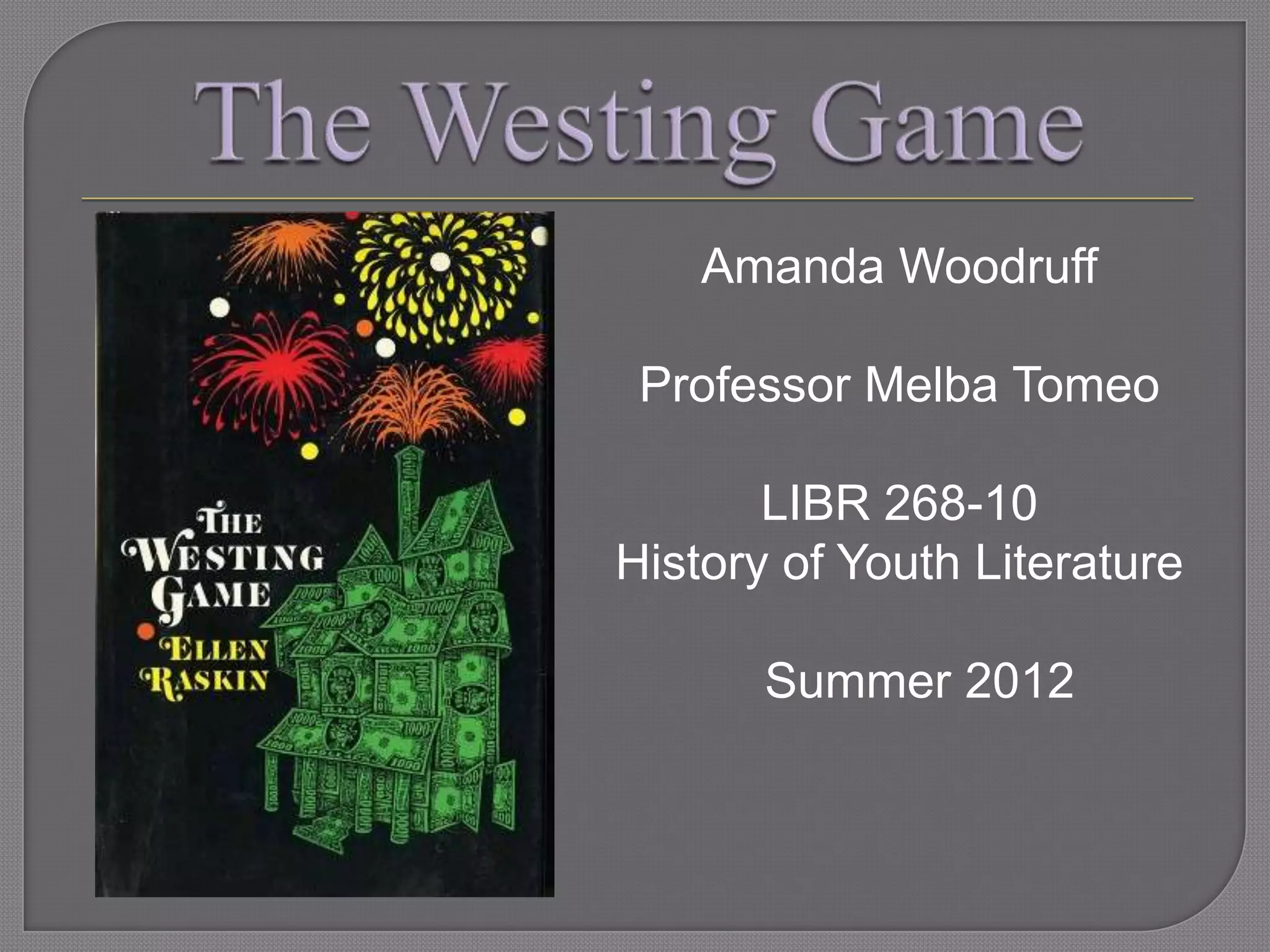
Amanda Woodruff

 Professor Melba Tomeo

       LIBR 268-10
History of Youth Literature

       Summer 2012
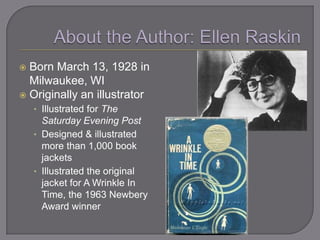
 Born March 13, 1928 in
  Milwaukee, WI
 Originally an illustrator
    • Illustrated for The
      Saturday Evening Post
    • Designed & illustrated
      more than 1,000 book
      jackets
    • Illustrated the original
      jacket for A Wrinkle In
      Time, the 1963 Newbery
      Award winner
   Wrote her first picture book, Nothing Ever Happens on My
    Block, in 1966
   A recurring theme in her books is that things are not always
    what they seem
    • Demonstrated through clever word play and characters who often
      change physical appearance/image/role
   Her editor, Ann Durell, said in her 2004 foreword to The
    Westing Game, ―…I never even tried to edit her ‗for
    children.‘ She was too wise, too funny, too ingenious–and
    therefore unique–to tamper with in that way. She said that
    she wrote for the child in herself, but for once I think she
    was wrong. I think she wrote for the adult in children. She
    never disrespected them or ‗wrote down,‘ because she
    didn‘t know how.‖
   Said that growing up during the Depression is what made her a
    humorist.
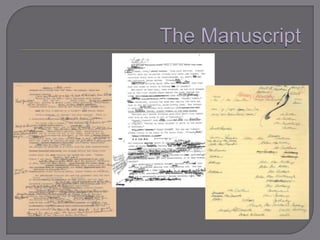
   Donated The Westing Game manuscript to the Cooperative
    Children‘s Book (CCBC) at the University of Wisconsin, Madison
     • Had to ―convince‖ them three times before they accepted amid
       the university‘s fears that they could not preserve the papers
       properly
   Wanted students to understand what writing and revising a book
    was really like
   Didn‘t mind if her original works fell apart as long as it meant the
    students were using them
   Manuscripts (and audio of Raskin describing the writing process)
    are now online at the CCBC
   Died August 8, 1984, at age 56
 More   than 30 awards & honors for her books
  and illustrations
 New York Times, Best Illustrated Children‘s
  Books 1966, 1968
 ALA Notable Children‘s Book, 1968, 1969,
  1971 through 1978
 Library of Congress Children‘s Book, 1969,
  ‗71, ‗74, ‗78
 Figgs and Phantoms named Newbery Honor
  book in 1975
 Sadly, she never won a Caldecott for her first
  love, illustrating
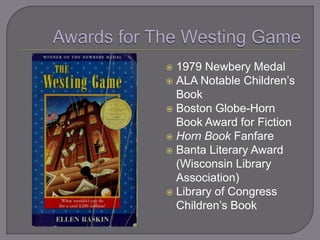
 1979 Newbery Medal
 ALA Notable Children‘s
  Book
 Boston Globe-Horn
  Book Award for Fiction
 Horn Book Fanfare
 Banta Literary Award
  (Wisconsin Library
  Association)
 Library of Congress
  Children‘s Book
 The  Westing Game is an excellent book,
  but it also came out at the right time.
 Few other stand-outs in 1978
  • A Swiftly Tilting Planet by Madeline L‘Engle
  • The Great Gilly Hopkins by Katherine Paterson,
    the only Newbery Honor book of 1979
  • And two that were popular, but probably too YA to
    be considered for children‘s book:
    The Basketball Diaries by Jim Carroll
    Killing Mr. Griffin by Lois Duncan
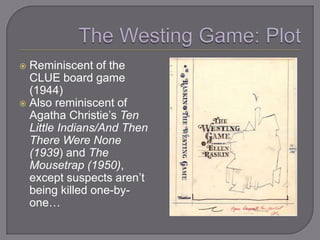
 Reminiscent of the
  CLUE board game
  (1944)
 Also reminiscent of
  Agatha Christie‘s Ten
  Little Indians/And Then
  There Were None
  (1939) and The
  Mousetrap (1950),
  except suspects aren‘t
  being killed one-by-
  one…
   "I sat down at the typewriter with no wish of an idea, just the urge
    to write another children's book.... It is 1976, the Bicentennial
    year. My story will have a historical background; its locale, the
    place I know best: Milwaukee.... Recalling that Amy Kellman's
    daughter asked for a puzzle-mystery, I decide that the format of
    my historical treatise will be a puzzle-mystery (whatever that is). I
    type out the words of `America the Beautiful' and cut them apart.
    Meanwhile on television ... come reports of the death of an
    infamous millionaire. Anyone who can spell Howard Hughes is
    forging a will.... Now I have Lake Michigan, a jumbled `America
    the Beautiful,' the first draft of a very strange will, and a dead
    millionaire--a fine beginning for a puzzle-mystery.
     • --Ellen Raskin, Horn Book 1979
   On a dare, Turtle Wexler sneaks into the spooky Westing
    mansion only to find the body of Samuel W. Westing
   At the funeral, Westing‘s executor reads the will and names
    sixteen heirs who will share $200 million dollars if they can
    figure out which one of them is Westing‘s murderer
   The heirs are divided into teams of two and are each given
    $10,000 and a set clues to assist them
   The clues seem to be random words at first but are, in fact,
    pieces from the lyrics to ―America the Beautiful‖
   Westing‘s comment on the clues, ―It is not what you have,
    it‘s what you don‘t have that counts.‖ (The missing letters
    spell the answer…)
   Turtle Wexler—a clever 13-year-old girl with an affinity for
    kicking the shins of anyone who touches her braids
   Grace Windsor Wexler—a haughty woman, Turtle‘s mother
    & claimed niece to Sam Westing
   Angela Wexler—Turtle‘s dutiful older sister, miserably
    engaged to Dr. Denton Deere
   Jake Wexler—podiatrist, husband to Grace, father of
    Anglea and Turtle
   Dr. Denton Deere—arrogant medical student
   Sandy McSouthers—kindly doorman at Sunset Towers
    where most of the heirs live
   James Shin Hoo—owner of Shin-Hoo‘s Chinese restaurant
    on the 5th floor of Sunset Towers
   Doug Hoo—18-year-old track star, son to James
   Madame Hoo—wife of James, step-mother to Doug.
    Speaks little English.
   Otis Amber—61-year-old delivery boy, seemingly dimwitted
   Berthe Crow—cleaning lady at Sunset Towers (later
    revealed to be first wife of Sam Westing)
   Flora Baumbach—Seamstress that befriends Turtle, almost
    as a mother figure
   Judge J.J. Ford—African-American female judge, Westing
    paid for her education
   Chris Theodorakis—15-year-old wheelchair-bound boy. His
    speech impediment belies his observant nature and quick
    wit. Enjoys bird (and people) watching.
   Theo Theodorakis—older brother to Chris, friend to Doug.
    Works in family café on first floor of Sunset Towers and
    enjoys chess.
   Sydelle Pulaski—out-of-work secretary, feigns injuries for
    attention
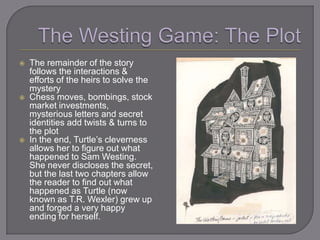
   The remainder of the story
    follows the interactions &
    efforts of the heirs to solve the
    mystery
   Chess moves, bombings, stock
    market investments,
    mysterious letters and secret
    identities add twists & turns to
    the plot
   In the end, Turtle‘s cleverness
    allows her to figure out what
    happened to Sam Westing.
    She never discloses the secret,
    but the last two chapters allow
    the reader to find out what
    happened as Turtle (now
    known as T.R. Wexler) grew up
    and forged a very happy
    ending for herself.
 Easily fits into both categories.
 Significance—received many awards, including
  Newbery, which are presented to new books not ones
  which readers are feeling sentimental about (at least
  not yet). Even though the book is reminiscent of other
  complex mysteries for adults, nothing like this had
  been directed at children before. Raskin gives kids
  credit that they can solve such a mystery. Still taught in
  schools today.
 Sentiment—this was a first (and complex!) mystery for
  many readers. Being given the tools and confidence
  that they, like Turtle, could solve such a mystery was
  empowering and special.
   Made into a 1997 movie titled, Get a Clue! (lukewarm reviews)
   In 2007, Dutton publishing acquired The Westing Quest
    sequel from the Raskin estate though, sadly, nothing yet
    has come from it
   Many student project book trailers can be found on
    YouTube
   Found a neat, interactive website about the book made in
    2001 by a 4th grade class from Plainfield, IL.
    http://library.thinkquest.org/CR0214945/about_us/about_ma
    in.html
   Interesting blog post about how one person felt The
    Westing Game, with its changing characters and group of
    misfits coming together in acceptance, was an important
    and hopeful book for him as a gay man.
    http://thenewgay.net/2009/03/read-me-westing-game-by-
    ellen-raskin.html
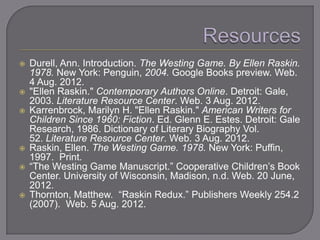
   Durell, Ann. Introduction. The Westing Game. By Ellen Raskin.
    1978. New York: Penguin, 2004. Google Books preview. Web.
    4 Aug. 2012.
   "Ellen Raskin." Contemporary Authors Online. Detroit: Gale,
    2003. Literature Resource Center. Web. 3 Aug. 2012.
   Karrenbrock, Marilyn H. "Ellen Raskin." American Writers for
    Children Since 1960: Fiction. Ed. Glenn E. Estes. Detroit: Gale
    Research, 1986. Dictionary of Literary Biography Vol.
    52. Literature Resource Center. Web. 3 Aug. 2012.
   Raskin, Ellen. The Westing Game. 1978. New York: Puffin,
    1997. Print.
   ―The Westing Game Manuscript.‖ Cooperative Children‘s Book
    Center. University of Wisconsin, Madison, n.d. Web. 20 June,
    2012.
   Thornton, Matthew. ―Raskin Redux.‖ Publishers Weekly 254.2
    (2007). Web. 5 Aug. 2012.

The Westing Game

  • 1.
    Amanda Woodruff ProfessorMelba Tomeo LIBR 268-10 History of Youth Literature Summer 2012
  • 2.
     Born March13, 1928 in Milwaukee, WI  Originally an illustrator • Illustrated for The Saturday Evening Post • Designed & illustrated more than 1,000 book jackets • Illustrated the original jacket for A Wrinkle In Time, the 1963 Newbery Award winner
  • 3.
    Wrote her first picture book, Nothing Ever Happens on My Block, in 1966  A recurring theme in her books is that things are not always what they seem • Demonstrated through clever word play and characters who often change physical appearance/image/role  Her editor, Ann Durell, said in her 2004 foreword to The Westing Game, ―…I never even tried to edit her ‗for children.‘ She was too wise, too funny, too ingenious–and therefore unique–to tamper with in that way. She said that she wrote for the child in herself, but for once I think she was wrong. I think she wrote for the adult in children. She never disrespected them or ‗wrote down,‘ because she didn‘t know how.‖
  • 4.
    Said that growing up during the Depression is what made her a humorist.  Donated The Westing Game manuscript to the Cooperative Children‘s Book (CCBC) at the University of Wisconsin, Madison • Had to ―convince‖ them three times before they accepted amid the university‘s fears that they could not preserve the papers properly  Wanted students to understand what writing and revising a book was really like  Didn‘t mind if her original works fell apart as long as it meant the students were using them  Manuscripts (and audio of Raskin describing the writing process) are now online at the CCBC  Died August 8, 1984, at age 56
  • 6.
     More than 30 awards & honors for her books and illustrations  New York Times, Best Illustrated Children‘s Books 1966, 1968  ALA Notable Children‘s Book, 1968, 1969, 1971 through 1978  Library of Congress Children‘s Book, 1969, ‗71, ‗74, ‗78  Figgs and Phantoms named Newbery Honor book in 1975  Sadly, she never won a Caldecott for her first love, illustrating
  • 7.
     1979 NewberyMedal  ALA Notable Children‘s Book  Boston Globe-Horn Book Award for Fiction  Horn Book Fanfare  Banta Literary Award (Wisconsin Library Association)  Library of Congress Children‘s Book
  • 8.
     The Westing Game is an excellent book, but it also came out at the right time.  Few other stand-outs in 1978 • A Swiftly Tilting Planet by Madeline L‘Engle • The Great Gilly Hopkins by Katherine Paterson, the only Newbery Honor book of 1979 • And two that were popular, but probably too YA to be considered for children‘s book:  The Basketball Diaries by Jim Carroll  Killing Mr. Griffin by Lois Duncan
  • 9.
     Reminiscent ofthe CLUE board game (1944)  Also reminiscent of Agatha Christie‘s Ten Little Indians/And Then There Were None (1939) and The Mousetrap (1950), except suspects aren‘t being killed one-by- one…
  • 10.
    "I sat down at the typewriter with no wish of an idea, just the urge to write another children's book.... It is 1976, the Bicentennial year. My story will have a historical background; its locale, the place I know best: Milwaukee.... Recalling that Amy Kellman's daughter asked for a puzzle-mystery, I decide that the format of my historical treatise will be a puzzle-mystery (whatever that is). I type out the words of `America the Beautiful' and cut them apart. Meanwhile on television ... come reports of the death of an infamous millionaire. Anyone who can spell Howard Hughes is forging a will.... Now I have Lake Michigan, a jumbled `America the Beautiful,' the first draft of a very strange will, and a dead millionaire--a fine beginning for a puzzle-mystery. • --Ellen Raskin, Horn Book 1979
  • 11.
    On a dare, Turtle Wexler sneaks into the spooky Westing mansion only to find the body of Samuel W. Westing  At the funeral, Westing‘s executor reads the will and names sixteen heirs who will share $200 million dollars if they can figure out which one of them is Westing‘s murderer  The heirs are divided into teams of two and are each given $10,000 and a set clues to assist them  The clues seem to be random words at first but are, in fact, pieces from the lyrics to ―America the Beautiful‖  Westing‘s comment on the clues, ―It is not what you have, it‘s what you don‘t have that counts.‖ (The missing letters spell the answer…)
  • 12.
    Turtle Wexler—a clever 13-year-old girl with an affinity for kicking the shins of anyone who touches her braids  Grace Windsor Wexler—a haughty woman, Turtle‘s mother & claimed niece to Sam Westing  Angela Wexler—Turtle‘s dutiful older sister, miserably engaged to Dr. Denton Deere  Jake Wexler—podiatrist, husband to Grace, father of Anglea and Turtle  Dr. Denton Deere—arrogant medical student  Sandy McSouthers—kindly doorman at Sunset Towers where most of the heirs live  James Shin Hoo—owner of Shin-Hoo‘s Chinese restaurant on the 5th floor of Sunset Towers  Doug Hoo—18-year-old track star, son to James  Madame Hoo—wife of James, step-mother to Doug. Speaks little English.
  • 13.
    Otis Amber—61-year-old delivery boy, seemingly dimwitted  Berthe Crow—cleaning lady at Sunset Towers (later revealed to be first wife of Sam Westing)  Flora Baumbach—Seamstress that befriends Turtle, almost as a mother figure  Judge J.J. Ford—African-American female judge, Westing paid for her education  Chris Theodorakis—15-year-old wheelchair-bound boy. His speech impediment belies his observant nature and quick wit. Enjoys bird (and people) watching.  Theo Theodorakis—older brother to Chris, friend to Doug. Works in family café on first floor of Sunset Towers and enjoys chess.  Sydelle Pulaski—out-of-work secretary, feigns injuries for attention
  • 14.
    The remainder of the story follows the interactions & efforts of the heirs to solve the mystery  Chess moves, bombings, stock market investments, mysterious letters and secret identities add twists & turns to the plot  In the end, Turtle‘s cleverness allows her to figure out what happened to Sam Westing. She never discloses the secret, but the last two chapters allow the reader to find out what happened as Turtle (now known as T.R. Wexler) grew up and forged a very happy ending for herself.
  • 15.
     Easily fitsinto both categories.  Significance—received many awards, including Newbery, which are presented to new books not ones which readers are feeling sentimental about (at least not yet). Even though the book is reminiscent of other complex mysteries for adults, nothing like this had been directed at children before. Raskin gives kids credit that they can solve such a mystery. Still taught in schools today.  Sentiment—this was a first (and complex!) mystery for many readers. Being given the tools and confidence that they, like Turtle, could solve such a mystery was empowering and special.
  • 16.
    Made into a 1997 movie titled, Get a Clue! (lukewarm reviews)  In 2007, Dutton publishing acquired The Westing Quest sequel from the Raskin estate though, sadly, nothing yet has come from it  Many student project book trailers can be found on YouTube  Found a neat, interactive website about the book made in 2001 by a 4th grade class from Plainfield, IL. http://library.thinkquest.org/CR0214945/about_us/about_ma in.html  Interesting blog post about how one person felt The Westing Game, with its changing characters and group of misfits coming together in acceptance, was an important and hopeful book for him as a gay man. http://thenewgay.net/2009/03/read-me-westing-game-by- ellen-raskin.html
  • 17.
    Durell, Ann. Introduction. The Westing Game. By Ellen Raskin. 1978. New York: Penguin, 2004. Google Books preview. Web. 4 Aug. 2012.  "Ellen Raskin." Contemporary Authors Online. Detroit: Gale, 2003. Literature Resource Center. Web. 3 Aug. 2012.  Karrenbrock, Marilyn H. "Ellen Raskin." American Writers for Children Since 1960: Fiction. Ed. Glenn E. Estes. Detroit: Gale Research, 1986. Dictionary of Literary Biography Vol. 52. Literature Resource Center. Web. 3 Aug. 2012.  Raskin, Ellen. The Westing Game. 1978. New York: Puffin, 1997. Print.  ―The Westing Game Manuscript.‖ Cooperative Children‘s Book Center. University of Wisconsin, Madison, n.d. Web. 20 June, 2012.  Thornton, Matthew. ―Raskin Redux.‖ Publishers Weekly 254.2 (2007). Web. 5 Aug. 2012.