Chickpea Pests and their management
Gram pod borer Beet army worm
Termite
s
Cutworm
Aphids
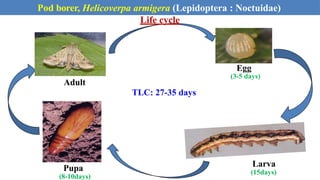
Life cycle
Egg
(3-5 days)
Larva
(15days)
Pupa
(8-10days)
Adult
TLC: 27-35 days
Pod borer, Helicoverpa armigera (Lepidoptera : Noctuidae)
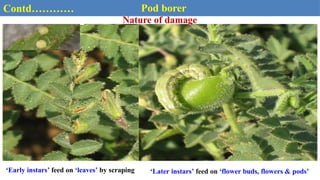
‘Later instars’ feed on ‘flower buds, flowers & pods’
Contd………… Pod borer
Nature of damage
‘Early instars’ feed on ‘leaves’ by scraping
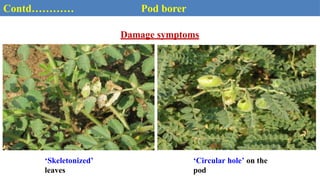
Damage symptoms
Contd………… Pod borer
‘Circular hole’ on the
pod
‘Skeletonized’
leaves
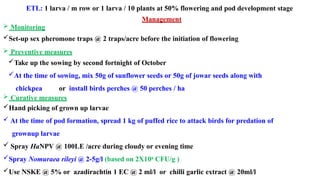
ETL: 1 larva / m row or 1 larva / 10 plants at 50% flowering and pod development stage
Management
 Monitoring
Set-up sex pheromone traps @ 2 traps/acre before the initiation of flowering
 Preventive measures
Take up the sowing by second fortnight of October
At the time of sowing, mix 50g of sunflower seeds or 50g of jowar seeds along with
chickpea or install birds perches @ 50 perches / ha
 Curative measures
Hand picking of grown up larvae
 At the time of pod formation, spread 1 kg of puffed rice to attack birds for predation of
grownup larvae
 Spray HaNPV @ 100LE /acre during cloudy or evening time
Spray Nomuraea rileyi @ 2-5g/l (based on 2X10⁸ CFU/g )
Use NSKE @ 5% or azadirachtin 1 EC @ 2 ml/l or chilli garlic extract @ 20ml/l
Contd……..
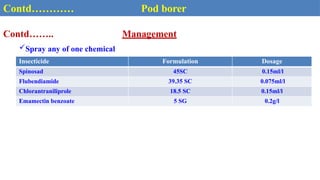
Spray any of one chemical
Management
Insecticide Formulation Dosage
Spinosad 45SC 0.15ml/l
Flubendiamide 39.35 SC 0.075ml/l
Chlorantraniliprole 18.5 SC 0.15ml/l
Emamectin benzoate 5 SG 0.2g/l
Contd………… Pod borer
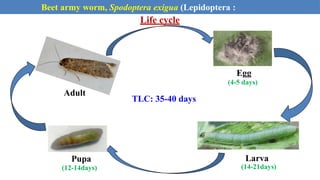
Adult
Life cycle
Egg
(4-5 days)
Larva
(14-21days)
Pupa
(12-14days)
TLC: 35-40 days
Beet army worm, Spodoptera exigua (Lepidoptera :
Noctuidae)
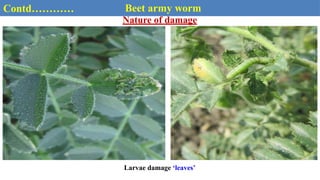
Contd………… Beet army worm
Nature of damage
Larvae damage ‘leaves’
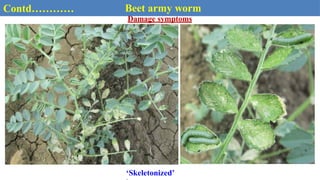
Contd………… Beet army worm
Damage symptoms
‘Skeletonized’
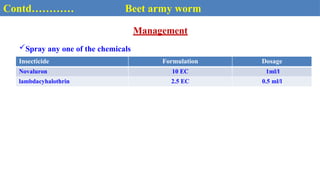
Management
Spray any one of the chemicals
Contd………… Beet army worm
Insecticide Formulation Dosage
Novaluron 10 EC 1ml/l
lambdacyhalothrin 2.5 EC 0.5 ml/l

10 Chickpea no change.pptx about chick pea

  • 1.
    Chickpea Pests andtheir management Gram pod borer Beet army worm Termite s Cutworm Aphids
  • 2.
    Life cycle Egg (3-5 days) Larva (15days) Pupa (8-10days) Adult TLC:27-35 days Pod borer, Helicoverpa armigera (Lepidoptera : Noctuidae)
  • 3.
    ‘Later instars’ feedon ‘flower buds, flowers & pods’ Contd………… Pod borer Nature of damage ‘Early instars’ feed on ‘leaves’ by scraping
  • 4.
    Damage symptoms Contd………… Podborer ‘Circular hole’ on the pod ‘Skeletonized’ leaves
  • 5.
    ETL: 1 larva/ m row or 1 larva / 10 plants at 50% flowering and pod development stage Management  Monitoring Set-up sex pheromone traps @ 2 traps/acre before the initiation of flowering  Preventive measures Take up the sowing by second fortnight of October At the time of sowing, mix 50g of sunflower seeds or 50g of jowar seeds along with chickpea or install birds perches @ 50 perches / ha  Curative measures Hand picking of grown up larvae  At the time of pod formation, spread 1 kg of puffed rice to attack birds for predation of grownup larvae  Spray HaNPV @ 100LE /acre during cloudy or evening time Spray Nomuraea rileyi @ 2-5g/l (based on 2X10⁸ CFU/g ) Use NSKE @ 5% or azadirachtin 1 EC @ 2 ml/l or chilli garlic extract @ 20ml/l
  • 6.
    Contd…….. Spray any ofone chemical Management Insecticide Formulation Dosage Spinosad 45SC 0.15ml/l Flubendiamide 39.35 SC 0.075ml/l Chlorantraniliprole 18.5 SC 0.15ml/l Emamectin benzoate 5 SG 0.2g/l Contd………… Pod borer
  • 7.
    Adult Life cycle Egg (4-5 days) Larva (14-21days) Pupa (12-14days) TLC:35-40 days Beet army worm, Spodoptera exigua (Lepidoptera : Noctuidae)
  • 8.
    Contd………… Beet armyworm Nature of damage Larvae damage ‘leaves’
  • 9.
    Contd………… Beet armyworm Damage symptoms ‘Skeletonized’
  • 10.
    Management Spray any oneof the chemicals Contd………… Beet army worm Insecticide Formulation Dosage Novaluron 10 EC 1ml/l lambdacyhalothrin 2.5 EC 0.5 ml/l