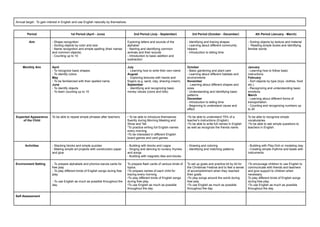
Annual target : To gain interest in English and use English naturally by themselves.
Period 1st Period (April - June) 2nd Period (July - September) 3rd Period (October - December) 4th Period (January - March)
Aim - Shape recognition
- Sorting objects by color and size
- Name recognition and simple spelling (their names
and common objects)
- Counting up to 10
Exploring letters and sounds of the
alphabet
- Naming and identifying common
animals and their sounds
- Introduction to basic addition and
subtraction
- Identifying and tracing shapes
- Learning about different community
helpers
- Introduction to telling time
- Sorting objects by texture and material
- Reading simple books and identifying
familiar words
Monthly Aim April
- To recognize basic shapes.
- To identify colors
May
- To be familiarized with their spelled name.
June
- To identify objects
- To learn counting up to 10
July
- Learning how to write their own name
August
- Exploring textures with hands and
fingers (e.g. sand, clay, shaving cream)
September
- Identifying and recognizing basic
money values (coins and bills)
October
- Basic gardening and plant care
- Learning about different habitats and
environments
November
- Learning about different shapes and
sizes
- Understanding and identifying basic
patterns
December
- Introduction to telling time
- Beginning to understand cause and
effect
January
- Learning how to follow basic
instructions
February
- Sort objects by type (toys, clothes, food
etc.)
- Recognizing and understanding basic
emotions
March
- Learning about different forms of
transportation
- Counting and recognizing numbers up
to 20
Expected Appearance
of the Child
To be able to repeat simple phrases after teachers. • To be able to introduce themselves
fluently during Morning Meeting and
Show and Tell.
*To practice writing full English names
every morning.
•To be interested in different English
board games and card games.
•To be able to understand 75% of a
teacher's instructions (English).
•To be able to write full names in English
as well as recognize the friends name.
To be able to recognize simple
vocabularies.
•To be able to ask simple questions to
teachers in English.
Activities - Stacking blocks and simple puzzles
- Making simple art projects with construction paper
and glue
- Building with blocks and Legos
- Singing and dancing to nursery rhymes
and songs
- Building with magnetic tiles and blocks
- Drawing and coloring
- Identifying and matching patterns
- Building with Play-Doh or modeling clay
- Creating simple rhythms and beats with
instruments
Environment Setting - To prepare alphabets and phonics karuta cards for
free play.
- To play different kinds of English songs during free
play.
- To use English as much as possible throughout the
day.
To prepare flash cards of various kinds of
topics.
•To prepare names of each child for
tracing every morning.
•To play different kinds of English songs
during free play.
•To use English as much as possible
throughout the day.
To set up goals and practice bit by bit for
the Christmas Festival and to feel a sense
of accomplishment when they reached
their goals.
•To play songs around the world during
free play.
•To use English as much as possible
throughout the day.
•To encourage children to use English to
communicate with friends and teachers
and give support to children when
necessary.
To play different kinds of English songs
during free play.
•To use English as much as possible
throughout the day.
Self Assessment

1 year Lesson Plan (1).pdf

  • 1.
    Annual target :To gain interest in English and use English naturally by themselves. Period 1st Period (April - June) 2nd Period (July - September) 3rd Period (October - December) 4th Period (January - March) Aim - Shape recognition - Sorting objects by color and size - Name recognition and simple spelling (their names and common objects) - Counting up to 10 Exploring letters and sounds of the alphabet - Naming and identifying common animals and their sounds - Introduction to basic addition and subtraction - Identifying and tracing shapes - Learning about different community helpers - Introduction to telling time - Sorting objects by texture and material - Reading simple books and identifying familiar words Monthly Aim April - To recognize basic shapes. - To identify colors May - To be familiarized with their spelled name. June - To identify objects - To learn counting up to 10 July - Learning how to write their own name August - Exploring textures with hands and fingers (e.g. sand, clay, shaving cream) September - Identifying and recognizing basic money values (coins and bills) October - Basic gardening and plant care - Learning about different habitats and environments November - Learning about different shapes and sizes - Understanding and identifying basic patterns December - Introduction to telling time - Beginning to understand cause and effect January - Learning how to follow basic instructions February - Sort objects by type (toys, clothes, food etc.) - Recognizing and understanding basic emotions March - Learning about different forms of transportation - Counting and recognizing numbers up to 20 Expected Appearance of the Child To be able to repeat simple phrases after teachers. • To be able to introduce themselves fluently during Morning Meeting and Show and Tell. *To practice writing full English names every morning. •To be interested in different English board games and card games. •To be able to understand 75% of a teacher's instructions (English). •To be able to write full names in English as well as recognize the friends name. To be able to recognize simple vocabularies. •To be able to ask simple questions to teachers in English. Activities - Stacking blocks and simple puzzles - Making simple art projects with construction paper and glue - Building with blocks and Legos - Singing and dancing to nursery rhymes and songs - Building with magnetic tiles and blocks - Drawing and coloring - Identifying and matching patterns - Building with Play-Doh or modeling clay - Creating simple rhythms and beats with instruments Environment Setting - To prepare alphabets and phonics karuta cards for free play. - To play different kinds of English songs during free play. - To use English as much as possible throughout the day. To prepare flash cards of various kinds of topics. •To prepare names of each child for tracing every morning. •To play different kinds of English songs during free play. •To use English as much as possible throughout the day. To set up goals and practice bit by bit for the Christmas Festival and to feel a sense of accomplishment when they reached their goals. •To play songs around the world during free play. •To use English as much as possible throughout the day. •To encourage children to use English to communicate with friends and teachers and give support to children when necessary. To play different kinds of English songs during free play. •To use English as much as possible throughout the day. Self Assessment