PEA-210–Lecture#
NUMBERS
Content
Content
 CLASSIFICATION OF NUMBERS
ii) Conversion of a decimal number to fraction
 POWER CYCLE/ UNIT DIGIT
 FACTORS AND MULTIPLES
i) Number of factors
ii) Sum of factors
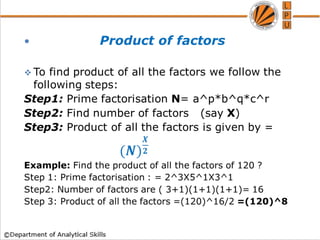
iii) Product of factors
How to find whether a no is Prime or not
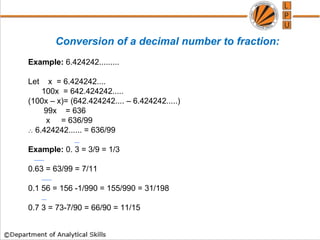
Conversion of a decimal number to fraction:
Example: 6.424242.........
Let x = 6.424242....
100x = 642.424242.....
(100x – x)= (642.424242.... – 6.424242.....)
99x = 636
x = 636/99
∴ 6.424242...... = 636/99
Example: 0. 3 = 3/9 = 1/3
0.63 = 63/99 = 7/11
0.1 56 = 156 -1/990 = 155/990 = 31/198
0.7 3 = 73-7/90 = 66/90 = 11/15
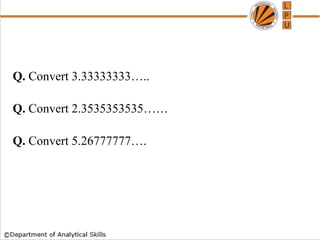
Q. Convert 3.33333333…..
Q. Convert 2.3535353535……
Q. Convert 5.26777777….
How to find whether a no is Prime or not
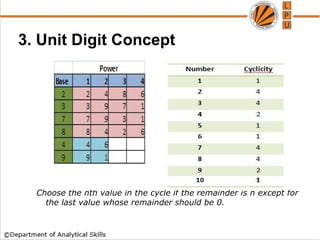
Choose the nth value in the cycle if the remainder is n except for
the last value whose remainder should be 0.
3. Unit Digit Concept
How to find whether a no is Prime or not
Note: The last digit of an expression will always depend on the unit digit of the
values.
Example: The unit digit of 123 x 456 x 789 = 3 x 6 x 9
= 18 x 9
= 8 x 9
= 2
How to find whether a no is Prime or not
Example 2: What is the unit digit of (123)^42?
The unit digit pattern of 3 repeats four times. So find the remainder when the
power value is divided by 4.
42/4= R(2)
2nd
value in 3 cycle is 9.
∴ Unit digit of (123)^42 is 9
Example 3: Find the units place digit of 252^84?
Consider only unit digit of a number i.e. 2^84
84/4 = 0 (Remainder)
So, power of 2 will become its Cyclicity i.e. 4.
Therefore, Unit digit of 24 = 6.
Q) What is the unit digit of (127)^223
Q) What is the unit digit in the product (3^65 x 6^59 x 7^71)?
Q) Find the units place digit of 27^184?
4. Factors
 Factors of a number are the values that divides the number
completely.
Example: Factors of 10 are 1, 2, 5 and 10.
 Multiple of a number is the product of that number and any
other whole number.
Example: multiples of 10 are 10, 20, 30,…..
Number of factors
Example: Find total number of factors of 3600?
OR
Find all the numbers which can divide 3600?
Sol:
Step 1: Prime factorize the given number
3600 = 36 x 100
= 6^2 x 10^2
= 2^2 x 3^2 x 2^2 x 5^2
= 2^4 x 3^2 x 5^2
Step 2: Add 1 to the powers and multiply.
(4+1) x (2+1) x (2+1)
= 5 x 3 x 3
= 45
∴ Number of factors of 3600 is 45.
Q) Find the number of factors of 14400?
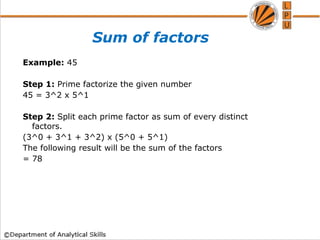
Sum of factors
Example: 45
Step 1: Prime factorize the given number
45 = 3^2 x 5^1
Step 2: Split each prime factor as sum of every distinct
factors.
(3^0 + 3^1 + 3^2) x (5^0 + 5^1)
The following result will be the sum of the factors
= 78
6. FACTORIAL
 6! = 1 * 2 * 3 * 4 * 5 * 6 = 720
n! = 1 when n = 0, and n! = (n-1)! * n if n > 0
 The highest power of prime number p in n!
= [n/p1] + [n/p2] + [n/p3] + [n/p4] + …..
where [n/p1] denotes the quotient when n is divided by p
Example: The maximum power of 5 in 60!
60! = 1 x 2 x 3 ..................60 so every fifth number is a multiple of 5. So
there must be 60/5 = 12
In addition to this 25 and 50 contribute another two 5's. so total number is
12 + 2 = 14
Short cut: [60/5]+[60/25]=12+2=14
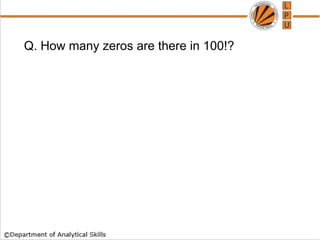
Q. How many zeros are there in 100!?
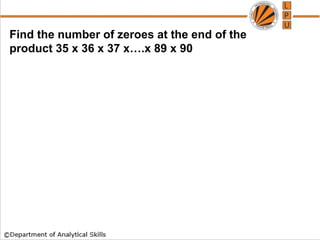
Find the number of zeroes at the end of the
product 35 x 36 x 37 x….x 89 x 90
Find the number of zeroes at the end of the
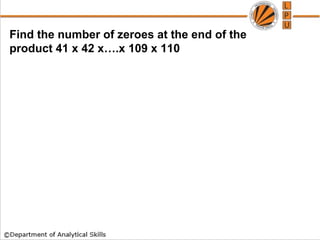
product 41 x 42 x….x 109 x 110
Divisibility Rules
Divisibility Rules
Question: If number 1792N is divisible by 2. How many values
N can take?
[A] 4
[B] 5
[C] 3
[D] 6
Question: What should come in place of K if 563K5 is divisible
by 9?
[A] 7
[B] 8
[C] 9
[D] 2
Question: For what values of P number 345472P34 is exactly
divisible by 9.
[A] 3
[B] 4
[C] 6
[D] 7
Question: For what values of N number 9724N is exactly
divisible by 6.
[A] 2 & 8
[B] 4 & 6
[C] 2 & 6
[D] 6 & 8
Question: For what values of N number 857N32 is exactly
divisible by 11.
[A] 1
[B] 0
[C] 3
[D] 4
Question: What should come in place x if 4857x is divisible by
88?
[A] 6
[B] 8
[C] 2
[D] 4
Remainder theorem
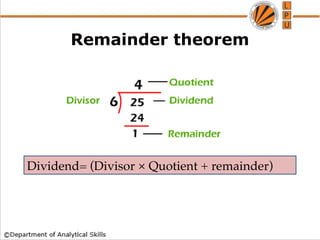
Dividend= (Divisor × Quotient + remainder)
Q) Remainder when 17^23 is divided by 16?
[A] 1
[B] 2
[C] 3
[D] 4
Q) Remainder when 35^113 is divided by 9?
[A] 1
[B] 8
[C] 3
[D] 4
Q) Remainder when 2^33 is divided by 9?
[A] 1
[B] 4
[C] 8
[D] 5
Next Class HCF & LCM

1 UNITI Numbers System.pdf

  • 1.
  • 2.
    Content Content  CLASSIFICATION OFNUMBERS ii) Conversion of a decimal number to fraction  POWER CYCLE/ UNIT DIGIT  FACTORS AND MULTIPLES i) Number of factors ii) Sum of factors iii) Product of factors
  • 3.
    How to findwhether a no is Prime or not Conversion of a decimal number to fraction: Example: 6.424242......... Let x = 6.424242.... 100x = 642.424242..... (100x – x)= (642.424242.... – 6.424242.....) 99x = 636 x = 636/99 ∴ 6.424242...... = 636/99 Example: 0. 3 = 3/9 = 1/3 0.63 = 63/99 = 7/11 0.1 56 = 156 -1/990 = 155/990 = 31/198 0.7 3 = 73-7/90 = 66/90 = 11/15
  • 4.
    Q. Convert 3.33333333….. Q.Convert 2.3535353535…… Q. Convert 5.26777777…. How to find whether a no is Prime or not
  • 5.
    Choose the nthvalue in the cycle if the remainder is n except for the last value whose remainder should be 0. 3. Unit Digit Concept
  • 7.
    How to findwhether a no is Prime or not Note: The last digit of an expression will always depend on the unit digit of the values. Example: The unit digit of 123 x 456 x 789 = 3 x 6 x 9 = 18 x 9 = 8 x 9 = 2
  • 8.
    How to findwhether a no is Prime or not Example 2: What is the unit digit of (123)^42? The unit digit pattern of 3 repeats four times. So find the remainder when the power value is divided by 4. 42/4= R(2) 2nd value in 3 cycle is 9. ∴ Unit digit of (123)^42 is 9 Example 3: Find the units place digit of 252^84? Consider only unit digit of a number i.e. 2^84 84/4 = 0 (Remainder) So, power of 2 will become its Cyclicity i.e. 4. Therefore, Unit digit of 24 = 6.
  • 9.
    Q) What isthe unit digit of (127)^223 Q) What is the unit digit in the product (3^65 x 6^59 x 7^71)? Q) Find the units place digit of 27^184?
  • 10.
    4. Factors  Factorsof a number are the values that divides the number completely. Example: Factors of 10 are 1, 2, 5 and 10.  Multiple of a number is the product of that number and any other whole number. Example: multiples of 10 are 10, 20, 30,…..
  • 11.
    Number of factors Example:Find total number of factors of 3600? OR Find all the numbers which can divide 3600? Sol: Step 1: Prime factorize the given number 3600 = 36 x 100 = 6^2 x 10^2 = 2^2 x 3^2 x 2^2 x 5^2 = 2^4 x 3^2 x 5^2 Step 2: Add 1 to the powers and multiply. (4+1) x (2+1) x (2+1) = 5 x 3 x 3 = 45 ∴ Number of factors of 3600 is 45.
  • 12.
    Q) Find thenumber of factors of 14400?
  • 13.
    Sum of factors Example:45 Step 1: Prime factorize the given number 45 = 3^2 x 5^1 Step 2: Split each prime factor as sum of every distinct factors. (3^0 + 3^1 + 3^2) x (5^0 + 5^1) The following result will be the sum of the factors = 78
  • 15.
    6. FACTORIAL  6!= 1 * 2 * 3 * 4 * 5 * 6 = 720 n! = 1 when n = 0, and n! = (n-1)! * n if n > 0  The highest power of prime number p in n! = [n/p1] + [n/p2] + [n/p3] + [n/p4] + ….. where [n/p1] denotes the quotient when n is divided by p Example: The maximum power of 5 in 60! 60! = 1 x 2 x 3 ..................60 so every fifth number is a multiple of 5. So there must be 60/5 = 12 In addition to this 25 and 50 contribute another two 5's. so total number is 12 + 2 = 14 Short cut: [60/5]+[60/25]=12+2=14
  • 16.
    Q. How manyzeros are there in 100!?
  • 17.
    Find the numberof zeroes at the end of the product 35 x 36 x 37 x….x 89 x 90
  • 18.
    Find the numberof zeroes at the end of the product 41 x 42 x….x 109 x 110
  • 19.
  • 20.
    Question: If number1792N is divisible by 2. How many values N can take? [A] 4 [B] 5 [C] 3 [D] 6
  • 21.
    Question: What shouldcome in place of K if 563K5 is divisible by 9? [A] 7 [B] 8 [C] 9 [D] 2
  • 22.
    Question: For whatvalues of P number 345472P34 is exactly divisible by 9. [A] 3 [B] 4 [C] 6 [D] 7
  • 23.
    Question: For whatvalues of N number 9724N is exactly divisible by 6. [A] 2 & 8 [B] 4 & 6 [C] 2 & 6 [D] 6 & 8
  • 24.
    Question: For whatvalues of N number 857N32 is exactly divisible by 11. [A] 1 [B] 0 [C] 3 [D] 4
  • 25.
    Question: What shouldcome in place x if 4857x is divisible by 88? [A] 6 [B] 8 [C] 2 [D] 4
  • 26.
    Remainder theorem Dividend= (Divisor× Quotient + remainder)
  • 27.
    Q) Remainder when17^23 is divided by 16? [A] 1 [B] 2 [C] 3 [D] 4
  • 28.
    Q) Remainder when35^113 is divided by 9? [A] 1 [B] 8 [C] 3 [D] 4
  • 29.
    Q) Remainder when2^33 is divided by 9? [A] 1 [B] 4 [C] 8 [D] 5
  • 30.