1. The design of a singly-linked list
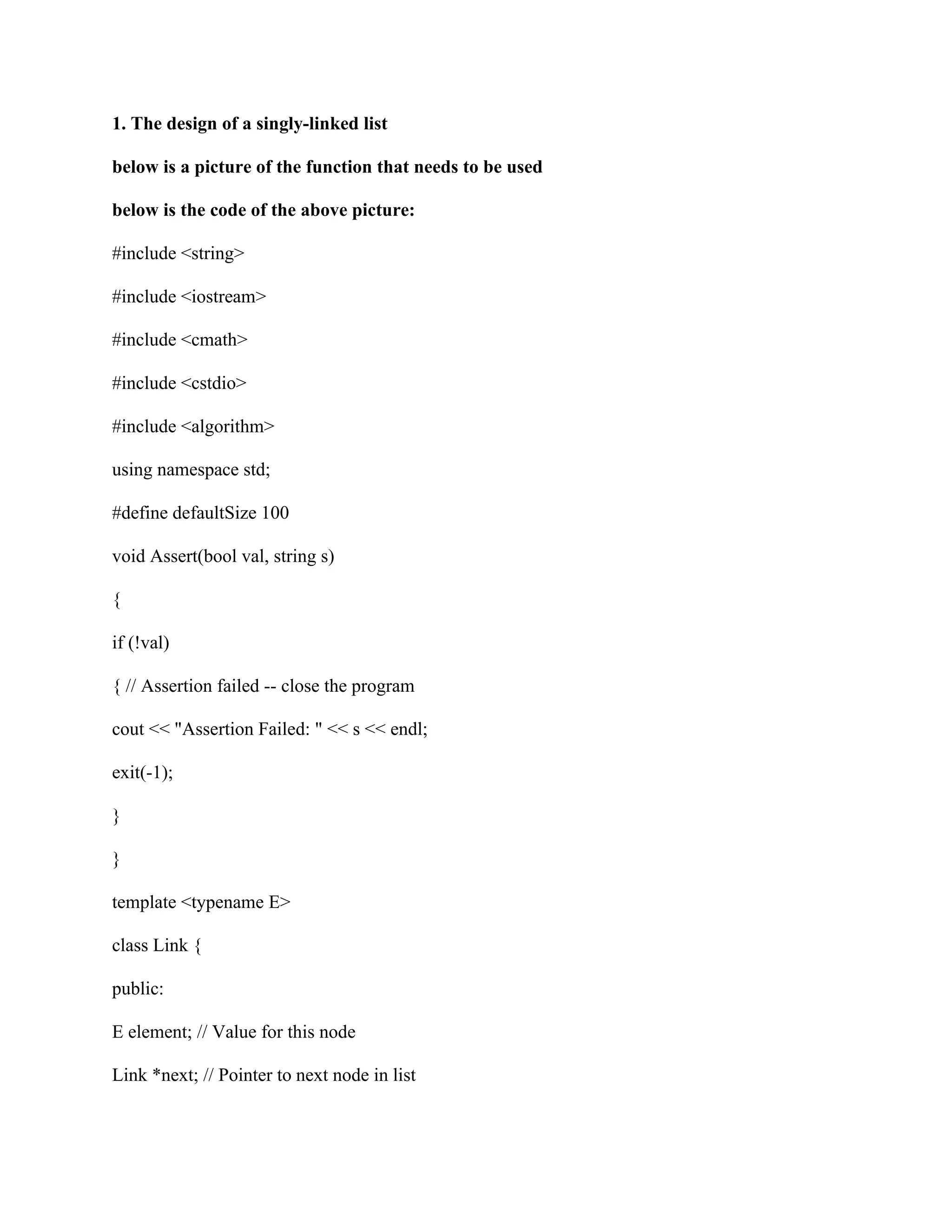
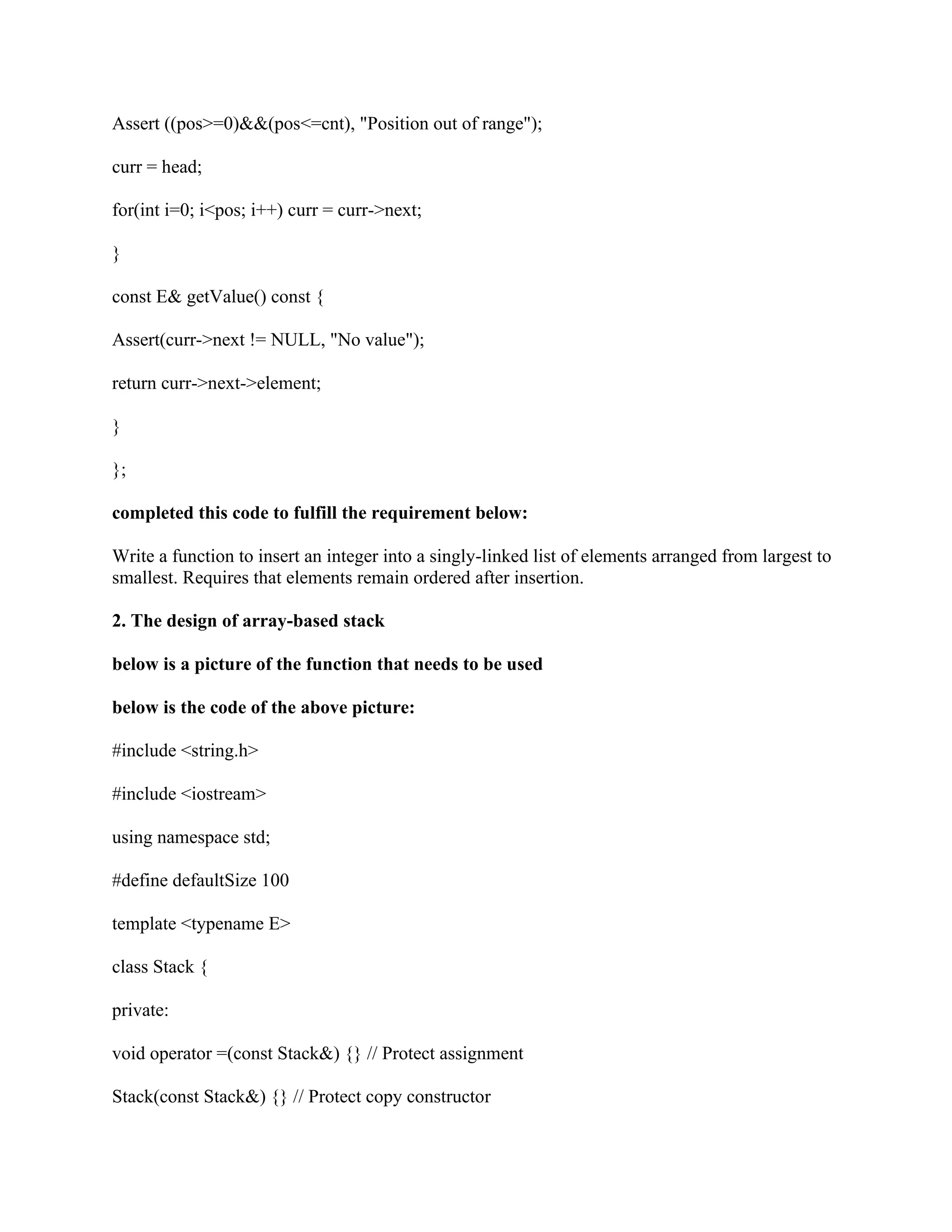
below is a picture of the function that needs to be used
below is the code of the above picture:
#include <string>
#include <iostream>
#include <cmath>
#include <cstdio>
#include <algorithm>
using namespace std;
#define defaultSize 100
void Assert(bool val, string s)
{
if (!val)
{ // Assertion failed -- close the program
cout << "Assertion Failed: " << s << endl;
exit(-1);
}
}
template <typename E>
class Link {
public:
E element; // Value for this node
Link *next; // Pointer to next node in list
// Constructors
Link(const E& elemval, Link<E>* nextval = NULL)
{ element = elemval; next = nextval; }
Link(Link<E>* nextval =NULL) { next = nextval; }
};
template <typename E>
class LList: public Link<E> {
private:
Link<E>* head;// Intialization helper method
Link<E>* tail;// Pointer to last element
Link<E>* curr;// Access to current element
int cnt;// Size of list
void init(){// Intialization helper method
curr = tail = head = new Link<E>;
cnt = 0;
}
void removeall() {// Return link nodes to free store
while(head != NULL) {
curr = head;
head = head->next;
delete curr;
}
}
public:
LList(int size=defaultSize) { init(); }// Constructor
~LList() { removeall(); }// Destructor
void print() const;// Print list contents
void clear() { removeall(); init(); }// Clear list
// Insert "it" at current position
void insert(const E& it) {
curr->next = new Link<E>(it, curr->next);
if (tail == curr) tail = curr->next; // New tail
cnt++;
}
void append(const E& it) { // Append "it" to list
tail = tail->next = new Link<E>(it, NULL);
cnt++;
}
// Remove and return current element
E remove() {
Assert(curr->next != NULL, "No element");
E it = curr->next->element; // Remember value
Link<E>* ltemp = curr->next; // Remember link node
if (tail == curr->next) tail = curr; // Reset tail
curr->next = curr->next->next; // Remove from list
delete ltemp; // Reclaim space
cnt--; // Decrement the count
return it;
}
void moveToStart()// Place curr at list start
{ curr = head; }
void moveToEnd() // Place curr at list end
{ curr = tail; }
void prev(){
if (curr == head) return;
Link<E>* temp = head;
while (temp->next!=curr) temp=temp->next;
curr = temp;
}
void next(){ if (curr != tail) curr = curr->next; }
int length() const { return cnt; }
int currPos() const {
Link<E>* temp = head;
int i;
for (i=0; curr != temp; i++)
temp = temp->next;
return i;
}
void moveToPos(int pos){
Assert ((pos>=0)&&(pos<=cnt), "Position out of range");
curr = head;
for(int i=0; i<pos; i++) curr = curr->next;
}
const E& getValue() const {
Assert(curr->next != NULL, "No value");
return curr->next->element;
}
};
completed this code to fulfill the requirement below:
Write a function to insert an integer into a singly-linked list of elements arranged from largest to
smallest. Requires that elements remain ordered after insertion.
2. The design of array-based stack
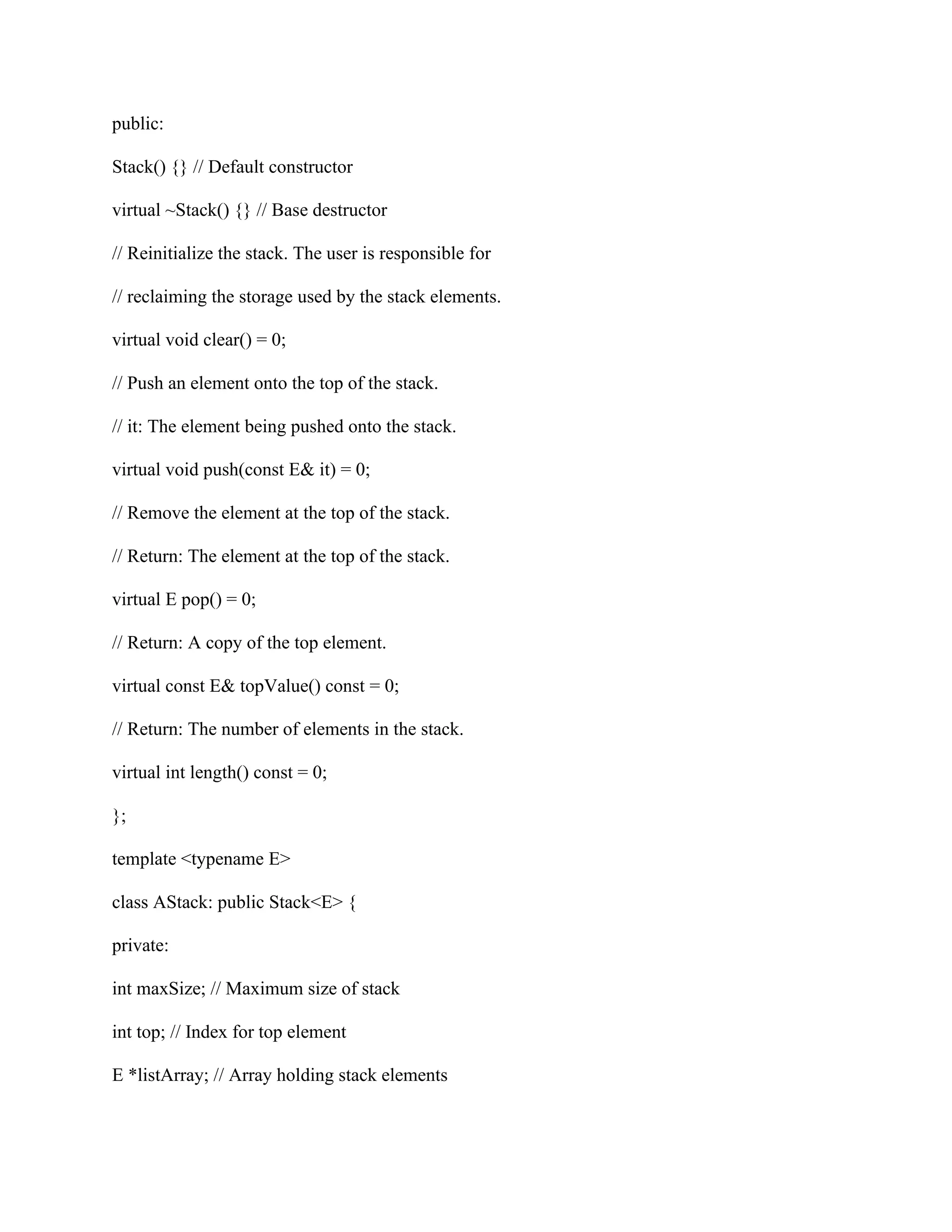
below is a picture of the function that needs to be used
below is the code of the above picture:
#include <string.h>
#include <iostream>
using namespace std;
#define defaultSize 100
template <typename E>
class Stack {
private:
void operator =(const Stack&) {} // Protect assignment
Stack(const Stack&) {} // Protect copy constructor
public:
Stack() {} // Default constructor
virtual ~Stack() {} // Base destructor
// Reinitialize the stack. The user is responsible for
// reclaiming the storage used by the stack elements.
virtual void clear() = 0;
// Push an element onto the top of the stack.
// it: The element being pushed onto the stack.
virtual void push(const E& it) = 0;
// Remove the element at the top of the stack.
// Return: The element at the top of the stack.
virtual E pop() = 0;
// Return: A copy of the top element.
virtual const E& topValue() const = 0;
// Return: The number of elements in the stack.
virtual int length() const = 0;
};
template <typename E>
class AStack: public Stack<E> {
private:
int maxSize; // Maximum size of stack
int top; // Index for top element
E *listArray; // Array holding stack elements
public:
AStack(int size =defaultSize) // Constructor
{ maxSize = size; top = 0; listArray = new E[size]; }
~AStack() { delete [] listArray; } // Destructor
void clear() { top = 0; } // Reinitialize
void push(const E& it) { // Put "it" on stack
// Assert(top != maxSize, "Stack is full");
listArray[top++] = it;
}
E pop() { // Pop top element
// Assert(top != 0, "Stack is empty");
return listArray[--top];
}
const E& topValue() const { // Return top element
// Assert(top != 0, "Stack is empty");
return listArray[top-1];
}
int length() const { return top; } // Return length
};
completed this code to fulfill the requirement below:
Write a function that uses the stack to check whether the parentheses in the string are balanced.
For example, "(()(()))" is balanced, and "(()()" and "())" are unbalanced.
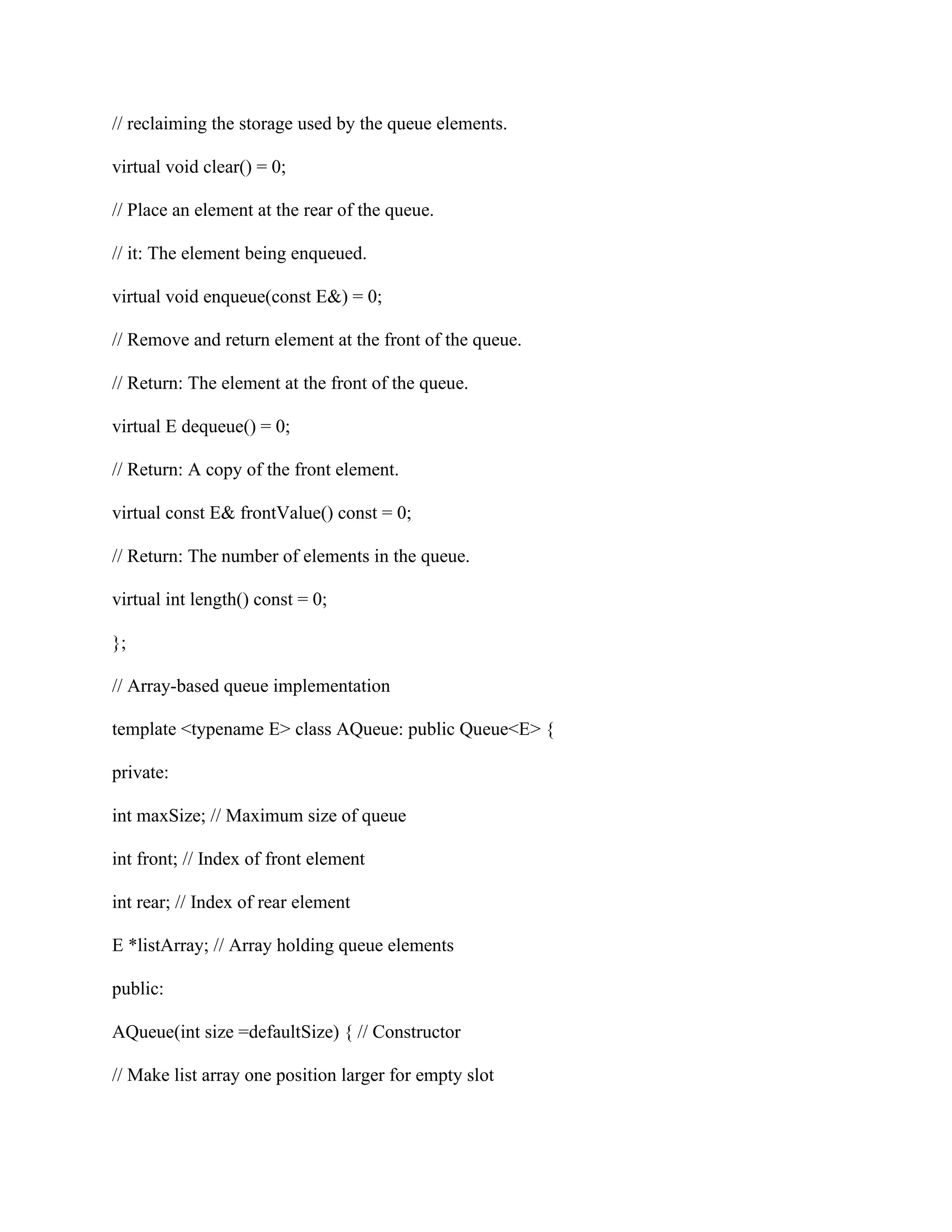
3. The design of array-based queue
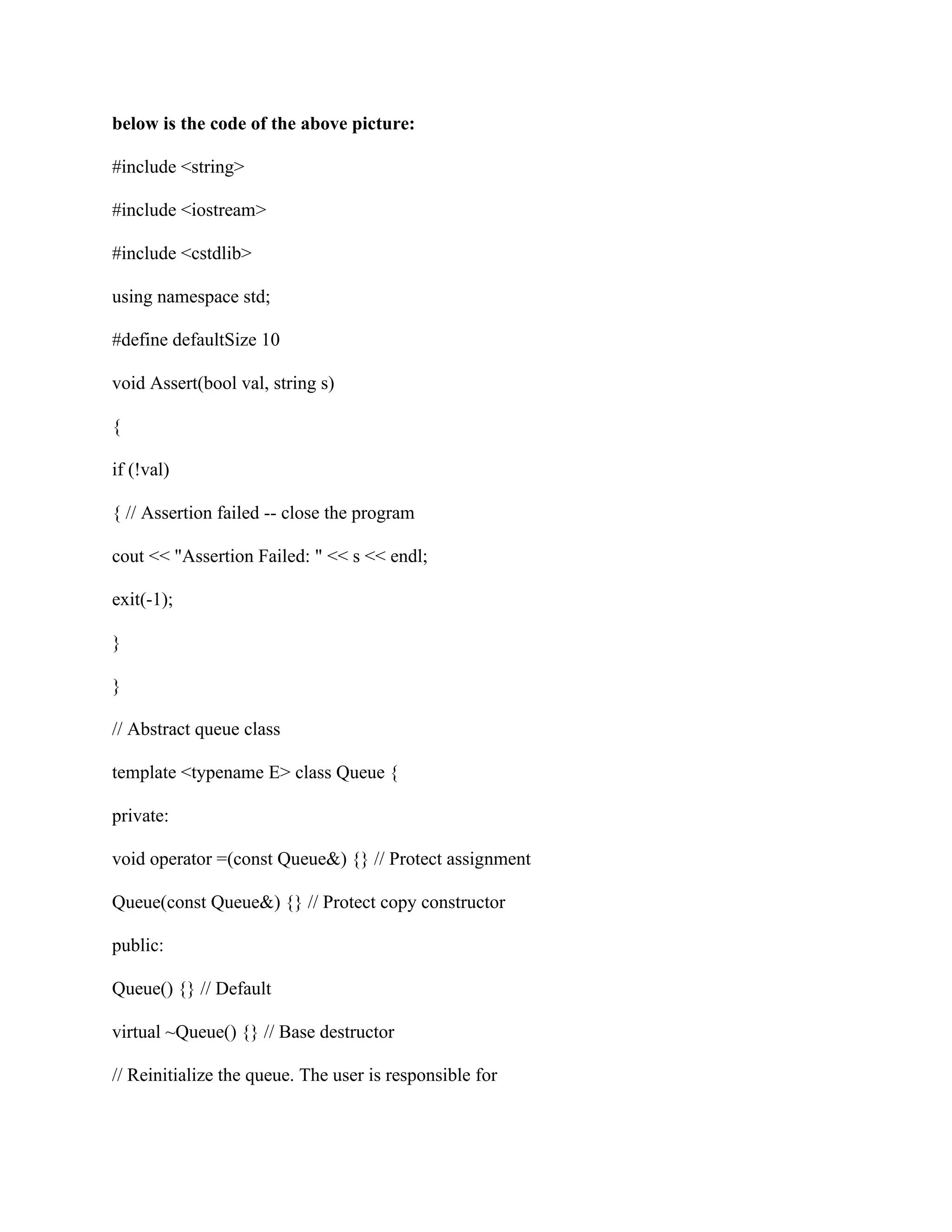
below is a picture of the function that needs to be used
below is the code of the above picture:
#include <string>
#include <iostream>
#include <cstdlib>
using namespace std;
#define defaultSize 10
void Assert(bool val, string s)
{
if (!val)
{ // Assertion failed -- close the program
cout << "Assertion Failed: " << s << endl;
exit(-1);
}
}
// Abstract queue class
template <typename E> class Queue {
private:
void operator =(const Queue&) {} // Protect assignment
Queue(const Queue&) {} // Protect copy constructor
public:
Queue() {} // Default
virtual ~Queue() {} // Base destructor
// Reinitialize the queue. The user is responsible for
// reclaiming the storage used by the queue elements.
virtual void clear() = 0;
// Place an element at the rear of the queue.
// it: The element being enqueued.
virtual void enqueue(const E&) = 0;
// Remove and return element at the front of the queue.
// Return: The element at the front of the queue.
virtual E dequeue() = 0;
// Return: A copy of the front element.
virtual const E& frontValue() const = 0;
// Return: The number of elements in the queue.
virtual int length() const = 0;
};
// Array-based queue implementation
template <typename E> class AQueue: public Queue<E> {
private:
int maxSize; // Maximum size of queue
int front; // Index of front element
int rear; // Index of rear element
E *listArray; // Array holding queue elements
public:
AQueue(int size =defaultSize) { // Constructor
// Make list array one position larger for empty slot
maxSize = size+1;
rear = 0; front = 1;
listArray = new E[maxSize];
}
~AQueue() { delete [] listArray; } // Destructor
void clear() { rear = 0; front = 1; } // Reinitialize
void enqueue(const E& it) { // Put "it" in queue
Assert(((rear+2) % maxSize) != front, "Queue is full");
rear = (rear+1) % maxSize; // Circular increment
listArray[rear] = it;
}
E dequeue() { // Take element out
Assert(length() != 0, "Queue is empty");
E it = listArray[front];
front = (front+1) % maxSize; // Circular increment
return it;
}
const E& frontValue() const { // Get front value
Assert(length() != 0, "Queue is empty");
return listArray[front];
}
virtual int length() const // Return length
{ return ((rear+maxSize) - front + 1) % maxSize; }
};
completed this code to fulfill the requirement below:
Write a function that the user selects queue i (0i9), and then inserts any number of numbers into
queue i. Input "#" to indicate that the user does not select any queue. At the end of the program,
the non-empty queue among the 10 queues is output in the order of queue number from the
smallest to the largest.
For example
Input
0(queue number)
1 3 5 7 9 8
1(queue number)
2 4 6
9(queue number)
111 222 333
#
Output
1 3 5 7 9 8 2 4 6 111 222 333

1- The design of a singly-linked list below is a picture of the functi (1).pdf

  • 1.
    1. The designof a singly-linked list below is a picture of the function that needs to be used below is the code of the above picture: #include <string> #include <iostream> #include <cmath> #include <cstdio> #include <algorithm> using namespace std; #define defaultSize 100 void Assert(bool val, string s) { if (!val) { // Assertion failed -- close the program cout << "Assertion Failed: " << s << endl; exit(-1); } } template <typename E> class Link { public: E element; // Value for this node Link *next; // Pointer to next node in list
  • 2.
    // Constructors Link(const E&elemval, Link<E>* nextval = NULL) { element = elemval; next = nextval; } Link(Link<E>* nextval =NULL) { next = nextval; } }; template <typename E> class LList: public Link<E> { private: Link<E>* head;// Intialization helper method Link<E>* tail;// Pointer to last element Link<E>* curr;// Access to current element int cnt;// Size of list void init(){// Intialization helper method curr = tail = head = new Link<E>; cnt = 0; } void removeall() {// Return link nodes to free store while(head != NULL) { curr = head; head = head->next; delete curr; } }
  • 3.
    public: LList(int size=defaultSize) {init(); }// Constructor ~LList() { removeall(); }// Destructor void print() const;// Print list contents void clear() { removeall(); init(); }// Clear list // Insert "it" at current position void insert(const E& it) { curr->next = new Link<E>(it, curr->next); if (tail == curr) tail = curr->next; // New tail cnt++; } void append(const E& it) { // Append "it" to list tail = tail->next = new Link<E>(it, NULL); cnt++; } // Remove and return current element E remove() { Assert(curr->next != NULL, "No element"); E it = curr->next->element; // Remember value Link<E>* ltemp = curr->next; // Remember link node if (tail == curr->next) tail = curr; // Reset tail curr->next = curr->next->next; // Remove from list delete ltemp; // Reclaim space
  • 4.
    cnt--; // Decrementthe count return it; } void moveToStart()// Place curr at list start { curr = head; } void moveToEnd() // Place curr at list end { curr = tail; } void prev(){ if (curr == head) return; Link<E>* temp = head; while (temp->next!=curr) temp=temp->next; curr = temp; } void next(){ if (curr != tail) curr = curr->next; } int length() const { return cnt; } int currPos() const { Link<E>* temp = head; int i; for (i=0; curr != temp; i++) temp = temp->next; return i; } void moveToPos(int pos){
  • 5.
    Assert ((pos>=0)&&(pos<=cnt), "Positionout of range"); curr = head; for(int i=0; i<pos; i++) curr = curr->next; } const E& getValue() const { Assert(curr->next != NULL, "No value"); return curr->next->element; } }; completed this code to fulfill the requirement below: Write a function to insert an integer into a singly-linked list of elements arranged from largest to smallest. Requires that elements remain ordered after insertion. 2. The design of array-based stack below is a picture of the function that needs to be used below is the code of the above picture: #include <string.h> #include <iostream> using namespace std; #define defaultSize 100 template <typename E> class Stack { private: void operator =(const Stack&) {} // Protect assignment Stack(const Stack&) {} // Protect copy constructor
  • 6.
    public: Stack() {} //Default constructor virtual ~Stack() {} // Base destructor // Reinitialize the stack. The user is responsible for // reclaiming the storage used by the stack elements. virtual void clear() = 0; // Push an element onto the top of the stack. // it: The element being pushed onto the stack. virtual void push(const E& it) = 0; // Remove the element at the top of the stack. // Return: The element at the top of the stack. virtual E pop() = 0; // Return: A copy of the top element. virtual const E& topValue() const = 0; // Return: The number of elements in the stack. virtual int length() const = 0; }; template <typename E> class AStack: public Stack<E> { private: int maxSize; // Maximum size of stack int top; // Index for top element E *listArray; // Array holding stack elements
  • 7.
    public: AStack(int size =defaultSize)// Constructor { maxSize = size; top = 0; listArray = new E[size]; } ~AStack() { delete [] listArray; } // Destructor void clear() { top = 0; } // Reinitialize void push(const E& it) { // Put "it" on stack // Assert(top != maxSize, "Stack is full"); listArray[top++] = it; } E pop() { // Pop top element // Assert(top != 0, "Stack is empty"); return listArray[--top]; } const E& topValue() const { // Return top element // Assert(top != 0, "Stack is empty"); return listArray[top-1]; } int length() const { return top; } // Return length }; completed this code to fulfill the requirement below: Write a function that uses the stack to check whether the parentheses in the string are balanced. For example, "(()(()))" is balanced, and "(()()" and "())" are unbalanced. 3. The design of array-based queue below is a picture of the function that needs to be used
  • 8.
    below is thecode of the above picture: #include <string> #include <iostream> #include <cstdlib> using namespace std; #define defaultSize 10 void Assert(bool val, string s) { if (!val) { // Assertion failed -- close the program cout << "Assertion Failed: " << s << endl; exit(-1); } } // Abstract queue class template <typename E> class Queue { private: void operator =(const Queue&) {} // Protect assignment Queue(const Queue&) {} // Protect copy constructor public: Queue() {} // Default virtual ~Queue() {} // Base destructor // Reinitialize the queue. The user is responsible for
  • 9.
    // reclaiming thestorage used by the queue elements. virtual void clear() = 0; // Place an element at the rear of the queue. // it: The element being enqueued. virtual void enqueue(const E&) = 0; // Remove and return element at the front of the queue. // Return: The element at the front of the queue. virtual E dequeue() = 0; // Return: A copy of the front element. virtual const E& frontValue() const = 0; // Return: The number of elements in the queue. virtual int length() const = 0; }; // Array-based queue implementation template <typename E> class AQueue: public Queue<E> { private: int maxSize; // Maximum size of queue int front; // Index of front element int rear; // Index of rear element E *listArray; // Array holding queue elements public: AQueue(int size =defaultSize) { // Constructor // Make list array one position larger for empty slot
  • 10.
    maxSize = size+1; rear= 0; front = 1; listArray = new E[maxSize]; } ~AQueue() { delete [] listArray; } // Destructor void clear() { rear = 0; front = 1; } // Reinitialize void enqueue(const E& it) { // Put "it" in queue Assert(((rear+2) % maxSize) != front, "Queue is full"); rear = (rear+1) % maxSize; // Circular increment listArray[rear] = it; } E dequeue() { // Take element out Assert(length() != 0, "Queue is empty"); E it = listArray[front]; front = (front+1) % maxSize; // Circular increment return it; } const E& frontValue() const { // Get front value Assert(length() != 0, "Queue is empty"); return listArray[front]; } virtual int length() const // Return length { return ((rear+maxSize) - front + 1) % maxSize; }
  • 11.
    }; completed this codeto fulfill the requirement below: Write a function that the user selects queue i (0i9), and then inserts any number of numbers into queue i. Input "#" to indicate that the user does not select any queue. At the end of the program, the non-empty queue among the 10 queues is output in the order of queue number from the smallest to the largest. For example Input 0(queue number) 1 3 5 7 9 8 1(queue number) 2 4 6 9(queue number) 111 222 333 # Output 1 3 5 7 9 8 2 4 6 111 222 333