Smell
Olfaction
Dr. Berjin
Jr Resident
Department of Physiology
LEARNING OBJECTIVES
• Olfactory Epithelium
• Olfactory Sensory Pathway
• Odor Detection Threshold
• Abnormalities
• The flavor of foods is a combination of its taste
and smell
• Smell and taste receptors are chemoreceptors as
they are stimulated by molecules in solution
(mucus in the nose and saliva in the mouth)
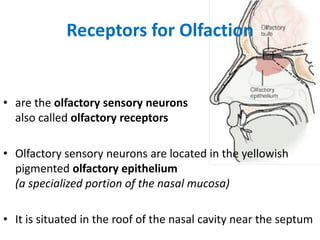
Receptors for Olfaction
• are the olfactory sensory neurons
also called olfactory receptors
• Olfactory sensory neurons are located in the yellowish
pigmented olfactory epithelium
(a specialized portion of the nasal mucosa)
• It is situated in the roof of the nasal cavity near the septum
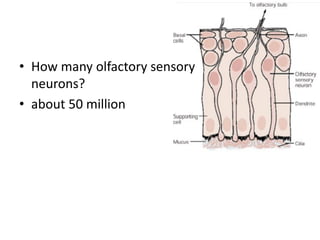
• How many olfactory sensory
neurons?
• about 50 million
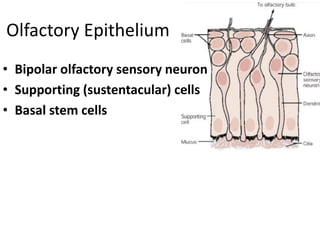
Olfactory Epithelium
• Bipolar olfactory sensory neuron
• Supporting (sustentacular) cells
• Basal stem cells
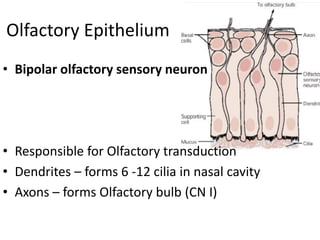
Olfactory Epithelium
• Bipolar olfactory sensory neuron
• Responsible for Olfactory transduction
• Dendrites – forms 6 -12 cilia in nasal cavity
• Axons – forms Olfactory bulb (CN I)
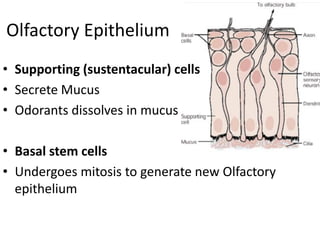
Olfactory Epithelium
• Supporting (sustentacular) cells
• Secrete Mucus
• Odorants dissolves in mucus
• Basal stem cells
• Undergoes mitosis to generate new Olfactory
epithelium
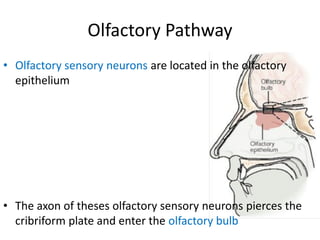
Olfactory Pathway
• Olfactory sensory neurons are located in the olfactory
epithelium
• The axon of theses olfactory sensory neurons pierces the
cribriform plate and enter the olfactory bulb
Olfactory Pathway - olfactory bulb
• In the olfactory bulb, the axons
synapse with the dendrites of the
mitral cells and tufted cells and
form globular synaptic units called
called olfactory glomeruli
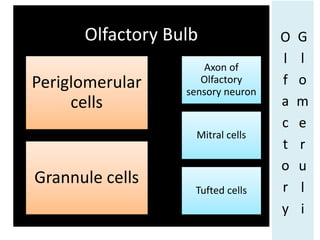
• The olfactory bulb also contains
periglomerular cells and granule
cells
Olfactory Bulb
Periglomerular
cells
Grannule cells
Axon of
Olfactory
sensory neuron
Mitral cells
Tufted cells
O
l
f
a
c
t
o
r
y
G
l
o
m
e
r
u
l
i
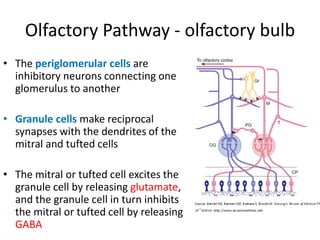
Olfactory Pathway - olfactory bulb
• The periglomerular cells are
inhibitory neurons connecting one
glomerulus to another
• Granule cells make reciprocal
synapses with the dendrites of the
mitral and tufted cells
• The mitral or tufted cell excites the
granule cell by releasing glutamate,
and the granule cell in turn inhibits
the mitral or tufted cell by releasing
GABA
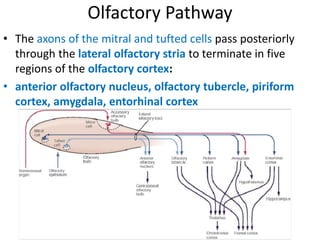
Olfactory Pathway
• The axons of the mitral and tufted cells pass posteriorly
through the lateral olfactory stria to terminate in five
regions of the olfactory cortex:
• anterior olfactory nucleus, olfactory tubercle, piriform
cortex, amygdala, entorhinal cortex
Olfactory Pathway
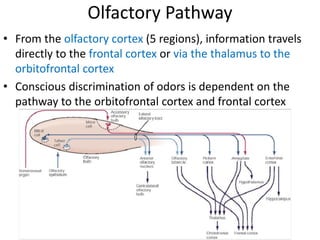
• From the olfactory cortex (5 regions), information travels
directly to the frontal cortex or via the thalamus to the
orbitofrontal cortex
• Conscious discrimination of odors is dependent on the
pathway to the orbitofrontal cortex and frontal cortex
Olfactory Pathway
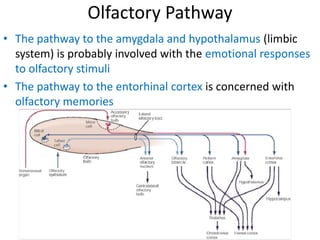
• The pathway to the amygdala and hypothalamus (limbic
system) is probably involved with the emotional responses
to olfactory stimuli
• The pathway to the entorhinal cortex is concerned with
olfactory memories
Odorant receptors
• Odorant receptors are located on the cilia of the
olfactory sensory neurons, that project into the mucus
• There are about 1000 different odorant receptors
• They are G Protein Coupled Receptors
• We can discriminate more than 10,000 different odors
ODOR DETECTION THRESHOLD
• The olfactory receptors are very sensitive
• Low concentrations of chemical that can be
detected is called Odor detection threshold
• Eg - Hydrogen Sulphide, Kerosene
• Women > Men
Abnormalities of smell
• Anosmia – Inability to smell
• Hyposmia – Diminished olfactory sensitivity
• Causes:
- Simple nasal congestion, nasal polyps
– Damage to the olfactory nerves eg fractures,
tumors, infections
– Ageing
Abnormalities of smell
• Hyperosmia : Enhanced Olfactory Sensitivity
Pregnant women are sometimes oversensitive to
smell
• Dysosmia : Distorted sense of smell
– Sinus infections
– Partial damage to the olfactory nerves
1. Smell.pdf

1. Smell.pdf

  • 1.
  • 2.
    LEARNING OBJECTIVES • OlfactoryEpithelium • Olfactory Sensory Pathway • Odor Detection Threshold • Abnormalities
  • 3.
    • The flavorof foods is a combination of its taste and smell • Smell and taste receptors are chemoreceptors as they are stimulated by molecules in solution (mucus in the nose and saliva in the mouth)
  • 4.
    Receptors for Olfaction •are the olfactory sensory neurons also called olfactory receptors • Olfactory sensory neurons are located in the yellowish pigmented olfactory epithelium (a specialized portion of the nasal mucosa) • It is situated in the roof of the nasal cavity near the septum
  • 5.
    • How manyolfactory sensory neurons? • about 50 million
  • 6.
    Olfactory Epithelium • Bipolarolfactory sensory neuron • Supporting (sustentacular) cells • Basal stem cells
  • 7.
    Olfactory Epithelium • Bipolarolfactory sensory neuron • Responsible for Olfactory transduction • Dendrites – forms 6 -12 cilia in nasal cavity • Axons – forms Olfactory bulb (CN I)
  • 8.
    Olfactory Epithelium • Supporting(sustentacular) cells • Secrete Mucus • Odorants dissolves in mucus • Basal stem cells • Undergoes mitosis to generate new Olfactory epithelium
  • 9.
    Olfactory Pathway • Olfactorysensory neurons are located in the olfactory epithelium • The axon of theses olfactory sensory neurons pierces the cribriform plate and enter the olfactory bulb
  • 10.
    Olfactory Pathway -olfactory bulb • In the olfactory bulb, the axons synapse with the dendrites of the mitral cells and tufted cells and form globular synaptic units called called olfactory glomeruli • The olfactory bulb also contains periglomerular cells and granule cells
  • 11.
    Olfactory Bulb Periglomerular cells Grannule cells Axonof Olfactory sensory neuron Mitral cells Tufted cells O l f a c t o r y G l o m e r u l i
  • 12.
    Olfactory Pathway -olfactory bulb • The periglomerular cells are inhibitory neurons connecting one glomerulus to another • Granule cells make reciprocal synapses with the dendrites of the mitral and tufted cells • The mitral or tufted cell excites the granule cell by releasing glutamate, and the granule cell in turn inhibits the mitral or tufted cell by releasing GABA
  • 13.
    Olfactory Pathway • Theaxons of the mitral and tufted cells pass posteriorly through the lateral olfactory stria to terminate in five regions of the olfactory cortex: • anterior olfactory nucleus, olfactory tubercle, piriform cortex, amygdala, entorhinal cortex
  • 14.
    Olfactory Pathway • Fromthe olfactory cortex (5 regions), information travels directly to the frontal cortex or via the thalamus to the orbitofrontal cortex • Conscious discrimination of odors is dependent on the pathway to the orbitofrontal cortex and frontal cortex
  • 15.
    Olfactory Pathway • Thepathway to the amygdala and hypothalamus (limbic system) is probably involved with the emotional responses to olfactory stimuli • The pathway to the entorhinal cortex is concerned with olfactory memories
  • 16.
    Odorant receptors • Odorantreceptors are located on the cilia of the olfactory sensory neurons, that project into the mucus • There are about 1000 different odorant receptors • They are G Protein Coupled Receptors • We can discriminate more than 10,000 different odors
  • 17.
    ODOR DETECTION THRESHOLD •The olfactory receptors are very sensitive • Low concentrations of chemical that can be detected is called Odor detection threshold • Eg - Hydrogen Sulphide, Kerosene • Women > Men
  • 18.
    Abnormalities of smell •Anosmia – Inability to smell • Hyposmia – Diminished olfactory sensitivity • Causes: - Simple nasal congestion, nasal polyps – Damage to the olfactory nerves eg fractures, tumors, infections – Ageing
  • 19.
    Abnormalities of smell •Hyperosmia : Enhanced Olfactory Sensitivity Pregnant women are sometimes oversensitive to smell • Dysosmia : Distorted sense of smell – Sinus infections – Partial damage to the olfactory nerves