Ecological Indicators 21 (2012) 7–16
Contents lists available at ScienceDirect
Ecological Indicators
journal homepage: www.elsevier.com/locate/ecolind
Ecosystem properties, potentials and services – The EPPS conceptual framework
and an urban application example
Olaf Bastiana,∗
, Dagmar Haaseb
, Karsten Grunewalda
a
Leibniz Institute of Ecological and Regional Development (IOER), Dresden, Germany
b
Humboldt-University, Berlin, Germany
a r t i c l e i n f o
Keywords:
Ecosystem services
Ecosystem functions
Landscape planning
Urban green spaces
Carbon sequestration
Recreation
a b s t r a c t
The concept of ecosystem services is an approach widely discussed to clarify and to assess the dependence
of human society on ecosystems and landscapes. In order to better differentiate between the potential
performance of ecosystems and landscapes and the quality needed or demanded by society, in this paper
we suggest returning to the landscape potential concept developed by landscape ecologists in the 1970s.
Emerging from both concepts is the hereinafter discussed EPPS framework – ecosystem (or landscape)
properties, potentials and services – which is a way to better link both potentials and services to current
planning and management practice and governance schemes. The empirical part of the paper shows
applications of the EPPS framework in an urban region.
© 2011 Elsevier Ltd. All rights reserved.
1. Introduction
Ecosystem services (ES) can be defined as “the benefits peo-
ple obtain from ecosystems” (MA, 2005). For about two decades
the scientific concept of ecosystem goods and services has gained
increasing attention and importance among scientists worldwide
(e.g. Lappé, 2009; Burkhard et al., 2010).
This growing popularity of the ecosystem services concept can
be seen primarily as a reaction on the interplay of firstly the long-
term neglecting of biophysical and ecosystem functions – often
considered gratis – in our economic cycles and the societal system
as such and, secondly, the growing devastation and degradation
of the ecosystems providing these performances (Norberg, 1999;
Boyd and Banzhaf, 2007). With the publication of the Millennium
Ecosystem Assessment (MA, 2005) at the latest it also became clear
for the critical expert public that humankind depends on nature and
ecosystems, their functions and the variety of processes and fluxes.
Another example for the growing importance of ecosystem services
for global policy is the TEEB (2010) which focuses on the economics
of ecosystems and biodiversity. Currently, the issues of biodiversity
and ecosystem services might draw policy-makers’ attention: In
June 2010 the Intergovernmental Science-Policy Platform on Bio-
diversity and Ecosystem Services (IPBES) was founded in Busan,
South Korea (Nature, 2010).
The attractiveness of the ecosystem services concept results on
the one hand from its interdisciplinary character – it is integrated by
∗ Corresponding author.
E-mail address: o.bastian@ioer.de (O. Bastian).
nature – and on the other hand, it explicitly involves both natural
science based and socio-economic science views and approaches
(Müller and Burkhard, 2007). Neßhöver et al. (2007) call ecosystem
services a missing link between ecosystems and human well-being,
which is close to the view of the MA, too.
However, despite all progress in making ecosystems, their goods
and services popular, we are still far from firstly, a satisfying
and comprehensive scientific description of the multiple rela-
tionships and feedbacks among different ecosystem services, and
secondly, a real impact of the ecosystem services approach on
political decision-making (Cox and Searle, 2009; Haines-Young and
Potschin, 2010). Instead, we have to state an increasing degradation
of ecosystems worldwide (MA, 2005; Heinberg, 2010) along with
the increase of impacts of natural hazards (floods, land slides, for-
est fires, heat waves) dramatically showing the declining resilience
of ecosystems worldwide. One most likely reason for this impair-
ment is the non-integration of ecosystem services in spatial and
land use planning in many countries worldwide. Particularly the
environmental legislation in many countries is not at all aware of
the ecosystem services concept. But also science has still not met
thresholds for policy impacts due to a lack of information, stan-
dards or verification (Cox and Searle, 2009). This is surprising so
far as there are various traditional scientific approaches to value
ecosystems and landscapes such as the framework of natural poten-
tials and landscape diagnosis by Haase et al. (further reading Haase
and Haase, 2002); or the landscape functions concept (e.g. Marks
et al., 1992; Bastian and Steinhardt, 2002; Bastian and Lütz, 2006;
Willemen, 2010). For example in Germany or the Netherlands, the
concept of landscape functions is used in landscape planning in
order to delineate protection zones or to determine priority areas
1470-160X/$ – see front matter © 2011 Elsevier Ltd. All rights reserved.
doi:10.1016/j.ecolind.2011.03.014
8 O. Bastian et al. / Ecological Indicators 21 (2012) 7–16
for agricultural, forest or recreational use (ROG, 2008; Willemen,
2010). For most of the German planners – at least – it remains
unclear how to bring natural science-based landscape functions
together with the more valuation-centered ecosystem services
(Boyd and Banzhaf, 2007; Ranganathan et al., 2008; Volk et al.,
2008). What are the linkages between these two concepts (func-
tions/services)?
At this point, we argue, that a joint view at and a combina-
tion of the variety of the approaches to assess the ecosystems or
landscapes would help to better integrate the ecosystem services
concept into spatial planning. In so doing, this paper presents a
methodological framework which is based on the three pillars: (1)
the description and analysis of ecosystems’ and landscapes’ prop-
erties (structure, processes and biophysical functioning), (2) the
derivation of ecosystems’ and landscapes’ potentials to provide
services, (3) the definition and valuation of services for human
benefit creating. Therefore, we call this framework hereinafter
EPPS (Ecosystem Properties, Potentials, and Services). In the EPPS
framework, we will highlight the importance of the aspects of
the ‘natural potential’ (in German Naturraumpotenzial) for ecosys-
tems/landscapes and their functioning as it–explicitly using the
term ‘potential’–better differentiates between potential supply and
current demands/usage of ecosystem services. The terminus ‘nat-
ural’ in this case means biophysical processes and structures of
ecosystems and landscapes and should not be mixed up with ‘pris-
tine’ or ‘undisturbed’. Without ignoring the fact that ecosystem and
landscape represent two quite different concepts, the EPPS frame-
work applies to ecosystems as well as to landscapes, since both
provide potentials and services.
Corresponding to its conceptual foundation, in the second part
of the paper, the EPPS framework is applied to urban ecosystems
and their functions, potentials and services as we find here on the
one hand a particular pressure on ecosystems and natural resources
but on the other hand also a high demand and potential for partic-
ipation in integrative planning and land use management (Ravetz,
2000, 2004).
2. Conceptual foundations
2.1. Ecosystem properties
Ecosystem properties include the structures and processes of
ecosystems and landscapes in its spatial and temporal variability
(e.g. soil properties, biotic material production, nutrient cycles, bio-
logical diversity), which form the basis for the existence of society
and of any kind of services utilisable by humanity. This ecological
endowment does not consider potential or actual users, yet. It is
assigned only to the factual level. Based on that, ecosystems (as
well as landscapes) have the ability to render certain services for
human society. From a (landscape-) ecological viewpoint, analysing
the structures and processes of the ecosystems (or the landscape)
is a basic prerequisite to approach ecosystem services. This also
includes the ‘functioning’; the distinction to the ‘societal functions’
must be considered, though (see below and Section 2.3).
The term ‘function’ is not used consistently in literature.
This is frequently leading to terminological uncertainties, mis-
understanding and confusion (cf. Burkhard et al., 2010). Thus, a
purely ecological interpretation is common, in the sense of the
ecosystem ‘functioning’ as a scientifically determined organisation
of structural–procedural contexts (e.g. food chains and nutrient
cycles); cf. Forman and Godron, 1986 where function is “the inter-
actions among the spatial elements, that is, the flows of energy,
materials, and species among the component ecosystem”. In the
TEEB study (TEEB, 2010), functions are also regarded as purely eco-
logical phenomena.
By comparison, according to Costanza et al. (1997) or the Mil-
lennium Ecosystem Assessment (MA, 2005), ecosystem functions
support ecosystem services (ES). For Boyd and Banzhaf, 2007, func-
tions are ‘intermediate products’ of ecosystem services. Already
van der Maarel (1978) and (later) Eliáˇs, 1983 distinguished early
between two basic groups of functions: ecological resp. internal or
regulating functions (important for the existence of the ecosystems,
regardless of perception by humans or specific societal claims), and
societal functions satisfying human needs and demands. However,
a clear distinction between both mentioned types of functions is
missing there. Jax, 2003 comprehensively dealt with the different
uses of the term ‘function’ and suggests using it exclusively when
related to society, in other words, representing a service.
Ecosystem properties are a component of the natural capital
(Costanza et al., 1997; Potschin and Haines-Young, 2003) resp. of
the ‘quality of life capital’ (Santos and Martins, 2007). Thus, ecosys-
tem properties are a prerequisite for the human well-being that
is based on the natural capital of the earth from which goods and
services are generated (Finvers, 2008).
In the EPPS framework, we consider the analysis of ecosystem
and landscape properties as the base for the assessment steps fol-
lowing in the pillars 2 and 3. Functions in the sense of functioning
without any expressive human perspective (e.g. nutrient cycles,
pedogenesis, and litter decomposition) are belonging to the first
pillar, too.
2.2. Ecosystem potentials
In European concepts and schools of landscape ecology, for
example, in the German ‘landscape literature’, landscape poten-
tials have been conceptualized, set into operation and were broadly
discussed (see here Bastian and Schreiber, 1999; Bastian and
Steinhardt, 2002; Haase and Mannsfeld, 2002; Burkhard et al.,
2009; Grunewald and Bastian, 2010).
The concept of potentials assesses nature’s goods from the point
of view of the potential user and by means of a primarily science-
driven (explicitly including natural and social sciences) mode of
operation. The goal is to display the service capacities of an ecosys-
tem (or of the bio-physical part of a landscape area) as a field
of options available to society for usage. So doing, the potential-
approach also considers categories as risk, carrying capacity and the
capacity to capture and balance stresses (increasingly summarised
today in the term ‘resilience’) which limit or may even exclude
certain intended uses. By making ecosystem and landscape poten-
tials scientific categories and having them ascertained according
to specific parameters of biophysical processes, they can be dis-
tinguished from natural resources, which represent an economic
category (Mannsfeld, 1983).
The approach of (landscape) potentials constitutes an impor-
tant foundation for land use and landscape planning. Knowledge
about potentials, which are available but still largely barely used
can be applied to improve land use and to develop resources. This
concept was introduced by Bobek and Schmithüsen (1949), ini-
tially as a ‘spatial arrangement of nature-bond opportunities for
development’. The scientific literature, moreover, covers such con-
cepts as ‘natural potential’ (Langer, 1970; Buchwald, 1973); Lüttig
and Pfeiffer (1974) drew ‘maps of natural landscape potentials’ (cp.
Durwen, 1995; Leser, 1997). In botany, the term ‘potential’ appears
in the form of ‘potential natural vegetation’, which was an integral
used to indicate the totality of growth conditions at a given site
(Tüxen, 1956).
Driven by his view that all social and economic processes
which trigger ecological changes are detectable via the turnover
of material and energy, Neef (1966) defined a ‘(regional) economic
potential of a landscape’ (in German gebietswirtschaftliches Poten-
zial) as “the sum of all energy which is latently available in a certain
O. Bastian et al. / Ecological Indicators 21 (2012) 7–16 9
area, which is released and converted by economic activities in the
landscape”. Haase (1973, 1978) offered a way out of this hardly
manageable complexity by suggesting that, instead of a summary
energy standard for a theoretically conceivable overall potential,
specific factors (properties, indicators) should be addressed in a
particular case and so-called ‘partial natural landscape potentials’
defined with a clear focus on more specific socio-economic or soci-
etal goals and basic functions. This includes for example biotic
yield potential and regulatory potentials, water supply and dis-
posal potentials, construction and recreational potentials. At the
same time, van der Maarel (1978) and Lahaye et al., 1979 in the
Netherlands defined ‘landscape potencies’ which can contribute to
the fulfilment of specific societal needs.
But even very recently the term ‘potential’ has also been used:
For example, Burkhard et al. (2009) formulate “What potential
do the different land cover units have to provide which ecosys-
tem services?” and they mention “. . . the presence of trees or
plants with potential use for timber” and that “the water stor-
age potential can change with the conversion of wetlands or the
replacement of forests with croplands or croplands with urban
areas.” Laurijssen and Faaij (2009) deal with so-called ‘biomass
production potentials’. Wiggering et al. (2003) link socio-economic
requirements with landscape potentials. Finally, the United Nations
(2003) emphasize that “the objective of a better understanding of
the relationship between economic activities and the environment
requires that both the use of land by different economic activities
and the potentials of land from an ecological view” is to be taken
into account, and: “The potentials can be assessed from several
points of view, one of them being the capacity of the landscape
to sustain natural life under the pressure of human activities.”
In addition to ‘potential’, the term ‘capacity’ can also be found
in literature about ecosystem functions, goods and services rather
often. Thus, De Groot et al. (2002) and Willemen (2010) define
‘ecosystem functions’ (and ‘landscape functions’) as “the capacity
of natural processes and components to provide goods and services
which directly and/or indirectly satisfy human needs.” Capacity
covers both performance and capability of an ecosystem or a land-
scape to deliver services and is thus, compared to potential, not
limited to an imagined but not necessarily demanded performance.
The Millennium Ecosystem Assessment (MA, 2005) argues that the
ecosystem capacity (as a function of abiotic and biotic characteris-
tics, including geomorphology, soil quality, weather conditions and
biodiversity) makes some potentially desirable ecosystem services
biologically impossible (e.g. growing coffee in Canada). The state of
the ecosystem capacity at the time a decision is taken sets the ini-
tial condition for the range, level, and quality of intended services
that can be obtained. Additionally, MA (2005) emphasizes another,
very important aspect: “the capacity of the natural system to sus-
tain the flow of economic, ecological, social, and cultural benefits
in the future.”
Hence, we include the concept of ecosystem and landscape
potentials as the 2nd pillar in the EPPS framework to distinguish
between the potential (= capacity) to supply services and the actual
or demanded/needed use of these services by humans. With the
concept of potentials we address both the question of non-use or
inadequate use of natural resources and the problems of overex-
ploitation (see Section 5).
2.3. Ecosystem services
Although the concept of ecosystem services already emerged
during the 1960s it had been established in the international envi-
ronmental discussion in the 1990s (e.g. De Groot, 1992; Daily, 1997;
Costanza et al., 1997). But still today there remains a lack of a con-
sistent terminology. Both Costanza et al. (1997) and the Millennium
Ecosystem Assessment (MA, 2005) define ecosystem services as
“the benefits people obtain from ecosystems”. Boyd and Banzhaf
(2007), contrarily, differentiate between ecosystem services and
the benefits which they generate. Fisher et al. (2009) define ecosys-
tem services as those aspects of ecosystems which, actively or
passively, provide human well-being, while TEEB (2010) sees them
as the direct and indirect contributions of ecosystems to human
well-being.
Boyd and Banzhaf (2007) criticise the fact that many of the
‘services’ listed by Daily (1997) or in the Millennium Ecosystem
Assessment (MA, 2005) are actually ecosystem processes or func-
tions. However, the simultaneous or synonymous use of the terms
‘functions’ and ‘services’ without defining either clearly or distin-
guishing them from one another occurs quite regularly (e.g. Vejre,
2009; Willemen, 2010). While the term ‘service’ has gained accep-
tance in the English-speaking realm, the approach of the ‘societal
functions’ of nature and the landscape found entrance in the sci-
entific discussion nearly exclusively in German-speaking countries
(Ansink et al., 2008; Grunewald and Bastian, 2010). Spangenberg
and Settele (2010) argue that “talking about ecosystem services
instead of ecosystem functions” will help “to convey the message
to decision-makers in a terminology they are used to and which
might stimulate them to act.”
While potentials describe the opportunity to use structures and
processes of ecosystems and landscapes, the realization of this use
is captured by the concept of ecosystem (or landscape) functions
(in the sense of services, cp. Section 2.1). Niemann (1977, 1982),
for instance, designed a methodology for ascertaining the degree
of ‘functional performance’ of landscape elements and landscape
units. In spatial and regional planning, functions are defined as
“tasks which an area is to fulfil for the needs of life of the people”
(ARL, 1995). According to Wiggering et al. (2003), the determina-
tion of the multiple ecological, social and economic functions of
the landscape (multifunctionality) in their regional differentiation
is the prerequisite for sustainable land use.
Consequently, we regard ecosystem services as the actually
used or demanded contributions of ecosystems and landscapes to
human benefits and the human well-being. They represent the 3rd
pillar of the EPPS framework and include the term ‘function’ in its
strong human perspective.
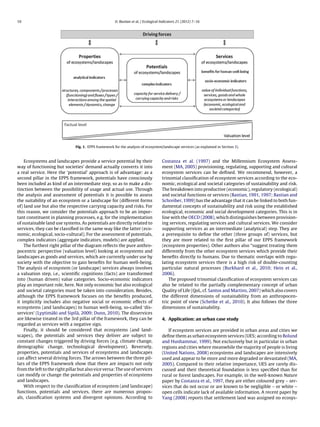
3. The EPPS framework
The EPPS framework that we propose for the analysis and the
assessment of ecosystem (and landscape) services consists of three
related and depending pillars – given in Fig. 1. The EPPS frame-
work applies to ecosystems and landscapes as well. Landscape
services are related to landscape elements (not necessarily ecosys-
tems, e.g. buildings and other human-made structures), they are
associated with pattern–process-relationships, and they are more
relevant and legitimate to local practitioners (cp. Termorshuizen
and Opdam, 2009). The left side of the diagram (pillar 1) shows
the ecosystem (or landscape) properties including its structures
(components) and processes (incl. functions in the sense of func-
tioning), which form the fundamentals for the existence of society
and of any services. Spatial aspects (the arrangement of parts of
the system, interactions between elements as well as fluxes of
matter, energy and living-beings), typification of ecosystems and
landscapes, but also aspects of time (ecosystem dynamics, changes
in ecosystems and landscapes) are included. In this first step within
the EPPS framework, the analysis of ecosystem properties is driven
by predominantly natural science methods using analytical indi-
cators. The results represent facts and data without – for the time
being – any relation to potential benefits, values or demands for
services by society.
10 O. Bastian et al. / Ecological Indicators 21 (2012) 7–16
Fig. 1. EPPS framework for the analysis of ecosystem/landscape services (as explained in Section 3).
Ecosystems and landscapes provide a service potential by their
way of functioning but societies’ demand actually converts it into
a real service. Here the ‘potential’ approach is of advantage: as a
second pillar in the EPPS framework, potentials have consciously
been included as kind of an intermediate step, so as to make a dis-
tinction between the possibility of usage and actual use. Through
the analysis and assessment of potentials it is possible to assess
the suitability of an ecosystem or a landscape for (different forms
of) land use but also the respective carrying capacity and risks. For
this reason, we consider the potentials approach to be an impor-
tant constituent in planning processes, e.g. for the implementation
of sustainable land use systems. As potentials are directly related to
services, they can be classified in the same way like the latter (eco-
nomic, ecological, socio-cultural). For the assessment of potentials,
complex indicators (aggregate indicators, models) are applied.
The furthest right pillar of the diagram reflects the pure anthro-
pocentric perspective (valuation level) looking at ecosystems and
landscapes as goods and services, which are currently under use by
society with the objective to gain benefits for human well-being.
The analysis of ecosystem (or landscape) services always involves
a valuation step, i.e., scientific cognitions (facts) are transformed
into (human driven) value categories. Socio-economic indicators
play an important role, here. Not only economic but also ecological
and societal categories must be taken into consideration. Besides,
although the EPPS framework focuses on the benefits produced,
it implicitly includes also negative social or economic effects of
ecosystems (and landscapes) to human well-being, so-called ‘dis-
services’ (Lyytimäki and Sipilä, 2009; Dunn, 2010). The disservices
are likewise treated in the 3rd pillar of the framework, they can be
regarded as services with a negative sign.
Finally, it should be considered that ecosystems (and land-
scapes), the potentials and services they deliver are subject to
constant changes triggered by driving forces (e.g. climate change,
demographic change, technological development). Reversely,
properties, potentials and services of ecosystems and landscapes
can affect several driving forces. The arrows between the three pil-
lars of the EPPS framework show that there are impacts not only
from the left to the right pillar but also vice versa: The use of services
can modify or change the potentials and properties of ecosystems
and landscapes.
With respect to the classification of ecosystem (and landscape)
functions, potentials and services, there are numerous propos-
als, classification systems and divergent opinions. According to
Costanza et al. (1997) and the Millennium Ecosystem Assess-
ment (MA, 2005) provisioning, regulating, supporting and cultural
ecosystem services can be defined. We recommend, however, a
trinomial classification of ecosystem services according to the eco-
nomic, ecological and societal categories of sustainability and risk.
The breakdown into productive (economic), regulatory (ecological)
and societal functions or services (Bastian, 1991, 1997; Bastian and
Schreiber, 1999) has the advantage that it can be linked to both fun-
damental concepts of sustainability and risk using the established
ecological, economic and social development categories. This is in
line with the OECD (2008), which distinguishes between provision-
ing services, regulating services and cultural services. We consider
supporting services as an intermediate (analytical) step. They are
a prerequisite to define the other (three groups of) services, but
they are more related to the first pillar of our EPPS framework
(ecosystem properties). Other authors also “suggest treating them
differently from the other ecosystem services which provide their
benefits directly to humans. Due to thematic overlaps with regu-
lating ecosystem services there is a high risk of double-counting
particular natural processes (Burkhard et al., 2010; Hein et al.,
2006).
The proposed trinomial classification of ecosystem services can
also be related to the partially complementary concept of urban
Quality of Life (QoL, cf. Santos and Martins, 2007) which also covers
the different dimensions of sustainability from an anthropocen-
tric point of view (Schetke et al., 2010). It also follows the three
dimensions of sustainability.
4. Application: an urban case study
If ecosystem services are provided in urban areas and cities we
define them as urban ecosystem services (UES; according to Bolund
and Hunhammar, 1999). Not exclusively but in particular in urban
regions and cities where meanwhile the majority of people is living
(United Nations, 2008) ecosystems and landscapes are intensively
used and appear to be more and more degraded or devastated (MA,
2005). Compared to their relative importance, UES are rarely dis-
cussed and their theoretical foundation is less specified than for
rural or forest landscapes. For example, in the well-known Nature
paper by Costanza et al., 1997, they are either coloured grey – ser-
vices that do not occur or are known to be negligible – or white –
open cells indicate lack of available information. A recent paper by
Yang (2008) reports that settlement land was assigned no ecosys-
O. Bastian et al. / Ecological Indicators 21 (2012) 7–16 11
tem service value derived from plants in residential and urban
areas. Thus, this section’s purpose is in fact twofold: to apply and
demonstrate the EPPS framework by providing the urban example
of the city of Leipzig, Germany. Leipzig as such is particularly inter-
esting since it passed a dynamics phase of suburban sprawl and
inner-urban shrinkage during the last 20 years after the fall of the
Berlin wall (Nuissl and Rink, 2005).
According to McDonald (2009), UES are provided at different
scales within an urban landscape: at the local (e.g. temperature reg-
ulation by tree shade, water and pollutant filtration at a single soil
plot or timber production in a specific tree estate), at the regional
(recreation, climate regulation, biodiversity) and at the global scale
(carbon mitigation, contribution to the continental or worldwide
gene pool and biodiversity).
UES are closely related to the usage of urban land as such: In
particular urban green spaces – that is forests, trees, parks, allot-
ments or cemeteries – provide a whole range of ecosystem services
for the residents of a city. Firstly, they help regulating extreme
day and night-time temperatures by shading, evapotranspiration
and lower surface emissivity (Chiesura, 2004; Priego et al., 2008;
Chang et al., 2007; Kottmeier et al., 2007). Nearly all types of urban
open and green spaces provide recreational facilities. Unsealed land
helps to regulate surface water flows, enhances infiltration, lowers
water travel times, which help to prevent floods and related dam-
ages (Haase, 2003). To support this kind of services by unsealed
land, urban water management increasingly uses ‘in situ drainage
sites’ (Haase, 2009). In terms of carbon mitigation urban trees and
urban soils contribute to the carbon uptake and thus to a partial
decrease of the urban footprint. Nowak and Crane (2002) estimated
that urban trees and forests balance about 1–2% of the urban C-
emissions.
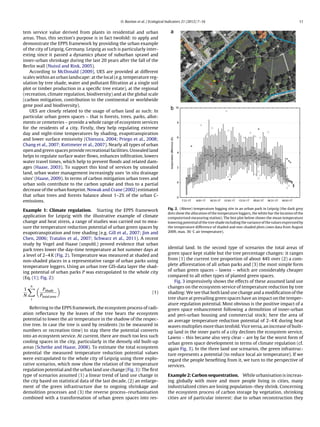
Example 1: Climate regulation. Starting the EPPS framework
application for Leipzig with the illustrative example of climate
change and heat stress, a range of studies was carried out to mea-
sure the temperature reduction potential of urban green spaces by
evapotranspiration and tree shading (e.g. Gill et al., 2007; Jim and
Chen, 2006; Tratalos et al., 2007; Schwarz et al., 2011). A recent
study by Vogel and Haase (unpubl.) proved evidence that urban
park trees lower the day-time temperature at hot summer days at
a level of 2–4 K (Fig. 2). Temperature was measured at shaded and
non-shaded places in a representative range of urban parks using
temperature loggers. Using an urban tree GIS-data layer the shad-
ing potential of urban parks P was extrapolated to the whole city
(Eq. (1); Fig. 2):
1
N
n
i
Pshade
Ptotal area
(1)
Referring to the EPPS framework, the ecosystem process of radi-
ation reflectance by the leaves of the tree bears the ecosystem
potential to lower the air temperature in the shadow of the respec-
tive tree. In case the tree is used by residents (to be measured in
numbers or recreation time) to stay there the potential converts
into an ecosystem service. At current, there are much too less such
cooling spaces in the city, particularly in the densely old built-up
areas (Schetke and Haase, 2008). To estimate the total ecosystem
potential the measured temperature reduction potential values
were extrapolated to the whole city of Leipzig using three explo-
rative scenarios, which now show the relation of the temperature
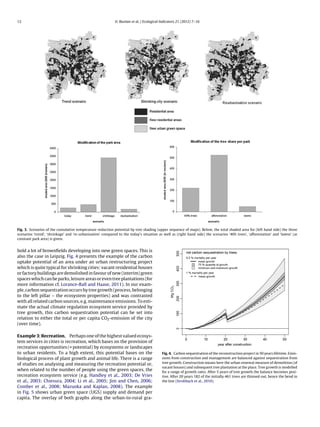
regulation potential and the urban land use change (Fig. 3): The first
type of scenarios assumed (1) a linear trend of land use change in
the city based on statistical data of the last decade, (2) an enlarge-
ment of the green infrastructure due to ongoing shrinkage and
demolition processes and (3) the reverse process–reurbanisation
combined with a transformation of urban green spaces into res-
Fig. 2. (Above) temperature logging site in an urban park in Leipzig (the dark grey
dots show the allocation of the temperature loggers, the white bar the location of the
computerised measuring station). The box plot below shows the mean temperature
lowering potential of the tree shade including the variance of the values expressed by
the temperature difference of shaded and non-shaded plots (own data from August
2009, max. 36 ◦
C air temperature).
idential land. In the second type of scenarios the total areas of
green space kept stable but the tree percentage changes: it ranges
from (1) the current tree proportion of about 44% over (2) a com-
plete afforestation of all urban parks and (3) the most simple form
of urban green spaces – lawns – which are considerably cheaper
compared to all other types of planted green spaces.
Fig. 3 impressively shows the effects of these assumed land use
changes on the ecosystem service of temperature reduction by tree
shading: We see that both land use change and a modification of the
tree share at prevailing green spaces have an impact on the temper-
ature regulation potential. Most obvious is the positive impact of a
green space enhancement following a demolition of inner-urban
and peri-urban housing and commercial stock; here the area of
an average temperature reduction potential of 2–4 K during heat
waves multiplies more than tenfold. Vice versa, an increase of built-
up land in the inner parts of a city declines the ecosystem service.
Lawns – this became also very clear – are by far the worst form of
urban green space development in terms of climate regulation (cf.
again Fig. 3). In the three land use scenarios, the green infrastruc-
ture represents a potential (to reduce local air temperature). If we
regard the people benefiting from it, we turn to the perspective of
services.
Example 2: Carbon sequestration. While urbanisation is increas-
ing globally with more and more people living in cities, many
industrialized cities are losing population–they shrink. Concerning
the ecosystem process of carbon storage by vegetation, shrinking
cities are of particular interest: due to urban reconstruction they
12 O. Bastian et al. / Ecological Indicators 21 (2012) 7–16
Fig. 3. Scenarios of the cumulative temperature reduction potential by tree shading (upper sequence of maps). Below, the total shaded area for (left hand side) the three
scenarios ‘trend’, ‘shrinkage’ and ‘re-urbanisation’ compared to the today’s situation as well as (right hand side) the scenarios ‘40% trees’, ‘afforestation’ and ‘lawns’ (at
constant park area) is given.
hold a lot of brownfields developing into new green spaces. This is
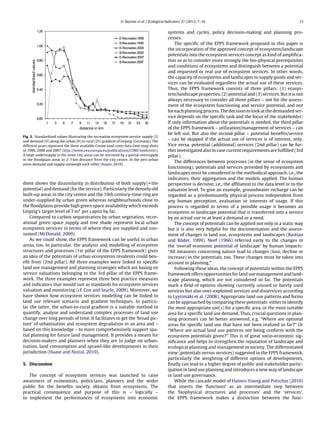
also the case in Leipzig. Fig. 4 presents the example of the carbon
uptake potential of an area under an urban restructuring project
which is quite typical for shrinking cities: vacant residential houses
or factory buildings are demolished in favour of new (interim) green
spaces which can be parks, leisure areas or even tree plantations (for
more information cf. Lorance-Rall and Haase, 2011). In our exam-
ple, carbon sequestration occurs by tree growth (process, belonging
to the left pillar – the ecosystem properties) and was contrasted
with all related carbon sources, e.g. maintenance emissions. To esti-
mate the actual climate regulation ecosystem service provided by
tree growth, this carbon sequestration potential can be set into
relation to either the total or per capita CO2-emission of the city
(over time).
Example 3: Recreation. Perhaps one of the highest valued ecosys-
tem services in cities is recreation, which bases on the provision of
recreation opportunities (= potential) by ecosystems or landscapes
to urban residents. To a high extent, this potential bases on the
biological process of plant growth and animal life. There is a range
of studies on analysing and measuring the recreation potential or,
when related to the number of people using the green spaces, the
recreation ecosystem service (e.g. Handley et al., 2003; De Vries
et al., 2003; Chiesura, 2004; Li et al., 2005; Jim and Chen, 2006;
Comber et al., 2008; Mazuoka and Kaplan, 2008). The example
in Fig. 5 shows urban green space (UGS) supply and demand per
capita. The overlay of both graphs along the urban-to-rural gra-
Fig. 4. Carbon sequestration of the reconstruction project in 50 years lifetime. Emis-
sions from construction and management are balanced against sequestration from
tree growth. Construction means here the urban renewal measure of demolition (of
vacant houses) and subsequent tree plantation at the place. Tree growth is modelled
for a range of growth rates. After 5 years of tree growth the balance becomes posi-
tive. After 20 years 182 of the initially 461 trees are thinned out, hence the bend in
the line (Strohbach et al., 2010).
O. Bastian et al. / Ecological Indicators 21 (2012) 7–16 13
Fig. 5. Standardised values illustrating the recreation ecosystem service supply (S)
and demand (D) along the urban (0) to rural (25) gradient of Leipzig (Germany). The
different years represent the three available Corine land cover data time snap shots
of 1990, 2000 and 2007 (http://www.eea.europa.eu/publications/COR0-landcover).
A large undersupply in the inner city areas can be mirrored by a partial oversupply
in the floodplain areas in 2–7 km distance from the city centre. In the peri-urban
areas demand and supply outweigh each other (Haase, 2010).
dient shows the dissimilarity in distribution of both supply (= the
potential) and demand (for the service). Particularly the densely old
built-up areas in the city centre and the 19th century-time ring are
under-supplied by urban green whereas neighbourhoods close to
the floodplains provide high green space availability which exceeds
Leipzig’s target level of 7 m2 per capita by far.
Compared to carbon sequestration by urban vegetation, recre-
ational green space supply and tree shade represent local urban
ecosystem services in terms of where they are supplied and con-
sumed (McDonald, 2009).
As we could show, the EPPS framework can be useful in urban
areas, too. In particular, the analysis and modelling of ecosystem
structures and processes (1st pillar of the EPPS framework) gives
an idea of the potentials of urban ecosystems residents could ben-
efit from (2nd pillar). All three examples were linked to specific
land use management and planning strategies which are basing on
service valuations belonging to the 3rd pillar of the EPPS frame-
work. The three examples represent three best practice measures
and indicators that would suit as standards for ecosystem services
valuation and monitoring (cf. Cox and Searle, 2009). Moreover, we
have shown how ecosystem services modelling can be linked to
land use relevant scenario and gradient techniques. In particu-
lar the latter, the urban-to-rural gradient is a suitable method to
quantify, analyse and understand complex processes of land use
change over long periods of time. It facilitates to get the ‘broad pic-
ture’ of urbanisation and ecosystem degradation in an area and –
based on this knowledge – to more comprehensively support spa-
tial planning for future land management. It provides a means for
decision-makers and planners when they are to judge on urban-
isation, land consumption and sprawl-like developments in their
jurisdiction (Haase and Nuissl, 2010).
5. Discussion
The concept of ecosystem services was launched to raise
awareness of economists, politicians, planners and the wider
public for the benefits society obtains from ecosystems. The
practical consequence and purpose of this is – logically –
to implement the performances of ecosystems into economic
systems and cycles, policy decision-making and planning pro-
cesses.
The specific of the EPPS framework proposed in this paper is
the incorporation of the approved concept of ecosystem/landscape
potentials into the ecosystem services concept as kind of amplifica-
tion so as to consider more strongly the bio-physical prerequisites
and conditions of ecosystems and distinguish between a potential
and requested or real use of ecosystem services. In other words,
the capacity of ecosystems and landscapes to supply goods and ser-
vices can be evaluated regardless the actual use of these services.
Thus, the EPPS framework consists of three pillars: (1) ecosys-
tem/landscape properties, (2) potential and (3) services. But it is not
always necessary to consider all three pillars – not for the assess-
ment of the ecosystem functioning and service potential, and not
for each planning process. The decision to look at the demanded ser-
vice depends on the specific task and the focus of the stakeholder:
If only information about the potentials is needed, the third pillar
of the EPPS framework – utilization/management of services – can
be left out. But also the second pillar – potential benefits/service
– can be skipped if the actual use of services is of interest, only.
Vice versa, potential (additional) services (2nd pillar) can be fur-
ther investigated also in case current requirements are fulfilled (3rd
pillar).
The differences between processes (in the sense of ecosystem
functioning), potentials and services provided by ecosystems and
landscapes must be considered in the methodical approach, i.e., the
indicators, their aggregation and the models applied. The human
perspective is decisive, i.e., the affiliation to the data level or to the
valuation level. To give an example, groundwater recharge can be
regarded as a predominantly physical process independent from
any human perception, evaluation or interests of usage. If this
process is regarded in terms of a possible usage it becomes an
ecosystem or landscape potential that is transferred into a service
by an actual use or at least a demand or a need.
The concept of potentials can be applied not only in a static way
but it is also very helpful for the documentation and the assess-
ment of changes in land use, ecosystems and landscapes (Bastian
and Röder, 1999). Neef (1966) referred early to the changes in
the ‘overall economic potential of landscape’ by human impacts:
“All measures concerning nature lead to changes (loss, decline or
increase) in the potentials, too. These changes must be taken into
account in planning.”
Following these ideas, the concept of potentials within the EPPS
framework offers opportunities for land use management and land-
scape planning, which are not considered so far. The potentials
mark a field of options showing currently unused or barely used
services but also over-exploited services and disservices according
to Lyytimäki et al. (2008). Appropriate land use patterns and forms
can be approached by comparing these potentials: either to identify
the most appropriate use(s) for a specific area, or the most suitable
area for a specific land use demand. Thus, crucial questions in plan-
ning processes can be better answered, e.g. “Where are optional
areas for specific land use that have not been realized so far?” Or
“Where are actual land use patterns not being conform with the
ecosystem potentials given?” This is of great socio-economic sig-
nificance and helps to strengthen the reputation of landscape and
ecological planning and management in society. The differentiated
view (potentials versus services) suggested in the EPPS framework,
particularly the weighting of different options of developments,
finally can lead to a higher degree of public and stakeholder partic-
ipation in land use planning and introduces a new way of landscape
or land use governance.
While the cascade model of Haines-Young and Potschin (2010)
that inserts the ‘functions’ as an intermediate step between
the ‘biophysical structures and processes’ and the ‘services’,
the EPPS framework makes a distinction between the func-
14 O. Bastian et al. / Ecological Indicators 21 (2012) 7–16
tion(ing)(belonging to the 1st pillar) and the functions used by the
society (societal functions in the sense of services, 3rd pillar), and it
emphasizes especially the potentials (2nd pillar) as an intermediate
step between biophysical processes and real services.
Especially in urban landscape planning, stakeholder-oriented in
nature, the EPPS framework including the concept of potentials
can be helpful: integrative planning thereby means the removal
of sectoral thinking and actions in favour of more holistic con-
cepts of regional and local regeneration and adaptation (Ravetz,
2000, 2004). Accordingly, expert-driven formal planning will be
enhanced and accompanied by participatory processes to ensure a
better integration within a city. For example, not exclusively but
most notably in shrinking cities concepts of ‘green and blue ser-
vices’ provide potential to move from a simple ‘land use view’ of
green and water areas in cities towards a valuation of ecosystem
processes and spatial potentials of each piece of land.
By including various groups of stakeholders in decision-making
during planning processes, the concept of potentials shows close
relations to different forms of governance, which can be seen as soft
forms of steering (e.g. Fürst, 2003; Fürst et al., 2008) or as “a process
of coordination of actors, social groups and institutions in order to
attain appropriate goals that have been discussed and collectively
defined in fragmented, uncertain environments” (Le Galès, 1998;
Wirth et al., 2010).
There are several examples of relations between ecosystem ser-
vices and governance in the literature, e.g. Haslett et al. (2009) who
argue that a “focus on governance and institutions and increased
communication and integration across the different sectors” is
a supposition “to incorporate an ecosystem services approach.”
Other authors (Norgaard and Jin, 2008; Tallis et al., 2009; TEEB,
2010) deal with trade and the governance of ecosystem ser-
vices. According to Termorshuizen and Opdam (2009), in systems
of governance planning (‘collaborative planning’ or ‘collaborative
management’) decision-making on landscape changes is becoming
the domain of various groups of actors at regional and local scales
where different demands on the landscape exist and, accordingly,
different perceptions of the benefits those landscapes must deliver
to society are held. The relation between the concept of potentials
on the one hand and the different governance schemes on the other
hand are not investigated thoroughly, yet.
6. Conclusions
There is a large variety of terms, topics, theoretical foundations
and methodological approaches in the area of ecosystem services.
The attempt to better adopt the concept of ecosystem services for
planning purposes and to put more emphasis on the difference
between the capacity of ecosystems and landscapes to supply goods
and services on the one hand, and of the actual use of these services
on the other hand, inevitably leads to the concept of ecosystem and
landscape potentials, which was elaborated already in the 1970s.
The potentials can be regarded as one of three pillars of the EPPS
framework proposed in this paper that ranges from the properties
of ecosystems and/or landscapes across its potentials to services
they supply. The theoretical concept was applied to urban ecosys-
tems to show the way it works. The concept of ecosystem and
landscape potentials is able to improve the implementation of the
ecosystem services approach in planning processes, e.g. by weight-
ing alternative land use development options. This ultimately can
lead to more participation in land use and landscape planning and
better governance schemes for conserving ecosystems, particularly
in intensively used dense urban areas of which an example was
shown in this paper.
Acknowledgements
We would like to thank Bradley Schmidt for polishing the lan-
guage of the paper. The urban case study was financially supported
by the EU Integrated Project PLUREL (contract no. 036921).
References
Ansink, E., Hein, L., Hasund, K.P., 2008. To value functions or services? An analysis
of ecosystem valuation approaches. Environmental Values 17, 489–503.
ARL (Academy for Spatial Research and Urban and Regional Planning, Ed.), 1995.
Handbuch der Raumordnung. Hannover.
Bastian, O., 1991. Biotische Komponenten in der Landschaftsforschung und-planung
Probleme ihrer Erfassung und Bewertung. Post-doc. Diss. M. Luther Univ., Halle-
Wittenberg.
Bastian, O., 1997. Gedanken zur Bewertung von Landschaftsfunktionen – unter
besonderer Berücksichtigung der Habitatfunktion. NNA Reports Schneverdin-
gen 10, 106–125.
Bastian, O., Lütz, M., 2006. Landscape functions as indicators for the development of
local agri-environmental measures. Ecological Indicators 6, 215–227.
Bastian, O., Röder, M., 1999. Analyse und Bewertung anthropogen bedingter
Landschaftsveränderungen–anhand von zwei Beispielsgebieten des sächsi-
schen Hügellandes.–In: Haase, G. (Ed.), Beiträge zur Landschaftsanalyse und
Landschaftsdiagnose.– Abhandl. Sächs. Akad. Wiss. zu Leipzig, math.-nat. Klasse,
vol. 59(1), pp. 75–149.
Bastian, O., Schreiber, K.-F. (Eds.), 1999. Analyse und ökologische Bewertung der
Landschaft, Spectrum Akadem. Verlag, Heidelberg/Berlin, 564 pp. (1st ed. 1994).
Bastian, O., Steinhardt, U. (Eds.), 2002. Development and Perspectives of Landscape
Ecology. Kluwer Academic Publishers, Dordrecht/Boston/London, 498 pp.
Bobek, H., Schmithüsen, J., 1949. Die Landschaft im logischen System der Geogra-
phie. Erdkunde 3, 112–120.
Bolund, P., Hunhammar, S., 1999. Ecosystem services in urban areas. Ecological
Economics 29, 293–301.
Boyd, J., Banzhaf, S., 2007. What are ecosystem services? The need for standardized
environmental accounting units. Ecological Economics 63, 616–626.
Buchwald, K., 1973. Landschaftsplanung und Ausführung landschaftspflegerischer
Maßnahmen. In: Buchwald, K., Engelhardt, W. (Eds.), Landschaftspflege und
Naturschutz in der Praxis. BLV-Buchverlag, München.
Burkhard, B., Kroll, F., Müller, F., Windhorst, W., 2009. Landscapes’ capacities to
provide ecosystem services – a concept for spatial modeling. Landscape Online
1/06, 1–30.
Burkhard, B., Petrosillo, I., Costanza, R., 2010. Ecosystem services – bridging ecology,
economy and social sciences. Ecological Complexity 7, 257–259.
Chang, C.R., Li, W.-H., Chang, S.-D., 2007. A preliminary study on the local cool-island
intensity of Taipei city parks. Landscape and Urban Planning 80, 386–395.
Chiesura, A., 2004. The role of urban parks for the sustainable city. Landscape and
Urban Planning 68, 29–138.
Comber, A., Brunsdon, C., Green, E., 2008. Using a GIS-based network analysis to
determine urban green space accessibility for different ethnic and religious
groups. Landscape and Urban Planning 86, 103–114.
Costanza, R., d’Arge, R., deGroot, R., Farber, S., Grasso, M., Hannon, B., Limburg, K.,
Naeem, S., O’Neill, R., Paruelo, J., et al., 1997. The value of the world’s ecosystem
services and natural capital. Nature 387, 253–260.
Cox, S., Searle, B., 2009. The State of Ecosystem Services. The Bridgespan Group.
Daily, G. (Ed.), 1997. Nature’s Services: Societal Dependence on Natural Ecosystems.
Island Press, Washington, D.C..
De Groot, R.S., 1992. Functions of Nature: Evaluation of Nature in Environmental
Planning, Management and Decision-making. Wolters-Noordhoff, Groningen.
De Groot, R.S., Wilson, M., Boumans, R., 2002. A typology for description, classifica-
tion and valuation of ecosystem functions, goods and services. Environmental
Economics 41, 393–408.
De Vries, S., Verheij, R.A., Groenewegen, P.P., Spreeuwenberg, P., 2003. Natural envi-
ronments – healthy environments? An exploratory analysis of the relationship
between greenspace and health. Environment and Planning A 35, 1717–1731.
Dunn, R.R., 2010. Global mapping of ecosystem disservices: the unspoken reality
that nature sometimes kills us. Biotropica 42, 555–557.
Durwen, K.J., 1995. Naturraum-Potential und Landschaftsplanung. Nürtinger
Hochschulschriften 13, 45–82.
Eliáˇs, P., 1983. Ecological and social functions of vegetation. Ekológia (ˇCSSR) 2,
93–104.
Finvers, M.A., 2008. Application of DPSIR for analysis of soil protection issues and
an assessment of British Columbia’s soil protection legislation. M. Sc. Thesis.
Cranfield University, UK.
Fisher, B., Turner, R.K., Morlin, P., 2009. Defining and classifying ecosystem services
for decision-making. Ecological Economics 68, 643–653.
Forman, R.T.T., Godron, M., 1986. Landscape Ecology. John Wiley Sons, New York.
Fürst, D., 2003. Steuerung auf regionaler Ebene versus Regional Governance. Infor-
mationen zur Raumentwicklung 8/9, 441–450.
Fürst, D., Gailing, L., Pollermann, K., Röhring, A. (Eds.), 2008. Kulturlandschaft
als Handlungsraum – Institutionen und Governance im Umgang mit dem
regionalen Gemeinschaftsgut Kulturlandschaft. Rohn, Dortmund, 328 pp.
Gill, S., Handley, J.F., Ennos, A.R., Pauleit, S., 2007. Adapting cities for climate change:
the role of the Green Infrastructure. Built Environment 33, 115–133.
O. Bastian et al. / Ecological Indicators 21 (2012) 7–16 15
Grunewald, K., Bastian, O., 2010. Ökosystemdienstleistungen analysieren – begrif-
flicher und konzeptioneller Rahmen aus landschaftsökologischer Sicht. GEOÖKO
31, 50–82.
Haase, D., 2003. Holocene floodplains and their distribution in urban areas – func-
tionality indicators for their retention potentials. Landscape and Urban Planning
66, 5–18.
Haase, D., 2009. Effects of urbanisation on the water balance – a long-term trajectory.
Environment Impact Assessment Review 29, 211–219.
Haase, D., 2010. Trade-offs between ecosystem services under conditions of
changing land use: the urban perspective. In: Global Land Project Workshop
on Representation of ecosystem services in the modelling of land systems,
Aberdeen, March 2010.
Haase, D., Nuissl, H., 2010. Assessing the impacts of land use change on transforming
regions. Editorial. Land Use Science 5 (2), 67–721.
Haase, G., 1973. Zur Ausgliederung von Raumeinheiten der chorischen und der
regionischen Dimension – dargestellt an Beispielen aus der Bodengeographie.
Petermanns Geogr. Mittell 17, 81–90.
Haase, G., 1978. Zur Ableitung und Kennzeichnung von Naturraumpotenzialen.
Petermanns Geogr. Mittell 22, 113–125.
Haase, G., Haase, D., 2002. Approaches and methods of landscape diagnosis. In:
Bastian, O, Steinhardt, U., Naveh, Z. (Eds.), Development and Perspectives of
Landscape Ecology. Kluwer, pp. 113–122.
Haase, G., Mannsfeld, K. (Eds.), 2002. Naturraumeinheiten, Landschaftsfunktionen
und Leitbilder am Beispiel von Sachsen. Forschungen zur deutschen Lan-
deskunde, vol. 250. Flensburg, 214 pp.
Haines-Young, R., Potschin, M., 2010. Proposal for a Common International Classifi-
cation of Ecosystem Goods and Services (CICES) for Integrated Envi-ronmental
and Economic Accounting, Report to the European Environmental Agency, Not-
tingham.
Handley, J., Pauleit, S., Slinn, P., Lindley, S., Baker, M., Barber, A., Jones, C., 2003,
Providing accessible natural green space in towns and cities: a practical guide
to assessing the resource and implementing local standards for provision,
http://wwwenglish-natureorguk/pubs/publication/PDF/Accessgreenspacepdf.
Haslett, J.R., Berry, P.M., Bela, G., Jongman, R.H.G., Pataki, G., Samways, M.J., Zobel,
M., 2009. Changing conservation strategies in Europe: a framework integrating
ecosystem services and dynamics. Biodiversity and Conservation, 15 pp.
Hein, L., van Koppen, K., de Groot, R.S., van Ierland, E.C., 2006. Spatial scales,
stakeholders and the valuation of ecosystem services. Ecological Economics 57,
209–228.
Heinberg, R., 2010. Turning the Corner on Growth. Solutions – Perspectives.
http://www.thesolutionsjournal.com/node/539.
Jax, K., 2003. Die Funktion biologischer Vielfalt. In: Körner, S., Nagel, A., Eisel, U. (Eds.),
Naturschutzbegründungen. Bundesamt für Naturschutz, Bonn-Bad Godesberg,
pp. 150–174.
Jim, C.Y., Chen, W.Y., 2006. Recreation-amenity use and contingent valuation of
urban green spaces in Guanzhou, China. Landscape and Urban Planning 75,
81–96.
Kottmeier, C., Biegert, C., Corsmeier, U., 2007. Effects of urban land use on surface
temperature in Berlin: case study. Journal of Urban Planning and Development,
128–137.
Lahaye, P., Harms, B., Stortelder, A., Vos, W., 1979. Grundlagen für die Anwendung
landschaftsökologischer Erkenntnisse in der Raumplanung. Verhandl. d. Ges. f.
Ökologie Münster 7, 79–84.
Laurijssen, J., Faaij, A.P.C., 2009. Trading biomass or GHG emission credits? Climatic
Change 94, 287–317.
Langer, H., 1970. Die ökologische Gliederung der Landschaft und ihre Bedeutung für
die Fragestellung der Landschaftspflege. Landschaft + Stadt 3.
Lappé, F.M., 2009. Questions to ask strategies to save our planet. Solutions 1,
34–35.
Le Galès, P., 1998. Regulations and governance in European cities. International
Journal of Urban and Regional Research 22, 482–506.
Leser, H., 1997. Landschaftsökologie, 4th ed. Eugen Ulmer, Stuttgart,
644 pp.
Li, F., Wang, R., Paulussen, J., Liu, X., 2005. Comprehensive concept planning of
urban greening based on ecological principles: a case study from Beijing, China.
Landscape and Urban Planning 72, 325–336.
Lorance-Rall, E.D., Haase, D., 2011. Creative Intervention in a dynamic city: a sus-
tainability assessment of an interim use strategy for brownfields in Leipzig,
Germany. Landscape and Urban Planning 100, 189–201.
Lüttig, G., Pfeiffer, D., 1974. Die Karte des Naturraumpotentials, Ein neues
Ausdrucksmittel geowissenschaftlicher Forschung für Landesplanung und Rau-
mordnung. N. Arch. f. Nds. 23, 3–13.
Lyytimäki, J., Petersen, L.-K., Normander, B., Bezák, P., 2008. Nature as a nuisance?
Ecosystem services and disservices to urban lifestyle. Journal of Integrative Envi-
ronmental Sciences 5 (3), 161–172.
Lyytimäki, J., Sipilä, M., 2009. Hopping on one leg – the challenge of ecosystem
disservices for urban green management. Urban Forestry and Urban Greening
8, 309–315.
MA (Millennium Ecosystem Assessment), 2005. Ecosystems and Human Wellbeing:
Synthesis. Island Press, Washington, DC.
van der Maarel, E., 1978. Ecological principles for physical planning. In: Holdgate,
W., Woodman, M.J. (Eds.), The Breakdown and Restoration of Ecosystems. Conf.
Ser. I Ecology 3. Plenum Press, New York/London, pp. 413–450.
Mannsfeld, K., 1983. Landschaftsanalyse und Ableitung von Naturraumpotentialen.
In: Abhandl. Sächs. Akad. Wiss., Leipzig, math. nat. class, vol. 35,. Academie-
Verlag, Berlin.
Marks, R., Müller, M.J., Leser, H., Klink, H.J. (Eds.), 1992. Anleitung zur Bewertung
des Leistungsvermögens des Landschaftshaushaltes. Forsch. zur Deutschen Lan-
deskunde, vol. 229. Trier (2nd ed.; 1st ed. 1989).
Mazuoka, R.H., Kaplan, R., 2008. People needs in the urban landscape: analysis of
landscape and urban planning contributions. Landscape and Urban Planning 84,
7–19.
McDonald, R., 2009. Ecosystem service demand and supply along the urban-to-rural
gradient. Journal of Conservation Planning 5, 1–14.
Müller, F., Burkhard, B., 2007. An ecosystem based framework to link landscape
structures, functions and services. In: Mander, Ü., Wiggering, H., Helming, K.
(Eds.), Multifunctional Land Use – Meeting Future Demands for Landscape Goods
and Services. Springer, Berlin/Heidelberg/New York, pp. 37–64.
Nature, 2010. Wanted: an IPCC for biodiversity. Nature 465 (June (7298)), 525.
Neef, E., 1966. Zur Frage des gebietwirtschaftlichen Potentials. Forschungen und
Fortschritte 40, 65–70.
Neßhöver, C., Beck, S., Born, W., Dziock, S., Görg, C., Hansjürgens, B., Jax, K., Köck, W.,
Rauschmeyer, F., Ring, I., Schmidt-Loske, K., Unnerstall, H., Wittmer, H., Henle,
K., 2007. Das Millennium Ecosystem Assessment – eine deutsche Perspektive.
Natur und Landschaft 82, 262–267.
Niemann, E., 1977. Eine Methode zur Erarbeitung der Funktionsleistungsgrade von
Landschaftselementen. Arch. Nat. schutz Landsch. forsch. 17, 119–158.
Niemann, E., 1982. Methodik zur Bestimmung der Eignung, Leistung und Belast-
barkeit von Landschaftselementen und Landschaftseinheiten. In: Wiss. Mitt. d.
Inst. f. Geogr. u. Geoökol. d. Akad. d. Wiss. d. DDR, Leipzig, special issue no. 2.
Norberg, J., 1999. Linking nature’s services to ecosystems: some general ecological
concepts. Ecological Economics 29, 183–202.
Norgaard, R.B., Jin, L., 2008. Trade and the governance of ecosystem services. Eco-
logical Economics 66, 638–652.
Nowak, D.J., Crane, D.E., 2002. Carbon storage and sequestration by urban trees in
the USA. Environmental Pollution 116, 381–389.
Nuissl, H., Rink, D., 2005. The ‘production’ of urban sprawl, urban sprawl in eastern
Germany as a phenomenon of post-socialist transformation. Cities 22, 123–134.
2008. Strategic Environmental Assessment and Ecosystem Services. DAC Network
on Environment and Development Co-operation (ENVIRONET), Paris, 26 pp.
Potschin, M.B., Haines-Young, R., 2003. Improving the quality of environmental
assessments using the concept of natural capital: a case study from southern
Germany. Landscape and Urban Planning 63, 93–108.
Priego, C., Breuste, J., Rojas, J., 2008. Perception and value of nature in urban land-
scapes: a comparative analysis of cities in Germany. Chile and Spain. Landscape
Online 7, 1–22.
Ranganathan, J. et al., 2008. Ecosystem services: A guide for decision-makers. Tech.
Rep., World Resources Institute.
Ravetz, J., 2000. City Region 2020. Integrated planning for a sustainable environment.
Earthscan, London.
Ravetz, J., 2004. City-Region 2020: Integrated Planning for a Sustainable Environ-
ment. Taipei Chan’s Publishing Co., Ltd, Taiwan.
ROG, 2008. Federal Spatial Planning Act of Germany [Raumordnungsgesetz (ROG)],
22.12.2008.
Santos, L.D., Martins, I., 2007. Monitoring urban quality of life – the Porto experience.
Social Indicators Research 80, 411–425.
Schetke, S., Haase, D., Breuste, J., 2010. Green space functionality under conditions
of uneven urban land use development. Land Use Science 5, 143–158.
Schetke, S., Haase, D., 2008. Multi-criteria assessment of socio-environmental
aspects in shrinking cities. Experiences from Eastern Germany. Environmental
Impact Assessment Review 28, 483–503.
Schwarz, N., Bauer, A., Haase, D., 2011. Assessing climate impacts of local and
regional planning policies – quantification of impacts for Leipzig (Germany).
Environmental Impact Assessment Review 31, 97–111.
Spangenberg, J.H., Settele, J., 2010. Precisely incorrect? Monetising the value of
ecosystem services. Ecological Complexity 7, 327–337.
Strohbach, M.W., Arnold, E., Haase, D., 2010. The carbon mitigation potential of urban
restructuring – a life cycle analysis of green space development. Leipzig, mscr.,
unpubl.
Tallis, H., Goldman, R., Uhl, M., Brosi, B., 2009. Integrating conservation and develop-
ment in the field: implementing ecosystem service projects. Frontiers in Ecology
and Environment 7, 12–20.
The Economics of Ecosystems and Biodiversity, 2010, http://www.teebweb.org/.
Termorshuizen, J.W., Opdam, P., 2009. Landscape services as a bridge between
landscape ecology and sustainable development. Landscape Ecology, online 4
January 2009, 17 pp.
Tratalos, J., Fuller, R.A., Warren, P.H., Davies, R.G., Gaston, K.J., 2007. Urban form,
biodiversity potential and ecosystem services. Landscape and Urban Planning
83, 308–317.
Tüxen, R., 1956. Die heutige potentielle natürliche Vegetation als Gegenstand der
Vegetationskartierung. Angewandte Pflanzensoziologie 13, 5–42.
United Nations, European Commission, IMF (International Monetary
Fund), OECD (Organisation for Economic Co-operation and Devel-
opment), and World Bank, 2003. Handbook of National Accounting:
Integrated Environmental and Economic Accounting. Washington, DC.
http://unstats.un.org/unsd/envAccounting/seea2003.pdf.
United Nations, Department of Economic and Social Affairs, Population Divi-
sion, 2008. World urbanization prospects: The 2007 revision. Available at:
http://esa.un.org/unup (accessed 02.07.10).
Vejre, H., 2009. Quantification and aggregation of landscape functions/services in
periurban landscapes. In: Breuste, J., Kozová, M., Finka, M. (Eds.), Proc. Europ.
IALE Conf. Salzburg 2009, pp. 430–432.
16 O. Bastian et al. / Ecological Indicators 21 (2012) 7–16
Volk, M., Hirschfeld, J., Dehnhardt, A., Schmidt, G., Bohn, C., Liersch, S., Gassmann,
P.W., 2008. Integrated ecological-economic modelling of water pollution abate-
ment management options in the Upper Ems River Basin. Ecological Economics
66 (1), 66–76.
Wiggering, H., Müller, K., Werner, A., Helming, K., 2003. The concept of mul-
tifunctionality in sustainable land development. In: Helming, K., Wiggering,
H. (Eds.), Sustainable Development of Multifunctional Landscapes. Springer,
Berlin/Heidelberg/New York, pp. 3–18.
Willemen, L., 2010. Mapping and modelling multifunctional landscapes. Ph.D. The-
sis. Wageningen, 152 pp.
Wirth, P., Hutter, G., Schanze, J., 2010. Flood risk management and regional gover-
nance – The case of Weisseritz Regio (Germany). In: Kluvánková-Oravská,
T., et al. (Eds.), From Government to Governance? New Governance for
Water and Biodiversity in an Enlarged Europe. Alfa Nakladatelství, Prague,
pp. 128–141.
Yang, H., 2008. An ecosystem service value assessment of land-use change on Poyang
lake basin under 3S technology, China. In: The International Archives of the
Photogrammetry, Remote Sensing and Spatial Information Sciences, vol. 37. Part
B8, Beijing, pp. 327–330.

1 s2.0-urbag ecoservices concept

  • 1.
    Ecological Indicators 21(2012) 7–16 Contents lists available at ScienceDirect Ecological Indicators journal homepage: www.elsevier.com/locate/ecolind Ecosystem properties, potentials and services – The EPPS conceptual framework and an urban application example Olaf Bastiana,∗ , Dagmar Haaseb , Karsten Grunewalda a Leibniz Institute of Ecological and Regional Development (IOER), Dresden, Germany b Humboldt-University, Berlin, Germany a r t i c l e i n f o Keywords: Ecosystem services Ecosystem functions Landscape planning Urban green spaces Carbon sequestration Recreation a b s t r a c t The concept of ecosystem services is an approach widely discussed to clarify and to assess the dependence of human society on ecosystems and landscapes. In order to better differentiate between the potential performance of ecosystems and landscapes and the quality needed or demanded by society, in this paper we suggest returning to the landscape potential concept developed by landscape ecologists in the 1970s. Emerging from both concepts is the hereinafter discussed EPPS framework – ecosystem (or landscape) properties, potentials and services – which is a way to better link both potentials and services to current planning and management practice and governance schemes. The empirical part of the paper shows applications of the EPPS framework in an urban region. © 2011 Elsevier Ltd. All rights reserved. 1. Introduction Ecosystem services (ES) can be defined as “the benefits peo- ple obtain from ecosystems” (MA, 2005). For about two decades the scientific concept of ecosystem goods and services has gained increasing attention and importance among scientists worldwide (e.g. Lappé, 2009; Burkhard et al., 2010). This growing popularity of the ecosystem services concept can be seen primarily as a reaction on the interplay of firstly the long- term neglecting of biophysical and ecosystem functions – often considered gratis – in our economic cycles and the societal system as such and, secondly, the growing devastation and degradation of the ecosystems providing these performances (Norberg, 1999; Boyd and Banzhaf, 2007). With the publication of the Millennium Ecosystem Assessment (MA, 2005) at the latest it also became clear for the critical expert public that humankind depends on nature and ecosystems, their functions and the variety of processes and fluxes. Another example for the growing importance of ecosystem services for global policy is the TEEB (2010) which focuses on the economics of ecosystems and biodiversity. Currently, the issues of biodiversity and ecosystem services might draw policy-makers’ attention: In June 2010 the Intergovernmental Science-Policy Platform on Bio- diversity and Ecosystem Services (IPBES) was founded in Busan, South Korea (Nature, 2010). The attractiveness of the ecosystem services concept results on the one hand from its interdisciplinary character – it is integrated by ∗ Corresponding author. E-mail address: o.bastian@ioer.de (O. Bastian). nature – and on the other hand, it explicitly involves both natural science based and socio-economic science views and approaches (Müller and Burkhard, 2007). Neßhöver et al. (2007) call ecosystem services a missing link between ecosystems and human well-being, which is close to the view of the MA, too. However, despite all progress in making ecosystems, their goods and services popular, we are still far from firstly, a satisfying and comprehensive scientific description of the multiple rela- tionships and feedbacks among different ecosystem services, and secondly, a real impact of the ecosystem services approach on political decision-making (Cox and Searle, 2009; Haines-Young and Potschin, 2010). Instead, we have to state an increasing degradation of ecosystems worldwide (MA, 2005; Heinberg, 2010) along with the increase of impacts of natural hazards (floods, land slides, for- est fires, heat waves) dramatically showing the declining resilience of ecosystems worldwide. One most likely reason for this impair- ment is the non-integration of ecosystem services in spatial and land use planning in many countries worldwide. Particularly the environmental legislation in many countries is not at all aware of the ecosystem services concept. But also science has still not met thresholds for policy impacts due to a lack of information, stan- dards or verification (Cox and Searle, 2009). This is surprising so far as there are various traditional scientific approaches to value ecosystems and landscapes such as the framework of natural poten- tials and landscape diagnosis by Haase et al. (further reading Haase and Haase, 2002); or the landscape functions concept (e.g. Marks et al., 1992; Bastian and Steinhardt, 2002; Bastian and Lütz, 2006; Willemen, 2010). For example in Germany or the Netherlands, the concept of landscape functions is used in landscape planning in order to delineate protection zones or to determine priority areas 1470-160X/$ – see front matter © 2011 Elsevier Ltd. All rights reserved. doi:10.1016/j.ecolind.2011.03.014
  • 2.
    8 O. Bastianet al. / Ecological Indicators 21 (2012) 7–16 for agricultural, forest or recreational use (ROG, 2008; Willemen, 2010). For most of the German planners – at least – it remains unclear how to bring natural science-based landscape functions together with the more valuation-centered ecosystem services (Boyd and Banzhaf, 2007; Ranganathan et al., 2008; Volk et al., 2008). What are the linkages between these two concepts (func- tions/services)? At this point, we argue, that a joint view at and a combina- tion of the variety of the approaches to assess the ecosystems or landscapes would help to better integrate the ecosystem services concept into spatial planning. In so doing, this paper presents a methodological framework which is based on the three pillars: (1) the description and analysis of ecosystems’ and landscapes’ prop- erties (structure, processes and biophysical functioning), (2) the derivation of ecosystems’ and landscapes’ potentials to provide services, (3) the definition and valuation of services for human benefit creating. Therefore, we call this framework hereinafter EPPS (Ecosystem Properties, Potentials, and Services). In the EPPS framework, we will highlight the importance of the aspects of the ‘natural potential’ (in German Naturraumpotenzial) for ecosys- tems/landscapes and their functioning as it–explicitly using the term ‘potential’–better differentiates between potential supply and current demands/usage of ecosystem services. The terminus ‘nat- ural’ in this case means biophysical processes and structures of ecosystems and landscapes and should not be mixed up with ‘pris- tine’ or ‘undisturbed’. Without ignoring the fact that ecosystem and landscape represent two quite different concepts, the EPPS frame- work applies to ecosystems as well as to landscapes, since both provide potentials and services. Corresponding to its conceptual foundation, in the second part of the paper, the EPPS framework is applied to urban ecosystems and their functions, potentials and services as we find here on the one hand a particular pressure on ecosystems and natural resources but on the other hand also a high demand and potential for partic- ipation in integrative planning and land use management (Ravetz, 2000, 2004). 2. Conceptual foundations 2.1. Ecosystem properties Ecosystem properties include the structures and processes of ecosystems and landscapes in its spatial and temporal variability (e.g. soil properties, biotic material production, nutrient cycles, bio- logical diversity), which form the basis for the existence of society and of any kind of services utilisable by humanity. This ecological endowment does not consider potential or actual users, yet. It is assigned only to the factual level. Based on that, ecosystems (as well as landscapes) have the ability to render certain services for human society. From a (landscape-) ecological viewpoint, analysing the structures and processes of the ecosystems (or the landscape) is a basic prerequisite to approach ecosystem services. This also includes the ‘functioning’; the distinction to the ‘societal functions’ must be considered, though (see below and Section 2.3). The term ‘function’ is not used consistently in literature. This is frequently leading to terminological uncertainties, mis- understanding and confusion (cf. Burkhard et al., 2010). Thus, a purely ecological interpretation is common, in the sense of the ecosystem ‘functioning’ as a scientifically determined organisation of structural–procedural contexts (e.g. food chains and nutrient cycles); cf. Forman and Godron, 1986 where function is “the inter- actions among the spatial elements, that is, the flows of energy, materials, and species among the component ecosystem”. In the TEEB study (TEEB, 2010), functions are also regarded as purely eco- logical phenomena. By comparison, according to Costanza et al. (1997) or the Mil- lennium Ecosystem Assessment (MA, 2005), ecosystem functions support ecosystem services (ES). For Boyd and Banzhaf, 2007, func- tions are ‘intermediate products’ of ecosystem services. Already van der Maarel (1978) and (later) Eliáˇs, 1983 distinguished early between two basic groups of functions: ecological resp. internal or regulating functions (important for the existence of the ecosystems, regardless of perception by humans or specific societal claims), and societal functions satisfying human needs and demands. However, a clear distinction between both mentioned types of functions is missing there. Jax, 2003 comprehensively dealt with the different uses of the term ‘function’ and suggests using it exclusively when related to society, in other words, representing a service. Ecosystem properties are a component of the natural capital (Costanza et al., 1997; Potschin and Haines-Young, 2003) resp. of the ‘quality of life capital’ (Santos and Martins, 2007). Thus, ecosys- tem properties are a prerequisite for the human well-being that is based on the natural capital of the earth from which goods and services are generated (Finvers, 2008). In the EPPS framework, we consider the analysis of ecosystem and landscape properties as the base for the assessment steps fol- lowing in the pillars 2 and 3. Functions in the sense of functioning without any expressive human perspective (e.g. nutrient cycles, pedogenesis, and litter decomposition) are belonging to the first pillar, too. 2.2. Ecosystem potentials In European concepts and schools of landscape ecology, for example, in the German ‘landscape literature’, landscape poten- tials have been conceptualized, set into operation and were broadly discussed (see here Bastian and Schreiber, 1999; Bastian and Steinhardt, 2002; Haase and Mannsfeld, 2002; Burkhard et al., 2009; Grunewald and Bastian, 2010). The concept of potentials assesses nature’s goods from the point of view of the potential user and by means of a primarily science- driven (explicitly including natural and social sciences) mode of operation. The goal is to display the service capacities of an ecosys- tem (or of the bio-physical part of a landscape area) as a field of options available to society for usage. So doing, the potential- approach also considers categories as risk, carrying capacity and the capacity to capture and balance stresses (increasingly summarised today in the term ‘resilience’) which limit or may even exclude certain intended uses. By making ecosystem and landscape poten- tials scientific categories and having them ascertained according to specific parameters of biophysical processes, they can be dis- tinguished from natural resources, which represent an economic category (Mannsfeld, 1983). The approach of (landscape) potentials constitutes an impor- tant foundation for land use and landscape planning. Knowledge about potentials, which are available but still largely barely used can be applied to improve land use and to develop resources. This concept was introduced by Bobek and Schmithüsen (1949), ini- tially as a ‘spatial arrangement of nature-bond opportunities for development’. The scientific literature, moreover, covers such con- cepts as ‘natural potential’ (Langer, 1970; Buchwald, 1973); Lüttig and Pfeiffer (1974) drew ‘maps of natural landscape potentials’ (cp. Durwen, 1995; Leser, 1997). In botany, the term ‘potential’ appears in the form of ‘potential natural vegetation’, which was an integral used to indicate the totality of growth conditions at a given site (Tüxen, 1956). Driven by his view that all social and economic processes which trigger ecological changes are detectable via the turnover of material and energy, Neef (1966) defined a ‘(regional) economic potential of a landscape’ (in German gebietswirtschaftliches Poten- zial) as “the sum of all energy which is latently available in a certain
  • 3.
    O. Bastian etal. / Ecological Indicators 21 (2012) 7–16 9 area, which is released and converted by economic activities in the landscape”. Haase (1973, 1978) offered a way out of this hardly manageable complexity by suggesting that, instead of a summary energy standard for a theoretically conceivable overall potential, specific factors (properties, indicators) should be addressed in a particular case and so-called ‘partial natural landscape potentials’ defined with a clear focus on more specific socio-economic or soci- etal goals and basic functions. This includes for example biotic yield potential and regulatory potentials, water supply and dis- posal potentials, construction and recreational potentials. At the same time, van der Maarel (1978) and Lahaye et al., 1979 in the Netherlands defined ‘landscape potencies’ which can contribute to the fulfilment of specific societal needs. But even very recently the term ‘potential’ has also been used: For example, Burkhard et al. (2009) formulate “What potential do the different land cover units have to provide which ecosys- tem services?” and they mention “. . . the presence of trees or plants with potential use for timber” and that “the water stor- age potential can change with the conversion of wetlands or the replacement of forests with croplands or croplands with urban areas.” Laurijssen and Faaij (2009) deal with so-called ‘biomass production potentials’. Wiggering et al. (2003) link socio-economic requirements with landscape potentials. Finally, the United Nations (2003) emphasize that “the objective of a better understanding of the relationship between economic activities and the environment requires that both the use of land by different economic activities and the potentials of land from an ecological view” is to be taken into account, and: “The potentials can be assessed from several points of view, one of them being the capacity of the landscape to sustain natural life under the pressure of human activities.” In addition to ‘potential’, the term ‘capacity’ can also be found in literature about ecosystem functions, goods and services rather often. Thus, De Groot et al. (2002) and Willemen (2010) define ‘ecosystem functions’ (and ‘landscape functions’) as “the capacity of natural processes and components to provide goods and services which directly and/or indirectly satisfy human needs.” Capacity covers both performance and capability of an ecosystem or a land- scape to deliver services and is thus, compared to potential, not limited to an imagined but not necessarily demanded performance. The Millennium Ecosystem Assessment (MA, 2005) argues that the ecosystem capacity (as a function of abiotic and biotic characteris- tics, including geomorphology, soil quality, weather conditions and biodiversity) makes some potentially desirable ecosystem services biologically impossible (e.g. growing coffee in Canada). The state of the ecosystem capacity at the time a decision is taken sets the ini- tial condition for the range, level, and quality of intended services that can be obtained. Additionally, MA (2005) emphasizes another, very important aspect: “the capacity of the natural system to sus- tain the flow of economic, ecological, social, and cultural benefits in the future.” Hence, we include the concept of ecosystem and landscape potentials as the 2nd pillar in the EPPS framework to distinguish between the potential (= capacity) to supply services and the actual or demanded/needed use of these services by humans. With the concept of potentials we address both the question of non-use or inadequate use of natural resources and the problems of overex- ploitation (see Section 5). 2.3. Ecosystem services Although the concept of ecosystem services already emerged during the 1960s it had been established in the international envi- ronmental discussion in the 1990s (e.g. De Groot, 1992; Daily, 1997; Costanza et al., 1997). But still today there remains a lack of a con- sistent terminology. Both Costanza et al. (1997) and the Millennium Ecosystem Assessment (MA, 2005) define ecosystem services as “the benefits people obtain from ecosystems”. Boyd and Banzhaf (2007), contrarily, differentiate between ecosystem services and the benefits which they generate. Fisher et al. (2009) define ecosys- tem services as those aspects of ecosystems which, actively or passively, provide human well-being, while TEEB (2010) sees them as the direct and indirect contributions of ecosystems to human well-being. Boyd and Banzhaf (2007) criticise the fact that many of the ‘services’ listed by Daily (1997) or in the Millennium Ecosystem Assessment (MA, 2005) are actually ecosystem processes or func- tions. However, the simultaneous or synonymous use of the terms ‘functions’ and ‘services’ without defining either clearly or distin- guishing them from one another occurs quite regularly (e.g. Vejre, 2009; Willemen, 2010). While the term ‘service’ has gained accep- tance in the English-speaking realm, the approach of the ‘societal functions’ of nature and the landscape found entrance in the sci- entific discussion nearly exclusively in German-speaking countries (Ansink et al., 2008; Grunewald and Bastian, 2010). Spangenberg and Settele (2010) argue that “talking about ecosystem services instead of ecosystem functions” will help “to convey the message to decision-makers in a terminology they are used to and which might stimulate them to act.” While potentials describe the opportunity to use structures and processes of ecosystems and landscapes, the realization of this use is captured by the concept of ecosystem (or landscape) functions (in the sense of services, cp. Section 2.1). Niemann (1977, 1982), for instance, designed a methodology for ascertaining the degree of ‘functional performance’ of landscape elements and landscape units. In spatial and regional planning, functions are defined as “tasks which an area is to fulfil for the needs of life of the people” (ARL, 1995). According to Wiggering et al. (2003), the determina- tion of the multiple ecological, social and economic functions of the landscape (multifunctionality) in their regional differentiation is the prerequisite for sustainable land use. Consequently, we regard ecosystem services as the actually used or demanded contributions of ecosystems and landscapes to human benefits and the human well-being. They represent the 3rd pillar of the EPPS framework and include the term ‘function’ in its strong human perspective. 3. The EPPS framework The EPPS framework that we propose for the analysis and the assessment of ecosystem (and landscape) services consists of three related and depending pillars – given in Fig. 1. The EPPS frame- work applies to ecosystems and landscapes as well. Landscape services are related to landscape elements (not necessarily ecosys- tems, e.g. buildings and other human-made structures), they are associated with pattern–process-relationships, and they are more relevant and legitimate to local practitioners (cp. Termorshuizen and Opdam, 2009). The left side of the diagram (pillar 1) shows the ecosystem (or landscape) properties including its structures (components) and processes (incl. functions in the sense of func- tioning), which form the fundamentals for the existence of society and of any services. Spatial aspects (the arrangement of parts of the system, interactions between elements as well as fluxes of matter, energy and living-beings), typification of ecosystems and landscapes, but also aspects of time (ecosystem dynamics, changes in ecosystems and landscapes) are included. In this first step within the EPPS framework, the analysis of ecosystem properties is driven by predominantly natural science methods using analytical indi- cators. The results represent facts and data without – for the time being – any relation to potential benefits, values or demands for services by society.
  • 4.
    10 O. Bastianet al. / Ecological Indicators 21 (2012) 7–16 Fig. 1. EPPS framework for the analysis of ecosystem/landscape services (as explained in Section 3). Ecosystems and landscapes provide a service potential by their way of functioning but societies’ demand actually converts it into a real service. Here the ‘potential’ approach is of advantage: as a second pillar in the EPPS framework, potentials have consciously been included as kind of an intermediate step, so as to make a dis- tinction between the possibility of usage and actual use. Through the analysis and assessment of potentials it is possible to assess the suitability of an ecosystem or a landscape for (different forms of) land use but also the respective carrying capacity and risks. For this reason, we consider the potentials approach to be an impor- tant constituent in planning processes, e.g. for the implementation of sustainable land use systems. As potentials are directly related to services, they can be classified in the same way like the latter (eco- nomic, ecological, socio-cultural). For the assessment of potentials, complex indicators (aggregate indicators, models) are applied. The furthest right pillar of the diagram reflects the pure anthro- pocentric perspective (valuation level) looking at ecosystems and landscapes as goods and services, which are currently under use by society with the objective to gain benefits for human well-being. The analysis of ecosystem (or landscape) services always involves a valuation step, i.e., scientific cognitions (facts) are transformed into (human driven) value categories. Socio-economic indicators play an important role, here. Not only economic but also ecological and societal categories must be taken into consideration. Besides, although the EPPS framework focuses on the benefits produced, it implicitly includes also negative social or economic effects of ecosystems (and landscapes) to human well-being, so-called ‘dis- services’ (Lyytimäki and Sipilä, 2009; Dunn, 2010). The disservices are likewise treated in the 3rd pillar of the framework, they can be regarded as services with a negative sign. Finally, it should be considered that ecosystems (and land- scapes), the potentials and services they deliver are subject to constant changes triggered by driving forces (e.g. climate change, demographic change, technological development). Reversely, properties, potentials and services of ecosystems and landscapes can affect several driving forces. The arrows between the three pil- lars of the EPPS framework show that there are impacts not only from the left to the right pillar but also vice versa: The use of services can modify or change the potentials and properties of ecosystems and landscapes. With respect to the classification of ecosystem (and landscape) functions, potentials and services, there are numerous propos- als, classification systems and divergent opinions. According to Costanza et al. (1997) and the Millennium Ecosystem Assess- ment (MA, 2005) provisioning, regulating, supporting and cultural ecosystem services can be defined. We recommend, however, a trinomial classification of ecosystem services according to the eco- nomic, ecological and societal categories of sustainability and risk. The breakdown into productive (economic), regulatory (ecological) and societal functions or services (Bastian, 1991, 1997; Bastian and Schreiber, 1999) has the advantage that it can be linked to both fun- damental concepts of sustainability and risk using the established ecological, economic and social development categories. This is in line with the OECD (2008), which distinguishes between provision- ing services, regulating services and cultural services. We consider supporting services as an intermediate (analytical) step. They are a prerequisite to define the other (three groups of) services, but they are more related to the first pillar of our EPPS framework (ecosystem properties). Other authors also “suggest treating them differently from the other ecosystem services which provide their benefits directly to humans. Due to thematic overlaps with regu- lating ecosystem services there is a high risk of double-counting particular natural processes (Burkhard et al., 2010; Hein et al., 2006). The proposed trinomial classification of ecosystem services can also be related to the partially complementary concept of urban Quality of Life (QoL, cf. Santos and Martins, 2007) which also covers the different dimensions of sustainability from an anthropocen- tric point of view (Schetke et al., 2010). It also follows the three dimensions of sustainability. 4. Application: an urban case study If ecosystem services are provided in urban areas and cities we define them as urban ecosystem services (UES; according to Bolund and Hunhammar, 1999). Not exclusively but in particular in urban regions and cities where meanwhile the majority of people is living (United Nations, 2008) ecosystems and landscapes are intensively used and appear to be more and more degraded or devastated (MA, 2005). Compared to their relative importance, UES are rarely dis- cussed and their theoretical foundation is less specified than for rural or forest landscapes. For example, in the well-known Nature paper by Costanza et al., 1997, they are either coloured grey – ser- vices that do not occur or are known to be negligible – or white – open cells indicate lack of available information. A recent paper by Yang (2008) reports that settlement land was assigned no ecosys-
  • 5.
    O. Bastian etal. / Ecological Indicators 21 (2012) 7–16 11 tem service value derived from plants in residential and urban areas. Thus, this section’s purpose is in fact twofold: to apply and demonstrate the EPPS framework by providing the urban example of the city of Leipzig, Germany. Leipzig as such is particularly inter- esting since it passed a dynamics phase of suburban sprawl and inner-urban shrinkage during the last 20 years after the fall of the Berlin wall (Nuissl and Rink, 2005). According to McDonald (2009), UES are provided at different scales within an urban landscape: at the local (e.g. temperature reg- ulation by tree shade, water and pollutant filtration at a single soil plot or timber production in a specific tree estate), at the regional (recreation, climate regulation, biodiversity) and at the global scale (carbon mitigation, contribution to the continental or worldwide gene pool and biodiversity). UES are closely related to the usage of urban land as such: In particular urban green spaces – that is forests, trees, parks, allot- ments or cemeteries – provide a whole range of ecosystem services for the residents of a city. Firstly, they help regulating extreme day and night-time temperatures by shading, evapotranspiration and lower surface emissivity (Chiesura, 2004; Priego et al., 2008; Chang et al., 2007; Kottmeier et al., 2007). Nearly all types of urban open and green spaces provide recreational facilities. Unsealed land helps to regulate surface water flows, enhances infiltration, lowers water travel times, which help to prevent floods and related dam- ages (Haase, 2003). To support this kind of services by unsealed land, urban water management increasingly uses ‘in situ drainage sites’ (Haase, 2009). In terms of carbon mitigation urban trees and urban soils contribute to the carbon uptake and thus to a partial decrease of the urban footprint. Nowak and Crane (2002) estimated that urban trees and forests balance about 1–2% of the urban C- emissions. Example 1: Climate regulation. Starting the EPPS framework application for Leipzig with the illustrative example of climate change and heat stress, a range of studies was carried out to mea- sure the temperature reduction potential of urban green spaces by evapotranspiration and tree shading (e.g. Gill et al., 2007; Jim and Chen, 2006; Tratalos et al., 2007; Schwarz et al., 2011). A recent study by Vogel and Haase (unpubl.) proved evidence that urban park trees lower the day-time temperature at hot summer days at a level of 2–4 K (Fig. 2). Temperature was measured at shaded and non-shaded places in a representative range of urban parks using temperature loggers. Using an urban tree GIS-data layer the shad- ing potential of urban parks P was extrapolated to the whole city (Eq. (1); Fig. 2): 1 N n i Pshade Ptotal area (1) Referring to the EPPS framework, the ecosystem process of radi- ation reflectance by the leaves of the tree bears the ecosystem potential to lower the air temperature in the shadow of the respec- tive tree. In case the tree is used by residents (to be measured in numbers or recreation time) to stay there the potential converts into an ecosystem service. At current, there are much too less such cooling spaces in the city, particularly in the densely old built-up areas (Schetke and Haase, 2008). To estimate the total ecosystem potential the measured temperature reduction potential values were extrapolated to the whole city of Leipzig using three explo- rative scenarios, which now show the relation of the temperature regulation potential and the urban land use change (Fig. 3): The first type of scenarios assumed (1) a linear trend of land use change in the city based on statistical data of the last decade, (2) an enlarge- ment of the green infrastructure due to ongoing shrinkage and demolition processes and (3) the reverse process–reurbanisation combined with a transformation of urban green spaces into res- Fig. 2. (Above) temperature logging site in an urban park in Leipzig (the dark grey dots show the allocation of the temperature loggers, the white bar the location of the computerised measuring station). The box plot below shows the mean temperature lowering potential of the tree shade including the variance of the values expressed by the temperature difference of shaded and non-shaded plots (own data from August 2009, max. 36 ◦ C air temperature). idential land. In the second type of scenarios the total areas of green space kept stable but the tree percentage changes: it ranges from (1) the current tree proportion of about 44% over (2) a com- plete afforestation of all urban parks and (3) the most simple form of urban green spaces – lawns – which are considerably cheaper compared to all other types of planted green spaces. Fig. 3 impressively shows the effects of these assumed land use changes on the ecosystem service of temperature reduction by tree shading: We see that both land use change and a modification of the tree share at prevailing green spaces have an impact on the temper- ature regulation potential. Most obvious is the positive impact of a green space enhancement following a demolition of inner-urban and peri-urban housing and commercial stock; here the area of an average temperature reduction potential of 2–4 K during heat waves multiplies more than tenfold. Vice versa, an increase of built- up land in the inner parts of a city declines the ecosystem service. Lawns – this became also very clear – are by far the worst form of urban green space development in terms of climate regulation (cf. again Fig. 3). In the three land use scenarios, the green infrastruc- ture represents a potential (to reduce local air temperature). If we regard the people benefiting from it, we turn to the perspective of services. Example 2: Carbon sequestration. While urbanisation is increas- ing globally with more and more people living in cities, many industrialized cities are losing population–they shrink. Concerning the ecosystem process of carbon storage by vegetation, shrinking cities are of particular interest: due to urban reconstruction they
  • 6.
    12 O. Bastianet al. / Ecological Indicators 21 (2012) 7–16 Fig. 3. Scenarios of the cumulative temperature reduction potential by tree shading (upper sequence of maps). Below, the total shaded area for (left hand side) the three scenarios ‘trend’, ‘shrinkage’ and ‘re-urbanisation’ compared to the today’s situation as well as (right hand side) the scenarios ‘40% trees’, ‘afforestation’ and ‘lawns’ (at constant park area) is given. hold a lot of brownfields developing into new green spaces. This is also the case in Leipzig. Fig. 4 presents the example of the carbon uptake potential of an area under an urban restructuring project which is quite typical for shrinking cities: vacant residential houses or factory buildings are demolished in favour of new (interim) green spaces which can be parks, leisure areas or even tree plantations (for more information cf. Lorance-Rall and Haase, 2011). In our exam- ple, carbon sequestration occurs by tree growth (process, belonging to the left pillar – the ecosystem properties) and was contrasted with all related carbon sources, e.g. maintenance emissions. To esti- mate the actual climate regulation ecosystem service provided by tree growth, this carbon sequestration potential can be set into relation to either the total or per capita CO2-emission of the city (over time). Example 3: Recreation. Perhaps one of the highest valued ecosys- tem services in cities is recreation, which bases on the provision of recreation opportunities (= potential) by ecosystems or landscapes to urban residents. To a high extent, this potential bases on the biological process of plant growth and animal life. There is a range of studies on analysing and measuring the recreation potential or, when related to the number of people using the green spaces, the recreation ecosystem service (e.g. Handley et al., 2003; De Vries et al., 2003; Chiesura, 2004; Li et al., 2005; Jim and Chen, 2006; Comber et al., 2008; Mazuoka and Kaplan, 2008). The example in Fig. 5 shows urban green space (UGS) supply and demand per capita. The overlay of both graphs along the urban-to-rural gra- Fig. 4. Carbon sequestration of the reconstruction project in 50 years lifetime. Emis- sions from construction and management are balanced against sequestration from tree growth. Construction means here the urban renewal measure of demolition (of vacant houses) and subsequent tree plantation at the place. Tree growth is modelled for a range of growth rates. After 5 years of tree growth the balance becomes posi- tive. After 20 years 182 of the initially 461 trees are thinned out, hence the bend in the line (Strohbach et al., 2010).
  • 7.
    O. Bastian etal. / Ecological Indicators 21 (2012) 7–16 13 Fig. 5. Standardised values illustrating the recreation ecosystem service supply (S) and demand (D) along the urban (0) to rural (25) gradient of Leipzig (Germany). The different years represent the three available Corine land cover data time snap shots of 1990, 2000 and 2007 (http://www.eea.europa.eu/publications/COR0-landcover). A large undersupply in the inner city areas can be mirrored by a partial oversupply in the floodplain areas in 2–7 km distance from the city centre. In the peri-urban areas demand and supply outweigh each other (Haase, 2010). dient shows the dissimilarity in distribution of both supply (= the potential) and demand (for the service). Particularly the densely old built-up areas in the city centre and the 19th century-time ring are under-supplied by urban green whereas neighbourhoods close to the floodplains provide high green space availability which exceeds Leipzig’s target level of 7 m2 per capita by far. Compared to carbon sequestration by urban vegetation, recre- ational green space supply and tree shade represent local urban ecosystem services in terms of where they are supplied and con- sumed (McDonald, 2009). As we could show, the EPPS framework can be useful in urban areas, too. In particular, the analysis and modelling of ecosystem structures and processes (1st pillar of the EPPS framework) gives an idea of the potentials of urban ecosystems residents could ben- efit from (2nd pillar). All three examples were linked to specific land use management and planning strategies which are basing on service valuations belonging to the 3rd pillar of the EPPS frame- work. The three examples represent three best practice measures and indicators that would suit as standards for ecosystem services valuation and monitoring (cf. Cox and Searle, 2009). Moreover, we have shown how ecosystem services modelling can be linked to land use relevant scenario and gradient techniques. In particu- lar the latter, the urban-to-rural gradient is a suitable method to quantify, analyse and understand complex processes of land use change over long periods of time. It facilitates to get the ‘broad pic- ture’ of urbanisation and ecosystem degradation in an area and – based on this knowledge – to more comprehensively support spa- tial planning for future land management. It provides a means for decision-makers and planners when they are to judge on urban- isation, land consumption and sprawl-like developments in their jurisdiction (Haase and Nuissl, 2010). 5. Discussion The concept of ecosystem services was launched to raise awareness of economists, politicians, planners and the wider public for the benefits society obtains from ecosystems. The practical consequence and purpose of this is – logically – to implement the performances of ecosystems into economic systems and cycles, policy decision-making and planning pro- cesses. The specific of the EPPS framework proposed in this paper is the incorporation of the approved concept of ecosystem/landscape potentials into the ecosystem services concept as kind of amplifica- tion so as to consider more strongly the bio-physical prerequisites and conditions of ecosystems and distinguish between a potential and requested or real use of ecosystem services. In other words, the capacity of ecosystems and landscapes to supply goods and ser- vices can be evaluated regardless the actual use of these services. Thus, the EPPS framework consists of three pillars: (1) ecosys- tem/landscape properties, (2) potential and (3) services. But it is not always necessary to consider all three pillars – not for the assess- ment of the ecosystem functioning and service potential, and not for each planning process. The decision to look at the demanded ser- vice depends on the specific task and the focus of the stakeholder: If only information about the potentials is needed, the third pillar of the EPPS framework – utilization/management of services – can be left out. But also the second pillar – potential benefits/service – can be skipped if the actual use of services is of interest, only. Vice versa, potential (additional) services (2nd pillar) can be fur- ther investigated also in case current requirements are fulfilled (3rd pillar). The differences between processes (in the sense of ecosystem functioning), potentials and services provided by ecosystems and landscapes must be considered in the methodical approach, i.e., the indicators, their aggregation and the models applied. The human perspective is decisive, i.e., the affiliation to the data level or to the valuation level. To give an example, groundwater recharge can be regarded as a predominantly physical process independent from any human perception, evaluation or interests of usage. If this process is regarded in terms of a possible usage it becomes an ecosystem or landscape potential that is transferred into a service by an actual use or at least a demand or a need. The concept of potentials can be applied not only in a static way but it is also very helpful for the documentation and the assess- ment of changes in land use, ecosystems and landscapes (Bastian and Röder, 1999). Neef (1966) referred early to the changes in the ‘overall economic potential of landscape’ by human impacts: “All measures concerning nature lead to changes (loss, decline or increase) in the potentials, too. These changes must be taken into account in planning.” Following these ideas, the concept of potentials within the EPPS framework offers opportunities for land use management and land- scape planning, which are not considered so far. The potentials mark a field of options showing currently unused or barely used services but also over-exploited services and disservices according to Lyytimäki et al. (2008). Appropriate land use patterns and forms can be approached by comparing these potentials: either to identify the most appropriate use(s) for a specific area, or the most suitable area for a specific land use demand. Thus, crucial questions in plan- ning processes can be better answered, e.g. “Where are optional areas for specific land use that have not been realized so far?” Or “Where are actual land use patterns not being conform with the ecosystem potentials given?” This is of great socio-economic sig- nificance and helps to strengthen the reputation of landscape and ecological planning and management in society. The differentiated view (potentials versus services) suggested in the EPPS framework, particularly the weighting of different options of developments, finally can lead to a higher degree of public and stakeholder partic- ipation in land use planning and introduces a new way of landscape or land use governance. While the cascade model of Haines-Young and Potschin (2010) that inserts the ‘functions’ as an intermediate step between the ‘biophysical structures and processes’ and the ‘services’, the EPPS framework makes a distinction between the func-
  • 8.
    14 O. Bastianet al. / Ecological Indicators 21 (2012) 7–16 tion(ing)(belonging to the 1st pillar) and the functions used by the society (societal functions in the sense of services, 3rd pillar), and it emphasizes especially the potentials (2nd pillar) as an intermediate step between biophysical processes and real services. Especially in urban landscape planning, stakeholder-oriented in nature, the EPPS framework including the concept of potentials can be helpful: integrative planning thereby means the removal of sectoral thinking and actions in favour of more holistic con- cepts of regional and local regeneration and adaptation (Ravetz, 2000, 2004). Accordingly, expert-driven formal planning will be enhanced and accompanied by participatory processes to ensure a better integration within a city. For example, not exclusively but most notably in shrinking cities concepts of ‘green and blue ser- vices’ provide potential to move from a simple ‘land use view’ of green and water areas in cities towards a valuation of ecosystem processes and spatial potentials of each piece of land. By including various groups of stakeholders in decision-making during planning processes, the concept of potentials shows close relations to different forms of governance, which can be seen as soft forms of steering (e.g. Fürst, 2003; Fürst et al., 2008) or as “a process of coordination of actors, social groups and institutions in order to attain appropriate goals that have been discussed and collectively defined in fragmented, uncertain environments” (Le Galès, 1998; Wirth et al., 2010). There are several examples of relations between ecosystem ser- vices and governance in the literature, e.g. Haslett et al. (2009) who argue that a “focus on governance and institutions and increased communication and integration across the different sectors” is a supposition “to incorporate an ecosystem services approach.” Other authors (Norgaard and Jin, 2008; Tallis et al., 2009; TEEB, 2010) deal with trade and the governance of ecosystem ser- vices. According to Termorshuizen and Opdam (2009), in systems of governance planning (‘collaborative planning’ or ‘collaborative management’) decision-making on landscape changes is becoming the domain of various groups of actors at regional and local scales where different demands on the landscape exist and, accordingly, different perceptions of the benefits those landscapes must deliver to society are held. The relation between the concept of potentials on the one hand and the different governance schemes on the other hand are not investigated thoroughly, yet. 6. Conclusions There is a large variety of terms, topics, theoretical foundations and methodological approaches in the area of ecosystem services. The attempt to better adopt the concept of ecosystem services for planning purposes and to put more emphasis on the difference between the capacity of ecosystems and landscapes to supply goods and services on the one hand, and of the actual use of these services on the other hand, inevitably leads to the concept of ecosystem and landscape potentials, which was elaborated already in the 1970s. The potentials can be regarded as one of three pillars of the EPPS framework proposed in this paper that ranges from the properties of ecosystems and/or landscapes across its potentials to services they supply. The theoretical concept was applied to urban ecosys- tems to show the way it works. The concept of ecosystem and landscape potentials is able to improve the implementation of the ecosystem services approach in planning processes, e.g. by weight- ing alternative land use development options. This ultimately can lead to more participation in land use and landscape planning and better governance schemes for conserving ecosystems, particularly in intensively used dense urban areas of which an example was shown in this paper. Acknowledgements We would like to thank Bradley Schmidt for polishing the lan- guage of the paper. The urban case study was financially supported by the EU Integrated Project PLUREL (contract no. 036921). References Ansink, E., Hein, L., Hasund, K.P., 2008. To value functions or services? An analysis of ecosystem valuation approaches. Environmental Values 17, 489–503. ARL (Academy for Spatial Research and Urban and Regional Planning, Ed.), 1995. Handbuch der Raumordnung. Hannover. Bastian, O., 1991. Biotische Komponenten in der Landschaftsforschung und-planung Probleme ihrer Erfassung und Bewertung. Post-doc. Diss. M. Luther Univ., Halle- Wittenberg. Bastian, O., 1997. Gedanken zur Bewertung von Landschaftsfunktionen – unter besonderer Berücksichtigung der Habitatfunktion. NNA Reports Schneverdin- gen 10, 106–125. Bastian, O., Lütz, M., 2006. Landscape functions as indicators for the development of local agri-environmental measures. Ecological Indicators 6, 215–227. Bastian, O., Röder, M., 1999. Analyse und Bewertung anthropogen bedingter Landschaftsveränderungen–anhand von zwei Beispielsgebieten des sächsi- schen Hügellandes.–In: Haase, G. (Ed.), Beiträge zur Landschaftsanalyse und Landschaftsdiagnose.– Abhandl. Sächs. Akad. Wiss. zu Leipzig, math.-nat. Klasse, vol. 59(1), pp. 75–149. Bastian, O., Schreiber, K.-F. (Eds.), 1999. Analyse und ökologische Bewertung der Landschaft, Spectrum Akadem. Verlag, Heidelberg/Berlin, 564 pp. (1st ed. 1994). Bastian, O., Steinhardt, U. (Eds.), 2002. Development and Perspectives of Landscape Ecology. Kluwer Academic Publishers, Dordrecht/Boston/London, 498 pp. Bobek, H., Schmithüsen, J., 1949. Die Landschaft im logischen System der Geogra- phie. Erdkunde 3, 112–120. Bolund, P., Hunhammar, S., 1999. Ecosystem services in urban areas. Ecological Economics 29, 293–301. Boyd, J., Banzhaf, S., 2007. What are ecosystem services? The need for standardized environmental accounting units. Ecological Economics 63, 616–626. Buchwald, K., 1973. Landschaftsplanung und Ausführung landschaftspflegerischer Maßnahmen. In: Buchwald, K., Engelhardt, W. (Eds.), Landschaftspflege und Naturschutz in der Praxis. BLV-Buchverlag, München. Burkhard, B., Kroll, F., Müller, F., Windhorst, W., 2009. Landscapes’ capacities to provide ecosystem services – a concept for spatial modeling. Landscape Online 1/06, 1–30. Burkhard, B., Petrosillo, I., Costanza, R., 2010. Ecosystem services – bridging ecology, economy and social sciences. Ecological Complexity 7, 257–259. Chang, C.R., Li, W.-H., Chang, S.-D., 2007. A preliminary study on the local cool-island intensity of Taipei city parks. Landscape and Urban Planning 80, 386–395. Chiesura, A., 2004. The role of urban parks for the sustainable city. Landscape and Urban Planning 68, 29–138. Comber, A., Brunsdon, C., Green, E., 2008. Using a GIS-based network analysis to determine urban green space accessibility for different ethnic and religious groups. Landscape and Urban Planning 86, 103–114. Costanza, R., d’Arge, R., deGroot, R., Farber, S., Grasso, M., Hannon, B., Limburg, K., Naeem, S., O’Neill, R., Paruelo, J., et al., 1997. The value of the world’s ecosystem services and natural capital. Nature 387, 253–260. Cox, S., Searle, B., 2009. The State of Ecosystem Services. The Bridgespan Group. Daily, G. (Ed.), 1997. Nature’s Services: Societal Dependence on Natural Ecosystems. Island Press, Washington, D.C.. De Groot, R.S., 1992. Functions of Nature: Evaluation of Nature in Environmental Planning, Management and Decision-making. Wolters-Noordhoff, Groningen. De Groot, R.S., Wilson, M., Boumans, R., 2002. A typology for description, classifica- tion and valuation of ecosystem functions, goods and services. Environmental Economics 41, 393–408. De Vries, S., Verheij, R.A., Groenewegen, P.P., Spreeuwenberg, P., 2003. Natural envi- ronments – healthy environments? An exploratory analysis of the relationship between greenspace and health. Environment and Planning A 35, 1717–1731. Dunn, R.R., 2010. Global mapping of ecosystem disservices: the unspoken reality that nature sometimes kills us. Biotropica 42, 555–557. Durwen, K.J., 1995. Naturraum-Potential und Landschaftsplanung. Nürtinger Hochschulschriften 13, 45–82. Eliáˇs, P., 1983. Ecological and social functions of vegetation. Ekológia (ˇCSSR) 2, 93–104. Finvers, M.A., 2008. Application of DPSIR for analysis of soil protection issues and an assessment of British Columbia’s soil protection legislation. M. Sc. Thesis. Cranfield University, UK. Fisher, B., Turner, R.K., Morlin, P., 2009. Defining and classifying ecosystem services for decision-making. Ecological Economics 68, 643–653. Forman, R.T.T., Godron, M., 1986. Landscape Ecology. John Wiley Sons, New York. Fürst, D., 2003. Steuerung auf regionaler Ebene versus Regional Governance. Infor- mationen zur Raumentwicklung 8/9, 441–450. Fürst, D., Gailing, L., Pollermann, K., Röhring, A. (Eds.), 2008. Kulturlandschaft als Handlungsraum – Institutionen und Governance im Umgang mit dem regionalen Gemeinschaftsgut Kulturlandschaft. Rohn, Dortmund, 328 pp. Gill, S., Handley, J.F., Ennos, A.R., Pauleit, S., 2007. Adapting cities for climate change: the role of the Green Infrastructure. Built Environment 33, 115–133.
  • 9.
    O. Bastian etal. / Ecological Indicators 21 (2012) 7–16 15 Grunewald, K., Bastian, O., 2010. Ökosystemdienstleistungen analysieren – begrif- flicher und konzeptioneller Rahmen aus landschaftsökologischer Sicht. GEOÖKO 31, 50–82. Haase, D., 2003. Holocene floodplains and their distribution in urban areas – func- tionality indicators for their retention potentials. Landscape and Urban Planning 66, 5–18. Haase, D., 2009. Effects of urbanisation on the water balance – a long-term trajectory. Environment Impact Assessment Review 29, 211–219. Haase, D., 2010. Trade-offs between ecosystem services under conditions of changing land use: the urban perspective. In: Global Land Project Workshop on Representation of ecosystem services in the modelling of land systems, Aberdeen, March 2010. Haase, D., Nuissl, H., 2010. Assessing the impacts of land use change on transforming regions. Editorial. Land Use Science 5 (2), 67–721. Haase, G., 1973. Zur Ausgliederung von Raumeinheiten der chorischen und der regionischen Dimension – dargestellt an Beispielen aus der Bodengeographie. Petermanns Geogr. Mittell 17, 81–90. Haase, G., 1978. Zur Ableitung und Kennzeichnung von Naturraumpotenzialen. Petermanns Geogr. Mittell 22, 113–125. Haase, G., Haase, D., 2002. Approaches and methods of landscape diagnosis. In: Bastian, O, Steinhardt, U., Naveh, Z. (Eds.), Development and Perspectives of Landscape Ecology. Kluwer, pp. 113–122. Haase, G., Mannsfeld, K. (Eds.), 2002. Naturraumeinheiten, Landschaftsfunktionen und Leitbilder am Beispiel von Sachsen. Forschungen zur deutschen Lan- deskunde, vol. 250. Flensburg, 214 pp. Haines-Young, R., Potschin, M., 2010. Proposal for a Common International Classifi- cation of Ecosystem Goods and Services (CICES) for Integrated Envi-ronmental and Economic Accounting, Report to the European Environmental Agency, Not- tingham. Handley, J., Pauleit, S., Slinn, P., Lindley, S., Baker, M., Barber, A., Jones, C., 2003, Providing accessible natural green space in towns and cities: a practical guide to assessing the resource and implementing local standards for provision, http://wwwenglish-natureorguk/pubs/publication/PDF/Accessgreenspacepdf. Haslett, J.R., Berry, P.M., Bela, G., Jongman, R.H.G., Pataki, G., Samways, M.J., Zobel, M., 2009. Changing conservation strategies in Europe: a framework integrating ecosystem services and dynamics. Biodiversity and Conservation, 15 pp. Hein, L., van Koppen, K., de Groot, R.S., van Ierland, E.C., 2006. Spatial scales, stakeholders and the valuation of ecosystem services. Ecological Economics 57, 209–228. Heinberg, R., 2010. Turning the Corner on Growth. Solutions – Perspectives. http://www.thesolutionsjournal.com/node/539. Jax, K., 2003. Die Funktion biologischer Vielfalt. In: Körner, S., Nagel, A., Eisel, U. (Eds.), Naturschutzbegründungen. Bundesamt für Naturschutz, Bonn-Bad Godesberg, pp. 150–174. Jim, C.Y., Chen, W.Y., 2006. Recreation-amenity use and contingent valuation of urban green spaces in Guanzhou, China. Landscape and Urban Planning 75, 81–96. Kottmeier, C., Biegert, C., Corsmeier, U., 2007. Effects of urban land use on surface temperature in Berlin: case study. Journal of Urban Planning and Development, 128–137. Lahaye, P., Harms, B., Stortelder, A., Vos, W., 1979. Grundlagen für die Anwendung landschaftsökologischer Erkenntnisse in der Raumplanung. Verhandl. d. Ges. f. Ökologie Münster 7, 79–84. Laurijssen, J., Faaij, A.P.C., 2009. Trading biomass or GHG emission credits? Climatic Change 94, 287–317. Langer, H., 1970. Die ökologische Gliederung der Landschaft und ihre Bedeutung für die Fragestellung der Landschaftspflege. Landschaft + Stadt 3. Lappé, F.M., 2009. Questions to ask strategies to save our planet. Solutions 1, 34–35. Le Galès, P., 1998. Regulations and governance in European cities. International Journal of Urban and Regional Research 22, 482–506. Leser, H., 1997. Landschaftsökologie, 4th ed. Eugen Ulmer, Stuttgart, 644 pp. Li, F., Wang, R., Paulussen, J., Liu, X., 2005. Comprehensive concept planning of urban greening based on ecological principles: a case study from Beijing, China. Landscape and Urban Planning 72, 325–336. Lorance-Rall, E.D., Haase, D., 2011. Creative Intervention in a dynamic city: a sus- tainability assessment of an interim use strategy for brownfields in Leipzig, Germany. Landscape and Urban Planning 100, 189–201. Lüttig, G., Pfeiffer, D., 1974. Die Karte des Naturraumpotentials, Ein neues Ausdrucksmittel geowissenschaftlicher Forschung für Landesplanung und Rau- mordnung. N. Arch. f. Nds. 23, 3–13. Lyytimäki, J., Petersen, L.-K., Normander, B., Bezák, P., 2008. Nature as a nuisance? Ecosystem services and disservices to urban lifestyle. Journal of Integrative Envi- ronmental Sciences 5 (3), 161–172. Lyytimäki, J., Sipilä, M., 2009. Hopping on one leg – the challenge of ecosystem disservices for urban green management. Urban Forestry and Urban Greening 8, 309–315. MA (Millennium Ecosystem Assessment), 2005. Ecosystems and Human Wellbeing: Synthesis. Island Press, Washington, DC. van der Maarel, E., 1978. Ecological principles for physical planning. In: Holdgate, W., Woodman, M.J. (Eds.), The Breakdown and Restoration of Ecosystems. Conf. Ser. I Ecology 3. Plenum Press, New York/London, pp. 413–450. Mannsfeld, K., 1983. Landschaftsanalyse und Ableitung von Naturraumpotentialen. In: Abhandl. Sächs. Akad. Wiss., Leipzig, math. nat. class, vol. 35,. Academie- Verlag, Berlin. Marks, R., Müller, M.J., Leser, H., Klink, H.J. (Eds.), 1992. Anleitung zur Bewertung des Leistungsvermögens des Landschaftshaushaltes. Forsch. zur Deutschen Lan- deskunde, vol. 229. Trier (2nd ed.; 1st ed. 1989). Mazuoka, R.H., Kaplan, R., 2008. People needs in the urban landscape: analysis of landscape and urban planning contributions. Landscape and Urban Planning 84, 7–19. McDonald, R., 2009. Ecosystem service demand and supply along the urban-to-rural gradient. Journal of Conservation Planning 5, 1–14. Müller, F., Burkhard, B., 2007. An ecosystem based framework to link landscape structures, functions and services. In: Mander, Ü., Wiggering, H., Helming, K. (Eds.), Multifunctional Land Use – Meeting Future Demands for Landscape Goods and Services. Springer, Berlin/Heidelberg/New York, pp. 37–64. Nature, 2010. Wanted: an IPCC for biodiversity. Nature 465 (June (7298)), 525. Neef, E., 1966. Zur Frage des gebietwirtschaftlichen Potentials. Forschungen und Fortschritte 40, 65–70. Neßhöver, C., Beck, S., Born, W., Dziock, S., Görg, C., Hansjürgens, B., Jax, K., Köck, W., Rauschmeyer, F., Ring, I., Schmidt-Loske, K., Unnerstall, H., Wittmer, H., Henle, K., 2007. Das Millennium Ecosystem Assessment – eine deutsche Perspektive. Natur und Landschaft 82, 262–267. Niemann, E., 1977. Eine Methode zur Erarbeitung der Funktionsleistungsgrade von Landschaftselementen. Arch. Nat. schutz Landsch. forsch. 17, 119–158. Niemann, E., 1982. Methodik zur Bestimmung der Eignung, Leistung und Belast- barkeit von Landschaftselementen und Landschaftseinheiten. In: Wiss. Mitt. d. Inst. f. Geogr. u. Geoökol. d. Akad. d. Wiss. d. DDR, Leipzig, special issue no. 2. Norberg, J., 1999. Linking nature’s services to ecosystems: some general ecological concepts. Ecological Economics 29, 183–202. Norgaard, R.B., Jin, L., 2008. Trade and the governance of ecosystem services. Eco- logical Economics 66, 638–652. Nowak, D.J., Crane, D.E., 2002. Carbon storage and sequestration by urban trees in the USA. Environmental Pollution 116, 381–389. Nuissl, H., Rink, D., 2005. The ‘production’ of urban sprawl, urban sprawl in eastern Germany as a phenomenon of post-socialist transformation. Cities 22, 123–134. 2008. Strategic Environmental Assessment and Ecosystem Services. DAC Network on Environment and Development Co-operation (ENVIRONET), Paris, 26 pp. Potschin, M.B., Haines-Young, R., 2003. Improving the quality of environmental assessments using the concept of natural capital: a case study from southern Germany. Landscape and Urban Planning 63, 93–108. Priego, C., Breuste, J., Rojas, J., 2008. Perception and value of nature in urban land- scapes: a comparative analysis of cities in Germany. Chile and Spain. Landscape Online 7, 1–22. Ranganathan, J. et al., 2008. Ecosystem services: A guide for decision-makers. Tech. Rep., World Resources Institute. Ravetz, J., 2000. City Region 2020. Integrated planning for a sustainable environment. Earthscan, London. Ravetz, J., 2004. City-Region 2020: Integrated Planning for a Sustainable Environ- ment. Taipei Chan’s Publishing Co., Ltd, Taiwan. ROG, 2008. Federal Spatial Planning Act of Germany [Raumordnungsgesetz (ROG)], 22.12.2008. Santos, L.D., Martins, I., 2007. Monitoring urban quality of life – the Porto experience. Social Indicators Research 80, 411–425. Schetke, S., Haase, D., Breuste, J., 2010. Green space functionality under conditions of uneven urban land use development. Land Use Science 5, 143–158. Schetke, S., Haase, D., 2008. Multi-criteria assessment of socio-environmental aspects in shrinking cities. Experiences from Eastern Germany. Environmental Impact Assessment Review 28, 483–503. Schwarz, N., Bauer, A., Haase, D., 2011. Assessing climate impacts of local and regional planning policies – quantification of impacts for Leipzig (Germany). Environmental Impact Assessment Review 31, 97–111. Spangenberg, J.H., Settele, J., 2010. Precisely incorrect? Monetising the value of ecosystem services. Ecological Complexity 7, 327–337. Strohbach, M.W., Arnold, E., Haase, D., 2010. The carbon mitigation potential of urban restructuring – a life cycle analysis of green space development. Leipzig, mscr., unpubl. Tallis, H., Goldman, R., Uhl, M., Brosi, B., 2009. Integrating conservation and develop- ment in the field: implementing ecosystem service projects. Frontiers in Ecology and Environment 7, 12–20. The Economics of Ecosystems and Biodiversity, 2010, http://www.teebweb.org/. Termorshuizen, J.W., Opdam, P., 2009. Landscape services as a bridge between landscape ecology and sustainable development. Landscape Ecology, online 4 January 2009, 17 pp. Tratalos, J., Fuller, R.A., Warren, P.H., Davies, R.G., Gaston, K.J., 2007. Urban form, biodiversity potential and ecosystem services. Landscape and Urban Planning 83, 308–317. Tüxen, R., 1956. Die heutige potentielle natürliche Vegetation als Gegenstand der Vegetationskartierung. Angewandte Pflanzensoziologie 13, 5–42. United Nations, European Commission, IMF (International Monetary Fund), OECD (Organisation for Economic Co-operation and Devel- opment), and World Bank, 2003. Handbook of National Accounting: Integrated Environmental and Economic Accounting. Washington, DC. http://unstats.un.org/unsd/envAccounting/seea2003.pdf. United Nations, Department of Economic and Social Affairs, Population Divi- sion, 2008. World urbanization prospects: The 2007 revision. Available at: http://esa.un.org/unup (accessed 02.07.10). Vejre, H., 2009. Quantification and aggregation of landscape functions/services in periurban landscapes. In: Breuste, J., Kozová, M., Finka, M. (Eds.), Proc. Europ. IALE Conf. Salzburg 2009, pp. 430–432.
  • 10.
    16 O. Bastianet al. / Ecological Indicators 21 (2012) 7–16 Volk, M., Hirschfeld, J., Dehnhardt, A., Schmidt, G., Bohn, C., Liersch, S., Gassmann, P.W., 2008. Integrated ecological-economic modelling of water pollution abate- ment management options in the Upper Ems River Basin. Ecological Economics 66 (1), 66–76. Wiggering, H., Müller, K., Werner, A., Helming, K., 2003. The concept of mul- tifunctionality in sustainable land development. In: Helming, K., Wiggering, H. (Eds.), Sustainable Development of Multifunctional Landscapes. Springer, Berlin/Heidelberg/New York, pp. 3–18. Willemen, L., 2010. Mapping and modelling multifunctional landscapes. Ph.D. The- sis. Wageningen, 152 pp. Wirth, P., Hutter, G., Schanze, J., 2010. Flood risk management and regional gover- nance – The case of Weisseritz Regio (Germany). In: Kluvánková-Oravská, T., et al. (Eds.), From Government to Governance? New Governance for Water and Biodiversity in an Enlarged Europe. Alfa Nakladatelství, Prague, pp. 128–141. Yang, H., 2008. An ecosystem service value assessment of land-use change on Poyang lake basin under 3S technology, China. In: The International Archives of the Photogrammetry, Remote Sensing and Spatial Information Sciences, vol. 37. Part B8, Beijing, pp. 327–330.