1
Cell Nucleus
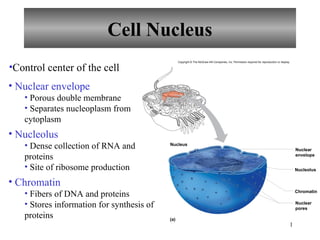
•Control center of the cell
• Nuclear envelope
• Porous double membrane
• Separates nucleoplasm from
cytoplasm
• Nucleolus
• Dense collection of RNA and
proteins
• Site of ribosome production
• Chromatin
• Fibers of DNA and proteins
• Stores information for synthesis of
proteins
Copyright © The McGraw-Hill Companies, Inc. Permission required for reproduction or display.
Nucleus
Nucleolus
Chromatin
(a)
Nuclear
pores
Nuclear
envelope
2
3.3: Movements Into
and Out of the Cell
Passive (Physical) Processes
• Require no cellular
energy and include:
• Simple diffusion
• Facilitated diffusion
• Osmosis
• Filtration
Active (Physiological) Processes
• Require cellular energy and
include:
• Active transport
• Endocytosis
• Exocytosis
• Transcytosis
3
Simple Diffusion
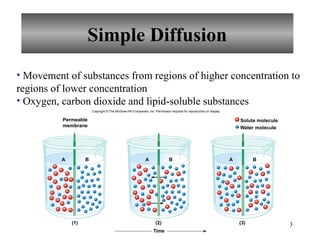
• Movement of substances from regions of higher concentration to
regions of lower concentration
• Oxygen, carbon dioxide and lipid-soluble substances
Time
Solute molecule
Water molecule
A B A B
(2) (3)
Permeable
membrane
A B
(1)
Copyright © The McGraw-Hill Companies, Inc. Permission required for reproduction or display.
4
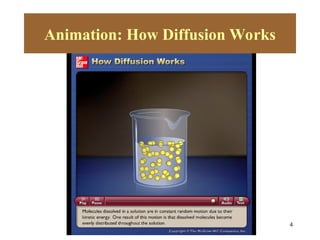
Animation: How Diffusion Works
Please note that due to differing
operating systems, some animations
will not appear until the presentation is
viewed in Presentation Mode (Slide
Show view). You may see blank slides
in the “Normal” or “Slide Sorter” views.
All animations will appear after viewing
in Presentation Mode and playing each
animation. Most animations will require
the latest version of the Flash Player,
which is available at
http://get.adobe.com/flashplayer.
5
Facilitated Diffusion
• Diffusion across a membrane with the help of a channel or carrier
molecule
• Glucose and amino acids
Region of higher
concentration
Transported
substance
Region of lower
concentration
Protein carrier
molecule
Cell
membrane
Copyright © The McGraw-Hill Companies, Inc. Permission required for reproduction or display.
6
Animation: How Facilitated Diffusion Works
Please note that due to differing
operating systems, some animations
will not appear until the presentation is
viewed in Presentation Mode (Slide
Show view). You may see blank slides
in the “Normal” or “Slide Sorter” views.
All animations will appear after viewing
in Presentation Mode and playing each
animation. Most animations will require
the latest version of the Flash Player,
which is available at
http://get.adobe.com/flashplayer.

Cell nucleus, structure and functions.ppt

  • 1.
    1 Cell Nucleus •Control centerof the cell • Nuclear envelope • Porous double membrane • Separates nucleoplasm from cytoplasm • Nucleolus • Dense collection of RNA and proteins • Site of ribosome production • Chromatin • Fibers of DNA and proteins • Stores information for synthesis of proteins Copyright © The McGraw-Hill Companies, Inc. Permission required for reproduction or display. Nucleus Nucleolus Chromatin (a) Nuclear pores Nuclear envelope
  • 2.
    2 3.3: Movements Into andOut of the Cell Passive (Physical) Processes • Require no cellular energy and include: • Simple diffusion • Facilitated diffusion • Osmosis • Filtration Active (Physiological) Processes • Require cellular energy and include: • Active transport • Endocytosis • Exocytosis • Transcytosis
  • 3.
    3 Simple Diffusion • Movementof substances from regions of higher concentration to regions of lower concentration • Oxygen, carbon dioxide and lipid-soluble substances Time Solute molecule Water molecule A B A B (2) (3) Permeable membrane A B (1) Copyright © The McGraw-Hill Companies, Inc. Permission required for reproduction or display.
  • 4.
    4 Animation: How DiffusionWorks Please note that due to differing operating systems, some animations will not appear until the presentation is viewed in Presentation Mode (Slide Show view). You may see blank slides in the “Normal” or “Slide Sorter” views. All animations will appear after viewing in Presentation Mode and playing each animation. Most animations will require the latest version of the Flash Player, which is available at http://get.adobe.com/flashplayer.
  • 5.
    5 Facilitated Diffusion • Diffusionacross a membrane with the help of a channel or carrier molecule • Glucose and amino acids Region of higher concentration Transported substance Region of lower concentration Protein carrier molecule Cell membrane Copyright © The McGraw-Hill Companies, Inc. Permission required for reproduction or display.
  • 6.
    6 Animation: How FacilitatedDiffusion Works Please note that due to differing operating systems, some animations will not appear until the presentation is viewed in Presentation Mode (Slide Show view). You may see blank slides in the “Normal” or “Slide Sorter” views. All animations will appear after viewing in Presentation Mode and playing each animation. Most animations will require the latest version of the Flash Player, which is available at http://get.adobe.com/flashplayer.