ENGLISH FOR
ACADEMIC
AND
PROFESSIONAL
PURPOSES
JESSA MAE N.SARDAN
Faculty, USTP-SHS
PRESENT AT IO
N OUT LINE
INTRODUCTION OBJECTIVES
LEARNING
COMPETENCIES
DISCUSSION/
ACTIVITIES
INTRODUCTION
Overview of the
course
- one of the applied
subjects offered in
the Senior High
School
-entails much
LEARNING
COMPETENCIES
Differentiates language used
in academic texts from
various disciplines
Uses knowledge of text structure
to glean the information he/she
needs (CS_EN11/12A-EAPP-la-c-4)
LEARNING OBJECTIVES
Define what is an academic text.
Differentiate academic text from
the non-academic text; academic
writing from professional writing
Identify the language used
in academic text
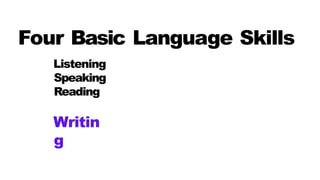
Four Basic Language Skills
Listening
Speaking
Reading
Writin
g
JUMBLED
WORDS
ACTIVITY #1
KOBO
WVEIER
ANSWER:
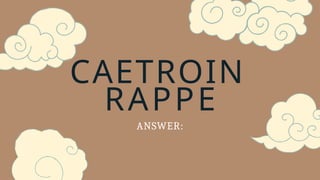
CAETROIN
RAPPE
ANSWER:
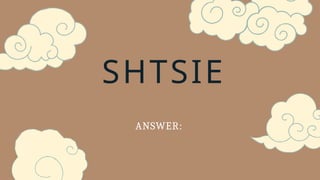
SHTSIE
ANSWER:
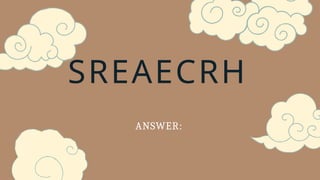
SREAECRH
ANSWER:
NHCIELCAT
ANSWER:
RMLFAO
GEAULGNA
ANSWER:
WHAT IS AN
ACADEMIC TEXT ?
Academic text is defined
as critical, objective,
specialized text written by
experts or professionals in
a given field
using formal language
EXAMPLES OF
ACADEMIC TEXT
RESEARCH PAPER
uses outside information to support a thesis or
make an argument
LITERARY ANALYSIS
examines, evaluates, and makes an argument
about a literary work
EXAMPLE OF
ACADEMIC WRITING
THESIS
A statement or theory that is put forward as a
premise to be maintained or proved.
DISSERTATION
is a document submitted at the conclusion of a
PhD program
ACADEMIC
TEXT IS...
formal
objective
(impersonal)
and
technical
LANGUAGE USED IN
ACADEMIC TEXT FROM
VARIOUS DISCIPLINES
Formal language is used
in Academic Text
Avoid using colloquial or
jargon words
Avoid Hifalutin words
Language used must be
in Layman's Terms
FOUR FEATURES OF A
LANGUAGE
1.FORMALITY
- your dignified stance in writing
-avoid colloquial words
or expressions
WAYS TO ACHIEVE
FORMALITY
1.choosing expanded forms
over contracted forms
Ex: don't - do not, shouldn't -
FOUR FEATURES OF A
LANGUAGE
2.Choose one-word verbs
over two-word verbs
Ex: mess- up
-ruin/damage lookup
to - admire
get away -escape
3.Avoid using
abbreviations Ex: tom-
tomorrow
FOUR FEATURES OF A
LANGUAGE
2. OBJECTIVITY
the focus of the information is
on the topic rather than the writer
himself/herself.
WAYS TO ACHIEVE
OBJECTIVITY
1
. Avoid using Personal
pronouns Ex: I, you, my
, we, me,
mine
FOUR FEATURES OF A
LANGUAGE
2.Avoid rhetorical questions
- academic texts aim to inform
3.Avoid emotive language
that shows biases
Ex: The police investigators were
shocked to see the results of the
test.
FOUR FEATURES OF A
LANGUAGE
3. EXPLICITNESS
The clarity of writing structure
-clear and precise
- using clear conjunctions and
other connectors
FOUR FEATURES OF A
LANGUAGE
4. CAUTION
The careful attention to
avoid sweeping
generalization
-no hasty generalization
Ex: Government officials are
corrupt.
REMEMBER:
TO BE A GOOD ACADEMIC WRITER,
YOU NEED TO LEARN THE SPECIFIC
STYLES AND STRUCTURES OF YOUR
DISCIPLINE
SOME ACADEMIC
DISCIPLINES
Business
Social
studies
Humanities
Natural and Applied
Sciences Medicine
REMEMBER:
A WELL- STRUCTURED TEXT ENABLES THE
READER TO FOLLOW THE ARGUMENT AND
NAVIGATE THE TEXT
THREE-PART ESSAY
STRUCTURE
IMRAD STRUCTURE
TWO COMMON STRUCTURES
OF ACADEMIC TEXT
1.
1.
THREE-PART ESSAY
It consists
of:
Introduction
Body
Conclusion
INTRODUCTION
Its purpose is to clearly tell
the reader the topic,
purpose, and structure of
the paper
.
Write your introduction after
you know both your overall
point of view( if it is
persuasive paper) and the
whole structure of your
BODY
-What is the topic
about?
-The largest part of
the essay
.
It may elaborate directly
on the topic sentence by
giving definitions,
classifications,
explanations,contrasts,
CONCLUSION
"mirror image of
the introduction"
If the introduction begins
with general information and
ends with specific
information, the conclusion
moves in the opposite
direction.
CONCLUSION
It begins by briefly
summarizing the main
scope or structure of the
paper
It ends with a more
general statement about
how this topic relates to
its context
CONCLUSION
It begins by briefly
summarizing the main
scope or structure of the
paper
It ends with a more
general statement about
how this topic relates to
its context
IMRAD
STRUCTURE
INTRODUCTION
METHODS
RESULTS AND
DISCUSSION
The Introduction usually
depicts the background of
the topic and the central
focus of the study.
The Methodology lets your
readers know your data
collection methods,research
instrument employed,
sample size and so on.
Results and Discussion
states the brief
summary of the key
findings or the results
of your study.
THANK YOU FOR
LISTENING!
Don't hesitate to ask any
questions!

1. Introduction to EAPP - Academic Texts.pptx

Editor's Notes

  • #8 Answer: Book Review
  • #9 Answer: Reaction Paper
  • #10 Answer: Thesis
  • #11 Answer: Research
  • #12 Answer: Technical
  • #13 Answer: Formal Language
  • #14 hat is an Academic Text? An academic text is a piece of writing that is: Formal – uses proper grammar and avoids slang. Informative – gives clear information, explanations, or arguments. Evidence-based – often uses facts, examples, or references. Purposeful – meant to teach, inform, or argue a point. In short, it’s writing that is serious, structured, and used for learning or research. Examples relatable to Grade 11 students: Type of Academic TextExample / Relatable ExplanationEssayA report about climate change, your favorite book, or a historical event.Research PaperA mini-project about pollution in your town or a science experiment report.ArticleA magazine article that explains a scientific discovery or a social issue.ReviewA critique of a novel, movie, or a school project.ReportA lab report in science class or a social studies fieldwork report.
  • #15 Literary analysis is examining and interpreting a piece of literature—like a novel, short story, poem, or play—to understand: How it works – how the story is told, the techniques the author uses. What it means – the themes, messages, or lessons in the text. Why it matters – the effect on the reader and why the author wrote it that way. In short, it’s digging deeper into a text instead of just summarizing the story. Literary devices used: symbols, similes, metaphors, irony, imagery.
  • #16 1. Thesis Level: Usually written for a master’s degree (sometimes for undergrad honors). Purpose: To show understanding of existing knowledge and your ability to analyze and discuss a topic. Focus: Often shorter than a dissertation, focuses on reviewing and interpreting existing research. Example: A master’s thesis on “The effects of social media on teen study habits.” 2. Dissertation Level: Usually written for a doctoral (PhD) degree. Purpose: To produce original research and contribute new knowledge to a field. Focus: Much longer and deeper, involves extensive research, experiments, or fieldwork. Example: A PhD dissertation developing a new teaching method to improve English writing skills in high school students.
  • #17 1. Formal Meaning: Uses proper grammar, complete sentences, and avoids slang or casual language. 2. Objective (Impersonal) Meaning: Focuses on facts, evidence, and logical reasoning rather than personal opinions. Uses neutral language. 3. Technical Meaning: Uses specialized vocabulary, terms, or concepts related to a specific field or subject.
  • #18 Colloquial Words Casual, everyday language. Used when talking with friends. Example: “gonna” (going to), “cool” (good). Jargon Words Specialized words for a certain field or profession. Used by experts to communicate clearly. Example: “algorithm” (computing), “ROI” (business). Highfalutin Words: fancy sounding words Meaning: Fancy, big, or showy words that sound impressive. Often used to sound smarter or more formal than necessary. Can sometimes confuse people if overused. Examples: “Utilize” instead of “use” “Commence” instead of “start” “Elucidate” instead of “explain” Layman’s terms = plain, simple, easy-to-understand language. Examples: Cease – stop “Instead of saying “Stop, cease.” Terminate / end “The termination of our relationship instead of at the end of our relationship
  • #20 2. Look into – investigate; find out – discover (who are you to find out?); put off – postpone; come up with – invent/create; give up – quit or surrender Abbreviation Examples: lol, btw, u/ur, FYI, idk, tbh
  • #21 Why we avoid first-person in academic texts: Academic writing should be formal and objective, not personal. Using “I” or “we” makes it subjective. Instead, use third-person or neutral statements. Examples: ❌ “I think students learn faster with visuals.” ✅ “Students learn faster with visuals.”
  • #22 Why avoid rhetorical questions in academic texts: Academic texts aim to inform, not just make the reader think. Rhetorical questions don’t give clear information. Better: State facts directly. Example: ❌ “Who doesn’t want to learn faster?” ✅ “Students benefit from strategies that improve learning.” Avoid emotive language that shows bias because: Academic writing should be neutral and fair. Words that show strong feelings or opinions can make your work seem untrustworthy or biased. Stick to facts and evidence, not emotions. Example: Biased/emotive: “The government foolishly wasted money on this project.” Neutral: “The project exceeded its budget by 20%.”
  • #23 Making your writing clear and easy to follow. Use precise words and connectors like and, but, because, therefore to show relationships between ideas. Clear conjunctions: instead of using so, use therefore, anyways, not suitable
  • #24 to avoid making broad, sweeping conclusions about a whole group or situation based on too few examples or unrepresentative evidence, essentially "jumping to conclusions" without sufficient proof. Caution: Be careful when making statements. Avoid saying something is always true based on limited evidence. Don’t make hasty or sweeping generalizations. Example: ❌ “All teenagers are lazy.” → too general, not true for everyone. ✅ “Some teenagers may struggle with motivation at times.” → careful, accurate statement.
  • #25 Good academic writing follows the rules of your subject. Each field (science, literature, social studies, etc.) has its own style, structure, and way of presenting ideas. Learning these rules helps you write clearly, correctly, and professionally. Example: Science papers: use IMRaD structure (Introduction, Methods, Results, Discussion). Literature essays: focus on analysis, themes, and evidence from texts. 💡 Think: “Each subject has its own blueprint—learn it to write well.”