GENERAL STRUCTURE FOR WRITING
AN ACADEMIC
JOURNAL ARTICLE
INTRODUCTION
• An introduction is a pivotal part of the article writing process. An
introduction not only introduces your topic and your stance on the
topic, but it also (situates/contextualizes) your argument in the broader
academic field.
KEYWORDS
• Keywords are an essential part of producing a journal article; when
writing a journal article you must select keywords that you would like
your article to rank for.
• Keywords help potential readers to discover your article when
conducting research using search engines.
ABSTRACT
• The purpose of your abstract is to express the key points of your
research, clearly and concisely. An abstract must always be well
considered, as it is the primary element of your work that readers will
come across.
• An abstract should be a short paragraph (around 300 words) that
summarizes the findings of your journal article. Ordinarily an abstract
will be comprised of:
• What your research is about
• What methods have been used
• What your main findings are
ACKNOWLEDGEMENTS
• Acknowledgements can appear to be a small aspect of your journal
article, however it is still important. This is where you acknowledge the
individuals who do not qualify for co-authorship, but contributed to
your article intellectually, financially, or in some other manner.
• When you acknowledge someone in your academic texts, it gives you
more integrity as a writer as it shows that you are not claiming other
academic’s ideas as your own intellectual property. It can also aid your
readers in their own research journeys.
TITLE
• The title of your article is one of the first indicators readers will get of
your research and concepts. It should be concise, accurate, and
informative. You should include your most relevant keywords in your
title, but avoid including abbreviations and formulae.
MAIN BODY
• The main body is where your main arguments and your evidence are
located. Each paragraph will encapsulate a different notion (theme) and
there will be clear linking between each paragraph.
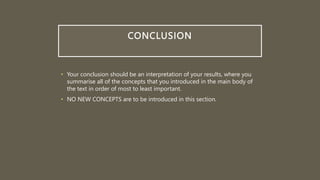
CONCLUSION
• Your conclusion should be an interpretation of your results, where you
summarise all of the concepts that you introduced in the main body of
the text in order of most to least important.
• NO NEW CONCEPTS are to be introduced in this section.
REFERENCES
• References should be well balanced, current and relevant. Although
every field is different, you should aim to cite references that are not
more than 5 years old if possible. (as you’re researching ‘current’ trends)
• The studies you cite should be strongly related to your research
question.
TIPS FOR WRITING AN
ACADEMIC JOURNAL ARTICLE
DON’T BE AFRAID TO EXPLAIN
• Write your journal article with confidence, to give your reader certainty
in your research. Make sure that you’ve described your methodology
and approach; whilst it may seem obvious to you, it may not to your
reader. And don’t forget to explain acronyms when they first appear.
• The better the explanation, the more likely it will hit the higher grade
level criteria
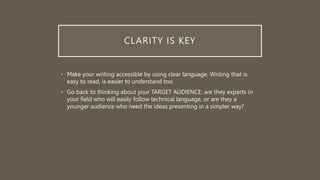
CLARITY IS KEY
• Make your writing accessible by using clear language. Writing that is
easy to read, is easier to understand too.
• Go back to thinking about your TARGET AUDIENCE; are they experts in
your field who will easily follow technical language, or are they a
younger audience who need the ideas presenting in a simpler way?
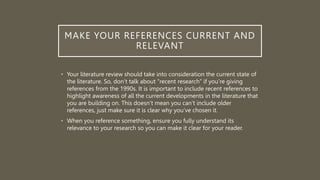
MAKE YOUR REFERENCES CURRENT AND
RELEVANT
• Your literature review should take into consideration the current state of
the literature. So, don’t talk about “recent research” if you’re giving
references from the 1990s. It is important to include recent references to
highlight awareness of all the current developments in the literature that
you are building on. This doesn’t mean you can’t include older
references, just make sure it is clear why you’ve chosen it.
• When you reference something, ensure you fully understand its
relevance to your research so you can make it clear for your reader.
BE ORIGINAL
• Make sure to communicate your unique point of view to stand out. You
may be building on a concept already in existence, but you still need to
have something new to say. Make sure you say it convincingly, and fully
understand and reference what has gone before.
PICTURES/ INFORGRAPICS
• All images, photos and graphs that you include in your article MUST be
DIRECTLY relevant to your argument.
• Don’t just insert pretty pictures for the sake of it
• Select images that will:
• Help your readers understand your point
• Illustrate your ideas
• All images must have a caption (in-text) and state a figure _: description
of infographic before it

1. General structure for writing an academic.pptx

  • 1.
    GENERAL STRUCTURE FORWRITING AN ACADEMIC JOURNAL ARTICLE
  • 2.
    INTRODUCTION • An introductionis a pivotal part of the article writing process. An introduction not only introduces your topic and your stance on the topic, but it also (situates/contextualizes) your argument in the broader academic field.
  • 3.
    KEYWORDS • Keywords arean essential part of producing a journal article; when writing a journal article you must select keywords that you would like your article to rank for. • Keywords help potential readers to discover your article when conducting research using search engines.
  • 4.
    ABSTRACT • The purposeof your abstract is to express the key points of your research, clearly and concisely. An abstract must always be well considered, as it is the primary element of your work that readers will come across. • An abstract should be a short paragraph (around 300 words) that summarizes the findings of your journal article. Ordinarily an abstract will be comprised of: • What your research is about • What methods have been used • What your main findings are
  • 5.
    ACKNOWLEDGEMENTS • Acknowledgements canappear to be a small aspect of your journal article, however it is still important. This is where you acknowledge the individuals who do not qualify for co-authorship, but contributed to your article intellectually, financially, or in some other manner. • When you acknowledge someone in your academic texts, it gives you more integrity as a writer as it shows that you are not claiming other academic’s ideas as your own intellectual property. It can also aid your readers in their own research journeys.
  • 6.
    TITLE • The titleof your article is one of the first indicators readers will get of your research and concepts. It should be concise, accurate, and informative. You should include your most relevant keywords in your title, but avoid including abbreviations and formulae.
  • 7.
    MAIN BODY • Themain body is where your main arguments and your evidence are located. Each paragraph will encapsulate a different notion (theme) and there will be clear linking between each paragraph.
  • 8.
    CONCLUSION • Your conclusionshould be an interpretation of your results, where you summarise all of the concepts that you introduced in the main body of the text in order of most to least important. • NO NEW CONCEPTS are to be introduced in this section.
  • 9.
    REFERENCES • References shouldbe well balanced, current and relevant. Although every field is different, you should aim to cite references that are not more than 5 years old if possible. (as you’re researching ‘current’ trends) • The studies you cite should be strongly related to your research question.
  • 10.
    TIPS FOR WRITINGAN ACADEMIC JOURNAL ARTICLE
  • 11.
    DON’T BE AFRAIDTO EXPLAIN • Write your journal article with confidence, to give your reader certainty in your research. Make sure that you’ve described your methodology and approach; whilst it may seem obvious to you, it may not to your reader. And don’t forget to explain acronyms when they first appear. • The better the explanation, the more likely it will hit the higher grade level criteria
  • 12.
    CLARITY IS KEY •Make your writing accessible by using clear language. Writing that is easy to read, is easier to understand too. • Go back to thinking about your TARGET AUDIENCE; are they experts in your field who will easily follow technical language, or are they a younger audience who need the ideas presenting in a simpler way?
  • 13.
    MAKE YOUR REFERENCESCURRENT AND RELEVANT • Your literature review should take into consideration the current state of the literature. So, don’t talk about “recent research” if you’re giving references from the 1990s. It is important to include recent references to highlight awareness of all the current developments in the literature that you are building on. This doesn’t mean you can’t include older references, just make sure it is clear why you’ve chosen it. • When you reference something, ensure you fully understand its relevance to your research so you can make it clear for your reader.
  • 14.
    BE ORIGINAL • Makesure to communicate your unique point of view to stand out. You may be building on a concept already in existence, but you still need to have something new to say. Make sure you say it convincingly, and fully understand and reference what has gone before.
  • 15.
    PICTURES/ INFORGRAPICS • Allimages, photos and graphs that you include in your article MUST be DIRECTLY relevant to your argument. • Don’t just insert pretty pictures for the sake of it • Select images that will: • Help your readers understand your point • Illustrate your ideas • All images must have a caption (in-text) and state a figure _: description of infographic before it