ASIA NETWORK FOR SUSTAINABLE
AGRICULTURE AND BIORESOURCES (ANSAB)
of Natural Resources Dependent Communities
Entrepreneurship
Development
Toolkit 1Rural Development
Toolkit Series
Other ANSAB Rural Development
Toolkits in this series (2010)
Business Planning for Community
Based Natural Product Enterprises
This Toolkit offers skills, methods and
tools with which the field facilitators
can support rural people to prepare
and implement the business plan for
their enterprises. The purpose is to
build the capacity of facilitators and
enterprise leaders on how they can
support a rigorous process of planning
and successful operation of sustainable
community-based natural product
enterprises.
Marketing Information System for
Natural Products
This Toolkit focuses on the process of
setting up a marketing information
system (MIS) program and the methods of
collection, processing and dissemination
of information on markets and marketing
of natural products. The objective is
to provide guidance in developing and
implementing the MIS for natural products
in order to enhance market transparency
and good value chain governance.
Participatory Inventory of
Non-Timber Forest Products
This Toolkit provides practical methods
and tools to determine total stock and
harvestable amount of the selected NTFPs
and derive specific recommendations
for forest management interventions.
The objective is to provide participatory
inventory method that provides a basis
for sustainable forest management.
Participatory Biodiversity
Monitoring in Community
Managed Forests
This Toolkit provides methods and tools
needed to generate useful data to
periodically assess the biodiversity status
and to track the impact of community
based forest management on biodiversity.
The purpose is to derive important
lessons for improving management that
promotes the conservation of biodiversity
while maximizing the value of forest
products and services.
Development and Mobilization of
Local Resource Persons
This Toolkit focuses on the process
and methods of recruiting, training
and mobilizing local resource persons
(LRPs) so that development services
could be more effectively delivered in
rural settings through locally available
human resource even beyond the
termination of a development project.
Certification of Community
Managed Forests
This Toolkit focuses on group forest
management certification. The major
objective of the toolkit is to provide
important methods and tools for
developing and implementing the
Forest Stewardship Council’s (FSC)
group forest management certification
so that the communities achieve a
position of getting recognition and
rewards for their good practices, while
conserving the forest and biodiversity.
Chain of Custody Certification for
Community Forest Enterprises
This Toolkit provides field practitioners
and program managers with up to date
methods, tools and techniques for
obtaining and implementing the Forest
Stewardship Council’s (FSC) Group
Chain of Custody certification. The
purpose is to enable small companies
and cooperatives promote their certified
products in national and international
markets and get rewarded.
of Natural Resources Dependent Communities
Entrepreneurship
Development
Toolkit 1Rural Development
Toolkit Series
ASIA NETWORK FOR SUSTAINABLE
AGRICULTURE AND BIORESOURCES (ANSAB)
ii
© ANSAB, 2010
Citation: ANSAB. 2010. Entrepreneurship Development of Natural Resources Dependent Communities.
Asia Network for Sustainable Agriculture and Bioresources. Kathmandu, Nepal.
All rights reserved. Reproduction and dissemination of information in this toolkit for educational,
research or other non-commercial purposes are authorized without any prior written permission from
ANSAB provided the source is fully acknowledged. The reproduction of the information from this
toolkit for any commercial purposes is prohibited without written permission from ANSAB.
ISBN:978-99933-796-6-9
First edition: 2010
Designed and Printed in Nepal
Entrepreneurship
Development of
Natural Resources
Dependent
Communities
iii
Rural development presents an immense
challenge both to theorists and practitioners
in the field. Many rural development
and conservation projects end up in utter
frustration because they are not equipped
with effective methods and tools. ANSAB
itself has tried various approaches since its
establishment in 1992. We have developed
a practical combination of environmental,
social and economic interventions that
conserve biodiversity, create jobs and
provide income for the rural poor in
remote but resource-rich areas of Nepal.
The encouraging outcomes of these
interventions have led us to pursue the
successful approaches over the past several
years.
By 2009, we were able to organize and
develop 393 enterprise-oriented community
forest user groups and 1,166 economic
entities, which generated US $6.82 million
in annual total monetary benefits to
78,828 individuals and, at the same time,
brought over 100,000 hectares of forests
and meadows in Nepal Himalaya under
improved community management. When
applied properly under an enabling policy
environment, this approach can transform
rural poor women and men into well
governed, organized entrepreneurs that are
capable of accessing the market as well as
essential business development services.
By creating economic incentives to local
stewards, the approach helps to reverse
deforestation and enhance the stock of
natural wealth for improved and sustained
flow of ecosystem services and for climate
change mitigation and adaptation.
Building on these insights, we have been
producing a number of manuals, toolkits,
and guidelines. This Rural Development
Toolkit Series represents the continuation
of our attempt to present our learning to a
wide range of development practitioners.
This Series consists of eight separate but
interrelated toolkits. These toolkits offer
practical guidance on the key methods
and tools that were developed, tested and
refined over the years by working with
local communities, development partners
and government agencies. These capture
the experiential knowledge of dozens
of people working for ANSAB and are
published after a thorough field testing and
peer review. These toolkits are primarily
designed for field facilitators and managers
of development and conservation programs
who have some basic facilitation skills and
experience of working with rural people.
We are hopeful that the toolkits will prove
useful to other rural development and
conservation programs, and consequently,
to a wider application of our fruitful
approach. It is expected that users will
adapt the methods and tools presented here
to work in different social contexts.
This Toolkit “Entrepreneurship
Development of Natural Resources
Dependent Communities” focuses on
developing entrepreneurial skills and
capacities of local communities, especially
the poorest among them, to promote the
development of sustainable community
based natural product enterprises.
The purpose is to provide guidance in
developing and implementing programs
Preface
iv
on developing entrepreneurship skills
and culture at the community level. This
toolkit is divided into 4 stages. A number
of steps are suggested for each stage and a
number of activities are recommended for
each step. Practical tools and considerations
are provided along with activities when
required.
We are thankful to the blue moon fund
(bmf) for providing the grant that
allowed us to develop the Series and
for encouraging us to translate ANSAB
expertise into simple-to-use toolkits. The
main contributors of the toolkit are Sushil
Gyawali, Nabaraj Panta and Bhishma
Subedi. Surya B. Binayee through his
work in ANSAB program contributed
to the evolution and development of
the methodology. A number of ANSAB
staff (especially Bhuwan Dhakal, Ram
P. Acharya, Chandika Amagain, Gopal
Sharma, Prakash Katwal, Bishnu Luintel,
Govinda Baral, Indra Adhikari, Sony
Baral, Durga Regmi and Puspa Lal
Ghimire), donors (the Ford Foundation,
USAID), partners (EWV), NGOs and
local communities contributed to this
methodology through their involvement
in ANSAB programs. Hari Dhungana,
an experienced ANSAB technical expert,
edited the Series.
We welcome suggestions and feedback
from readers and users as we are very much
keen on periodically updating the toolkits
to make it more productive and useful.
Bhishma P. Subedi, PhD
Executive Director, ANSAB
Entrepreneurship
Development of
Natural Resources
Dependent
Communities
v
ANSAB 	 Asia Network for Sustainable Agriculture and Bioresources
CBO 	 Community based organization
DDC 	 District Development Committee
DFO	 District Forest Officer
IEDI 	 Industrial Enterprise Development Center
INGO	 International non-governmental organization
LRP 	 Local resource person
MA&D 	 Market analysis and development
NGO	 Non-governmental organization
PRA 	 Participatory Rural Appraisal
SIYB 	 Start and Improve Your Business
FMU	 Forest management unit
FGD	 Focus Group Discussion
Acronym
vi
Glossary
Business planning: A document that shows
how an enterprise will achieve its business
objectives over a certain period of time; it
includes four main components: marketing
plan, production plan, organization and
management plan, and financial plan
Local Resource Person: An individual
recruited from local communityand trained
and mobilized for the delivery of specific
development services to the community
Facilitator: A person who supports the
local community and other groups to
conduct a specific activity or a range of
activities primarily in reference to the
objectives of a development program
Market Analysis and Development:
Participatory methodology designed to
assist local people in developing enterprises
while conserving tree and forest resources
Start and improve your business: A training
package developed by ILO to develop
enterprise skills of communities using
exercise and game methods
Value Chain: A sequence of target-oriented
combinations of production factors that
create a marketable product or service from
its conception to the final consumption
Entrepreneurship
Development of
Natural Resources
Dependent
Communities
vii
Preface------------------------------------------------------------------------------------------------------------- iii
Acronyms---------------------------------------------------------------------------------------------------------- v
Glossary----------------------------------------------------------------------------------------------------------- vi
Table of Contents---------------------------------------------------------------------------------------------- vii
About the Module----------------------------------------------------------------------------------------------- 1
Stage 1: Get prepared for facilitation-------------------------------------------------- 4
Step 1: Know yourself------------------------------------------------------------------------------------------ 4
Step 2: Select the site-------------------------------------------------------------------------------------------- 4
Step 3: Select LRPs and local staffs and build their capacity------------------------------------------ 6
Step 4: Make rapid assessment of the site----------------------------------------------------------------- 7
Stage 2: Build the Community Capacity for Gathering and Analyzing
Information------------------------------------------------------------------------------------10
Step 1: Conduct planning and sharing meeting---------------------------------------------------------10
Step 2: Build community capacity for information seeking------------------------------------------11
Step 3: Facilitate for sharing and review of information----------------------------------------------13
Stage 3: Build Community Capacity To Select Enterprise Options-------------14
Step 1: Select enterprise options----------------------------------------------------------------------------14
Step 2: Analyze the value chain and initiate enterprise planning----------------------------------15
Stage 4: Develop Enterprise Management and Leadership Skill----------------17
Step 1: Develop enterprise management skill-----------------------------------------------------------17
Step 2: Develop enterprise leadership skill---------------------------------------------------------------19
Additional References----------------------------------------------------------------------23
Annexes-----------------------------------------------------------------------------------------24
Table of Contents
viii
Entrepreneurship
Development of
Natural Resources
Dependent
Communities
1
This toolkit on “Entrepreneurship
Development for the Natural Resource
Dependent Communities” offers methods,
tools and techniques with which the field
facilitators will support rural people to
start natural product-based enterprises.
Most people in rural areas depend on
forest and other natural resources for their
daily livelihoods. But, they generally use
these resources in a subsistence mode.
These people neither harness the optimum
potential of the resource, nor do they
generate good income and employment for
themselves. So there is little incentive for
them to conserve and manage the resources.
We can also find such subsistence approach
on using natural product as a reason for
the continuation of rural poverty and the
degradation of the resource base.
In this context, establishment of natural
products enterprises provides a basis for the
generation of income and employment to
local people and sustainable management
of natural resources. As local people
see greater income and employment
forthcoming, they perceive it wise to
manage resource sustainably. But major
concern is to make the community capable
for starting their own enterprise and
sustain it. ANSAB, with its experience,
perceived that the ultra-poor (poorest)
communities need entrepreneurship skills
making them able to establish and develop
sustainable natural product enterprise.
Entrepreneurship at community level is a
pre-requisite and the first step toward the
success of natural products enterprises.
Entrepreneurship development provides
the resource-dependent community with
the skills and competence necessary to
address enterprise challenges and to tap
the opportunities in the long run. Once
imparted with such skills and competencies,
the community can initiate enterprises with
or without external support.
Thus this toolkit presents methods, tools
and techniques that are essential to the
facilitators that support community groups
About the Toolkit
Box 1: Entrepreneurship at the
community level
Entrepreneurship at the community level is
the process of organizing and preparing an
economic group by assessing the appropri-
ate economic opportunities for enterprise
development in a locality. This requires
developing entrepreneurship of individuals
in the group and designing group efforts by
combining individuals’ skills. Entrepreneur-
ship development is a continuous process,
and at the community level it builds on the
local experiences.
The phrase “Entrepreneurship at community
level” as used in this toolkit refers to the
advancement of community groups by:
•	 having developed entrepreneurial qualities
based on the various skills of the leaders
and the members complementing to each
other;
•	 being capable to identify enterprise
opportunities and to develop community
enterprises to uplift the livelihood of local
people;
•	 being capable to deal with the dynamic
business environment in the long-run
without external support; and
•	 building on the success of an enterprise in
order to develop other rural enterprises.
2
to develop entrepreneurship. This
toolkit also helps to identify and
address the challenges in community
entrepreneurship development.
Objectives
This toolkit aims to provide guidance
to facilitators and program managers
for developing entrepreneurship at
community level enabling communities
to develop sustainable community-
based natural product enterprises.
More specifically, the toolkit:
•	 provides methods, tools and
techniques to develop different
entrepreneurial skills that leads
to the success of community
enterprises and
•	 enhances the understanding
of the approach of developing
entrepreneurship at the community
level.
Who is this Toolkit for?
This toolkit is designed for field
facilitators and development
program managers for developing
entrepreneurship of natural resources
dependent communities. This toolkit
is also useful to community groups,
existing entrepreneurs, students
and other interested in community
enterprises and natural products.
What does this Toolkit contain?
This toolkit contains four stages
(See Figure 1). Stage one describes
how the facilitator should prepare
for developing community
entrepreneurship, whereas the stage
two provides guidelines to make
Box 2: Sikre Community in Nepal: an example of
community entrepreneurship development
In October 2007, the community at Sikre village
of Sindhupalchowk district, Central Nepal, started
identifying natural products-based enterprise options,
in the technical support of ANSAB. By April 2008,
they established an essential oil distillation unit.
The enterprise had a joint investment of community
groups and other investors. The enterprise initially
took the loan of NRs. 150,000 in order to purchase
the construction materials for the factory. Within six
months, the community was successful in paying back
the loan. In the same year, they started a bee-hive
briquette enterprise as they found it to be profitable
and matching with the interest and skills of the
ultra-poor and women members. In both enterprises,
the community achieved success due to the good
leadership, adoption of suitable technology, and
efficient management. They found that there was
an increase in demand for briquette in Kathmandu,
but also that existing Kathmandu based marketing
companies were not supportive to the growth of
community enterprises. With the continuous facilitation
by ANSAB staffs, they worked out ways to overcome
the marketing challenges. They started a new
briquette marketing company in Kathmandu in 2009
in partnership with other briquette enterprises and
investors. This has been a stepping stone in developing
briquette industry in Nepal. This has had a great impact
at individual level on workers and members as they
have improved their livelihood. They have also developed
their own individual enterprises utilizing the entrepreneurial
quality developed through the experiences gained in the
community enterprises. For example, Birkha Bahadur
Shrestha,having worked as a machine operator of the
briquette enterprise for a year, developed a poultry firm
on his own. Similarly, several farmers started commercial
farming of vegetables. Thus community members develop
community enterprises on one hand and started their
small businesses on the other.
Entrepreneurship
Development of
Natural Resources
Dependent
Communities
3
the community able to seek information.
Similarly, stage three provides guidance
on how to build community capabilities
to select enterprise option. The stage four
describes on how to develop enterprise
management and leadership skills of the
community group. We have also presented
relevant case studies and examples in each of
these stages.
While this toolkit is meant to develop
entrepreneurial capacity of community
groups, it doesn’t provide sufficient
technical guideline to develop or manage
an enterprise. It is focused on developing
community capacity to identify enterprise
opportunities, build their capacity to plan
enterprises and develop management
and leadership skill. We recommend the
readers to consult “Enterprise Development
for Natural Products Manual (ANSAB, 2003)”
and Toolkit Business Planning for Community
based Natural Products based Enterprises
in this series for technical guidelines on
development of natural products based
enterprises. Similarly, for a detailed process
of group organizing at the community level,
we suggest you to refer Local Communities
and Natural Products: A manual for organizing
Natural Resource Management Groups for
Resource Management Planning, Enterprise
Development, and Integration into Value Chain
(ANSAB, 2007). Additional references for
developing community enterprises are
available at ANSAB resource center.
l	Develop
enterprise
managerial skill
l	Develop
enterprise
leadership skill
Develop
Enterprise
Management and
Leadership Skill
l	Select
enterprise
options
l	Analyze the
value chain
and initiate
enterprise
planning
Build community
capacity to select
enterprise option
l	Conduct planning
and sharing
meeting
l	Build community
capacity for
information
seeking
l	Facilitate for
sharing and
review of
information
Build the
community
capacity for
gathering
and analyzing
information
Figure 1: Framework of the toolkit
l	Know yourself
l	Select the site
l	Select LRPs
and local staff
and build their
capacity
l	Make rapid
assessment of
the site
Get Prepared
for Facilitation
4
Get Prepared for
FacilitationStage One
The first stage of this toolkit contains
four steps (see Figure 2). It prepares
the facilitator for entrepreneurship
development through skill enhancement,
site selection, staff recruitment and site
assessment. At this stage, the facilitator will
be able to:
•	 select most suitable sites and
communities;
•	 gain a detailed understanding of the
selected sites and the communities;
•	 collect information for planning of the
field activities; and
•	 establish trust with the selected
communities and build confidence
for successful implementation of the
program.
Step 1: Know yourself
Before supporting communities, the
facilitator has to check own understanding
on entrepreneurship development and, if
required, has to develop skills. The more
qualified the facilitator is, the greater the
chance of developing entrepreneurship at
community level.
Apart from the general qualities of the
facilitator, following are the specific
qualities a facilitator must possess for
developing community entrepreneurship:
•	 Have proper planning: The facilitator
needs to review the plans time and
again and make necessary adjustments
as circumstances require
•	 Always have a plan B (an alternative
plan): If the facilitator is sure that plan
A (main plan) is not going to work, s/he
should use plan B.
•	 Know the strengths of the community
in terms of resources, commitment,
capacity, technology and policy.
•	 Don’t avoid social activities that may
not be directly linked with enterprise
development. The activities like
marriage ceremony, feasts and festivals
help build rapport in community.
•	 Be proactive to assess the favorable
situation for interventions and to make
timely interventions.
•	 Be able to provide proper guidance
in situations the community group is
not, in itself, making an appropriate
decision.
Step 2: Select the site
The facilitator needs to find out the
potential sites, where the entrepreneurship
development is deemed to be successful
with effective interventions. There are four
main activities (See Figure 3) required for
site selection:
Figure 2: Steps of getting prepared
Select the site
Select LRPs and local staff and build
their capacity
Know yourself
Make rapid assessment of the site
Entrepreneurship
Development of
Natural Resources
Dependent
Communities
5
Preliminary selection: develop a list of
potential sites
There could be many sites where the
entrepreneurship development has the
potential, or the facilitator may receive
request from many communities. The
facilitator should list such sites considering
the need as well as potential impact of
assistance. The following are some of
the factors to be considered during site
selection.
•	 Sites defined and prioritized in project
design: larger geographic area might
have been identified but may need to
select specific sites
•	 Sites identified as potential or
having a high demand from the local
communities: the sites frequently cited
by literature or media or in public
forums highlighting strong demand or
high potential of such program
•	 Sites in record of implementing
organization: there might be frequent
request from communities themselves
for the services or have organizational
assessment of various sites having
strong demand or have higher success
potential for such services or have better
matching with other existing projects
•	 Sites according to the purpose of
program: some sites may have the
potential for demonstration or further
expansion or generate quick impact.
Short-listing of sites
It is not always practical –for example
due to shortage of resources—to carry out
entrepreneurship development program
in all the sites identified in the preliminary
selection. Thus, the facilitator should review
each of these sites against a set of criteria
presented below and develop their short-
list. For this, the facilitator should:
•	 consult with different stakeholders
(DDC [District Development
Committee], DFO [District Forest
Officer], NGOs [Non-governmental
Figure 3: Process of site selection
Preliminary Selection
Finalization of the site Rapid verification of the
short-listed sites through visits
Short listing of the sites
6
organizations], CBOs [community-based
Organizations], and enterprises) at the
district level;
•	 conduct key informants interview in the
community; and
•	 carry out a rapid market visit.
The following are the main criteria that can
be used in the short-listing of the sites
Geography and location: Distance from the
nearest market, climatic condition of the
area, land use pattern.
Social factors: Demographic situation,
status of women and disadvantaged
groups, social bonding and equity,
community interest, specific government
policies applicable to the area (if any),
cultural practices and social norms
Infrastructure: Means of transportation and
communication, availability of local market
Raw materials: Existing production and
trade situation, sustainable management
practices, cultivation potential.
Technology: Technologies in practice on
forest and agriculture sector, availability
of technical human resource, potential to
fabricate or repair machines locally.
Economic development: Average per
capita income, major sources of income, job
opportunities.
Program needs: Urgency of development
support to the community and relevance
with the program, feasibility of having
desired impacts within the available time
and resources
Rapid verification of the short-listed sites
through visits
The facilitator should visit all the shortlisted
sites to get primary information. During
such visit, the facilitator needs to obtain
firsthand information about the sites against
the factors mentioned above and verify the
information. For obtaining information, the
facilitator needs to:
•	 carry out focus group discussion; and
•	 participate in the meetings of
community groups, such as forest user
group, irrigation committee, saving
credit committee, or women group.
Finalization of the sites
After the careful examination of the
secondary and primary information (as
above), the sites for entrepreneurship
development are selected. For this, the
short-listed sites are ranked by using the
attractiveness matrix (Table 1). The site
with highest rank has the highest prospect
of entrepreneurship development. So the
program can start working with that site,
and gradually move to other sites. Such a
site can often serve as a demonstration to
others.
Step 3: Select LRPs and local staffs
and build their capacity
The community members require regular
backstopping in technical activities to
initiate business. The facilitators should
invest a significant time with communities
for various enterprise development
activities mainly during initial stage. Such
regular support has to be provided through
Local Resource Persons (LRPs) and local
staffs to ensure the sustainability of the
service after the project period. Thus, it is
Entrepreneurship
Development of
Natural Resources
Dependent
Communities
7
very important to recruit local staff and
LRPs and to develop their capacity on
entrepreneurship development. Please refer
Toolkit Development and Mobilization of Local
Resource Persons in this series for the details
on how to develop LRPs for a community
enterprise.
Step 4: Make rapid assessment of the
site
Once the local staff and LRPs are selected,
it is time to collect detailed information of
the site through them. The information will
help the facilitator to plan entrepreneurship
development in the selected site. This
assessment verifies information collected
during short-listing and reconnaissance
visit and familiarizes facilitating team
on local situation. The information helps
facilitators to effectively initiate dialogue
with communities in planning future
activities. Additionally, this will also
provide some baseline information for the
project. The information category to be
covered in rapid assessment are:
•	 institutions and individuals in the area;
•	 economic activities;
•	 social and institutional setup;
•	 resource potential (especially availability
of raw materials);
•	 financial institutions; and
•	 existing enterprise development
activities.
The following are main methods used in
rapid assessment.
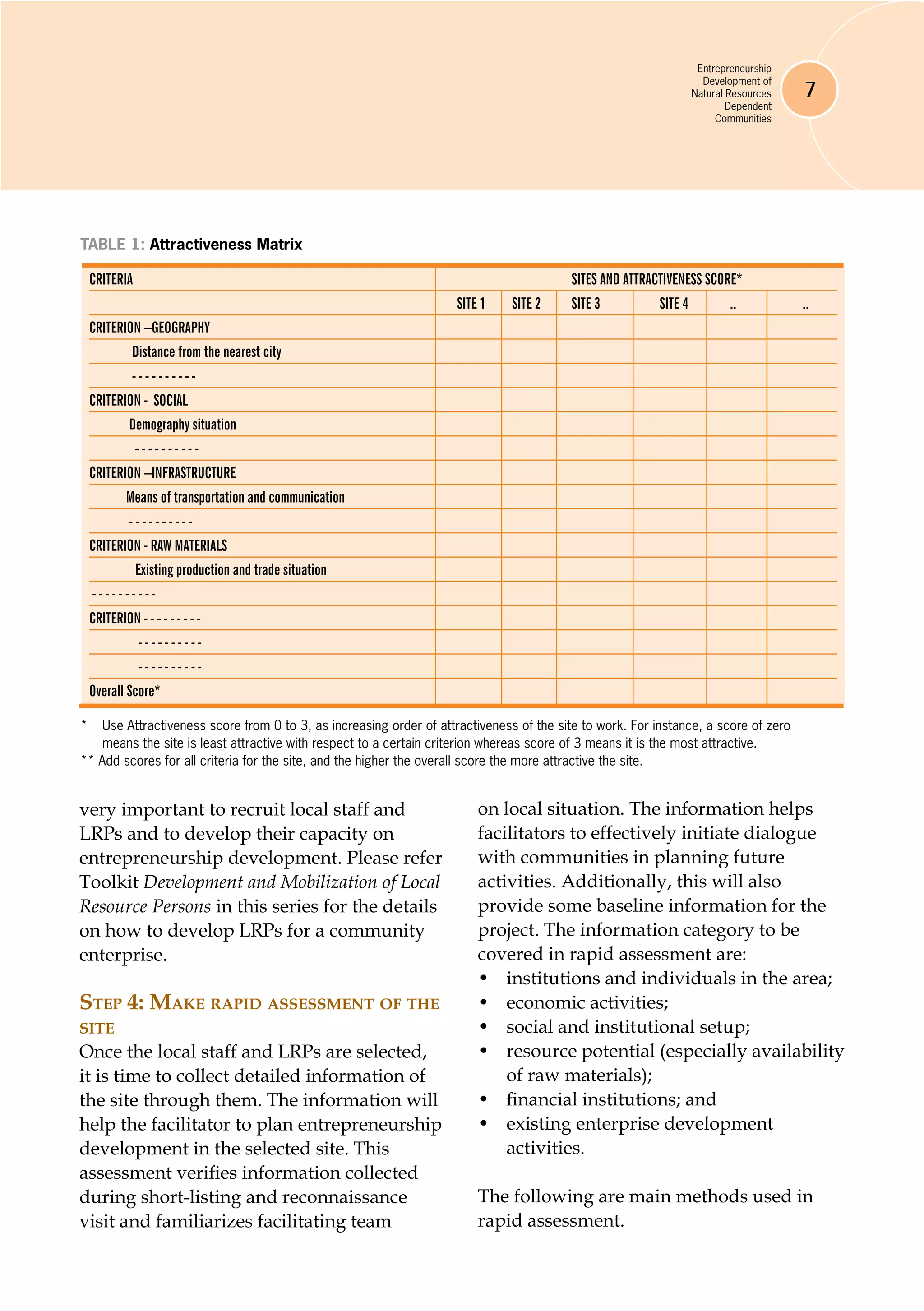
Criteria			 Sites and Attractiveness Score*
	 Site 1	 Site 2	 Site 3	 Site 4	 ..	 ..
Criterion –Geography
Distance from the nearest city
- - - - - - - - - -
Criterion - Social
Demography situation
- - - - - - - - - -
Criterion –Infrastructure
Means of transportation and communication
- - - - - - - - - -
Criterion - Raw Materials
Existing production and trade situation
- - - - - - - - - -
Criterion - - - - - - - - -
- - - - - - - - - -
- - - - - - - - - -
Overall Score*
table 1: Attractiveness Matrix
*	 Use Attractiveness score from 0 to 3, as increasing order of attractiveness of the site to work. For instance, a score of zero
means the site is least attractive with respect to a certain criterion whereas score of 3 means it is the most attractive.
** Add scores for all criteria for the site, and the higher the overall score the more attractive the site.
8
Participatory resource mapping
Participatory resource mapping is a tool for
identification of social, physical and natural
features in an area in active participation
of local people. It guides for selection of
resources, products, area and community in
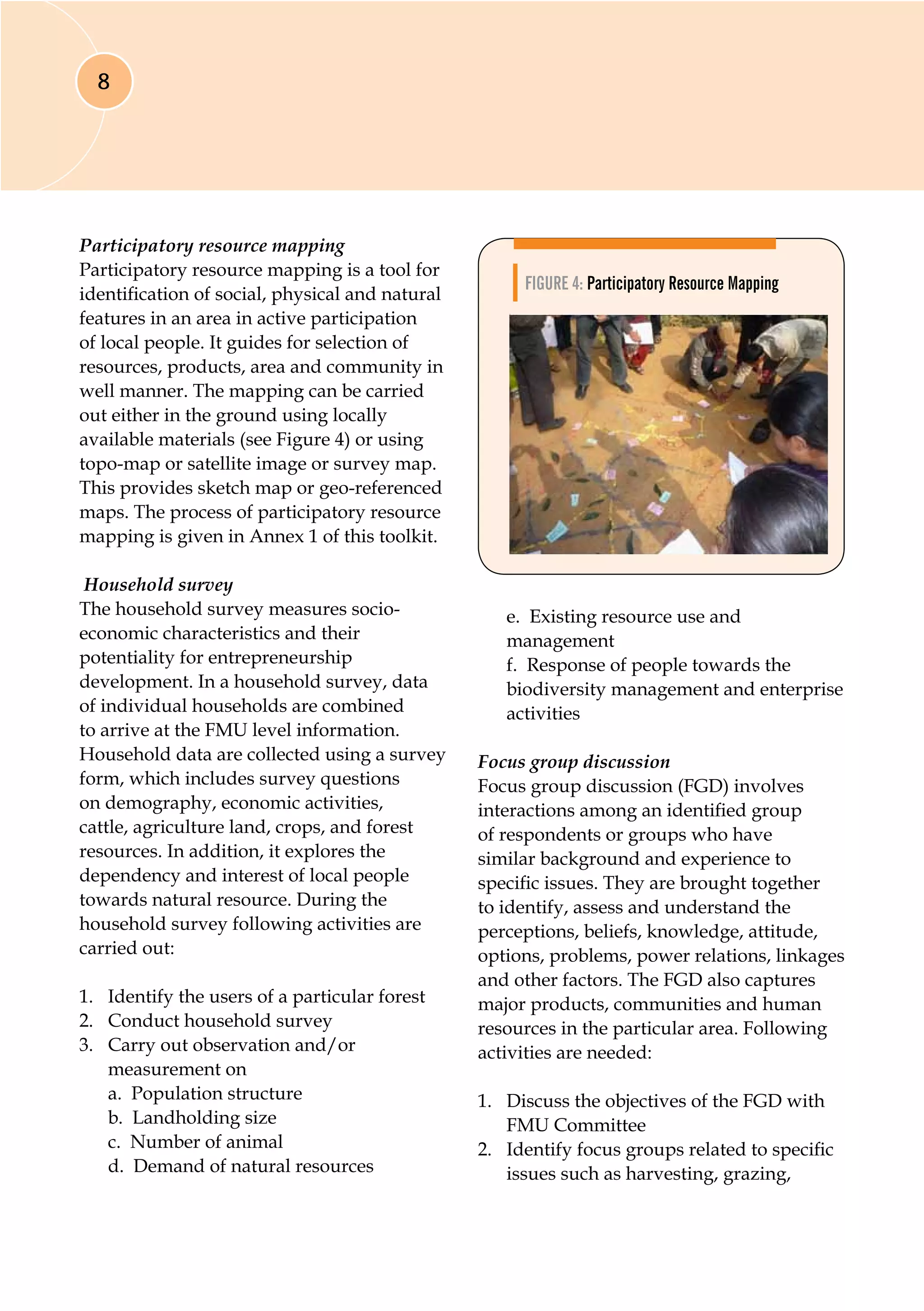
well manner. The mapping can be carried
out either in the ground using locally
available materials (see Figure 4) or using
topo-map or satellite image or survey map.
This provides sketch map or geo-referenced
maps. The process of participatory resource
mapping is given in Annex 1 of this toolkit.
Household survey
The household survey measures socio-
economic characteristics and their
potentiality for entrepreneurship
development. In a household survey, data
of individual households are combined
to arrive at the FMU level information.
Household data are collected using a survey
form, which includes survey questions
on demography, economic activities,
cattle, agriculture land, crops, and forest
resources. In addition, it explores the
dependency and interest of local people
towards natural resource. During the
household survey following activities are
carried out:
1.	 Identify the users of a particular forest
2.	 Conduct household survey
3.	 Carry out observation and/or
measurement on
	 a. Population structure
	 b. Landholding size
	 c. Number of animal
	 d. Demand of natural resources
	 e. Existing resource use and
management
	 f. Response of people towards the 	
biodiversity management and enterprise
activities
Focus group discussion
Focus group discussion (FGD) involves
interactions among an identified group
of respondents or groups who have
similar background and experience to
specific issues. They are brought together
to identify, assess and understand the
perceptions, beliefs, knowledge, attitude,
options, problems, power relations, linkages
and other factors. The FGD also captures
major products, communities and human
resources in the particular area. Following
activities are needed:
1.	 Discuss the objectives of the FGD with
FMU Committee
2.	 Identify focus groups related to specific
issues such as harvesting, grazing,
Figure 4: Participatory Resource Mapping
Entrepreneurship
Development of
Natural Resources
Dependent
Communities
9
participation and access to decision-
making (women and dalits) through
discussion with FMU committee
3.	 Conduct discussion with identified
focus group to generate qualitative
information on changes in knowledge,
practices, and attitudes as they relate to
the resource management
Key informants interview
The facilitator needs to identify key
informants having knowledge on a wide
range of information on the particular area.
To draw the required information, the
facilitator needs to conduct the following
activities:
1.	 Prepare the checklists focusing the
natural resources, their potentiality,
human resources and their interest on
enterprises development
2.	 Identify the key informants who have
particular knowledge on specific issues,
such as harvesting and medicinal
plant use. These people include NTFP
collector, forest products traders,
herders, old aged people, local teachers,
and natural healers (Amchi/Baidhya)
3.	 Gather the facts from selected key
informants against the checklist.
10 Build the Community
Capacity for Gathering and
Analyzing Information
Stage Two
The Stage two of this toolkit presents
methods and tools for helping the
community to gather and analyze
information essential for entrepreneurship
development. While developing enterprises,
it is important to encourage community
members to reflect upon themselves and
seek information on the following:
•	 What they should know?
•	 What they should do and should not
do?
•	 What they have?
•	 What they don’t have?
Successful entrepreneurs are very smart
on having such information and on
identifying what they themselves can do
and for what they need assistance. With
such information, they make strategies to
maximize the use of resources. Similarly,
they should be able to efficiently gather,
record, and analyze the information, and
to use that for their own benefits. Being
in group, community enterprises face
several complications to gather and use
information. For example, they find it
difficult to maintain their confidentiality.
But, as a group, they can gather information
from many people (with wide knowledge
base) and can make wider outside linkages
through their members.
By following the steps of this stage,
facilitators will make the community
become able to:
•	 collect, share and analyze the
information for selection of enterprise
options and develop enterprises; and
•	 analyze gaps in information and take
actions to fulfill the gaps
The following are the steps of this stage and
the activities in each of them (see Figure 5).
Step 1: Conduct Planning and
Sharing Meeting
The facilitator needs to work with the
community leaders (see Box 4) to plan
Box 3: Note on capacity building
To initiate sustainable enterprises, the com-
munity should have an orientation on enter-
prise development. They should have basic
understanding on enterprise development.
Capacity development requires high invest-
ment and systematic approach. Resources
should be invested on capacity development
once an enterprise option is identified.
In this toolkit, all the capacity building activi-
ties are suggested in fourth stage so that
the activities could base on the enterprise
option. The first module of SIYB training
could be linked with planning and sharing
meeting or could be conducted separately in
the beginning.
Figure 5: Steps to build the community capacity
for gathering and analyzing information
Build community capacity
for information seeking
Facilitate for sharing and review of
Information
Conduct planning and sharing meeting
Entrepreneurship
Development of
Natural Resources
Dependent
Communities
11
ahead. The facilitator holds a sharing and
planning meeting with the community
leaders. This meeting enhances local
ownership in the enterprise development
process from the beginning. Following are
the activities of the planning and sharing
meeting:
Sharing of general information
Sharing of general information about
the community helps to identify gaps in
information. This leads to the discussion on
what information they have (or can have)
and what they need to gather.
Identifying information need and sources
The facilitator should encourage the
community members discuss how some
information benefits them and identify
sources to gather that information. The
facilitator should provide examples for such
information sources. For example, they
can collect information from a neighboring
village or check posts of Forest Department
(for NTFP trade volume).
Making strategies and actions to get
information
The facilitator should support communities
in the following activities like:
•	 identify and enlist community members
having knowledge on various enterprise
aspects;
•	 provide responsibility to particular
individuals for specific activities; and
•	 provide checklist for collecting
information (marketing, financial, raw
material, technology, policy).
Step 2: Build community capacity for
information seeking
Communities mostly lack knowledge and
skills for information collection. They hesitate
to communicate and lead discussions and
are often unable to document or record the
discussion, speak in a convincing manner,
segregate and analyze information. Thus,
the facilitator should systematically plan
activities to develop their skill and knowledge
on information collection. Following activities
are essential:
Box 4: Key points to identify
community leaders
Select local leaders of different expertise
required for enterprise development so that
the capacity of a leader complements to that
of others. Make a larger list and select them
with consideration of the following points:
• The person having leadership experience
in local institutions, such as community for-
est user group, schools, or women groups
• Young energetic people with or without
leadership experience but with good vision
and leadership skill
• Local entrepreneur with good social image
Box 5: Information collection
While planning with community leaders for
information collection, there are chances that
some people will come forward and express
their interest and capability. Considering their
position and reputation in society, strate-
gies should be developed to promote the
individual into an entrepreneur.
12
Provide an orientation training on using
checklist
Communities require an orientation
training to develop and use checklists
for information collection. The facilitator
should guide community members to
use the checklist and collect required
information. This also helps to identify
committed leaders and leaders are
practically found to be applying checklists
for information collection.
Provide a short informal training on
information collection
Facilitator can plan a short practical
orientation training on information
collection. The training can also be linked
with other community meetings planned
for enterprise development. The basic
techniques for communication along with
examples are the contents of the training.
Sometimes, a successful entrepreneur in the
area could be invited as a trainer for this
purpose.
Promote learning on information seeking
through practical activities
The learning on information collection
involves mainly the following activities:
•	 Select one of the activities designed in
the planning meeting and discuss with
the leaders and members responsible for
that.
•	 Share your experience on how the
informant would provide information.
•	 If the activity is assigned to a group,
facilitate them to plan about their
roles within the group for information
seeking.
•	 Support the community to organize
meetings with informants and use the
Box 6:	 Key points for promoting the
community enterprise leaders
•	 Don’t focus on few; discuss with many
people (at least 5-10) representing
different groups.
•	 Out of those, only 2-3 leaders will have
matching interests with the proposed
community enterprise.
•	 They are important for every initiative
in community enterprise development.
Therefore developing entrepreneurial
qualities of the leaders is crucial.
Improving their skills in enterprise
planning and management has to be
planned systematically. Such skill and
ability to take initiatives help them to be
a good entrepreneur and an enterprise
leader.
•	 Out of 2-3 leaders, generally 1-2 come
forward and establish themselves as
leaders. In addition to the leader, there
can be other members important in
various enterprise activities such as raw
material purchase, handling legal affairs,
or finding appropriate technology. But
there must be one trusted leader to
coordinate all these activities.
•	 If there are any other entrepreneurs
working in the area, it is suggested
to consult with them and look for
possibilities of partnership. This
helps community group acquire
entrepreneurship skill.
•	 Sometime, some individuals with vested
interest may present themselves as
candidate for leadership and community
group might be unable to deal with
them. If facilitator senses that the
person is not right fit, s/he has to
tactfully organize the community
discussions to manage such issue.
•	 Pre-planning and preparation before
community meetings/gathering to
discuss selection of leader is important
to ensure that the good leaders are
selected.
Entrepreneurship
Development of
Natural Resources
Dependent
Communities
13
techniques discussed earlier
•	 Provide feedback on group’s
performance on the activity.
Step 3: Facilitate for sharing and
review of information
At the third step of the stage two, the
information gathered from different sources
is reviewed and analyzed. This step builds
community capacity to assess the quality
of information and to organize it so that
they have needed evidence regarding the
selection of enterprise options.
Information reviewing process enhances
communities’ capacity to identify and
analyze different enterprise opportunities,
Box 7: 	 Examples for Information
collection activities
•	 Study market and contact different
market actors
•	 Visit enterprise facilities
•	 Read enterprise policies, magazines,
trade statistics and browse websites
•	 Talk to government authorities
•	 Understand government and other
development program
•	 Organize meetings with potential partners
and collaborators
to make strategy to capture the enterprise
opportunities and to take timely initiatives.
Information collection, however,is not
necessarily a documented, structured
process. Quite frequently, critical
information is acquired from informal
discussions. When the communities are
brought together for sharing and making
use of information, they should first
triangulate the information collected by
each of them and then verify it to reach to
conclusion. For this purpose, the facilitator
should facilitate one to one discussion
amongst community members and organize
meeting of community leaders. During the
group meeting, they should analyze the
information whether or not it is sufficient
for identifying business opportunities and
challenges. The following are the activities
to be considered during this step:
•	 Facilitate discussion among group
members to triangulate the information.
•	 Support to organize information
collected by community members. The
community should tabulate information
according to (a) Social, (b) Market,
(c) Finance, (d) Technology and (e)
Policy Provision categories, so that
attractiveness of each option could be
compared.
14 Build Community
Capacity to Select
Enterprise Options
Stage Three:
The stage three of this toolkit presents
methods and tools about how to facilitate
the rural community members for selecting
enterprise options. The community, as an
entrepreneur entity, needs to be confident
enough on the enterprise option that it
identifies. This is possible through a process
which requires good deal of effort and
time. To select an enterprise option the
community should review and analyze the
information and look for alternate scenarios.
They can then select an enterprise option
that best captures enterprise opportunities.
An enterprise option that is selected as a
part of enterprise development program
should be running sustainably in a
long run. Thus, community capacity is
important, as the enterprise should be run
by the community and be responsive to
changing business environment. As the
output of this stage, communities will be
able to :
•	 analyze new enterprise opportunities as
well as analyze their existing enterprise
in changing business context; and
•	 identify necessary actions required
in their business to co-op in dynamic
business environment
The following are the steps of this stage (see
Figure 6).
Step 1: Select enterprise option
At the first step, the facilitator should build
community capacity for selecting enterprise
options. The following activities are carried
out for this purpose:
Facilitate the communities to list the
potential enterprise options
The facilitator should organize a community
meeting and ask the participants to prepare
a list of all potential enterprise options that
they can think from the information gathered
earlier (see Figure 4).
Conduct orientation training on ANSAB’s
enterprise development manual and market
analysis and development (MA&D) manual
This is required to build their capacity to
shortlist, prioritize and select enterprise
options. Please refer “Community Based Tree
and Forest Product Enterprise: MA&D“ During
the training, facilitate communities to form
a small task force which will analyze the
information collected and prioritize and
select an enterprise options. This group
could take role for analysis of the enterprise
option.
Facilitate community groups to review and
analyze existing information and identify
enterprise options
The facilitator should support communities
to filter information to identify appropriate
enterprise option. For this, the facilitators
refer to the methodologies presented during
Figure 6: Steps of building community capacity
to select enterprise option
Analyze the value chain and initiate
enterprise planning
Select enterprise Option
Entrepreneurship
Development of
Natural Resources
Dependent
Communities
15
the MA&D training and support to make
judgments about enterprise options by
using the MA&D criteria.
Facilitate enterprise leaders to share
selected options with larger group
The leaders will then start process of
building consensus on the enterprise option
and raise commitment of community in
developing the enterprise. This is carried
out through community meetings organized
exclusively for this purpose or those
organized for other purposes. During the
meetings, opportunities and challenges on
the enterprise options have to be discussed.
Help the community to develop consensus
on enterprise option
Finally, a community meeting is organized
to discuss on the selected enterprise option.
In the meeting, leaders brief about the
strength of the enterprise option and the
potential benefits.
In ANSAB’s experience, the enterprise
option in which community leaders are not
fully confident and committed took longer
time for setting up enterprises and were not
successful in managing operations. Therefore
the facilitator should encourage formal and
informal discussions within community to
build consensus on the option.
Step 2: Analyze the value chain and
initiate enterprise planning
At the second step, the facilitator should
facilitate the analysis of value chain and to
initiate enterprise planning.
Provide orientation training on value chain
analysis
The training on value chain analysis helps
to identify ways to promote systemic
competitiveness of the selected enterprise
option and to identify actions that
secure benefits to the local community.
Sometimes a value chain may not be in
favor of communities, and in such case the
enterprise option identification process
may need to be revisited. This also helps in
analyzing Business Development Services
(BDS) to make the value chain competitive
and working in the favor of community.
Figure 7: Selecting enterprise option
Successful enterprise development
(Business planning and review)
Appropriate
enterprise options
(MA & D and Value
chain analysis)
Various enterprise options
(Seeking information)
16
Help community to reflect on their position
in value chain
This is important for existing enterprises
when the community searches for new
Box 8: 	 Case study: Allo wool making
instead of making thread in
Bajhang, Nepal
In 2004, ANSAB was supporting communities
in Talkot area of Bajhang, western Nepal to
develop natural product enterprises. The
enterprise option identified by the feasibility
study was allo thread making. There was
equal demand of both allo thread and wool in
the market. There was almost a consensus
and a final decision for allo thread making
enterprise in the community. Enterprise
planning activities started accordingly. When
the financial analysis was made; allo wool
was found more feasible than the thread. In
this way, enterprise options might have to be
revised after the financial analysis.
business opportunities. The facilitator
encourages the community to analyze
their experience in building value chain
relationships and their position in value
chain to get maximum possible benefits.
The facilitator can plan for arranging
market study visits and building linkages to
strengthen their position in value chain.
Initiate business planning process for the
selected enterprise options
Business planning helps the local
community assess the enterprise options
thoroughly to find the level of profit.
Sometimes the enterprise options which
appeared suitable with the steps above
may not be feasible after detailed financial
analysis of the project (see Box 8). Therefore
entrepreneurs have to prepare business
plan for which Toolkit Business Planning
for Natural Products Enterprises in this series
will be helpful.
Entrepreneurship
Development of
Natural Resources
Dependent
Communities
17
The final stage of this toolkit presents steps,
methods and tools on how the facilitator
supports the community in their skill
enhancement on enterprise management
and leadership. Once an enterprise
option is identified, the community needs
enterprise skills in order to successfully
develop, manage and grow the enterprise.
The community also requires additional
skills for organizing the group, managing
various aspirations of the community
members, gaining ownership of members
on the enterprise’s vision, mission and
management decisions, and ensuring
equitable distribution of benefits. This stage
guides facilitators to develop enterprise
management and leadership skills of the
community (see Figure 8). From this stage
communities will be able to:
•	 gain management skills to plan and
operate enterprises smoothly; and
•	 develop leadership skill for successful
enterprise operation.
The following steps and activities are
carried out to achieve the outputs of this
stage.
Step 1: Develop Enterprise
Management Skill
At this step, the facilitator develops
the essential managerial skills to run
community-owned enterprises successfully.
The skills are mainly categorized as
planning, organizing, controlling, and
motivating. Community entrepreneurs
should also be able to incorporate the
interests of the poor and marginalized
groups while ensuring sustainable
management of natural resources.
Develop Enterprise
Management and
Leadership Skill
Stage Four:
Specifically, the managerial skills of
community entrepreneur include:
•	 design and implement strategies
to fulfill financial, technological,
market- related and administrative
requirements;
Figure 8: Steps of developing enterprise
management and leadership skill
Develop enterprise leadership skill
Develop enterprise managerial skill
Box 9: 	 Systematic record keeping and
reporting is crucial
Many community enterprises lack systematic
record keeping though trainings and
standard formats were provided by ANSAB.
Our experience suggests that systematic
record keeping is not perceived important
culturally in rural settings and this makes
enterprise leaders and managers incapable
to generate financial statements that create
mistrust within the group. To deal with this,
the facilitator should support the community
members responsible for record keeping to
work according to the formats and training
provided to them. The recording formats
might need to be simplified depending on
the members’ capacity. Record keeping
should be established as standard system
to be maintained regularly, and reported
periodically. The facilitator and community
leaders need to verify reports and conduct
internal audit to ensure proper reporting.
18
•	 plan to mobilize enterprise staff,
workers and members;
•	 coordinate other business activities such
as production, finance and raw material
purchase in a regular basis;
•	 understand and implement accounting
and governance system; and
•	 institutionalize sustainable raw material
supply system
The following activities should be carried
out to develop managerial skills.
Provide training on business planning
To manage enterprises effectively,
entrepreneurs should make fact-based
decisions on business activities. They must
be able to prepare, implement, review and
revise their business plan that serves as a
guiding document. The facilitator should
undertake the following:
•	 organize an orientation training for
community and enterprise leaders to
introduce about the business plan, its
importance and the components;
•	 conduct a workshop of community
members for the detailed analysis on
various components of business plan
and prepare the document (Please
refer to Toolkit Business Planning
for Community Based Natural Product
Enterprises in this series for details of
business planning.
Provide training on marketing and
enterprise management
To run enterprises systematically, the
communities should be able to develop and
implement standard operating systems,
and systematic record keeping system (see
Box 9), transparent incentive mechanism,
sustainable sourcing of raw materials
and other input, mechanisms to improve
community participation and strategies
for equity investment and financing (see
Box 10). They should also have marketing
strategies that enable scaling up the
business.
While structured management system and
marketing strategies is not necessary for
micro enterprises, they become a pre-requisite
as the business grows. As the enterprises
grow, the facilitator should arrange:
Length of discussion could be reduced by
promoting open discussion. Important factor
to make meetings efficient is the trust level of
enterprise leaders. To promote higher level of
trust, facilitator should understand relationship
between leaders and members. With such
efforts, meetings become easier in community
enterprises and leaders are able to make
business decision as effectively as individual
entrepreneurs.
One of the limitations often encountered in
the management of community enterprise
is efficiency in decision making. ANSAB’s
experience suggests that there is additional
cost of organizing regular meeting in community
enterprises to ensure good governance. If this
factor is valued high while initiating enterprises,
each community will take this factor into
account and establish a good practice of
organizing regular meeting from the beginning.
Box 10: 	Balancing efficient management and participatory approach
in community enterprises
Entrepreneurship
Development of
Natural Resources
Dependent
Communities
19
•	 training on management and marketing
in formal sessions, coaching and hands
on trainings;
•	 exposure visits; and
•	 market study tours.
The length of the formal training depends
upon the knowledge level of participants
and resources available. ANSAB organizes
specialized enterprise management and
marketing courses for natural product
based community enterprises (see Box 11).
Industrial Enterprise Development Center
(IEDI) in Nepal also organizes similar
trainings. There are many tools used in
this training. ANSAB has been using the
exercise on Paper Box making to develop
such skills. This is a simple and effective
exercise that can be conducted within 2 to 3
hours with minimal cost (see Annex 2).
Provide coaching and hands on training for
enterprise management
Beyond formal training, the facilitator
should also support communities with
hands on training and coaching on the
community’s routine business problems
and for capturing business opportunities.
This training requires greater time
commitment and effort but ANSAB found it
inevitable for community based enterprises.
The following are the tips for hands on
training and coaching:
•	 work together with enterprise leaders to
list sources of finance and strategies to
access finance;
•	 identify appropriate technology and list
the suppliers;
•	 understand the market;
•	 define standard production process,
yield percentage and percentage of
wastage;
•	 design and develop strategies for
infrastructures development;
•	 introduce batch production system
and develop recording system for
production;
•	 work together with community group
to develop policy and strategy for
selecting staff, providing orientation,
and assigning roles and targets;
•	 support community leaders on selecting,
orienting and assigning roles to staff and
supervising their work; and
•	 develop benefit package for staff and
members; the package includes salary,
commission, bonus, allowances, share
on profit, awards and leave.
Step 2: Develop Enterprise
Leadership Skill
The second step of this stage concerns
with developing leadership skills for the
successful operation of community owned
enterprise. A community enterprise is
complex, because various groups with
different interests participate in it. With
leadership skills, the leaders become able
Box 11: 	Customized marketing and
management training for
natural resource based
enterprises- ANSAB’s Example
ANSAB has customized training modules
for marketing and management of natural
product based enterprises. It uses its manual
on enterprise development for such training
and adopts various modules of SIYB to make
the trainings effective. Game module 3
and 4 of SIYB training are very effective for
marketing and management but that requires
customization to target specifically to natural
product based community enterprises.
20
to balance different interests and mobilize
groups for common purpose. The following
activities are carried out to develop
enterprise leadership skill.
Support the leaders to understand group
dynamics and plan accordingly
The diversity of caste, ethnic group and
socio-economic position create multiple
interests in a community. If the leaders do
not understand and respond to the dynamics
behind the multiple interests, the leader may
fail to solve issues of enterprise operation and
to address the needs of disadvantaged groups.
The leaders often face challenges at consensus
based decision making. For the purpose,
the facilitator should discuss with leaders
in a regular basis for initial one or two years
of enterprise development and help them
understand dynamics of various groups and
make strategies for consensus based decision
making. The leaders may need support in
planning to present various enterprise issues in
different community gatherings.
In some cases, the facilitator needs to
support the leaders for the resolution of
conflict between various groups. In cases
when direct visible involvement of the
facilitator is not perceived positively, the
facilitator should support the leader to
analyze the case and make questions for
further understanding of the conflict and
strategies to resolve it.
Encourage the leaders to ensure greater
participation of community members
Awareness raising programs are necessary
to increase the participation of community
members. These activities also strengthen
the leader’s position as s/he can effectively
mobilize the group for the success of
the enterprise. For example, in-kind
contribution of community members to
construction of enterprise building for
Mallika Enterprise was raised by organizing
a drama show in Kailash VDC of Bajhang.
Similarly the enterprise leaders delivered
messages in villages using loudspeakers to
motivate for higher participation.
Support the leaders to target the poor and
disadvantaged groups
Box 13 shows an example of how the facilitator
and enterprise leaders worked together to
Box 12: 	Who to choose as enterprise
leaders?
Usually people having good record of
leadership in social institutions are proposed
by community members for enterprise
leadership. The reputation of the person
plays important role in mobilizing the group
but if s/he lacks entrepreneurial quality, the
enterprise suffers in the long-run. Therefore,
it is important to have community enterprise
leaders with good reputation and with good
entrepreneurial qualities. Entrepreneurial
qualities cannot be compromised against
other qualities. Therefore a key factor
while promoting leadership in community
enterprises is to balance social image of the
individual and his/her entrepreneurial quality.
The facilitator should encourage community
members to weigh various qualities of
candidate leaders and to decide which one of
them best serves their interests.
The facilitator can encourage community
members think about their leaders at both
the hamlet and community levels. The
facilitator should sensitize the community
members about selecting a good leader and
the importance of doing it to the success of
enterprise.
Entrepreneurship
Development of
Natural Resources
Dependent
Communities
21
channel greater benefits from the enterprise to
the poor and disadvantaged groups.
Support to maintain transparency and good
governance
The way to maintain the transparency
of business activities is to share the
information to executive committee or
general assembly. All information of
business activities in community enterprises
may not be appropriate or necessary to
share openly in the group. But the leader
should share confidential information
in the executive committee in order to
avoid the monopoly in decision making.
The key concern of the general member
in community enterprises is the profit
made through the business. Therefore,
enterprise leaders should be able to
differentiate the information according
to forums (e.g., assembly) or stakeholder
groups. The following actions enhance the
leader’s capacity to handle transparency in
community enterprises:
•	 Support to schedule meetings of
different governing bodies such as
executive committee, general assembly,
and financial audit committee in
a regular basis. If they don’t meet
regularly and there is a gap of
communication, it allows individuals
to make own assumptions regarding
the operation of the business. Small
problems of miscommunication may
develop into mistrust and become
unmanageable leading to the failure of
the enterprise. When it is not feasible
to conduct a meeting of the executive
body, discussion among major leaders
helps a lot for censuses making.
•	 Support to participate training on
good governance: Community leaders
should maintain good governance by
developing and enforcing the rules
strictly and transparently. They can
learn insights for this by participating
in a structured training. The training
might be expensive for the facilitators
•	 Facilitate enterprises to make decision for
distributing return on investment
Things to consider
•	 While designing ownership modality,
enterprise leaders should be careful about
getting support for ultra-poor to make
investment in the enterprise. This could be
from community organization or government
agencies or development programs
•	 The ultra poor, who struggle for daily basic
needs, have to be provided the return on
their investment every year to keep their
motivation high and make raw material
collection and production uninterrupted and
efficient.
•	 Identify ultra poor groups (use well being
ranking)
•	 Categorize the identified members in various
enterprise functions as per their interest and
capacity
•	 Identify private enterprises or individuals that
can be partners in the community enterprise
•	 Discuss the proportion of the investment
of the ultra-poor group (in terms of in-kind
contribution), community and private
enterprises first in group and then offer that
option to private enterprises. (while dealing
with private enterprises consider what
are the community groups’ comparative
advantage from the partnership)
Box 13: 	Activities of Bhimeshwor enterprise in Dolakha Nepal for
equitable benefit sharing
22
to organize themselves, but they can
explore opportunity sending the
leaders in such training hosted by other
organizations.
•	 Support enterprise bodies to function
effectively e.g. by preparing formats for
audit committee to review enterprise
situation and provide trainings.
•	 Help enterprise leaders to prepare
annual report of the enterprises to share
with members in general assembly
•	 Provide assistance to leader to develop
enterprise vision, mission and goal by
bringing the analysis of the community
situation and aspiration of members.
•	 Help to develop skill to adopt business
strategies in dynamic business
environment by reviewing and
reflecting plans and strategies
Orientation to community to promote good
leadership
Though leadership skill corresponds to
the leaders, the community members also
play crucial role in shaping leadership
(see Box 14). If the community is not
oriented enough on business scenario
and is unaware of how to challenge the
leaders, the leader may become unable
to work in adverse situations and to
capture bigger opportunities. Therefore,
orientation is required at the community
level to maintain patience during adverse
situation and become optimistic for bigger
opportunities. By doing this, community
members and leaders become entrepreneurs
prepared for growth and learning in
favorable and adverse situations. Regular
community meeting and visit of the leader
to community households are required.
Box 14: 	Strength of leadership of
Buddamaya in Dharedhunga
Sub group lies with her
members
Twenty-two rural women of Dharedhunga
sub group of Shankadevi Community Forest
User Group (CFUG) have been organized
to carry out income generating activities
while conserving their forest. They have
a revolving fund of NRs.52,000 which is
generated by monthly saving of NRs. 20/
member. They invest their entire fund
for income generating activities such as
vegetable farming, goat rearing, retail shop
and poultry farming. In 2009, they invested
NRs.35,000 for briquette enterprise and
earned NRs. 176,000 by selling 16,000
briquettes. Out of 22 members, 17 members
are involved in this enterprise (8 in briquette
production, 7 in charcoal production, 1
operator and 1 enterprise manager). They
have also cultivated more than 15,000
Argeli plants (used in paper making) in the
forest that is allocated to the sub-group by
CFUG. They have been also very effective in
stopping illegal harvesting of forest products,
controlling forest fire and grazing. These
activities were amongst the toughest tasks for
the whole CFUG in the past.
Ms. Buddamaya Tamang, the leader of the sub
group, is committed for the development of
the sub-group, but she doesn’t have minimum
education and not much past experience of
leadership. But the group made remarkable
success because of the well organized group
which made and enforced good practices. All
members are mostly poor and uneducated but
their interests match for sub-group activities.
They all participate regularly in group meeting,
respect group decision and provide support
to the leader to move forward with new ideas.
The strength of leadership of Buddamaya
basically lies at the team work of the member
of the sub-group.
Entrepreneurship
Development of
Natural Resources
Dependent
Communities
23
ADDITIONAL REFERENCES
1.	 ANSAB and USAID. 2007. Local Communities and Natural Resources:
A Manual for Organizing Natural Resource Management Groups
for Resource Management Planning, Enterprise Development, and
Integration into Value Chains. Kathmandu.
2.	 ANSAB. 2003. Enterprise Development for Natural Products Manual.
Kathmandu.
3.	 FAO. 2002. Community Based Tree and Forest Product Enterprises.
Market Analysis and Development. Food and Agriculture Organization
of the United Nations. Rome.
24 Steps in
Participatory
Resource Mapping
Annex 1
Step 1: Identify and gather the
community members
At first facilitator has to identify and
gather the community members who have
knowledge about society, geography and
natural resources of particular area such as
local teachers, natural resource collectors,
traders, herders, local leaders etc.
Step 2: Select location
The facilitator has to identify a suitable area
of ground for mapping from where whole
forest and village is visible
Step 3: Make participants clear on
objectives
The facilitator should explain the purpose
and process of participatory mapping
to the key community members which
makes the mapping process more effective
and efficient making easier to locate the
available resources in the area.
Step 4: Facilitate for mapping
process:
•	 To proceed the mapping process ahead,
facilitator needs to follow the below
steps Choose two community members
to draw the forest boundary and block
division on the map
•	 Facilitate then need to gather the
materials (e.g. sticks, stones, ash,
flowers, leaves, and other material that
are available locally) to develop the
participatory resource mapping (the
facilitator can also can use the brown
sheet and marker of various color)
•	 Then as per the direction of the
community members, the facilitator
need to use symbols in the ground to
indicate different land uses etc., rather
than drawing on paper as people will
be more interested in the mapping
process because of clear representation
understandable by them
•	 The facilitator then support participants
to find the north direction first and
sketch the boundary from a direction
regarding north as base
•	 The facilitator has to prepare sketch
map showing the forest resources,
topographic features (river, terrain
structures), community and physical
infrastructure including road and foot
trails (figure 4).
•	 Then the facilitator needs to support
communities to sketch the potential
habitat of commercially important forest
(timber/NTFP) species which provides
an idea about the species distribution
and abundance which is crucial part
to select right products. In addition,
it provides habitat of community, for
enterprise development.
Entrepreneurship
Development of
Natural Resources
Dependent
Communities
25Exercise on
Paper BoxAnnex 2
In order to develop the managerial skill of
communities, a game is an effective tool.
ANSAB has been using the exercise of
paper box for enhancing the planning and
managerial skills of community. The game
has been very effective.
The game exercise seeks to explain main
aspects of business management with
an example of paper box making. In the
exercise, the participants produce paper
box and market it. During the process of
production and marketing, the participants
learn different aspects of business
management like how to convince the
buyers, how to adjust the box design to suit
to customer interest, and so on.
It is important for the facilitator be very
clear and trained in prior to effectively
conduct this exercise.
Planning:
1.	 Each group sets up the business in an
organized form and gives an attractive
name for it. For this, the facilitator
instructs the trainees about the different
roles taken by different persons in an
organized business like managerial role,
labors, etc. As per the instruction, the
trainees divide different roles among
themselves.
2.	 Set production target: Each group sets a
certain target of production. They also
determine the quantity of raw materials
Materials	 Quantity
Table	 1
Chair	 As per the number of participants
Scissors	 1
Scale	 1
Pencil	 1
A4 size paper sheets	 400 Sheets (Used papers can be utilized)
Marker pen	 1
A. Required materials for the exercise in each group
Activities	 Time for each activity (This could be increased)
Planning	 20 minutes
Producing	 15 minutes
Marketing	 15 minutes
B. Method for conducting the exercise
1.	 Divide trainees into 4 to 5 groups in which each group is composed of at least 4 members
2.	 Clearly explain the rules of the exercise to the participants
3.	 Under this exercise, each group has to carry out following activities within the given time frame.
The facilitator may increase the assigned time according the level of participants
26
required. It helps to know what amount
is required for buying necessary
materials for production.
3.	 Fill in the requisition form. Facilitator
provides the requisition form to each
group to request the required materials.
The example of such requisition form
is provided below. In such form, the
facilitator includes the materials that
may not be necessary for making paper
box and instructs groups to fill the form
but doesn’t disclose the items required
and their quantities. The groups
themselves identify and fill the required
materials and their amount. Each group
fills the form and requests materials
to the facilitator who then acts as the
supplier of the materials.
4.	 Make an agreement with marketing
company/exporter: As per the
production target, the groups plan for
marketing the product and hence make an
agreement with the marketing company
or the exporter. The facilitator provides
the format for the agreement, as shown
below and acts as a marketing company
representative. Or, the facilitator can
provide the role of marketing company
or exporter to certain other participants
of the training. The agreement paper is
signed by both parties.
S.N.	 Items	 Quantity (A)	 Rate (B)	 Total (A×B)	
1	 Table (on rent)	 	 50	
2	 Chair (on rent)	 	 25	
3	 Scissors	 	 25	
4	 Scale	 	 25	
5	 Pencil	 	 5	
6	 A4 size paper sheets	 	 10	
7	Marker pen	 	 20	
8	 Rent for factory space		 50	
9	 Labor cost (per person)		 100	
	 Total	
		
===========	 ===========
Requested by	 Approved by
Name of the Business: Everest Paper Box Enterprise
Before the planning, the facilitator
needs to demonstrate the trainees
on how to make paper box. Such
box will be sample box to be
provided during the agreement
between producer and buyers. See
guidelines for making box below
(section D)
Entrepreneurship
Development of
Natural Resources
Dependent
Communities
27
Agreement Paper
As per the approved sample, we … … … … …, on behalf of the business agree to supply … …
number of paper boxes within [write the date]. We … … … on behalf of the customer agree to pur-
chase … … number of paper boxes having the agreed quality standard. The terms and conditions of
the agreement remain as below. This agreement is signed on the year … … month … … day … …
On behalf of the business					 On behalf of the customer
Name:							 Name:
Signature:							 Signature:
Terms and Condition
•	 The boxes should have uniformity in length and width).
•	 It should be folded well or have correct edging) .
•	 The boxes should be clean and attractive.
Rate for the agreed boxes will be as below:
•	 Grate A : Rs 50 for each box
•	 Grate A : Rs 40 for each box
•	 In case of failure to supply the paper boxes as mentioned in this agreement, the business
needs to pay penalty of Rs 10 per box to the customer.
Particulars 		 Target			 Actual
		 Quantity	 Rate	 Total	 Quantity	 Rate	 Total
A. Income	
Grade A Boxes	 	 50	 	 	 50	
Grade B Boxes	 	 40	 	 	 40	
Total Income	 	 	 	 	 	
B. Expenditure	 	 	 	 	 	
Table (on rent)	 	 50	 	 	 	
Chair (on rent)	 	 25	 	 	 	
Scissors	 		 25	 	 	 	
Scale	 		 25	 	 	 	
Pencil	 		 5	 	 	 	
A4 size paper sheets	 	 10	 	 	 	
Marker pen	 		 20	 	 	 	
Rent for factory space		 50	 	 	 	
Labor cost (per person)		 100	 	 	 	
Penalty	 	 10	 	 	 	
Total Expenditure	 	 	 	 	 	
Profit/Loss(A-B)	 	 	 	 	 	
Profit and loss statement:
Name of the Business:
28
1. Fold the paper into 16 equal parts
2. Fold the paper from both sides (length side)
3. Fold the four corners of the paper
4. Wrap the folded corners using the unfolded parts of the paper. In this stage,
the shape of the box is almost ready
5. Straighten the paper in the box shape. One side of the box is ready by this process
Repeat the process from step 1-4 to prepare another side of the box
6. Insert a part of the box into another carefully
5.	 Prepare profit and loss statement: Each
group prepares the estimated profit and
loss statement as per the format provided
below. This profit and loss statement
will be based on the estimated cost of
production and income from sales. In
this stage, only the target column is filled
while the actual column will be filled
after the marketing of the product.
Producing
For producing the paper boxes, the
facilitator provides requested material
in the planning phase by each group
and also instructs the available time for
the production. Accordingly, as per the
targeted production, each group starts
production and tries to meet the target in
the given time frame.
Marketing
The groupssupplytheproductstothecustomer.
The customershallhavetherighttoacceptor
reject theproductsandgradethequalityofthe
productasgradeoneorgradetwo.
After the marketing, the participants fill the
actual column of profit and loss statement
form and compare the actual vs. targeted
profit/loss statement.
C. Draw the lessons
After the marketing of the product, the
exercise completes, but the facilitator needs
to draw the lessons learnt from the exercise
and share with the participants. There could
be many lessons to be learnt. Some major
lessons could be as below:
1.	 Whether appropriate role is assigned to
appropriate person or not; and whether
the assigned role is being followed or not.
2.	 Whatarethebasisofsettingproductiontarget
3.	 Material requested may be more or less
than needed
4.	 Some group may produce fewer boxes
than the targeted one while some may
meet the target and even more than the
targeted one.
5.	 Same quality products may be graded
differently for different groups according
to the marketing skill they possess
D. Guidelines for making paper box
Some Relevant Publications
from ANSAB
•	 ANSAB and FAO. 2009. Challenges and Opportunities for Nepal’s
Small and Medium Forest Enterprises.
•	 Subedi, B. P. 2006. Linking Plant-Based Enterprises and Local
Communities to Biodiversity Conservation in Nepal Himalaya.
ANSAB. Adroit Publishers, New Delhi.
•	 ANSAB and FECOFUN. 2005. Forest Certification in Nepal (In
Nepali). Kathmandu
•	 ANSAB and SNV/Nepal. 2003. Commercially Important Non Timber
Forest Products (NTFPs) of Nepal (In Nepali). Kathmandu.
•	 ANSAB. 2003. Forest Products Based Enterprise Development. Field
Manual (In Nepali). Kathmandu.
•	 Subedi, B. P., Binayee, S.B., Ojha, H.R. and Nicholson, K. 2002.
Community Based Enterprises in Nepal: Case Studies, Lessons and
Implications. ANSAB and SNV/Nepal, Kathmandu.
•	 ANSAB, EWW and IRG. 2006. Role of Natural Products in Resource
Management, Poverty Alleviation, and Good Governance: A Case
Study of Jatamansi and Wintergreen Value Chains in Nepal.
•	 ANSAB. 1999. Monitoring the Effects of Community Based
Conservation and Commercial Utilization of Natural Products in
Humla, Nepal.
•	 ANSAB. 1999. Socio-Economic and Institutional Impacts of
Community Based Ecosystem Management Project in Humla, Nepal.
•	 Video Documentaries on
-	 Forest Certification - Steps Towards Sustainability (English and
Nepali)- 30 Minutes
-	 In Search of Yarshagumba (English and Nepali)- 29 Minutes
-	 Community Enterprises (In Nepali)- 29 Minutes
Asia Network for Sustainable Agriculture
and Bioresources (ANSAB)
P.O. Box 11035, Kathmandu, Nepal
Tel: (977-01)-4497547 or 4478412
Fax: (977-01)-4476586
E-mail: ansab@ansab.org
Website: www.ansab.org
The Asia Network for Sustainable Agriculture and Bioresources
(ANSAB) is a civil society organization that has been
conserving biodiversity and improving livelihoods across
South Asia for almost twenty years. It places community
empowerment and economic incentives at the heart of its
approach, believing that as people benefit from natural
resources they become more motivated to conserve them
– and vice-versa. ANSAB implements a variety of innovative
solutions in line with this core conviction, such as the
creation of enterprises based on the sustainable use of
natural resources, especially Non Timber Forest Products
(NTFPs), and the establishment of payment-schemes for
environmental services, especially for Reducing Emissions
from Deforestation and Forest Degradation (REDD) plus.
It has notably pioneered the Forest Stewardship Council
(FSC) certification in Nepal and introduced the concept of
subgroup in community forestry to ensure that ultra-poor and
marginalized people benefit from the natural resources of
their communities. ANSAB is also deeply involved in climate
change mitigation and adaptation as the issue continues
to threaten the environmental and economic progresses
achieved so far – in Nepal as in the rest of the world.
Visit www.ansab.org to
n	 Read our detailed capability
statement
n	 Watch short documentaries
about our work
n	 Consult more than 50
publications
n	 Subscribe to our newsletter,
price list & more
ISBN:978-99933-796-6-9

1. entrepreneurship-development-tool kit

  • 1.
    ASIA NETWORK FORSUSTAINABLE AGRICULTURE AND BIORESOURCES (ANSAB) of Natural Resources Dependent Communities Entrepreneurship Development Toolkit 1Rural Development Toolkit Series
  • 2.
    Other ANSAB RuralDevelopment Toolkits in this series (2010) Business Planning for Community Based Natural Product Enterprises This Toolkit offers skills, methods and tools with which the field facilitators can support rural people to prepare and implement the business plan for their enterprises. The purpose is to build the capacity of facilitators and enterprise leaders on how they can support a rigorous process of planning and successful operation of sustainable community-based natural product enterprises. Marketing Information System for Natural Products This Toolkit focuses on the process of setting up a marketing information system (MIS) program and the methods of collection, processing and dissemination of information on markets and marketing of natural products. The objective is to provide guidance in developing and implementing the MIS for natural products in order to enhance market transparency and good value chain governance. Participatory Inventory of Non-Timber Forest Products This Toolkit provides practical methods and tools to determine total stock and harvestable amount of the selected NTFPs and derive specific recommendations for forest management interventions. The objective is to provide participatory inventory method that provides a basis for sustainable forest management. Participatory Biodiversity Monitoring in Community Managed Forests This Toolkit provides methods and tools needed to generate useful data to periodically assess the biodiversity status and to track the impact of community based forest management on biodiversity. The purpose is to derive important lessons for improving management that promotes the conservation of biodiversity while maximizing the value of forest products and services. Development and Mobilization of Local Resource Persons This Toolkit focuses on the process and methods of recruiting, training and mobilizing local resource persons (LRPs) so that development services could be more effectively delivered in rural settings through locally available human resource even beyond the termination of a development project. Certification of Community Managed Forests This Toolkit focuses on group forest management certification. The major objective of the toolkit is to provide important methods and tools for developing and implementing the Forest Stewardship Council’s (FSC) group forest management certification so that the communities achieve a position of getting recognition and rewards for their good practices, while conserving the forest and biodiversity. Chain of Custody Certification for Community Forest Enterprises This Toolkit provides field practitioners and program managers with up to date methods, tools and techniques for obtaining and implementing the Forest Stewardship Council’s (FSC) Group Chain of Custody certification. The purpose is to enable small companies and cooperatives promote their certified products in national and international markets and get rewarded.
  • 3.
    of Natural ResourcesDependent Communities Entrepreneurship Development Toolkit 1Rural Development Toolkit Series ASIA NETWORK FOR SUSTAINABLE AGRICULTURE AND BIORESOURCES (ANSAB)
  • 4.
    ii © ANSAB, 2010 Citation:ANSAB. 2010. Entrepreneurship Development of Natural Resources Dependent Communities. Asia Network for Sustainable Agriculture and Bioresources. Kathmandu, Nepal. All rights reserved. Reproduction and dissemination of information in this toolkit for educational, research or other non-commercial purposes are authorized without any prior written permission from ANSAB provided the source is fully acknowledged. The reproduction of the information from this toolkit for any commercial purposes is prohibited without written permission from ANSAB. ISBN:978-99933-796-6-9 First edition: 2010 Designed and Printed in Nepal
  • 5.
    Entrepreneurship Development of Natural Resources Dependent Communities iii Ruraldevelopment presents an immense challenge both to theorists and practitioners in the field. Many rural development and conservation projects end up in utter frustration because they are not equipped with effective methods and tools. ANSAB itself has tried various approaches since its establishment in 1992. We have developed a practical combination of environmental, social and economic interventions that conserve biodiversity, create jobs and provide income for the rural poor in remote but resource-rich areas of Nepal. The encouraging outcomes of these interventions have led us to pursue the successful approaches over the past several years. By 2009, we were able to organize and develop 393 enterprise-oriented community forest user groups and 1,166 economic entities, which generated US $6.82 million in annual total monetary benefits to 78,828 individuals and, at the same time, brought over 100,000 hectares of forests and meadows in Nepal Himalaya under improved community management. When applied properly under an enabling policy environment, this approach can transform rural poor women and men into well governed, organized entrepreneurs that are capable of accessing the market as well as essential business development services. By creating economic incentives to local stewards, the approach helps to reverse deforestation and enhance the stock of natural wealth for improved and sustained flow of ecosystem services and for climate change mitigation and adaptation. Building on these insights, we have been producing a number of manuals, toolkits, and guidelines. This Rural Development Toolkit Series represents the continuation of our attempt to present our learning to a wide range of development practitioners. This Series consists of eight separate but interrelated toolkits. These toolkits offer practical guidance on the key methods and tools that were developed, tested and refined over the years by working with local communities, development partners and government agencies. These capture the experiential knowledge of dozens of people working for ANSAB and are published after a thorough field testing and peer review. These toolkits are primarily designed for field facilitators and managers of development and conservation programs who have some basic facilitation skills and experience of working with rural people. We are hopeful that the toolkits will prove useful to other rural development and conservation programs, and consequently, to a wider application of our fruitful approach. It is expected that users will adapt the methods and tools presented here to work in different social contexts. This Toolkit “Entrepreneurship Development of Natural Resources Dependent Communities” focuses on developing entrepreneurial skills and capacities of local communities, especially the poorest among them, to promote the development of sustainable community based natural product enterprises. The purpose is to provide guidance in developing and implementing programs Preface
  • 6.
    iv on developing entrepreneurshipskills and culture at the community level. This toolkit is divided into 4 stages. A number of steps are suggested for each stage and a number of activities are recommended for each step. Practical tools and considerations are provided along with activities when required. We are thankful to the blue moon fund (bmf) for providing the grant that allowed us to develop the Series and for encouraging us to translate ANSAB expertise into simple-to-use toolkits. The main contributors of the toolkit are Sushil Gyawali, Nabaraj Panta and Bhishma Subedi. Surya B. Binayee through his work in ANSAB program contributed to the evolution and development of the methodology. A number of ANSAB staff (especially Bhuwan Dhakal, Ram P. Acharya, Chandika Amagain, Gopal Sharma, Prakash Katwal, Bishnu Luintel, Govinda Baral, Indra Adhikari, Sony Baral, Durga Regmi and Puspa Lal Ghimire), donors (the Ford Foundation, USAID), partners (EWV), NGOs and local communities contributed to this methodology through their involvement in ANSAB programs. Hari Dhungana, an experienced ANSAB technical expert, edited the Series. We welcome suggestions and feedback from readers and users as we are very much keen on periodically updating the toolkits to make it more productive and useful. Bhishma P. Subedi, PhD Executive Director, ANSAB
  • 7.
    Entrepreneurship Development of Natural Resources Dependent Communities v ANSAB Asia Network for Sustainable Agriculture and Bioresources CBO Community based organization DDC District Development Committee DFO District Forest Officer IEDI Industrial Enterprise Development Center INGO International non-governmental organization LRP Local resource person MA&D Market analysis and development NGO Non-governmental organization PRA Participatory Rural Appraisal SIYB Start and Improve Your Business FMU Forest management unit FGD Focus Group Discussion Acronym
  • 8.
    vi Glossary Business planning: Adocument that shows how an enterprise will achieve its business objectives over a certain period of time; it includes four main components: marketing plan, production plan, organization and management plan, and financial plan Local Resource Person: An individual recruited from local communityand trained and mobilized for the delivery of specific development services to the community Facilitator: A person who supports the local community and other groups to conduct a specific activity or a range of activities primarily in reference to the objectives of a development program Market Analysis and Development: Participatory methodology designed to assist local people in developing enterprises while conserving tree and forest resources Start and improve your business: A training package developed by ILO to develop enterprise skills of communities using exercise and game methods Value Chain: A sequence of target-oriented combinations of production factors that create a marketable product or service from its conception to the final consumption
  • 9.
    Entrepreneurship Development of Natural Resources Dependent Communities vii Preface-------------------------------------------------------------------------------------------------------------iii Acronyms---------------------------------------------------------------------------------------------------------- v Glossary----------------------------------------------------------------------------------------------------------- vi Table of Contents---------------------------------------------------------------------------------------------- vii About the Module----------------------------------------------------------------------------------------------- 1 Stage 1: Get prepared for facilitation-------------------------------------------------- 4 Step 1: Know yourself------------------------------------------------------------------------------------------ 4 Step 2: Select the site-------------------------------------------------------------------------------------------- 4 Step 3: Select LRPs and local staffs and build their capacity------------------------------------------ 6 Step 4: Make rapid assessment of the site----------------------------------------------------------------- 7 Stage 2: Build the Community Capacity for Gathering and Analyzing Information------------------------------------------------------------------------------------10 Step 1: Conduct planning and sharing meeting---------------------------------------------------------10 Step 2: Build community capacity for information seeking------------------------------------------11 Step 3: Facilitate for sharing and review of information----------------------------------------------13 Stage 3: Build Community Capacity To Select Enterprise Options-------------14 Step 1: Select enterprise options----------------------------------------------------------------------------14 Step 2: Analyze the value chain and initiate enterprise planning----------------------------------15 Stage 4: Develop Enterprise Management and Leadership Skill----------------17 Step 1: Develop enterprise management skill-----------------------------------------------------------17 Step 2: Develop enterprise leadership skill---------------------------------------------------------------19 Additional References----------------------------------------------------------------------23 Annexes-----------------------------------------------------------------------------------------24 Table of Contents
  • 10.
  • 11.
    Entrepreneurship Development of Natural Resources Dependent Communities 1 Thistoolkit on “Entrepreneurship Development for the Natural Resource Dependent Communities” offers methods, tools and techniques with which the field facilitators will support rural people to start natural product-based enterprises. Most people in rural areas depend on forest and other natural resources for their daily livelihoods. But, they generally use these resources in a subsistence mode. These people neither harness the optimum potential of the resource, nor do they generate good income and employment for themselves. So there is little incentive for them to conserve and manage the resources. We can also find such subsistence approach on using natural product as a reason for the continuation of rural poverty and the degradation of the resource base. In this context, establishment of natural products enterprises provides a basis for the generation of income and employment to local people and sustainable management of natural resources. As local people see greater income and employment forthcoming, they perceive it wise to manage resource sustainably. But major concern is to make the community capable for starting their own enterprise and sustain it. ANSAB, with its experience, perceived that the ultra-poor (poorest) communities need entrepreneurship skills making them able to establish and develop sustainable natural product enterprise. Entrepreneurship at community level is a pre-requisite and the first step toward the success of natural products enterprises. Entrepreneurship development provides the resource-dependent community with the skills and competence necessary to address enterprise challenges and to tap the opportunities in the long run. Once imparted with such skills and competencies, the community can initiate enterprises with or without external support. Thus this toolkit presents methods, tools and techniques that are essential to the facilitators that support community groups About the Toolkit Box 1: Entrepreneurship at the community level Entrepreneurship at the community level is the process of organizing and preparing an economic group by assessing the appropri- ate economic opportunities for enterprise development in a locality. This requires developing entrepreneurship of individuals in the group and designing group efforts by combining individuals’ skills. Entrepreneur- ship development is a continuous process, and at the community level it builds on the local experiences. The phrase “Entrepreneurship at community level” as used in this toolkit refers to the advancement of community groups by: • having developed entrepreneurial qualities based on the various skills of the leaders and the members complementing to each other; • being capable to identify enterprise opportunities and to develop community enterprises to uplift the livelihood of local people; • being capable to deal with the dynamic business environment in the long-run without external support; and • building on the success of an enterprise in order to develop other rural enterprises.
  • 12.
    2 to develop entrepreneurship.This toolkit also helps to identify and address the challenges in community entrepreneurship development. Objectives This toolkit aims to provide guidance to facilitators and program managers for developing entrepreneurship at community level enabling communities to develop sustainable community- based natural product enterprises. More specifically, the toolkit: • provides methods, tools and techniques to develop different entrepreneurial skills that leads to the success of community enterprises and • enhances the understanding of the approach of developing entrepreneurship at the community level. Who is this Toolkit for? This toolkit is designed for field facilitators and development program managers for developing entrepreneurship of natural resources dependent communities. This toolkit is also useful to community groups, existing entrepreneurs, students and other interested in community enterprises and natural products. What does this Toolkit contain? This toolkit contains four stages (See Figure 1). Stage one describes how the facilitator should prepare for developing community entrepreneurship, whereas the stage two provides guidelines to make Box 2: Sikre Community in Nepal: an example of community entrepreneurship development In October 2007, the community at Sikre village of Sindhupalchowk district, Central Nepal, started identifying natural products-based enterprise options, in the technical support of ANSAB. By April 2008, they established an essential oil distillation unit. The enterprise had a joint investment of community groups and other investors. The enterprise initially took the loan of NRs. 150,000 in order to purchase the construction materials for the factory. Within six months, the community was successful in paying back the loan. In the same year, they started a bee-hive briquette enterprise as they found it to be profitable and matching with the interest and skills of the ultra-poor and women members. In both enterprises, the community achieved success due to the good leadership, adoption of suitable technology, and efficient management. They found that there was an increase in demand for briquette in Kathmandu, but also that existing Kathmandu based marketing companies were not supportive to the growth of community enterprises. With the continuous facilitation by ANSAB staffs, they worked out ways to overcome the marketing challenges. They started a new briquette marketing company in Kathmandu in 2009 in partnership with other briquette enterprises and investors. This has been a stepping stone in developing briquette industry in Nepal. This has had a great impact at individual level on workers and members as they have improved their livelihood. They have also developed their own individual enterprises utilizing the entrepreneurial quality developed through the experiences gained in the community enterprises. For example, Birkha Bahadur Shrestha,having worked as a machine operator of the briquette enterprise for a year, developed a poultry firm on his own. Similarly, several farmers started commercial farming of vegetables. Thus community members develop community enterprises on one hand and started their small businesses on the other.
  • 13.
    Entrepreneurship Development of Natural Resources Dependent Communities 3 thecommunity able to seek information. Similarly, stage three provides guidance on how to build community capabilities to select enterprise option. The stage four describes on how to develop enterprise management and leadership skills of the community group. We have also presented relevant case studies and examples in each of these stages. While this toolkit is meant to develop entrepreneurial capacity of community groups, it doesn’t provide sufficient technical guideline to develop or manage an enterprise. It is focused on developing community capacity to identify enterprise opportunities, build their capacity to plan enterprises and develop management and leadership skill. We recommend the readers to consult “Enterprise Development for Natural Products Manual (ANSAB, 2003)” and Toolkit Business Planning for Community based Natural Products based Enterprises in this series for technical guidelines on development of natural products based enterprises. Similarly, for a detailed process of group organizing at the community level, we suggest you to refer Local Communities and Natural Products: A manual for organizing Natural Resource Management Groups for Resource Management Planning, Enterprise Development, and Integration into Value Chain (ANSAB, 2007). Additional references for developing community enterprises are available at ANSAB resource center. l Develop enterprise managerial skill l Develop enterprise leadership skill Develop Enterprise Management and Leadership Skill l Select enterprise options l Analyze the value chain and initiate enterprise planning Build community capacity to select enterprise option l Conduct planning and sharing meeting l Build community capacity for information seeking l Facilitate for sharing and review of information Build the community capacity for gathering and analyzing information Figure 1: Framework of the toolkit l Know yourself l Select the site l Select LRPs and local staff and build their capacity l Make rapid assessment of the site Get Prepared for Facilitation
  • 14.
    4 Get Prepared for FacilitationStageOne The first stage of this toolkit contains four steps (see Figure 2). It prepares the facilitator for entrepreneurship development through skill enhancement, site selection, staff recruitment and site assessment. At this stage, the facilitator will be able to: • select most suitable sites and communities; • gain a detailed understanding of the selected sites and the communities; • collect information for planning of the field activities; and • establish trust with the selected communities and build confidence for successful implementation of the program. Step 1: Know yourself Before supporting communities, the facilitator has to check own understanding on entrepreneurship development and, if required, has to develop skills. The more qualified the facilitator is, the greater the chance of developing entrepreneurship at community level. Apart from the general qualities of the facilitator, following are the specific qualities a facilitator must possess for developing community entrepreneurship: • Have proper planning: The facilitator needs to review the plans time and again and make necessary adjustments as circumstances require • Always have a plan B (an alternative plan): If the facilitator is sure that plan A (main plan) is not going to work, s/he should use plan B. • Know the strengths of the community in terms of resources, commitment, capacity, technology and policy. • Don’t avoid social activities that may not be directly linked with enterprise development. The activities like marriage ceremony, feasts and festivals help build rapport in community. • Be proactive to assess the favorable situation for interventions and to make timely interventions. • Be able to provide proper guidance in situations the community group is not, in itself, making an appropriate decision. Step 2: Select the site The facilitator needs to find out the potential sites, where the entrepreneurship development is deemed to be successful with effective interventions. There are four main activities (See Figure 3) required for site selection: Figure 2: Steps of getting prepared Select the site Select LRPs and local staff and build their capacity Know yourself Make rapid assessment of the site
  • 15.
    Entrepreneurship Development of Natural Resources Dependent Communities 5 Preliminaryselection: develop a list of potential sites There could be many sites where the entrepreneurship development has the potential, or the facilitator may receive request from many communities. The facilitator should list such sites considering the need as well as potential impact of assistance. The following are some of the factors to be considered during site selection. • Sites defined and prioritized in project design: larger geographic area might have been identified but may need to select specific sites • Sites identified as potential or having a high demand from the local communities: the sites frequently cited by literature or media or in public forums highlighting strong demand or high potential of such program • Sites in record of implementing organization: there might be frequent request from communities themselves for the services or have organizational assessment of various sites having strong demand or have higher success potential for such services or have better matching with other existing projects • Sites according to the purpose of program: some sites may have the potential for demonstration or further expansion or generate quick impact. Short-listing of sites It is not always practical –for example due to shortage of resources—to carry out entrepreneurship development program in all the sites identified in the preliminary selection. Thus, the facilitator should review each of these sites against a set of criteria presented below and develop their short- list. For this, the facilitator should: • consult with different stakeholders (DDC [District Development Committee], DFO [District Forest Officer], NGOs [Non-governmental Figure 3: Process of site selection Preliminary Selection Finalization of the site Rapid verification of the short-listed sites through visits Short listing of the sites
  • 16.
    6 organizations], CBOs [community-based Organizations],and enterprises) at the district level; • conduct key informants interview in the community; and • carry out a rapid market visit. The following are the main criteria that can be used in the short-listing of the sites Geography and location: Distance from the nearest market, climatic condition of the area, land use pattern. Social factors: Demographic situation, status of women and disadvantaged groups, social bonding and equity, community interest, specific government policies applicable to the area (if any), cultural practices and social norms Infrastructure: Means of transportation and communication, availability of local market Raw materials: Existing production and trade situation, sustainable management practices, cultivation potential. Technology: Technologies in practice on forest and agriculture sector, availability of technical human resource, potential to fabricate or repair machines locally. Economic development: Average per capita income, major sources of income, job opportunities. Program needs: Urgency of development support to the community and relevance with the program, feasibility of having desired impacts within the available time and resources Rapid verification of the short-listed sites through visits The facilitator should visit all the shortlisted sites to get primary information. During such visit, the facilitator needs to obtain firsthand information about the sites against the factors mentioned above and verify the information. For obtaining information, the facilitator needs to: • carry out focus group discussion; and • participate in the meetings of community groups, such as forest user group, irrigation committee, saving credit committee, or women group. Finalization of the sites After the careful examination of the secondary and primary information (as above), the sites for entrepreneurship development are selected. For this, the short-listed sites are ranked by using the attractiveness matrix (Table 1). The site with highest rank has the highest prospect of entrepreneurship development. So the program can start working with that site, and gradually move to other sites. Such a site can often serve as a demonstration to others. Step 3: Select LRPs and local staffs and build their capacity The community members require regular backstopping in technical activities to initiate business. The facilitators should invest a significant time with communities for various enterprise development activities mainly during initial stage. Such regular support has to be provided through Local Resource Persons (LRPs) and local staffs to ensure the sustainability of the service after the project period. Thus, it is
  • 17.
    Entrepreneurship Development of Natural Resources Dependent Communities 7 veryimportant to recruit local staff and LRPs and to develop their capacity on entrepreneurship development. Please refer Toolkit Development and Mobilization of Local Resource Persons in this series for the details on how to develop LRPs for a community enterprise. Step 4: Make rapid assessment of the site Once the local staff and LRPs are selected, it is time to collect detailed information of the site through them. The information will help the facilitator to plan entrepreneurship development in the selected site. This assessment verifies information collected during short-listing and reconnaissance visit and familiarizes facilitating team on local situation. The information helps facilitators to effectively initiate dialogue with communities in planning future activities. Additionally, this will also provide some baseline information for the project. The information category to be covered in rapid assessment are: • institutions and individuals in the area; • economic activities; • social and institutional setup; • resource potential (especially availability of raw materials); • financial institutions; and • existing enterprise development activities. The following are main methods used in rapid assessment. Criteria Sites and Attractiveness Score* Site 1 Site 2 Site 3 Site 4 .. .. Criterion –Geography Distance from the nearest city - - - - - - - - - - Criterion - Social Demography situation - - - - - - - - - - Criterion –Infrastructure Means of transportation and communication - - - - - - - - - - Criterion - Raw Materials Existing production and trade situation - - - - - - - - - - Criterion - - - - - - - - - - - - - - - - - - - - - - - - - - - - - Overall Score* table 1: Attractiveness Matrix * Use Attractiveness score from 0 to 3, as increasing order of attractiveness of the site to work. For instance, a score of zero means the site is least attractive with respect to a certain criterion whereas score of 3 means it is the most attractive. ** Add scores for all criteria for the site, and the higher the overall score the more attractive the site.
  • 18.
    8 Participatory resource mapping Participatoryresource mapping is a tool for identification of social, physical and natural features in an area in active participation of local people. It guides for selection of resources, products, area and community in well manner. The mapping can be carried out either in the ground using locally available materials (see Figure 4) or using topo-map or satellite image or survey map. This provides sketch map or geo-referenced maps. The process of participatory resource mapping is given in Annex 1 of this toolkit. Household survey The household survey measures socio- economic characteristics and their potentiality for entrepreneurship development. In a household survey, data of individual households are combined to arrive at the FMU level information. Household data are collected using a survey form, which includes survey questions on demography, economic activities, cattle, agriculture land, crops, and forest resources. In addition, it explores the dependency and interest of local people towards natural resource. During the household survey following activities are carried out: 1. Identify the users of a particular forest 2. Conduct household survey 3. Carry out observation and/or measurement on a. Population structure b. Landholding size c. Number of animal d. Demand of natural resources e. Existing resource use and management f. Response of people towards the biodiversity management and enterprise activities Focus group discussion Focus group discussion (FGD) involves interactions among an identified group of respondents or groups who have similar background and experience to specific issues. They are brought together to identify, assess and understand the perceptions, beliefs, knowledge, attitude, options, problems, power relations, linkages and other factors. The FGD also captures major products, communities and human resources in the particular area. Following activities are needed: 1. Discuss the objectives of the FGD with FMU Committee 2. Identify focus groups related to specific issues such as harvesting, grazing, Figure 4: Participatory Resource Mapping
  • 19.
    Entrepreneurship Development of Natural Resources Dependent Communities 9 participationand access to decision- making (women and dalits) through discussion with FMU committee 3. Conduct discussion with identified focus group to generate qualitative information on changes in knowledge, practices, and attitudes as they relate to the resource management Key informants interview The facilitator needs to identify key informants having knowledge on a wide range of information on the particular area. To draw the required information, the facilitator needs to conduct the following activities: 1. Prepare the checklists focusing the natural resources, their potentiality, human resources and their interest on enterprises development 2. Identify the key informants who have particular knowledge on specific issues, such as harvesting and medicinal plant use. These people include NTFP collector, forest products traders, herders, old aged people, local teachers, and natural healers (Amchi/Baidhya) 3. Gather the facts from selected key informants against the checklist.
  • 20.
    10 Build theCommunity Capacity for Gathering and Analyzing Information Stage Two The Stage two of this toolkit presents methods and tools for helping the community to gather and analyze information essential for entrepreneurship development. While developing enterprises, it is important to encourage community members to reflect upon themselves and seek information on the following: • What they should know? • What they should do and should not do? • What they have? • What they don’t have? Successful entrepreneurs are very smart on having such information and on identifying what they themselves can do and for what they need assistance. With such information, they make strategies to maximize the use of resources. Similarly, they should be able to efficiently gather, record, and analyze the information, and to use that for their own benefits. Being in group, community enterprises face several complications to gather and use information. For example, they find it difficult to maintain their confidentiality. But, as a group, they can gather information from many people (with wide knowledge base) and can make wider outside linkages through their members. By following the steps of this stage, facilitators will make the community become able to: • collect, share and analyze the information for selection of enterprise options and develop enterprises; and • analyze gaps in information and take actions to fulfill the gaps The following are the steps of this stage and the activities in each of them (see Figure 5). Step 1: Conduct Planning and Sharing Meeting The facilitator needs to work with the community leaders (see Box 4) to plan Box 3: Note on capacity building To initiate sustainable enterprises, the com- munity should have an orientation on enter- prise development. They should have basic understanding on enterprise development. Capacity development requires high invest- ment and systematic approach. Resources should be invested on capacity development once an enterprise option is identified. In this toolkit, all the capacity building activi- ties are suggested in fourth stage so that the activities could base on the enterprise option. The first module of SIYB training could be linked with planning and sharing meeting or could be conducted separately in the beginning. Figure 5: Steps to build the community capacity for gathering and analyzing information Build community capacity for information seeking Facilitate for sharing and review of Information Conduct planning and sharing meeting
  • 21.
    Entrepreneurship Development of Natural Resources Dependent Communities 11 ahead.The facilitator holds a sharing and planning meeting with the community leaders. This meeting enhances local ownership in the enterprise development process from the beginning. Following are the activities of the planning and sharing meeting: Sharing of general information Sharing of general information about the community helps to identify gaps in information. This leads to the discussion on what information they have (or can have) and what they need to gather. Identifying information need and sources The facilitator should encourage the community members discuss how some information benefits them and identify sources to gather that information. The facilitator should provide examples for such information sources. For example, they can collect information from a neighboring village or check posts of Forest Department (for NTFP trade volume). Making strategies and actions to get information The facilitator should support communities in the following activities like: • identify and enlist community members having knowledge on various enterprise aspects; • provide responsibility to particular individuals for specific activities; and • provide checklist for collecting information (marketing, financial, raw material, technology, policy). Step 2: Build community capacity for information seeking Communities mostly lack knowledge and skills for information collection. They hesitate to communicate and lead discussions and are often unable to document or record the discussion, speak in a convincing manner, segregate and analyze information. Thus, the facilitator should systematically plan activities to develop their skill and knowledge on information collection. Following activities are essential: Box 4: Key points to identify community leaders Select local leaders of different expertise required for enterprise development so that the capacity of a leader complements to that of others. Make a larger list and select them with consideration of the following points: • The person having leadership experience in local institutions, such as community for- est user group, schools, or women groups • Young energetic people with or without leadership experience but with good vision and leadership skill • Local entrepreneur with good social image Box 5: Information collection While planning with community leaders for information collection, there are chances that some people will come forward and express their interest and capability. Considering their position and reputation in society, strate- gies should be developed to promote the individual into an entrepreneur.
  • 22.
    12 Provide an orientationtraining on using checklist Communities require an orientation training to develop and use checklists for information collection. The facilitator should guide community members to use the checklist and collect required information. This also helps to identify committed leaders and leaders are practically found to be applying checklists for information collection. Provide a short informal training on information collection Facilitator can plan a short practical orientation training on information collection. The training can also be linked with other community meetings planned for enterprise development. The basic techniques for communication along with examples are the contents of the training. Sometimes, a successful entrepreneur in the area could be invited as a trainer for this purpose. Promote learning on information seeking through practical activities The learning on information collection involves mainly the following activities: • Select one of the activities designed in the planning meeting and discuss with the leaders and members responsible for that. • Share your experience on how the informant would provide information. • If the activity is assigned to a group, facilitate them to plan about their roles within the group for information seeking. • Support the community to organize meetings with informants and use the Box 6: Key points for promoting the community enterprise leaders • Don’t focus on few; discuss with many people (at least 5-10) representing different groups. • Out of those, only 2-3 leaders will have matching interests with the proposed community enterprise. • They are important for every initiative in community enterprise development. Therefore developing entrepreneurial qualities of the leaders is crucial. Improving their skills in enterprise planning and management has to be planned systematically. Such skill and ability to take initiatives help them to be a good entrepreneur and an enterprise leader. • Out of 2-3 leaders, generally 1-2 come forward and establish themselves as leaders. In addition to the leader, there can be other members important in various enterprise activities such as raw material purchase, handling legal affairs, or finding appropriate technology. But there must be one trusted leader to coordinate all these activities. • If there are any other entrepreneurs working in the area, it is suggested to consult with them and look for possibilities of partnership. This helps community group acquire entrepreneurship skill. • Sometime, some individuals with vested interest may present themselves as candidate for leadership and community group might be unable to deal with them. If facilitator senses that the person is not right fit, s/he has to tactfully organize the community discussions to manage such issue. • Pre-planning and preparation before community meetings/gathering to discuss selection of leader is important to ensure that the good leaders are selected.
  • 23.
    Entrepreneurship Development of Natural Resources Dependent Communities 13 techniquesdiscussed earlier • Provide feedback on group’s performance on the activity. Step 3: Facilitate for sharing and review of information At the third step of the stage two, the information gathered from different sources is reviewed and analyzed. This step builds community capacity to assess the quality of information and to organize it so that they have needed evidence regarding the selection of enterprise options. Information reviewing process enhances communities’ capacity to identify and analyze different enterprise opportunities, Box 7: Examples for Information collection activities • Study market and contact different market actors • Visit enterprise facilities • Read enterprise policies, magazines, trade statistics and browse websites • Talk to government authorities • Understand government and other development program • Organize meetings with potential partners and collaborators to make strategy to capture the enterprise opportunities and to take timely initiatives. Information collection, however,is not necessarily a documented, structured process. Quite frequently, critical information is acquired from informal discussions. When the communities are brought together for sharing and making use of information, they should first triangulate the information collected by each of them and then verify it to reach to conclusion. For this purpose, the facilitator should facilitate one to one discussion amongst community members and organize meeting of community leaders. During the group meeting, they should analyze the information whether or not it is sufficient for identifying business opportunities and challenges. The following are the activities to be considered during this step: • Facilitate discussion among group members to triangulate the information. • Support to organize information collected by community members. The community should tabulate information according to (a) Social, (b) Market, (c) Finance, (d) Technology and (e) Policy Provision categories, so that attractiveness of each option could be compared.
  • 24.
    14 Build Community Capacityto Select Enterprise Options Stage Three: The stage three of this toolkit presents methods and tools about how to facilitate the rural community members for selecting enterprise options. The community, as an entrepreneur entity, needs to be confident enough on the enterprise option that it identifies. This is possible through a process which requires good deal of effort and time. To select an enterprise option the community should review and analyze the information and look for alternate scenarios. They can then select an enterprise option that best captures enterprise opportunities. An enterprise option that is selected as a part of enterprise development program should be running sustainably in a long run. Thus, community capacity is important, as the enterprise should be run by the community and be responsive to changing business environment. As the output of this stage, communities will be able to : • analyze new enterprise opportunities as well as analyze their existing enterprise in changing business context; and • identify necessary actions required in their business to co-op in dynamic business environment The following are the steps of this stage (see Figure 6). Step 1: Select enterprise option At the first step, the facilitator should build community capacity for selecting enterprise options. The following activities are carried out for this purpose: Facilitate the communities to list the potential enterprise options The facilitator should organize a community meeting and ask the participants to prepare a list of all potential enterprise options that they can think from the information gathered earlier (see Figure 4). Conduct orientation training on ANSAB’s enterprise development manual and market analysis and development (MA&D) manual This is required to build their capacity to shortlist, prioritize and select enterprise options. Please refer “Community Based Tree and Forest Product Enterprise: MA&D“ During the training, facilitate communities to form a small task force which will analyze the information collected and prioritize and select an enterprise options. This group could take role for analysis of the enterprise option. Facilitate community groups to review and analyze existing information and identify enterprise options The facilitator should support communities to filter information to identify appropriate enterprise option. For this, the facilitators refer to the methodologies presented during Figure 6: Steps of building community capacity to select enterprise option Analyze the value chain and initiate enterprise planning Select enterprise Option
  • 25.
    Entrepreneurship Development of Natural Resources Dependent Communities 15 theMA&D training and support to make judgments about enterprise options by using the MA&D criteria. Facilitate enterprise leaders to share selected options with larger group The leaders will then start process of building consensus on the enterprise option and raise commitment of community in developing the enterprise. This is carried out through community meetings organized exclusively for this purpose or those organized for other purposes. During the meetings, opportunities and challenges on the enterprise options have to be discussed. Help the community to develop consensus on enterprise option Finally, a community meeting is organized to discuss on the selected enterprise option. In the meeting, leaders brief about the strength of the enterprise option and the potential benefits. In ANSAB’s experience, the enterprise option in which community leaders are not fully confident and committed took longer time for setting up enterprises and were not successful in managing operations. Therefore the facilitator should encourage formal and informal discussions within community to build consensus on the option. Step 2: Analyze the value chain and initiate enterprise planning At the second step, the facilitator should facilitate the analysis of value chain and to initiate enterprise planning. Provide orientation training on value chain analysis The training on value chain analysis helps to identify ways to promote systemic competitiveness of the selected enterprise option and to identify actions that secure benefits to the local community. Sometimes a value chain may not be in favor of communities, and in such case the enterprise option identification process may need to be revisited. This also helps in analyzing Business Development Services (BDS) to make the value chain competitive and working in the favor of community. Figure 7: Selecting enterprise option Successful enterprise development (Business planning and review) Appropriate enterprise options (MA & D and Value chain analysis) Various enterprise options (Seeking information)
  • 26.
    16 Help community toreflect on their position in value chain This is important for existing enterprises when the community searches for new Box 8: Case study: Allo wool making instead of making thread in Bajhang, Nepal In 2004, ANSAB was supporting communities in Talkot area of Bajhang, western Nepal to develop natural product enterprises. The enterprise option identified by the feasibility study was allo thread making. There was equal demand of both allo thread and wool in the market. There was almost a consensus and a final decision for allo thread making enterprise in the community. Enterprise planning activities started accordingly. When the financial analysis was made; allo wool was found more feasible than the thread. In this way, enterprise options might have to be revised after the financial analysis. business opportunities. The facilitator encourages the community to analyze their experience in building value chain relationships and their position in value chain to get maximum possible benefits. The facilitator can plan for arranging market study visits and building linkages to strengthen their position in value chain. Initiate business planning process for the selected enterprise options Business planning helps the local community assess the enterprise options thoroughly to find the level of profit. Sometimes the enterprise options which appeared suitable with the steps above may not be feasible after detailed financial analysis of the project (see Box 8). Therefore entrepreneurs have to prepare business plan for which Toolkit Business Planning for Natural Products Enterprises in this series will be helpful.
  • 27.
    Entrepreneurship Development of Natural Resources Dependent Communities 17 Thefinal stage of this toolkit presents steps, methods and tools on how the facilitator supports the community in their skill enhancement on enterprise management and leadership. Once an enterprise option is identified, the community needs enterprise skills in order to successfully develop, manage and grow the enterprise. The community also requires additional skills for organizing the group, managing various aspirations of the community members, gaining ownership of members on the enterprise’s vision, mission and management decisions, and ensuring equitable distribution of benefits. This stage guides facilitators to develop enterprise management and leadership skills of the community (see Figure 8). From this stage communities will be able to: • gain management skills to plan and operate enterprises smoothly; and • develop leadership skill for successful enterprise operation. The following steps and activities are carried out to achieve the outputs of this stage. Step 1: Develop Enterprise Management Skill At this step, the facilitator develops the essential managerial skills to run community-owned enterprises successfully. The skills are mainly categorized as planning, organizing, controlling, and motivating. Community entrepreneurs should also be able to incorporate the interests of the poor and marginalized groups while ensuring sustainable management of natural resources. Develop Enterprise Management and Leadership Skill Stage Four: Specifically, the managerial skills of community entrepreneur include: • design and implement strategies to fulfill financial, technological, market- related and administrative requirements; Figure 8: Steps of developing enterprise management and leadership skill Develop enterprise leadership skill Develop enterprise managerial skill Box 9: Systematic record keeping and reporting is crucial Many community enterprises lack systematic record keeping though trainings and standard formats were provided by ANSAB. Our experience suggests that systematic record keeping is not perceived important culturally in rural settings and this makes enterprise leaders and managers incapable to generate financial statements that create mistrust within the group. To deal with this, the facilitator should support the community members responsible for record keeping to work according to the formats and training provided to them. The recording formats might need to be simplified depending on the members’ capacity. Record keeping should be established as standard system to be maintained regularly, and reported periodically. The facilitator and community leaders need to verify reports and conduct internal audit to ensure proper reporting.
  • 28.
    18 • plan tomobilize enterprise staff, workers and members; • coordinate other business activities such as production, finance and raw material purchase in a regular basis; • understand and implement accounting and governance system; and • institutionalize sustainable raw material supply system The following activities should be carried out to develop managerial skills. Provide training on business planning To manage enterprises effectively, entrepreneurs should make fact-based decisions on business activities. They must be able to prepare, implement, review and revise their business plan that serves as a guiding document. The facilitator should undertake the following: • organize an orientation training for community and enterprise leaders to introduce about the business plan, its importance and the components; • conduct a workshop of community members for the detailed analysis on various components of business plan and prepare the document (Please refer to Toolkit Business Planning for Community Based Natural Product Enterprises in this series for details of business planning. Provide training on marketing and enterprise management To run enterprises systematically, the communities should be able to develop and implement standard operating systems, and systematic record keeping system (see Box 9), transparent incentive mechanism, sustainable sourcing of raw materials and other input, mechanisms to improve community participation and strategies for equity investment and financing (see Box 10). They should also have marketing strategies that enable scaling up the business. While structured management system and marketing strategies is not necessary for micro enterprises, they become a pre-requisite as the business grows. As the enterprises grow, the facilitator should arrange: Length of discussion could be reduced by promoting open discussion. Important factor to make meetings efficient is the trust level of enterprise leaders. To promote higher level of trust, facilitator should understand relationship between leaders and members. With such efforts, meetings become easier in community enterprises and leaders are able to make business decision as effectively as individual entrepreneurs. One of the limitations often encountered in the management of community enterprise is efficiency in decision making. ANSAB’s experience suggests that there is additional cost of organizing regular meeting in community enterprises to ensure good governance. If this factor is valued high while initiating enterprises, each community will take this factor into account and establish a good practice of organizing regular meeting from the beginning. Box 10: Balancing efficient management and participatory approach in community enterprises
  • 29.
    Entrepreneurship Development of Natural Resources Dependent Communities 19 • training on management and marketing in formal sessions, coaching and hands on trainings; • exposure visits; and • market study tours. The length of the formal training depends upon the knowledge level of participants and resources available. ANSAB organizes specialized enterprise management and marketing courses for natural product based community enterprises (see Box 11). Industrial Enterprise Development Center (IEDI) in Nepal also organizes similar trainings. There are many tools used in this training. ANSAB has been using the exercise on Paper Box making to develop such skills. This is a simple and effective exercise that can be conducted within 2 to 3 hours with minimal cost (see Annex 2). Provide coaching and hands on training for enterprise management Beyond formal training, the facilitator should also support communities with hands on training and coaching on the community’s routine business problems and for capturing business opportunities. This training requires greater time commitment and effort but ANSAB found it inevitable for community based enterprises. The following are the tips for hands on training and coaching: • work together with enterprise leaders to list sources of finance and strategies to access finance; • identify appropriate technology and list the suppliers; • understand the market; • define standard production process, yield percentage and percentage of wastage; • design and develop strategies for infrastructures development; • introduce batch production system and develop recording system for production; • work together with community group to develop policy and strategy for selecting staff, providing orientation, and assigning roles and targets; • support community leaders on selecting, orienting and assigning roles to staff and supervising their work; and • develop benefit package for staff and members; the package includes salary, commission, bonus, allowances, share on profit, awards and leave. Step 2: Develop Enterprise Leadership Skill The second step of this stage concerns with developing leadership skills for the successful operation of community owned enterprise. A community enterprise is complex, because various groups with different interests participate in it. With leadership skills, the leaders become able Box 11: Customized marketing and management training for natural resource based enterprises- ANSAB’s Example ANSAB has customized training modules for marketing and management of natural product based enterprises. It uses its manual on enterprise development for such training and adopts various modules of SIYB to make the trainings effective. Game module 3 and 4 of SIYB training are very effective for marketing and management but that requires customization to target specifically to natural product based community enterprises.
  • 30.
    20 to balance differentinterests and mobilize groups for common purpose. The following activities are carried out to develop enterprise leadership skill. Support the leaders to understand group dynamics and plan accordingly The diversity of caste, ethnic group and socio-economic position create multiple interests in a community. If the leaders do not understand and respond to the dynamics behind the multiple interests, the leader may fail to solve issues of enterprise operation and to address the needs of disadvantaged groups. The leaders often face challenges at consensus based decision making. For the purpose, the facilitator should discuss with leaders in a regular basis for initial one or two years of enterprise development and help them understand dynamics of various groups and make strategies for consensus based decision making. The leaders may need support in planning to present various enterprise issues in different community gatherings. In some cases, the facilitator needs to support the leaders for the resolution of conflict between various groups. In cases when direct visible involvement of the facilitator is not perceived positively, the facilitator should support the leader to analyze the case and make questions for further understanding of the conflict and strategies to resolve it. Encourage the leaders to ensure greater participation of community members Awareness raising programs are necessary to increase the participation of community members. These activities also strengthen the leader’s position as s/he can effectively mobilize the group for the success of the enterprise. For example, in-kind contribution of community members to construction of enterprise building for Mallika Enterprise was raised by organizing a drama show in Kailash VDC of Bajhang. Similarly the enterprise leaders delivered messages in villages using loudspeakers to motivate for higher participation. Support the leaders to target the poor and disadvantaged groups Box 13 shows an example of how the facilitator and enterprise leaders worked together to Box 12: Who to choose as enterprise leaders? Usually people having good record of leadership in social institutions are proposed by community members for enterprise leadership. The reputation of the person plays important role in mobilizing the group but if s/he lacks entrepreneurial quality, the enterprise suffers in the long-run. Therefore, it is important to have community enterprise leaders with good reputation and with good entrepreneurial qualities. Entrepreneurial qualities cannot be compromised against other qualities. Therefore a key factor while promoting leadership in community enterprises is to balance social image of the individual and his/her entrepreneurial quality. The facilitator should encourage community members to weigh various qualities of candidate leaders and to decide which one of them best serves their interests. The facilitator can encourage community members think about their leaders at both the hamlet and community levels. The facilitator should sensitize the community members about selecting a good leader and the importance of doing it to the success of enterprise.
  • 31.
    Entrepreneurship Development of Natural Resources Dependent Communities 21 channelgreater benefits from the enterprise to the poor and disadvantaged groups. Support to maintain transparency and good governance The way to maintain the transparency of business activities is to share the information to executive committee or general assembly. All information of business activities in community enterprises may not be appropriate or necessary to share openly in the group. But the leader should share confidential information in the executive committee in order to avoid the monopoly in decision making. The key concern of the general member in community enterprises is the profit made through the business. Therefore, enterprise leaders should be able to differentiate the information according to forums (e.g., assembly) or stakeholder groups. The following actions enhance the leader’s capacity to handle transparency in community enterprises: • Support to schedule meetings of different governing bodies such as executive committee, general assembly, and financial audit committee in a regular basis. If they don’t meet regularly and there is a gap of communication, it allows individuals to make own assumptions regarding the operation of the business. Small problems of miscommunication may develop into mistrust and become unmanageable leading to the failure of the enterprise. When it is not feasible to conduct a meeting of the executive body, discussion among major leaders helps a lot for censuses making. • Support to participate training on good governance: Community leaders should maintain good governance by developing and enforcing the rules strictly and transparently. They can learn insights for this by participating in a structured training. The training might be expensive for the facilitators • Facilitate enterprises to make decision for distributing return on investment Things to consider • While designing ownership modality, enterprise leaders should be careful about getting support for ultra-poor to make investment in the enterprise. This could be from community organization or government agencies or development programs • The ultra poor, who struggle for daily basic needs, have to be provided the return on their investment every year to keep their motivation high and make raw material collection and production uninterrupted and efficient. • Identify ultra poor groups (use well being ranking) • Categorize the identified members in various enterprise functions as per their interest and capacity • Identify private enterprises or individuals that can be partners in the community enterprise • Discuss the proportion of the investment of the ultra-poor group (in terms of in-kind contribution), community and private enterprises first in group and then offer that option to private enterprises. (while dealing with private enterprises consider what are the community groups’ comparative advantage from the partnership) Box 13: Activities of Bhimeshwor enterprise in Dolakha Nepal for equitable benefit sharing
  • 32.
    22 to organize themselves,but they can explore opportunity sending the leaders in such training hosted by other organizations. • Support enterprise bodies to function effectively e.g. by preparing formats for audit committee to review enterprise situation and provide trainings. • Help enterprise leaders to prepare annual report of the enterprises to share with members in general assembly • Provide assistance to leader to develop enterprise vision, mission and goal by bringing the analysis of the community situation and aspiration of members. • Help to develop skill to adopt business strategies in dynamic business environment by reviewing and reflecting plans and strategies Orientation to community to promote good leadership Though leadership skill corresponds to the leaders, the community members also play crucial role in shaping leadership (see Box 14). If the community is not oriented enough on business scenario and is unaware of how to challenge the leaders, the leader may become unable to work in adverse situations and to capture bigger opportunities. Therefore, orientation is required at the community level to maintain patience during adverse situation and become optimistic for bigger opportunities. By doing this, community members and leaders become entrepreneurs prepared for growth and learning in favorable and adverse situations. Regular community meeting and visit of the leader to community households are required. Box 14: Strength of leadership of Buddamaya in Dharedhunga Sub group lies with her members Twenty-two rural women of Dharedhunga sub group of Shankadevi Community Forest User Group (CFUG) have been organized to carry out income generating activities while conserving their forest. They have a revolving fund of NRs.52,000 which is generated by monthly saving of NRs. 20/ member. They invest their entire fund for income generating activities such as vegetable farming, goat rearing, retail shop and poultry farming. In 2009, they invested NRs.35,000 for briquette enterprise and earned NRs. 176,000 by selling 16,000 briquettes. Out of 22 members, 17 members are involved in this enterprise (8 in briquette production, 7 in charcoal production, 1 operator and 1 enterprise manager). They have also cultivated more than 15,000 Argeli plants (used in paper making) in the forest that is allocated to the sub-group by CFUG. They have been also very effective in stopping illegal harvesting of forest products, controlling forest fire and grazing. These activities were amongst the toughest tasks for the whole CFUG in the past. Ms. Buddamaya Tamang, the leader of the sub group, is committed for the development of the sub-group, but she doesn’t have minimum education and not much past experience of leadership. But the group made remarkable success because of the well organized group which made and enforced good practices. All members are mostly poor and uneducated but their interests match for sub-group activities. They all participate regularly in group meeting, respect group decision and provide support to the leader to move forward with new ideas. The strength of leadership of Buddamaya basically lies at the team work of the member of the sub-group.
  • 33.
    Entrepreneurship Development of Natural Resources Dependent Communities 23 ADDITIONALREFERENCES 1. ANSAB and USAID. 2007. Local Communities and Natural Resources: A Manual for Organizing Natural Resource Management Groups for Resource Management Planning, Enterprise Development, and Integration into Value Chains. Kathmandu. 2. ANSAB. 2003. Enterprise Development for Natural Products Manual. Kathmandu. 3. FAO. 2002. Community Based Tree and Forest Product Enterprises. Market Analysis and Development. Food and Agriculture Organization of the United Nations. Rome.
  • 34.
    24 Steps in Participatory ResourceMapping Annex 1 Step 1: Identify and gather the community members At first facilitator has to identify and gather the community members who have knowledge about society, geography and natural resources of particular area such as local teachers, natural resource collectors, traders, herders, local leaders etc. Step 2: Select location The facilitator has to identify a suitable area of ground for mapping from where whole forest and village is visible Step 3: Make participants clear on objectives The facilitator should explain the purpose and process of participatory mapping to the key community members which makes the mapping process more effective and efficient making easier to locate the available resources in the area. Step 4: Facilitate for mapping process: • To proceed the mapping process ahead, facilitator needs to follow the below steps Choose two community members to draw the forest boundary and block division on the map • Facilitate then need to gather the materials (e.g. sticks, stones, ash, flowers, leaves, and other material that are available locally) to develop the participatory resource mapping (the facilitator can also can use the brown sheet and marker of various color) • Then as per the direction of the community members, the facilitator need to use symbols in the ground to indicate different land uses etc., rather than drawing on paper as people will be more interested in the mapping process because of clear representation understandable by them • The facilitator then support participants to find the north direction first and sketch the boundary from a direction regarding north as base • The facilitator has to prepare sketch map showing the forest resources, topographic features (river, terrain structures), community and physical infrastructure including road and foot trails (figure 4). • Then the facilitator needs to support communities to sketch the potential habitat of commercially important forest (timber/NTFP) species which provides an idea about the species distribution and abundance which is crucial part to select right products. In addition, it provides habitat of community, for enterprise development.
  • 35.
    Entrepreneurship Development of Natural Resources Dependent Communities 25Exerciseon Paper BoxAnnex 2 In order to develop the managerial skill of communities, a game is an effective tool. ANSAB has been using the exercise of paper box for enhancing the planning and managerial skills of community. The game has been very effective. The game exercise seeks to explain main aspects of business management with an example of paper box making. In the exercise, the participants produce paper box and market it. During the process of production and marketing, the participants learn different aspects of business management like how to convince the buyers, how to adjust the box design to suit to customer interest, and so on. It is important for the facilitator be very clear and trained in prior to effectively conduct this exercise. Planning: 1. Each group sets up the business in an organized form and gives an attractive name for it. For this, the facilitator instructs the trainees about the different roles taken by different persons in an organized business like managerial role, labors, etc. As per the instruction, the trainees divide different roles among themselves. 2. Set production target: Each group sets a certain target of production. They also determine the quantity of raw materials Materials Quantity Table 1 Chair As per the number of participants Scissors 1 Scale 1 Pencil 1 A4 size paper sheets 400 Sheets (Used papers can be utilized) Marker pen 1 A. Required materials for the exercise in each group Activities Time for each activity (This could be increased) Planning 20 minutes Producing 15 minutes Marketing 15 minutes B. Method for conducting the exercise 1. Divide trainees into 4 to 5 groups in which each group is composed of at least 4 members 2. Clearly explain the rules of the exercise to the participants 3. Under this exercise, each group has to carry out following activities within the given time frame. The facilitator may increase the assigned time according the level of participants
  • 36.
    26 required. It helpsto know what amount is required for buying necessary materials for production. 3. Fill in the requisition form. Facilitator provides the requisition form to each group to request the required materials. The example of such requisition form is provided below. In such form, the facilitator includes the materials that may not be necessary for making paper box and instructs groups to fill the form but doesn’t disclose the items required and their quantities. The groups themselves identify and fill the required materials and their amount. Each group fills the form and requests materials to the facilitator who then acts as the supplier of the materials. 4. Make an agreement with marketing company/exporter: As per the production target, the groups plan for marketing the product and hence make an agreement with the marketing company or the exporter. The facilitator provides the format for the agreement, as shown below and acts as a marketing company representative. Or, the facilitator can provide the role of marketing company or exporter to certain other participants of the training. The agreement paper is signed by both parties. S.N. Items Quantity (A) Rate (B) Total (A×B) 1 Table (on rent) 50 2 Chair (on rent) 25 3 Scissors 25 4 Scale 25 5 Pencil 5 6 A4 size paper sheets 10 7 Marker pen 20 8 Rent for factory space 50 9 Labor cost (per person) 100 Total =========== =========== Requested by Approved by Name of the Business: Everest Paper Box Enterprise Before the planning, the facilitator needs to demonstrate the trainees on how to make paper box. Such box will be sample box to be provided during the agreement between producer and buyers. See guidelines for making box below (section D)
  • 37.
    Entrepreneurship Development of Natural Resources Dependent Communities 27 AgreementPaper As per the approved sample, we … … … … …, on behalf of the business agree to supply … … number of paper boxes within [write the date]. We … … … on behalf of the customer agree to pur- chase … … number of paper boxes having the agreed quality standard. The terms and conditions of the agreement remain as below. This agreement is signed on the year … … month … … day … … On behalf of the business On behalf of the customer Name: Name: Signature: Signature: Terms and Condition • The boxes should have uniformity in length and width). • It should be folded well or have correct edging) . • The boxes should be clean and attractive. Rate for the agreed boxes will be as below: • Grate A : Rs 50 for each box • Grate A : Rs 40 for each box • In case of failure to supply the paper boxes as mentioned in this agreement, the business needs to pay penalty of Rs 10 per box to the customer. Particulars Target Actual Quantity Rate Total Quantity Rate Total A. Income Grade A Boxes 50 50 Grade B Boxes 40 40 Total Income B. Expenditure Table (on rent) 50 Chair (on rent) 25 Scissors 25 Scale 25 Pencil 5 A4 size paper sheets 10 Marker pen 20 Rent for factory space 50 Labor cost (per person) 100 Penalty 10 Total Expenditure Profit/Loss(A-B) Profit and loss statement: Name of the Business:
  • 38.
    28 1. Fold thepaper into 16 equal parts 2. Fold the paper from both sides (length side) 3. Fold the four corners of the paper 4. Wrap the folded corners using the unfolded parts of the paper. In this stage, the shape of the box is almost ready 5. Straighten the paper in the box shape. One side of the box is ready by this process Repeat the process from step 1-4 to prepare another side of the box 6. Insert a part of the box into another carefully 5. Prepare profit and loss statement: Each group prepares the estimated profit and loss statement as per the format provided below. This profit and loss statement will be based on the estimated cost of production and income from sales. In this stage, only the target column is filled while the actual column will be filled after the marketing of the product. Producing For producing the paper boxes, the facilitator provides requested material in the planning phase by each group and also instructs the available time for the production. Accordingly, as per the targeted production, each group starts production and tries to meet the target in the given time frame. Marketing The groupssupplytheproductstothecustomer. The customershallhavetherighttoacceptor reject theproductsandgradethequalityofthe productasgradeoneorgradetwo. After the marketing, the participants fill the actual column of profit and loss statement form and compare the actual vs. targeted profit/loss statement. C. Draw the lessons After the marketing of the product, the exercise completes, but the facilitator needs to draw the lessons learnt from the exercise and share with the participants. There could be many lessons to be learnt. Some major lessons could be as below: 1. Whether appropriate role is assigned to appropriate person or not; and whether the assigned role is being followed or not. 2. Whatarethebasisofsettingproductiontarget 3. Material requested may be more or less than needed 4. Some group may produce fewer boxes than the targeted one while some may meet the target and even more than the targeted one. 5. Same quality products may be graded differently for different groups according to the marketing skill they possess D. Guidelines for making paper box
  • 39.
    Some Relevant Publications fromANSAB • ANSAB and FAO. 2009. Challenges and Opportunities for Nepal’s Small and Medium Forest Enterprises. • Subedi, B. P. 2006. Linking Plant-Based Enterprises and Local Communities to Biodiversity Conservation in Nepal Himalaya. ANSAB. Adroit Publishers, New Delhi. • ANSAB and FECOFUN. 2005. Forest Certification in Nepal (In Nepali). Kathmandu • ANSAB and SNV/Nepal. 2003. Commercially Important Non Timber Forest Products (NTFPs) of Nepal (In Nepali). Kathmandu. • ANSAB. 2003. Forest Products Based Enterprise Development. Field Manual (In Nepali). Kathmandu. • Subedi, B. P., Binayee, S.B., Ojha, H.R. and Nicholson, K. 2002. Community Based Enterprises in Nepal: Case Studies, Lessons and Implications. ANSAB and SNV/Nepal, Kathmandu. • ANSAB, EWW and IRG. 2006. Role of Natural Products in Resource Management, Poverty Alleviation, and Good Governance: A Case Study of Jatamansi and Wintergreen Value Chains in Nepal. • ANSAB. 1999. Monitoring the Effects of Community Based Conservation and Commercial Utilization of Natural Products in Humla, Nepal. • ANSAB. 1999. Socio-Economic and Institutional Impacts of Community Based Ecosystem Management Project in Humla, Nepal. • Video Documentaries on - Forest Certification - Steps Towards Sustainability (English and Nepali)- 30 Minutes - In Search of Yarshagumba (English and Nepali)- 29 Minutes - Community Enterprises (In Nepali)- 29 Minutes
  • 40.
    Asia Network forSustainable Agriculture and Bioresources (ANSAB) P.O. Box 11035, Kathmandu, Nepal Tel: (977-01)-4497547 or 4478412 Fax: (977-01)-4476586 E-mail: ansab@ansab.org Website: www.ansab.org The Asia Network for Sustainable Agriculture and Bioresources (ANSAB) is a civil society organization that has been conserving biodiversity and improving livelihoods across South Asia for almost twenty years. It places community empowerment and economic incentives at the heart of its approach, believing that as people benefit from natural resources they become more motivated to conserve them – and vice-versa. ANSAB implements a variety of innovative solutions in line with this core conviction, such as the creation of enterprises based on the sustainable use of natural resources, especially Non Timber Forest Products (NTFPs), and the establishment of payment-schemes for environmental services, especially for Reducing Emissions from Deforestation and Forest Degradation (REDD) plus. It has notably pioneered the Forest Stewardship Council (FSC) certification in Nepal and introduced the concept of subgroup in community forestry to ensure that ultra-poor and marginalized people benefit from the natural resources of their communities. ANSAB is also deeply involved in climate change mitigation and adaptation as the issue continues to threaten the environmental and economic progresses achieved so far – in Nepal as in the rest of the world. Visit www.ansab.org to n Read our detailed capability statement n Watch short documentaries about our work n Consult more than 50 publications n Subscribe to our newsletter, price list & more ISBN:978-99933-796-6-9