Introduction to Waste Management
1
Copyright Anders Damgaard & Morton A. Barlaz, NC State University
• What is solid waste
• Why manage it
• Material flows
• Waste management systems
• Issues in waste management
• Approaches in waste management
What is solid waste
2
Copyright Anders Damgaard & Morton A. Barlaz, NC State University
• No universally accepted definition exists
• A useful definition:
“Waste is a left-over, a redundant product or material of no or
marginal value for the owner and which the owner wants to
discard” (Solid Waste Technology and Management)
• The definition suggests that waste depends on time (e.g. new
products, war/shortage), location (e.g rural/small town vs. urban,
climatic differences), culture (e.g food-wise), and social
conditions (e.g. poor vs. rich)
• Focus on municipal waste in this class
Definitions – Other wastes
3
Copyright Anders Damgaard & Morton A. Barlaz, NC State University
• Construction wastes:
– From work on individual residences and
commercial/industrial buildings
• Demolition wastes:
– Dirt, stones, concrete, bricks, plastics, lumber, pipes,
shingle from razed buildings
• Agricultural wastes:
– Wastes from agricultural sources
Why manage it?
4
Copyright Anders Damgaard & Morton A. Barlaz, NC State University
• We generate over 350 million tons per year
• Every governmental unit must address solid
waste management
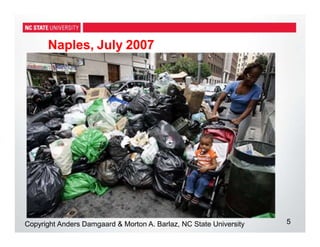
• Waste will cause public health problems if not
managed properly
Naples, July 2007
5
Copyright Anders Damgaard & Morton A. Barlaz, NC State University
The current state of
solid waste management
6
• New landfills and waste-to-energy facilities are difficult
to site
• Public interest in landfill diversion is high and is thought
to represent a solution to waste problems
• The perceived risks associated with any waste
management facility are high
The current state of
solid waste management
7
• Solid waste is an area where the technical and
political processes must work together.
• Solid waste is a local issue, not something that
just occurs in industrial areas.
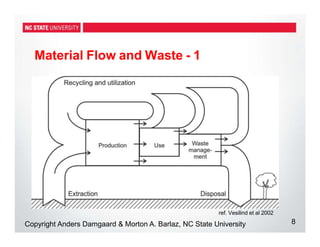
Material Flow and Waste - 1
8
Copyright Anders Damgaard & Morton A. Barlaz, NC State University
ref. Vesilind et al 2002
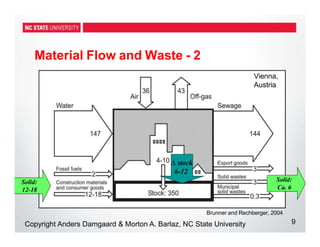
Material Flow and Waste - 2
Brunner and Rechberger, 2004
Solid:
12-18
Solid:
Ca. 6
∆ stock
6-12
9
Copyright Anders Damgaard & Morton A. Barlaz, NC State University
Vienna,
Austria
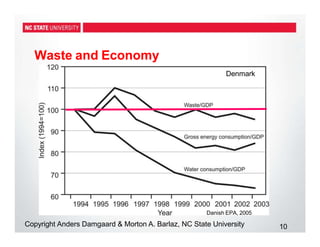
Waste and Economy
Danish EPA, 2005
Denmark
Copyright Anders Damgaard & Morton A. Barlaz, NC State University 10
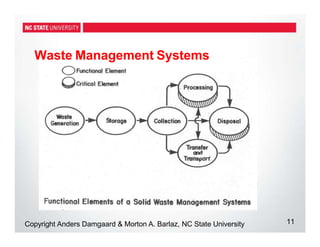
Waste Management Systems
11
Copyright Anders Damgaard & Morton A. Barlaz, NC State University
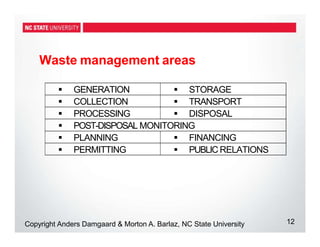
 GENERATION  STORAGE
 COLLECTION  TRANSPORT
 PROCESSING  DISPOSAL
 POST-DISPOSAL MONITORING
 PLANNING  FINANCING
 PERMITTING  PUBLIC RELATIONS
12
Copyright Anders Damgaard & Morton A. Barlaz, NC State University
Waste management areas
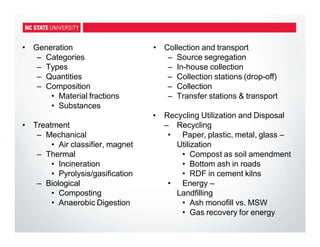
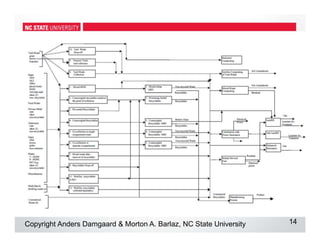
• Generation
– Categories
– Types
– Quantities
– Composition
• Material fractions
• Substances
• Treatment
– Mechanical
• Air classifier, magnet
– Thermal
• Incineration
• Pyrolysis/gasification
– Biological
• Composting
• Anaerobic Digestion
• Collection and transport
– Source segregation
– In-house collection
– Collection stations (drop-off)
– Collection
– Transfer stations & transport
• Recycling Utilization and Disposal
– Recycling
• Paper, plastic, metal, glass –
Utilization
• Compost as soil amendment
• Bottom ash in roads
• RDF in cement kilns
• Energy –
Landfilling
• Ash monofill vs. MSW
• Gas recovery for energy
14
14
Copyright Anders Damgaard & Morton A. Barlaz, NC State University
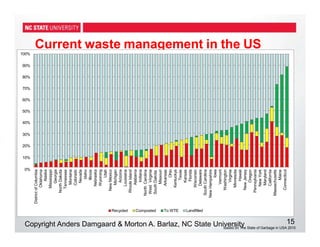
Current waste management in the US
15
Based on The State of Garbage in USA 2010
100%
90%
80%
70%
60%
50%
40%
30%
20%
10%
0%
District
of
Columbia
Oklahoma
Alaska
Mississippi
Georgia
North
Dakota
Tennessee
Montana
Colorado
Nevada
Idaho
Illinois
Nebraska
Wyoming
Utah
New
Mexico
Michigan
Arizona
Louisiana
Rhode
Island
Alabama
Indiana
North
Carolina
West
Virginia
South
Dakota
Missouri
Arkansas
Ohio
Kentuckys
Texas
Kansas
Florida
Wisconsin
Delaware
South
Carolina
New
Hampshire
Iowa
Vermont
Washington
Virginia
Minnesota
Hawaii
New
Jersey
Oregon
Pennsylvania
New
York
Maryland
California
Massachusetts
Maine
Connecticut
Recycled Composted To WTE Landfilled
Issues in solid waste: 1
16
Copyright Anders Damgaard & Morton A. Barlaz, NC State University
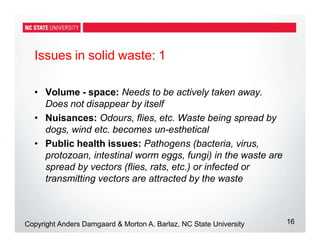
• Volume - space: Needs to be actively taken away.
Does not disappear by itself
• Nuisances: Odours, flies, etc. Waste being spread by
dogs, wind etc. becomes un-esthetical
• Public health issues: Pathogens (bacteria, virus,
protozoan, intestinal worm eggs, fungi) in the waste are
spread by vectors (flies, rats, etc.) or infected or
transmitting vectors are attracted by the waste
Issues in solid waste: 2
17
Copyright Anders Damgaard & Morton A. Barlaz, NC State University
• Economy: The scale of waste generation makes
economy an important issue
• Contamination of the environment: Waste
components transferred to air, water or soil may cause
contamination
• Resource issues: Waste contains resources that
should be used in order to save on other resources
Waste management criteria: 1
18
Copyright Anders Damgaard & Morton A. Barlaz, NC State University
The ideal waste management system:
• Provide a customised and robust handling of all waste
with a minimum of effort for the customer
• Result in the lowest possible load on the environment in
terms of noise and contamination of air, water and soil
• Provide a maximum of resource recovery from the
waste while minimising use of resource in the waste
handling
Waste management criteria: 2
19
Copyright Anders Damgaard & Morton A. Barlaz, NC State University
• Provide only little impact on the city with respect to
traffic, vehicle exhaust, noise, traffic accidents and spill
of waste
• Include architectural considerations in establishing
waste collection and treatment facilities
Waste management criteria: 3
20
Copyright Anders Damgaard & Morton A. Barlaz, NC State University
• As a minimum enforce current laws, regulations and
code of practice
• Economically acceptable!
• Ultimately, understanding the economics of waste
management will lead to an understanding of why
material flows in the way that it does
Approaches to management: 1
21
Copyright Anders Damgaard & Morton A. Barlaz, NC State University
• Common sense strategy: Some issues should meet defined
minimum standards (occupational health, level of service,
compatibility with regulations, etc.), while the balancing of the other
issues is a matter of discussion/ policy
• Waste hierarchy (3-5 levels):
- waste minimization and cleaner technology
- waste reuse and recycling (definition is partly political)
- incineration with energy recovery
- landfilling
Approaches to management: 2
22
Copyright Anders Damgaard & Morton A. Barlaz, NC State University
• Sustainability: World Commission on Environment and
Development, 1987 (The Brundtland-report: Our Common Future)
defines: Development that meets the needs of the present without
compromising the ability of future generations to meet their own
needs.
• Not many direct suggestions, but a way of thinking: long term
issues should receive more attention, each generation solves its
own problems, local responsibility, etc.
Approaches to management: 3
23
Copyright Anders Damgaard & Morton A. Barlaz, NC State University
• Life-cycle assessment (LCA) is a common tool used in evaluation
and minimising the environmental impact of industrial products, but
still fairly new in waste management:
• LCI: Life cycle inventory is the basis: account of all mass flows and
emissions as well as energy use and production. We will do some
in this class.
• LCIA: Life cycle impact assessment: converts LCI to potential
impacts and compares these, e.g., Global Warming
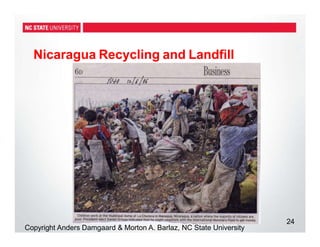
Nicaragua Recycling and Landfill
24
Copyright Anders Damgaard & Morton A. Barlaz, NC State University
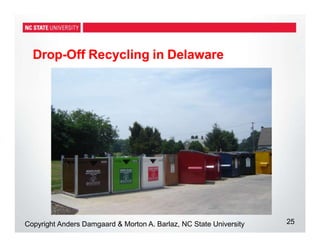
Drop-Off Recycling in Delaware
25
Copyright Anders Damgaard & Morton A. Barlaz, NC State University
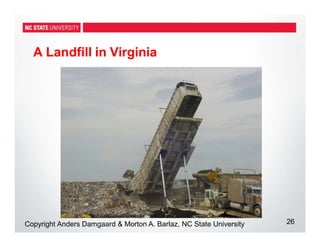
A Landfill in Virginia
26
Copyright Anders Damgaard & Morton A. Barlaz, NC State University

1 course intro (1).pptx

  • 1.
    Introduction to WasteManagement 1 Copyright Anders Damgaard & Morton A. Barlaz, NC State University • What is solid waste • Why manage it • Material flows • Waste management systems • Issues in waste management • Approaches in waste management
  • 2.
    What is solidwaste 2 Copyright Anders Damgaard & Morton A. Barlaz, NC State University • No universally accepted definition exists • A useful definition: “Waste is a left-over, a redundant product or material of no or marginal value for the owner and which the owner wants to discard” (Solid Waste Technology and Management) • The definition suggests that waste depends on time (e.g. new products, war/shortage), location (e.g rural/small town vs. urban, climatic differences), culture (e.g food-wise), and social conditions (e.g. poor vs. rich) • Focus on municipal waste in this class
  • 3.
    Definitions – Otherwastes 3 Copyright Anders Damgaard & Morton A. Barlaz, NC State University • Construction wastes: – From work on individual residences and commercial/industrial buildings • Demolition wastes: – Dirt, stones, concrete, bricks, plastics, lumber, pipes, shingle from razed buildings • Agricultural wastes: – Wastes from agricultural sources
  • 4.
    Why manage it? 4 CopyrightAnders Damgaard & Morton A. Barlaz, NC State University • We generate over 350 million tons per year • Every governmental unit must address solid waste management • Waste will cause public health problems if not managed properly
  • 5.
    Naples, July 2007 5 CopyrightAnders Damgaard & Morton A. Barlaz, NC State University
  • 6.
    The current stateof solid waste management 6 • New landfills and waste-to-energy facilities are difficult to site • Public interest in landfill diversion is high and is thought to represent a solution to waste problems • The perceived risks associated with any waste management facility are high
  • 7.
    The current stateof solid waste management 7 • Solid waste is an area where the technical and political processes must work together. • Solid waste is a local issue, not something that just occurs in industrial areas.
  • 8.
    Material Flow andWaste - 1 8 Copyright Anders Damgaard & Morton A. Barlaz, NC State University ref. Vesilind et al 2002
  • 9.
    Material Flow andWaste - 2 Brunner and Rechberger, 2004 Solid: 12-18 Solid: Ca. 6 ∆ stock 6-12 9 Copyright Anders Damgaard & Morton A. Barlaz, NC State University Vienna, Austria
  • 10.
    Waste and Economy DanishEPA, 2005 Denmark Copyright Anders Damgaard & Morton A. Barlaz, NC State University 10
  • 11.
    Waste Management Systems 11 CopyrightAnders Damgaard & Morton A. Barlaz, NC State University
  • 12.
     GENERATION STORAGE  COLLECTION  TRANSPORT  PROCESSING  DISPOSAL  POST-DISPOSAL MONITORING  PLANNING  FINANCING  PERMITTING  PUBLIC RELATIONS 12 Copyright Anders Damgaard & Morton A. Barlaz, NC State University Waste management areas
  • 13.
    • Generation – Categories –Types – Quantities – Composition • Material fractions • Substances • Treatment – Mechanical • Air classifier, magnet – Thermal • Incineration • Pyrolysis/gasification – Biological • Composting • Anaerobic Digestion • Collection and transport – Source segregation – In-house collection – Collection stations (drop-off) – Collection – Transfer stations & transport • Recycling Utilization and Disposal – Recycling • Paper, plastic, metal, glass – Utilization • Compost as soil amendment • Bottom ash in roads • RDF in cement kilns • Energy – Landfilling • Ash monofill vs. MSW • Gas recovery for energy
  • 14.
    14 14 Copyright Anders Damgaard& Morton A. Barlaz, NC State University
  • 15.
    Copyright Anders Damgaard& Morton A. Barlaz, NC State University Current waste management in the US 15 Based on The State of Garbage in USA 2010 100% 90% 80% 70% 60% 50% 40% 30% 20% 10% 0% District of Columbia Oklahoma Alaska Mississippi Georgia North Dakota Tennessee Montana Colorado Nevada Idaho Illinois Nebraska Wyoming Utah New Mexico Michigan Arizona Louisiana Rhode Island Alabama Indiana North Carolina West Virginia South Dakota Missouri Arkansas Ohio Kentuckys Texas Kansas Florida Wisconsin Delaware South Carolina New Hampshire Iowa Vermont Washington Virginia Minnesota Hawaii New Jersey Oregon Pennsylvania New York Maryland California Massachusetts Maine Connecticut Recycled Composted To WTE Landfilled
  • 16.
    Issues in solidwaste: 1 16 Copyright Anders Damgaard & Morton A. Barlaz, NC State University • Volume - space: Needs to be actively taken away. Does not disappear by itself • Nuisances: Odours, flies, etc. Waste being spread by dogs, wind etc. becomes un-esthetical • Public health issues: Pathogens (bacteria, virus, protozoan, intestinal worm eggs, fungi) in the waste are spread by vectors (flies, rats, etc.) or infected or transmitting vectors are attracted by the waste
  • 17.
    Issues in solidwaste: 2 17 Copyright Anders Damgaard & Morton A. Barlaz, NC State University • Economy: The scale of waste generation makes economy an important issue • Contamination of the environment: Waste components transferred to air, water or soil may cause contamination • Resource issues: Waste contains resources that should be used in order to save on other resources
  • 18.
    Waste management criteria:1 18 Copyright Anders Damgaard & Morton A. Barlaz, NC State University The ideal waste management system: • Provide a customised and robust handling of all waste with a minimum of effort for the customer • Result in the lowest possible load on the environment in terms of noise and contamination of air, water and soil • Provide a maximum of resource recovery from the waste while minimising use of resource in the waste handling
  • 19.
    Waste management criteria:2 19 Copyright Anders Damgaard & Morton A. Barlaz, NC State University • Provide only little impact on the city with respect to traffic, vehicle exhaust, noise, traffic accidents and spill of waste • Include architectural considerations in establishing waste collection and treatment facilities
  • 20.
    Waste management criteria:3 20 Copyright Anders Damgaard & Morton A. Barlaz, NC State University • As a minimum enforce current laws, regulations and code of practice • Economically acceptable! • Ultimately, understanding the economics of waste management will lead to an understanding of why material flows in the way that it does
  • 21.
    Approaches to management:1 21 Copyright Anders Damgaard & Morton A. Barlaz, NC State University • Common sense strategy: Some issues should meet defined minimum standards (occupational health, level of service, compatibility with regulations, etc.), while the balancing of the other issues is a matter of discussion/ policy • Waste hierarchy (3-5 levels): - waste minimization and cleaner technology - waste reuse and recycling (definition is partly political) - incineration with energy recovery - landfilling
  • 22.
    Approaches to management:2 22 Copyright Anders Damgaard & Morton A. Barlaz, NC State University • Sustainability: World Commission on Environment and Development, 1987 (The Brundtland-report: Our Common Future) defines: Development that meets the needs of the present without compromising the ability of future generations to meet their own needs. • Not many direct suggestions, but a way of thinking: long term issues should receive more attention, each generation solves its own problems, local responsibility, etc.
  • 23.
    Approaches to management:3 23 Copyright Anders Damgaard & Morton A. Barlaz, NC State University • Life-cycle assessment (LCA) is a common tool used in evaluation and minimising the environmental impact of industrial products, but still fairly new in waste management: • LCI: Life cycle inventory is the basis: account of all mass flows and emissions as well as energy use and production. We will do some in this class. • LCIA: Life cycle impact assessment: converts LCI to potential impacts and compares these, e.g., Global Warming
  • 24.
    Nicaragua Recycling andLandfill 24 Copyright Anders Damgaard & Morton A. Barlaz, NC State University
  • 25.
    Drop-Off Recycling inDelaware 25 Copyright Anders Damgaard & Morton A. Barlaz, NC State University
  • 26.
    A Landfill inVirginia 26 Copyright Anders Damgaard & Morton A. Barlaz, NC State University