CLOUD CONCEPTS
Amazon Web Services
#1
@SHAGUNRATHORE
#1
@SHAGUNRATHORE
"The cloud" refers to servers that are accessed
over the Internet.
Cloud servers are located in the data centers
that are present all over the world.
No need to manage physical servers.
No need to run software's on your own
machine.
AWS is a Cloud Provider, provides you servers
and services that you can use on demand and
scale easily
CLOUD COMPUTING
#1
@SHAGUNRATHORE
#1
On demand Usage
Trade capital expense for variable expense
Benefit from massive economies of scale
Increase speed and agility
Go global in minutes
Lower compute costs
Improved performance
Secure
Scalable
Reduce software costs
Pay-as-you-go pricing
ADVANTAGES
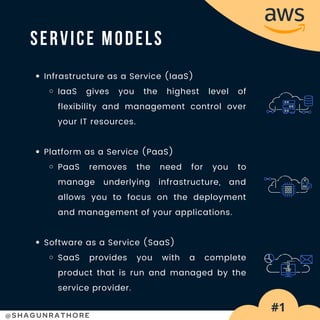
Infrastructure as a Service (IaaS)
IaaS gives you the highest level of
flexibility and management control over
your IT resources.
Platform as a Service (PaaS)
PaaS removes the need for you to
manage underlying infrastructure, and
allows you to focus on the deployment
and management of your applications.
Software as a Service (SaaS)
SaaS provides you with a complete
product that is run and managed by the
service provider.
SERVICE MODELS
@SHAGUNRATHORE
#1
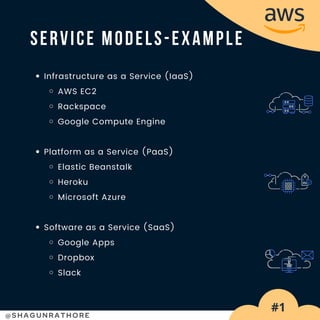
Infrastructure as a Service (IaaS)
AWS EC2
Rackspace
Google Compute Engine
Platform as a Service (PaaS)
Elastic Beanstalk
Heroku
Microsoft Azure
Software as a Service (SaaS)
Google Apps
Dropbox
Slack
SERVICE MODELS-EXAMPLE
@SHAGUNRATHORE
#1
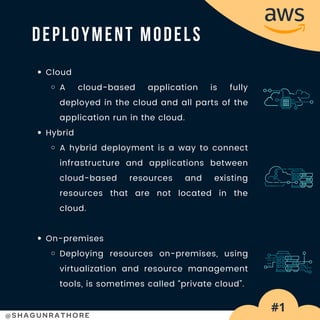
Cloud
A cloud-based application is fully
deployed in the cloud and all parts of the
application run in the cloud.
Hybrid
A hybrid deployment is a way to connect
infrastructure and applications between
cloud-based resources and existing
resources that are not located in the
cloud.
On-premises
Deploying resources on-premises, using
virtualization and resource management
tools, is sometimes called “private cloud”.
DEPLOYMENT MODELS
@SHAGUNRATHORE
#1
@SHAGUNRATHORE
#1
EMAIL
itshagunrathore@gmail.com
INSTAGRAM
@cloudeazy

#1 Cloud concepts - Amazon web services.

  • 1.
    CLOUD CONCEPTS Amazon WebServices #1 @SHAGUNRATHORE #1
  • 2.
    @SHAGUNRATHORE "The cloud" refersto servers that are accessed over the Internet. Cloud servers are located in the data centers that are present all over the world. No need to manage physical servers. No need to run software's on your own machine. AWS is a Cloud Provider, provides you servers and services that you can use on demand and scale easily CLOUD COMPUTING #1
  • 3.
    @SHAGUNRATHORE #1 On demand Usage Tradecapital expense for variable expense Benefit from massive economies of scale Increase speed and agility Go global in minutes Lower compute costs Improved performance Secure Scalable Reduce software costs Pay-as-you-go pricing ADVANTAGES
  • 4.
    Infrastructure as aService (IaaS) IaaS gives you the highest level of flexibility and management control over your IT resources. Platform as a Service (PaaS) PaaS removes the need for you to manage underlying infrastructure, and allows you to focus on the deployment and management of your applications. Software as a Service (SaaS) SaaS provides you with a complete product that is run and managed by the service provider. SERVICE MODELS @SHAGUNRATHORE #1
  • 5.
    Infrastructure as aService (IaaS) AWS EC2 Rackspace Google Compute Engine Platform as a Service (PaaS) Elastic Beanstalk Heroku Microsoft Azure Software as a Service (SaaS) Google Apps Dropbox Slack SERVICE MODELS-EXAMPLE @SHAGUNRATHORE #1
  • 6.
    Cloud A cloud-based applicationis fully deployed in the cloud and all parts of the application run in the cloud. Hybrid A hybrid deployment is a way to connect infrastructure and applications between cloud-based resources and existing resources that are not located in the cloud. On-premises Deploying resources on-premises, using virtualization and resource management tools, is sometimes called “private cloud”. DEPLOYMENT MODELS @SHAGUNRATHORE #1
  • 7.