BODY FLUIDS
INTRODUCTION
FUNCTIONS OF BODY FLUIDS
• Facilitate in the transport [nutrients, hormones, proteins,& others]
• Aid in removal of cellular metabolic wastes
• Provide medium for cellular metabolism
• Regulate body temperature
• Provide lubrication of musculoskeletal jts. and all
• body cavities [parietal, pleural fluids]
THE BODY FLUIDS
• Distribution of total body water (TBW):
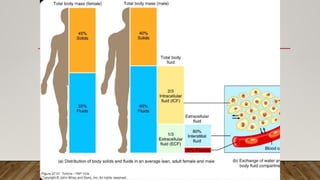
• - The total body water (TBW) is approximately 60% of body weight (42litres).
• - The percentage of TBW is highest in newborns (70%) and adult males(60%)
and lowest in adult females(50%).
• -TBW is distributed as follows :
• (1) Intracellular fluid (ICF):
• - This constitutes about 2/3 of the TBW (about 40% of the body weight).
• - It averages 28 litres.
• (2) Extracellular fluid (ECF):
• - This constitutes about 1/3 of TBW (about 20% of the body weight).
• - It averages 14 litres.
• - It includes the following subdivisions:
• Intravascular fluid (the plasma):
• - This constitutes about 5% of the body weight
• - It averages 3 litres.
• Interstitial fluid (= tissue fluid):
• - It constitutes about 15 % of the body weight.
• - It averages 11 litres.
• Solutes – dissolved particles
• Electrolytes – charged particles
• Cations – positively charged ions Na+, K+ , Ca++, H+
• Anions – negatively charged ions Cl -, HCO3, PO4
• Non-electrolytes – Uncharged Proteins, urea, glucose, O2, CO2
• Composition of the ICF & ECF:
• 1) The intracellular fluid contains large amount of potassium (K+) as the chief
cation with small amount of Mg+, Na+ & phosphates and proteins as the anions.
• 2) The extracellular fluid contains sodium (Na+) as the chief cation, with small
amount of Ca++ & K+ while chlorides (Cl-) & bicarbonate as the anions.
DIFFUSION
• Movement of solutes from an area of higher concentration to an area of lower
concentration in a solution and/or across a permeable membrane (permeable for
that solute)
• Movement occurs until near equal state
• It is passive process
OSMOLALITY
• Osmolality - amount of solute or particles in KG of water.
• Osmolality = solute/solvent
• Plasma osmolality = 2 x (Na) +
• (Glucose/18)+(Urea/2.8)
Normal value ( 275-290mOsm/L )
BODY FLUIDS CHARACTERISTICS
• Electrically neutral
• Osmotically maintained Specific no of particles per volume of fluid
• ECF Osmolality = ICF Osmolality
• Homeostasis must preserve narrow plasma osmolality Range for optimal cellular
functioning and viability
• To maintain homeostasis water intake must
• match with water excretion.
• Water balance
• • Daily Intake of Water
• – it is ingested in the form of liquids or water in the food
• – it is synthesized in the body as a result of oxidation of
• carbohydrates, adding about
• • Daily Loss of Body Water
• • Insensible Water Loss
• • evaporation from the respiratory tract and diffusion
• through the skin
• • Fluid Loss in Sweat
• • Water Loss in Feces
• • Kidneys
DISTURBANCE IN COMPOSITION
• Sodium (Na+)
• It is the most abundant cation of the extra cellular fluid. 90 % of total ECF cations
• Normal value is 135- 145mom/l
• Most important ion in regulating water balance
• Important in nerve and muscle function.
• Hyponatremia Defined as Sodium level < 135mmol/L
• Hypernatremia Na+ more than 145 mmol
TRANSPORT ACROSS CELL MEMBRANE
• Transport across cell membrane
• [I] Transport of small molecules (Micromolecules):
• A) Passive transport (diffusion):
• 1- Simple diffusion.
• 2- Facilitated diffusion.
• B) Active transport:
• 1- Primary active transport.
• 2- Secondary active transport.
• [II] Transport of large molecules (macromolecules):
• “Vesicular Transport”
• Endocytosis.
• Exocytosis.
PASSIVE
TRANSPORT=
DIFFUSION
• (1)Simple diffusion
• - Simple diffusion needs no energy.
• - occurs down an electrochemical gradient (“downhill”).
• - They are 3 pathways for passage through the cell membrane
by simple
• diffusion:
• A) Diffusion through lipid bilayer:
• - Lipid soluble molecules e.g. O2 & CO2 and steroid hormones.
• - Charged particles e.g. Na+ or K+ & glucose can not pass.
• B) Diffusion through protein channels:
• - Important for diffusion of ions & some water soluble
substances.
• - Highly selective i.e. there are specific channels for transport of
Na+, K+.
• C) Diffusion through aquaporin channels: ( Osmosis)
• - It is the net diffusion of H2O across a semipermeable
membrane by
(2) FACILITATED DIFFUSION
• l Characters:
• 1- Depend on the concentration gradient across the membrane.
• 2- Require no energy.
• 3-Require carrier “carrier protein”.
• lExample:
• - Transport of glucose into skeletal muscle and adipose cells by the GLUT4.
• 1- Glucose binds to a specific type of carrier protein called the glucose
• transporter (GluT) on the outside surface of the membrane.
• 2- As the transporter undergoes a change in shape, glucose passes
• through the membrane.
• 3- The transporter releases glucose on the other side of the membrane.
TYPES OF CARRIER PROTEINS
1- Uniport system:
• - A carrier that transports one substance in one direction e.g. D-glucose.
2- Co-transport or Symport system::
• - A carrier that transports two substances simultaneously in the same
• direction.e.g. Na+-sugar transporters (glucose, mannose, galactose).
3- Countertransport or Antiport system:
• - A carrier that transports one substance in one direction and another
• substance in the opposite direction. e.g. Na+ in & Ca++ out in nerve cell.
ACTIVE TRANSPORT
• - It is the net movement of molecules and ions across a membrane from the
• region of lower to the region of higher concentrations.
• - It requires energy (ATP) & carrier protein.
• (1) Primary active transport:
• - Active transport can move substances through cell membrane against concentration
gradient.
• - It requires energy (ATP) & carrier protein with ATP-ase activity.
• ■ Example: (Na+-K+ pump)
• - Sodium is more concentrated on the outside of the cell, whereas potassium is
• more concentrated on the inside of the cell. The Na + /K + pump helps to
• maintain these concentration differences by transporting 3Na + out of the cell
• and 2 K + into the cell.
• - Energy is provided by breakdown of ATP.
(2) SECONDARY ACTIVE TRANSPORT (COUPLED
TRANSPORT):
• - Transport of two or more solutes is coupled.
• - One of the solutes, usually Na+, moves down its concentration gradient
• (downhill), and the other solute moves against its concentration gradient
• (uphill).
• - Energy, as ATP, is not used directly, but it is supplied indirectly in the Na+
• concentration gradient across the cell membrane.
• - The Na+-K+ ATPase creates and maintains this Na+ gradient.
• ■ Example:
• - Na+-glucose cotransport in intestinal & renal cells.
ENDOCYTOSIS
• Definition:
• Transport of macromolecules or large particles from outside to inside cell “through vesicle
formation”
• Mechanism:
• - Portion of cell membrane invaginate to envelop a substance.
• - The membrane pinches off to form an intracellular vesicle.
• - Vesicle fuse with primary lysosomes forming secondary lysosomes that
• contain hydrolytic enzymes digesting the macromolecules contents of
• the vesicle.
TYPES OF ENDOCYTOSIS
1- Phagocytosis (cell eating):
• - For large particles e.g. bacteria.
• - Occurs only in macrophages.
2- Pinocytosis (cell drinking):
• - For water soluble macromolecules e.g. protein.
• - Occurs in all cells.
• 3- Receptor-mediated endocytosis:
• - Specific substances are ingested e.g. LDL.
EXOCYTOSIS
Definition:
• It is the process by which cells release their secretions to the exterior.
Mechanism:
• - Vesicles already present within the cell.
• - Vesicles fuses with the plasma membrane & release its contents into the
• fluid surrounding the cell.
•Thank you

1 BODY FLUIDS.pptx

  • 1.
  • 2.
    INTRODUCTION FUNCTIONS OF BODYFLUIDS • Facilitate in the transport [nutrients, hormones, proteins,& others] • Aid in removal of cellular metabolic wastes • Provide medium for cellular metabolism • Regulate body temperature • Provide lubrication of musculoskeletal jts. and all • body cavities [parietal, pleural fluids]
  • 3.
    THE BODY FLUIDS •Distribution of total body water (TBW): • - The total body water (TBW) is approximately 60% of body weight (42litres). • - The percentage of TBW is highest in newborns (70%) and adult males(60%) and lowest in adult females(50%).
  • 5.
    • -TBW isdistributed as follows : • (1) Intracellular fluid (ICF): • - This constitutes about 2/3 of the TBW (about 40% of the body weight). • - It averages 28 litres. • (2) Extracellular fluid (ECF): • - This constitutes about 1/3 of TBW (about 20% of the body weight). • - It averages 14 litres. • - It includes the following subdivisions: • Intravascular fluid (the plasma): • - This constitutes about 5% of the body weight • - It averages 3 litres. • Interstitial fluid (= tissue fluid): • - It constitutes about 15 % of the body weight. • - It averages 11 litres.
  • 6.
    • Solutes –dissolved particles • Electrolytes – charged particles • Cations – positively charged ions Na+, K+ , Ca++, H+ • Anions – negatively charged ions Cl -, HCO3, PO4 • Non-electrolytes – Uncharged Proteins, urea, glucose, O2, CO2
  • 7.
    • Composition ofthe ICF & ECF: • 1) The intracellular fluid contains large amount of potassium (K+) as the chief cation with small amount of Mg+, Na+ & phosphates and proteins as the anions. • 2) The extracellular fluid contains sodium (Na+) as the chief cation, with small amount of Ca++ & K+ while chlorides (Cl-) & bicarbonate as the anions.
  • 10.
    DIFFUSION • Movement ofsolutes from an area of higher concentration to an area of lower concentration in a solution and/or across a permeable membrane (permeable for that solute) • Movement occurs until near equal state • It is passive process
  • 11.
    OSMOLALITY • Osmolality -amount of solute or particles in KG of water. • Osmolality = solute/solvent • Plasma osmolality = 2 x (Na) + • (Glucose/18)+(Urea/2.8) Normal value ( 275-290mOsm/L )
  • 12.
    BODY FLUIDS CHARACTERISTICS •Electrically neutral • Osmotically maintained Specific no of particles per volume of fluid • ECF Osmolality = ICF Osmolality • Homeostasis must preserve narrow plasma osmolality Range for optimal cellular functioning and viability
  • 13.
    • To maintainhomeostasis water intake must • match with water excretion. • Water balance • • Daily Intake of Water • – it is ingested in the form of liquids or water in the food • – it is synthesized in the body as a result of oxidation of • carbohydrates, adding about • • Daily Loss of Body Water • • Insensible Water Loss • • evaporation from the respiratory tract and diffusion • through the skin • • Fluid Loss in Sweat • • Water Loss in Feces • • Kidneys
  • 14.
    DISTURBANCE IN COMPOSITION •Sodium (Na+) • It is the most abundant cation of the extra cellular fluid. 90 % of total ECF cations • Normal value is 135- 145mom/l • Most important ion in regulating water balance • Important in nerve and muscle function. • Hyponatremia Defined as Sodium level < 135mmol/L • Hypernatremia Na+ more than 145 mmol
  • 15.
    TRANSPORT ACROSS CELLMEMBRANE • Transport across cell membrane • [I] Transport of small molecules (Micromolecules): • A) Passive transport (diffusion): • 1- Simple diffusion. • 2- Facilitated diffusion. • B) Active transport: • 1- Primary active transport. • 2- Secondary active transport.
  • 16.
    • [II] Transportof large molecules (macromolecules): • “Vesicular Transport” • Endocytosis. • Exocytosis.
  • 17.
    PASSIVE TRANSPORT= DIFFUSION • (1)Simple diffusion •- Simple diffusion needs no energy. • - occurs down an electrochemical gradient (“downhill”). • - They are 3 pathways for passage through the cell membrane by simple • diffusion: • A) Diffusion through lipid bilayer: • - Lipid soluble molecules e.g. O2 & CO2 and steroid hormones. • - Charged particles e.g. Na+ or K+ & glucose can not pass. • B) Diffusion through protein channels: • - Important for diffusion of ions & some water soluble substances. • - Highly selective i.e. there are specific channels for transport of Na+, K+. • C) Diffusion through aquaporin channels: ( Osmosis) • - It is the net diffusion of H2O across a semipermeable membrane by
  • 18.
    (2) FACILITATED DIFFUSION •l Characters: • 1- Depend on the concentration gradient across the membrane. • 2- Require no energy. • 3-Require carrier “carrier protein”. • lExample: • - Transport of glucose into skeletal muscle and adipose cells by the GLUT4. • 1- Glucose binds to a specific type of carrier protein called the glucose • transporter (GluT) on the outside surface of the membrane. • 2- As the transporter undergoes a change in shape, glucose passes • through the membrane. • 3- The transporter releases glucose on the other side of the membrane.
  • 19.
    TYPES OF CARRIERPROTEINS 1- Uniport system: • - A carrier that transports one substance in one direction e.g. D-glucose. 2- Co-transport or Symport system:: • - A carrier that transports two substances simultaneously in the same • direction.e.g. Na+-sugar transporters (glucose, mannose, galactose). 3- Countertransport or Antiport system: • - A carrier that transports one substance in one direction and another • substance in the opposite direction. e.g. Na+ in & Ca++ out in nerve cell.
  • 20.
    ACTIVE TRANSPORT • -It is the net movement of molecules and ions across a membrane from the • region of lower to the region of higher concentrations. • - It requires energy (ATP) & carrier protein. • (1) Primary active transport: • - Active transport can move substances through cell membrane against concentration gradient. • - It requires energy (ATP) & carrier protein with ATP-ase activity. • ■ Example: (Na+-K+ pump) • - Sodium is more concentrated on the outside of the cell, whereas potassium is • more concentrated on the inside of the cell. The Na + /K + pump helps to • maintain these concentration differences by transporting 3Na + out of the cell • and 2 K + into the cell. • - Energy is provided by breakdown of ATP.
  • 21.
    (2) SECONDARY ACTIVETRANSPORT (COUPLED TRANSPORT): • - Transport of two or more solutes is coupled. • - One of the solutes, usually Na+, moves down its concentration gradient • (downhill), and the other solute moves against its concentration gradient • (uphill). • - Energy, as ATP, is not used directly, but it is supplied indirectly in the Na+ • concentration gradient across the cell membrane. • - The Na+-K+ ATPase creates and maintains this Na+ gradient. • ■ Example: • - Na+-glucose cotransport in intestinal & renal cells.
  • 22.
    ENDOCYTOSIS • Definition: • Transportof macromolecules or large particles from outside to inside cell “through vesicle formation” • Mechanism: • - Portion of cell membrane invaginate to envelop a substance. • - The membrane pinches off to form an intracellular vesicle. • - Vesicle fuse with primary lysosomes forming secondary lysosomes that • contain hydrolytic enzymes digesting the macromolecules contents of • the vesicle.
  • 23.
    TYPES OF ENDOCYTOSIS 1-Phagocytosis (cell eating): • - For large particles e.g. bacteria. • - Occurs only in macrophages. 2- Pinocytosis (cell drinking): • - For water soluble macromolecules e.g. protein. • - Occurs in all cells. • 3- Receptor-mediated endocytosis: • - Specific substances are ingested e.g. LDL.
  • 24.
    EXOCYTOSIS Definition: • It isthe process by which cells release their secretions to the exterior. Mechanism: • - Vesicles already present within the cell. • - Vesicles fuses with the plasma membrane & release its contents into the • fluid surrounding the cell.
  • 25.