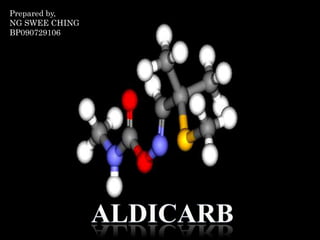
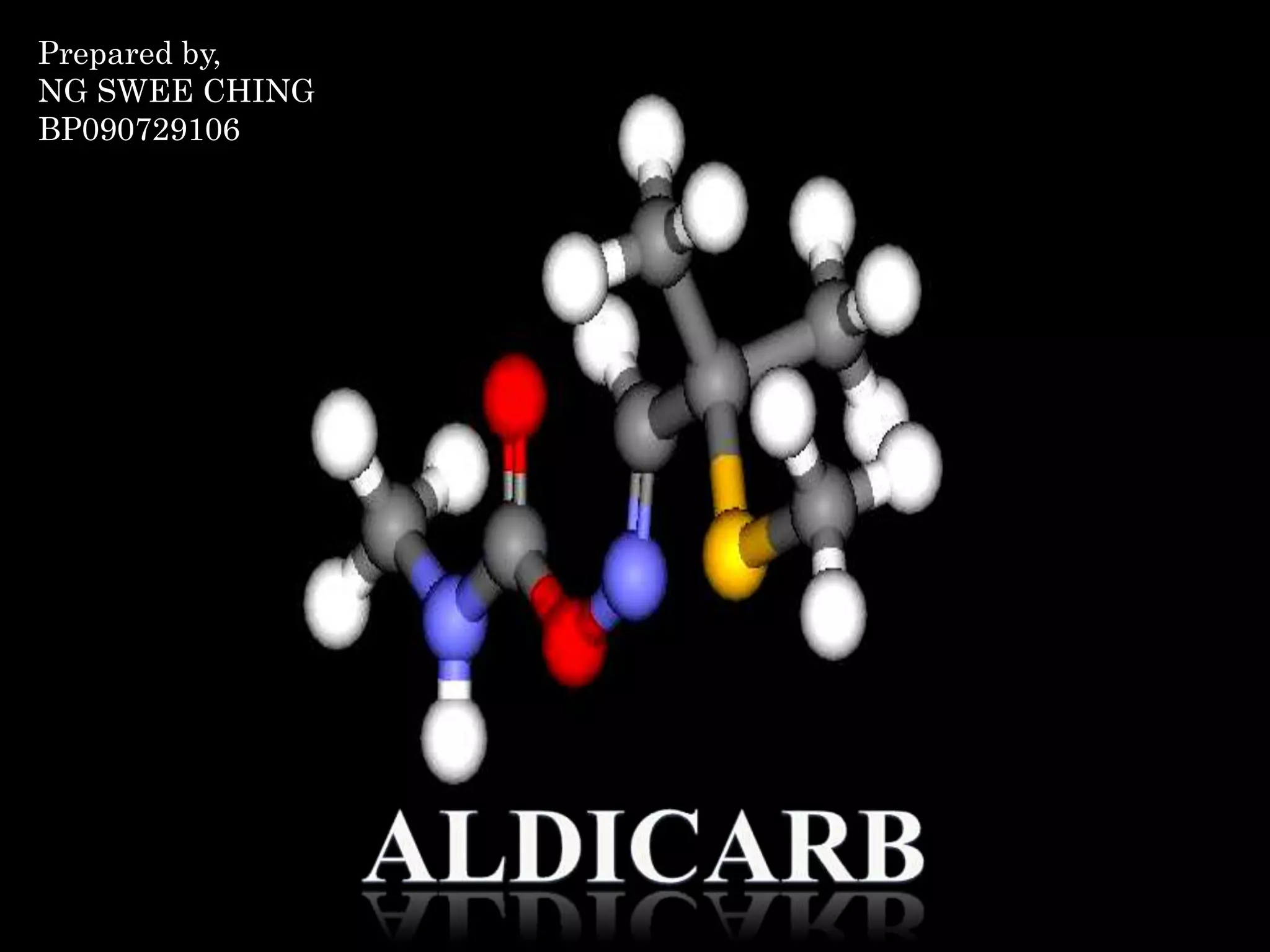
Prepared by,
NG SWEE CHING
BP090729106
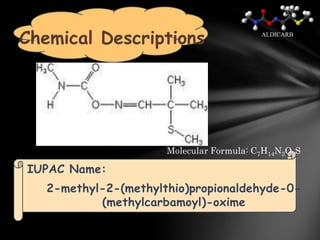
Chemical Descriptions                     ALDICARB


                      Molecular Formula: C7H14N2O2S

IUPAC Name:
   2-methyl-2-(methylthio)propionaldehyde-0-
           (methylcarbamoyl)-oxime
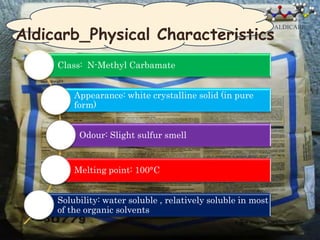
Aldicarb_Physical Characteristics
                                                              ALDICARB


     Class: N-Methyl Carbamate


         Appearance: white crystalline solid (in pure
         form)


          Odour: Slight sulfur smell


         Melting point: 100°C


     Solubility: water soluble , relatively soluble in most
     of the organic solvents
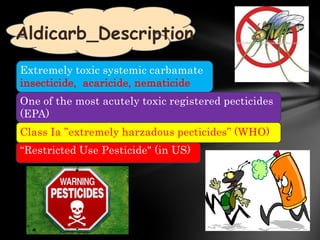
Aldicarb_Description
Extremely toxic systemic carbamate
insecticide, acaricide, nematicide
One of the most acutely toxic registered pecticides
(EPA)
Class Ia ”extremely harzadous pecticides” (WHO)
“Restricted Use Pesticide" (in US)
Aldicarb                                  ALDICARB


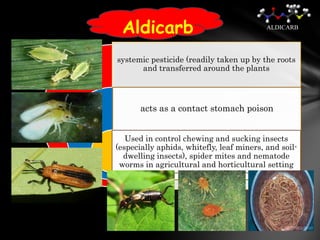
systemic pesticide (readily taken up by the roots
      and transferred around the plants


       acts as a contact stomach poison


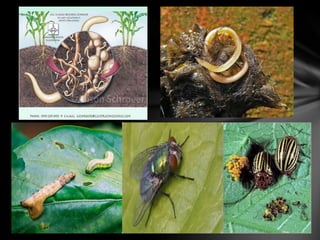
   Used in control chewing and sucking insects
(especially aphids, whitefly, leaf miners, and soil-
  dwelling insects), spider mites and nematode
 worms in agricultural and horticultural setting
Aldicarb_Mode of
     Action                                                          ALDICARB


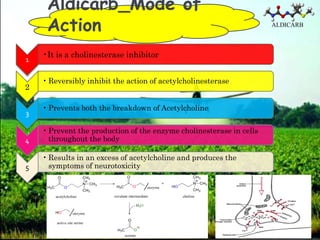
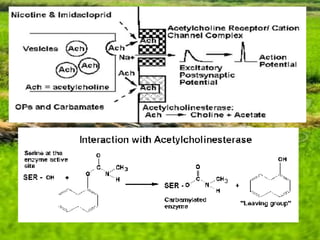
    •It is a cholinesterase inhibitor
1

    • Reversibly inhibit the action of acetylcholinesterase
2

    • Prevents both the breakdown of Acetylcholine
3

    • Prevent the production of the enzyme cholinesterase in cells
4     throughout the body

    • Results in an excess of acetylcholine and produces the
5     symptoms of neurotoxicity
Aldicarb_Uses and Usage
                                                    ALDICARB


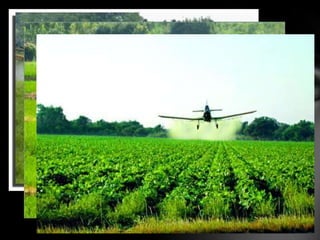
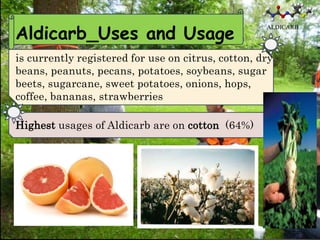
is currently registered for use on citrus, cotton, dry
beans, peanuts, pecans, potatoes, soybeans, sugar
beets, sugarcane, sweet potatoes, onions, hops,
coffee, bananas, strawberries

Highest usages of Aldicarb are on cotton (64%)
Aldicarb_Acute Toxicity            ALDICARB

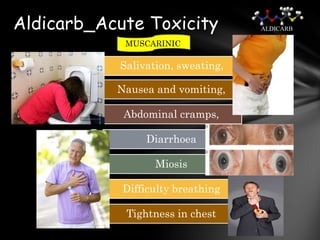
            MUSCARINIC

           Salivation, sweating,

           Nausea and vomiting,

            Abdominal cramps,

                Diarrhoea

                  Miosis

            Difficulty breathing

            Tightness in chest
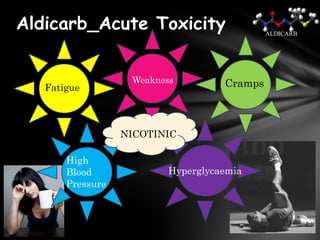
Aldicarb_Acute Toxicity                         ALDICARB


Muscular effects :

                      Weakness         Cramps
    Fatigue


                     NICOTINIC

        High
        Blood                Hyperglycaemia
        Pressure
Aldicarb_Acute Toxicity

 The acute toxicity of Aldicarb is probably the
 highest of any commonly used pesticide in UK and
 US. (The National Academy of Science)

 Aldicarb is registered as: 'Toxic in contact with the
 skin, by inhalation and if swallowed”. (UK)

 There are almost 2000 people became ill after
 consumes watermelons that were contaminated
 with Aldicarb and following the poisoning episode
 there are 6 deaths and 2 stillbirths were reported
 in July 1985.
Aldicarb_Chronic Toxicity                         ALDICARB


The evidence of chronic effect of Aldicarb exposure is
very little which rat and dogs which fed with low doses
of Aldicarb for 2 years showed no significant side effects.

Another 2 studies on Aldicarb-exposed chicks : changes
in the chick’s gait and indicate it may have long term
delayed behavioural effects.
In 1986, epidemiologists in the US found that
consumption of low levels of Aldicarb contaminated well
water was associated with one immune system
abnormality.
Aldicarb_Toxicology effect
  Teratogenic, Mutagenic and Carcinogenic Effects

        No teratogenic, mutagenic, or reproductive effects have been
        associated with the chemical's use in both animals and humans. [EPA
        and EXTOXNET]


            The exposure to Aldicarb has not been associated with the
            increase in cancer incidence. [National Toxicology Program]


            Aldicarb has possibility of carcinogenic due to the potential of in
            vivo transformation to the nitroso derivative. [Richer et al]


        “Although no one study is unacceptable, the collective data from the
        several studies provide sufficient evidence on the lack of an oncogenic
        effect.” California’s Department of Pesticide Regulation
Aldicarb_Toxicology effect
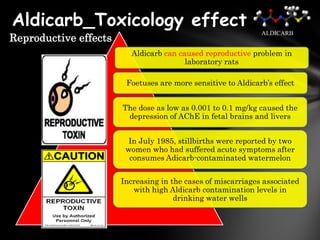
Reproductive effects
                                                              ALDICARB


                         Aldicarb can caused reproductive problem in
                                        laboratory rats

                        Foetuses are more sensitive to Aldicarb’s effect


                       The dose as low as 0.001 to 0.1 mg/kg caused the
                        depression of AChE in fetal brains and livers


                         In July 1985, stillbirths were reported by two
                        women who had suffered acute symptoms after
                         consumes Adicarb-contaminated watermelon


                       Increasing in the cases of miscarriages associated
                          with high Aldicarb contamination levels in
                                      drinking water wells
Aldicarb_Treatment                            ALDICARB


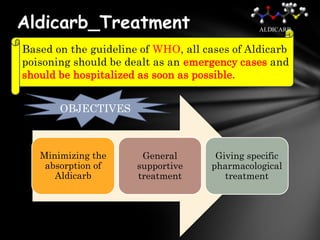
Based on the guideline of WHO, all cases of Aldicarb
poisoning should be dealt as an emergency cases and
should be hospitalized as soon as possible.


       OBJECTIVES


   Minimizing the      General       Giving specific
    absorption of     supportive    pharmacological
      Aldicarb        treatment        treatment
Objectives                                           ALDICARB


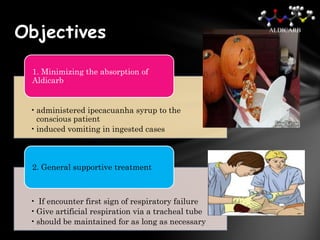
 1. Minimizing the absorption of
 Aldicarb


 • administered ipecacuanha syrup to the
   conscious patient
 • induced vomiting in ingested cases


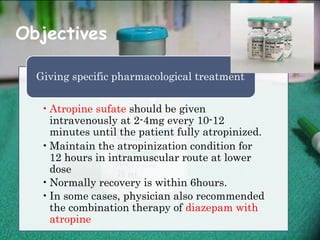
 2. General supportive treatment


 • If encounter first sign of respiratory failure
 • Give artificial respiration via a tracheal tube
 • should be maintained for as long as necessary
Objectives

     .
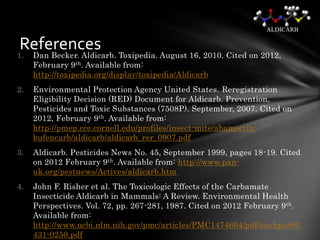
  Giving specific pharmacological treatment


   • Atropine sufate should be given
     intravenously at 2-4mg every 10-12
     minutes until the patient fully atropinized.
   • Maintain the atropinization condition for
     12 hours in intramuscular route at lower
     dose
   • Normally recovery is within 6hours.
   • In some cases, physician also recommended
     the combination therapy of diazepam with
     atropine
ALDICARB


Aldicarb_Prognosis
The chances of complete recovery are very high
if survived from the acute effects.
ALDICARB

 References Toxipedia. August 16, 2010. Cited on 2012,
1. Dan Becker. Aldicarb.
     February 9th. Available from:
     http://toxipedia.org/display/toxipedia/Aldicarb
2.   Environmental Protection Agency United States. Reregistration
     Eligibility Decision (RED) Document for Aldicarb. Prevention,
     Pesticides and Toxic Substances (7508P). September, 2007. Cited on
     2012, February 9 th. Available from:
     http://pmep.cce.cornell.edu/profiles/insect-mite/abamectin-
     bufencarb/aldicarb/aldicarb_rer_0907.pdf
3.   Aldicarb. Pesticides News No. 45, September 1999, pages 18-19. Cited
     on 2012 February 9 th. Available from: http://www.pan-
     uk.org/pestnews/Actives/aldicarb.htm
4.   John F. Risher et al. The Toxicologic Effects of the Carbamate
     Insecticide Aldicarb in Mammals: A Review. Environmental Health
     Perspectives. Vol. 72, pp. 267-281, 1987. Cited on 2012 February 9 th.
     Available from:
     http://www.ncbi.nlm.nih.gov/pmc/articles/PMC1474664/pdf/envhper00
     431-0250.pdf
References                                                         ALDICARB


5.   Extension Toxicology Network (EXTOXNET). Aldicarb.
     Cooperative Extension offices of Cornell University, Michigan
     State University, Oregon State University, and University of
     California, Davis. 1993 September. Cited on 2012 February 9 th.
     Available from: http://pmep.cce.cornell.edu/profiles/extoxnet/24d-
     captan/aldicarb-ext.html
6.   Caroline Cox. Aldicarb. Journal of Pesticide Reform. 1992. Vol 12.
     No.2. Cited on 2012 February 6 th. Available from:
     http://www.pesticide.org/get-the-facts/pesticide-
     factsheets/factsheets/aldicarb
7.   World Health Organization. Data Sheet on Pesticides No.53
     Aldicarb. Food And Agriculture Organization. IPCS Inchem Home.
     Vbc/Ds/83.53. Cited on 2012 February 9 th. Available from:
     http://www.inchem.org/documents/pds/pds/pest53_e.htm
8.   World Health Organization. Health and Safety Guide. Aldicarb.
     Geneva: United Nation Environmental Programme, the
     International Labour Organization, and the World Health
     Organization. Health and Safety Guide No. 64.Cited on 2012
     February 10th. Available from:
     http://www.inchem.org/documents/hsg/hsg/hsg064.htm
ALDICARB


Prepared by,
NG SWEE CHING
BP090729106

1. aldicarb ng swee ching

  • 1.
    Prepared by, NG SWEECHING BP090729106
  • 2.
    Chemical Descriptions ALDICARB Molecular Formula: C7H14N2O2S IUPAC Name: 2-methyl-2-(methylthio)propionaldehyde-0- (methylcarbamoyl)-oxime
  • 3.
    Aldicarb_Physical Characteristics ALDICARB Class: N-Methyl Carbamate Appearance: white crystalline solid (in pure form) Odour: Slight sulfur smell Melting point: 100°C Solubility: water soluble , relatively soluble in most of the organic solvents
  • 4.
    Aldicarb_Description Extremely toxic systemiccarbamate insecticide, acaricide, nematicide One of the most acutely toxic registered pecticides (EPA) Class Ia ”extremely harzadous pecticides” (WHO) “Restricted Use Pesticide" (in US)
  • 7.
    Aldicarb ALDICARB systemic pesticide (readily taken up by the roots and transferred around the plants acts as a contact stomach poison Used in control chewing and sucking insects (especially aphids, whitefly, leaf miners, and soil- dwelling insects), spider mites and nematode worms in agricultural and horticultural setting
  • 8.
    Aldicarb_Mode of Action ALDICARB •It is a cholinesterase inhibitor 1 • Reversibly inhibit the action of acetylcholinesterase 2 • Prevents both the breakdown of Acetylcholine 3 • Prevent the production of the enzyme cholinesterase in cells 4 throughout the body • Results in an excess of acetylcholine and produces the 5 symptoms of neurotoxicity
  • 10.
    Aldicarb_Uses and Usage ALDICARB is currently registered for use on citrus, cotton, dry beans, peanuts, pecans, potatoes, soybeans, sugar beets, sugarcane, sweet potatoes, onions, hops, coffee, bananas, strawberries Highest usages of Aldicarb are on cotton (64%)
  • 11.
    Aldicarb_Acute Toxicity ALDICARB MUSCARINIC Salivation, sweating, Nausea and vomiting, Abdominal cramps, Diarrhoea Miosis Difficulty breathing Tightness in chest
  • 12.
    Aldicarb_Acute Toxicity ALDICARB Muscular effects : Weakness Cramps Fatigue NICOTINIC High Blood Hyperglycaemia Pressure
  • 13.
    Aldicarb_Acute Toxicity Theacute toxicity of Aldicarb is probably the highest of any commonly used pesticide in UK and US. (The National Academy of Science) Aldicarb is registered as: 'Toxic in contact with the skin, by inhalation and if swallowed”. (UK) There are almost 2000 people became ill after consumes watermelons that were contaminated with Aldicarb and following the poisoning episode there are 6 deaths and 2 stillbirths were reported in July 1985.
  • 14.
    Aldicarb_Chronic Toxicity ALDICARB The evidence of chronic effect of Aldicarb exposure is very little which rat and dogs which fed with low doses of Aldicarb for 2 years showed no significant side effects. Another 2 studies on Aldicarb-exposed chicks : changes in the chick’s gait and indicate it may have long term delayed behavioural effects. In 1986, epidemiologists in the US found that consumption of low levels of Aldicarb contaminated well water was associated with one immune system abnormality.
  • 15.
    Aldicarb_Toxicology effect Teratogenic, Mutagenic and Carcinogenic Effects No teratogenic, mutagenic, or reproductive effects have been associated with the chemical's use in both animals and humans. [EPA and EXTOXNET] The exposure to Aldicarb has not been associated with the increase in cancer incidence. [National Toxicology Program] Aldicarb has possibility of carcinogenic due to the potential of in vivo transformation to the nitroso derivative. [Richer et al] “Although no one study is unacceptable, the collective data from the several studies provide sufficient evidence on the lack of an oncogenic effect.” California’s Department of Pesticide Regulation
  • 16.
    Aldicarb_Toxicology effect Reproductive effects ALDICARB Aldicarb can caused reproductive problem in laboratory rats Foetuses are more sensitive to Aldicarb’s effect The dose as low as 0.001 to 0.1 mg/kg caused the depression of AChE in fetal brains and livers In July 1985, stillbirths were reported by two women who had suffered acute symptoms after consumes Adicarb-contaminated watermelon Increasing in the cases of miscarriages associated with high Aldicarb contamination levels in drinking water wells
  • 17.
    Aldicarb_Treatment ALDICARB Based on the guideline of WHO, all cases of Aldicarb poisoning should be dealt as an emergency cases and should be hospitalized as soon as possible. OBJECTIVES Minimizing the General Giving specific absorption of supportive pharmacological Aldicarb treatment treatment
  • 18.
    Objectives ALDICARB 1. Minimizing the absorption of Aldicarb • administered ipecacuanha syrup to the conscious patient • induced vomiting in ingested cases 2. General supportive treatment • If encounter first sign of respiratory failure • Give artificial respiration via a tracheal tube • should be maintained for as long as necessary
  • 19.
    Objectives . Giving specific pharmacological treatment • Atropine sufate should be given intravenously at 2-4mg every 10-12 minutes until the patient fully atropinized. • Maintain the atropinization condition for 12 hours in intramuscular route at lower dose • Normally recovery is within 6hours. • In some cases, physician also recommended the combination therapy of diazepam with atropine
  • 20.
    ALDICARB Aldicarb_Prognosis The chances ofcomplete recovery are very high if survived from the acute effects.
  • 21.
    ALDICARB References Toxipedia.August 16, 2010. Cited on 2012, 1. Dan Becker. Aldicarb. February 9th. Available from: http://toxipedia.org/display/toxipedia/Aldicarb 2. Environmental Protection Agency United States. Reregistration Eligibility Decision (RED) Document for Aldicarb. Prevention, Pesticides and Toxic Substances (7508P). September, 2007. Cited on 2012, February 9 th. Available from: http://pmep.cce.cornell.edu/profiles/insect-mite/abamectin- bufencarb/aldicarb/aldicarb_rer_0907.pdf 3. Aldicarb. Pesticides News No. 45, September 1999, pages 18-19. Cited on 2012 February 9 th. Available from: http://www.pan- uk.org/pestnews/Actives/aldicarb.htm 4. John F. Risher et al. The Toxicologic Effects of the Carbamate Insecticide Aldicarb in Mammals: A Review. Environmental Health Perspectives. Vol. 72, pp. 267-281, 1987. Cited on 2012 February 9 th. Available from: http://www.ncbi.nlm.nih.gov/pmc/articles/PMC1474664/pdf/envhper00 431-0250.pdf
  • 22.
    References ALDICARB 5. Extension Toxicology Network (EXTOXNET). Aldicarb. Cooperative Extension offices of Cornell University, Michigan State University, Oregon State University, and University of California, Davis. 1993 September. Cited on 2012 February 9 th. Available from: http://pmep.cce.cornell.edu/profiles/extoxnet/24d- captan/aldicarb-ext.html 6. Caroline Cox. Aldicarb. Journal of Pesticide Reform. 1992. Vol 12. No.2. Cited on 2012 February 6 th. Available from: http://www.pesticide.org/get-the-facts/pesticide- factsheets/factsheets/aldicarb 7. World Health Organization. Data Sheet on Pesticides No.53 Aldicarb. Food And Agriculture Organization. IPCS Inchem Home. Vbc/Ds/83.53. Cited on 2012 February 9 th. Available from: http://www.inchem.org/documents/pds/pds/pest53_e.htm 8. World Health Organization. Health and Safety Guide. Aldicarb. Geneva: United Nation Environmental Programme, the International Labour Organization, and the World Health Organization. Health and Safety Guide No. 64.Cited on 2012 February 10th. Available from: http://www.inchem.org/documents/hsg/hsg/hsg064.htm
  • 23.