DevOps - Introduction
•DevOps is a combination of cultural philosophies, practices,
and tools that help organizations deliver applications and
services at high velocity.
• Essentially, DevOps bridges the gap between Development
(Dev) and Operations (Ops) to foster collaboration and
deliver better results.
3.
DevOps - Lifecycle
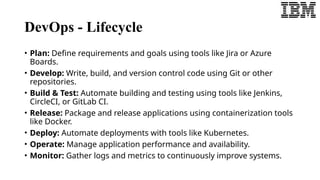
•Plan: Define requirements and goals using tools like Jira or Azure
Boards.
• Develop: Write, build, and version control code using Git or other
repositories.
• Build & Test: Automate building and testing using tools like Jenkins,
CircleCI, or GitLab CI.
• Release: Package and release applications using containerization tools
like Docker.
• Deploy: Automate deployments with tools like Kubernetes.
• Operate: Manage application performance and availability.
• Monitor: Gather logs and metrics to continuously improve systems.
4.
Why is DevOpsImportant?
In today’s competitive world, businesses need to innovate
rapidly to meet customer demands and stay ahead of the
competition. DevOps facilitates this by enabling:
• Faster delivery of software features and updates.
• Improved collaboration between teams.
• Greater resilience and reliability in software systems.
5.
Project Execution Methodologies
ITProject Execution Methodologies are structured
approaches to planning, organizing, executing, and delivering
IT projects. These methodologies help teams ensure that
projects are completed efficiently, within budget, on time, and
with the desired quality.
• Waterfall Methodology
• Agile Methodology – Scrum, Kanban, XP, Lean
6.
Agile Methodologies
Agile methodologiesare a set of principles and practices for managing and executing
projects in an iterative, collaborative, and customer-focused manner. Agile emphasizes
flexibility, delivering value continuously, and adapting to changes quickly.
Agile methodologies are iterative and incremental. They prioritize flexibility,
collaboration, and customer satisfaction. Major companies like Facebook, Google, and
Amazon utilize it for its flexibility and customer-focused approach.
Core Values of the Agile Manifesto (2001)
• Individuals and Interactions over Processes and Tools
• Working Software over Comprehensive Documentation
• Customer Collaboration over Contract Negotiation
• Responding to Change over Following a Plan
Agile Practices inDetail
• Backlog Management: The backlog is a prioritized list of tasks/features.
Agile teams constantly refine the backlog to reflect the most valuable and
current work.
• User Stories: Requirements are written from the user’s perspective,
focusing on delivering value.
• Example: "As a user, on clicking Next Button, it should take me to the next page."
• Continuous Integration/Continuous Delivery (CI/CD): Automates the
process of integrating code changes and delivering them to production.
• Retrospectives: After each iteration, teams reflect on what went well and
what can be improved.
• Burndown Charts: A visual tool showing remaining work versus time in a
sprint
9.
Advantages of Agile
•Customer-Centric: Regular feedback ensures the product
meets customer needs.
• Flexibility: Teams can adapt to changing requirements at any
stage.
• Faster Time-to-Market: Incremental delivery allows for
faster releases.
• Improved Quality: Continuous testing and collaboration
enhance product quality.
• Team Collaboration: Agile fosters a culture of teamwork and
communication.
10.
Challenges of Agile
•Scope Creep: Frequent changes can lead to uncontrolled
scope growth.
• Requires Experienced Teams: Teams must be skilled in
Agile practices for successful implementation.
• Difficult to Scale: Scaling Agile for large organizations or
complex projects can be challenging.
• Stakeholder Involvement: Requires consistent input and
engagement from stakeholders.
11.
Real-World Agile Examples
•Spotify: Spotify organizes teams into "squads" (small Agile teams),
"tribes" (related squads), and "guilds" (cross-functional groups).
• Amazon: Amazon uses Agile to continuously innovate and deliver
updates, such as one-click purchasing or AI-driven
recommendations.
• Google: Google’s iterative updates to products like Gmail and
Google Maps reflect Agile principles, focusing on user feedback
and rapid development cycles.
• Netflix: Netflix employs Agile to optimize its recommendation
engine, using real-time data and A/B testing to improve the
customer experience.
12.
Scrum Definition
• Scrumis an Agile framework used for managing complex
projects, primarily in software development, though it is
applicable to other industries. It emphasizes iterative progress,
collaboration, adaptability, and continuous improvement
through well-defined roles, events, and artifacts.
• Scrum Team Roles:
• Product Owner: Defines the product vision, prioritizes the backlog, and
represents the stakeholders.
• Scrum Master: Facilitates the process, removes obstacles, and ensures
adherence to Scrum principles.
• Development Team: Cross-functional team responsible for delivering
increments of the product.
13.
Scrum Artifacts
• ScrumArtifacts:
• User Stories: Requirements provided by the Business Team based
on discussions with the user.
• Product Backlog: A prioritized list of work items (features, fixes,
tasks) managed by the Product Owner.
• Sprint Backlog: The selected tasks from the Product Backlog for
the current sprint.
• Increment: The completed work that meets the Definition of
Done (DoD) and is potentially shippable.
14.
Scrum Ceremonies
• ScrumEvents (Ceremonies):
• Sprint: A time-boxed iteration (usually 1–4 weeks) where work is
completed.
• Sprint Planning: Meeting where the team selects backlog items or
user stories to work on during the sprint.
• Daily Scrum (Stand-up): A 15-minute daily meeting to discuss
progress and obstacles.
• Sprint Review: A demonstration of completed work to
stakeholders at the end of the sprint.
• Sprint Retrospective: A meeting to reflect on the sprint and
identify areas for improvement.
15.
Scrum Sprint Planning
•Sprint Planning is the first event in a Scrum Sprint, where the
Scrum Team collaboratively decides what work will be completed
in the upcoming Sprint and how it will be accomplished. This
meeting is time-boxed (typically max 8 hours for a 4-week Sprint
and proportionally shorter for shorter Sprints).
Purpose of Sprint Planning
• Define the Sprint Goal (a high-level objective for the Sprint).
• Select Product Backlog items to be worked on during the Sprint.
• Break down backlog items into smaller, manageable tasks.
• Estimate effort and align team capacity with workload.
16.
Scrum Metrics
1. SprintMetrics
1.1 Velocity
• Definition: Measures the average amount of work (story points or user stories) completed per Sprint.
• Purpose: Helps predict future sprint capacity.
• Formula: Velocity=Total Story Points Completed/Number of Sprints
1.2 Sprint Burndown Chart
• Definition: A graphical representation of work remaining in the Sprint.
• Purpose: Tracks sprint progress and helps identify scope creep or bottlenecks.
• How it Works:
• X-axis Time (Sprint duration).
→
• Y-axis Remaining work (Story points or hours).
→
• Ideal burndown line vs. actual progress.
1.3 Sprint Goal Success Rate
• Definition: Measures how many Sprint Goals are fully achieved.
• Purpose: Evaluates how well the team meets commitments.
• Formula: Success Rate=Sprints with Completed Goals/Total Sprints×100
17.
Scrum Metrics
2. ProductMetrics
2.1 Release Burndown Chart
• Definition: Tracks work completion over multiple Sprints toward a release.
• Purpose: Helps forecast release readiness and track overall progress.
2.2 Cumulative Flow Diagram (CFD)
• Definition: A visual representation of the status of work items (To Do, In Progress,
Done) over time.
• Purpose: Identifies bottlenecks and helps optimize workflow.
2.3 Lead Time & Cycle Time
• Lead Time: Time from when a user story is requested until it is delivered.
• Cycle Time: Time from when work on a story starts until it is completed.
• Purpose: Measures efficiency and identifies delays in the process.
18.
Scrum Metrics
3. QualityMetrics
3.1 Defect Density
• Definition: Measures the number of defects per unit of work
completed.
• Purpose: Tracks software quality and helps teams improve testing
practices.
• Formula: Defect Density=Total Defects/Total Story Points or Features
3.2 Escaped Defects
• Definition: Bugs found in production after release.
• Purpose: Evaluates the effectiveness of testing and quality control.
19.
Scrum Metrics
4. ProcessMetrics
4.1 Work in Progress (WIP) Limit
• Definition: The maximum number of tasks that can be in progress
at once.
• Purpose: Prevents bottlenecks and ensures focus on finishing tasks.
4.2 Team Happiness Index
• Definition: A subjective measure of team morale and job
satisfaction.
• Purpose: Ensures a sustainable and productive work environment.