Introduction to
Research Methodology
Walelign Asnake (BSc, MPH
St.pauls hospital millennium medical college
Session Objectives
By the end of this session the students will be able to:
1. Define and classify different types of research
2. Describe health research
3. Understand issues in topic selection
4. Describe components of the research process
5. Prepare topics for Research
4/17/202
4
walelign asnake tefera 2
Session Contents
1. Definition, concepts and types of research
2. Overview of the research process
3. Selection of research topic
4/17/202
4
walelign asnake tefera 3
“We all possess the vital instinct of inquisitiveness and our
inquisitiveness makes us probe and attain full and fuller
understanding of the unknown”
4/17/202
4
walelign asnake tefera 4
Definition, concept and types
of research
4/17/202
4
walelign asnake tefera 5
What is Research?
 A quest for knowledge through diligent search or investigation or
experimentation aimed at the discovery and interpretation of new
knowledge.
 Systematized effort to gain new knowledge.
 It is the pursuit of fact with the help of study, observation, comparison
and experiment.
 Research is a scientific and systematic search for pertinent information on
a specific topic
 “Research is an art of scientific investigation”
 Creativity may provide the difference between
satisfactory and outstanding research.
4/17/202
4
walelign asnake tefera 6
 Research refers to the systematic method consisting of
defining the problem, formulating a hypothesis,
collecting the facts or data, analyzing the facts and
reaching certain conclusions either in the form of
solutions(s) towards the concerned problem or in
certain generalizations for some theoretical
formulation.
 Research is not
 Accidental discovery
 Data collection
 Searching out published research results
in libraries (or the internet)
4/17/202
4
walelign asnake tefera 7
Purpose of research
The main aim of research is to find out answers to
questions through the application of scientific procedures.
Generally, the purpose can be grouped as:
 To gain familiarity with a phenomenon or to achieve
new insights into it. (Exploratory or formulating)
 To portray accurately the characteristics of a particular,
situation individual or a group. (descriptive research)
 To determine the frequency with which something
occurs or with which it is associated with something
else. (diagnostic research)
 To test a hypothesis of a causal relationship between
variables (hypothesis-testing research)
4/17/202
4
walelign asnake tefera 8
What drives people to conduct
research?
4/17/202
4
walelign asnake tefera 9
Drivers for reserach
 Curiosity-driven – without a clear
goal, ideas discovered by chance
 Minoxidil (the drug for male baldness
 treatment of hypertension.
 Sildenafil (Viagra)  cardiovascular
research programme
 Needs-driven – having a clear goal to
find a solution to a defined problem
 Based on the government’s priorities to
promote the health of their
populations
4/17/202
4
walelign asnake tefera 10
 Opportunity driven – availability of funding, invitation
from other researchers (international research)
 Profit driven - pursue research for profit (e.g.
pharmaceutical companies)
Other drivers:
 Desire to get a research degree, Academic promotion
 Desire to get intellectual joy of doing some creative
work;
 Desire to be of service to society
 Desire to get respectability.
4/17/202
4
walelign asnake tefera 11
Characteristics of scientific research
 Logical: Based on reasoning
 Deterministic: All events have causes, nothing
just happens without reason
Originates with a question or problem.

Often divides main problem into sub problems.
 General: General understanding rather than
explaining individual events
 Discovering both factors that determine the
event as well as that don’t
 Specific: To generalize, research must be
specific and precise in measuring events
Follows a specific plan or procedure.
Requires clear articulation of a goal.
 Empirically verifiable: quantifiable
4/17/202
4
walelign asnake tefera 12
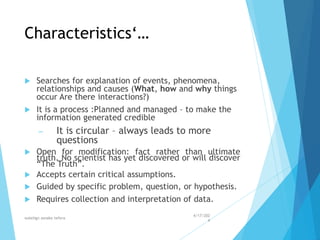
Characteristics‘…
 Searches for explanation of events, phenomena,
relationships and causes (What, how and why things
occur Are there interactions?)
 It is a process :Planned and managed – to make the
information generated credible
– It is circular – always leads to more
questions
 Open for modification: fact rather than ultimate
truth. No scientist has yet discovered or will discover
“The Truth”.
 Accepts certain critical assumptions.
 Guided by specific problem, question, or hypothesis.
 Requires collection and interpretation of data.
4/17/202
4
walelign asnake tefera 13
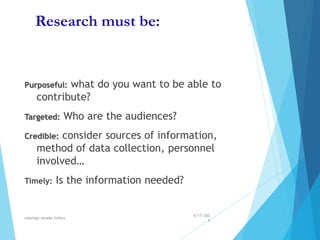
Research must be:
Purposeful: what do you want to be able to
contribute?
Targeted: Who are the audiences?
Credible: consider sources of information,
method of data collection, personnel
involved…
Timely: Is the information needed?
4/17/202
4
walelign asnake tefera 14
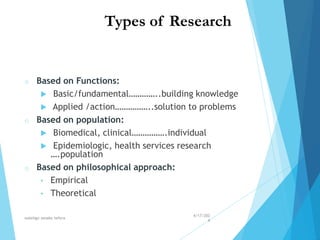
Types of Research
o Based on Functions:
 Basic/fundamental…………..building knowledge
 Applied /action……………..solution to problems
o Based on population:
 Biomedical, clinical…………….individual
 Epidemiologic, health services research
….population
o Based on philosophical approach:
• Empirical
• Theoretical
4/17/202
4
walelign asnake tefera 15
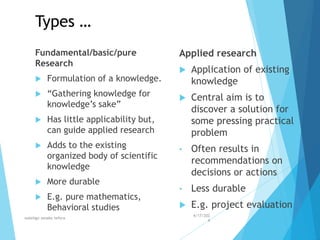
Types …
Applied research
 Application of existing
knowledge
 Central aim is to
discover a solution for
some pressing practical
problem
• Often results in
recommendations on
decisions or actions
• Less durable
 E.g. project evaluation
Fundamental/basic/pure
Research
 Formulation of a knowledge.
 “Gathering knowledge for
knowledge’s sake”
 Has little applicability but,
can guide applied research
 Adds to the existing
organized body of scientific
knowledge
 More durable
 E.g. pure mathematics,
Behavioral studies
4/17/202
4
walelign asnake tefera 16
Types …
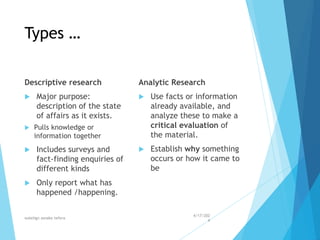
Descriptive research
 Major purpose:
description of the state
of affairs as it exists.
 Pulls knowledge or
information together
 Includes surveys and
fact-finding enquiries of
different kinds
 Only report what has
happened /happening.
Analytic Research
 Use facts or information
already available, and
analyze these to make a
critical evaluation of
the material.
 Establish why something
occurs or how it came to
be
4/17/202
4
walelign asnake tefera 17
Types …
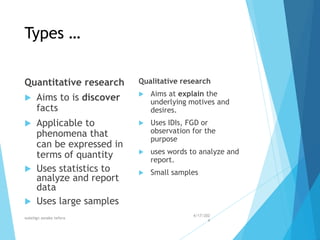
Quantitative research
 Aims to is discover
facts
 Applicable to
phenomena that
can be expressed in
terms of quantity
 Uses statistics to
analyze and report
data
 Uses large samples
Qualitative research
 Aims at explain the
underlying motives and
desires.
 Uses IDIs, FGD or
observation for the
purpose
 uses words to analyze and
report.
 Small samples
4/17/202
4
walelign asnake tefera 18
Types …
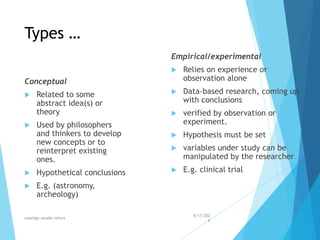
Conceptual
 Related to some
abstract idea(s) or
theory
 Used by philosophers
and thinkers to develop
new concepts or to
reinterpret existing
ones.
 Hypothetical conclusions
 E.g. (astronomy,
archeology)
Empirical/experimental
 Relies on experience or
observation alone
 Data-based research, coming up
with conclusions
 verified by observation or
experiment.
 Hypothesis must be set
 variables under study can be
manipulated by the researcher
 E.g. clinical trial
4/17/202
4
walelign asnake tefera 19
What is health research?
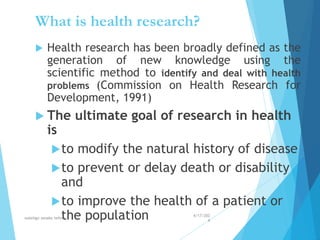
 Health research has been broadly defined as the
generation of new knowledge using the
scientific method to identify and deal with health
problems (Commission on Health Research for
Development, 1991)
 The ultimate goal of research in health
is
to modify the natural history of disease
to prevent or delay death or disability
and
to improve the health of a patient or
the population 4/17/202
4
walelign asnake tefera 20
Criteria for good research
 The purpose of the research should be clearly defined
 The research procedure used should be described in sufficient detail
to permit another researcher to repeat the research for further
advancement
 Research design should be carefully planned to yield results that are
as objective as possible.
 The researcher should report with complete frankness, flaws in
procedural design and estimate their effects upon the findings.
4/17/202
4
walelign asnake tefera 21
Good research…
 The analysis of data should be sufficient adequate to
reveal its significance.
 Methods of analysis used should be appropriate.
 The validity and reliability of the data should be
checked carefully.
 Conclusions should be confined to those justified by the
data of the research.
4/17/202
4
walelign asnake tefera 22
Overview of the
Research Process
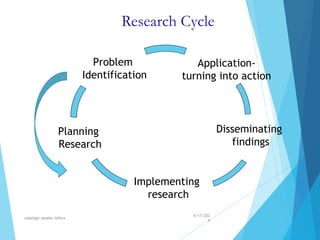
Research Cycle
Problem
Identification
Planning
Research
Implementing
research
Application-
turning into action
Disseminating
findings
4/17/202
4
walelign asnake tefera 24
Steps in undertaking a
research
1. Formulation of problems and setting
research objectives
2. Development of proposals
3. Designing research studies
4. Identifying the study population,
sample selection
5. Designing methods of data collection
6. Data processing analysis and
interpretation
7. Dissemination and utilization of
research
4/17/202
4
walelign asnake tefera 25
Problem
formulation
Problem Identification
Research question
 Research begins with a problem, namely research
question.
 A Research Question is a statement that identifies the
phenomenon to be studied.
 Without clearly defined problem conducting research is
not meaningful
 Identifying this problem can be the hardest part of
research.
 REMEMBER!!! A legitimate scientific study is NOT to
prove that something is true but rather to find out
whether it is true.
4/17/202
4
walelign asnake tefera 27
4/17/202
4
walelign asnake tefera 28
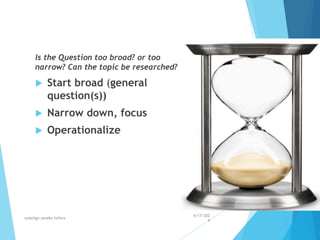
Is the Question too broad? or too
narrow? Can the topic be researched?
 Start broad (general
question(s))
 Narrow down, focus
 Operationalize
4/17/202
4
walelign asnake tefera 29
Requirements for identifying the
problem
 Knowledge of the field
 What are the important problems in the field?
 What does the literature say about the field?
 Has a great deal of research already been
conducted in this topic area? If so,
 What areas need further exploration?
 Could this study fill a gap? Lead to greater
understanding
 Is the timing right for this question to be
answered? (BURNING ISSUE?)
4/17/202
4
walelign asnake tefera 30
Research questions must be:
 Possible to answer
 Specific
 Interest/relevant to you (and
important to others)
Good research question depends on:
 What you ask
 How you ask (explore, explain?)
 Where you look
Exercise
1. What factors influence
Hepatitis B vaccination
uptake among
healthcare workers at
SPHMMC?
2. How effective is the
private wing service
at SPHMMC?
4/17/202
4
walelign asnake tefera 31
Use FINER criteria to refine your
research question
F easible
I nteresting / important
N ovel
E thical
R elevant
4/17/202
4
walelign asnake tefera 32
Feasible?
 Can this question/ project be done? (study Subjects: how
many?, from where? How will you recruit them?
 How will you collect and analyze the outcome data? (tool
available?, Expertise? Money? Equipment?
Interesting?
 Do you really care about this? Will it help you on your
career?
 Does your mentor/supervisor/granter care about this?
 Would your target audience care about the answer(s) to
this question? (community, health leaders, journal readers,
etc)
4/17/202
4
walelign asnake tefera 33
Novel?
 Has this been addressed before? If yes, how would this differ?
 Would your project provide any new information?
Ethical?
 Is there a sound scientific research design? Is the risk/benefit
balanced? Safety monitoring? Conflict of interest?
Relevance
 Will it be of interest to anyone else?
 Will it be important to the community/population you are studying?
E.g. ‘fish eye size and color’
 Will the outcome potentially change health practices/training
and/or policies?
4/17/202
4
walelign asnake tefera 34
Research title
• Short, descriptive and make clear sense of research
• Attract attention and interest of the reader
• Should clearly indicate the WHO/WHAT, WHEN, WHY,
WHERE and HOW.
• It is the focus of your research.
 A good title is usually a compromise between conciseness
and explicitness.
 Titles should be comprehensive enough to indicate the
nature of the research.
 One good way to cut the length of titles is to avoid words
that add nothing to a reader's understanding, such as
"Studies on...," "Investigations...," or "Research on Some
Problems in...."
4/17/202
4
walelign asnake tefera 35
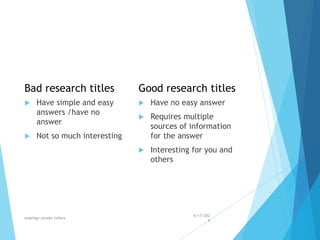
Bad research titles
 Have simple and easy
answers /have no
answer
 Not so much interesting
Good research titles
 Have no easy answer
 Requires multiple
sources of information
for the answer
 Interesting for you and
others
4/17/202
4
walelign asnake tefera 36
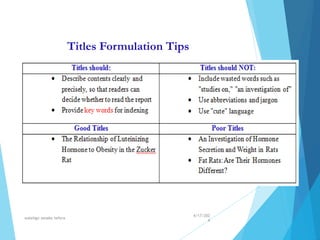
Titles Formulation Tips
4/17/202
4
walelign asnake tefera 37
Thank you!
4/17/202
4
walelign asnake tefera 38
References
 Bowling A. Research Methods in Health: Investigating Health and Health
Services. Berkshire: McGraw Hill Open University Press, 2009, 1st
Edition.
 Fathalla MF. World Health Organization Regional Publications Eastern
Mediterranean Series 30: A Practical Guide For Health Researchers.
Cairo, WHO Regional Office for the Eastern Mediterranean, 2004, 1st
Edition.
 Varkevisser CM, Pathmanathan I, Brownlee A. Designing and Conducting
Health Systems Research Projects: Volume I: Proposal Development and
Fieldwork. Amsterdam, KIT Publisher and International Development
Research Center (IDRC) in association with the Africa Regional Office
(AFRO) of the World Health Organization, 2003, 1st Edition.
 Varkevisser CM, Pathmanathan I, Brownlee A. Designing and Conducting
Health Systems Research Projects: Volume II: Data Analysis and Report
Writing. Amsterdam, KIT Publisher and International Development
Research Center (IDRC) in association with the Africa Regional Office
(AFRO) of the World Health Organization, 2003, 1st Edition
4/17/202
4
walelign asnake tefera 39

1. (39) Introduction to research methodology.ppt

  • 1.
    Introduction to Research Methodology WalelignAsnake (BSc, MPH St.pauls hospital millennium medical college
  • 2.
    Session Objectives By theend of this session the students will be able to: 1. Define and classify different types of research 2. Describe health research 3. Understand issues in topic selection 4. Describe components of the research process 5. Prepare topics for Research 4/17/202 4 walelign asnake tefera 2
  • 3.
    Session Contents 1. Definition,concepts and types of research 2. Overview of the research process 3. Selection of research topic 4/17/202 4 walelign asnake tefera 3
  • 4.
    “We all possessthe vital instinct of inquisitiveness and our inquisitiveness makes us probe and attain full and fuller understanding of the unknown” 4/17/202 4 walelign asnake tefera 4
  • 5.
    Definition, concept andtypes of research 4/17/202 4 walelign asnake tefera 5
  • 6.
    What is Research? A quest for knowledge through diligent search or investigation or experimentation aimed at the discovery and interpretation of new knowledge.  Systematized effort to gain new knowledge.  It is the pursuit of fact with the help of study, observation, comparison and experiment.  Research is a scientific and systematic search for pertinent information on a specific topic  “Research is an art of scientific investigation”  Creativity may provide the difference between satisfactory and outstanding research. 4/17/202 4 walelign asnake tefera 6
  • 7.
     Research refersto the systematic method consisting of defining the problem, formulating a hypothesis, collecting the facts or data, analyzing the facts and reaching certain conclusions either in the form of solutions(s) towards the concerned problem or in certain generalizations for some theoretical formulation.  Research is not  Accidental discovery  Data collection  Searching out published research results in libraries (or the internet) 4/17/202 4 walelign asnake tefera 7
  • 8.
    Purpose of research Themain aim of research is to find out answers to questions through the application of scientific procedures. Generally, the purpose can be grouped as:  To gain familiarity with a phenomenon or to achieve new insights into it. (Exploratory or formulating)  To portray accurately the characteristics of a particular, situation individual or a group. (descriptive research)  To determine the frequency with which something occurs or with which it is associated with something else. (diagnostic research)  To test a hypothesis of a causal relationship between variables (hypothesis-testing research) 4/17/202 4 walelign asnake tefera 8
  • 9.
    What drives peopleto conduct research? 4/17/202 4 walelign asnake tefera 9
  • 10.
    Drivers for reserach Curiosity-driven – without a clear goal, ideas discovered by chance  Minoxidil (the drug for male baldness  treatment of hypertension.  Sildenafil (Viagra)  cardiovascular research programme  Needs-driven – having a clear goal to find a solution to a defined problem  Based on the government’s priorities to promote the health of their populations 4/17/202 4 walelign asnake tefera 10
  • 11.
     Opportunity driven– availability of funding, invitation from other researchers (international research)  Profit driven - pursue research for profit (e.g. pharmaceutical companies) Other drivers:  Desire to get a research degree, Academic promotion  Desire to get intellectual joy of doing some creative work;  Desire to be of service to society  Desire to get respectability. 4/17/202 4 walelign asnake tefera 11
  • 12.
    Characteristics of scientificresearch  Logical: Based on reasoning  Deterministic: All events have causes, nothing just happens without reason Originates with a question or problem. Often divides main problem into sub problems.  General: General understanding rather than explaining individual events  Discovering both factors that determine the event as well as that don’t  Specific: To generalize, research must be specific and precise in measuring events Follows a specific plan or procedure. Requires clear articulation of a goal.  Empirically verifiable: quantifiable 4/17/202 4 walelign asnake tefera 12
  • 13.
    Characteristics‘…  Searches forexplanation of events, phenomena, relationships and causes (What, how and why things occur Are there interactions?)  It is a process :Planned and managed – to make the information generated credible – It is circular – always leads to more questions  Open for modification: fact rather than ultimate truth. No scientist has yet discovered or will discover “The Truth”.  Accepts certain critical assumptions.  Guided by specific problem, question, or hypothesis.  Requires collection and interpretation of data. 4/17/202 4 walelign asnake tefera 13
  • 14.
    Research must be: Purposeful:what do you want to be able to contribute? Targeted: Who are the audiences? Credible: consider sources of information, method of data collection, personnel involved… Timely: Is the information needed? 4/17/202 4 walelign asnake tefera 14
  • 15.
    Types of Research oBased on Functions:  Basic/fundamental…………..building knowledge  Applied /action……………..solution to problems o Based on population:  Biomedical, clinical…………….individual  Epidemiologic, health services research ….population o Based on philosophical approach: • Empirical • Theoretical 4/17/202 4 walelign asnake tefera 15
  • 16.
    Types … Applied research Application of existing knowledge  Central aim is to discover a solution for some pressing practical problem • Often results in recommendations on decisions or actions • Less durable  E.g. project evaluation Fundamental/basic/pure Research  Formulation of a knowledge.  “Gathering knowledge for knowledge’s sake”  Has little applicability but, can guide applied research  Adds to the existing organized body of scientific knowledge  More durable  E.g. pure mathematics, Behavioral studies 4/17/202 4 walelign asnake tefera 16
  • 17.
    Types … Descriptive research Major purpose: description of the state of affairs as it exists.  Pulls knowledge or information together  Includes surveys and fact-finding enquiries of different kinds  Only report what has happened /happening. Analytic Research  Use facts or information already available, and analyze these to make a critical evaluation of the material.  Establish why something occurs or how it came to be 4/17/202 4 walelign asnake tefera 17
  • 18.
    Types … Quantitative research Aims to is discover facts  Applicable to phenomena that can be expressed in terms of quantity  Uses statistics to analyze and report data  Uses large samples Qualitative research  Aims at explain the underlying motives and desires.  Uses IDIs, FGD or observation for the purpose  uses words to analyze and report.  Small samples 4/17/202 4 walelign asnake tefera 18
  • 19.
    Types … Conceptual  Relatedto some abstract idea(s) or theory  Used by philosophers and thinkers to develop new concepts or to reinterpret existing ones.  Hypothetical conclusions  E.g. (astronomy, archeology) Empirical/experimental  Relies on experience or observation alone  Data-based research, coming up with conclusions  verified by observation or experiment.  Hypothesis must be set  variables under study can be manipulated by the researcher  E.g. clinical trial 4/17/202 4 walelign asnake tefera 19
  • 20.
    What is healthresearch?  Health research has been broadly defined as the generation of new knowledge using the scientific method to identify and deal with health problems (Commission on Health Research for Development, 1991)  The ultimate goal of research in health is to modify the natural history of disease to prevent or delay death or disability and to improve the health of a patient or the population 4/17/202 4 walelign asnake tefera 20
  • 21.
    Criteria for goodresearch  The purpose of the research should be clearly defined  The research procedure used should be described in sufficient detail to permit another researcher to repeat the research for further advancement  Research design should be carefully planned to yield results that are as objective as possible.  The researcher should report with complete frankness, flaws in procedural design and estimate their effects upon the findings. 4/17/202 4 walelign asnake tefera 21
  • 22.
    Good research…  Theanalysis of data should be sufficient adequate to reveal its significance.  Methods of analysis used should be appropriate.  The validity and reliability of the data should be checked carefully.  Conclusions should be confined to those justified by the data of the research. 4/17/202 4 walelign asnake tefera 22
  • 23.
  • 24.
  • 25.
    Steps in undertakinga research 1. Formulation of problems and setting research objectives 2. Development of proposals 3. Designing research studies 4. Identifying the study population, sample selection 5. Designing methods of data collection 6. Data processing analysis and interpretation 7. Dissemination and utilization of research 4/17/202 4 walelign asnake tefera 25
  • 26.
  • 27.
    Problem Identification Research question Research begins with a problem, namely research question.  A Research Question is a statement that identifies the phenomenon to be studied.  Without clearly defined problem conducting research is not meaningful  Identifying this problem can be the hardest part of research.  REMEMBER!!! A legitimate scientific study is NOT to prove that something is true but rather to find out whether it is true. 4/17/202 4 walelign asnake tefera 27
  • 28.
  • 29.
    Is the Questiontoo broad? or too narrow? Can the topic be researched?  Start broad (general question(s))  Narrow down, focus  Operationalize 4/17/202 4 walelign asnake tefera 29
  • 30.
    Requirements for identifyingthe problem  Knowledge of the field  What are the important problems in the field?  What does the literature say about the field?  Has a great deal of research already been conducted in this topic area? If so,  What areas need further exploration?  Could this study fill a gap? Lead to greater understanding  Is the timing right for this question to be answered? (BURNING ISSUE?) 4/17/202 4 walelign asnake tefera 30
  • 31.
    Research questions mustbe:  Possible to answer  Specific  Interest/relevant to you (and important to others) Good research question depends on:  What you ask  How you ask (explore, explain?)  Where you look Exercise 1. What factors influence Hepatitis B vaccination uptake among healthcare workers at SPHMMC? 2. How effective is the private wing service at SPHMMC? 4/17/202 4 walelign asnake tefera 31
  • 32.
    Use FINER criteriato refine your research question F easible I nteresting / important N ovel E thical R elevant 4/17/202 4 walelign asnake tefera 32
  • 33.
    Feasible?  Can thisquestion/ project be done? (study Subjects: how many?, from where? How will you recruit them?  How will you collect and analyze the outcome data? (tool available?, Expertise? Money? Equipment? Interesting?  Do you really care about this? Will it help you on your career?  Does your mentor/supervisor/granter care about this?  Would your target audience care about the answer(s) to this question? (community, health leaders, journal readers, etc) 4/17/202 4 walelign asnake tefera 33
  • 34.
    Novel?  Has thisbeen addressed before? If yes, how would this differ?  Would your project provide any new information? Ethical?  Is there a sound scientific research design? Is the risk/benefit balanced? Safety monitoring? Conflict of interest? Relevance  Will it be of interest to anyone else?  Will it be important to the community/population you are studying? E.g. ‘fish eye size and color’  Will the outcome potentially change health practices/training and/or policies? 4/17/202 4 walelign asnake tefera 34
  • 35.
    Research title • Short,descriptive and make clear sense of research • Attract attention and interest of the reader • Should clearly indicate the WHO/WHAT, WHEN, WHY, WHERE and HOW. • It is the focus of your research.  A good title is usually a compromise between conciseness and explicitness.  Titles should be comprehensive enough to indicate the nature of the research.  One good way to cut the length of titles is to avoid words that add nothing to a reader's understanding, such as "Studies on...," "Investigations...," or "Research on Some Problems in...." 4/17/202 4 walelign asnake tefera 35
  • 36.
    Bad research titles Have simple and easy answers /have no answer  Not so much interesting Good research titles  Have no easy answer  Requires multiple sources of information for the answer  Interesting for you and others 4/17/202 4 walelign asnake tefera 36
  • 37.
  • 38.
  • 39.
    References  Bowling A.Research Methods in Health: Investigating Health and Health Services. Berkshire: McGraw Hill Open University Press, 2009, 1st Edition.  Fathalla MF. World Health Organization Regional Publications Eastern Mediterranean Series 30: A Practical Guide For Health Researchers. Cairo, WHO Regional Office for the Eastern Mediterranean, 2004, 1st Edition.  Varkevisser CM, Pathmanathan I, Brownlee A. Designing and Conducting Health Systems Research Projects: Volume I: Proposal Development and Fieldwork. Amsterdam, KIT Publisher and International Development Research Center (IDRC) in association with the Africa Regional Office (AFRO) of the World Health Organization, 2003, 1st Edition.  Varkevisser CM, Pathmanathan I, Brownlee A. Designing and Conducting Health Systems Research Projects: Volume II: Data Analysis and Report Writing. Amsterdam, KIT Publisher and International Development Research Center (IDRC) in association with the Africa Regional Office (AFRO) of the World Health Organization, 2003, 1st Edition 4/17/202 4 walelign asnake tefera 39