benefits magazine  july 201546
DidYourPlan
Receive28%in
RetireeDrug
Subsidies?
july 2015  benefits magazine 47
Plan sponsors have benefited
from the Retiree Drug Subsidy (RDS)
program but, because of inaccurate recordkeeping
and income cost-reporting processes,
they may not be maximizing
the subsidies.
by | Brian N. Anderson
Reproduced with permission from Benefits Magazine, Volume 52, No. 7, July
2015, pages 46-50, published by the International Foundation of Employee
Benefit Plans (www.ifebp.org), Brookfield, Wis. All rights reserved. Statements
or opinions expressed in this article are those of the author and do not necessarily
represent the views or positions of the International Foundation, its officers,
directors or staff. No further transmission or electronic distribution of this
material is permitted.M A G A Z I N E
pdf/615
benefits magazine  july 201548
retiree health plans
T
he Retiree Drug Subsidy
(RDS) program offered by
the Centers for Medicare and
Medicaid Services (CMS) re-
imburses plan sponsors such as em-
ployers, multiemployer plans and mu-
nicipalities for a portion of qualifying
prescription drug expenses for their
Medicare-eligible retirees. However,
plan sponsors—especially larger ones—
could be leaving millions of dollars on
the table because of the complexity of
the cost-reporting requirements.
According to CMS, subsidy pay-
ments should equal 28% of a qualify-
ing retiree’s allowable prescription drug
costs.1
But many plans are receiving a
reduced subsidy because of incomplete
or inaccurate cost reporting for the sub-
sidy. This shortfall can be remedied by
conducting an audit of the cost report-
ing that goes well beyond the standard
RDS reconciliation performed after the
end of the plan year.
Ideally, plan sponsors should take
a proactive approach and conduct
these audits a few months prior to
completing the RDS reconciliation.
In this case, the audit will assist in
building confidence when complet-
ing the CMS-required reconciliation
agreement to receive federal funds. It
will also avoid the need to request a
reopening of a prior year, as described
below.
In cases where the RDS reconcili-
ation already has been completed, an
audit may provide evidence to warrant
a reopening request to collect addition-
al funds. Plan sponsors may request a
reopening for applications going back
four years—and even longer for good
cause—under federal regulations.2
Large plans with incomplete reporting
potentially could uncover millions of
dollars, while smaller ones could also
recoup significant sums. In such cases,
the cost of an effective audit typically
would be far below what plan sponsors
could gain in additional subsidies.
How Complexity
Yields Inefficiencies
Given the complex administration
and arcane rules of the RDS program,
there are three main reasons for the
shortfalls:
	1.	Underreporting the number of
Medicare-eligible participants
enrolled in the plan
	2.	Underreporting of the eligible
prescription drugs under Medi-
care Part D
	3.	Miscalculation of RDS amounts
in accordance with the CMS
guidelines and requirements.
RDS Program Origins
The RDS program was enacted as
part of the Medicare Modernization Act
of 2003 and became effective January 1,
2006, concurrent with the inception of
Medicare Part D. RDS payments to plan
sponsors were seen as a way to avoid
the mass elimination of retiree phar-
macy coverage by helping offset the ris-
ing costs of these plans. Under the RDS
program, plan sponsors could keep their
existing benefits and collect a subsidy, as
long as their benefits were at least as rich
as the Part D defined standard benefit.
This was the most common approach
for plans providing retiree coverage in
2006, but its popularity has somewhat
declined in recent years with the benefit
enhancements under Medicare Part D
and the elimination of the tax-preferred
status of the RDS program.
Filing Requirements
Challenge Plans
In practice, the RDS program has
been an administrative burden for
many plan sponsors, requiring the hir-
ing of additional staff or outsourcing
the administration of Part D. To receive
the subsidy, plan sponsors must com-
ply with federal guidelines and auditing
standards. In terms of deadlines, they
need to submit an application gener-
ally three months before the beginning
of a plan year in order to be eligible for
the subsidy for that time period. Plan
sponsors have 15 months after the end
of a plan year to file the reconciliation.
Simple enough—until one considers
the complexity of the cost reporting
that plan sponsors must send to CMS.
There is also the added cost of having
to hire an actuary to attest to the plan
qualifications for the RDS program, as
required by law.
learn more >>
Education
Certificate Series
October 12-17, Las Vegas, Nevada
Visit www.ifebp.org/certificateseries for more information.
From the Bookstore
Pharmacy Benefits: Plan Design and Management
F. Randy Vogenberg. International Foundation. 2011.
Visit www.ifebp.org/books.asp?6962 for more details.
july 2015  benefits magazine 49
retiree health plans
The plan sponsor must manage retiree information dur-
ing the entire lifecycle of an RDS application. Plan spon-
sors must specify to CMS the method used to submit re-
tiree data, what source was used and how the CMS RDS
Center should deliver responses and weekly notification
files on retirees. Cost reporting on qualifying covered re-
tirees must be done on monthly, quarterly, interim annual
or annual bases and must be done for reconciliation. If a
payment is not requested, there is no government subsidy.
Remedies
Given the complex rules and data requirements, it is no
surprise that many plan sponsors are not receiving the full
amounts for which they are eligible. To bridge the gap, plan
sponsors can conduct a thorough audit of their and vendor
practices. Plan sponsors first need to find an auditor with
prescription drug and database management expertise,
along with experience with the arcane RDS program rules.
An effective audit should include a review of the following:
•	 Data preparation. The plan sponsor or pharmacy
benefit manager (PBM) should provide the auditor
with the complete eligibility file, prescription drug
claims file and covered retiree lists (CRLs) used for the
interim cost reporting for the plan year being audited.
It is important for the auditor to receive the eligibility
file and prescription drug claims file for all members
rather than only members the plan sponsor or PBM
believes are eligible.
•	 Cooperation of the PBM. Critical to the audit are
items provided by the PBM, such as the method in
which rebates are allocated to retirees, the methodol-
ogy used for separating Part B versus Part D medica-
tions, the Part D drug list used to calculate the cost
reporting and the cost-reporting information submit-
ted to CMS.
•	 Member eligibility. The audit process needs to iden-
tify eligible members. The auditor also should verify
that members listed on the CRL have the same Social
Security number or health insurance claim number
listed in the claims file. As a result of this process, the
auditor could identify additional members who the
plan sponsor may request be added to the CRL.
•	 Prescription drug eligibility. This ensures that all
drugs eligible for Part D are included in the cost re-
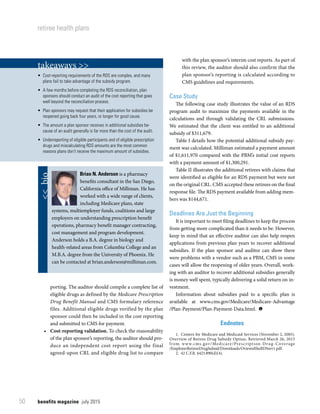
Table I
Calculating the Potential Additional Subsidy Payment
Milliman and PBM Estimation Comparison
				 Gross		 Allowable	Subsidy
	 Gross	 Threshold	 Limit	 Eligible	 Actual Cost	 Retiree	 Amount
	 Retiree	 Reduction	 Reduction	(GE)5GRC2	 Adjustment	 Cost (ARC)	 (SA)5ARC
	 Cost (GRC)	 (THR)	 (LR)	 (THR1LR)	(ACA)	5GE2ACA	 30.28
Milliman Estimation	 $7,186,361	 $986,076	 $240,589	 $5,959,697	 $ 202,662	 $5,757,034	 $1,611,970
PBM’s Initial Cost Reports	 $6,084,603	 $879,205	 $157,671	 $5,047,726	 $ 403,830	 $4,643,896	 $1,300,291
Difference in Dollars	 $1,101,758	 $106,871	 $ 82,918	 $ 911,971	 $ (201,168)	 $1,113,138	 $ 311,679
Table II
Additional Retirees With Claims
Additional Eligible Retirees Not Found on Initial CRl
				 Gross		 Allowable	Subsidy
	 Gross	 Threshold	 Limit	 Eligible	 Actual Cost	 Retiree	 Amount
	 Retiree	 Reduction	 Reduction	(GE)5GRC2	 Adjustment	 Cost (ARC)	 (SA)5ARC
	 Cost (GRC)	 (THR)	 (LR)	 (THR1LR)	(ACA)	5GE2ACA	 30.28
Milliman Estimation	 $7,186,361	 $986,076	 $240,589	 $5,959,697	 $ 202,662	 $5,757,034	 $1,611,970
PBM’s Initial Cost Reports	 $6,518,719	 $889,209	 $204,684	 $5,424,826	 $ 184,474	 $5,240,352	 $1,467,299
Difference in Dollars	 $ 667,642	 $ 96,867	 $ 35,905	 $ 534,871	 $ 18,188	 $ 516,682	 $ 144,671
benefits magazine  july 201550
retiree health plans
porting. The auditor should compile a complete list of
eligible drugs as defined by the Medicare Prescription
Drug Benefit Manual and CMS formulary reference
files. Additional eligible drugs verified by the plan
sponsor could then be included in the cost reporting
and submitted to CMS for payment.
•	 Cost-reporting validation. To check the reasonability
of the plan sponsor’s reporting, the auditor should pro-
duce an independent cost report using the final
agreed-upon CRL and eligible drug list to compare
with the plan sponsor’s interim cost reports. As part of
this review, the auditor should also confirm that the
plan sponsor’s reporting is calculated according to
CMS guidelines and requirements.
Case Study
The following case study illustrates the value of an RDS
program audit to maximize the payments available in the
calculations and through validating the CRL submissions.
We estimated that the client was entitled to an additional
subsidy of $311,679.
Table I details how the potential additional subsidy pay-
ment was calculated. Milliman estimated a payment amount
of $1,611,970 compared with the PBM’s initial cost reports
with a payment amount of $1,300,291.
Table II illustrates the additional retirees with claims that
were identified as eligible for an RDS payment but were not
on the original CRL. CMS accepted these retirees on the final
response file. The RDS payment available from adding mem-
bers was $144,671.
Deadlines Are Just the Beginning
It is important to meet filing deadlines to keep the process
from getting more complicated than it needs to be. However,
keep in mind that an effective auditor can also help reopen
applications from previous plan years to recover additional
subsidies. If the plan sponsor and auditor can show there
were problems with a vendor such as a PBM, CMS in some
cases will allow the reopening of older years. Overall, work-
ing with an auditor to recover additional subsidies generally
is money well spent, typically delivering a solid return on in-
vestment.
Information about subsidies paid to a specific plan is
available at www.cms.gov/Medicare/Medicare-Advantage
/Plan-Payment/Plan-Payment-Data.html. 
Endnotes
	 1.	 Centers for Medicare and Medicaid Services (November 2, 2005).
Overview of Retiree Drug Subsidy Option. Retrieved March 26, 2015
from www.cms.gov/Medicare/Prescription-Drug-Coverage
/EmployerRetireeDrugSubsid/Downloads/OviewoftheRDSrev1.pdf.
	 2.	 42 C.F.R. §423.890(d)(4).
takeaways >>
•  Cost-reporting requirements of the RDS are complex, and many
plans fail to take advantage of the subsidy program.
•  A few months before completing the RDS reconciliation, plan
sponsors should conduct an audit of the cost reporting that goes
well beyond the reconciliation process.
•  Plan sponsors may request that their application for subsidies be
reopened going back four years, or longer for good cause.
•  The amount a plan sponsor receives in additional subsidies be-
cause of an audit generally is far more than the cost of the audit.
•  Underreporting of eligible participants and of eligible prescription
drugs and miscalculating RDS amounts are the most common
reasons plans don’t receive the maximum amount of subsidies.
Brian N. Anderson is a pharmacy
benefits consultant in the San Diego,
California office of Milliman. He has
worked with a wide range of clients,
including Medicare plans, state
systems, multiemployer funds, coalitions and large
employers on understanding prescription benefit
operations, pharmacy benefit manager contracting,
cost management and program development.
Anderson holds a B.A. degree in biology and
health-related areas from Columbia College and an
M.B.A. degree from the University of Phoenix. He
can be contacted at brian.anderson@milliman.com.
 bio

09 Ben Mag July

  • 1.
    benefits magazine  july201546 DidYourPlan Receive28%in RetireeDrug Subsidies?
  • 2.
    july 2015  benefitsmagazine 47 Plan sponsors have benefited from the Retiree Drug Subsidy (RDS) program but, because of inaccurate recordkeeping and income cost-reporting processes, they may not be maximizing the subsidies. by | Brian N. Anderson Reproduced with permission from Benefits Magazine, Volume 52, No. 7, July 2015, pages 46-50, published by the International Foundation of Employee Benefit Plans (www.ifebp.org), Brookfield, Wis. All rights reserved. Statements or opinions expressed in this article are those of the author and do not necessarily represent the views or positions of the International Foundation, its officers, directors or staff. No further transmission or electronic distribution of this material is permitted.M A G A Z I N E pdf/615
  • 3.
    benefits magazine  july201548 retiree health plans T he Retiree Drug Subsidy (RDS) program offered by the Centers for Medicare and Medicaid Services (CMS) re- imburses plan sponsors such as em- ployers, multiemployer plans and mu- nicipalities for a portion of qualifying prescription drug expenses for their Medicare-eligible retirees. However, plan sponsors—especially larger ones— could be leaving millions of dollars on the table because of the complexity of the cost-reporting requirements. According to CMS, subsidy pay- ments should equal 28% of a qualify- ing retiree’s allowable prescription drug costs.1 But many plans are receiving a reduced subsidy because of incomplete or inaccurate cost reporting for the sub- sidy. This shortfall can be remedied by conducting an audit of the cost report- ing that goes well beyond the standard RDS reconciliation performed after the end of the plan year. Ideally, plan sponsors should take a proactive approach and conduct these audits a few months prior to completing the RDS reconciliation. In this case, the audit will assist in building confidence when complet- ing the CMS-required reconciliation agreement to receive federal funds. It will also avoid the need to request a reopening of a prior year, as described below. In cases where the RDS reconcili- ation already has been completed, an audit may provide evidence to warrant a reopening request to collect addition- al funds. Plan sponsors may request a reopening for applications going back four years—and even longer for good cause—under federal regulations.2 Large plans with incomplete reporting potentially could uncover millions of dollars, while smaller ones could also recoup significant sums. In such cases, the cost of an effective audit typically would be far below what plan sponsors could gain in additional subsidies. How Complexity Yields Inefficiencies Given the complex administration and arcane rules of the RDS program, there are three main reasons for the shortfalls: 1. Underreporting the number of Medicare-eligible participants enrolled in the plan 2. Underreporting of the eligible prescription drugs under Medi- care Part D 3. Miscalculation of RDS amounts in accordance with the CMS guidelines and requirements. RDS Program Origins The RDS program was enacted as part of the Medicare Modernization Act of 2003 and became effective January 1, 2006, concurrent with the inception of Medicare Part D. RDS payments to plan sponsors were seen as a way to avoid the mass elimination of retiree phar- macy coverage by helping offset the ris- ing costs of these plans. Under the RDS program, plan sponsors could keep their existing benefits and collect a subsidy, as long as their benefits were at least as rich as the Part D defined standard benefit. This was the most common approach for plans providing retiree coverage in 2006, but its popularity has somewhat declined in recent years with the benefit enhancements under Medicare Part D and the elimination of the tax-preferred status of the RDS program. Filing Requirements Challenge Plans In practice, the RDS program has been an administrative burden for many plan sponsors, requiring the hir- ing of additional staff or outsourcing the administration of Part D. To receive the subsidy, plan sponsors must com- ply with federal guidelines and auditing standards. In terms of deadlines, they need to submit an application gener- ally three months before the beginning of a plan year in order to be eligible for the subsidy for that time period. Plan sponsors have 15 months after the end of a plan year to file the reconciliation. Simple enough—until one considers the complexity of the cost reporting that plan sponsors must send to CMS. There is also the added cost of having to hire an actuary to attest to the plan qualifications for the RDS program, as required by law. learn more >> Education Certificate Series October 12-17, Las Vegas, Nevada Visit www.ifebp.org/certificateseries for more information. From the Bookstore Pharmacy Benefits: Plan Design and Management F. Randy Vogenberg. International Foundation. 2011. Visit www.ifebp.org/books.asp?6962 for more details.
  • 4.
    july 2015  benefitsmagazine 49 retiree health plans The plan sponsor must manage retiree information dur- ing the entire lifecycle of an RDS application. Plan spon- sors must specify to CMS the method used to submit re- tiree data, what source was used and how the CMS RDS Center should deliver responses and weekly notification files on retirees. Cost reporting on qualifying covered re- tirees must be done on monthly, quarterly, interim annual or annual bases and must be done for reconciliation. If a payment is not requested, there is no government subsidy. Remedies Given the complex rules and data requirements, it is no surprise that many plan sponsors are not receiving the full amounts for which they are eligible. To bridge the gap, plan sponsors can conduct a thorough audit of their and vendor practices. Plan sponsors first need to find an auditor with prescription drug and database management expertise, along with experience with the arcane RDS program rules. An effective audit should include a review of the following: • Data preparation. The plan sponsor or pharmacy benefit manager (PBM) should provide the auditor with the complete eligibility file, prescription drug claims file and covered retiree lists (CRLs) used for the interim cost reporting for the plan year being audited. It is important for the auditor to receive the eligibility file and prescription drug claims file for all members rather than only members the plan sponsor or PBM believes are eligible. • Cooperation of the PBM. Critical to the audit are items provided by the PBM, such as the method in which rebates are allocated to retirees, the methodol- ogy used for separating Part B versus Part D medica- tions, the Part D drug list used to calculate the cost reporting and the cost-reporting information submit- ted to CMS. • Member eligibility. The audit process needs to iden- tify eligible members. The auditor also should verify that members listed on the CRL have the same Social Security number or health insurance claim number listed in the claims file. As a result of this process, the auditor could identify additional members who the plan sponsor may request be added to the CRL. • Prescription drug eligibility. This ensures that all drugs eligible for Part D are included in the cost re- Table I Calculating the Potential Additional Subsidy Payment Milliman and PBM Estimation Comparison Gross Allowable Subsidy Gross Threshold Limit Eligible Actual Cost Retiree Amount Retiree Reduction Reduction (GE)5GRC2 Adjustment Cost (ARC) (SA)5ARC Cost (GRC) (THR) (LR) (THR1LR) (ACA) 5GE2ACA 30.28 Milliman Estimation $7,186,361 $986,076 $240,589 $5,959,697 $ 202,662 $5,757,034 $1,611,970 PBM’s Initial Cost Reports $6,084,603 $879,205 $157,671 $5,047,726 $ 403,830 $4,643,896 $1,300,291 Difference in Dollars $1,101,758 $106,871 $ 82,918 $ 911,971 $ (201,168) $1,113,138 $ 311,679 Table II Additional Retirees With Claims Additional Eligible Retirees Not Found on Initial CRl Gross Allowable Subsidy Gross Threshold Limit Eligible Actual Cost Retiree Amount Retiree Reduction Reduction (GE)5GRC2 Adjustment Cost (ARC) (SA)5ARC Cost (GRC) (THR) (LR) (THR1LR) (ACA) 5GE2ACA 30.28 Milliman Estimation $7,186,361 $986,076 $240,589 $5,959,697 $ 202,662 $5,757,034 $1,611,970 PBM’s Initial Cost Reports $6,518,719 $889,209 $204,684 $5,424,826 $ 184,474 $5,240,352 $1,467,299 Difference in Dollars $ 667,642 $ 96,867 $ 35,905 $ 534,871 $ 18,188 $ 516,682 $ 144,671
  • 5.
    benefits magazine  july201550 retiree health plans porting. The auditor should compile a complete list of eligible drugs as defined by the Medicare Prescription Drug Benefit Manual and CMS formulary reference files. Additional eligible drugs verified by the plan sponsor could then be included in the cost reporting and submitted to CMS for payment. • Cost-reporting validation. To check the reasonability of the plan sponsor’s reporting, the auditor should pro- duce an independent cost report using the final agreed-upon CRL and eligible drug list to compare with the plan sponsor’s interim cost reports. As part of this review, the auditor should also confirm that the plan sponsor’s reporting is calculated according to CMS guidelines and requirements. Case Study The following case study illustrates the value of an RDS program audit to maximize the payments available in the calculations and through validating the CRL submissions. We estimated that the client was entitled to an additional subsidy of $311,679. Table I details how the potential additional subsidy pay- ment was calculated. Milliman estimated a payment amount of $1,611,970 compared with the PBM’s initial cost reports with a payment amount of $1,300,291. Table II illustrates the additional retirees with claims that were identified as eligible for an RDS payment but were not on the original CRL. CMS accepted these retirees on the final response file. The RDS payment available from adding mem- bers was $144,671. Deadlines Are Just the Beginning It is important to meet filing deadlines to keep the process from getting more complicated than it needs to be. However, keep in mind that an effective auditor can also help reopen applications from previous plan years to recover additional subsidies. If the plan sponsor and auditor can show there were problems with a vendor such as a PBM, CMS in some cases will allow the reopening of older years. Overall, work- ing with an auditor to recover additional subsidies generally is money well spent, typically delivering a solid return on in- vestment. Information about subsidies paid to a specific plan is available at www.cms.gov/Medicare/Medicare-Advantage /Plan-Payment/Plan-Payment-Data.html.  Endnotes 1. Centers for Medicare and Medicaid Services (November 2, 2005). Overview of Retiree Drug Subsidy Option. Retrieved March 26, 2015 from www.cms.gov/Medicare/Prescription-Drug-Coverage /EmployerRetireeDrugSubsid/Downloads/OviewoftheRDSrev1.pdf. 2. 42 C.F.R. §423.890(d)(4). takeaways >> •  Cost-reporting requirements of the RDS are complex, and many plans fail to take advantage of the subsidy program. •  A few months before completing the RDS reconciliation, plan sponsors should conduct an audit of the cost reporting that goes well beyond the reconciliation process. •  Plan sponsors may request that their application for subsidies be reopened going back four years, or longer for good cause. •  The amount a plan sponsor receives in additional subsidies be- cause of an audit generally is far more than the cost of the audit. •  Underreporting of eligible participants and of eligible prescription drugs and miscalculating RDS amounts are the most common reasons plans don’t receive the maximum amount of subsidies. Brian N. Anderson is a pharmacy benefits consultant in the San Diego, California office of Milliman. He has worked with a wide range of clients, including Medicare plans, state systems, multiemployer funds, coalitions and large employers on understanding prescription benefit operations, pharmacy benefit manager contracting, cost management and program development. Anderson holds a B.A. degree in biology and health-related areas from Columbia College and an M.B.A. degree from the University of Phoenix. He can be contacted at brian.anderson@milliman.com.  bio