Fundamentals of
Core Concepts & Applications
Griffin
MANAGEMENT
Copyright © 2003 Houghton Mifflin Company.All rights reserved.
Chapter
Managing the Control Process
Copyright © by Houghton Mifflin Company. All rights reserved. 14–2
Chapter Outline
• The Nature of Control
–The Purpose of Control
–Types of Control
–Steps in Control
• Operations Control
–Preliminary Control
–Screening Control
–Post action Control
Copyright © by Houghton Mifflin Company. All rights reserved. 14–3
Chapter Outline (cont’d)
• Financial Control
–Budgetary Control
–Other Tools of Financial Control
Copyright © by Houghton Mifflin Company. All rights reserved. 14–4
Learning Objectives
• After studying this chapter, you should be able to:
–Explain the purpose of control, identify different types of
control, and describe the steps in the control process.
–Identify and explain the three forms of operations control.
–Describe budgets and other tools of financial control.
–Identify and distinguish between two opposing forms of
structural control.
–Discuss the relationship between strategy and control,
including international control.
–Identify characteristics of effective control, why people resist
control, and how managers can overcome this resistance.
Copyright © by Houghton Mifflin Company. All rights reserved. 14–5
The Nature of Control
• Control
–The regulation of organizational activities so that some
targeted element of performance remains within
acceptable limits.
• Provides organizations with indications of how well they
are performing in relation to their goals.
• Provides a mechanism for adjusting performance to keep
organizations moving in the right direction.
Copyright © by Houghton Mifflin Company. All rights reserved. 14–6
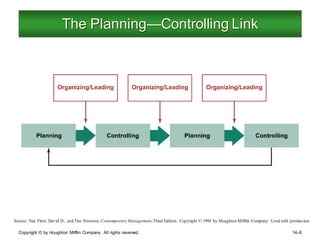
The Planning—Controlling Link
Source: Van Fleet, David D., and Tim Peterson, Contemporary Management,Third Edition. Copyright © 1994 by Houghton Mifflin Company. Used with permission.
Copyright © by Houghton Mifflin Company. All rights reserved. 14–7
The Nature of Control (cont’d)
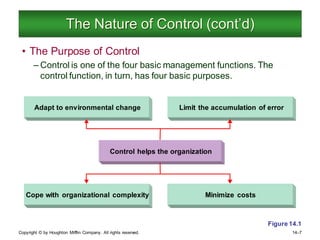
• The Purpose of Control
– Control is one of the four basic management functions. The
control function, in turn, has four basic purposes.
Adapt to environmental change Limit the accumulation of error
Control helps the organization
Cope with organizational complexity Minimize costs
Figure 14.1
Copyright © by Houghton Mifflin Company. All rights reserved. 14–8
The Nature of Control (cont’d)
• Types of Controls
–Areas of Control
• Physical resources—inventory management, quality
control, and equipment control.
• Human resources—selection and placement, training
and development, performance appraisal, and
compensation.
• Information resources—sales and marketing forecasts,
environmental analysis, public relations, production
scheduling, and economic forecasting.
• Financial resources—managing capital funds and cash
flow, collection and payment of debts.
Copyright © by Houghton Mifflin Company. All rights reserved. 14–9
The Nature of Control (cont’d)
• Types of Controls (cont’d)
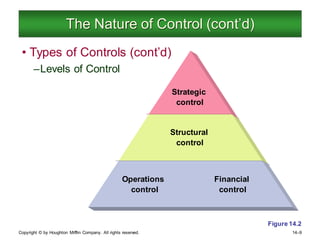
–Levels of Control
Strategic
control
Structural
control
Operations
control
Financial
control
Figure 14.2
Copyright © by Houghton Mifflin Company. All rights reserved. 14–10
The Nature of Control (cont’d)
• Types of Controls (cont’d)
–Responsibilities for Control
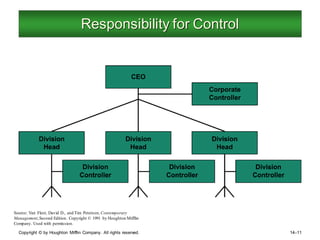
• Controller—a position in organizations
that helps line managers with
their control activities.
Copyright © by Houghton Mifflin Company. All rights reserved. 14–11
Responsibility for Control
Source: Van Fleet, David D., and Tim Peterson, Contemporary
Management,Second Edition. Copyright © 1991 by Houghton Mifflin
Company. Used with permission.
Copyright © by Houghton Mifflin Company. All rights reserved. 14–12
The Nature of Control (cont’d)
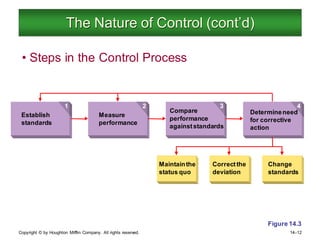
• Steps in the Control Process
Establish
standards
Measure
performance
Compare
performance
againststandards
Maintainthe
status quo
Correctthe
deviation
Change
standards
Determineneed
for corrective
action
2
1 4
3
Figure 14.3
Copyright © by Houghton Mifflin Company. All rights reserved. 14–13
The Nature of Control (cont’d)
• Steps in the Control Process (cont’d)
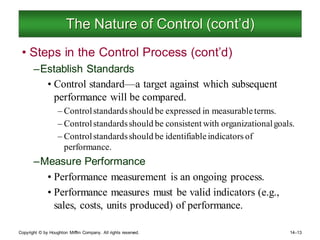
–Establish Standards
• Control standard—a target against which subsequent
performance will be compared.
– Controlstandardsshould be expressed in measurableterms.
– Controlstandardsshould be consistent with organizationalgoals.
– Controlstandardsshould be identifiableindicators of
performance.
–Measure Performance
• Performance measurement is an ongoing process.
• Performance measures must be valid indicators (e.g.,
sales, costs, units produced) of performance.
Copyright © by Houghton Mifflin Company. All rights reserved. 14–14
The Nature of Control (cont’d)
• Steps in the Control Process (cont’d)
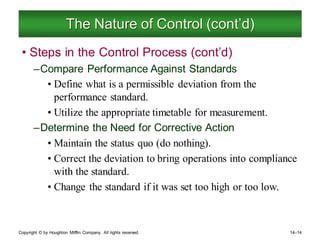
–Compare Performance Against Standards
• Define what is a permissible deviation from the
performance standard.
• Utilize the appropriate timetable for measurement.
–Determine the Need for Corrective Action
• Maintain the status quo (do nothing).
• Correct the deviation to bring operations into compliance
with the standard.
• Change the standard if it was set too high or too low.
Copyright © by Houghton Mifflin Company. All rights reserved. 14–15
The Nature of Control (cont’d)
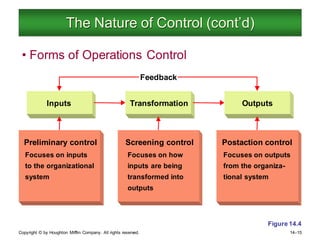
• Forms of Operations Control
Preliminary control
Focuses on inputs
to the organizational
system
Inputs Transformation Outputs
Screening control
Focuses on how
inputs are being
transformed into
outputs
Postaction control
Focuses on outputs
from the organiza-
tional system
Feedback
Figure 14.4
Copyright © by Houghton Mifflin Company. All rights reserved. 14–16
Financial Control
• Financial Control
–Control of financial resources (i.e., revenues,
shareholder investment) as they flow into the
organization, are held by the organization (i.e.,
working capital, retained earnings),
and flow out of the organization
(i.e., payment of expenses).
Copyright © by Houghton Mifflin Company. All rights reserved. 14–17
Financial Control (cont’d)
• Financial Control (cont’d)
–Budgetary Control
• Budgets may be established at any organizational level.
• Budgets are typically for one year or less.
• Budgets may be expressed in financial
terms, units of output, or
other quantifiable factors.
Copyright © by Houghton Mifflin Company. All rights reserved. 14–18
Financial Control (cont’d)
• Financial Control (cont’d)
–Budgets serve four purposes:
• Help managers coordinate resources and projects.
• Help define the established standards for control.
• Provide guidelines about the
organization’s resources
and expectations.
• Enable the organization
to evaluate the
performance of
managers and
organizational units.
Copyright © by Houghton Mifflin Company. All rights reserved. 14–19
Financial Control (cont’d)
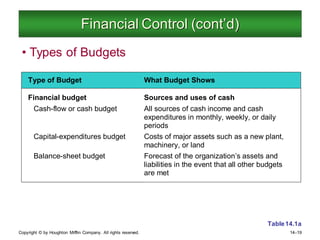
• Types of Budgets
Type of Budget What Budget Shows
Financial budget Sources and uses of cash
Cash-flow or cash budget All sources of cash income and cash
expenditures in monthly, weekly, or daily
periods
Capital-expenditures budget Costs of major assets such as a new plant,
machinery, or land
Balance-sheet budget Forecast of the organization’s assets and
liabilities in the event that all other budgets
are met
Table14.1a
Copyright © by Houghton Mifflin Company. All rights reserved. 14–20
Financial Control (cont’d)
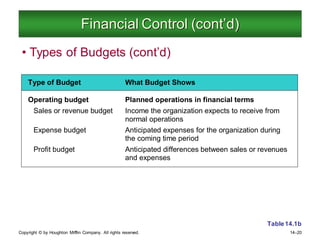
• Types of Budgets (cont’d)
Type of Budget What Budget Shows
Operating budget Planned operations in financial terms
Sales or revenue budget Income the organization expects to receive from
normal operations
Expense budget Anticipated expenses for the organization during
the coming time period
Profit budget Anticipated differences between sales or revenues
and expenses
Table14.1b
Copyright © by Houghton Mifflin Company. All rights reserved. 14–21
Financial Control (cont’d)
• Types of Budgets (cont’d)
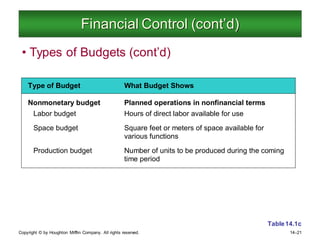
Type of Budget What Budget Shows
Nonmonetary budget Planned operations in nonfinancial terms
Labor budget Hours of direct labor available for use
Space budget Square feet or meters of space available for
various functions
Production budget Number of units to be produced during the coming
time period
Table14.1c
Copyright © by Houghton Mifflin Company. All rights reserved. 14–22
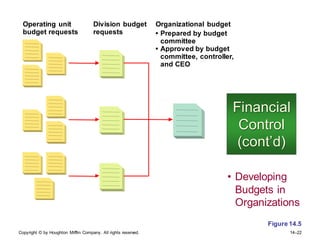
Financial
Control
(cont’d)
• Developing
Budgets in
Organizations
Operating unit
budget requests
Division budget
requests
Organizational budget
• Prepared by budget
committee
• Approved by budget
committee, controller,
and CEO
Figure 14.5
Copyright © by Houghton Mifflin Company. All rights reserved. 14–23
Financial Control (cont’d)
Copyright © by Houghton Mifflin Company. All rights reserved. 14–24
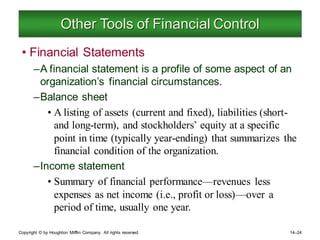
Other Tools of Financial Control
• Financial Statements
–A financial statement is a profile of some aspect of an
organization’s financial circumstances.
–Balance sheet
• A listing of assets (current and fixed), liabilities (short-
and long-term), and stockholders’ equity at a specific
point in time (typically year-ending) that summarizes the
financial condition of the organization.
–Income statement
• Summary of financial performance—revenues less
expenses as net income (i.e., profit or loss)—over a
period of time, usually one year.
Copyright © by Houghton Mifflin Company. All rights reserved. 14–25
Other Tools of Financial Control (cont’d)
• Ratio Analysis
–The calculation of of one or more financial ratios to
assess some aspect of the organization’s financial
health.
• Financial Audits
–Audit—an independent appraisal of an organization’s
accounting, financial, and operational systems.
• External audits—financial appraisals conducted by
experts who are not employees of the organization.
Internal audits—appraisals conducted by employees of
the organization.
Copyright © by Houghton Mifflin Company. All rights reserved. 14–26
Structural Control
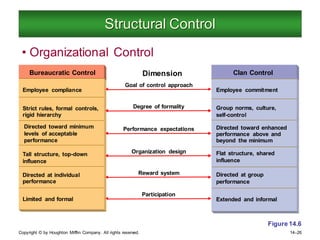
• Organizational Control
Dimension
Employee compliance
Goal of control approach
Strict rules, formal controls,
rigid hierarchy
Directed toward minimum
levels of acceptable
performance
Tall structure, top-down
influence
Directed at individual
performance
Limited and formal
Employee commitment
Group norms, culture,
self-control
Directed toward enhanced
performance above and
beyond the minimum
Flat structure, shared
influence
Directed at group
performance
Extended and informal
Performance expectations
Degree of formality
Organization design
Reward system
Participation
Bureaucratic Control Clan Control
Figure 14.6
Copyright © by Houghton Mifflin Company. All rights reserved. 14–27
Structural Control (cont’d)
• Bureaucratic Control
–A form of organizational control characterized by
formal and mechanistic structural arrangements.
• Clan Control
–An approach to organizational
control characterized by
informal and organic
structural arrangements.
Copyright © by Houghton Mifflin Company. All rights reserved. 14–28
Strategic Control
• Integrating Strategy and Control
–Strategic control
• Control aimed at ensuring that the organization is
maintaining an effective alignment with its environment
and moving toward achieving its strategic plan.
• Focuses on structure, leadership, technology, human
resources, and informational and operational systems.
• Focuses on the extent to which an implemented strategy
achieves the organization’s goals.
Copyright © by Houghton Mifflin Company. All rights reserved. 14–29
Strategic Control (cont’d)
• Integrating Strategy and Control (cont’d)
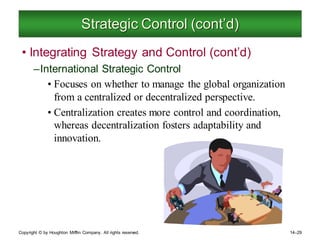
–International Strategic Control
• Focuses on whether to manage the global organization
from a centralized or decentralized perspective.
• Centralization creates more control and coordination,
whereas decentralization fosters adaptability and
innovation.
Copyright © by Houghton Mifflin Company. All rights reserved. 14–30
Managing Control in Organizations
• Characteristics of Effective Control
–Integration with Planning
• the more control is linked to planning, the more effective
the control system.
–Flexibility
• the control system must be flexible enough to
accommodate change.
–Accuracy
• Inaccurate information results in bad decision making
and inappropriate managerial actions.
Copyright © by Houghton Mifflin Company. All rights reserved. 14–31
Managing Control in Organizations (cont’d)
• Characteristics of Effective Control (cont’d)
–Timeliness
• A control system should provide information as often as
necessary.
–Objectivity
• A control system
must be free from bias
and distortion.
Copyright © by Houghton Mifflin Company. All rights reserved. 14–32
Managing Control in Organizations (cont’d)
• Resistance to Control
–Overcontrol
• Trying to control too many details becomes problematic
when control affects employee behavior and employees
perceive control attempts as unreasonable.
–Inappropriate Focus
• The control system may be too narrow or it may focus
too much on quantifiable variables and leave no room
for analysis or interpretation.
Copyright © by Houghton Mifflin Company. All rights reserved. 14–33
Managing Control in Organizations (cont’d)
• Resistance to Control (cont’d)
–Rewards for Inefficiency
• Rewarding operational inefficiency can lead employees
to behave in ways that are not in the best interests of the
organization.
–Too much accountability
• Efficient controls are resisted
by poorly performing
employees.
Copyright © by Houghton Mifflin Company. All rights reserved. 14–34
Overcoming Resistance to Control
• Resistance to control can be overcome by:
–Designing effective controls that are properly
integrated with organizational planning and aligned
with organizational goals and standards.
–Creating controls that are flexible, accurate, timely,
and objective.
–Avoiding overcontrol in the implementation of controls.
–Guarding against creating controls that reward
inefficiencies.
Copyright © by Houghton Mifflin Company. All rights reserved. 14–35
Overcoming Resistance to Control (cont’d)
• Resistance to control can be overcome by
(cont’d):
–Encouraging employee participation in the planning
and implementing of control systems.
–Developing a system of checks and balances in the
control systems through the use of multiple standards
and information systems that allow the organization to
verify the accuracy of performance indicators.

07.The controlling process.pdf

  • 1.
    Fundamentals of Core Concepts& Applications Griffin MANAGEMENT Copyright © 2003 Houghton Mifflin Company.All rights reserved. Chapter Managing the Control Process
  • 2.
    Copyright © byHoughton Mifflin Company. All rights reserved. 14–2 Chapter Outline • The Nature of Control –The Purpose of Control –Types of Control –Steps in Control • Operations Control –Preliminary Control –Screening Control –Post action Control
  • 3.
    Copyright © byHoughton Mifflin Company. All rights reserved. 14–3 Chapter Outline (cont’d) • Financial Control –Budgetary Control –Other Tools of Financial Control
  • 4.
    Copyright © byHoughton Mifflin Company. All rights reserved. 14–4 Learning Objectives • After studying this chapter, you should be able to: –Explain the purpose of control, identify different types of control, and describe the steps in the control process. –Identify and explain the three forms of operations control. –Describe budgets and other tools of financial control. –Identify and distinguish between two opposing forms of structural control. –Discuss the relationship between strategy and control, including international control. –Identify characteristics of effective control, why people resist control, and how managers can overcome this resistance.
  • 5.
    Copyright © byHoughton Mifflin Company. All rights reserved. 14–5 The Nature of Control • Control –The regulation of organizational activities so that some targeted element of performance remains within acceptable limits. • Provides organizations with indications of how well they are performing in relation to their goals. • Provides a mechanism for adjusting performance to keep organizations moving in the right direction.
  • 6.
    Copyright © byHoughton Mifflin Company. All rights reserved. 14–6 The Planning—Controlling Link Source: Van Fleet, David D., and Tim Peterson, Contemporary Management,Third Edition. Copyright © 1994 by Houghton Mifflin Company. Used with permission.
  • 7.
    Copyright © byHoughton Mifflin Company. All rights reserved. 14–7 The Nature of Control (cont’d) • The Purpose of Control – Control is one of the four basic management functions. The control function, in turn, has four basic purposes. Adapt to environmental change Limit the accumulation of error Control helps the organization Cope with organizational complexity Minimize costs Figure 14.1
  • 8.
    Copyright © byHoughton Mifflin Company. All rights reserved. 14–8 The Nature of Control (cont’d) • Types of Controls –Areas of Control • Physical resources—inventory management, quality control, and equipment control. • Human resources—selection and placement, training and development, performance appraisal, and compensation. • Information resources—sales and marketing forecasts, environmental analysis, public relations, production scheduling, and economic forecasting. • Financial resources—managing capital funds and cash flow, collection and payment of debts.
  • 9.
    Copyright © byHoughton Mifflin Company. All rights reserved. 14–9 The Nature of Control (cont’d) • Types of Controls (cont’d) –Levels of Control Strategic control Structural control Operations control Financial control Figure 14.2
  • 10.
    Copyright © byHoughton Mifflin Company. All rights reserved. 14–10 The Nature of Control (cont’d) • Types of Controls (cont’d) –Responsibilities for Control • Controller—a position in organizations that helps line managers with their control activities.
  • 11.
    Copyright © byHoughton Mifflin Company. All rights reserved. 14–11 Responsibility for Control Source: Van Fleet, David D., and Tim Peterson, Contemporary Management,Second Edition. Copyright © 1991 by Houghton Mifflin Company. Used with permission.
  • 12.
    Copyright © byHoughton Mifflin Company. All rights reserved. 14–12 The Nature of Control (cont’d) • Steps in the Control Process Establish standards Measure performance Compare performance againststandards Maintainthe status quo Correctthe deviation Change standards Determineneed for corrective action 2 1 4 3 Figure 14.3
  • 13.
    Copyright © byHoughton Mifflin Company. All rights reserved. 14–13 The Nature of Control (cont’d) • Steps in the Control Process (cont’d) –Establish Standards • Control standard—a target against which subsequent performance will be compared. – Controlstandardsshould be expressed in measurableterms. – Controlstandardsshould be consistent with organizationalgoals. – Controlstandardsshould be identifiableindicators of performance. –Measure Performance • Performance measurement is an ongoing process. • Performance measures must be valid indicators (e.g., sales, costs, units produced) of performance.
  • 14.
    Copyright © byHoughton Mifflin Company. All rights reserved. 14–14 The Nature of Control (cont’d) • Steps in the Control Process (cont’d) –Compare Performance Against Standards • Define what is a permissible deviation from the performance standard. • Utilize the appropriate timetable for measurement. –Determine the Need for Corrective Action • Maintain the status quo (do nothing). • Correct the deviation to bring operations into compliance with the standard. • Change the standard if it was set too high or too low.
  • 15.
    Copyright © byHoughton Mifflin Company. All rights reserved. 14–15 The Nature of Control (cont’d) • Forms of Operations Control Preliminary control Focuses on inputs to the organizational system Inputs Transformation Outputs Screening control Focuses on how inputs are being transformed into outputs Postaction control Focuses on outputs from the organiza- tional system Feedback Figure 14.4
  • 16.
    Copyright © byHoughton Mifflin Company. All rights reserved. 14–16 Financial Control • Financial Control –Control of financial resources (i.e., revenues, shareholder investment) as they flow into the organization, are held by the organization (i.e., working capital, retained earnings), and flow out of the organization (i.e., payment of expenses).
  • 17.
    Copyright © byHoughton Mifflin Company. All rights reserved. 14–17 Financial Control (cont’d) • Financial Control (cont’d) –Budgetary Control • Budgets may be established at any organizational level. • Budgets are typically for one year or less. • Budgets may be expressed in financial terms, units of output, or other quantifiable factors.
  • 18.
    Copyright © byHoughton Mifflin Company. All rights reserved. 14–18 Financial Control (cont’d) • Financial Control (cont’d) –Budgets serve four purposes: • Help managers coordinate resources and projects. • Help define the established standards for control. • Provide guidelines about the organization’s resources and expectations. • Enable the organization to evaluate the performance of managers and organizational units.
  • 19.
    Copyright © byHoughton Mifflin Company. All rights reserved. 14–19 Financial Control (cont’d) • Types of Budgets Type of Budget What Budget Shows Financial budget Sources and uses of cash Cash-flow or cash budget All sources of cash income and cash expenditures in monthly, weekly, or daily periods Capital-expenditures budget Costs of major assets such as a new plant, machinery, or land Balance-sheet budget Forecast of the organization’s assets and liabilities in the event that all other budgets are met Table14.1a
  • 20.
    Copyright © byHoughton Mifflin Company. All rights reserved. 14–20 Financial Control (cont’d) • Types of Budgets (cont’d) Type of Budget What Budget Shows Operating budget Planned operations in financial terms Sales or revenue budget Income the organization expects to receive from normal operations Expense budget Anticipated expenses for the organization during the coming time period Profit budget Anticipated differences between sales or revenues and expenses Table14.1b
  • 21.
    Copyright © byHoughton Mifflin Company. All rights reserved. 14–21 Financial Control (cont’d) • Types of Budgets (cont’d) Type of Budget What Budget Shows Nonmonetary budget Planned operations in nonfinancial terms Labor budget Hours of direct labor available for use Space budget Square feet or meters of space available for various functions Production budget Number of units to be produced during the coming time period Table14.1c
  • 22.
    Copyright © byHoughton Mifflin Company. All rights reserved. 14–22 Financial Control (cont’d) • Developing Budgets in Organizations Operating unit budget requests Division budget requests Organizational budget • Prepared by budget committee • Approved by budget committee, controller, and CEO Figure 14.5
  • 23.
    Copyright © byHoughton Mifflin Company. All rights reserved. 14–23 Financial Control (cont’d)
  • 24.
    Copyright © byHoughton Mifflin Company. All rights reserved. 14–24 Other Tools of Financial Control • Financial Statements –A financial statement is a profile of some aspect of an organization’s financial circumstances. –Balance sheet • A listing of assets (current and fixed), liabilities (short- and long-term), and stockholders’ equity at a specific point in time (typically year-ending) that summarizes the financial condition of the organization. –Income statement • Summary of financial performance—revenues less expenses as net income (i.e., profit or loss)—over a period of time, usually one year.
  • 25.
    Copyright © byHoughton Mifflin Company. All rights reserved. 14–25 Other Tools of Financial Control (cont’d) • Ratio Analysis –The calculation of of one or more financial ratios to assess some aspect of the organization’s financial health. • Financial Audits –Audit—an independent appraisal of an organization’s accounting, financial, and operational systems. • External audits—financial appraisals conducted by experts who are not employees of the organization. Internal audits—appraisals conducted by employees of the organization.
  • 26.
    Copyright © byHoughton Mifflin Company. All rights reserved. 14–26 Structural Control • Organizational Control Dimension Employee compliance Goal of control approach Strict rules, formal controls, rigid hierarchy Directed toward minimum levels of acceptable performance Tall structure, top-down influence Directed at individual performance Limited and formal Employee commitment Group norms, culture, self-control Directed toward enhanced performance above and beyond the minimum Flat structure, shared influence Directed at group performance Extended and informal Performance expectations Degree of formality Organization design Reward system Participation Bureaucratic Control Clan Control Figure 14.6
  • 27.
    Copyright © byHoughton Mifflin Company. All rights reserved. 14–27 Structural Control (cont’d) • Bureaucratic Control –A form of organizational control characterized by formal and mechanistic structural arrangements. • Clan Control –An approach to organizational control characterized by informal and organic structural arrangements.
  • 28.
    Copyright © byHoughton Mifflin Company. All rights reserved. 14–28 Strategic Control • Integrating Strategy and Control –Strategic control • Control aimed at ensuring that the organization is maintaining an effective alignment with its environment and moving toward achieving its strategic plan. • Focuses on structure, leadership, technology, human resources, and informational and operational systems. • Focuses on the extent to which an implemented strategy achieves the organization’s goals.
  • 29.
    Copyright © byHoughton Mifflin Company. All rights reserved. 14–29 Strategic Control (cont’d) • Integrating Strategy and Control (cont’d) –International Strategic Control • Focuses on whether to manage the global organization from a centralized or decentralized perspective. • Centralization creates more control and coordination, whereas decentralization fosters adaptability and innovation.
  • 30.
    Copyright © byHoughton Mifflin Company. All rights reserved. 14–30 Managing Control in Organizations • Characteristics of Effective Control –Integration with Planning • the more control is linked to planning, the more effective the control system. –Flexibility • the control system must be flexible enough to accommodate change. –Accuracy • Inaccurate information results in bad decision making and inappropriate managerial actions.
  • 31.
    Copyright © byHoughton Mifflin Company. All rights reserved. 14–31 Managing Control in Organizations (cont’d) • Characteristics of Effective Control (cont’d) –Timeliness • A control system should provide information as often as necessary. –Objectivity • A control system must be free from bias and distortion.
  • 32.
    Copyright © byHoughton Mifflin Company. All rights reserved. 14–32 Managing Control in Organizations (cont’d) • Resistance to Control –Overcontrol • Trying to control too many details becomes problematic when control affects employee behavior and employees perceive control attempts as unreasonable. –Inappropriate Focus • The control system may be too narrow or it may focus too much on quantifiable variables and leave no room for analysis or interpretation.
  • 33.
    Copyright © byHoughton Mifflin Company. All rights reserved. 14–33 Managing Control in Organizations (cont’d) • Resistance to Control (cont’d) –Rewards for Inefficiency • Rewarding operational inefficiency can lead employees to behave in ways that are not in the best interests of the organization. –Too much accountability • Efficient controls are resisted by poorly performing employees.
  • 34.
    Copyright © byHoughton Mifflin Company. All rights reserved. 14–34 Overcoming Resistance to Control • Resistance to control can be overcome by: –Designing effective controls that are properly integrated with organizational planning and aligned with organizational goals and standards. –Creating controls that are flexible, accurate, timely, and objective. –Avoiding overcontrol in the implementation of controls. –Guarding against creating controls that reward inefficiencies.
  • 35.
    Copyright © byHoughton Mifflin Company. All rights reserved. 14–35 Overcoming Resistance to Control (cont’d) • Resistance to control can be overcome by (cont’d): –Encouraging employee participation in the planning and implementing of control systems. –Developing a system of checks and balances in the control systems through the use of multiple standards and information systems that allow the organization to verify the accuracy of performance indicators.