NEED ASSESSMENT: SLUM HOMES
SETTING UP A MODEL TENT IN TUBURAHALLI SLUM
1
16-20
8-15
3
4-7
CONTENTS
BACKGROUND
SLUM HOUSING: AN OVERVIEW
An Overview
Types of Slums
Focus: Bengaluru
CASE STUDIES
Krishnappa slums
Yelahanka 4th phase
Jai prakash colony
Lingrajpuram
Pai layout
CONSTRUCTING THE SLUM HOME
Tuburahalli – an overview
General observations
Path forward
The construction process
21-35
2
RESERCH
Systems
Material
36-38
39-43
CONCEPTS AND IDEAS
Ventilation
Storage
MODIFICATIONS
Natural light
Chimney
Ventilation
Door
44-45NEXT STEPS
OBJECTIVES
• CASE STUDIES - To understand slum housing and various
adaptations and innovations done by slum dwellers
• CONSTRUCT A SLUM HOME – To get an understanding of
the finances, materials they use, their construction
techniques, lifestyle, layout plan, issues they face, etc.
• VALUE ADD’S - Using materials found locally within the
stipulated budget, making modifications to the existing slum
home
ABOUT THE PROJECT
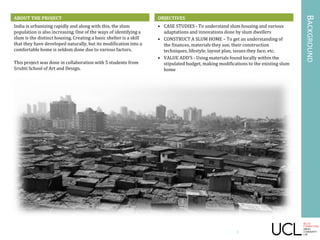
India is urbanizing rapidly and along with this, the slum
population is also increasing. One of the ways of identifying a
slum is the distinct housing. Creating a basic shelter is a skill
that they have developed naturally, but its modification into a
comfortable home is seldom done due to various factors.
This project was done in collaboration with 5 students from
Srishti School of Art and Design.
BACKGROUND
ABOUT THE PROJECT
3
SLUM HOUSING
4
HOUSING: A PRIMARY NEED
An estimated 25% of urban population still subsists on
incomes that are below poverty line. 80% of these earnings go
towards food and energy, leaving very little for meeting costs
of living in an increasingly monetized society. The majority
then end up living in slums and squatter settlements in
inhuman conditions that deny dignity, shelter, security, right
to basic amenities, ill-health, etc.
As the percentage of urban households in the next two decades
will rise from the present 28% to 50% of the country’s
population, we can expect that slums will grow at an even
faster rate.
SLUM: THE DEFINITION
As defined by the NSSO:
“A slum is a compact settlement of atleast 20 households
with a collection of poorly built tenements, mostly of
temporary nature, crowded together usually with
inadequate sanitary and drinking water facilities in
unhygienic conditions.”
URBANISATION AND SLUMS
Sources:
Report of committee on Slum statistics/Census by GOI MHUPA
SLUMS–ANOVERVIEW
Census of India 2011
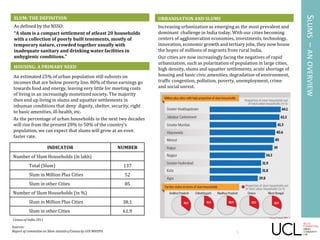
Increasing urbanization as emerging as the most prevalent and
dominant challenge in India today. With our cities becoming
centers of agglomeration economies, investments, technology,
innovation, economic growth and tertiary jobs, they now house
the hopes of millions of migrants from rural India.
Our cities are now increasingly facing the negatives of rapid
urbanization, such as polarization of population in large cities,
high density, slums and squatter settlements, acute shortage of
housing and basic civic amenities, degradation of environment,
traffic congestion, pollution, poverty, unemployment, crime
and social unrest.
INDICATOR NUMBER
Number of Slum Households (in lakh)
Total (Slum) 137
Slum in Million Plus Cities 52
Slum in other Cities 85
Number of Slum Households (in %)
Slum in Million Plus Cities 38.1
Slum in other Cities 61.9
5
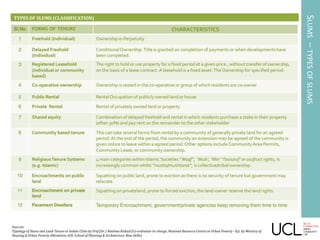
TYPES OF SLUMS (CLASSIFICATION)
SLUMS–TYPESOFSLUMS
Sources:
Typology of Slums and Land Tenure in Indian Cities by Prof.(Dr.) Neelima Risbud (Co-ordinator In-charge, National Resource Centre on Urban Poverty - Est. by Ministry of
Housing & Urban Poverty Alleviation, GOI. School of Planning & Architecture, New Delhi)
6
SLUMS IN BANGALORE
According to a 2012 report submitted to the World Bank by
Karnataka Slum Clearance Board, Bangalore has 862 slums
from total of around 2000 slums in Karnataka. It is estimated
that about 20% of Bangalore population reside in urban slums.
The families living in the slum are not ready to move into the
temporary shelters. 42% of the households migrated from
different parts of India and 43% of the households had
remained in the slums for over 10 years. The Karnataka
Municipality, works to shift 300 families annually to newly
constructed buildings. One third of these slum clearance
projects lack basic service connections, 60% of slum dwellers
lack complete water supply lines and share BWSSB water
supply.
FOCUS:BENGALURU
Source:
• "Major Slum Areas in Top Ten Cities of India". WalkThroughIndia. 13 July 2010.
Retrieved 22 October 2012.
• Teja, Bhanu. "Slum dwellers rehoused Bangalore – The SoftCopy". Iijnm.org. Retrieved
22 October 2012.
• "Water India Slums". India Sanitation Portal. Retrieved 22 October 2012.
• "Slum Dwellers Illegally Tap Board of Water Supply Bangalore's Supply".
Youthkiawaaz.com. 19 February 2011. Retrieved 22 October 2012.
• "All India figures at a glance" (PDF). Department of Economics and Statistics,
Government of Karnataka. Retrieved 1 November 2010.[dead
link]http://www.webcitation.org/5hhoB0jVy
SLUM POPULATION IN BANGALORE (10%)
OWNERSHIP OF NOTIFIED SLUMS
DISTRIBUTION OF RECOGNIZED SLUMS IN BANGALORE
SUBURB
NO. OF
SLUMS
NO. OF
HUTS
POPULATION
Gandhinagar 12 1901 9925
Chikkapete 6 1343 6956
Binnypete 13 1533 9105
Chamarajpete 22 5034 26439
Shantinagar 6 1233 6795
Basavanagadi 7 1276 5985
Yelahanka 13 3297 18696
Jayamahal 16 2096 13111
Malleswaram 24 4401 25233
Bharatinagar 20 1794 11166
Shivajinagar 1 60 350
Jayanagar 24 7302 42426
Rajajinagar 10 1866 13677
Varthur 23 5916 24468
Uttarahalli 34 14758 83020
TOTAL 231 53810 297352
10% (847,497 persons) of
Bangalore's population live
in Slums.
Karnataka Slum Clearance Board, 2008
7
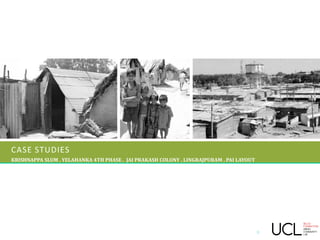
CASE STUDIES
KRISHNAPPA SLUM . YELAHANKA 4TH PHASE . JAI PRAKASH COLONY . LINGRAJPURAM . PAI LAYOUT
8
Name: Rosemary
No. of family members: 3
House type: Built (permanent)
Size: 12’ x 8’x 9’ (ht)
Space Study:
Material Study:
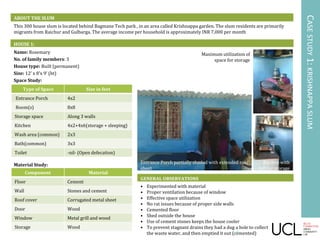
ABOUT THE SLUM
This 300 house slum is located behind Bagmane Tech park , in an area called Krishnappa garden. The slum residents are primarily
migrants from Raichur and Gulbarga. The average income per household is approximately INR 7,000 per month
HOUSE 1:
GENERAL OBSERVATIONS
• Experimented with material
• Proper ventilation because of window
• Effective space utilization
• No rat issues because of proper side walls
• Cemented floor
• Shed outside the house
• Use of cement stones keeps the house cooler
• To prevent stagnant drains they had a dug a hole to collect
the waste water, and then emptied it out (cemented)
CASESTUDY1:KRISHNAPPASLUM
Type of Space Size in feet
Entrance Porch 4x2
Room(s) 8x8
Storage space Along 3 walls
Kitchen 4x2+4x6(storage + sleeping)
Wash area (common) 2x3

Bath(common) 3x3
Toilet -nil- (Open defecation)
Component Material
Floor Cement
Wall Stones and cement
Roof cover Corrugated metal sheet
Door Wood
Window Metal grill and wood
Storage Wood
Entrance Porch partially shaded with extended roof
sheet
Maximum utilization of
space for storage
Kitchen with
loft for storage
9
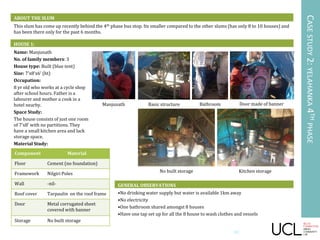
Name: Manjunath
No. of family members: 3
House type: Built (blue tent)
Size: 7’x8’x6’ (ht)
Occupation:
8 yr old who works at a cycle shop
after school hours. Father is a
labourer and mother a cook in a
hotel nearby.
Space Study:
The house consists of just one room
of 7’x8’ with no partitions. They
have a small kitchen area and lack
storage space.
Material Study:
ABOUT THE SLUM
This slum has come up recently behind the 4th phase bus stop. Its smaller compared to the other slums (has only 8 to 10 houses) and
has been there only for the past 6 months.
HOUSE 1:
GENERAL OBSERVATIONS
•No drinking water supply but water is available 1km away
•No electricity
•One bathroom shared amongst 8 houses
•Have one tap set up for all the 8 house to wash clothes and vessels
CASESTUDY2:YELAHANKA4THPHASE
Component Material
Floor Cement (no foundation)
Framework Nilgiri Poles
Wall -nil-
Roof cover Tarpaulin on the roof frame
Door Metal corrugated sheet
covered with banner
Storage No built storage
Basic structure Bathroom Door made of banner
No built storage Kitchen storage
Manjunath
10
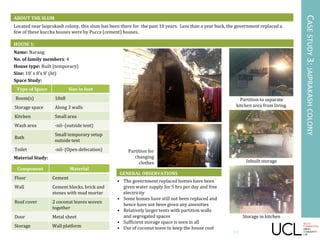
Name: Narang
No. of family members: 4
House type: Built (temporary)
Size: 10’ x 8’x 8’ (ht)
Space Study:
Material Study:
ABOUT THE SLUM
Located near Jaiprakash colony, this slum has been there for the past 10 years. Less than a year back, the government replaced a
few of these kuccha houses were by Pucca (cement) houses.
HOUSE 1:
GENERAL OBSERVATIONS
• The government replaced homes have been
given water supply for 5 hrs per day and free
electricity
• Some homes have still not been replaced and
hence have not been given any amenities
• Relatively larger tents with partition walls
and segregated spaces
• Sufficient storage space is seen in all
• Use of coconut leave to keep the house cool
CASESTUDY3:JAIPRAKASHCOLONY
Type of Space Size in feet
Room(s) 10x8
Storage space Along 3 walls
Kitchen Small area
Wash area -nil- (outside tent)
Bath
Small temporary setup
outside tent
Toilet -nil- (Open defecation)
Component Material
Floor Cement
Wall Cement blocks, brick and
stones with mud mortar
Roof cover 2 coconut leaves woven
together
Door Metal sheet
Storage Wall platform
Partition to separate
kitchen area from living.
Storage in kitchen
Partition for
changing
clothes Inbuilt storage
11
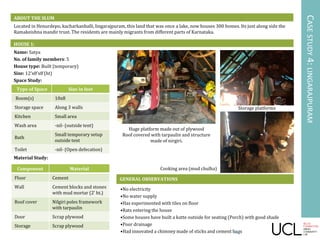
Name: Satya
No. of family members: 5
House type: Built (temporary)
Size: 12’x8’x8’(ht)
Space Study:
Material Study:
ABOUT THE SLUM
Located in Henurdepo, kacharkanhalli, lingarajpuram, this land that was once a lake, now houses 300 homes. Its just along side the
Ramakeishna mandir trust. The residents are mainly migrants from different parts of Karnataka.
HOUSE 1:
GENERAL OBSERVATIONS
•No electricity
•No water supply
•Has experimented with tiles on floor
•Rats entering the house
•Some houses have built a katte outside for seating (Porch) with good shade
•Poor drainage
•Had innovated a chimney made of sticks and cement bags
CASESTUDY4:LINGARAJPURAM
Component Material
Floor Cement
Wall Cement blocks and stones
with mud mortar (2’ ht.)
Roof cover Nilgiri poles framework
with tarpaulin
Door Scrap plywood
Storage Scrap plywood
Cooking area (mud chulha)
Huge platform made out of plywood
Roof covered with tarpaulin and structure
made of nirgiri.
Storage platforms
Type of Space Size in feet
Room(s) 10x8
Storage space Along 3 walls
Kitchen Small area
Wash area -nil- (outside tent)
Bath
Small temporary setup
outside tent
Toilet -nil- (Open defecation)
12
Space Study:
Material Study:
ABOUT THE SLUM
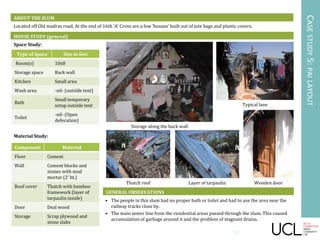
Located off Old madras road, At the end of 16th ‘A’ Cross are a few ‘houses’ built out of jute bags and plastic covers.
HOUSE STUDY (general)
GENERAL OBSERVATIONS
• The people in this slum had no proper bath or toilet and had to use the area near the
railway tracks close by.
• The main sewer line from the residential areas passed through the slum. This caused
accumulation of garbage around it and the problem of stagnant drains.
CASESTUDY5:PAILAYOUT
Component Material
Floor Cement
Wall Cement blocks and
stones with mud
mortar (2’ ht.)
Roof cover Thatch with bamboo
framework (layer of
tarpaulin inside)
Door Deal wood
Storage Scrap plywood and
stone slabs
Type of Space Size in feet
Room(s) 10x8
Storage space Back wall
Kitchen Small area
Wash area -nil- (outside tent)
Bath
Small temporary
setup outside tent
Toilet
-nil- (Open
defecation)
Storage along the back wall
Typical lane
Thatch roof Wooden doorLayer of tarpaulin
13
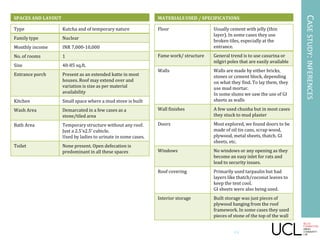
SPACES AND LAYOUT
Type Kutcha and of temporary nature
Family type Nuclear
Monthly income INR 7,000-10,000
No. of rooms 1
Size 40-85 sq.ft.
Entrance porch Present as an extended katte in most
houses. Roof may extend over and
variation is size as per material
availability
Kitchen Small space where a mud stove is built
Wash Area Demarcated in a few cases as a
stone/tiled area
Bath Area Temporary structure without any roof.
Just a 2.5’x2.5’ cubicle.
Used by ladies to urinate in some cases.
Toilet None present. Open defecation is
predominant in all these spaces
MATERIALS USED / SPECIFICATIONS
Floor Usually cement with jelly (thin
layer). In some cases they use
broken tiles, especially at the
entrance.
Fame work/ structure General trend is to use casurina or
nilgiri poles that are easily available
Walls Walls are made by either bricks,
stones or cement block, depending
on what they find. To lay them, they
use mud mortar.
In some slums we saw the use of GI
sheets as walls
Wall finishes A few used chunha but in most cases
they stuck to mud plaster
Doors Most explored, we found doors to be
made of oil tin cans, scrap wood,
plywood, metal sheets, thatch. GI
sheets, etc.
Windows No windows or any opening as they
become an easy inlet for rats and
lead to security issues.
Roof covering Primarily used tarpaulin but had
layers like thatch/coconut leaves to
keep the tent cool.
GI sheets were also being used.
Interior storage Built storage was just pieces of
plywood hanging from the roof
framework. In some cases they used
pieces of stone of the top of the wall
CASESTUDY:INFERENCES
14
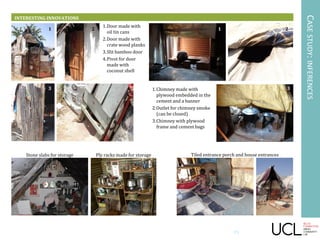
INTERESTING INNOVATIONS
CASESTUDY:INFERENCES
1.Door made with
oil tin cans
2.Door made with
crate wood planks
3.Slit bamboo door
4.Pivot for door
made with
coconut shell
1 2
3 4 1.Chimney made with
plywood embedded in the
cement and a banner
2.Outlet for chimney smoke
(can be closed)
3.Chimney with plywood
frame and cement bags
1 2
3
Tiled entrance porch and house entrancesStone slabs for storage Ply racks made for storage
15
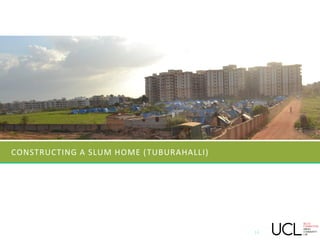
CONSTRUCTING A SLUM HOME (TUBURAHALLI)
16
TUBURAHALLI–ANOVERVIEW
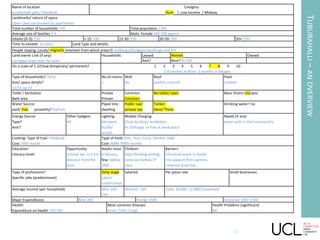
Name of location
Kundanhalli gate, Tubrahalli
Category
Slum / Low Income / Midway
Landmarks/ nature of space
Open Land surrounded by apartments
Total number of households 150 Total population 1200
Average size of families 5-6 Male: Female 500:700 approx
Infants (0-3): 150 < 15: 100 15-30: 350 30-50: 350 50+: 150
Time its existed: 15 years Land Type and details:
People staying: Locals/ migrants (mention from which areas?)- Gulbarga,khedgaon,deodurga and A.P
Land owner Link (if any):
nursappa stays near the slum
Households: Leased Rented Owned
Amt? Rent? Rs 200
On a scale of 1-10 how temporary/ permanent? 1 2 3 4 5 6 7 8 9 10
(10 months in Blore, 2 months in Village)
Type of Households? Tents
Size/ space details?
12/15 sqr fit
No of rooms:
1
Wall
No
Roof
palithin covered
Floor
Cement
Toilet / Sanitation
Bath area
Private
Private
Common
Common
No toilet/ open Basic Drains (no/yes)
Water Source:
paid/ free proximity? Half km
Piped into
dwelling
Public tap/
private tap
Tanker
Here/ There
Drinking water? no
Energy Source
Type?
Amt?
Other Gadgets
Nil
Lighting
Kerosene
Rs200/
month
Mobile Charging
Close by shop/ workplace
Rs 5/charge or free at work place
Needs (if any)
water with in their community
Cooking: Type of Fuel- Firewood
Cost: 300/ month
Type of food: Roti, Rice, Curry, Sambar, Sabji
Cost: 6000-7000/ month
Education
Literacy Level-
Opportunity
schools are in 1 km
distance from the
slum
Adults most-
0 literacy,
few- bellow
10th
Children
Basic Reading writing,
some are bellow 5th
class
Barriers
>financial issues in family
>no support from parents
>interest level low
Type of professions?
Specific jobs (predominant)
Daily wage
Labor/
construction
Salaried Per piece rate Small businesses
Average income (per household) Men-200-
250
Women- 150 Total: 10,000- 12,000/ household
Major Expenditures Rent 200 Energy 1500 Groceries 1000-1500
Health:
Expenditure on health 150-200
Most common illnesses
Fever, Cold, Cough
Health Problems (significant)
Nil
17
TUBURAHALLI–GENERALOBSERVATIONS
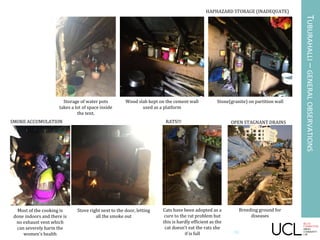
Cats have been adopted as a
cure to the rat problem but
this is hardly efficient as the
cat doesn’t eat the rats she
if is full
Breeding ground for
diseases
Most of the cooking is
done indoors and there is
no exhaust vent which
can severely harm the
women's health
Wood slab kept on the cement wall
used as a platform
Stone(granite) on partition wallStorage of water pots
takes a lot of space inside
the tent.
Stove right next to the door, letting
all the smoke out
OPEN STAGNANT DRAINS
HAPHAZARD STORAGE (INADEQUATE)
SMOKE ACCUMULATION RATS!!!
18
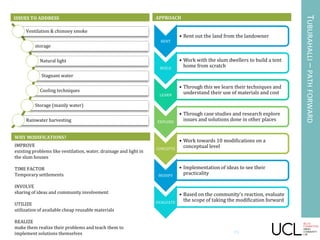
ISSUES TO ADDRESS APPROACH
RENT
• Rent out the land from the landowner
BUILD
• Work with the slum dwellers to build a tent
home from scratch
LEARN
• Through this we learn their techniques and
understand their use of materials and cost
EXPLORE
• Through case studies and research explore
issues and solutions done in other places
CONCEPTS
• Work towards 10 modifications on a
conceptual level
MODIFY
• Implementation of ideas to see their
practicality
EVALUATE
• Based on the community’s reaction, evaluate
the scope of taking the modification forward
WHY MODIFICATIONS?
TUBURAHALLI–PATHFORWARD
Ventilation & chimney smoke
storage
Natural light
Stagnant water
Cooling techniques
Storage (mainly water)
Rainwater harvesting
IMPROVE
existing problems like ventilation, water, drainage and light in
the slum houses
TIME FACTOR
Temporary settlements
INVOLVE
sharing of ideas and community involvement
UTILIZE
utilization of available cheap reusable materials
REALIZE
make them realize their problems and teach them to
implement solutions themselves 19
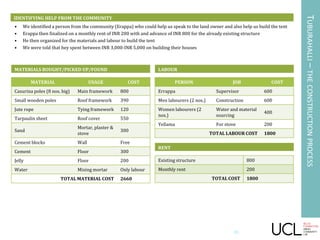
IDENTIFYING HELP FROM THE COMMUNITY
• We identified a person from the community (Erappa) who could help us speak to the land owner and also help us build the tent
• Erappa then finalized on a monthly rent of INR 200 with and advance of INR 800 for the already existing structure
• He then organized for the materials and labour to build the tent
• We were told that hey spent between INR 3,000-INR 5,000 on building their houses
MATERIALS BOUGHT/PICKED UP/FOUND
MATERIAL USAGE COST
Casurina poles (8 nos. big) Main framework 800
Small wooden poles Roof framework 390
Jute rope Tying framework 120
Tarpaulin sheet Roof cover 550
Sand
Mortar, plaster &
stove
300
Cement blocks Wall Free
Cement Floor 300
Jelly Floor 200
Water Mixing mortar Only labour
TOTAL MATERIAL COST 2660
LABOUR
PERSON JOB COST
Errappa Supervisor 600
Men labourers (2 nos.) Construction 600
Women labourers (2
nos.)
Water and material
sourcing
400
Yellama For stove 200
TOTAL LABOUR COST 1800
RENT
Existing structure 800
Monthly rent 200
TOTAL COST 1800
20
TUBURAHALLI–THECONSTRUCTIONPROCESS
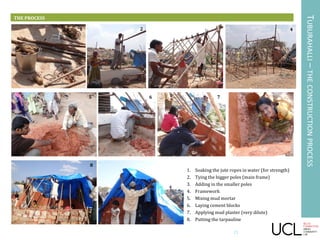
THE PROCESS
1. Soaking the jute ropes in water (for strength)
2. Tying the bigger poles (main frame)
3. Adding in the smaller poles
4. Framework
5. Mixing mud mortar
6. Laying cement blocks
7. Applying mud plaster (very dilute)
8. Putting the tarpauline
TUBURAHALLI–THECONSTRUCTIONPROCESS
1 2 3 4
5 6 7
8
21
RESEARCH
22
RESEARCH:SYSTEMS
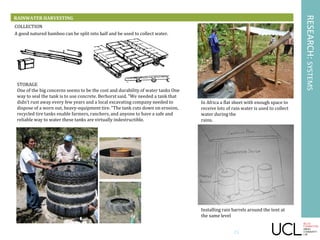
RAINWATER HARVESTING
STORAGE
One of the big concerns seems to be the cost and durability of water tanks One
way to seal the tank is to use concrete. Berhorst said. "We needed a tank that
didn't rust away every few years and a local excavating company needed to
dispose of a worn out, heavy-equipment tire. "The tank cuts down on erosion,
recycled tire tanks enable farmers, ranchers, and anyone to have a safe and
reliable way to water these tanks are virtually indestructible.
COLLECTION
A good natured bamboo can be split into half and be used to collect water.
In Africa a flat sheet with enough space to
receive lots of rain water is used to collect
water during the
rains.
Installing rain barrels around the tent at
the same level
23
SAND FILTERS – PURIFICATION AND PERCOLATION
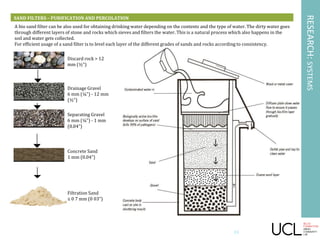
A bio sand filter can be also used for obtaining drinking water depending on the contents and the type of water. The dirty water goes
through different layers of stone and rocks which sieves and filters the water. This is a natural process which also happens in the
soil and water gets collected.
For efficient usage of a sand filter is to level each layer of the different grades of sands and rocks according to consistency.
Discard rock > 12
mm (½“)
Drainage Gravel
6 mm (¼”) - 12 mm
(½“)
Separating Gravel
6 mm (¼”) - 1 mm
(0.04”)
Concrete Sand
1 mm (0.04”)
Filtration Sand
≤ 0 7 mm (0 03”)
RESEARCH:SYSTEMS
24
NATURAL VENTILATION
RESEARCH:SYSTEMS
25
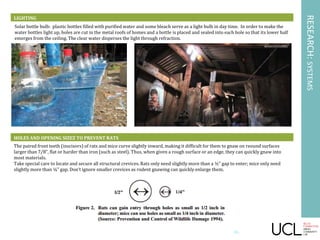
LIGHTING
Solar bottle bulb: plastic bottles filled with purified water and some bleach serve as a light bulb in day time. In order to make the
water bottles light up, holes are cut in the metal roofs of homes and a bottle is placed and sealed into each hole so that its lower half
emerges from the ceiling. The clear water disperses the light through refraction.
RESEARCH:SYSTEMS
26
HOLES AND OPENING SIZEZ TO PREVENT RATS
The paired front teeth (inscisors) of rats and mice curve slightly inward, making it difficult for them to gnaw on reound surfaces
larger than 7/8”, flat or harder than iron (such as steel). Thus, when given a rough surface or an edge, they can quickly gnaw into
most materials.
Take special care to locate and secure all structural crevices. Rats only need slightly more than a ½” gap to enter; mice only need
slightly more than ¼” gap. Don’t ignore smaller crevices as rodent gnawing can quickly enlarge them.
RESEARCH:MATERIAL
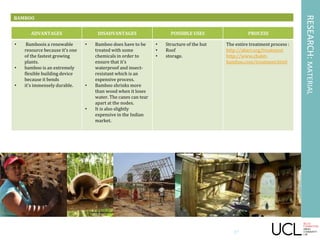
BAMBOO
ADVANTAGES DISADVANTAGES POSSIBLE USES PROCESS
• Bamboois a renewable
resource because it's one
of the fastest growing
plants.
• bamboo is an extremely
flexible building device
because it bends
• it's immensely durable.
• Bamboo does have to be
treated with some
chemicals in order to
ensure that it's
waterproof and insect-
resistant which is an
expensive process.
• Bamboo shrinks more
than wood when it loses
water. The canes can tear
apart at the nodes.
• It is also slightly
expensive in the Indian
market.
• Structure of the hut
• Roof
• storage.
The entire treatment process :
http://abari.org/treatment
http://www.chalet-
bamboo.com/treatment.html
27
RESEARCH:MATERIAL
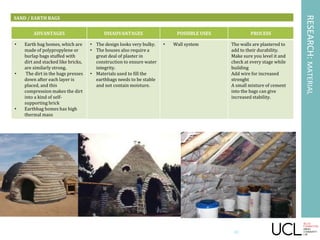
SAND / EARTH BAGS
ADVANTAGES DISADVANTAGES POSSIBLE USES PROCESS
• Earth bag homes, which are
made of polypropylene or
burlap bags stuffed with
dirt and stacked like bricks,
are similarly strong.
• The dirt in the bags presses
down after each layer is
placed, and this
compression makes the dirt
into a kind of self-
supporting brick
• Earthbag homes has high
thermal mass
• The design looks very bulky.
• The houses also require a
great deal of plaster in
construction to ensure water
integrity.
• Materials used to fill the
earthbags needs to be stable
and not contain moisture.
• Wall system The walls are plastered to
add to their durability.
Make sure you level it and
check at every stage while
building
Add wire for increased
strenght
A small mixture of cement
into the bags can give
increased stability.
28
RESEARCH:MATERIAL
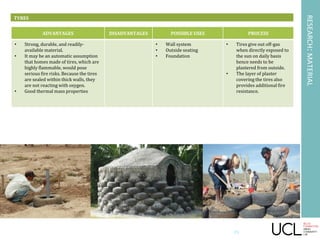
TYRES
ADVANTAGES DISADVANTAGES POSSIBLE USES PROCESS
• Strong, durable, and readily-
available material.
• It may be an automatic assumption
that homes made of tires, which are
highly flammable, would pose
serious fire risks. Because the tires
are sealed within thick walls, they
are not reacting with oxygen.
• Good thermal mass properties
• Wall system
• Outside seating
• Foundation
• Tires give out off-gas
when directly exposed to
the sun on daily basis
hence needs to be
plastered from outside.
• The layer of plaster
covering the tires also
provides additional fire
resistance.
29
RESEARCH:MATERIAL
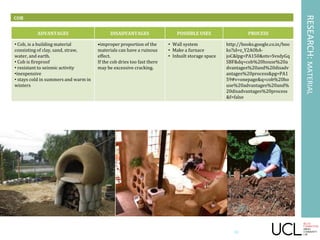
COB
ADVANTAGES DISADVANTAGES POSSIBLE USES PROCESS
• Cob, is a building material
consisting of clay, sand, straw,
water, and earth.
• Cob is fireproof
• resistant to seismic activity
•inexpensive
• stays cold in summers and warm in
winters
•improper proportion of the
materials can have a ruinous
effect.
If the cob dries too fast there
may be excessive cracking.
• Wall system
• Make a furnace
• Inbuilt storage space
http://books.google.co.in/boo
ks?id=z_Y2AObA-
joC&lpg=PA150&ots=SvsdyGq
SBF&dq=cob%20house%20a
dvantages%20and%20disadv
antages%20process&pg=PA1
59#v=onepage&q=cob%20ho
use%20advantages%20and%
20disadvantages%20process
&f=false
30
RESEARCH:MATERIAL
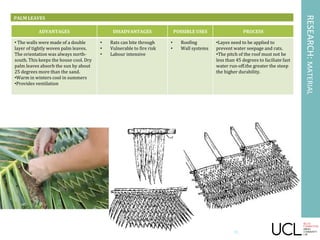
PALM LEAVES
ADVANTAGES DISADVANTAGES POSSIBLE USES PROCESS
• The walls were made of a double
layer of tightly woven palm leaves.
The orientation was always north-
south. This keeps the house cool. Dry
palm leaves absorb the sun by about
25 degrees more than the sand.
•Warm in winters cool in summers
•Provides ventilation
• Rats can bite through
• Vulnerable to fire risk
• Labour intensive
• Roofing
• Wall systems
•Layes need to be applied to
prevent water seepage and rats.
•The pitch of the roof must not be
less than 45 degrees to faciliate fast
water run-off.the greater the steep
the higher durability.
31
RESEARCH:MATERIAL
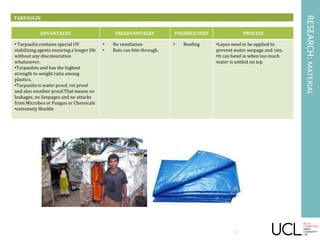
TARPAULIN
ADVANTAGES DISADVANTAGES POSSIBLE USES PROCESS
• Tarpaulin contains special UV
stabilizing agents ensuring a longer life
without any discolouration
whatsoever.
•Tarpaulins and has the highest
strength to weight ratio among
plastics.
•Tarpaulin is water proof, rot proof
and also weather proof.That means no
leakages, no Seepages and no attacks
from Microbes or Fungus or Chemicals
•extremely flexible
• No ventilation
• Rats can bite through.
• Roofing •Layes need to be applied to
prevent water seepage and rats.
•It can bend in when too much
water is settled on top
32
RESEARCH:MATERIAL
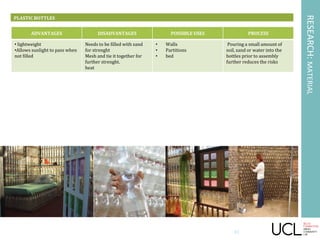
PLASTIC BOTTLES
ADVANTAGES DISADVANTAGES POSSIBLE USES PROCESS
• lightweight
•Allows sunlight to pass when
not filled
Needs to be filled with sand
for strenght
Mesh and tie it together for
further strenght.
heat
• Walls
• Partitions
• bed
Pouring a small amount of
soil, sand or water into the
bottles prior to assembly
further reduces the risks
33
RESEARCH:MATERIAL
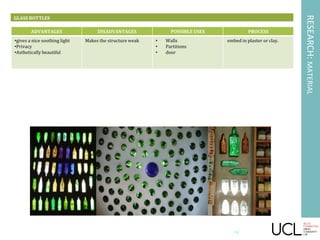
GLASS BOTTLES
ADVANTAGES DISADVANTAGES POSSIBLE USES PROCESS
•gives a nice soothing light
•Privacy
•Asthetically beautiful
Makes the structure weak • Walls
• Partitions
• door
embed in plaster or clay.
34
RESEARCH:MATERIAL
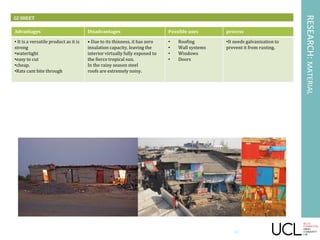
GI SHEET
Advantages Disadvantages Possible uses process
• It is a versatile product as it is
strong
•watertight
•easy to cut
•cheap.
•Rats cant bite through
• Due to its thinness, it has zero
insulation capacity, leaving the
interior virtually fully exposed to
the fierce tropical sun.
In the rainy season steel
roofs are extremely noisy.
• Roofing
• Wall systems
• Windows
• Doors
•It needs galvanization to
prevent it from rusting.
35
CONCEPTS AND IDEAS
36
CONCEPTSANDIDEAS:VENTILATION
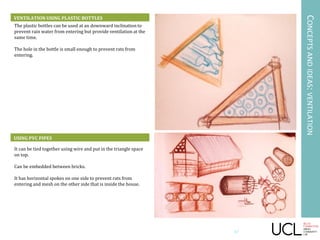
VENTILATION USING PLASTIC BOTTLES
USING PVC PIPES
37
The plastic bottles can be used at an downward inclination to
prevent rain water from entering but provide ventilation at the
same time.
The hole in the bottle is small enough to prevent rats from
entering.
It can be tied together using wire and put in the triangle space
on top.
Can be embedded between bricks.
It has horizontal spokes on one side to prevent rats from
entering and mesh on the other side that is inside the house.
CONCEPTSANDIDEAS:STORAGE
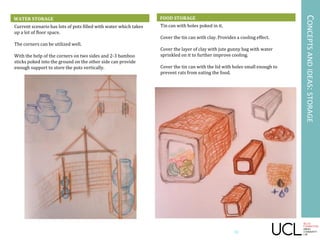
FOOD STORAGEWATER STORAGE
38
Tin can with holes poked in it.
Cover the tin can with clay. Provides a cooling effect.
Cover the layer of clay with jute gunny bag with water
sprinkled on it to further improve cooling.
Cover the tin can with the lid with holes small enough to
prevent rats from eating the food.
Current scenario has lots of pots filled with water which takes
up a lot of floor space.
The corners can be utilized well.
With the help of the corners on two sides and 2-3 bamboo
sticks poked into the ground on the other side can provide
enough support to store the pots vertically.
MODIFICATIONS
39
MODIFICATIONS:NATURALLIGHT
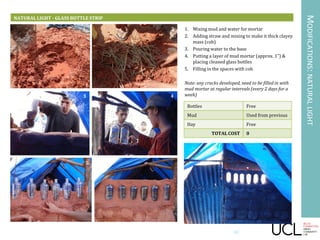
NATURAL LIGHT - GLASS BOTTLE STRIP
1. Mixing mud and water for mortar
2. Adding straw and mixing to make it thick clayey
mass (cob)
3. Pouring water to the base
4. Putting a layer of mud mortar (approx. 1”) &
placing cleaned glass bottles
5. Filling in the spaces with cob
Note: any cracks developed, need to be filled in with
mud mortar at regular intervals (every 2 days for a
week)
1 2
3 4
5
Bottles Free
Mud Used from previous
Hay Free
TOTAL COST 0
40
MODIFICATIONS:CHIMNEYSMOKE
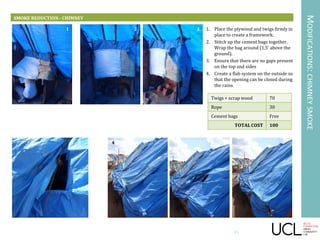
SMOKE REDUCTION - CHIMNEY
1. Place the plywood and twigs firmly in
place to create a framework.
2. Stitch up the cement bags together.
Wrap the bag around (1.5’ above the
ground).
3. Ensure that there are no gaps present
on the top and sides
4. Create a flab system on the outside so
that the opening can be closed during
the rains
Twigs + scrap wood 70
Rope 30
Cement bags Free
TOTAL COST 100
1 2 3
4
41
MODIFICATIONS:VENTILATION
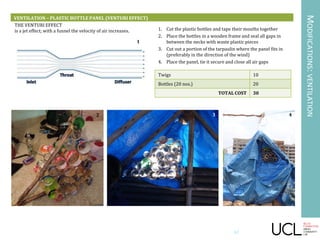
VENTILATION – PLASTIC BOTTLE PANEL (VENTURI EFFECT)
THE VENTURI EFFECT
is a jet effect; with a funnel the velocity of air increases. 1. Cut the plastic bottles and tape their mouths together
2. Place the bottles in a wooden frame and seal all gaps in
between the necks with waste plastic pieces
3. Cut out a portion of the tarpaulin where the panel fits in
(preferably in the direction of the wind)
4. Place the panel, tie it secure and close all air gaps
Twigs 10
Bottles (20 nos.) 20
TOTAL COST 30
1
2 3 4
42
MODIFICATIONS:DOOR
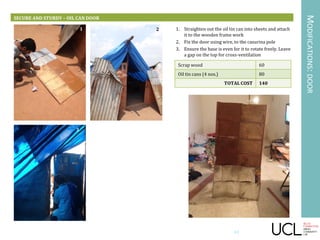
SECURE AND STURDY – OIL CAN DOOR
1. Straighten out the oil tin can into sheets and attach
it to the wooden frame work
2. Fix the door using wire, to the casurina pole
3. Ensure the base is even for it to rotate freely. Leave
a gap on the top for cross-ventilation
Scrap wood 60
Oil tin cans (4 nos.) 80
TOTAL COST 140
1 2
3
43
NEXT STEPS
44
NEXTSTEPS
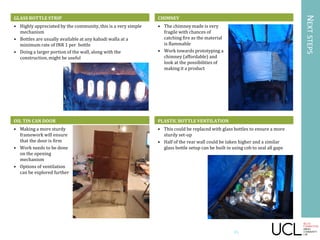
GLASS BOTTLE STRIP
• Highly appreciated by the community, this is a very simple
mechanism
• Bottles are usually available at any kabadi walla at a
minimum rate of INR 1 per bottle
• Doing a larger portion of the wall, along with the
construction, might be useful
OIL TIN CAN DOOR
• Making a more sturdy
framework will ensure
that the door is firm
• Work needs to be done
on the opening
mechanism
• Options of ventilation
can be explored further
CHIMNEY
• The chimney made is very
fragile with chances of
catching fire as the material
is flammable
• Work towards prototyping a
chimney (affordable) and
look at the possibilities of
making it a product
PLASTIC BOTTLE VENTILATION
• This could be replaced with glass bottles to ensure a more
sturdy set-up
• Half of the rear wall could be taken higher and a similar
glass bottle setup can be built in using cob to seal all gaps
45
THANK YOU
46

06UCL_NeedAssessment_SlumHomes

  • 1.
    NEED ASSESSMENT: SLUMHOMES SETTING UP A MODEL TENT IN TUBURAHALLI SLUM 1
  • 2.
    16-20 8-15 3 4-7 CONTENTS BACKGROUND SLUM HOUSING: ANOVERVIEW An Overview Types of Slums Focus: Bengaluru CASE STUDIES Krishnappa slums Yelahanka 4th phase Jai prakash colony Lingrajpuram Pai layout CONSTRUCTING THE SLUM HOME Tuburahalli – an overview General observations Path forward The construction process 21-35 2 RESERCH Systems Material 36-38 39-43 CONCEPTS AND IDEAS Ventilation Storage MODIFICATIONS Natural light Chimney Ventilation Door 44-45NEXT STEPS
  • 3.
    OBJECTIVES • CASE STUDIES- To understand slum housing and various adaptations and innovations done by slum dwellers • CONSTRUCT A SLUM HOME – To get an understanding of the finances, materials they use, their construction techniques, lifestyle, layout plan, issues they face, etc. • VALUE ADD’S - Using materials found locally within the stipulated budget, making modifications to the existing slum home ABOUT THE PROJECT India is urbanizing rapidly and along with this, the slum population is also increasing. One of the ways of identifying a slum is the distinct housing. Creating a basic shelter is a skill that they have developed naturally, but its modification into a comfortable home is seldom done due to various factors. This project was done in collaboration with 5 students from Srishti School of Art and Design. BACKGROUND ABOUT THE PROJECT 3
  • 4.
  • 5.
    HOUSING: A PRIMARYNEED An estimated 25% of urban population still subsists on incomes that are below poverty line. 80% of these earnings go towards food and energy, leaving very little for meeting costs of living in an increasingly monetized society. The majority then end up living in slums and squatter settlements in inhuman conditions that deny dignity, shelter, security, right to basic amenities, ill-health, etc. As the percentage of urban households in the next two decades will rise from the present 28% to 50% of the country’s population, we can expect that slums will grow at an even faster rate. SLUM: THE DEFINITION As defined by the NSSO: “A slum is a compact settlement of atleast 20 households with a collection of poorly built tenements, mostly of temporary nature, crowded together usually with inadequate sanitary and drinking water facilities in unhygienic conditions.” URBANISATION AND SLUMS Sources: Report of committee on Slum statistics/Census by GOI MHUPA SLUMS–ANOVERVIEW Census of India 2011 Increasing urbanization as emerging as the most prevalent and dominant challenge in India today. With our cities becoming centers of agglomeration economies, investments, technology, innovation, economic growth and tertiary jobs, they now house the hopes of millions of migrants from rural India. Our cities are now increasingly facing the negatives of rapid urbanization, such as polarization of population in large cities, high density, slums and squatter settlements, acute shortage of housing and basic civic amenities, degradation of environment, traffic congestion, pollution, poverty, unemployment, crime and social unrest. INDICATOR NUMBER Number of Slum Households (in lakh) Total (Slum) 137 Slum in Million Plus Cities 52 Slum in other Cities 85 Number of Slum Households (in %) Slum in Million Plus Cities 38.1 Slum in other Cities 61.9 5
  • 6.
    TYPES OF SLUMS(CLASSIFICATION) SLUMS–TYPESOFSLUMS Sources: Typology of Slums and Land Tenure in Indian Cities by Prof.(Dr.) Neelima Risbud (Co-ordinator In-charge, National Resource Centre on Urban Poverty - Est. by Ministry of Housing & Urban Poverty Alleviation, GOI. School of Planning & Architecture, New Delhi) 6
  • 7.
    SLUMS IN BANGALORE Accordingto a 2012 report submitted to the World Bank by Karnataka Slum Clearance Board, Bangalore has 862 slums from total of around 2000 slums in Karnataka. It is estimated that about 20% of Bangalore population reside in urban slums. The families living in the slum are not ready to move into the temporary shelters. 42% of the households migrated from different parts of India and 43% of the households had remained in the slums for over 10 years. The Karnataka Municipality, works to shift 300 families annually to newly constructed buildings. One third of these slum clearance projects lack basic service connections, 60% of slum dwellers lack complete water supply lines and share BWSSB water supply. FOCUS:BENGALURU Source: • "Major Slum Areas in Top Ten Cities of India". WalkThroughIndia. 13 July 2010. Retrieved 22 October 2012. • Teja, Bhanu. "Slum dwellers rehoused Bangalore – The SoftCopy". Iijnm.org. Retrieved 22 October 2012. • "Water India Slums". India Sanitation Portal. Retrieved 22 October 2012. • "Slum Dwellers Illegally Tap Board of Water Supply Bangalore's Supply". Youthkiawaaz.com. 19 February 2011. Retrieved 22 October 2012. • "All India figures at a glance" (PDF). Department of Economics and Statistics, Government of Karnataka. Retrieved 1 November 2010.[dead link]http://www.webcitation.org/5hhoB0jVy SLUM POPULATION IN BANGALORE (10%) OWNERSHIP OF NOTIFIED SLUMS DISTRIBUTION OF RECOGNIZED SLUMS IN BANGALORE SUBURB NO. OF SLUMS NO. OF HUTS POPULATION Gandhinagar 12 1901 9925 Chikkapete 6 1343 6956 Binnypete 13 1533 9105 Chamarajpete 22 5034 26439 Shantinagar 6 1233 6795 Basavanagadi 7 1276 5985 Yelahanka 13 3297 18696 Jayamahal 16 2096 13111 Malleswaram 24 4401 25233 Bharatinagar 20 1794 11166 Shivajinagar 1 60 350 Jayanagar 24 7302 42426 Rajajinagar 10 1866 13677 Varthur 23 5916 24468 Uttarahalli 34 14758 83020 TOTAL 231 53810 297352 10% (847,497 persons) of Bangalore's population live in Slums. Karnataka Slum Clearance Board, 2008 7
  • 8.
    CASE STUDIES KRISHNAPPA SLUM. YELAHANKA 4TH PHASE . JAI PRAKASH COLONY . LINGRAJPURAM . PAI LAYOUT 8
  • 9.
    Name: Rosemary No. offamily members: 3 House type: Built (permanent) Size: 12’ x 8’x 9’ (ht) Space Study: Material Study: ABOUT THE SLUM This 300 house slum is located behind Bagmane Tech park , in an area called Krishnappa garden. The slum residents are primarily migrants from Raichur and Gulbarga. The average income per household is approximately INR 7,000 per month HOUSE 1: GENERAL OBSERVATIONS • Experimented with material • Proper ventilation because of window • Effective space utilization • No rat issues because of proper side walls • Cemented floor • Shed outside the house • Use of cement stones keeps the house cooler • To prevent stagnant drains they had a dug a hole to collect the waste water, and then emptied it out (cemented) CASESTUDY1:KRISHNAPPASLUM Type of Space Size in feet Entrance Porch 4x2 Room(s) 8x8 Storage space Along 3 walls Kitchen 4x2+4x6(storage + sleeping) Wash area (common) 2x3 Bath(common) 3x3 Toilet -nil- (Open defecation) Component Material Floor Cement Wall Stones and cement Roof cover Corrugated metal sheet Door Wood Window Metal grill and wood Storage Wood Entrance Porch partially shaded with extended roof sheet Maximum utilization of space for storage Kitchen with loft for storage 9
  • 10.
    Name: Manjunath No. offamily members: 3 House type: Built (blue tent) Size: 7’x8’x6’ (ht) Occupation: 8 yr old who works at a cycle shop after school hours. Father is a labourer and mother a cook in a hotel nearby. Space Study: The house consists of just one room of 7’x8’ with no partitions. They have a small kitchen area and lack storage space. Material Study: ABOUT THE SLUM This slum has come up recently behind the 4th phase bus stop. Its smaller compared to the other slums (has only 8 to 10 houses) and has been there only for the past 6 months. HOUSE 1: GENERAL OBSERVATIONS •No drinking water supply but water is available 1km away •No electricity •One bathroom shared amongst 8 houses •Have one tap set up for all the 8 house to wash clothes and vessels CASESTUDY2:YELAHANKA4THPHASE Component Material Floor Cement (no foundation) Framework Nilgiri Poles Wall -nil- Roof cover Tarpaulin on the roof frame Door Metal corrugated sheet covered with banner Storage No built storage Basic structure Bathroom Door made of banner No built storage Kitchen storage Manjunath 10
  • 11.
    Name: Narang No. offamily members: 4 House type: Built (temporary) Size: 10’ x 8’x 8’ (ht) Space Study: Material Study: ABOUT THE SLUM Located near Jaiprakash colony, this slum has been there for the past 10 years. Less than a year back, the government replaced a few of these kuccha houses were by Pucca (cement) houses. HOUSE 1: GENERAL OBSERVATIONS • The government replaced homes have been given water supply for 5 hrs per day and free electricity • Some homes have still not been replaced and hence have not been given any amenities • Relatively larger tents with partition walls and segregated spaces • Sufficient storage space is seen in all • Use of coconut leave to keep the house cool CASESTUDY3:JAIPRAKASHCOLONY Type of Space Size in feet Room(s) 10x8 Storage space Along 3 walls Kitchen Small area Wash area -nil- (outside tent) Bath Small temporary setup outside tent Toilet -nil- (Open defecation) Component Material Floor Cement Wall Cement blocks, brick and stones with mud mortar Roof cover 2 coconut leaves woven together Door Metal sheet Storage Wall platform Partition to separate kitchen area from living. Storage in kitchen Partition for changing clothes Inbuilt storage 11
  • 12.
    Name: Satya No. offamily members: 5 House type: Built (temporary) Size: 12’x8’x8’(ht) Space Study: Material Study: ABOUT THE SLUM Located in Henurdepo, kacharkanhalli, lingarajpuram, this land that was once a lake, now houses 300 homes. Its just along side the Ramakeishna mandir trust. The residents are mainly migrants from different parts of Karnataka. HOUSE 1: GENERAL OBSERVATIONS •No electricity •No water supply •Has experimented with tiles on floor •Rats entering the house •Some houses have built a katte outside for seating (Porch) with good shade •Poor drainage •Had innovated a chimney made of sticks and cement bags CASESTUDY4:LINGARAJPURAM Component Material Floor Cement Wall Cement blocks and stones with mud mortar (2’ ht.) Roof cover Nilgiri poles framework with tarpaulin Door Scrap plywood Storage Scrap plywood Cooking area (mud chulha) Huge platform made out of plywood Roof covered with tarpaulin and structure made of nirgiri. Storage platforms Type of Space Size in feet Room(s) 10x8 Storage space Along 3 walls Kitchen Small area Wash area -nil- (outside tent) Bath Small temporary setup outside tent Toilet -nil- (Open defecation) 12
  • 13.
    Space Study: Material Study: ABOUTTHE SLUM Located off Old madras road, At the end of 16th ‘A’ Cross are a few ‘houses’ built out of jute bags and plastic covers. HOUSE STUDY (general) GENERAL OBSERVATIONS • The people in this slum had no proper bath or toilet and had to use the area near the railway tracks close by. • The main sewer line from the residential areas passed through the slum. This caused accumulation of garbage around it and the problem of stagnant drains. CASESTUDY5:PAILAYOUT Component Material Floor Cement Wall Cement blocks and stones with mud mortar (2’ ht.) Roof cover Thatch with bamboo framework (layer of tarpaulin inside) Door Deal wood Storage Scrap plywood and stone slabs Type of Space Size in feet Room(s) 10x8 Storage space Back wall Kitchen Small area Wash area -nil- (outside tent) Bath Small temporary setup outside tent Toilet -nil- (Open defecation) Storage along the back wall Typical lane Thatch roof Wooden doorLayer of tarpaulin 13
  • 14.
    SPACES AND LAYOUT TypeKutcha and of temporary nature Family type Nuclear Monthly income INR 7,000-10,000 No. of rooms 1 Size 40-85 sq.ft. Entrance porch Present as an extended katte in most houses. Roof may extend over and variation is size as per material availability Kitchen Small space where a mud stove is built Wash Area Demarcated in a few cases as a stone/tiled area Bath Area Temporary structure without any roof. Just a 2.5’x2.5’ cubicle. Used by ladies to urinate in some cases. Toilet None present. Open defecation is predominant in all these spaces MATERIALS USED / SPECIFICATIONS Floor Usually cement with jelly (thin layer). In some cases they use broken tiles, especially at the entrance. Fame work/ structure General trend is to use casurina or nilgiri poles that are easily available Walls Walls are made by either bricks, stones or cement block, depending on what they find. To lay them, they use mud mortar. In some slums we saw the use of GI sheets as walls Wall finishes A few used chunha but in most cases they stuck to mud plaster Doors Most explored, we found doors to be made of oil tin cans, scrap wood, plywood, metal sheets, thatch. GI sheets, etc. Windows No windows or any opening as they become an easy inlet for rats and lead to security issues. Roof covering Primarily used tarpaulin but had layers like thatch/coconut leaves to keep the tent cool. GI sheets were also being used. Interior storage Built storage was just pieces of plywood hanging from the roof framework. In some cases they used pieces of stone of the top of the wall CASESTUDY:INFERENCES 14
  • 15.
    INTERESTING INNOVATIONS CASESTUDY:INFERENCES 1.Door madewith oil tin cans 2.Door made with crate wood planks 3.Slit bamboo door 4.Pivot for door made with coconut shell 1 2 3 4 1.Chimney made with plywood embedded in the cement and a banner 2.Outlet for chimney smoke (can be closed) 3.Chimney with plywood frame and cement bags 1 2 3 Tiled entrance porch and house entrancesStone slabs for storage Ply racks made for storage 15
  • 16.
    CONSTRUCTING A SLUMHOME (TUBURAHALLI) 16
  • 17.
    TUBURAHALLI–ANOVERVIEW Name of location Kundanhalligate, Tubrahalli Category Slum / Low Income / Midway Landmarks/ nature of space Open Land surrounded by apartments Total number of households 150 Total population 1200 Average size of families 5-6 Male: Female 500:700 approx Infants (0-3): 150 < 15: 100 15-30: 350 30-50: 350 50+: 150 Time its existed: 15 years Land Type and details: People staying: Locals/ migrants (mention from which areas?)- Gulbarga,khedgaon,deodurga and A.P Land owner Link (if any): nursappa stays near the slum Households: Leased Rented Owned Amt? Rent? Rs 200 On a scale of 1-10 how temporary/ permanent? 1 2 3 4 5 6 7 8 9 10 (10 months in Blore, 2 months in Village) Type of Households? Tents Size/ space details? 12/15 sqr fit No of rooms: 1 Wall No Roof palithin covered Floor Cement Toilet / Sanitation Bath area Private Private Common Common No toilet/ open Basic Drains (no/yes) Water Source: paid/ free proximity? Half km Piped into dwelling Public tap/ private tap Tanker Here/ There Drinking water? no Energy Source Type? Amt? Other Gadgets Nil Lighting Kerosene Rs200/ month Mobile Charging Close by shop/ workplace Rs 5/charge or free at work place Needs (if any) water with in their community Cooking: Type of Fuel- Firewood Cost: 300/ month Type of food: Roti, Rice, Curry, Sambar, Sabji Cost: 6000-7000/ month Education Literacy Level- Opportunity schools are in 1 km distance from the slum Adults most- 0 literacy, few- bellow 10th Children Basic Reading writing, some are bellow 5th class Barriers >financial issues in family >no support from parents >interest level low Type of professions? Specific jobs (predominant) Daily wage Labor/ construction Salaried Per piece rate Small businesses Average income (per household) Men-200- 250 Women- 150 Total: 10,000- 12,000/ household Major Expenditures Rent 200 Energy 1500 Groceries 1000-1500 Health: Expenditure on health 150-200 Most common illnesses Fever, Cold, Cough Health Problems (significant) Nil 17
  • 18.
    TUBURAHALLI–GENERALOBSERVATIONS Cats have beenadopted as a cure to the rat problem but this is hardly efficient as the cat doesn’t eat the rats she if is full Breeding ground for diseases Most of the cooking is done indoors and there is no exhaust vent which can severely harm the women's health Wood slab kept on the cement wall used as a platform Stone(granite) on partition wallStorage of water pots takes a lot of space inside the tent. Stove right next to the door, letting all the smoke out OPEN STAGNANT DRAINS HAPHAZARD STORAGE (INADEQUATE) SMOKE ACCUMULATION RATS!!! 18
  • 19.
    ISSUES TO ADDRESSAPPROACH RENT • Rent out the land from the landowner BUILD • Work with the slum dwellers to build a tent home from scratch LEARN • Through this we learn their techniques and understand their use of materials and cost EXPLORE • Through case studies and research explore issues and solutions done in other places CONCEPTS • Work towards 10 modifications on a conceptual level MODIFY • Implementation of ideas to see their practicality EVALUATE • Based on the community’s reaction, evaluate the scope of taking the modification forward WHY MODIFICATIONS? TUBURAHALLI–PATHFORWARD Ventilation & chimney smoke storage Natural light Stagnant water Cooling techniques Storage (mainly water) Rainwater harvesting IMPROVE existing problems like ventilation, water, drainage and light in the slum houses TIME FACTOR Temporary settlements INVOLVE sharing of ideas and community involvement UTILIZE utilization of available cheap reusable materials REALIZE make them realize their problems and teach them to implement solutions themselves 19
  • 20.
    IDENTIFYING HELP FROMTHE COMMUNITY • We identified a person from the community (Erappa) who could help us speak to the land owner and also help us build the tent • Erappa then finalized on a monthly rent of INR 200 with and advance of INR 800 for the already existing structure • He then organized for the materials and labour to build the tent • We were told that hey spent between INR 3,000-INR 5,000 on building their houses MATERIALS BOUGHT/PICKED UP/FOUND MATERIAL USAGE COST Casurina poles (8 nos. big) Main framework 800 Small wooden poles Roof framework 390 Jute rope Tying framework 120 Tarpaulin sheet Roof cover 550 Sand Mortar, plaster & stove 300 Cement blocks Wall Free Cement Floor 300 Jelly Floor 200 Water Mixing mortar Only labour TOTAL MATERIAL COST 2660 LABOUR PERSON JOB COST Errappa Supervisor 600 Men labourers (2 nos.) Construction 600 Women labourers (2 nos.) Water and material sourcing 400 Yellama For stove 200 TOTAL LABOUR COST 1800 RENT Existing structure 800 Monthly rent 200 TOTAL COST 1800 20 TUBURAHALLI–THECONSTRUCTIONPROCESS
  • 21.
    THE PROCESS 1. Soakingthe jute ropes in water (for strength) 2. Tying the bigger poles (main frame) 3. Adding in the smaller poles 4. Framework 5. Mixing mud mortar 6. Laying cement blocks 7. Applying mud plaster (very dilute) 8. Putting the tarpauline TUBURAHALLI–THECONSTRUCTIONPROCESS 1 2 3 4 5 6 7 8 21
  • 22.
  • 23.
    RESEARCH:SYSTEMS RAINWATER HARVESTING STORAGE One ofthe big concerns seems to be the cost and durability of water tanks One way to seal the tank is to use concrete. Berhorst said. "We needed a tank that didn't rust away every few years and a local excavating company needed to dispose of a worn out, heavy-equipment tire. "The tank cuts down on erosion, recycled tire tanks enable farmers, ranchers, and anyone to have a safe and reliable way to water these tanks are virtually indestructible. COLLECTION A good natured bamboo can be split into half and be used to collect water. In Africa a flat sheet with enough space to receive lots of rain water is used to collect water during the rains. Installing rain barrels around the tent at the same level 23
  • 24.
    SAND FILTERS –PURIFICATION AND PERCOLATION A bio sand filter can be also used for obtaining drinking water depending on the contents and the type of water. The dirty water goes through different layers of stone and rocks which sieves and filters the water. This is a natural process which also happens in the soil and water gets collected. For efficient usage of a sand filter is to level each layer of the different grades of sands and rocks according to consistency. Discard rock > 12 mm (½“) Drainage Gravel 6 mm (¼”) - 12 mm (½“) Separating Gravel 6 mm (¼”) - 1 mm (0.04”) Concrete Sand 1 mm (0.04”) Filtration Sand ≤ 0 7 mm (0 03”) RESEARCH:SYSTEMS 24
  • 25.
  • 26.
    LIGHTING Solar bottle bulb:plastic bottles filled with purified water and some bleach serve as a light bulb in day time. In order to make the water bottles light up, holes are cut in the metal roofs of homes and a bottle is placed and sealed into each hole so that its lower half emerges from the ceiling. The clear water disperses the light through refraction. RESEARCH:SYSTEMS 26 HOLES AND OPENING SIZEZ TO PREVENT RATS The paired front teeth (inscisors) of rats and mice curve slightly inward, making it difficult for them to gnaw on reound surfaces larger than 7/8”, flat or harder than iron (such as steel). Thus, when given a rough surface or an edge, they can quickly gnaw into most materials. Take special care to locate and secure all structural crevices. Rats only need slightly more than a ½” gap to enter; mice only need slightly more than ¼” gap. Don’t ignore smaller crevices as rodent gnawing can quickly enlarge them.
  • 27.
    RESEARCH:MATERIAL BAMBOO ADVANTAGES DISADVANTAGES POSSIBLEUSES PROCESS • Bamboois a renewable resource because it's one of the fastest growing plants. • bamboo is an extremely flexible building device because it bends • it's immensely durable. • Bamboo does have to be treated with some chemicals in order to ensure that it's waterproof and insect- resistant which is an expensive process. • Bamboo shrinks more than wood when it loses water. The canes can tear apart at the nodes. • It is also slightly expensive in the Indian market. • Structure of the hut • Roof • storage. The entire treatment process : http://abari.org/treatment http://www.chalet- bamboo.com/treatment.html 27
  • 28.
    RESEARCH:MATERIAL SAND / EARTHBAGS ADVANTAGES DISADVANTAGES POSSIBLE USES PROCESS • Earth bag homes, which are made of polypropylene or burlap bags stuffed with dirt and stacked like bricks, are similarly strong. • The dirt in the bags presses down after each layer is placed, and this compression makes the dirt into a kind of self- supporting brick • Earthbag homes has high thermal mass • The design looks very bulky. • The houses also require a great deal of plaster in construction to ensure water integrity. • Materials used to fill the earthbags needs to be stable and not contain moisture. • Wall system The walls are plastered to add to their durability. Make sure you level it and check at every stage while building Add wire for increased strenght A small mixture of cement into the bags can give increased stability. 28
  • 29.
    RESEARCH:MATERIAL TYRES ADVANTAGES DISADVANTAGES POSSIBLEUSES PROCESS • Strong, durable, and readily- available material. • It may be an automatic assumption that homes made of tires, which are highly flammable, would pose serious fire risks. Because the tires are sealed within thick walls, they are not reacting with oxygen. • Good thermal mass properties • Wall system • Outside seating • Foundation • Tires give out off-gas when directly exposed to the sun on daily basis hence needs to be plastered from outside. • The layer of plaster covering the tires also provides additional fire resistance. 29
  • 30.
    RESEARCH:MATERIAL COB ADVANTAGES DISADVANTAGES POSSIBLEUSES PROCESS • Cob, is a building material consisting of clay, sand, straw, water, and earth. • Cob is fireproof • resistant to seismic activity •inexpensive • stays cold in summers and warm in winters •improper proportion of the materials can have a ruinous effect. If the cob dries too fast there may be excessive cracking. • Wall system • Make a furnace • Inbuilt storage space http://books.google.co.in/boo ks?id=z_Y2AObA- joC&lpg=PA150&ots=SvsdyGq SBF&dq=cob%20house%20a dvantages%20and%20disadv antages%20process&pg=PA1 59#v=onepage&q=cob%20ho use%20advantages%20and% 20disadvantages%20process &f=false 30
  • 31.
    RESEARCH:MATERIAL PALM LEAVES ADVANTAGES DISADVANTAGESPOSSIBLE USES PROCESS • The walls were made of a double layer of tightly woven palm leaves. The orientation was always north- south. This keeps the house cool. Dry palm leaves absorb the sun by about 25 degrees more than the sand. •Warm in winters cool in summers •Provides ventilation • Rats can bite through • Vulnerable to fire risk • Labour intensive • Roofing • Wall systems •Layes need to be applied to prevent water seepage and rats. •The pitch of the roof must not be less than 45 degrees to faciliate fast water run-off.the greater the steep the higher durability. 31
  • 32.
    RESEARCH:MATERIAL TARPAULIN ADVANTAGES DISADVANTAGES POSSIBLEUSES PROCESS • Tarpaulin contains special UV stabilizing agents ensuring a longer life without any discolouration whatsoever. •Tarpaulins and has the highest strength to weight ratio among plastics. •Tarpaulin is water proof, rot proof and also weather proof.That means no leakages, no Seepages and no attacks from Microbes or Fungus or Chemicals •extremely flexible • No ventilation • Rats can bite through. • Roofing •Layes need to be applied to prevent water seepage and rats. •It can bend in when too much water is settled on top 32
  • 33.
    RESEARCH:MATERIAL PLASTIC BOTTLES ADVANTAGES DISADVANTAGESPOSSIBLE USES PROCESS • lightweight •Allows sunlight to pass when not filled Needs to be filled with sand for strenght Mesh and tie it together for further strenght. heat • Walls • Partitions • bed Pouring a small amount of soil, sand or water into the bottles prior to assembly further reduces the risks 33
  • 34.
    RESEARCH:MATERIAL GLASS BOTTLES ADVANTAGES DISADVANTAGESPOSSIBLE USES PROCESS •gives a nice soothing light •Privacy •Asthetically beautiful Makes the structure weak • Walls • Partitions • door embed in plaster or clay. 34
  • 35.
    RESEARCH:MATERIAL GI SHEET Advantages DisadvantagesPossible uses process • It is a versatile product as it is strong •watertight •easy to cut •cheap. •Rats cant bite through • Due to its thinness, it has zero insulation capacity, leaving the interior virtually fully exposed to the fierce tropical sun. In the rainy season steel roofs are extremely noisy. • Roofing • Wall systems • Windows • Doors •It needs galvanization to prevent it from rusting. 35
  • 36.
  • 37.
    CONCEPTSANDIDEAS:VENTILATION VENTILATION USING PLASTICBOTTLES USING PVC PIPES 37 The plastic bottles can be used at an downward inclination to prevent rain water from entering but provide ventilation at the same time. The hole in the bottle is small enough to prevent rats from entering. It can be tied together using wire and put in the triangle space on top. Can be embedded between bricks. It has horizontal spokes on one side to prevent rats from entering and mesh on the other side that is inside the house.
  • 38.
    CONCEPTSANDIDEAS:STORAGE FOOD STORAGEWATER STORAGE 38 Tincan with holes poked in it. Cover the tin can with clay. Provides a cooling effect. Cover the layer of clay with jute gunny bag with water sprinkled on it to further improve cooling. Cover the tin can with the lid with holes small enough to prevent rats from eating the food. Current scenario has lots of pots filled with water which takes up a lot of floor space. The corners can be utilized well. With the help of the corners on two sides and 2-3 bamboo sticks poked into the ground on the other side can provide enough support to store the pots vertically.
  • 39.
  • 40.
    MODIFICATIONS:NATURALLIGHT NATURAL LIGHT -GLASS BOTTLE STRIP 1. Mixing mud and water for mortar 2. Adding straw and mixing to make it thick clayey mass (cob) 3. Pouring water to the base 4. Putting a layer of mud mortar (approx. 1”) & placing cleaned glass bottles 5. Filling in the spaces with cob Note: any cracks developed, need to be filled in with mud mortar at regular intervals (every 2 days for a week) 1 2 3 4 5 Bottles Free Mud Used from previous Hay Free TOTAL COST 0 40
  • 41.
    MODIFICATIONS:CHIMNEYSMOKE SMOKE REDUCTION -CHIMNEY 1. Place the plywood and twigs firmly in place to create a framework. 2. Stitch up the cement bags together. Wrap the bag around (1.5’ above the ground). 3. Ensure that there are no gaps present on the top and sides 4. Create a flab system on the outside so that the opening can be closed during the rains Twigs + scrap wood 70 Rope 30 Cement bags Free TOTAL COST 100 1 2 3 4 41
  • 42.
    MODIFICATIONS:VENTILATION VENTILATION – PLASTICBOTTLE PANEL (VENTURI EFFECT) THE VENTURI EFFECT is a jet effect; with a funnel the velocity of air increases. 1. Cut the plastic bottles and tape their mouths together 2. Place the bottles in a wooden frame and seal all gaps in between the necks with waste plastic pieces 3. Cut out a portion of the tarpaulin where the panel fits in (preferably in the direction of the wind) 4. Place the panel, tie it secure and close all air gaps Twigs 10 Bottles (20 nos.) 20 TOTAL COST 30 1 2 3 4 42
  • 43.
    MODIFICATIONS:DOOR SECURE AND STURDY– OIL CAN DOOR 1. Straighten out the oil tin can into sheets and attach it to the wooden frame work 2. Fix the door using wire, to the casurina pole 3. Ensure the base is even for it to rotate freely. Leave a gap on the top for cross-ventilation Scrap wood 60 Oil tin cans (4 nos.) 80 TOTAL COST 140 1 2 3 43
  • 44.
  • 45.
    NEXTSTEPS GLASS BOTTLE STRIP •Highly appreciated by the community, this is a very simple mechanism • Bottles are usually available at any kabadi walla at a minimum rate of INR 1 per bottle • Doing a larger portion of the wall, along with the construction, might be useful OIL TIN CAN DOOR • Making a more sturdy framework will ensure that the door is firm • Work needs to be done on the opening mechanism • Options of ventilation can be explored further CHIMNEY • The chimney made is very fragile with chances of catching fire as the material is flammable • Work towards prototyping a chimney (affordable) and look at the possibilities of making it a product PLASTIC BOTTLE VENTILATION • This could be replaced with glass bottles to ensure a more sturdy set-up • Half of the rear wall could be taken higher and a similar glass bottle setup can be built in using cob to seal all gaps 45
  • 46.