UNIVERSITY OF CAMBRIDGE INTERNATIONAL EXAMINATIONS
International General Certificate of Secondary Education

*2845008432*

CHEMISTRY

0620/31

Paper 3 (Extended)

May/June 2013
1 hour 15 minutes

Candidates answer on the Question Paper.
No Additional Materials are required.
READ THESE INSTRUCTIONS FIRST
Write your Centre number, candidate number and name on all the work you hand in.
Write in dark blue or black pen.
You may use a pencil for any diagrams, graphs or rough working.
Do not use staples, paper clips, highlighters, glue or correction fluid.
DO NOT WRITE IN ANY BARCODES.
Answer all questions.
Electronic calculators may be used.
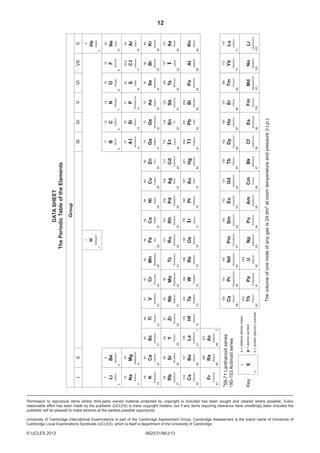
A copy of the Periodic Table is printed on page 12.
You may lose marks if you do not show your working or if you do not use appropriate units.
At the end of the examination, fasten all your work securely together.
The number of marks is given in brackets [ ] at the end of each question or part question.

This document consists of 12 printed pages.
IB13 06_0620_31/2RP
© UCLES 2013

[Turn over
2
1

For
Examiner’s
Use

Petroleum contains hydrocarbons which are separated by fractional distillation.
(a) (i) Complete the following definition of a hydrocarbon.
A hydrocarbon is a compound which .........................................................................
.............................................................................................................................. [2]
(ii) Explain what is meant by the term fractional distillation.
....................................................................................................................................
....................................................................................................................................
.............................................................................................................................. [2]
(b) Some of the fractions obtained from petroleum are given below.
State a use for each fraction.
bitumen ....................................................................
lubricating fraction ...................................................
paraffin fraction ........................................................
gasoline fraction ......................................................

[4]
[Total: 8]

2

An element, M, has the electron distribution 2 + 8 + 18 + 3.
(a) Which group in the Periodic Table is element M likely to be in?
..................................................................................................................................... [1]
(b) Predict whether element M is a poor or a good conductor of electricity.
Give a reason for your answer.
..................................................................................................................................... [1]
(c) Binary compounds contain two atoms per molecule, for example HCl.
Identify an element which could form a binary compound with element M.
..................................................................................................................................... [1]
(d) Predict the formula of the sulfate of M. The formula of the sulfate ion is SO42–.
..................................................................................................................................... [1]

© UCLES 2013

0620/31/M/J/13
3
For
Examiner’s
Use

(e) The hydroxide of M is a white powder which is insoluble in water.
Describe how you could show that this hydroxide is amphoteric.
...........................................................................................................................................
...........................................................................................................................................
..................................................................................................................................... [2]
[Total: 6]
3

A small piece of marble, CaCO3, was added to 5.0 cm3 of hydrochloric acid, concentration
1.0 mol / dm3, at 25 °C. The time taken for the reaction to stop was measured. The experiment
was repeated using 5.0 cm3 of different solutions of acids. The acid was in excess in all of the
experiments.
Typical results are given in the table.
experiment

temperature / °C

acid solution

1

25

hydrochloric acid 1.0 mol / dm3

3

2

25

hydrochloric acid 0.5 mol / dm3

7

3

25

ethanoic acid 1.0 mol / dm3

10

4

15

hydrochloric acid 1.0 mol / dm3

8

time / min

(a) (i) Explain why it is important that the pieces of marble are the same size and the same
shape.
....................................................................................................................................
....................................................................................................................................
.............................................................................................................................. [2]
(ii) How would you know when the reaction had stopped?
.............................................................................................................................. [1]
(b) The equation for the reaction in experiment 1 is:
CaCO3(s) + 2HCl (aq) → CaCl 2(aq) + CO2(g) + H2O(l)
Complete the following ionic equation.
CaCO3(s) + 2H+(aq) → ............ + ............ + ............

© UCLES 2013

0620/31/M/J/13

[1]

[Turn over
4
(c) (i) Explain why the reaction in experiment 1 is faster than the reaction in experiment 2.
....................................................................................................................................
.............................................................................................................................. [1]
(ii) The acids used for experiment 1 and experiment 3 have the same concentration.
Explain why experiment 3 is slower than experiment 1.
....................................................................................................................................
....................................................................................................................................
.............................................................................................................................. [2]
(iii) Explain in terms of collisions between reacting particles why experiment 4 is slower
than experiment 1.
....................................................................................................................................
....................................................................................................................................
.............................................................................................................................. [3]
[Total: 10]
4

The structural formula of cyclohexane is drawn below.
CH2
H 2C

CH2

H 2C

CH2
CH2

(a) The name gives information about the structure of the compound.
Hex because there are six carbon atoms and cyclo because they are joined in a ring.
What information about the structure of this compound is given by the ending ane?
...........................................................................................................................................
..................................................................................................................................... [2]
(b) What are the molecular and empirical formulae of cyclohexane?
molecular formula .............................
empirical formula ..............................

© UCLES 2013

[2]

0620/31/M/J/13

For
Examiner’s
Use
5
For
Examiner’s
Use

(c) Draw the structural formula of cyclobutane.

[1]
(d) (i) Deduce the molecular formula of hexene.
.............................................................................................................................. [1]
(ii) Explain why cyclohexane and the alkene, hexene, are isomers.
....................................................................................................................................
....................................................................................................................................
.............................................................................................................................. [2]
(e) Describe a test which would distinguish between cyclohexane and the unsaturated
hydrocarbon hexene.
test ....................................................................................................................................
result of test with cyclohexane ..........................................................................................
...........................................................................................................................................
result of test with hexene ..................................................................................................
..................................................................................................................................... [3]
[Total: 11]

© UCLES 2013

0620/31/M/J/13

[Turn over
6
5

The reactivity series shows the metals in order of reactivity.
(a) The reactivity series can be established using displacement reactions. A piece of zinc is
added to aqueous lead nitrate. The zinc becomes coated with a black deposit of lead.
Zn + Pb2+ → Zn2+ + Pb
Zinc is more reactive than lead.
The reactivity series can be written as a list of ionic equations.
...... →

...... + ......

Zn

→

Zn2+ + 2e–

Fe

→

Fe2+ + 2e–

Pb

→ Pb2+ + 2e–

most reactive metal : the best reductant (reducing agent)

Cu → Cu2+ + 2e–
Ag

→

Ag+ +

e–

(i) In the space at the top of the list, write an ionic equation for a metal which is more
reactive than zinc.
[1]
(ii) Write an ionic equation for the reaction between aqueous silver(I) nitrate and zinc.
.............................................................................................................................. [2]
(iii) Explain why the positive ions are likely to be oxidants (oxidising agents).
.............................................................................................................................. [1]
(iv) Deduce which ion is the best oxidant (oxidising agent).
.............................................................................................................................. [1]
(v) Which ion(s) in the list can oxidise lead metal?
.............................................................................................................................. [1]

© UCLES 2013

0620/31/M/J/13

For
Examiner’s
Use
7
(b) A reactivity series can also be established by measuring the voltage of simple cells. The
diagram shows a simple cell.

For
Examiner’s
Use

voltmeter
V

cadmium
electrode

copper
electrode
sulfuric acid

Results from cells using the metals tin, cadmium, zinc and copper are given in the table
below.
cell

electrode 1
positive electrode

electrode 2
negative electrode

voltage / volts

1

copper

cadmium

0.74

2

copper

tin

0.48

3

copper

zinc

1.10

Write the four metals in order of increasing reactivity and explain how you used the data
in the table to determine this order.
...........................................................................................................................................
...........................................................................................................................................
..................................................................................................................................... [3]
[Total: 9]
6

Ammonia is a compound which only contains the elements nitrogen and hydrogen. It is a
weak base.
(a) (i) Define the term base.
.............................................................................................................................. [1]
(ii) Given aqueous solutions of ammonia and sodium hydroxide, both having a
concentration of 0.1 mol / dm3, how could you show that ammonia is the weaker
base?
....................................................................................................................................
....................................................................................................................................
.............................................................................................................................. [2]

© UCLES 2013

0620/31/M/J/13

[Turn over
8
(b) Ammonia is manufactured by the Haber Process. The economics of this process require
that as much ammonia as possible is made as quickly as possible.
Explain how this can be done using the following information.
The conditions for the following reversible reaction are:
●
●
●

450 °C
200 atmospheres pressure
iron catalyst
N2(g) + 3H2(g)

2NH3(g)

the reaction is exothermic

...........................................................................................................................................
...........................................................................................................................................
...........................................................................................................................................
...........................................................................................................................................
...........................................................................................................................................
..................................................................................................................................... [5]
(c) Another compound which contains only nitrogen and hydrogen is hydrazine, N2H4.
Complete the equation for the preparation of hydrazine from ammonia.
.....NH3 + NaCl O → N2H4 + ............ + H2O

[2]

(d) The structural formula of hydrazine is given below.
H

H
N

H

N
H

Draw a diagram showing the arrangement of the valency electrons in one molecule of
the covalent compound hydrazine.
Use x to represent an electron from a nitrogen atom.
Use o to represent an electron from a hydrogen atom.

[3]

© UCLES 2013

0620/31/M/J/13

For
Examiner’s
Use
9
(e) Hydrazine is a weak base and it removes dissolved oxygen from water. It is added to
water in steel boilers to prevent rusting.

For
Examiner’s
Use

(i) One way it reduces the rate of rusting is by changing the pH of water.
What effect would hydrazine have on the pH of water?
.............................................................................................................................. [1]
(ii) Give a reason, other than pH, why hydrazine reduces the rate of rusting.
.............................................................................................................................. [1]
[Total: 15]
7

The hydroxides of the Group I metals are soluble in water. Most other metal hydroxides are
insoluble in water.
(a) (i) Crystals of lithium chloride can be prepared from lithium hydroxide by titration.

burette filled with
hydrochloric acid of
concentration 2.20 mol / dm3

conical flask

25.0 cm3 of aqueous lithium hydroxide
and indicator
25.0 cm3 of aqueous lithium hydroxide is pipetted into the conical flask.
A few drops of an indicator are added. Dilute hydrochloric acid is added slowly to the
alkali until the indicator just changes colour. The volume of acid needed to neutralise
the lithium hydroxide is noted.
A neutral solution of lithium chloride, which still contains the indicator, is left. Describe
how you could obtain a neutral solution of lithium chloride which does not contain an
indicator.
....................................................................................................................................
.............................................................................................................................. [2]

© UCLES 2013

0620/31/M/J/13

[Turn over
10
(ii) You cannot prepare a neutral solution of magnesium chloride by the same method.
Describe how you could prepare a neutral solution of magnesium chloride.
....................................................................................................................................
....................................................................................................................................
.............................................................................................................................. [3]
(b) The concentration of the hydrochloric acid was 2.20 mol / dm3. The volume of acid needed
to neutralise the 25.0 cm3 of lithium hydroxide was 20.0 cm3. Calculate the concentration
of the aqueous lithium hydroxide.
LiOH + HCl → LiCl + H2O
...........................................................................................................................................
...........................................................................................................................................
..................................................................................................................................... [2]
(c) Lithium chloride forms three hydrates. They are LiCl.H2O, LiCl.2H2O and LiCl.3H2O.
Which one of these three hydrates contains 45.9 % of water?
Show how you arrived at your answer.
...........................................................................................................................................
...........................................................................................................................................
..................................................................................................................................... [3]
[Total: 10]
8

There are three types of giant structure - ionic, metallic and giant covalent.
(a) In an ionic compound, the ions are held in a lattice by strong forces.
(i) Explain the term lattice.
....................................................................................................................................
.............................................................................................................................. [2]
(ii) Explain how the ions are held together by strong forces.
....................................................................................................................................
.............................................................................................................................. [1]

© UCLES 2013

0620/31/M/J/13

For
Examiner’s
Use
11
For
Examiner’s
Use

(b) Describe the bonding in a typical metal.
...........................................................................................................................................
...........................................................................................................................................
..................................................................................................................................... [3]
(c) The electrical conductivities of the three types of giant structure are given in the following
table.
type of structure

conductivity of solid

conductivity of liquid

ionic

poor

good

metallic

good

good

giant covalent

poor

poor

Explain the differences in electrical conductivity between the three types of giant structure
and the difference, if any, between the solid and liquid states of the same structure.
...........................................................................................................................................
...........................................................................................................................................
...........................................................................................................................................
...........................................................................................................................................
..................................................................................................................................... [5]
[Total: 11]

© UCLES 2013

0620/31/M/J/13

[Turn over
© UCLES 2013

24

40

Sodium

Calcium

88

0620/31/M/J/13

89

Key

b

X

a

72

b = proton (atomic) number

X = atomic symbol

a = relative atomic mass

*58-71 Lanthanoid series
90-103 Actinoid series

88

Ac

Actinium

Ra

Radium

Fr

Francium

87

*

Hafnium

Lanthanum

57

Hf

La

40

Zirconium

Zr

91

Titanium

178

Yttrium

22

48

Ti

139

39

Y

89

Scandium

21

227

Caesium

56

Barium

Cs

45

Sc

226

55

137

Ba

133

Strontium

Rubidium

38

Rb

37

Sr

85

20

Potassium

19

Ca

39

Magnesium

Na

12

Mg

23

Beryllium

4

Lithium

K

11

3

9

Be

7

II

Li

I

51

93

Ta

181

Niobium

Nb

90

58

73

52

96

Mo

W

184

141

Pa

Thorium

55

Tc
186

Re

144

Nd

92

60

Uranium

U

238

Neodymium

75

Rhenium

43

Technetium

25

Manganese

Mn
29

30

65

8

9

VII

2

0

Ru

101

Iron

190

Pm

Osmium

Os

93

Np
Neptunium

61

Promethium

76

44

Ruthenium

26

56

Fe

Sm

150

Iridium

94

Pu
Plutonium

62

Eu

152

Platinum

95

Am
Americium

63

Europium

78

195

Pt

192

46

Palladium

Pd

106

Nickel

Ni

Ir

Samarium

77

45

Rhodium

Rh

103

Cobalt

Co

Gd

157

Gold

Au

197

Silver

96

64

Curium

Cm

Gadolinium

79

47

Ag

108

Copper

Cu

201

Bk

Terbium

Tb

159

Mercury

Hg

97

Berkelium

65

80

48

Cadmium

Cd

112

Zinc

Zn

11

70

Dy

162

Thallium

Tl

204

Indium

98

Cf
Californium

66

Es

Holmium

Ho

165

Lead

Pb

207

Tin

99

Einsteinium

67

82

50

119

Sn

In

32

Germanium

Ge

73

Silicon

115

Gallium

Ga

Dysprosium

81

49

31

13

Aluminium

Si

Al
14

28

Carbon

27

Boron

12

C

14

75

Sb

122

Arsenic

As

Bi

209

Fermium

Fm

Erbium

Er

167

Bismuth

100

68

83

51

Antimony

33

15

Phosphorus

P

31

Nitrogen

N

Se

79

Sulfur

S

32

Oxygen

Po

169

Md

Thulium

Tm

101

Mendelevium

69

84

Polonium

52

Tellurium

Te

128

Selenium

34

16

16

O

Yb

173

Astatine

At

Iodine

I

127

Bromine

Br

80

Chlorine

No
102

Nobelium

70

Ytterbium

85

53

35

17

Cl

35.5

Fluorine

F

19

Lr

Lutetium

Lu

175

Radon

Rn

Xenon

Xe

131

Krypton

Kr

84

Argon

Ar

40

Neon

103

Lawrencium

71

86

54

36

18

10

Ne

20

Helium

Hydrogen

B

4

28

64

7

VI

He

27

59

6

V

H

59

5

IV

The volume of one mole of any gas is 24 dm3 at room temperature and pressure (r.t.p.).

91

Protactinium

Th

232

Praseodymium

Cerium

59

Pr

Ce

74

Tungsten

42

Molybdenum

24

Chromium

Cr

140

Tantalum

41

23

Vanadium

V

1

III
1

Group

DATA SHEET
The Periodic Table of the Elements

12

Permission to reproduce items where third-party owned material protected by copyright is included has been sought and cleared where possible. Every
reasonable effort has been made by the publisher (UCLES) to trace copyright holders, but if any items requiring clearance have unwittingly been included the
publisher will be pleased to make amends at the earliest possible opportunity.

University of Cambridge International Examinations is part of the Cambridge Assessment Group. Cambridge Assessment is the brand name of University of
Cambridge Local Examinations Syndicate (UCLES), which is itself a department of the University of Cambridge.

0620 s13 qp_31

  • 1.
    UNIVERSITY OF CAMBRIDGEINTERNATIONAL EXAMINATIONS International General Certificate of Secondary Education *2845008432* CHEMISTRY 0620/31 Paper 3 (Extended) May/June 2013 1 hour 15 minutes Candidates answer on the Question Paper. No Additional Materials are required. READ THESE INSTRUCTIONS FIRST Write your Centre number, candidate number and name on all the work you hand in. Write in dark blue or black pen. You may use a pencil for any diagrams, graphs or rough working. Do not use staples, paper clips, highlighters, glue or correction fluid. DO NOT WRITE IN ANY BARCODES. Answer all questions. Electronic calculators may be used. A copy of the Periodic Table is printed on page 12. You may lose marks if you do not show your working or if you do not use appropriate units. At the end of the examination, fasten all your work securely together. The number of marks is given in brackets [ ] at the end of each question or part question. This document consists of 12 printed pages. IB13 06_0620_31/2RP © UCLES 2013 [Turn over
  • 2.
    2 1 For Examiner’s Use Petroleum contains hydrocarbonswhich are separated by fractional distillation. (a) (i) Complete the following definition of a hydrocarbon. A hydrocarbon is a compound which ......................................................................... .............................................................................................................................. [2] (ii) Explain what is meant by the term fractional distillation. .................................................................................................................................... .................................................................................................................................... .............................................................................................................................. [2] (b) Some of the fractions obtained from petroleum are given below. State a use for each fraction. bitumen .................................................................... lubricating fraction ................................................... paraffin fraction ........................................................ gasoline fraction ...................................................... [4] [Total: 8] 2 An element, M, has the electron distribution 2 + 8 + 18 + 3. (a) Which group in the Periodic Table is element M likely to be in? ..................................................................................................................................... [1] (b) Predict whether element M is a poor or a good conductor of electricity. Give a reason for your answer. ..................................................................................................................................... [1] (c) Binary compounds contain two atoms per molecule, for example HCl. Identify an element which could form a binary compound with element M. ..................................................................................................................................... [1] (d) Predict the formula of the sulfate of M. The formula of the sulfate ion is SO42–. ..................................................................................................................................... [1] © UCLES 2013 0620/31/M/J/13
  • 3.
    3 For Examiner’s Use (e) The hydroxideof M is a white powder which is insoluble in water. Describe how you could show that this hydroxide is amphoteric. ........................................................................................................................................... ........................................................................................................................................... ..................................................................................................................................... [2] [Total: 6] 3 A small piece of marble, CaCO3, was added to 5.0 cm3 of hydrochloric acid, concentration 1.0 mol / dm3, at 25 °C. The time taken for the reaction to stop was measured. The experiment was repeated using 5.0 cm3 of different solutions of acids. The acid was in excess in all of the experiments. Typical results are given in the table. experiment temperature / °C acid solution 1 25 hydrochloric acid 1.0 mol / dm3 3 2 25 hydrochloric acid 0.5 mol / dm3 7 3 25 ethanoic acid 1.0 mol / dm3 10 4 15 hydrochloric acid 1.0 mol / dm3 8 time / min (a) (i) Explain why it is important that the pieces of marble are the same size and the same shape. .................................................................................................................................... .................................................................................................................................... .............................................................................................................................. [2] (ii) How would you know when the reaction had stopped? .............................................................................................................................. [1] (b) The equation for the reaction in experiment 1 is: CaCO3(s) + 2HCl (aq) → CaCl 2(aq) + CO2(g) + H2O(l) Complete the following ionic equation. CaCO3(s) + 2H+(aq) → ............ + ............ + ............ © UCLES 2013 0620/31/M/J/13 [1] [Turn over
  • 4.
    4 (c) (i) Explainwhy the reaction in experiment 1 is faster than the reaction in experiment 2. .................................................................................................................................... .............................................................................................................................. [1] (ii) The acids used for experiment 1 and experiment 3 have the same concentration. Explain why experiment 3 is slower than experiment 1. .................................................................................................................................... .................................................................................................................................... .............................................................................................................................. [2] (iii) Explain in terms of collisions between reacting particles why experiment 4 is slower than experiment 1. .................................................................................................................................... .................................................................................................................................... .............................................................................................................................. [3] [Total: 10] 4 The structural formula of cyclohexane is drawn below. CH2 H 2C CH2 H 2C CH2 CH2 (a) The name gives information about the structure of the compound. Hex because there are six carbon atoms and cyclo because they are joined in a ring. What information about the structure of this compound is given by the ending ane? ........................................................................................................................................... ..................................................................................................................................... [2] (b) What are the molecular and empirical formulae of cyclohexane? molecular formula ............................. empirical formula .............................. © UCLES 2013 [2] 0620/31/M/J/13 For Examiner’s Use
  • 5.
    5 For Examiner’s Use (c) Draw thestructural formula of cyclobutane. [1] (d) (i) Deduce the molecular formula of hexene. .............................................................................................................................. [1] (ii) Explain why cyclohexane and the alkene, hexene, are isomers. .................................................................................................................................... .................................................................................................................................... .............................................................................................................................. [2] (e) Describe a test which would distinguish between cyclohexane and the unsaturated hydrocarbon hexene. test .................................................................................................................................... result of test with cyclohexane .......................................................................................... ........................................................................................................................................... result of test with hexene .................................................................................................. ..................................................................................................................................... [3] [Total: 11] © UCLES 2013 0620/31/M/J/13 [Turn over
  • 6.
    6 5 The reactivity seriesshows the metals in order of reactivity. (a) The reactivity series can be established using displacement reactions. A piece of zinc is added to aqueous lead nitrate. The zinc becomes coated with a black deposit of lead. Zn + Pb2+ → Zn2+ + Pb Zinc is more reactive than lead. The reactivity series can be written as a list of ionic equations. ...... → ...... + ...... Zn → Zn2+ + 2e– Fe → Fe2+ + 2e– Pb → Pb2+ + 2e– most reactive metal : the best reductant (reducing agent) Cu → Cu2+ + 2e– Ag → Ag+ + e– (i) In the space at the top of the list, write an ionic equation for a metal which is more reactive than zinc. [1] (ii) Write an ionic equation for the reaction between aqueous silver(I) nitrate and zinc. .............................................................................................................................. [2] (iii) Explain why the positive ions are likely to be oxidants (oxidising agents). .............................................................................................................................. [1] (iv) Deduce which ion is the best oxidant (oxidising agent). .............................................................................................................................. [1] (v) Which ion(s) in the list can oxidise lead metal? .............................................................................................................................. [1] © UCLES 2013 0620/31/M/J/13 For Examiner’s Use
  • 7.
    7 (b) A reactivityseries can also be established by measuring the voltage of simple cells. The diagram shows a simple cell. For Examiner’s Use voltmeter V cadmium electrode copper electrode sulfuric acid Results from cells using the metals tin, cadmium, zinc and copper are given in the table below. cell electrode 1 positive electrode electrode 2 negative electrode voltage / volts 1 copper cadmium 0.74 2 copper tin 0.48 3 copper zinc 1.10 Write the four metals in order of increasing reactivity and explain how you used the data in the table to determine this order. ........................................................................................................................................... ........................................................................................................................................... ..................................................................................................................................... [3] [Total: 9] 6 Ammonia is a compound which only contains the elements nitrogen and hydrogen. It is a weak base. (a) (i) Define the term base. .............................................................................................................................. [1] (ii) Given aqueous solutions of ammonia and sodium hydroxide, both having a concentration of 0.1 mol / dm3, how could you show that ammonia is the weaker base? .................................................................................................................................... .................................................................................................................................... .............................................................................................................................. [2] © UCLES 2013 0620/31/M/J/13 [Turn over
  • 8.
    8 (b) Ammonia ismanufactured by the Haber Process. The economics of this process require that as much ammonia as possible is made as quickly as possible. Explain how this can be done using the following information. The conditions for the following reversible reaction are: ● ● ● 450 °C 200 atmospheres pressure iron catalyst N2(g) + 3H2(g) 2NH3(g) the reaction is exothermic ........................................................................................................................................... ........................................................................................................................................... ........................................................................................................................................... ........................................................................................................................................... ........................................................................................................................................... ..................................................................................................................................... [5] (c) Another compound which contains only nitrogen and hydrogen is hydrazine, N2H4. Complete the equation for the preparation of hydrazine from ammonia. .....NH3 + NaCl O → N2H4 + ............ + H2O [2] (d) The structural formula of hydrazine is given below. H H N H N H Draw a diagram showing the arrangement of the valency electrons in one molecule of the covalent compound hydrazine. Use x to represent an electron from a nitrogen atom. Use o to represent an electron from a hydrogen atom. [3] © UCLES 2013 0620/31/M/J/13 For Examiner’s Use
  • 9.
    9 (e) Hydrazine isa weak base and it removes dissolved oxygen from water. It is added to water in steel boilers to prevent rusting. For Examiner’s Use (i) One way it reduces the rate of rusting is by changing the pH of water. What effect would hydrazine have on the pH of water? .............................................................................................................................. [1] (ii) Give a reason, other than pH, why hydrazine reduces the rate of rusting. .............................................................................................................................. [1] [Total: 15] 7 The hydroxides of the Group I metals are soluble in water. Most other metal hydroxides are insoluble in water. (a) (i) Crystals of lithium chloride can be prepared from lithium hydroxide by titration. burette filled with hydrochloric acid of concentration 2.20 mol / dm3 conical flask 25.0 cm3 of aqueous lithium hydroxide and indicator 25.0 cm3 of aqueous lithium hydroxide is pipetted into the conical flask. A few drops of an indicator are added. Dilute hydrochloric acid is added slowly to the alkali until the indicator just changes colour. The volume of acid needed to neutralise the lithium hydroxide is noted. A neutral solution of lithium chloride, which still contains the indicator, is left. Describe how you could obtain a neutral solution of lithium chloride which does not contain an indicator. .................................................................................................................................... .............................................................................................................................. [2] © UCLES 2013 0620/31/M/J/13 [Turn over
  • 10.
    10 (ii) You cannotprepare a neutral solution of magnesium chloride by the same method. Describe how you could prepare a neutral solution of magnesium chloride. .................................................................................................................................... .................................................................................................................................... .............................................................................................................................. [3] (b) The concentration of the hydrochloric acid was 2.20 mol / dm3. The volume of acid needed to neutralise the 25.0 cm3 of lithium hydroxide was 20.0 cm3. Calculate the concentration of the aqueous lithium hydroxide. LiOH + HCl → LiCl + H2O ........................................................................................................................................... ........................................................................................................................................... ..................................................................................................................................... [2] (c) Lithium chloride forms three hydrates. They are LiCl.H2O, LiCl.2H2O and LiCl.3H2O. Which one of these three hydrates contains 45.9 % of water? Show how you arrived at your answer. ........................................................................................................................................... ........................................................................................................................................... ..................................................................................................................................... [3] [Total: 10] 8 There are three types of giant structure - ionic, metallic and giant covalent. (a) In an ionic compound, the ions are held in a lattice by strong forces. (i) Explain the term lattice. .................................................................................................................................... .............................................................................................................................. [2] (ii) Explain how the ions are held together by strong forces. .................................................................................................................................... .............................................................................................................................. [1] © UCLES 2013 0620/31/M/J/13 For Examiner’s Use
  • 11.
    11 For Examiner’s Use (b) Describe thebonding in a typical metal. ........................................................................................................................................... ........................................................................................................................................... ..................................................................................................................................... [3] (c) The electrical conductivities of the three types of giant structure are given in the following table. type of structure conductivity of solid conductivity of liquid ionic poor good metallic good good giant covalent poor poor Explain the differences in electrical conductivity between the three types of giant structure and the difference, if any, between the solid and liquid states of the same structure. ........................................................................................................................................... ........................................................................................................................................... ........................................................................................................................................... ........................................................................................................................................... ..................................................................................................................................... [5] [Total: 11] © UCLES 2013 0620/31/M/J/13 [Turn over
  • 12.
    © UCLES 2013 24 40 Sodium Calcium 88 0620/31/M/J/13 89 Key b X a 72 b= proton (atomic) number X = atomic symbol a = relative atomic mass *58-71 Lanthanoid series 90-103 Actinoid series 88 Ac Actinium Ra Radium Fr Francium 87 * Hafnium Lanthanum 57 Hf La 40 Zirconium Zr 91 Titanium 178 Yttrium 22 48 Ti 139 39 Y 89 Scandium 21 227 Caesium 56 Barium Cs 45 Sc 226 55 137 Ba 133 Strontium Rubidium 38 Rb 37 Sr 85 20 Potassium 19 Ca 39 Magnesium Na 12 Mg 23 Beryllium 4 Lithium K 11 3 9 Be 7 II Li I 51 93 Ta 181 Niobium Nb 90 58 73 52 96 Mo W 184 141 Pa Thorium 55 Tc 186 Re 144 Nd 92 60 Uranium U 238 Neodymium 75 Rhenium 43 Technetium 25 Manganese Mn 29 30 65 8 9 VII 2 0 Ru 101 Iron 190 Pm Osmium Os 93 Np Neptunium 61 Promethium 76 44 Ruthenium 26 56 Fe Sm 150 Iridium 94 Pu Plutonium 62 Eu 152 Platinum 95 Am Americium 63 Europium 78 195 Pt 192 46 Palladium Pd 106 Nickel Ni Ir Samarium 77 45 Rhodium Rh 103 Cobalt Co Gd 157 Gold Au 197 Silver 96 64 Curium Cm Gadolinium 79 47 Ag 108 Copper Cu 201 Bk Terbium Tb 159 Mercury Hg 97 Berkelium 65 80 48 Cadmium Cd 112 Zinc Zn 11 70 Dy 162 Thallium Tl 204 Indium 98 Cf Californium 66 Es Holmium Ho 165 Lead Pb 207 Tin 99 Einsteinium 67 82 50 119 Sn In 32 Germanium Ge 73 Silicon 115 Gallium Ga Dysprosium 81 49 31 13 Aluminium Si Al 14 28 Carbon 27 Boron 12 C 14 75 Sb 122 Arsenic As Bi 209 Fermium Fm Erbium Er 167 Bismuth 100 68 83 51 Antimony 33 15 Phosphorus P 31 Nitrogen N Se 79 Sulfur S 32 Oxygen Po 169 Md Thulium Tm 101 Mendelevium 69 84 Polonium 52 Tellurium Te 128 Selenium 34 16 16 O Yb 173 Astatine At Iodine I 127 Bromine Br 80 Chlorine No 102 Nobelium 70 Ytterbium 85 53 35 17 Cl 35.5 Fluorine F 19 Lr Lutetium Lu 175 Radon Rn Xenon Xe 131 Krypton Kr 84 Argon Ar 40 Neon 103 Lawrencium 71 86 54 36 18 10 Ne 20 Helium Hydrogen B 4 28 64 7 VI He 27 59 6 V H 59 5 IV The volume of one mole of any gas is 24 dm3 at room temperature and pressure (r.t.p.). 91 Protactinium Th 232 Praseodymium Cerium 59 Pr Ce 74 Tungsten 42 Molybdenum 24 Chromium Cr 140 Tantalum 41 23 Vanadium V 1 III 1 Group DATA SHEET The Periodic Table of the Elements 12 Permission to reproduce items where third-party owned material protected by copyright is included has been sought and cleared where possible. Every reasonable effort has been made by the publisher (UCLES) to trace copyright holders, but if any items requiring clearance have unwittingly been included the publisher will be pleased to make amends at the earliest possible opportunity. University of Cambridge International Examinations is part of the Cambridge Assessment Group. Cambridge Assessment is the brand name of University of Cambridge Local Examinations Syndicate (UCLES), which is itself a department of the University of Cambridge.