Download to read offline
![Centre Number
Candidate Number
Name
CAMBRIDGE INTERNATIONAL EXAMINATIONS
International General Certificate of Secondary Education
0620/02
CHEMISTRY
Paper 2
May/June 2003
1 hour
Candidates answer on the Question Paper.
No Additional Materials required
READ THESE INSTRUCTIONS FIRST
Write your name, centre number and candidate number in the spaces provided at the top of this page.
Write in dark blue or black pen in the spaces provided on the Question Paper.
You may use a pencil for any diagrams, graphs or rough working.
Do not use staples, paper clips, highlighters, glue or correction fluid.
Answer all questions.
The number of marks is given in brackets [ ] at the end of each question or part question.
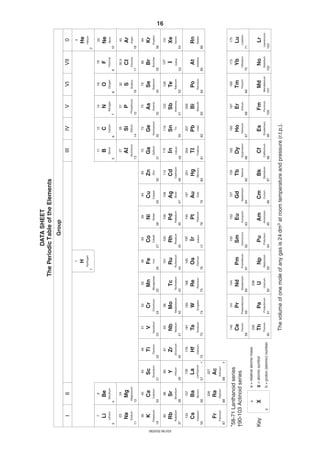
A copy of the Periodic Table is printed on page 16.
FOR EXAMINER’S USE
1
2
If you have been given a label, look at the
details. If any details are incorrect or
missing, please fill in your correct details
in the space given at the top of this page.
Stick your personal label here, if
provided.
3
4
5
6
TOTAL
This document consists of 16 printed pages.
SP (SC) S33034/4
© CIE 2003
[Turn over](https://image.slidesharecdn.com/0620s03qp2-140119135902-phpapp01/85/0620-s03-qp_2-1-320.jpg)
![Centre Number
Candidate Number
Name
CAMBRIDGE INTERNATIONAL EXAMINATIONS
International General Certificate of Secondary Education
0620/02
CHEMISTRY
Paper 2
May/June 2003
1 hour
Candidates answer on the Question Paper.
No Additional Materials required
READ THESE INSTRUCTIONS FIRST
Write your name, centre number and candidate number in the spaces provided at the top of this page.
Write in dark blue or black pen in the spaces provided on the Question Paper.
You may use a pencil for any diagrams, graphs or rough working.
Do not use staples, paper clips, highlighters, glue or correction fluid.
Answer all questions.
The number of marks is given in brackets [ ] at the end of each question or part question.
A copy of the Periodic Table is printed on page 16.
FOR EXAMINER’S USE
1
2
If you have been given a label, look at the
details. If any details are incorrect or
missing, please fill in your correct details
in the space given at the top of this page.
Stick your personal label here, if
provided.
3
4
5
6
TOTAL
This document consists of 16 printed pages.
SP (SC) S33034/4
© CIE 2003
[Turn over](https://image.slidesharecdn.com/0620s03qp2-140119135902-phpapp01/75/0620-s03-qp_2-1-2048.jpg)
![2
1
For
Examiner’s
Use
The diagram shows part of the Periodic Table.
I
II
III
IV
C
Li
Na
K
Fe
Cu
Zn
V
N
VI VII
O
S
F
Cl
Br
0
He
Ne
Ar
Kr
(a) Answer these questions using only the elements shown in the diagram.
Write down the symbol for an element which
(i)
is a transition metal.
(ii)
forms an acidic oxide.
(iii)
has six electrons in its outer shell.
(iv)
has a giant covalent structure.
(v)
reacts rapidly with water.
(vi)
has a higher proton (atomic) number than iron.
[6]
0620/02 M/J/03](https://image.slidesharecdn.com/0620s03qp2-140119135902-phpapp01/85/0620-s03-qp_2-2-320.jpg)
![3
For
Examiner’s
Use
(b) Some uses of some non-metallic elements are show below.
Draw lines between the boxes to link the elements to their correct uses.
The first one has been done for you.
element
use
oxygen
in light bulbs
argon
in oxygen tents in
hospitals
chlorine
to kill bacteria in water
purification
carbon (graphite)
in balloons
helium
as a lubricant
[4]
(c) The structures of some halogen compounds are shown below.
Na+
Cl
I
Cl
A
(i)
Cl
Cl – Na+
Cl – Na+
Na+
Cl –
Cl – Na+
B
F
F
F
Br
F
F
C
Describe the type of bonding in compound A.
...................................................................................................................................
(ii) State the simplest formula for compound C.
...................................................................................................................................
(iii)
Explain why compound B does not conduct electricity when solid but does conduct
when molten.
...................................................................................................................................
...............................................................................................................................[4]
0620/02 M/J/03
[Turn over](https://image.slidesharecdn.com/0620s03qp2-140119135902-phpapp01/85/0620-s03-qp_2-3-320.jpg)
![4
2
For
Examiner’s
Use
A student investigates the reaction between zinc and hydrochloric acid.
The hydrochloric acid is in excess.
The student uses the apparatus shown in the diagram.
hydrogen
gas
gas
syringe
small test
tube held by
a piece of
cotton
zinc power
hydrochloric acid
(a) What should the student do to start the reaction?
......................................................................................................................................[1]
(b) The student reads the volume of gas in the syringe every minute.
The results are shown in the table.
time in minutes
1
2
3
4
5
6
7
volume of gas in cm3
(i)
0
0
23
35
45
50
53
55
55
Plot the results on the grid on page 5.
0620/02 M/J/03](https://image.slidesharecdn.com/0620s03qp2-140119135902-phpapp01/85/0620-s03-qp_2-4-320.jpg)
![5
For
Examiner’s
Use
60
50
volume of gas / cm3
40
30
20
10
0
1
2
3
4
5
6
7
time / min
(ii)
Draw the best curve through the points.
(iii)
Explain why the volume of gas stays the same after six minutes.
...................................................................................................................................
...............................................................................................................................[5]
(c) The student does the experiment again.
The only difference is that the student uses warm, rather than cold,
hydrochloric acid.
On the grid, draw the shape of the graph you would expect for the
experiment with the warm hydrochloric acid.
[2]
.
0620/02 M/J/03
[Turn over](https://image.slidesharecdn.com/0620s03qp2-140119135902-phpapp01/85/0620-s03-qp_2-5-320.jpg)
![6
For
Examiner’s
Use
(d) (i) Balance the equation for the reaction between zinc and hydrochloric acid.
Zn
+
… HCl
→
ZnCl2
+
H2
(ii) Name the compound which has the formula ZnCl2.
...................................................................................................................................
(iii) Calculate the relative formula mass of ZnCl2.
[3]
(e) Zinc is an element.
State the meaning of the term element.
......................................................................................................................................
..................................................................................................................................[1]
0620/02 M/J/03](https://image.slidesharecdn.com/0620s03qp2-140119135902-phpapp01/85/0620-s03-qp_2-6-320.jpg)
![7
3
For
Examiner’s
Use
The states of matter are solid, liquid and gas.
The diagram below shows how the molecules are arranged in these three states.
melting
A
B
C
(a) State the name given to the change of state labelled
(i)
A ...............................................................................................................................
(ii)
B ...............................................................................................................................
(iii)
C ................................................................................................................................
[3]
(b) Which one of the following best describes the movement of molecules in the liquid
state?
Tick one box.
The molecules are not moving from place to place.
The molecules are sliding over each other.
The molecules are moving freely.
[1]
(c) Which of the changes A, B or C, is endothermic?
Explain your answer.
..........................................................................................................................................
......................................................................................................................................[2]
0620/02 M/J/03
[Turn over](https://image.slidesharecdn.com/0620s03qp2-140119135902-phpapp01/85/0620-s03-qp_2-7-320.jpg)
![8
(d) Choose from the following list of substances to answer the questions below.
bromine
chlorine
iron
mercury
sodium chloride
sulphur
Name a substance which is
(i)
a gas at room temperature. ......................................................................................
(ii)
a non-metallic liquid at room temperature. ...............................................................
(iii)
a compound which is a solid at room temperature. ...................................................
[3]
(e) A student set up the apparatus shown in the diagram below.
glass tube
X
cotton wool soaked in
ammonia solution
rubber bung
cotton wool soaked in
concentrated hydrochloric acid
The white solid is formed because the molecules of hydrogen chloride gas and
ammonia gas move at random throughout the tube and eventually react with each other.
(i)
State the name given to this random movement of molecules.
...................................................................................................................................
(ii)
State the name of the white solid formed at X.
...................................................................................................................................
(iii)
Suggest why the white solid is formed towards one end of the tube and not in the
middle.
...................................................................................................................................
...............................................................................................................................[3]
(f)
What type of chemical reaction takes place when ammonia reacts with hydrochloric
acid?
......................................................................................................................................[1]
0620/02 M/J/03
For
Examiner’s
Use](https://image.slidesharecdn.com/0620s03qp2-140119135902-phpapp01/85/0620-s03-qp_2-8-320.jpg)
![9
(g) The diagram below shows a simple apparatus that can be used for measuring the
melting point of a solid.
The liquid in the beaker is heated slowly and the temperature at which the solid B melts
is recorded.
For
Examiner’s
Use
A
small tube
stirrer
solid B
liquid
heat
(i)
State the name of the piece of apparatus labelled A.
...................................................................................................................................
(ii)
Solid B melted at 155oC.
Why would water not be a suitable liquid to put in the beaker when using this
apparatus to find the melting point of solid B?
...................................................................................................................................
...................................................................................................................................
(iii)
Suggest why the liquid needs to be kept stirred.
...................................................................................................................................
...............................................................................................................................[3]
0620/02 M/J/03
[Turn over](https://image.slidesharecdn.com/0620s03qp2-140119135902-phpapp01/85/0620-s03-qp_2-9-320.jpg)
![10
4
Catalytic cracking is carried out by oil companies to produce high grade petrol.
The process is carried out using an aluminium oxide catalyst.
The reaction is a type of thermal decomposition.
(a) Explain the meaning of
(i)
thermal decomposition.
...................................................................................................................................
...................................................................................................................................
(ii)
catalyst.
...................................................................................................................................
..............................................................................................................................[2]
(b) A typical ‘cracking’ reaction is
→
C10H22
C8H18
+
C2H4
State the name of the unsaturated compound in this equation.
......................................................................................................................................[1]
(c) The table shows some of the products obtained by cracking 100g of different ‘fractions’
under the same conditions.
products obtained / g per 100g of ‘fraction’ cracked
‘fraction’
cracked
methane
ethene
petrol
ethane
10
5
75
2
paraffin
1
15
30
23
diesel
(i)
hydrogen
0
6
20
17
Which ‘fraction’ is the best source of fuel for cars?
...................................................................................................................................
(ii) Calculate the amount of paraffin ‘fraction’ needed to make 600g of methane.
0620/02 M/J/03
For
Examiner’s
Use](https://image.slidesharecdn.com/0620s03qp2-140119135902-phpapp01/85/0620-s03-qp_2-10-320.jpg)
![11
(iii) Complete the equation for the cracking of ethane to produce hydrogen and ethene.
→
C2H6
………………
+
For
Examiner’s
Use
………………
[4]
(d) Ethene can be polymerised to form poly(ethene).
(i)
Complete the equation below to show the structure of two units in the
poly(ethene) molecule.
H
C
C
H
(ii)
H
H
H
C
C
H
+
H
H
→
State the name given to this type of polymerisarion.
...............................................................................................................................[2]
5
A precipitate may be formed when two aqueous solutions are mixed. The colour of these
precipitates may be used to identify particular aqueous ions.
(a) Complete the following table.
ion under test
solution to be added to
test for the ion
colour of precipitate
iron(II)
iodide
chloride
sulphate
[8]
0620/02 M/J/03
[Turn over](https://image.slidesharecdn.com/0620s03qp2-140119135902-phpapp01/85/0620-s03-qp_2-11-320.jpg)
![12
(b) When a solution of iron(III) chloride is added to a solution of sodium hydroxide, a
precipitate of iron(III) hydroxide is formed and sodium chloride remains in solution.
sodium chloride solution
iron(III) hydroxide
Explain how you would obtain a pure dry sample of sodium chloride from this mixture.
You may use diagrams to help with your explanation.
[3]
(c) Sodium chloride and iron(III) hydroxide are both compounds.
Explain the meaning of the term compound.
..........................................................................................................................................
..................................................................................................................................... [2]
(d) Molten sodium chloride can be electrolysed using graphite electrodes.
Predict the products of this electrolysis
(i)
at the anode ..............................................................................................................
(ii)
at the cathode ..........................................................................................................
[2]
0620/02 M/J/03
For
Examiner’s
Use](https://image.slidesharecdn.com/0620s03qp2-140119135902-phpapp01/85/0620-s03-qp_2-12-320.jpg)
![13
6
For
Examiner’s
Use
This question is about different metals.
The list below shows part of the metal reactivity series .
potassium
magnesium
aluminium
zinc
iron
copper
more reactive
less reactive
(a) From this list, choose a metal which is extracted using electrolysis.
......................................................................................................................................[1]
(b) Two thousand years ago, people were able to extract iron and copper from their ores.
They were not able to extract aluminium.
Suggest why they were not able to extract aluminium from its ore.
..........................................................................................................................................
......................................................................................................................................[1]
(c) Uranium is between magnesium and zinc in the reactivity series.
Equal sized strips of magnesium, uranium and zinc were placed in hydrochloric acid.
The hydrochloric acid was the same concentration.
The results are shown in the table.
(i)
Complete the result for uranium and hydrochloric acid.
metal
magnesium
observations on adding to hydrochloric acid
many bubbles of gas produced very rapidly and
magnesium dissolves quickly
uranium
zinc
(ii)
a few bubbles produced at a steady rate and zinc
dissolves slowly
Uranium has several isotopes which are radioactive.
One of these isotopes is uranium – 235 (235U).
What do you understand by the term isotopes?
...................................................................................................................................
...................................................................................................................................
(iii)
State one use of uranium –235.
...............................................................................................................................[3]
0620/02 M/J/03
[Turn over](https://image.slidesharecdn.com/0620s03qp2-140119135902-phpapp01/85/0620-s03-qp_2-13-320.jpg)
![14
(d) Metals high in the reactivity series react readily with oxygen.
Name the compound formed when magnesium reacts with oxygen.
......................................................................................................................................[1]
(e) Copper is alloyed with tin to make bronze.
(i)
State what is meant by the term alloy.
...................................................................................................................................
...................................................................................................................................
(ii)
Suggest why metals are often used in the form of alloys.
...................................................................................................................................
...................................................................................................................................
...............................................................................................................................[2]
(f)
Zinc can be extracted by heating zinc oxide with carbon.
ZnO
+
C
→
Zn
+
CO
Explain why carbon is a reducing agent (reductant) in this reaction.
..........................................................................................................................................
..........................................................................................................................................
......................................................................................................................................[1]
(g) Iron is used as a catalyst in the Haber Process for making ammonia.
3H2 +
(i)
What does the sign
N2
2NH3
mean?
...................................................................................................................................
(ii)
What is the approximate percentage of nitrogen in the air?
...............................................................................................................................[2]
0620/02 M/J/03
For
Examiner’s
Use](https://image.slidesharecdn.com/0620s03qp2-140119135902-phpapp01/85/0620-s03-qp_2-14-320.jpg)
![15
For
Examiner’s
Use
(h) Magnesium is in group II of the Periodic Table.
(i)
Draw a diagram to show the electronic structure of magnesium.
(ii)
Explain what happens to the magnesium atom when it reacts and forms a
magnesium ion.
...............................................................................................................................[3]
0620/02 M/J/03
[Turn over](https://image.slidesharecdn.com/0620s03qp2-140119135902-phpapp01/85/0620-s03-qp_2-15-320.jpg)

This document consists of a chemistry exam paper with multiple choice and short answer questions testing knowledge of chemistry concepts and principles. It includes questions on the periodic table, chemical reactions, states of matter, chemical bonding, and properties and reactions of various elements and compounds. The paper provides context for summarizing key chemistry ideas assessed on the exam.


