

Syllabus

Cambridge IGCSE Chemistry
Cambridge International Certificate*

Syllabus code 0620
For examination in June and November 2013

*This syllabus is accredited for use in England, Wales and Northern Ireland as a Cambridge
International Level 1/Level 2 Certificate.
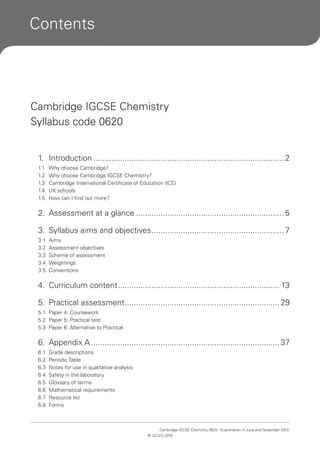
Contents

Cambridge IGCSE Chemistry
Syllabus code 0620
1. Introduction ..................................................................................... 2
1.1
1.2
1.3
1.4
1.5

Why choose Cambridge?
Why choose Cambridge IGCSE Chemistry?
Cambridge International Certificate of Education (ICE)
UK schools
How can I find out more?

2. Assessment at a glance .................................................................. 5
3. Syllabus aims and objectives ........................................................... 7
3.1
3.2
3.3
3.4
3.5

Aims
Assessment objectives
Scheme of assessment
Weightings
Conventions

4. Curriculum content ........................................................................ 13
5. Practical assessment ..................................................................... 29
5.1 Paper 4: Coursework
5.2 Paper 5: Practical test
5.3 Paper 6: Alternative to Practical

6. Appendix A .................................................................................... 37
6.1
6.2
6.3
6.4
6.5
6.6
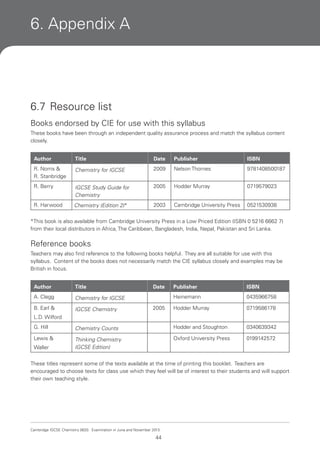
6.7
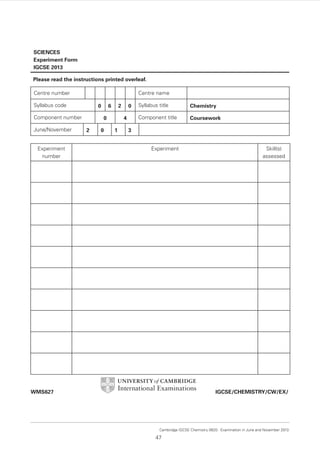
6.8

Grade descriptions
Periodic Table
Notes for use in qualitative analysis
Safety in the laboratory
Glossary of terms
Mathematical requirements
Resource list
Forms

Cambridge IGCSE Chemistry 0620. Examination in June and November 2013.
© UCLES 2010
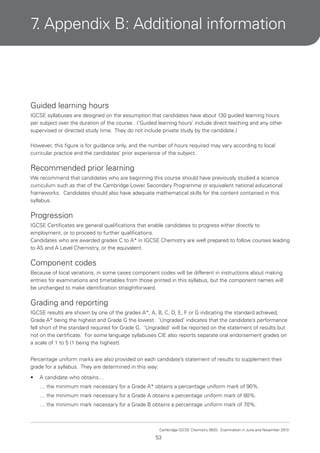
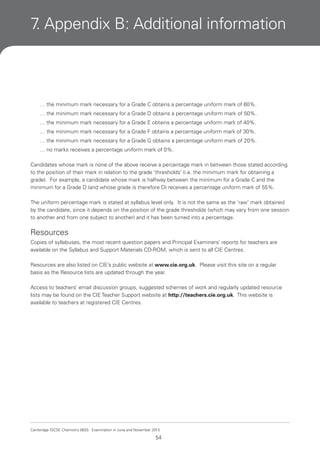
7 Appendix B: Additional information ............................................... 53
.
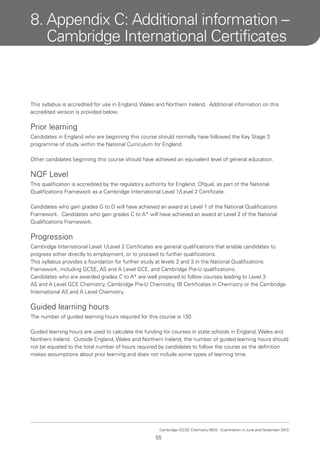
8. Appendix C: Additional information – Cambridge International
Certificates .................................................................................... 55
1. Introduction

1.1 Why choose Cambridge?
University of Cambridge International Examinations (CIE) is the world’s largest provider of international
qualifications. Around 1.5 million students from 150 countries enter Cambridge examinations every year.
What makes educators around the world choose Cambridge?

Recognition
Cambridge IGCSE is internationally recognised by schools, universities and employers as equivalent to UK
GCSE. Cambridge IGCSE is excellent preparation for A/AS Level, the Advanced International Certificate of
Education (AICE), US Advanced Placement Programme and the International Baccalaureate (IB) Diploma.
Learn more at www.cie.org.uk/recognition.

Support
CIE provides a world-class support service for teachers and exams officers. We offer a wide range of
teacher materials to Centres, plus teacher training (online and face-to-face) and student support materials.
Exams officers can trust in reliable, efficient administration of exams entry and excellent, personal support
from CIE Customer Services. Learn more at www.cie.org.uk/teachers.

Excellence in education
Cambridge qualifications develop successful students. They build not only understanding and knowledge
required for progression, but also learning and thinking skills that help students become independent
learners and equip them for life.

Not-for-profit, part of the University of Cambridge
CIE is part of Cambridge Assessment, a not-for-profit organisation and part of the University of Cambridge.
The needs of teachers and learners are at the core of what we do. CIE invests constantly in improving its
qualifications and services. We draw upon education research in developing our qualifications.

Cambridge IGCSE Chemistry 0620. Examination in June and November 2013.

2
1. Introduction

1.2 Why choose Cambridge IGCSE Chemistry?
Cambridge IGCSE Chemistry is accepted by universities and employers as proof of essential chemistry
knowledge and ability. As well as a subject focus, the Chemistry syllabus enables students to:
•

better understand the technological world in which they live, and take an informed interest in science
and scientific developments

•

learn about the basic principles of Chemistry through a mix of theoretical and practical studies

•

develop an understanding of the scientific skills essential for further study at A Level, skills which are
useful in everyday life

•

learn how science is studied and practised, and become aware that the results of scientific research can
have both good and bad effects on individuals, communities and the environment.

1.3 Cambridge International Certificate of Education (ICE)
Cambridge ICE is the group award of the International General Certificate of Secondary Education (IGCSE).
It requires the study of subjects drawn from the five different IGCSE subject groups. It gives schools the
opportunity to benefit from offering a broad and balanced curriculum by recognising the achievements of
students who pass examinations in at least seven subjects, including two languages, and one subject from
each of the other subject groups.
The Cambridge portfolio of IGCSE qualifications provides a solid foundation for higher level courses such
as GCE A and AS Levels and the International Baccalaureate Diploma as well as excellent preparation for
employment.
A wide range of IGCSE subjects is available and these are grouped into five curriculum areas. Chemistry
falls into Group III, Science.
Learn more about ICE at www.cie.org.uk/qualifications/academic/middlesec/ice.

Cambridge IGCSE Chemistry 0620. Examination in June and November 2013.

3
1. Introduction

1.4 UK schools
This syllabus is accredited for use in England, Wales and Northern Ireland. Information on the accredited
version of this syllabus can be found in the appendix to this document.

Achievement and Attainment Tables
Certain Cambridge IGCSEs and Cambridge International Certificates are now included in the Achievement
and Attainment Tables for schools in England. For up to date information on the performance tables,
including subjects eligible for inclusion in the English Baccalaureate, please go to the Department for
Education website at www.education.gov.uk/performancetables.

1.5 How can I find out more?
If you are already a Cambridge Centre
You can make entries for this qualification through your usual channels, e.g. CIE Direct. If you have any
queries, please contact us at international@cie.org.uk.

If you are not a Cambridge Centre
You can find out how your organisation can become a Cambridge Centre. Email us at
international@cie.org.uk. Learn more about the benefits of becoming a Cambridge Centre at
www.cie.org.uk.

Cambridge IGCSE Chemistry 0620. Examination in June and November 2013.

4
2. Assessment at a glance

Cambridge IGCSE Chemistry
Syllabus code 0620
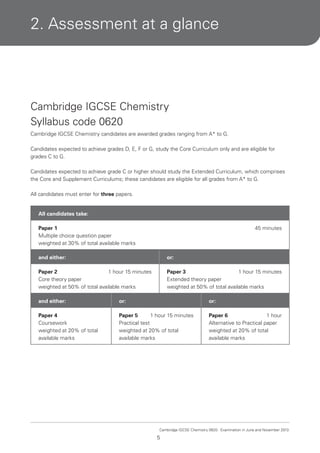
Cambridge IGCSE Chemistry candidates are awarded grades ranging from A* to G.
Candidates expected to achieve grades D, E, F or G, study the Core Curriculum only and are eligible for
grades C to G.
Candidates expected to achieve grade C or higher should study the Extended Curriculum, which comprises
the Core and Supplement Curriculums; these candidates are eligible for all grades from A* to G.
All candidates must enter for three papers.
All candidates take:
Paper 1
Multiple choice question paper
weighted at 30% of total available marks

45 minutes

and either:

or:

Paper 2
1 hour 15 minutes
Core theory paper
weighted at 50% of total available marks

Paper 3
1 hour 15 minutes
Extended theory paper
weighted at 50% of total available marks

and either:

or:

or:

Paper 4
Coursework
weighted at 20% of total
available marks

Paper 5
1 hour 15 minutes
Practical test
weighted at 20% of total
available marks

Paper 6
1 hour
Alternative to Practical paper
weighted at 20% of total
available marks

Cambridge IGCSE Chemistry 0620. Examination in June and November 2013.

5
2. Assessment at a glance

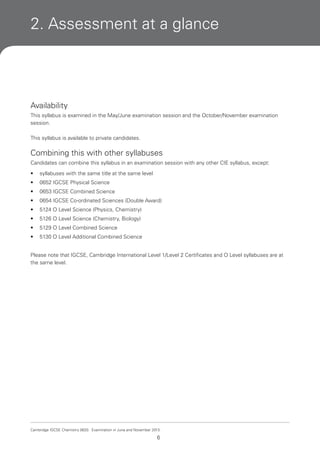
Availability
This syllabus is examined in the May/June examination session and the October/November examination
session.
This syllabus is available to private candidates.

Combining this with other syllabuses
Candidates can combine this syllabus in an examination session with any other CIE syllabus, except:
•

syllabuses with the same title at the same level

•

0652 IGCSE Physical Science

•

0653 IGCSE Combined Science

•

0654 IGCSE Co-ordinated Sciences (Double Award)

•

5124 O Level Science (Physics, Chemistry)

•

5126 O Level Science (Chemistry, Biology)

•

5129 O Level Combined Science

•

5130 O Level Additional Combined Science

Please note that IGCSE, Cambridge International Level 1/Level 2 Certificates and O Level syllabuses are at
the same level.

Cambridge IGCSE Chemistry 0620. Examination in June and November 2013.

6
3. Syllabus aims and objectives

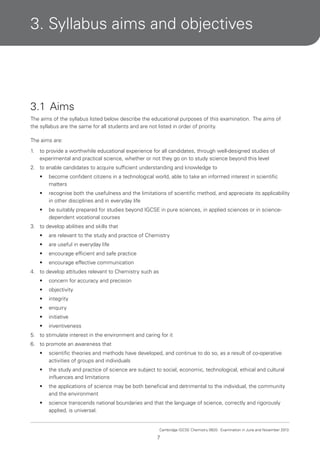
3.1 Aims
The aims of the syllabus listed below describe the educational purposes of this examination. The aims of
the syllabus are the same for all students and are not listed in order of priority.
The aims are:
1.

to provide a worthwhile educational experience for all candidates, through well-designed studies of
experimental and practical science, whether or not they go on to study science beyond this level

2. to enable candidates to acquire sufficient understanding and knowledge to
•

become confident citizens in a technological world, able to take an informed interest in scientific
matters

•

recognise both the usefulness and the limitations of scientific method, and appreciate its applicability
in other disciplines and in everyday life

•

be suitably prepared for studies beyond IGCSE in pure sciences, in applied sciences or in sciencedependent vocational courses

3. to develop abilities and skills that
•

are relevant to the study and practice of Chemistry

•

are useful in everyday life

•

encourage efficient and safe practice

•

encourage effective communication

4. to develop attitudes relevant to Chemistry such as
•

concern for accuracy and precision

•

objectivity

•

integrity

•

enquiry

•

initiative

•

inventiveness

5. to stimulate interest in the environment and caring for it
6. to promote an awareness that
•

scientific theories and methods have developed, and continue to do so, as a result of co-operative
activities of groups and individuals

•

the study and practice of science are subject to social, economic, technological, ethical and cultural
influences and limitations

•

the applications of science may be both beneficial and detrimental to the individual, the community
and the environment

•

science transcends national boundaries and that the language of science, correctly and rigorously
applied, is universal.

Cambridge IGCSE Chemistry 0620. Examination in June and November 2013.

7
3. Syllabus aims and objectives

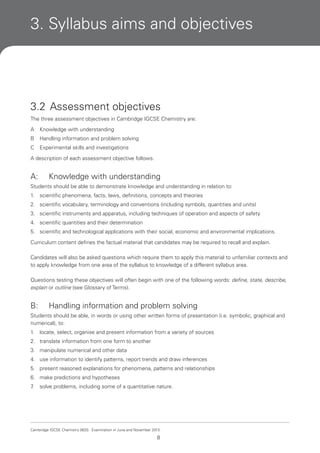
3.2 Assessment objectives
The three assessment objectives in Cambridge IGCSE Chemistry are:
A

Knowledge with understanding

B

Handling information and problem solving

C

Experimental skills and investigations

A description of each assessment objective follows.

A:

Knowledge with understanding

Students should be able to demonstrate knowledge and understanding in relation to:
1.

scientific phenomena, facts, laws, definitions, concepts and theories

2. scientific vocabulary, terminology and conventions (including symbols, quantities and units)
3. scientific instruments and apparatus, including techniques of operation and aspects of safety
4. scientific quantities and their determination
5. scientific and technological applications with their social, economic and environmental implications.
Curriculum content defines the factual material that candidates may be required to recall and explain.
Candidates will also be asked questions which require them to apply this material to unfamiliar contexts and
to apply knowledge from one area of the syllabus to knowledge of a different syllabus area.
Questions testing these objectives will often begin with one of the following words: define, state, describe,
explain or outline (see Glossary of Terms).

B:

Handling information and problem solving

Students should be able, in words or using other written forms of presentation (i.e. symbolic, graphical and
numerical), to:
1.

locate, select, organise and present information from a variety of sources

2. translate information from one form to another
3. manipulate numerical and other data
4. use information to identify patterns, report trends and draw inferences
5. present reasoned explanations for phenomena, patterns and relationships
6. make predictions and hypotheses
7
.

solve problems, including some of a quantitative nature.

Cambridge IGCSE Chemistry 0620. Examination in June and November 2013.

8
3. Syllabus aims and objectives

Questions testing these skills may be based on information that is unfamiliar to candidates, requiring them
to apply the principles and concepts from the syllabus to a new situation, in a logical, deductive way.
Questions testing these skills will often begin with one of the following words: predict, suggest, calculate or
determine. (See the Glossary of Terms.)

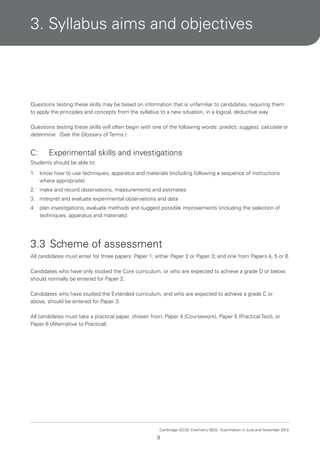
C:

Experimental skills and investigations

Students should be able to:
1.

know how to use techniques, apparatus and materials (including following a sequence of instructions
where appropriate)

2. make and record observations, measurements and estimates
3. interpret and evaluate experimental observations and data
4. plan investigations, evaluate methods and suggest possible improvements (including the selection of
techniques, apparatus and materials).

3.3 Scheme of assessment
All candidates must enter for three papers: Paper 1; either Paper 2 or Paper 3; and one from Papers 4, 5 or 6.
Candidates who have only studied the Core curriculum, or who are expected to achieve a grade D or below,
should normally be entered for Paper 2.
Candidates who have studied the Extended curriculum, and who are expected to achieve a grade C or
above, should be entered for Paper 3.
All candidates must take a practical paper, chosen from: Paper 4 (Coursework), Paper 5 (Practical Test), or
Paper 6 (Alternative to Practical).

Cambridge IGCSE Chemistry 0620. Examination in June and November 2013.

9
3. Syllabus aims and objectives

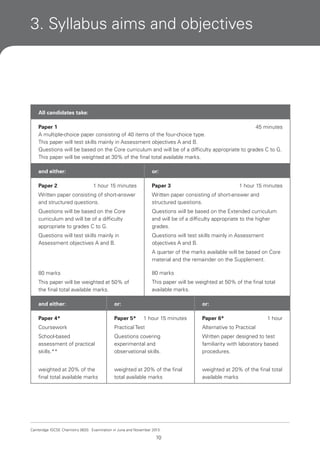
All candidates take:
Paper 1
45 minutes
A multiple-choice paper consisting of 40 items of the four-choice type.
This paper will test skills mainly in Assessment objectives A and B.
Questions will be based on the Core curriculum and will be of a difficulty appropriate to grades C to G.
This paper will be weighted at 30% of the final total available marks.
and either:
Paper 2

or:
Paper 3

1 hour 15 minutes

1 hour 15 minutes

Written paper consisting of short-answer
and structured questions.

Written paper consisting of short-answer and
structured questions.

Questions will be based on the Core
curriculum and will be of a difficulty
appropriate to grades C to G.

Questions will be based on the Extended curriculum
and will be of a difficulty appropriate to the higher
grades.

Questions will test skills mainly in
Assessment objectives A and B.

Questions will test skills mainly in Assessment
objectives A and B.
A quarter of the marks available will be based on Core
material and the remainder on the Supplement.

80 marks

80 marks

This paper will be weighted at 50% of
the final total available marks.

This paper will be weighted at 50% of the final total
available marks.

and either:

or:

or:

Paper 4*

Paper 5*

Coursework

Practical Test

Alternative to Practical

School-based
assessment of practical
skills.**

Questions covering
experimental and
observational skills.

Written paper designed to test
familiarity with laboratory based
procedures.

weighted at 20% of the
final total available marks

weighted at 20% of the final
total available marks

weighted at 20% of the final total
available marks

1 hour 15 minutes

Cambridge IGCSE Chemistry 0620. Examination in June and November 2013.

10

Paper 6*

1 hour
3. Syllabus aims and objectives

*

This component tests appropriate skills in assessment Objective C. Candidates will not be required to
use knowledge outside the Core curriculum.

** Teachers may not undertake school-based assessment without the written approval of CIE. This is only
given to teachers who satisfy CIE requirements concerning moderation and who have undergone special
training in assessment. CIE offers schools in-service training in the form of occasional face-to-face
courses held in countries where there is a need, and also through the Coursework Training Handbook,
available from CIE Publications.

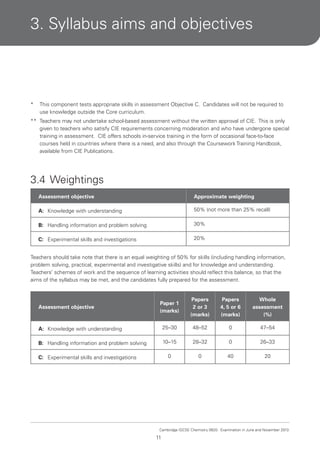
3.4 Weightings
Assessment objective

Approximate weighting

A: Knowledge with understanding

50% (not more than 25% recall)

B: Handling information and problem solving

30%

C: Experimental skills and investigations

20%

Teachers should take note that there is an equal weighting of 50% for skills (including handling information,
problem solving, practical, experimental and investigative skills) and for knowledge and understanding.
Teachers’ schemes of work and the sequence of learning activities should reflect this balance, so that the
aims of the syllabus may be met, and the candidates fully prepared for the assessment.

Paper 1
(marks)

Papers
2 or 3
(marks)

Papers
4, 5 or 6
(marks)

Whole
assessment
(%)

A: Knowledge with understanding

25–30

48–52

0

47–54

B: Handling information and problem solving

10–15

28–32

0

26–33

0

0

40

20

Assessment objective

C: Experimental skills and investigations

Cambridge IGCSE Chemistry 0620. Examination in June and November 2013.

11
3. Syllabus aims and objectives

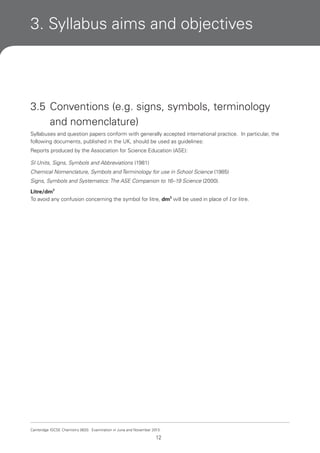
3.5 Conventions (e.g. signs, symbols, terminology
and nomenclature)
Syllabuses and question papers conform with generally accepted international practice. In particular, the
following documents, published in the UK, should be used as guidelines:
Reports produced by the Association for Science Education (ASE):
SI Units, Signs, Symbols and Abbreviations (1981)
Chemical Nomenclature, Symbols and Terminology for use in School Science (1985)
Signs, Symbols and Systematics: The ASE Companion to 16–19 Science (2000).
Litre/dm3
To avoid any confusion concerning the symbol for litre, dm3 will be used in place of l or litre.

Cambridge IGCSE Chemistry 0620. Examination in June and November 2013.

12
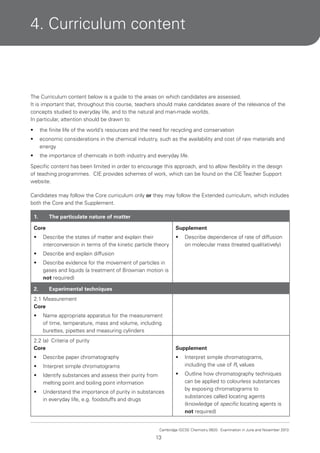
4. Curriculum content

The Curriculum content below is a guide to the areas on which candidates are assessed.
It is important that, throughout this course, teachers should make candidates aware of the relevance of the
concepts studied to everyday life, and to the natural and man-made worlds.
In particular, attention should be drawn to:
•

the finite life of the world’s resources and the need for recycling and conservation

•

economic considerations in the chemical industry, such as the availability and cost of raw materials and
energy

•

the importance of chemicals in both industry and everyday life.

Specific content has been limited in order to encourage this approach, and to allow flexibility in the design
of teaching programmes. CIE provides schemes of work, which can be found on the CIE Teacher Support
website.
Candidates may follow the Core curriculum only or they may follow the Extended curriculum, which includes
both the Core and the Supplement.
1.

The particulate nature of matter

Core

Supplement

•

Describe the states of matter and explain their
interconversion in terms of the kinetic particle theory

•

•

Describe and explain diffusion

•

Describe evidence for the movement of particles in
gases and liquids (a treatment of Brownian motion is
not required)

2.

Describe dependence of rate of diffusion
on molecular mass (treated qualitatively)

Experimental techniques

2.1 Measurement
Core
•

Name appropriate apparatus for the measurement
of time, temperature, mass and volume, including
burettes, pipettes and measuring cylinders

2.2 (a) Criteria of purity
Core

Supplement

•

Describe paper chromatography

•

•

Interpret simple chromatograms

Interpret simple chromatograms,
including the use of Rf values

•

Identify substances and assess their purity from
melting point and boiling point information

•

•

Understand the importance of purity in substances
in everyday life, e.g. foodstuffs and drugs

Outline how chromatography techniques
can be applied to colourless substances
by exposing chromatograms to
substances called locating agents
(knowledge of specific locating agents is
not required)

Cambridge IGCSE Chemistry 0620. Examination in June and November 2013.

13
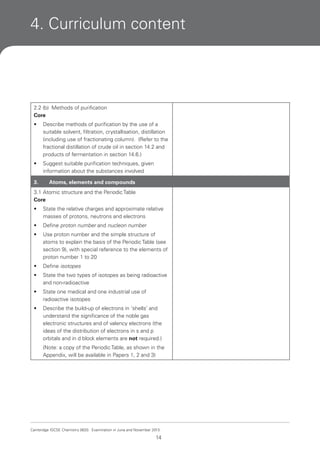
4. Curriculum content

2.2 (b) Methods of purification
Core
•

Describe methods of purification by the use of a
suitable solvent, filtration, crystallisation, distillation
(including use of fractionating column). (Refer to the
fractional distillation of crude oil in section 14.2 and
products of fermentation in section 14.6.)

•

Suggest suitable purification techniques, given
information about the substances involved

3.

Atoms, elements and compounds

3.1 Atomic structure and the Periodic Table
Core
•

State the relative charges and approximate relative
masses of protons, neutrons and electrons

•

Define proton number and nucleon number

•

Use proton number and the simple structure of
atoms to explain the basis of the Periodic Table (see
section 9), with special reference to the elements of
proton number 1 to 20

•

Define isotopes

•

State the two types of isotopes as being radioactive
and non-radioactive

•

State one medical and one industrial use of
radioactive isotopes

•

Describe the build-up of electrons in ‘shells’ and
understand the significance of the noble gas
electronic structures and of valency electrons (the
ideas of the distribution of electrons in s and p
orbitals and in d block elements are not required.)
(Note: a copy of the Periodic Table, as shown in the
Appendix, will be available in Papers 1, 2 and 3)

Cambridge IGCSE Chemistry 0620. Examination in June and November 2013.

14
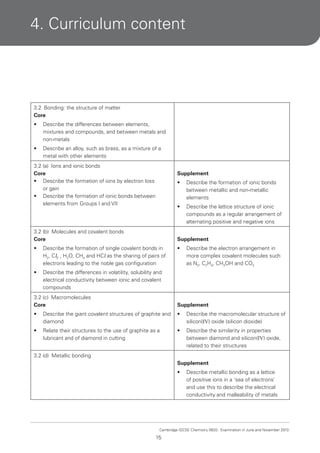
4. Curriculum content

3.2 Bonding: the structure of matter
Core
•

Describe the differences between elements,
mixtures and compounds, and between metals and
non-metals

•

Describe an alloy, such as brass, as a mixture of a
metal with other elements

3.2 (a) Ions and ionic bonds
Core
• Describe the formation of ions by electron loss
or gain
• Describe the formation of ionic bonds between
elements from Groups I and VII

Supplement
•

Describe the formation of ionic bonds
between metallic and non-metallic
elements

•

Describe the lattice structure of ionic
compounds as a regular arrangement of
alternating positive and negative ions

3.2 (b) Molecules and covalent bonds
Core

Supplement

•

Describe the formation of single covalent bonds in
H2, Cl2 , H2O, CH4 and HCl as the sharing of pairs of
electrons leading to the noble gas configuration

•

•

Describe the differences in volatility, solubility and
electrical conductivity between ionic and covalent
compounds

Describe the electron arrangement in
more complex covalent molecules such
as N2, C2H4, CH3OH and CO2

3.2 (c) Macromolecules
Core

Supplement

•

Describe the giant covalent structures of graphite and
diamond

•

Describe the macromolecular structure of
silicon(IV) oxide (silicon dioxide)

•

Relate their structures to the use of graphite as a
lubricant and of diamond in cutting

•

Describe the similarity in properties
between diamond and silicon(IV) oxide,
related to their structures

3.2 (d) Metallic bonding
Supplement
•

Describe metallic bonding as a lattice
of positive ions in a ‘sea of electrons’
and use this to describe the electrical
conductivity and malleability of metals

Cambridge IGCSE Chemistry 0620. Examination in June and November 2013.

15
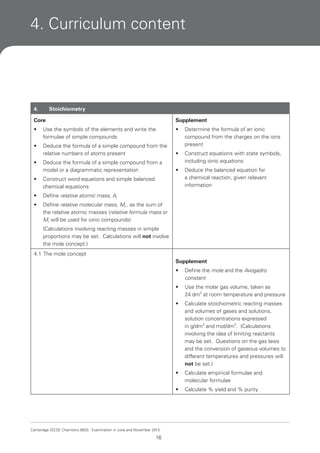
4. Curriculum content

4.

Stoichiometry

Core

Supplement

•

Use the symbols of the elements and write the
formulae of simple compounds

•

•

Deduce the formula of a simple compound from the
relative numbers of atoms present

Determine the formula of an ionic
compound from the charges on the ions
present

•

Deduce the formula of a simple compound from a
model or a diagrammatic representation

Construct equations with state symbols,
including ionic equations

•

Deduce the balanced equation for
a chemical reaction, given relevant
information

•
•

Construct word equations and simple balanced
chemical equations

•

Define relative atomic mass, Ar

•

Define relative molecular mass, Mr , as the sum of
the relative atomic masses (relative formula mass or
Mr will be used for ionic compounds)
(Calculations involving reacting masses in simple
proportions may be set. Calculations will not involve
the mole concept.)

4.1 The mole concept
Supplement
•
•

Calculate stoichiometric reacting masses
and volumes of gases and solutions,
solution concentrations expressed
in g/dm3 and mol/dm3. (Calculations
involving the idea of limiting reactants
may be set. Questions on the gas laws
and the conversion of gaseous volumes to
different temperatures and pressures will
not be set.)

•

Calculate empirical formulae and
molecular formulae

•

16

Use the molar gas volume, taken as
24 dm3 at room temperature and pressure

•

Cambridge IGCSE Chemistry 0620. Examination in June and November 2013.

Define the mole and the Avogadro
constant

Calculate % yield and % purity
4. Curriculum content

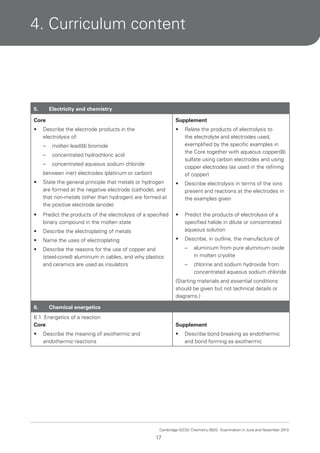
5.

Electricity and chemistry

Core

Supplement

•

•

Relate the products of electrolysis to
the electrolyte and electrodes used,
exemplified by the specific examples in
the Core together with aqueous copper(II)
sulfate using carbon electrodes and using
copper electrodes (as used in the refining
of copper)

Describe the electrode products in the
electrolysis of:
–

molten lead(II) bromide

–

concentrated hydrochloric acid

–

concentrated aqueous sodium chloride

between inert electrodes (platinum or carbon)
•

State the general principle that metals or hydrogen
are formed at the negative electrode (cathode), and
that non-metals (other than hydrogen) are formed at
the positive electrode (anode)

•

Describe electrolysis in terms of the ions
present and reactions at the electrodes in
the examples given

•

Predict the products of the electrolysis of a specified
binary compound in the molten state

•

•

Describe the electroplating of metals

Predict the products of electrolysis of a
specified halide in dilute or concentrated
aqueous solution

•

Name the uses of electroplating

•

Describe, in outline, the manufacture of

•

Describe the reasons for the use of copper and
(steel-cored) aluminium in cables, and why plastics
and ceramics are used as insulators

–

aluminium from pure aluminium oxide
in molten cryolite

–

chlorine and sodium hydroxide from
concentrated aqueous sodium chloride

(Starting materials and essential conditions
should be given but not technical details or
diagrams.)
6.

Chemical energetics

6.1 Energetics of a reaction
Core

Supplement

•

•

Describe the meaning of exothermic and
endothermic reactions

Describe bond breaking as endothermic
and bond forming as exothermic

Cambridge IGCSE Chemistry 0620. Examination in June and November 2013.

17
4. Curriculum content

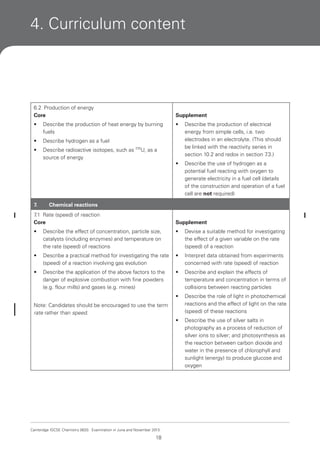
6.2 Production of energy
Core

Supplement

•

Describe the production of heat energy by burning
fuels

•

•

Describe hydrogen as a fuel

•

Describe radioactive isotopes, such as 235U, as a
source of energy

Describe the production of electrical
energy from simple cells, i.e. two
electrodes in an electrolyte. (This should
be linked with the reactivity series in
section 10.2 and redox in section 7
.3.)

•

Describe the use of hydrogen as a
potential fuel reacting with oxygen to
generate electricity in a fuel cell (details
of the construction and operation of a fuel
cell are not required)

7.

Chemical reactions

7 Rate (speed) of reaction
.1
Core

Supplement

•

Describe the effect of concentration, particle size,
catalysts (including enzymes) and temperature on
the rate (speed) of reactions

•

Devise a suitable method for investigating
the effect of a given variable on the rate
(speed) of a reaction

•

Describe a practical method for investigating the rate
(speed) of a reaction involving gas evolution

•

Interpret data obtained from experiments
concerned with rate (speed) of reaction

•

Describe the application of the above factors to the
danger of explosive combustion with fine powders
(e.g. flour mills) and gases (e.g. mines)

•

Describe and explain the effects of
temperature and concentration in terms of
collisions between reacting particles

•

Describe the role of light in photochemical
reactions and the effect of light on the rate
(speed) of these reactions

•

Describe the use of silver salts in
photography as a process of reduction of
silver ions to silver; and photosynthesis as
the reaction between carbon dioxide and
water in the presence of chlorophyll and
sunlight (energy) to produce glucose and
oxygen

Note: Candidates should be encouraged to use the term
rate rather than speed.

Cambridge IGCSE Chemistry 0620. Examination in June and November 2013.

18
4. Curriculum content

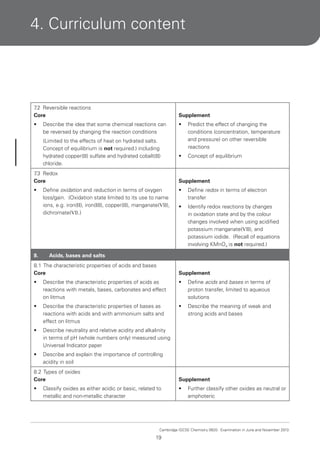
7 Reversible reactions
.2
Core

Supplement

•

•

Predict the effect of changing the
conditions (concentration, temperature
and pressure) on other reversible
reactions

•

Concept of equilibrium

Describe the idea that some chemical reactions can
be reversed by changing the reaction conditions
(Limited to the effects of heat on hydrated salts.
Concept of equilibrium is not required.) including
hydrated copper(II) sulfate and hydrated cobalt(II)
chloride.

7 Redox
.3
Core

Supplement

•

•

Define redox in terms of electron
transfer

•

Identify redox reactions by changes
in oxidation state and by the colour
changes involved when using acidified
potassium manganate(VII), and
potassium iodide. (Recall of equations
involving KMnO4 is not required.)

8.

Define oxidation and reduction in terms of oxygen
loss/gain. (Oxidation state limited to its use to name
ions, e.g. iron(II), iron(III), copper(II), manganate(VII),
dichromate(VI).)

Acids, bases and salts

8.1 The characteristic properties of acids and bases
Core

Supplement

•

Describe the characteristic properties of acids as
reactions with metals, bases, carbonates and effect
on litmus

•

Define acids and bases in terms of
proton transfer, limited to aqueous
solutions

•

Describe the characteristic properties of bases as
reactions with acids and with ammonium salts and
effect on litmus

•

Describe the meaning of weak and
strong acids and bases

•

Describe neutrality and relative acidity and alkalinity
in terms of pH (whole numbers only) measured using
Universal Indicator paper

•

Describe and explain the importance of controlling
acidity in soil

8.2 Types of oxides
Core

Supplement

•

•

Classify oxides as either acidic or basic, related to
metallic and non-metallic character

Further classify other oxides as neutral or
amphoteric

Cambridge IGCSE Chemistry 0620. Examination in June and November 2013.

19
4. Curriculum content

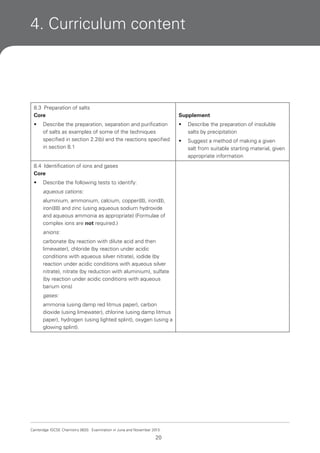
8.3 Preparation of salts
Core

Supplement

•

•

Describe the preparation of insoluble
salts by precipitation

•

Suggest a method of making a given
salt from suitable starting material, given
appropriate information

Describe the preparation, separation and purification
of salts as examples of some of the techniques
specified in section 2.2(b) and the reactions specified
in section 8.1

8.4 Identification of ions and gases
Core
•

Describe the following tests to identify:
aqueous cations:
aluminium, ammonium, calcium, copper(II), iron(II),
iron(III) and zinc (using aqueous sodium hydroxide
and aqueous ammonia as appropriate) (Formulae of
complex ions are not required.)
anions:
carbonate (by reaction with dilute acid and then
limewater), chloride (by reaction under acidic
conditions with aqueous silver nitrate), iodide (by
reaction under acidic conditions with aqueous silver
nitrate), nitrate (by reduction with aluminium), sulfate
(by reaction under acidic conditions with aqueous
barium ions)
gases:
ammonia (using damp red litmus paper), carbon
dioxide (using limewater), chlorine (using damp litmus
paper), hydrogen (using lighted splint), oxygen (using a
glowing splint).

Cambridge IGCSE Chemistry 0620. Examination in June and November 2013.

20
4. Curriculum content

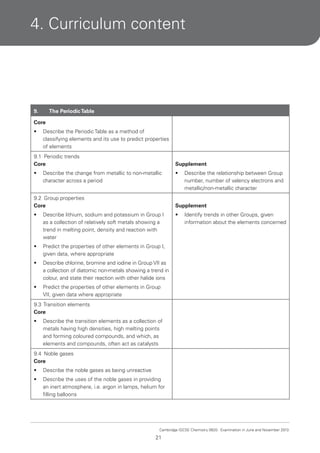
9.

The Periodic Table

Core
•

Describe the Periodic Table as a method of
classifying elements and its use to predict properties
of elements

9.1 Periodic trends
Core

Supplement

•

•

Describe the change from metallic to non-metallic
character across a period

Describe the relationship between Group
number, number of valency electrons and
metallic/non-metallic character

9.2 Group properties
Core

Supplement

•

Describe lithium, sodium and potassium in Group I
as a collection of relatively soft metals showing a
trend in melting point, density and reaction with
water

•

•

Predict the properties of other elements in Group I,
given data, where appropriate

•

Describe chlorine, bromine and iodine in Group VII as
a collection of diatomic non-metals showing a trend in
colour, and state their reaction with other halide ions

•

Predict the properties of other elements in Group
VII, given data where appropriate

Identify trends in other Groups, given
information about the elements concerned

9.3 Transition elements
Core
•

Describe the transition elements as a collection of
metals having high densities, high melting points
and forming coloured compounds, and which, as
elements and compounds, often act as catalysts

9.4 Noble gases
Core
•

Describe the noble gases as being unreactive

•

Describe the uses of the noble gases in providing
an inert atmosphere, i.e. argon in lamps, helium for
filling balloons

Cambridge IGCSE Chemistry 0620. Examination in June and November 2013.

21
4. Curriculum content

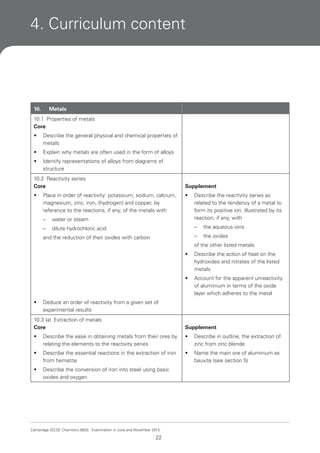
10.

Metals

10.1 Properties of metals
Core
•

Describe the general physical and chemical properties of
metals

•

Explain why metals are often used in the form of alloys

•

Identify representations of alloys from diagrams of
structure

10.2 Reactivity series
Core

Supplement

•

•

Place in order of reactivity: potassium, sodium, calcium,
magnesium, zinc, iron, (hydrogen) and copper, by
reference to the reactions, if any, of the metals with
–

water or steam

Describe the reactivity series as
related to the tendency of a metal to
form its positive ion, illustrated by its
reaction, if any, with

–

dilute hydrochloric acid

–

the aqueous ions

–

the oxides

and the reduction of their oxides with carbon

of the other listed metals
•

•

•

Describe the action of heat on the
hydroxides and nitrates of the listed
metals
Account for the apparent unreactivity
of aluminium in terms of the oxide
layer which adheres to the metal

Deduce an order of reactivity from a given set of
experimental results

10.3 (a) Extraction of metals
Core

Supplement

•

Describe the ease in obtaining metals from their ores by
relating the elements to the reactivity series

•

Describe in outline, the extraction of
zinc from zinc blende

•

Describe the essential reactions in the extraction of iron
from hematite

•

Name the main ore of aluminium as
bauxite (see section 5)

•

Describe the conversion of iron into steel using basic
oxides and oxygen

Cambridge IGCSE Chemistry 0620. Examination in June and November 2013.

22
4. Curriculum content

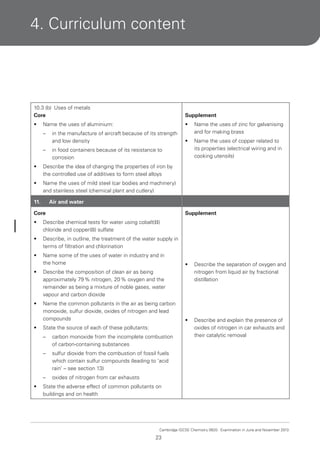
10.3 (b) Uses of metals
Core

Supplement

•

•

Name the uses of zinc for galvanising
and for making brass

•

Name the uses of copper related to
its properties (electrical wiring and in
cooking utensils)

Name the uses of aluminium:
–
–

in the manufacture of aircraft because of its strength
and low density
in food containers because of its resistance to
corrosion

•

Describe the idea of changing the properties of iron by
the controlled use of additives to form steel alloys

•

Name the uses of mild steel (car bodies and machinery)
and stainless steel (chemical plant and cutlery)

11.

Air and water
Supplement

Core
•

Describe chemical tests for water using cobalt(II)
chloride and copper(II) sulfate

•

Describe, in outline, the treatment of the water supply in
terms of filtration and chlorination

•

Name some of the uses of water in industry and in
the home

•

Name the common pollutants in the air as being carbon
monoxide, sulfur dioxide, oxides of nitrogen and lead
compounds

Describe the separation of oxygen and
nitrogen from liquid air by fractional
distillation

•

Describe and explain the presence of
oxides of nitrogen in car exhausts and
their catalytic removal

Describe the composition of clean air as being
approximately 79 % nitrogen, 20 % oxygen and the
remainder as being a mixture of noble gases, water
vapour and carbon dioxide

•

•

•

State the source of each of these pollutants:
–
–

sulfur dioxide from the combustion of fossil fuels
which contain sulfur compounds (leading to ‘acid
rain’ – see section 13)

–
•

carbon monoxide from the incomplete combustion
of carbon-containing substances

oxides of nitrogen from car exhausts

State the adverse effect of common pollutants on
buildings and on health

Cambridge IGCSE Chemistry 0620. Examination in June and November 2013.

23
4. Curriculum content

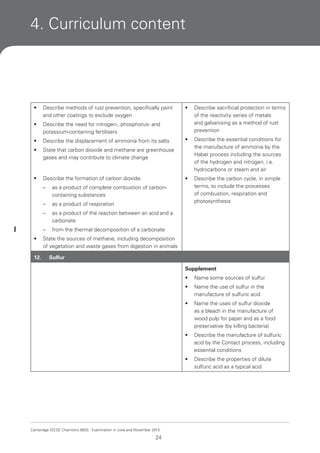
•

Describe methods of rust prevention, specifically paint
and other coatings to exclude oxygen

•

Describe the need for nitrogen-, phosphorus- and
potassium-containing fertilisers

•

Describe the displacement of ammonia from its salts

•

State that carbon dioxide and methane are greenhouse
gases and may contribute to climate change

•

Describe the formation of carbon dioxide:

•
12.

Describe the carbon cycle, in simple
terms, to include the processes
of combustion, respiration and
photosynthesis

as a product of the reaction between an acid and a
carbonate

–

Describe the essential conditions for
the manufacture of ammonia by the
Haber process including the sources
of the hydrogen and nitrogen, i.e.
hydrocarbons or steam and air

as a product of respiration

–

•

as a product of complete combustion of carboncontaining substances

–

Describe sacrificial protection in terms
of the reactivity series of metals
and galvanising as a method of rust
prevention

•

–

•

from the thermal decomposition of a carbonate

State the sources of methane, including decomposition
of vegetation and waste gases from digestion in animals
Sulfur
Supplement
•
•

Name the uses of sulfur dioxide
as a bleach in the manufacture of
wood pulp for paper and as a food
preservative (by killing bacteria)

•

Describe the manufacture of sulfuric
acid by the Contact process, including
essential conditions

•

24

Name the use of sulfur in the
manufacture of sulfuric acid

•

Cambridge IGCSE Chemistry 0620. Examination in June and November 2013.

Name some sources of sulfur

Describe the properties of dilute
sulfuric acid as a typical acid
4. Curriculum content

13.

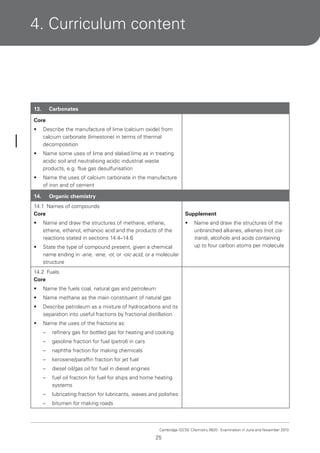
Carbonates

Core
•

Describe the manufacture of lime (calcium oxide) from
calcium carbonate (limestone) in terms of thermal
decomposition

•

Name some uses of lime and slaked lime as in treating
acidic soil and neutralising acidic industrial waste
products, e.g. flue gas desulfurisation

•

Name the uses of calcium carbonate in the manufacture
of iron and of cement

14.

Organic chemistry

14.1 Names of compounds
Core

Supplement

•

Name and draw the structures of methane, ethane,
ethene, ethanol, ethanoic acid and the products of the
reactions stated in sections 14.4–14.6

•

•

State the type of compound present, given a chemical
name ending in -ane, -ene, -ol, or -oic acid, or a molecular
structure

Name and draw the structures of the
unbranched alkanes, alkenes (not cistrans), alcohols and acids containing
up to four carbon atoms per molecule

14.2 Fuels
Core
•

Name the fuels coal, natural gas and petroleum

•

Name methane as the main constituent of natural gas

•

Describe petroleum as a mixture of hydrocarbons and its
separation into useful fractions by fractional distillation

•

Name the uses of the fractions as:
–

refinery gas for bottled gas for heating and cooking

–

gasoline fraction for fuel (petrol) in cars

–

naphtha fraction for making chemicals

–

kerosene/paraffin fraction for jet fuel

–

diesel oil/gas oil for fuel in diesel engines

–

fuel oil fraction for fuel for ships and home heating
systems

–

lubricating fraction for lubricants, waxes and polishes

–

bitumen for making roads

Cambridge IGCSE Chemistry 0620. Examination in June and November 2013.

25
4. Curriculum content

14.3 Homologous series
Core

Supplement

•

•

Describe the general characteristics of
an homologous series

•

Describe and identify structural
isomerism

Describe the concept of homologous series as a ‘family’
of similar compounds with similar properties due to the
presence of the same functional group

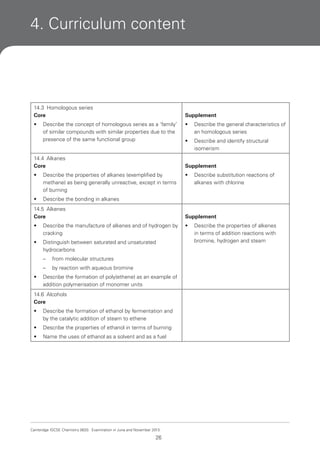
14.4 Alkanes
Core

Supplement

•

Describe the properties of alkanes (exemplified by
methane) as being generally unreactive, except in terms
of burning

•

•

Describe the bonding in alkanes

Describe substitution reactions of
alkanes with chlorine

14.5 Alkenes
Core

Supplement

•

Describe the manufacture of alkenes and of hydrogen by
cracking

•

•

Distinguish between saturated and unsaturated
hydrocarbons
–
–

•

from molecular structures
by reaction with aqueous bromine

Describe the formation of poly(ethene) as an example of
addition polymerisation of monomer units

14.6 Alcohols
Core
•

Describe the formation of ethanol by fermentation and
by the catalytic addition of steam to ethene

•

Describe the properties of ethanol in terms of burning

•

Name the uses of ethanol as a solvent and as a fuel

Cambridge IGCSE Chemistry 0620. Examination in June and November 2013.

26

Describe the properties of alkenes
in terms of addition reactions with
bromine, hydrogen and steam
4. Curriculum content

14.7 Acids
Core

Supplement

•

•

Describe the formation of ethanoic acid by the oxidation
of ethanol by fermentation and with acidified potassium
manganate(VII)

•

Describe ethanoic acid as a typical weak acid

•

Describe the reaction of ethanoic acid with ethanol to give an
ester (ethyl ethanoate)

Describe the physical
properties of aqueous
ethanoic acid

14.8 Macromolecules

Supplement
•

14.8 (a) Synthetic polymers

Describe macromolecules in terms of large molecules built up
from small units (monomers), different macromolecules having
different units and/or different linkages

Supplement
•

Name some typical uses of plastics and of man-made fibres

•

Describe the pollution problems caused by non-biodegradable
plastics

•

Deduce the structure of the polymer product from a given
alkene and vice versa

•

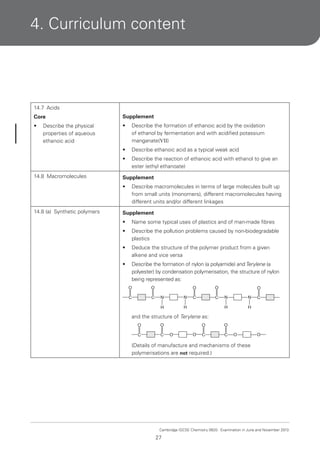
Describe the formation of nylon (a polyamide) and Terylene (a
polyester) by condensation polymerisation, the structure of nylon
being represented as:
O

O

C

C

O
N

N

H

O

C

C

O
N

H

H

N

H

C

and the structure of Terylene as:
O

O

C

C

O
O

O

O

C

C

O

O

(Details of manufacture and mechanisms of these
polymerisations are not required.)

Cambridge IGCSE Chemistry 0620. Examination in June and November 2013.

27
4. Curriculum content

14.8 (b) Natural macromolecules

Supplement
•

Name proteins, fats and carbohydrates as the main constituents
of food

•

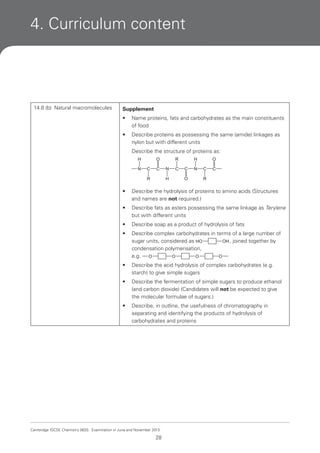
Describe proteins as possessing the same (amide) linkages as
nylon but with different units
Describe the structure of proteins as:
H
N

O
C

C

R

H

R
N
H

C

C
O

N

O
C

C

R

•

Describe the hydrolysis of proteins to amino acids (Structures
and names are not required.)

•

Describe fats as esters possessing the same linkage as Terylene
but with different units

•

Describe soap as a product of hydrolysis of fats

•

Describe complex carbohydrates in terms of a large number of
OH , joined together by
sugar units, considered as HO
condensation polymerisation,
e.g. O
O
O
O

•

Describe the acid hydrolysis of complex carbohydrates (e.g.
starch) to give simple sugars

•

Describe the fermentation of simple sugars to produce ethanol
(and carbon dioxide) (Candidates will not be expected to give
the molecular formulae of sugars.)

•

Describe, in outline, the usefulness of chromatography in
separating and identifying the products of hydrolysis of
carbohydrates and proteins

Cambridge IGCSE Chemistry 0620. Examination in June and November 2013.

28
5. Practical assessment

Scientific subjects are, by their nature, experimental. So it is important that an assessment of a candidate’s
knowledge and understanding of Chemistry should contain a practical component (see Assessment
objective C).
Schools’ circumstances (e.g. the availability of resources) differ greatly, so three alternative ways of
examining the practical component are provided. The three alternatives are:
•

Paper 4 – Coursework (school-based assessment)

•

Paper 5 – Practical Test

•

Paper 6 – Alternative to Practical (written paper).

Whichever practical assessment route is chosen, the following points should be noted:
•

the same assessment objectives apply

•

the same practical skills are to be learned and developed

•

the same benefits to theoretical understanding come from all practical work

•

the same motivational effect, enthusiasm and enjoyment should be experienced

•

the same sequence of practical activities is appropriate.

5.1 Paper 4: Coursework
Teachers may not undertake school-based assessment without the written approval of CIE. This will only
be given to teachers who satisfy CIE requirements concerning moderation and they will have to undergo
special training in assessment before entering candidates.
CIE offers schools in-service training in the form of courses held at intervals in Cambridge and elsewhere,
and also via distance training manuals.
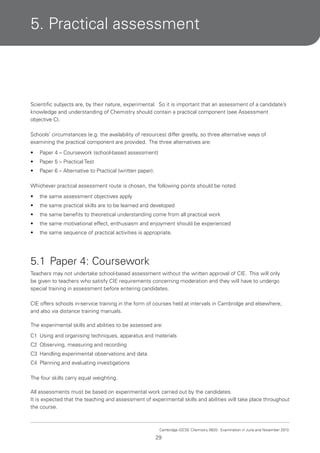
The experimental skills and abilities to be assessed are:
C1 Using and organising techniques, apparatus and materials
C2 Observing, measuring and recording
C3 Handling experimental observations and data
C4 Planning and evaluating investigations
The four skills carry equal weighting.
All assessments must be based on experimental work carried out by the candidates.
It is expected that the teaching and assessment of experimental skills and abilities will take place throughout
the course.

Cambridge IGCSE Chemistry 0620. Examination in June and November 2013.

29
5. Practical assessment

Teachers must ensure that they can make available to CIE evidence of two assessments of each skill for
each candidate. For skills C1 to C4 inclusive, information about the tasks set and how the marks were
awarded will be required. In addition, for skills C2, C3 and C4, the candidate’s written work will also be
required.
The assessment scores finally recorded for each skill must represent the candidate’s best performances.
For candidates who miss the assessment of a given skill through no fault of their own, for example because
of illness, and who cannot be assessed on another occasion, CIE procedure for special consideration should
be followed. However, candidates who for no good reason absent themselves from an assessment of a
given skill should be given a mark of zero for that assessment.

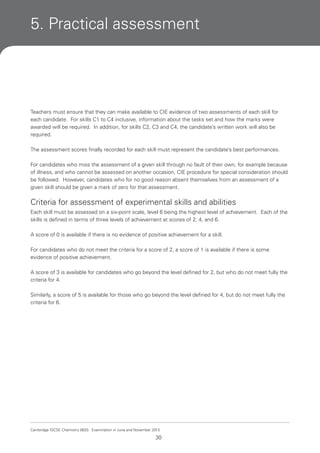
Criteria for assessment of experimental skills and abilities
Each skill must be assessed on a six-point scale, level 6 being the highest level of achievement. Each of the
skills is defined in terms of three levels of achievement at scores of 2, 4, and 6.
A score of 0 is available if there is no evidence of positive achievement for a skill.
For candidates who do not meet the criteria for a score of 2, a score of 1 is available if there is some
evidence of positive achievement.
A score of 3 is available for candidates who go beyond the level defined for 2, but who do not meet fully the
criteria for 4.
Similarly, a score of 5 is available for those who go beyond the level defined for 4, but do not meet fully the
criteria for 6.

Cambridge IGCSE Chemistry 0620. Examination in June and November 2013.

30
5. Practical assessment

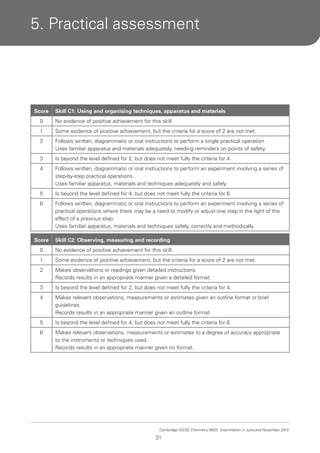
Score

Skill C1: Using and organising techniques, apparatus and materials

0

No evidence of positive achievement for this skill.

1

Some evidence of positive achievement, but the criteria for a score of 2 are not met.

2

Follows written, diagrammatic or oral instructions to perform a single practical operation.
Uses familiar apparatus and materials adequately, needing reminders on points of safety.

3

Is beyond the level defined for 2, but does not meet fully the criteria for 4.

4

Follows written, diagrammatic or oral instructions to perform an experiment involving a series of
step-by-step practical operations.
Uses familiar apparatus, materials and techniques adequately and safely.

5

Is beyond the level defined for 4, but does not meet fully the criteria for 6.

6

Follows written, diagrammatic or oral instructions to perform an experiment involving a series of
practical operations where there may be a need to modify or adjust one step in the light of the
effect of a previous step.
Uses familiar apparatus, materials and techniques safely, correctly and methodically.

Score

Skill C2: Observing, measuring and recording

0

No evidence of positive achievement for this skill.

1

Some evidence of positive achievement, but the criteria for a score of 2 are not met.

2

Makes observations or readings given detailed instructions.
Records results in an appropriate manner given a detailed format.

3

Is beyond the level defined for 2, but does not meet fully the criteria for 4.

4

Makes relevant observations, measurements or estimates given an outline format or brief
guidelines.
Records results in an appropriate manner given an outline format.

5

Is beyond the level defined for 4, but does not meet fully the criteria for 6.

6

Makes relevant observations, measurements or estimates to a degree of accuracy appropriate
to the instruments or techniques used.
Records results in an appropriate manner given no format.

Cambridge IGCSE Chemistry 0620. Examination in June and November 2013.

31
5. Practical assessment

Score

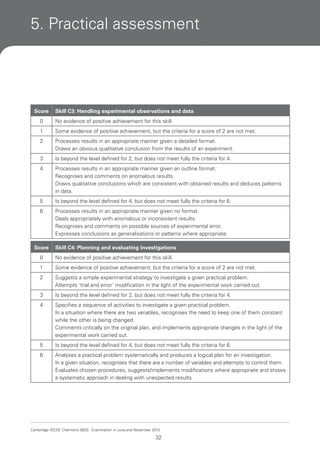
Skill C3: Handling experimental observations and data

0

No evidence of positive achievement for this skill.

1

Some evidence of positive achievement, but the criteria for a score of 2 are not met.

2

Processes results in an appropriate manner given a detailed format.
Draws an obvious qualitative conclusion from the results of an experiment.

3

Is beyond the level defined for 2, but does not meet fully the criteria for 4.

4

Processes results in an appropriate manner given an outline format.
Recognises and comments on anomalous results.
Draws qualitative conclusions which are consistent with obtained results and deduces patterns
in data.

5

Is beyond the level defined for 4, but does not meet fully the criteria for 6.

6

Processes results in an appropriate manner given no format.
Deals appropriately with anomalous or inconsistent results.
Recognises and comments on possible sources of experimental error.
Expresses conclusions as generalisations or patterns where appropriate.

Score

Skill C4: Planning and evaluating investigations

0

No evidence of positive achievement for this skill.

1

Some evidence of positive achievement, but the criteria for a score of 2 are not met.

2

Suggests a simple experimental strategy to investigate a given practical problem.
Attempts ‘trial and error’ modification in the light of the experimental work carried out.

3

Is beyond the level defined for 2, but does not meet fully the criteria for 4.

4

Specifies a sequence of activities to investigate a given practical problem.
In a situation where there are two variables, recognises the need to keep one of them constant
while the other is being changed.
Comments critically on the original plan, and implements appropriate changes in the light of the
experimental work carried out.

5

Is beyond the level defined for 4, but does not meet fully the criteria for 6.

6

Analyses a practical problem systematically and produces a logical plan for an investigation.
In a given situation, recognises that there are a number of variables and attempts to control them.
Evaluates chosen procedures, suggests/implements modifications where appropriate and shows
a systematic approach in dealing with unexpected results.

Cambridge IGCSE Chemistry 0620. Examination in June and November 2013.

32
5. Practical assessment

Guidance on candidate assessment
The following notes are designed to help teachers make valid and reliable assessments of the skills and
abilities of their candidates.
•

The assessments should be based on the principle of positive achievement: candidates should be given
opportunities to demonstrate what they understand and can do.

•

It is expected that candidates will have had opportunities to acquire a given skill before assessment
takes place.

•

It is not expected that all of the practical work undertaken by a candidate will be assessed.

•

Assessments can be carried out at any time during the course. However, at whatever stage
assessments are done, the standards applied must be those expected at the end of the course, as
exemplified in the criteria for the skills.

•

Assessments should normally be made by the person responsible for teaching the candidates.

•

A given practical task is unlikely to provide opportunities for all aspects of the criteria at a given level for a
particular skill to be satisfied; for example, there may not be any anomalous results (Skill C3). However,
by using a range of practical work, teachers should ensure that opportunities are provided for all aspects
of the criteria to be satisfied during the course.

•

Extended experimental investigations are of great educational value. If such investigations are used
for assessment purposes, teachers should make sure that the candidates have ample opportunity for
displaying the skills and abilities required by the scheme of assessment.

•

It is not necessary for all candidates within a teaching group, or within a Centre, to be assessed on
exactly the same practical work, although teachers can use work that is undertaken by all of their
candidates.

•

When assessing group work, teachers must ensure that each candidate’s individual contribution is
assessed.

•

Skill C1 might not generate a written product from the candidates; it will often be assessed by watching
the candidates carrying out practical work.

•

Skills C2, C3 and C4 will usually generate a written product from the candidates; this will provide
evidence for moderation.

•

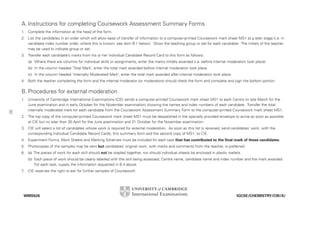
Raw scores for individual practical assessments should be recorded on the Individual Candidate Record
Card. The final, internally moderated total score should be recorded on the Coursework Assessment
Summary Form (examples of both forms, plus the Sciences Experiment Form, are at the back of this
syllabus).
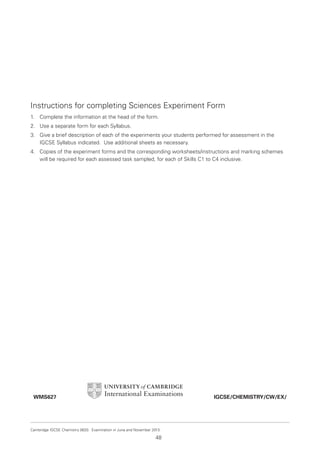
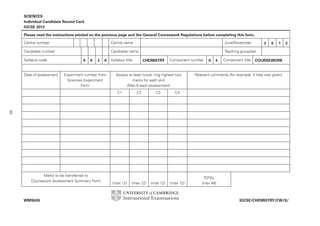
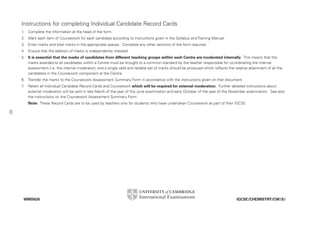
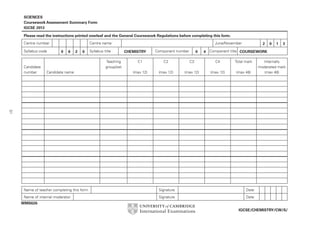
Raw scores for individual practical assessments may be given to candidates as part of the normal
feedback from the teacher. The final, internally moderated, total score should not be given to the
candidate.

•

Cambridge IGCSE Chemistry 0620. Examination in June and November 2013.

33
5. Practical assessment

Moderation
Internal moderation
When several teachers in a Centre are involved in internal assessment, arrangements must be made within
the Centre for all candidates to be assessed to the same standard. It is essential that the marks for each
skill assigned within different teaching groups (or classes) are moderated internally for the whole Centre
entry. The Centre assessments will then be moderated externally by CIE.
External moderation
CIE must receive internally moderated marks for all candidates by 30 April for the May/June examination and
by 31 October for the November examination. See the Handbook for Centres and the Administrative Guide
for Centres for more information on external moderation and on how to submit marks.
Once it has received the marks, CIE will draw up a list of sample candidates whose work will be moderated
(a further sample may also be requested), and will ask the Centre to send immediately every piece of
work that has contributed towards these candidates’ final marks. Individual Candidate Record Cards
and Coursework Assessment Summary Forms must also be sent with the coursework. All remaining
coursework and records should be kept by the Centre until results are published.
Ideally, Centres should use loose-leaf A4 file paper for practical written work, as this is cheaper to send by
post. Original work is preferred for moderation, but authenticated photocopies can be sent if absolutely
necessary.
Pieces of work for each skill should not be stapled together. Each piece of work should be clearly and
securely labelled with:
•

the skill being assessed

•

the Centre number

•

the candidate’s name and number

•

the title of the experiment

•

a copy of the mark scheme used

•

the mark awarded.

Cambridge IGCSE Chemistry 0620. Examination in June and November 2013.

34
5. Practical assessment

5.2 Paper 5: Practical test
Candidates may be asked to carry out exercises involving:
•

simple quantitative experiments involving the measurement of volumes

•

rates (speeds) of reaction

•

measurement of temperature based on a thermometer with 1 °C graduations

•

problems of an investigatory nature, possibly including suitable organic compounds

•

simple paper chromatography

•

filtration

•

identification of ions and gases as specified in the Core curriculum (the question papers will include
notes on qualitative analysis for the use of candidates in the examination).

Candidates may be required to do the following:
•

record readings from apparatus

•

describe, explain or comment on experimental arrangements and techniques

•

complete tables of data

•

draw conclusions from observations and/or from information given

•

interpret and evaluate observations and experimental data

•

plot graphs and/or interpret graphical information

•

identify sources of error and suggest possible improvements in procedures

•

plan an investigation, including suggesting suitable techniques and apparatus.

Candidates will not be required to carry out weighing for the practical test.
Apparatus List
This list below details the apparatus expected to be generally available for examination purposes. The list
is not exhaustive: in particular, items that are commonly regarded as standard equipment in a chemical
laboratory (such as Bunsen burners or tripods) are not included. The number of items stated is for each
candidate:
•

one burette, 50 cm3

•

one pipette, 25 cm3

•

a pipette filler

•

two conical flasks within the range 150 cm3 to 250 cm3

•

a measuring cylinder, 50 cm3 or 25 cm3

•

a filter funnel

•

a beaker, squat form with lip, 250 cm3

Cambridge IGCSE Chemistry 0620. Examination in June and November 2013.

35
5. Practical assessment

•

a thermometer, –10 °C to +110 °C at 1 °C graduations

•

a polystyrene or other plastic beaker of approximate capacity 150 cm3

•

clocks (or wall-clock) to measure to an accuracy of about 1s (where clocks are specified, candidates may
use their own wristwatch if they prefer)

•

wash bottle

•

test-tubes (some of which should be Pyrex or hard glass), approximately 125 mm × 16 mm

•

boiling tubes, approximately 150 mm × 25 mm

•

stirring rod.

5.3 Paper 6: Alternative to Practical
This paper is designed to test candidates’ familiarity with laboratory practical procedure.
Questions may be set from the following experimental contexts:
•

simple quantitative experiments involving the measurement of volumes

•

rates (speeds) of reaction

•

measurement of temperature based on a thermometer with 1 °C graduations

•

problems of an investigatory nature, possibly including suitable organic compounds

•

simple paper chromatography

•

filtration

•

identification of ions and gases as specified in the Core curriculum.

Questions may be set requiring candidates to do the following:
•

record readings from diagrams of apparatus

•

describe, explain or comment on experimental arrangements and techniques

•

complete tables of data

•

draw conclusions from information given

•

interpret and evaluate observations and experimental data

•

describe tests for gases and ions, and/or draw conclusions from such tests

•

plot graphs and/or interpret graphical information

•

identify sources of error and suggest possible improvements in procedures

•

plan an investigation, including suggesting suitable techniques and apparatus.

Cambridge IGCSE Chemistry 0620. Examination in June and November 2013.

36
6. Appendix A

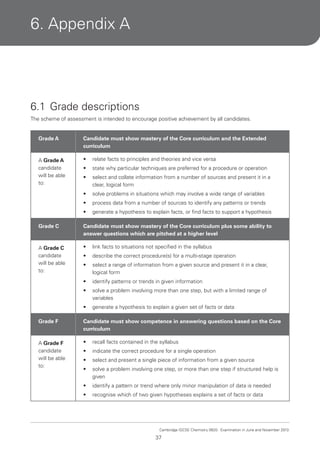
6.1 Grade descriptions
The scheme of assessment is intended to encourage positive achievement by all candidates.
Grade A

Candidate must show mastery of the Core curriculum and the Extended
curriculum

A Grade A
candidate
will be able
to:

•

relate facts to principles and theories and vice versa

•

state why particular techniques are preferred for a procedure or operation

•

select and collate information from a number of sources and present it in a
clear, logical form

•

solve problems in situations which may involve a wide range of variables

•

process data from a number of sources to identify any patterns or trends

•

generate a hypothesis to explain facts, or find facts to support a hypothesis

Grade C

Candidate must show mastery of the Core curriculum plus some ability to
answer questions which are pitched at a higher level

A Grade C
candidate
will be able
to:

•

link facts to situations not specified in the syllabus

•

describe the correct procedure(s) for a multi-stage operation

•

select a range of information from a given source and present it in a clear,
logical form

•

identify patterns or trends in given information

•

solve a problem involving more than one step, but with a limited range of
variables

•

generate a hypothesis to explain a given set of facts or data

Grade F

Candidate must show competence in answering questions based on the Core
curriculum

A Grade F
candidate
will be able
to:

•

recall facts contained in the syllabus

•

indicate the correct procedure for a single operation

•

select and present a single piece of information from a given source

•

solve a problem involving one step, or more than one step if structured help is
given

•

identify a pattern or trend where only minor manipulation of data is needed

•

recognise which of two given hypotheses explains a set of facts or data

Cambridge IGCSE Chemistry 0620. Examination in June and November 2013.

37
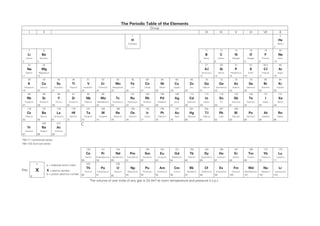
The Periodic Table of the Elements
Group
I

II

III

IV

V

VI

VII

0

1

4

H

He

Hydrogen

Helium

1

2

7

9

11

12

14

16

19

20

Li

Be

B

C

N

O

F

Ne

Lithium

Beryllium

3

Boron

4

5

Carbon

6

Nitrogen

7

Oxygen

8

Fluorine

9

Neon

10

23

24

27

28

31

32

35.5

40

Na

Mg

Al

Si

P

S

Cl

Ar

Sodium

11

Magnesium

Silicon

Aluminium

12

14

13

Phosphorus

15

Sulfur

16

Argon

Chlorine

18

17

39

40

45

48

51

52

55

56

59

59

64

65

70

73

75

79

80

84

K

Ca

Sc

Ti

V

Cr

Mn

Fe

Co

Ni

Cu

Zn

Ga

Ge

As

Se

Br

Kr

Potassium

19

Calcium

20

Scandium

Titanium

21

22

Vanadium

23

Chromium

24

Manganese

25

85

88

89

91

93

96

Rb

Sr

Y

Zr

Nb

Mo

Iron

26

Rubidium

37

Strontium

38

Yttrium

Zirconium

39

40

Niobium

41

Molybdenum

42

Cobalt

27

Nickel

28

Copper

29

Zinc

30

Gallium

31

Germanium

32

Arsenic

33

Selenium

34

Bromine

35

Krypton

36

101
Technetium

43

103

106

108

112

115

119

122

128

127

131

Ru

Tc

Rh

Pd

Ag

Cd

In

Sn

Sb

Te

I

Xe

Ruthenium

44

Rhodium

45

Palladium

46

Silver

47

Cadmium

48

Indium

49

Tin

50

Antimony

51

Tellurium

52

Iodine

53

Xenon

54

133

137

139

178

181

184

186

190

192

195

197

201

204

207

Cs

Ba

La

Hf

Ta

W

Re

Os

Ir

Pt

Au

Hg

Tl

Pb

Bi

Po

At

Rn

Caesium

Barium

Lanthanum

Hafnium

Tantalum

Tungsten

Rhenium

Osmium

Iridium

Platinum

Gold

Mercury

Thallium

Lead

Bismuth

Polonium

Astatine

Radon

55

56

57
226

* 72
227

Fr

Ra
Radium

74

75

76

77

78

79

80

82

81

83

84

85

86

C

Ac

Francium

73

209

Actinium

87

88

89

†

*58–71 Lanthanoid series
†90–103 Actinoid series
140

141

144

Ce

Pr

Nd

Cerium

Praseodymium

58
a

X

Key
b

a = relativea tomic mass

X = atomic symbol
b = proton (atomic) number 90

59

Neodymium

60

150
Promethium

61

152

157

159

163

165

167

169

173

175

Sm

Pm

Eu

Gd

Tb

Dy

Ho

Er

Tm

Yb

Lu

Samarium

62

Europium

63

Gadolinium

64

Terbium

65

Dysprosium

66

Holmium

67

Erbium

68

Thulium

69

Ytterbium

70

Lutetium

71

238

232

Th

Pa

U

Np

Pu

Am

Cm

Bk

Cf

Es

Fm

Md

No

Lr

Thorium

Protactinium

Uranium

Neptunium

Plutonium

Americium

Curium

Berkelium

Californium

Einsteinium

Fermium

Mendelevium

Nobelium

Lawrencium

91

92

93

94

95
3

96

97

98

99

The volume of one mole of any gas is 24 dm at room temperature and pressure (r.t.p.).

100

101

102

103
6. Appendix A

6.3 Notes for use in qualitative analysis
Tests for anions
anion

test

test result

carbonate (CO32–)

add dilute acid

effervescence, carbon dioxide
produced

chloride (Cl –)
[in solution]

acidify with dilute nitric acid, then add
aqueous silver nitrate

white ppt.

iodide (I –)
[in solution]

acidify with dilute nitric acid, then add
aqueous silver nitrate

yellow ppt.

nitrate (NO3–)
[in solution]

add aqueous sodium hydroxide, then
aluminium foil; warm carefully

ammonia produced

sulfate (SO42–)
[in solution]

acidify, then add aqueous barium nitrate

white ppt.

Tests for aqueous cations
cation

effect of aqueous sodium hydroxide

effect of aqueous ammonia

aluminium (Al 3+)

white ppt., soluble in excess giving a
colourless solution

white ppt., insoluble in excess

ammonium (NH4+)

ammonia produced on warming

calcium (Ca2+)

white ppt., insoluble in excess

no ppt. or very slight white ppt.

copper (Cu2+)

light blue ppt., insoluble in excess

light blue ppt., soluble in excess,
giving a dark blue solution

iron(II) (Fe2+)

green ppt., insoluble in excess

green ppt., insoluble in excess

iron(III) (Fe3+)

red-brown ppt., insoluble in excess

red-brown ppt., insoluble in excess

zinc (Zn2+)

white ppt., soluble in excess, giving a
colourless solution

white ppt., soluble in excess,
giving a colourless solution

–

Tests for gases
gas

test and test result

ammonia (NH3)

turns damp red litmus paper blue

carbon dioxide (CO2)

turns limewater milky

chlorine (Cl 2)

bleaches damp litmus paper

hydrogen (H2)

‘pops’ with a lighted splint

oxygen (O2)

relights a glowing splint
Cambridge IGCSE Chemistry 0620. Examination in June and November 2013.

39
6. Appendix A

6.4 Safety in the laboratory
Responsibility for safety matters rests with Centres. Further information can be found in the following UK
associations, websites, publications and regulations.

Associations
CLEAPSS is an advisory service providing support in practical science and technology, primarily for UK schools.
International schools and post-16 colleges can apply for associate membership which includes access to the
CLEAPSS publications listed below.
http://www.cleapss.org.uk

Websites
http://www.chemsoc.org/networks/learnnet/Safety.htm
http://www.ncbe.reading.ac.uk/NCBE/SAFETY/menu.html
http://www.microbiologyonline.org.uk/safety.html

Publications
Safeguards in the School Laboratory, ASE, 11th Edition, 2006
Topics in Safety, ASE, 3rd Edition, 2001
CLEAPSS Laboratory Handbook, updated 2005 (available to CLEAPSS members only)
CLEAPSS Hazcards, 2005 update of 1995 edition (available to CLEAPSS members only)
Safety in Science Education, DfES, HMSO, 1996
Hazardous Chemicals Manual, SSERC, 1997
Hazardous Chemicals. An interactive manual for science education, SSERC, 2002 (CD)

UK Regulations
Control of Substances Hazardous to Health Regulations (COSHH) 2002
http://www.opsi.gov.uk/SI/si2002/20022677.htm, a brief guide may be found at
http://www.hse.gov.uk/pubns/indg136.pdf

Cambridge IGCSE Chemistry 0620. Examination in June and November 2013.

40
6. Appendix A

6.5 Glossary of terms used in science papers
The glossary (which is relevant only to Science subjects) will prove helpful to candidates as a guide, but it is
neither exhaustive nor definitive. The glossary has been deliberately kept brief, not only with respect to the
number of terms included, but also to the descriptions of their meanings. Candidates should appreciate that
the meaning of a term must depend, in part, on its context.
1.

Define (the term(s) … ) is intended literally, only a formal statement or equivalent paraphrase being
required.

2. What do you understand by/What is meant by (the term(s) … ) normally implies that a definition should
be given, together with some relevant comment on the significance or context of the term(s) concerned,
especially where two or more terms are included in the question. The amount of supplementary
comment intended should be interpreted in the light of the indicated mark value.
3. State implies a concise answer with little or no supporting argument (e.g. a numerical answer that can
readily be obtained ‘by inspection’).
4. List requires a number of points, generally each of one word, with no elaboration. Where a given
number of points is specified this should not be exceeded.
5. Explain may imply reasoning or some reference to theory, depending on the context.
6. Describe requires the candidate to state in words (using diagrams where appropriate) the main points
of the topic. It is often used with reference either to particular phenomena or to particular experiments.
In the former instance, the term usually implies that the answer should include reference to (visual)
observations associated with the phenomena.
In other contexts, describe should be interpreted more generally (i.e. the candidate has greater
discretion about the nature and the organisation of the material to be included in the answer). Describe
and explain may be coupled, as may state and explain.
7
.

Discuss requires the candidate to give a critical account of the points involved in the topic.

8. Outline implies brevity (i.e. restricting the answer to giving essentials).
9. Predict implies that the candidate is not expected to produce the required answer by recall but by
making a logical connection between other pieces of information. Such information may be wholly given
in the question or may depend on answers extracted in an earlier part of the question.
Predict also implies a concise answer with no supporting statement required.
10. Deduce is used in a similar way to predict except that some supporting statement is required,
e.g. reference to a law or principle, or the necessary reasoning is to be included in the answer.
11. Suggest is used in two main contexts, i.e. either to imply that there is no unique answer (e.g. in
Chemistry, two or more substances may satisfy the given conditions describing an ‘unknown’), or to
imply that candidates are expected to apply their general knowledge of the subject to a ‘novel’ situation,
one that may be formally ‘not in the syllabus’ – many data response and problem solving questions are
of this type.
12. Find is a general term that may variously be interpreted as calculate, measure, determine, etc.

Cambridge IGCSE Chemistry 0620. Examination in June and November 2013.

41
6. Appendix A

13. Calculate is used when a numerical answer is required. In general, working should be shown, especially
where two or more steps are involved.
14. Measure implies that the quantity concerned can be directly obtained from a suitable measuring
instrument (e.g. length, using a rule, or mass, using a balance).
15. Determine often implies that the quantity concerned cannot be measured directly but is obtained
by calculation, substituting measured or known values of other quantities into a standard formula
e.g. relative molecular mass.
16. Estimate implies a reasoned order of magnitude statement or calculation of the quantity concerned,
making such simplifying assumptions as may be necessary about points of principle and about the
values of quantities not otherwise included in the question.
17 Sketch, when applied to graph work, implies that the shape and/or position of the curve need only be
.
qualitatively correct, but candidates should be aware that, depending on the context, some quantitative
aspects may be looked for (e.g. passing through the origin, having an intercept).
In diagrams, sketch implies that simple, freehand drawing is acceptable; nevertheless, care should be
taken over proportions and the clear exposition of important details.

Cambridge IGCSE Chemistry 0620. Examination in June and November 2013.

42
6. Appendix A

6.6 Mathematical requirements
Calculators may be used in all parts of the examination.
Candidates should be able to:
•

add, subtract, multiply and divide

•

use averages, decimals, fractions, percentages, ratios and reciprocals

•

recognise and use standard notation

•

use direct and inverse proportion

•

use positive, whole number indices

•

draw charts and graphs from given data

•

interpret charts and graphs

•

select suitable scales and axes for graphs

•

make approximate evaluations of numerical expressions

•

recognise and use the relationship between length, surface area and volume and their units on metric
scales

•

use usual mathematical instruments (ruler, compasses, protractor, set square)

•

understand the meaning of angle, curve, circle, radius, diameter, square, parallelogram, rectangle and
diagonal

•

solve equations of the form x = yz for any one term when the other two are known.

Cambridge IGCSE Chemistry 0620. Examination in June and November 2013.

43
6. Appendix A

6.7 Resource list
Books endorsed by CIE for use with this syllabus
These books have been through an independent quality assurance process and match the syllabus content
closely.
Author

Title

Date

Publisher

ISBN

R. Norris &
R. Stanbridge

Chemistry for IGCSE

2009

Nelson Thornes

9781408500187

R. Berry

IGCSE Study Guide for
Chemistry

2005

Hodder Murray

0719579023

R. Harwood

Chemistry (Edition 2)*

2003

Cambridge University Press

0521530938

*This book is also available from Cambridge University Press in a Low Priced Edition (ISBN 0 5216 6662 7)
from their local distributors in Africa, The Caribbean, Bangladesh, India, Nepal, Pakistan and Sri Lanka.

Reference books
Teachers may also find reference to the following books helpful. They are all suitable for use with this
syllabus. Content of the books does not necessarily match the CIE syllabus closely and examples may be
British in focus.
Author

Title

A. Clegg

Chemistry for IGCSE

B. Earl &

IGCSE Chemistry

Date

ISBN

Heinemann
2005

Publisher

0435966758

Hodder Murray

0719586178

L.D. Wilford
G. Hill

Chemistry Counts

Hodder and Stoughton

0340639342

Lewis &

Thinking Chemistry
(GCSE Edition)

Oxford University Press

0199142572

Waller

These titles represent some of the texts available at the time of printing this booklet. Teachers are
encouraged to choose texts for class use which they feel will be of interest to their students and will support
their own teaching style.

Cambridge IGCSE Chemistry 0620. Examination in June and November 2013.

44
6. Appendix A

Other resources
Copies of syllabuses, the most recent question papers and Principal Examiners’ reports for teachers are
available on the Syllabus and Support Materials CD-ROM, which is sent to all CIE Centres.
Resources are also listed on CIE’s public website at www.cie.org.uk. Please visit this site on a regular
basis as the Resource lists are updated through the year.
Access to teachers’ email discussion groups, suggested schemes of work and regularly updated resource
lists may be found on the CIE Teacher Support website at http://teachers.cie.org.uk. This website is
available to teachers at registered CIE Centres.

Cambridge IGCSE Chemistry 0620. Examination in June and November 2013.

45
6. Appendix A

6.8 Forms
This section contains copies of the following forms, together with instructions on how to complete them.
Sciences Experiment Form
Individual Candidate Record Card
Coursework Assessment Summary Form

Cambridge IGCSE Chemistry 0620. Examination in June and November 2013.

46
6. Appendix A
SCIENCES
Experiment Form
IGCSE 2013
Please read the instructions printed overleaf.
Centre number

Centre name

Syllabus code

0

Component number
June/November
Experiment
number

6

2

0
2

0

4
1

Syllabus title

Chemistry

Component title

0

Coursework

3
Experiment

Skill(s)
assessed

IGCSE/CHEMISTRY/CW/EX/

WMS627

Cambridge IGCSE Chemistry 0620. Examination in June and November 2013.

47
6. Appendix A

Instructions for completing Sciences Experiment Form
1.

Complete the information at the head of the form.

2. Use a separate form for each Syllabus.
3. Give a brief description of each of the experiments your students performed for assessment in the
IGCSE Syllabus indicated. Use additional sheets as necessary.
4. Copies of the experiment forms and the corresponding worksheets/instructions and marking schemes
will be required for each assessed task sampled, for each of Skills C1 to C4 inclusive.

IGCSE/CHEMISTRY/CW/EX/

WMS627

Cambridge IGCSE Chemistry 0620. Examination in June and November 2013.

48
SCIENCES
Individual Candidate Record Card
IGCSE 2013
Please read the instructions printed on the previous page and the General Coursework Regulations before completing this form.
Centre number

Centre name

June/November

Candidate number

Candidate name

Teaching group/set

Syllabus code

Date of assessment

0

6

2

0

Experiment number from
Sciences Experiment
Form

Syllabus title

CHEMISTRY

Component number

Assess at least twice: ring highest two
marks for each skill
(Max 6 each assessment)
C1

C2

C3

0

4

Component title

2

0

1

3

COURSEWORK

Relevant comments (for example, if help was given)

C4

49
Marks to be transferred to
Coursework Assessment Summary Form

WMS626

(max 12)

(max 12)

(max 12)

(max 12)

TOTAL
(max 48)

IGCSE/CHEMISTRY/CW/S/
Instructions for completing Individual Candidate Record Cards
1.

Complete the information at the head of the form.

2. Mark each item of Coursework for each candidate according to instructions given in the Syllabus and Training Manual.
3. Enter marks and total marks in the appropriate spaces. Complete any other sections of the form required.
4. Ensure that the addition of marks is independently checked.
5. It is essential that the marks of candidates from different teaching groups within each Centre are moderated internally. This means that the
marks awarded to all candidates within a Centre must be brought to a common standard by the teacher responsible for co-ordinating the internal
assessment (i.e. the internal moderator), and a single valid and reliable set of marks should be produced which reflects the relative attainment of all the
candidates in the Coursework component at the Centre.
6. Transfer the marks to the Coursework Assessment Summary Form in accordance with the instructions given on that document.
7
.

Retain all Individual Candidate Record Cards and Coursework which will be required for external moderation. Further detailed instructions about
external moderation will be sent in late March of the year of the June examination and early October of the year of the November examination. See also
the instructions on the Coursework Assessment Summary Form.
Note: These Record Cards are to be used by teachers only for students who have undertaken Coursework as part of their IGCSE.

50
WMS626

IGCSE/CHEMISTRY/CW/S/
SCIENCES
Coursework Assessment Summary Form
IGCSE 2013
Please read the instructions printed overleaf and the General Coursework Regulations before completing this form.
Centre number
Syllabus code

Candidate
number

Centre name
0

6

2

0

Syllabus title
Teaching
group/set

Candidate name

June/November
CHEMISTRY

Component number

0

2

0

1

3

4 Component title COURSEWORK

C1

C2

C3

C4

Total mark

(max 12)

(max 12)

(max 12)

(max 12)

(max 48)

Internally
moderated mark
(max 48)

51
Name of teacher completing this form

Signature

Date

Name of internal moderator

Signature

Date

WMS626
IGCSE/CHEMISTRY/CW/S/
A. Instructions for completing Coursework Assessment Summary Forms
1.

Complete the information at the head of the form.

2. List the candidates in an order which will allow ease of transfer of information to a computer-printed Coursework mark sheet MS1 at a later stage (i.e. in
candidate index number order, where this is known; see item B.1 below). Show the teaching group or set for each candidate. The initials of the teacher
may be used to indicate group or set.
3. Transfer each candidate’s marks from his or her Individual Candidate Record Card to this form as follows:
(a) Where there are columns for individual skills or assignments, enter the marks initially awarded (i.e. before internal moderation took place).
(b) In the column headed ‘Total Mark’, enter the total mark awarded before internal moderation took place.
(c) In the column headed ‘Internally Moderated Mark’, enter the total mark awarded after internal moderation took place.
4. Both the teacher completing the form and the internal moderator (or moderators) should check the form and complete and sign the bottom portion.

B. Procedures for external moderation
1.
52

University of Cambridge International Examinations (CIE) sends a computer-printed Coursework mark sheet MS1 to each Centre (in late March for the
June examination and in early October for the November examination) showing the names and index numbers of each candidate. Transfer the total
internally moderated mark for each candidate from the Coursework Assessment Summary Form to the computer-printed Coursework mark sheet MS1.

2. The top copy of the computer-printed Coursework mark sheet MS1 must be despatched in the specially provided envelope to arrive as soon as possible
at CIE but no later than 30 April for the June examination and 31 October for the November examination.
3. CIE will select a list of candidates whose work is required for external moderation. As soon as this list is received, send candidates’ work, with the
corresponding Individual Candidate Record Cards, this summary form and the second copy of MS1, to CIE.
4. Experiment Forms, Work Sheets and Marking Schemes must be included for each task that has contributed to the final mark of these candidates.
5. Photocopies of the samples may be sent but candidates’ original work, with marks and comments from the teacher, is preferred.
6. (a) The pieces of work for each skill should not be stapled together, nor should individual sheets be enclosed in plastic wallets.
(b) Each piece of work should be clearly labelled with the skill being assessed, Centre name, candidate name and index number and the mark awarded.
For each task, supply the information requested in B.4 above.
7
.

CIE reserves the right to ask for further samples of Coursework.

WMS626

IGCSE/CHEMISTRY/CW/S/
7 Appendix B: Additional information
.

Guided learning hours
IGCSE syllabuses are designed on the assumption that candidates have about 130 guided learning hours
per subject over the duration of the course. (‘Guided learning hours’ include direct teaching and any other
supervised or directed study time. They do not include private study by the candidate.)
However, this figure is for guidance only, and the number of hours required may vary according to local
curricular practice and the candidates’ prior experience of the subject.

Recommended prior learning
We recommend that candidates who are beginning this course should have previously studied a science
curriculum such as that of the Cambridge Lower Secondary Programme or equivalent national educational
frameworks. Candidates should also have adequate mathematical skills for the content contained in this
syllabus.

Progression
IGCSE Certificates are general qualifications that enable candidates to progress either directly to
employment, or to proceed to further qualifications.
Candidates who are awarded grades C to A* in IGCSE Chemistry are well prepared to follow courses leading
to AS and A Level Chemistry, or the equivalent.

Component codes
Because of local variations, in some cases component codes will be different in instructions about making
entries for examinations and timetables from those printed in this syllabus, but the component names will
be unchanged to make identification straightforward.

Grading and reporting
IGCSE results are shown by one of the grades A*, A, B, C, D, E, F or G indicating the standard achieved,
Grade A* being the highest and Grade G the lowest. ‘Ungraded’ indicates that the candidate’s performance
fell short of the standard required for Grade G. ‘Ungraded’ will be reported on the statement of results but
not on the certificate. For some language syllabuses CIE also reports separate oral endorsement grades on
a scale of 1 to 5 (1 being the highest).
Percentage uniform marks are also provided on each candidate’s statement of results to supplement their
grade for a syllabus. They are determined in this way:
•

A candidate who obtains…
… the minimum mark necessary for a Grade A* obtains a percentage uniform mark of 90%.
… the minimum mark necessary for a Grade A obtains a percentage uniform mark of 80%.
… the minimum mark necessary for a Grade B obtains a percentage uniform mark of 70%.

Cambridge IGCSE Chemistry 0620. Examination in June and November 2013.

53
7 Appendix B: Additional information
.

… the minimum mark necessary for a Grade C obtains a percentage uniform mark of 60%.
… the minimum mark necessary for a Grade D obtains a percentage uniform mark of 50%.
… the minimum mark necessary for a Grade E obtains a percentage uniform mark of 40%.
… the minimum mark necessary for a Grade F obtains a percentage uniform mark of 30%.
… the minimum mark necessary for a Grade G obtains a percentage uniform mark of 20%.
… no marks receives a percentage uniform mark of 0%.
Candidates whose mark is none of the above receive a percentage mark in between those stated according
to the position of their mark in relation to the grade ‘thresholds’ (i.e. the minimum mark for obtaining a
grade). For example, a candidate whose mark is halfway between the minimum for a Grade C and the
minimum for a Grade D (and whose grade is therefore D) receives a percentage uniform mark of 55%.
The uniform percentage mark is stated at syllabus level only. It is not the same as the ‘raw’ mark obtained
by the candidate, since it depends on the position of the grade thresholds (which may vary from one session
to another and from one subject to another) and it has been turned into a percentage.

Resources
Copies of syllabuses, the most recent question papers and Principal Examiners’ reports for teachers are
available on the Syllabus and Support Materials CD-ROM, which is sent to all CIE Centres.
Resources are also listed on CIE’s public website at www.cie.org.uk. Please visit this site on a regular
basis as the Resource lists are updated through the year.
Access to teachers’ email discussion groups, suggested schemes of work and regularly updated resource
lists may be found on the CIE Teacher Support website at http://teachers.cie.org.uk. This website is
available to teachers at registered CIE Centres.

Cambridge IGCSE Chemistry 0620. Examination in June and November 2013.

54
8. Appendix C: Additional information –
Cambridge International Certificates

This syllabus is accredited for use in England, Wales and Northern Ireland. Additional information on this
accredited version is provided below.

Prior learning
Candidates in England who are beginning this course should normally have followed the Key Stage 3
programme of study within the National Curriculum for England.
Other candidates beginning this course should have achieved an equivalent level of general education.

NQF Level
This qualification is accredited by the regulatory authority for England, Ofqual, as part of the National
Qualifications Framework as a Cambridge International Level 1/Level 2 Certificate.
Candidates who gain grades G to D will have achieved an award at Level 1 of the National Qualifications
Framework. Candidates who gain grades C to A* will have achieved an award at Level 2 of the National
Qualifications Framework.

Progression
Cambridge International Level 1/Level 2 Certificates are general qualifications that enable candidates to
progress either directly to employment, or to proceed to further qualifications.
This syllabus provides a foundation for further study at levels 2 and 3 in the National Qualifications
Framework, including GCSE, AS and A Level GCE, and Cambridge Pre-U qualifications.
Candidates who are awarded grades C to A* are well prepared to follow courses leading to Level 3
AS and A Level GCE Chemistry, Cambridge Pre-U Chemistry, IB Certificates in Chemistry or the Cambridge
International AS and A Level Chemistry.

Guided learning hours
The number of guided learning hours required for this course is 130.
Guided learning hours are used to calculate the funding for courses in state schools in England, Wales and
Northern Ireland. Outside England, Wales and Northern Ireland, the number of guided learning hours should
not be equated to the total number of hours required by candidates to follow the course as the definition
makes assumptions about prior learning and does not include some types of learning time.

Cambridge IGCSE Chemistry 0620. Examination in June and November 2013.

55
8. Appendix C: Additional information –
Cambridge International Certificates

Overlapping qualifications
Centres in England, Wales and Northern Ireland should be aware that every syllabus is assigned to a national
classification code indicating the subject area to which it belongs. Candidates who enter for more than one
qualification with the same classification code will have only one grade (the highest) counted for the purpose
of the school and college performance tables.
The classification code for this syllabus is 1110.

Spiritual, ethical, social, legislative, economic and cultural issues
The syllabus provides a number of areas in which candidates may appreciate the moral, social, ethical,
economic and cultural issues surrounding chemical industry, both on a local and on a global scale. It is
expected that candidates will gain a deeper appreciation and understanding of the atomic and molecular
workings of the world around them.
While gaining experience of practical skills, candidates have the opportunity to develop their ability to work
as a team, where appropriate, and to value the contribution of others’ ideas.

Sustainable development, health and safety considerations and
international developments
This syllabus offers opportunities to develop ideas on sustainable development and environmental issues,
health and safety, and the international dimension.
•

Sustainable development and environmental issues
Aspects of environmental education and sustainable development occur in relation to reducing the
impact of chemical industry on the environment and improving efficiency of synthesis.
Aspects of environmental education and sustainable development are covered in topics 6.2, 7 10.3, 11,
.2,
13, 14.2, 14.8(a).

•

Health and safety
The following health and safety issues feature in this syllabus:
•

candidates are required to adhere to good health and safety practice in the laboratory

•

issues associated with the impact of electricity generation and chemical industry on the
environment.

Health and safety issues are covered in topics 6.2, 7 11, 14.2.
.1,
•

The international dimension
There are opportunities in this syllabus to investigate local, national and international contributions to the
subject field, and to appreciate the global significance of chemistry.
For example, fuel cells (topic 6.2), industrial processes (topics 10.3(a), 11 and 14.5), polymer chemistry
(topic 14.8(a)), and environmental chemistry (topic 13).

Cambridge IGCSE Chemistry 0620. Examination in June and November 2013.

56
8. Appendix C: Additional information –
Cambridge International Certificates

Avoidance of Bias
CIE has taken great care in the preparation of this syllabus and assessment materials to avoid bias of any kind.

Language
This syllabus and the associated assessment materials are available in English only.

Key Skills
The development of the Key Skills of application of number, communication, and information technology,
along with the wider Key Skills of improving your own learning and performance, working with others and
problem solving can enhance teaching and learning strategies and motivate candidates towards learning
independently.
This syllabus will provide opportunities to develop the key skills of
•

application of number

•

communication

•

information technology

•

improving own learning and performance

•

working with others

•

problem solving.

The separately certificated Key Skills qualification recognises achievement in
•

application of number

•

communication

•

information technology.

Further information on Key Skills can be found on the Ofqual website (www.ofqual.gov.uk).

Resources
Copies of syllabuses, the most recent question papers and Principal Examiners’ reports for teachers are
available on the Syllabus and Support Materials CD-ROM, which is sent to all CIE Centres.
Resources are also listed on CIE’s public website at www.cie.org.uk. Please visit this site on a regular
basis as the Resource lists are updated through the year.
Access to teachers’ email discussion groups, suggested schemes of work and regularly updated resource
lists may be found on the CIE Teacher Support website at http://teachers.cie.org.uk. This website is
available to teachers at registered CIE Centres.

Cambridge IGCSE Chemistry 0620. Examination in June and November 2013.

57
University of Cambridge International Examinations
1 Hills Road, Cambridge, CB1 2EU, United Kingdom
Tel: +44 (0)1223 553554 Fax: +44 (0)1223 553558
Email: international@cie.org.uk Website: www.cie.org.uk
© University of Cambridge International Examinations 2010

0620 13

  • 1.
    Syllabus Cambridge IGCSE Chemistry CambridgeInternational Certificate* Syllabus code 0620 For examination in June and November 2013 *This syllabus is accredited for use in England, Wales and Northern Ireland as a Cambridge International Level 1/Level 2 Certificate.
  • 3.
    Contents Cambridge IGCSE Chemistry Syllabuscode 0620 1. Introduction ..................................................................................... 2 1.1 1.2 1.3 1.4 1.5 Why choose Cambridge? Why choose Cambridge IGCSE Chemistry? Cambridge International Certificate of Education (ICE) UK schools How can I find out more? 2. Assessment at a glance .................................................................. 5 3. Syllabus aims and objectives ........................................................... 7 3.1 3.2 3.3 3.4 3.5 Aims Assessment objectives Scheme of assessment Weightings Conventions 4. Curriculum content ........................................................................ 13 5. Practical assessment ..................................................................... 29 5.1 Paper 4: Coursework 5.2 Paper 5: Practical test 5.3 Paper 6: Alternative to Practical 6. Appendix A .................................................................................... 37 6.1 6.2 6.3 6.4 6.5 6.6 6.7 6.8 Grade descriptions Periodic Table Notes for use in qualitative analysis Safety in the laboratory Glossary of terms Mathematical requirements Resource list Forms Cambridge IGCSE Chemistry 0620. Examination in June and November 2013. © UCLES 2010
  • 4.
    7 Appendix B:Additional information ............................................... 53 . 8. Appendix C: Additional information – Cambridge International Certificates .................................................................................... 55
  • 6.
    1. Introduction 1.1 Whychoose Cambridge? University of Cambridge International Examinations (CIE) is the world’s largest provider of international qualifications. Around 1.5 million students from 150 countries enter Cambridge examinations every year. What makes educators around the world choose Cambridge? Recognition Cambridge IGCSE is internationally recognised by schools, universities and employers as equivalent to UK GCSE. Cambridge IGCSE is excellent preparation for A/AS Level, the Advanced International Certificate of Education (AICE), US Advanced Placement Programme and the International Baccalaureate (IB) Diploma. Learn more at www.cie.org.uk/recognition. Support CIE provides a world-class support service for teachers and exams officers. We offer a wide range of teacher materials to Centres, plus teacher training (online and face-to-face) and student support materials. Exams officers can trust in reliable, efficient administration of exams entry and excellent, personal support from CIE Customer Services. Learn more at www.cie.org.uk/teachers. Excellence in education Cambridge qualifications develop successful students. They build not only understanding and knowledge required for progression, but also learning and thinking skills that help students become independent learners and equip them for life. Not-for-profit, part of the University of Cambridge CIE is part of Cambridge Assessment, a not-for-profit organisation and part of the University of Cambridge. The needs of teachers and learners are at the core of what we do. CIE invests constantly in improving its qualifications and services. We draw upon education research in developing our qualifications. Cambridge IGCSE Chemistry 0620. Examination in June and November 2013. 2
  • 7.
    1. Introduction 1.2 Whychoose Cambridge IGCSE Chemistry? Cambridge IGCSE Chemistry is accepted by universities and employers as proof of essential chemistry knowledge and ability. As well as a subject focus, the Chemistry syllabus enables students to: • better understand the technological world in which they live, and take an informed interest in science and scientific developments • learn about the basic principles of Chemistry through a mix of theoretical and practical studies • develop an understanding of the scientific skills essential for further study at A Level, skills which are useful in everyday life • learn how science is studied and practised, and become aware that the results of scientific research can have both good and bad effects on individuals, communities and the environment. 1.3 Cambridge International Certificate of Education (ICE) Cambridge ICE is the group award of the International General Certificate of Secondary Education (IGCSE). It requires the study of subjects drawn from the five different IGCSE subject groups. It gives schools the opportunity to benefit from offering a broad and balanced curriculum by recognising the achievements of students who pass examinations in at least seven subjects, including two languages, and one subject from each of the other subject groups. The Cambridge portfolio of IGCSE qualifications provides a solid foundation for higher level courses such as GCE A and AS Levels and the International Baccalaureate Diploma as well as excellent preparation for employment. A wide range of IGCSE subjects is available and these are grouped into five curriculum areas. Chemistry falls into Group III, Science. Learn more about ICE at www.cie.org.uk/qualifications/academic/middlesec/ice. Cambridge IGCSE Chemistry 0620. Examination in June and November 2013. 3
  • 8.
    1. Introduction 1.4 UKschools This syllabus is accredited for use in England, Wales and Northern Ireland. Information on the accredited version of this syllabus can be found in the appendix to this document. Achievement and Attainment Tables Certain Cambridge IGCSEs and Cambridge International Certificates are now included in the Achievement and Attainment Tables for schools in England. For up to date information on the performance tables, including subjects eligible for inclusion in the English Baccalaureate, please go to the Department for Education website at www.education.gov.uk/performancetables. 1.5 How can I find out more? If you are already a Cambridge Centre You can make entries for this qualification through your usual channels, e.g. CIE Direct. If you have any queries, please contact us at international@cie.org.uk. If you are not a Cambridge Centre You can find out how your organisation can become a Cambridge Centre. Email us at international@cie.org.uk. Learn more about the benefits of becoming a Cambridge Centre at www.cie.org.uk. Cambridge IGCSE Chemistry 0620. Examination in June and November 2013. 4
  • 9.
    2. Assessment ata glance Cambridge IGCSE Chemistry Syllabus code 0620 Cambridge IGCSE Chemistry candidates are awarded grades ranging from A* to G. Candidates expected to achieve grades D, E, F or G, study the Core Curriculum only and are eligible for grades C to G. Candidates expected to achieve grade C or higher should study the Extended Curriculum, which comprises the Core and Supplement Curriculums; these candidates are eligible for all grades from A* to G. All candidates must enter for three papers. All candidates take: Paper 1 Multiple choice question paper weighted at 30% of total available marks 45 minutes and either: or: Paper 2 1 hour 15 minutes Core theory paper weighted at 50% of total available marks Paper 3 1 hour 15 minutes Extended theory paper weighted at 50% of total available marks and either: or: or: Paper 4 Coursework weighted at 20% of total available marks Paper 5 1 hour 15 minutes Practical test weighted at 20% of total available marks Paper 6 1 hour Alternative to Practical paper weighted at 20% of total available marks Cambridge IGCSE Chemistry 0620. Examination in June and November 2013. 5
  • 10.
    2. Assessment ata glance Availability This syllabus is examined in the May/June examination session and the October/November examination session. This syllabus is available to private candidates. Combining this with other syllabuses Candidates can combine this syllabus in an examination session with any other CIE syllabus, except: • syllabuses with the same title at the same level • 0652 IGCSE Physical Science • 0653 IGCSE Combined Science • 0654 IGCSE Co-ordinated Sciences (Double Award) • 5124 O Level Science (Physics, Chemistry) • 5126 O Level Science (Chemistry, Biology) • 5129 O Level Combined Science • 5130 O Level Additional Combined Science Please note that IGCSE, Cambridge International Level 1/Level 2 Certificates and O Level syllabuses are at the same level. Cambridge IGCSE Chemistry 0620. Examination in June and November 2013. 6
  • 11.
    3. Syllabus aimsand objectives 3.1 Aims The aims of the syllabus listed below describe the educational purposes of this examination. The aims of the syllabus are the same for all students and are not listed in order of priority. The aims are: 1. to provide a worthwhile educational experience for all candidates, through well-designed studies of experimental and practical science, whether or not they go on to study science beyond this level 2. to enable candidates to acquire sufficient understanding and knowledge to • become confident citizens in a technological world, able to take an informed interest in scientific matters • recognise both the usefulness and the limitations of scientific method, and appreciate its applicability in other disciplines and in everyday life • be suitably prepared for studies beyond IGCSE in pure sciences, in applied sciences or in sciencedependent vocational courses 3. to develop abilities and skills that • are relevant to the study and practice of Chemistry • are useful in everyday life • encourage efficient and safe practice • encourage effective communication 4. to develop attitudes relevant to Chemistry such as • concern for accuracy and precision • objectivity • integrity • enquiry • initiative • inventiveness 5. to stimulate interest in the environment and caring for it 6. to promote an awareness that • scientific theories and methods have developed, and continue to do so, as a result of co-operative activities of groups and individuals • the study and practice of science are subject to social, economic, technological, ethical and cultural influences and limitations • the applications of science may be both beneficial and detrimental to the individual, the community and the environment • science transcends national boundaries and that the language of science, correctly and rigorously applied, is universal. Cambridge IGCSE Chemistry 0620. Examination in June and November 2013. 7
  • 12.
    3. Syllabus aimsand objectives 3.2 Assessment objectives The three assessment objectives in Cambridge IGCSE Chemistry are: A Knowledge with understanding B Handling information and problem solving C Experimental skills and investigations A description of each assessment objective follows. A: Knowledge with understanding Students should be able to demonstrate knowledge and understanding in relation to: 1. scientific phenomena, facts, laws, definitions, concepts and theories 2. scientific vocabulary, terminology and conventions (including symbols, quantities and units) 3. scientific instruments and apparatus, including techniques of operation and aspects of safety 4. scientific quantities and their determination 5. scientific and technological applications with their social, economic and environmental implications. Curriculum content defines the factual material that candidates may be required to recall and explain. Candidates will also be asked questions which require them to apply this material to unfamiliar contexts and to apply knowledge from one area of the syllabus to knowledge of a different syllabus area. Questions testing these objectives will often begin with one of the following words: define, state, describe, explain or outline (see Glossary of Terms). B: Handling information and problem solving Students should be able, in words or using other written forms of presentation (i.e. symbolic, graphical and numerical), to: 1. locate, select, organise and present information from a variety of sources 2. translate information from one form to another 3. manipulate numerical and other data 4. use information to identify patterns, report trends and draw inferences 5. present reasoned explanations for phenomena, patterns and relationships 6. make predictions and hypotheses 7 . solve problems, including some of a quantitative nature. Cambridge IGCSE Chemistry 0620. Examination in June and November 2013. 8
  • 13.
    3. Syllabus aimsand objectives Questions testing these skills may be based on information that is unfamiliar to candidates, requiring them to apply the principles and concepts from the syllabus to a new situation, in a logical, deductive way. Questions testing these skills will often begin with one of the following words: predict, suggest, calculate or determine. (See the Glossary of Terms.) C: Experimental skills and investigations Students should be able to: 1. know how to use techniques, apparatus and materials (including following a sequence of instructions where appropriate) 2. make and record observations, measurements and estimates 3. interpret and evaluate experimental observations and data 4. plan investigations, evaluate methods and suggest possible improvements (including the selection of techniques, apparatus and materials). 3.3 Scheme of assessment All candidates must enter for three papers: Paper 1; either Paper 2 or Paper 3; and one from Papers 4, 5 or 6. Candidates who have only studied the Core curriculum, or who are expected to achieve a grade D or below, should normally be entered for Paper 2. Candidates who have studied the Extended curriculum, and who are expected to achieve a grade C or above, should be entered for Paper 3. All candidates must take a practical paper, chosen from: Paper 4 (Coursework), Paper 5 (Practical Test), or Paper 6 (Alternative to Practical). Cambridge IGCSE Chemistry 0620. Examination in June and November 2013. 9
  • 14.
    3. Syllabus aimsand objectives All candidates take: Paper 1 45 minutes A multiple-choice paper consisting of 40 items of the four-choice type. This paper will test skills mainly in Assessment objectives A and B. Questions will be based on the Core curriculum and will be of a difficulty appropriate to grades C to G. This paper will be weighted at 30% of the final total available marks. and either: Paper 2 or: Paper 3 1 hour 15 minutes 1 hour 15 minutes Written paper consisting of short-answer and structured questions. Written paper consisting of short-answer and structured questions. Questions will be based on the Core curriculum and will be of a difficulty appropriate to grades C to G. Questions will be based on the Extended curriculum and will be of a difficulty appropriate to the higher grades. Questions will test skills mainly in Assessment objectives A and B. Questions will test skills mainly in Assessment objectives A and B. A quarter of the marks available will be based on Core material and the remainder on the Supplement. 80 marks 80 marks This paper will be weighted at 50% of the final total available marks. This paper will be weighted at 50% of the final total available marks. and either: or: or: Paper 4* Paper 5* Coursework Practical Test Alternative to Practical School-based assessment of practical skills.** Questions covering experimental and observational skills. Written paper designed to test familiarity with laboratory based procedures. weighted at 20% of the final total available marks weighted at 20% of the final total available marks weighted at 20% of the final total available marks 1 hour 15 minutes Cambridge IGCSE Chemistry 0620. Examination in June and November 2013. 10 Paper 6* 1 hour
  • 15.
    3. Syllabus aimsand objectives * This component tests appropriate skills in assessment Objective C. Candidates will not be required to use knowledge outside the Core curriculum. ** Teachers may not undertake school-based assessment without the written approval of CIE. This is only given to teachers who satisfy CIE requirements concerning moderation and who have undergone special training in assessment. CIE offers schools in-service training in the form of occasional face-to-face courses held in countries where there is a need, and also through the Coursework Training Handbook, available from CIE Publications. 3.4 Weightings Assessment objective Approximate weighting A: Knowledge with understanding 50% (not more than 25% recall) B: Handling information and problem solving 30% C: Experimental skills and investigations 20% Teachers should take note that there is an equal weighting of 50% for skills (including handling information, problem solving, practical, experimental and investigative skills) and for knowledge and understanding. Teachers’ schemes of work and the sequence of learning activities should reflect this balance, so that the aims of the syllabus may be met, and the candidates fully prepared for the assessment. Paper 1 (marks) Papers 2 or 3 (marks) Papers 4, 5 or 6 (marks) Whole assessment (%) A: Knowledge with understanding 25–30 48–52 0 47–54 B: Handling information and problem solving 10–15 28–32 0 26–33 0 0 40 20 Assessment objective C: Experimental skills and investigations Cambridge IGCSE Chemistry 0620. Examination in June and November 2013. 11
  • 16.
    3. Syllabus aimsand objectives 3.5 Conventions (e.g. signs, symbols, terminology and nomenclature) Syllabuses and question papers conform with generally accepted international practice. In particular, the following documents, published in the UK, should be used as guidelines: Reports produced by the Association for Science Education (ASE): SI Units, Signs, Symbols and Abbreviations (1981) Chemical Nomenclature, Symbols and Terminology for use in School Science (1985) Signs, Symbols and Systematics: The ASE Companion to 16–19 Science (2000). Litre/dm3 To avoid any confusion concerning the symbol for litre, dm3 will be used in place of l or litre. Cambridge IGCSE Chemistry 0620. Examination in June and November 2013. 12
  • 17.
    4. Curriculum content TheCurriculum content below is a guide to the areas on which candidates are assessed. It is important that, throughout this course, teachers should make candidates aware of the relevance of the concepts studied to everyday life, and to the natural and man-made worlds. In particular, attention should be drawn to: • the finite life of the world’s resources and the need for recycling and conservation • economic considerations in the chemical industry, such as the availability and cost of raw materials and energy • the importance of chemicals in both industry and everyday life. Specific content has been limited in order to encourage this approach, and to allow flexibility in the design of teaching programmes. CIE provides schemes of work, which can be found on the CIE Teacher Support website. Candidates may follow the Core curriculum only or they may follow the Extended curriculum, which includes both the Core and the Supplement. 1. The particulate nature of matter Core Supplement • Describe the states of matter and explain their interconversion in terms of the kinetic particle theory • • Describe and explain diffusion • Describe evidence for the movement of particles in gases and liquids (a treatment of Brownian motion is not required) 2. Describe dependence of rate of diffusion on molecular mass (treated qualitatively) Experimental techniques 2.1 Measurement Core • Name appropriate apparatus for the measurement of time, temperature, mass and volume, including burettes, pipettes and measuring cylinders 2.2 (a) Criteria of purity Core Supplement • Describe paper chromatography • • Interpret simple chromatograms Interpret simple chromatograms, including the use of Rf values • Identify substances and assess their purity from melting point and boiling point information • • Understand the importance of purity in substances in everyday life, e.g. foodstuffs and drugs Outline how chromatography techniques can be applied to colourless substances by exposing chromatograms to substances called locating agents (knowledge of specific locating agents is not required) Cambridge IGCSE Chemistry 0620. Examination in June and November 2013. 13
  • 18.
    4. Curriculum content 2.2(b) Methods of purification Core • Describe methods of purification by the use of a suitable solvent, filtration, crystallisation, distillation (including use of fractionating column). (Refer to the fractional distillation of crude oil in section 14.2 and products of fermentation in section 14.6.) • Suggest suitable purification techniques, given information about the substances involved 3. Atoms, elements and compounds 3.1 Atomic structure and the Periodic Table Core • State the relative charges and approximate relative masses of protons, neutrons and electrons • Define proton number and nucleon number • Use proton number and the simple structure of atoms to explain the basis of the Periodic Table (see section 9), with special reference to the elements of proton number 1 to 20 • Define isotopes • State the two types of isotopes as being radioactive and non-radioactive • State one medical and one industrial use of radioactive isotopes • Describe the build-up of electrons in ‘shells’ and understand the significance of the noble gas electronic structures and of valency electrons (the ideas of the distribution of electrons in s and p orbitals and in d block elements are not required.) (Note: a copy of the Periodic Table, as shown in the Appendix, will be available in Papers 1, 2 and 3) Cambridge IGCSE Chemistry 0620. Examination in June and November 2013. 14
  • 19.
    4. Curriculum content 3.2Bonding: the structure of matter Core • Describe the differences between elements, mixtures and compounds, and between metals and non-metals • Describe an alloy, such as brass, as a mixture of a metal with other elements 3.2 (a) Ions and ionic bonds Core • Describe the formation of ions by electron loss or gain • Describe the formation of ionic bonds between elements from Groups I and VII Supplement • Describe the formation of ionic bonds between metallic and non-metallic elements • Describe the lattice structure of ionic compounds as a regular arrangement of alternating positive and negative ions 3.2 (b) Molecules and covalent bonds Core Supplement • Describe the formation of single covalent bonds in H2, Cl2 , H2O, CH4 and HCl as the sharing of pairs of electrons leading to the noble gas configuration • • Describe the differences in volatility, solubility and electrical conductivity between ionic and covalent compounds Describe the electron arrangement in more complex covalent molecules such as N2, C2H4, CH3OH and CO2 3.2 (c) Macromolecules Core Supplement • Describe the giant covalent structures of graphite and diamond • Describe the macromolecular structure of silicon(IV) oxide (silicon dioxide) • Relate their structures to the use of graphite as a lubricant and of diamond in cutting • Describe the similarity in properties between diamond and silicon(IV) oxide, related to their structures 3.2 (d) Metallic bonding Supplement • Describe metallic bonding as a lattice of positive ions in a ‘sea of electrons’ and use this to describe the electrical conductivity and malleability of metals Cambridge IGCSE Chemistry 0620. Examination in June and November 2013. 15
  • 20.
    4. Curriculum content 4. Stoichiometry Core Supplement • Usethe symbols of the elements and write the formulae of simple compounds • • Deduce the formula of a simple compound from the relative numbers of atoms present Determine the formula of an ionic compound from the charges on the ions present • Deduce the formula of a simple compound from a model or a diagrammatic representation Construct equations with state symbols, including ionic equations • Deduce the balanced equation for a chemical reaction, given relevant information • • Construct word equations and simple balanced chemical equations • Define relative atomic mass, Ar • Define relative molecular mass, Mr , as the sum of the relative atomic masses (relative formula mass or Mr will be used for ionic compounds) (Calculations involving reacting masses in simple proportions may be set. Calculations will not involve the mole concept.) 4.1 The mole concept Supplement • • Calculate stoichiometric reacting masses and volumes of gases and solutions, solution concentrations expressed in g/dm3 and mol/dm3. (Calculations involving the idea of limiting reactants may be set. Questions on the gas laws and the conversion of gaseous volumes to different temperatures and pressures will not be set.) • Calculate empirical formulae and molecular formulae • 16 Use the molar gas volume, taken as 24 dm3 at room temperature and pressure • Cambridge IGCSE Chemistry 0620. Examination in June and November 2013. Define the mole and the Avogadro constant Calculate % yield and % purity
  • 21.
    4. Curriculum content 5. Electricityand chemistry Core Supplement • • Relate the products of electrolysis to the electrolyte and electrodes used, exemplified by the specific examples in the Core together with aqueous copper(II) sulfate using carbon electrodes and using copper electrodes (as used in the refining of copper) Describe the electrode products in the electrolysis of: – molten lead(II) bromide – concentrated hydrochloric acid – concentrated aqueous sodium chloride between inert electrodes (platinum or carbon) • State the general principle that metals or hydrogen are formed at the negative electrode (cathode), and that non-metals (other than hydrogen) are formed at the positive electrode (anode) • Describe electrolysis in terms of the ions present and reactions at the electrodes in the examples given • Predict the products of the electrolysis of a specified binary compound in the molten state • • Describe the electroplating of metals Predict the products of electrolysis of a specified halide in dilute or concentrated aqueous solution • Name the uses of electroplating • Describe, in outline, the manufacture of • Describe the reasons for the use of copper and (steel-cored) aluminium in cables, and why plastics and ceramics are used as insulators – aluminium from pure aluminium oxide in molten cryolite – chlorine and sodium hydroxide from concentrated aqueous sodium chloride (Starting materials and essential conditions should be given but not technical details or diagrams.) 6. Chemical energetics 6.1 Energetics of a reaction Core Supplement • • Describe the meaning of exothermic and endothermic reactions Describe bond breaking as endothermic and bond forming as exothermic Cambridge IGCSE Chemistry 0620. Examination in June and November 2013. 17
  • 22.
    4. Curriculum content 6.2Production of energy Core Supplement • Describe the production of heat energy by burning fuels • • Describe hydrogen as a fuel • Describe radioactive isotopes, such as 235U, as a source of energy Describe the production of electrical energy from simple cells, i.e. two electrodes in an electrolyte. (This should be linked with the reactivity series in section 10.2 and redox in section 7 .3.) • Describe the use of hydrogen as a potential fuel reacting with oxygen to generate electricity in a fuel cell (details of the construction and operation of a fuel cell are not required) 7. Chemical reactions 7 Rate (speed) of reaction .1 Core Supplement • Describe the effect of concentration, particle size, catalysts (including enzymes) and temperature on the rate (speed) of reactions • Devise a suitable method for investigating the effect of a given variable on the rate (speed) of a reaction • Describe a practical method for investigating the rate (speed) of a reaction involving gas evolution • Interpret data obtained from experiments concerned with rate (speed) of reaction • Describe the application of the above factors to the danger of explosive combustion with fine powders (e.g. flour mills) and gases (e.g. mines) • Describe and explain the effects of temperature and concentration in terms of collisions between reacting particles • Describe the role of light in photochemical reactions and the effect of light on the rate (speed) of these reactions • Describe the use of silver salts in photography as a process of reduction of silver ions to silver; and photosynthesis as the reaction between carbon dioxide and water in the presence of chlorophyll and sunlight (energy) to produce glucose and oxygen Note: Candidates should be encouraged to use the term rate rather than speed. Cambridge IGCSE Chemistry 0620. Examination in June and November 2013. 18
  • 23.
    4. Curriculum content 7Reversible reactions .2 Core Supplement • • Predict the effect of changing the conditions (concentration, temperature and pressure) on other reversible reactions • Concept of equilibrium Describe the idea that some chemical reactions can be reversed by changing the reaction conditions (Limited to the effects of heat on hydrated salts. Concept of equilibrium is not required.) including hydrated copper(II) sulfate and hydrated cobalt(II) chloride. 7 Redox .3 Core Supplement • • Define redox in terms of electron transfer • Identify redox reactions by changes in oxidation state and by the colour changes involved when using acidified potassium manganate(VII), and potassium iodide. (Recall of equations involving KMnO4 is not required.) 8. Define oxidation and reduction in terms of oxygen loss/gain. (Oxidation state limited to its use to name ions, e.g. iron(II), iron(III), copper(II), manganate(VII), dichromate(VI).) Acids, bases and salts 8.1 The characteristic properties of acids and bases Core Supplement • Describe the characteristic properties of acids as reactions with metals, bases, carbonates and effect on litmus • Define acids and bases in terms of proton transfer, limited to aqueous solutions • Describe the characteristic properties of bases as reactions with acids and with ammonium salts and effect on litmus • Describe the meaning of weak and strong acids and bases • Describe neutrality and relative acidity and alkalinity in terms of pH (whole numbers only) measured using Universal Indicator paper • Describe and explain the importance of controlling acidity in soil 8.2 Types of oxides Core Supplement • • Classify oxides as either acidic or basic, related to metallic and non-metallic character Further classify other oxides as neutral or amphoteric Cambridge IGCSE Chemistry 0620. Examination in June and November 2013. 19
  • 24.
    4. Curriculum content 8.3Preparation of salts Core Supplement • • Describe the preparation of insoluble salts by precipitation • Suggest a method of making a given salt from suitable starting material, given appropriate information Describe the preparation, separation and purification of salts as examples of some of the techniques specified in section 2.2(b) and the reactions specified in section 8.1 8.4 Identification of ions and gases Core • Describe the following tests to identify: aqueous cations: aluminium, ammonium, calcium, copper(II), iron(II), iron(III) and zinc (using aqueous sodium hydroxide and aqueous ammonia as appropriate) (Formulae of complex ions are not required.) anions: carbonate (by reaction with dilute acid and then limewater), chloride (by reaction under acidic conditions with aqueous silver nitrate), iodide (by reaction under acidic conditions with aqueous silver nitrate), nitrate (by reduction with aluminium), sulfate (by reaction under acidic conditions with aqueous barium ions) gases: ammonia (using damp red litmus paper), carbon dioxide (using limewater), chlorine (using damp litmus paper), hydrogen (using lighted splint), oxygen (using a glowing splint). Cambridge IGCSE Chemistry 0620. Examination in June and November 2013. 20
  • 25.
    4. Curriculum content 9. ThePeriodic Table Core • Describe the Periodic Table as a method of classifying elements and its use to predict properties of elements 9.1 Periodic trends Core Supplement • • Describe the change from metallic to non-metallic character across a period Describe the relationship between Group number, number of valency electrons and metallic/non-metallic character 9.2 Group properties Core Supplement • Describe lithium, sodium and potassium in Group I as a collection of relatively soft metals showing a trend in melting point, density and reaction with water • • Predict the properties of other elements in Group I, given data, where appropriate • Describe chlorine, bromine and iodine in Group VII as a collection of diatomic non-metals showing a trend in colour, and state their reaction with other halide ions • Predict the properties of other elements in Group VII, given data where appropriate Identify trends in other Groups, given information about the elements concerned 9.3 Transition elements Core • Describe the transition elements as a collection of metals having high densities, high melting points and forming coloured compounds, and which, as elements and compounds, often act as catalysts 9.4 Noble gases Core • Describe the noble gases as being unreactive • Describe the uses of the noble gases in providing an inert atmosphere, i.e. argon in lamps, helium for filling balloons Cambridge IGCSE Chemistry 0620. Examination in June and November 2013. 21
  • 26.
    4. Curriculum content 10. Metals 10.1Properties of metals Core • Describe the general physical and chemical properties of metals • Explain why metals are often used in the form of alloys • Identify representations of alloys from diagrams of structure 10.2 Reactivity series Core Supplement • • Place in order of reactivity: potassium, sodium, calcium, magnesium, zinc, iron, (hydrogen) and copper, by reference to the reactions, if any, of the metals with – water or steam Describe the reactivity series as related to the tendency of a metal to form its positive ion, illustrated by its reaction, if any, with – dilute hydrochloric acid – the aqueous ions – the oxides and the reduction of their oxides with carbon of the other listed metals • • • Describe the action of heat on the hydroxides and nitrates of the listed metals Account for the apparent unreactivity of aluminium in terms of the oxide layer which adheres to the metal Deduce an order of reactivity from a given set of experimental results 10.3 (a) Extraction of metals Core Supplement • Describe the ease in obtaining metals from their ores by relating the elements to the reactivity series • Describe in outline, the extraction of zinc from zinc blende • Describe the essential reactions in the extraction of iron from hematite • Name the main ore of aluminium as bauxite (see section 5) • Describe the conversion of iron into steel using basic oxides and oxygen Cambridge IGCSE Chemistry 0620. Examination in June and November 2013. 22
  • 27.
    4. Curriculum content 10.3(b) Uses of metals Core Supplement • • Name the uses of zinc for galvanising and for making brass • Name the uses of copper related to its properties (electrical wiring and in cooking utensils) Name the uses of aluminium: – – in the manufacture of aircraft because of its strength and low density in food containers because of its resistance to corrosion • Describe the idea of changing the properties of iron by the controlled use of additives to form steel alloys • Name the uses of mild steel (car bodies and machinery) and stainless steel (chemical plant and cutlery) 11. Air and water Supplement Core • Describe chemical tests for water using cobalt(II) chloride and copper(II) sulfate • Describe, in outline, the treatment of the water supply in terms of filtration and chlorination • Name some of the uses of water in industry and in the home • Name the common pollutants in the air as being carbon monoxide, sulfur dioxide, oxides of nitrogen and lead compounds Describe the separation of oxygen and nitrogen from liquid air by fractional distillation • Describe and explain the presence of oxides of nitrogen in car exhausts and their catalytic removal Describe the composition of clean air as being approximately 79 % nitrogen, 20 % oxygen and the remainder as being a mixture of noble gases, water vapour and carbon dioxide • • • State the source of each of these pollutants: – – sulfur dioxide from the combustion of fossil fuels which contain sulfur compounds (leading to ‘acid rain’ – see section 13) – • carbon monoxide from the incomplete combustion of carbon-containing substances oxides of nitrogen from car exhausts State the adverse effect of common pollutants on buildings and on health Cambridge IGCSE Chemistry 0620. Examination in June and November 2013. 23
  • 28.
    4. Curriculum content • Describemethods of rust prevention, specifically paint and other coatings to exclude oxygen • Describe the need for nitrogen-, phosphorus- and potassium-containing fertilisers • Describe the displacement of ammonia from its salts • State that carbon dioxide and methane are greenhouse gases and may contribute to climate change • Describe the formation of carbon dioxide: • 12. Describe the carbon cycle, in simple terms, to include the processes of combustion, respiration and photosynthesis as a product of the reaction between an acid and a carbonate – Describe the essential conditions for the manufacture of ammonia by the Haber process including the sources of the hydrogen and nitrogen, i.e. hydrocarbons or steam and air as a product of respiration – • as a product of complete combustion of carboncontaining substances – Describe sacrificial protection in terms of the reactivity series of metals and galvanising as a method of rust prevention • – • from the thermal decomposition of a carbonate State the sources of methane, including decomposition of vegetation and waste gases from digestion in animals Sulfur Supplement • • Name the uses of sulfur dioxide as a bleach in the manufacture of wood pulp for paper and as a food preservative (by killing bacteria) • Describe the manufacture of sulfuric acid by the Contact process, including essential conditions • 24 Name the use of sulfur in the manufacture of sulfuric acid • Cambridge IGCSE Chemistry 0620. Examination in June and November 2013. Name some sources of sulfur Describe the properties of dilute sulfuric acid as a typical acid
  • 29.
    4. Curriculum content 13. Carbonates Core • Describethe manufacture of lime (calcium oxide) from calcium carbonate (limestone) in terms of thermal decomposition • Name some uses of lime and slaked lime as in treating acidic soil and neutralising acidic industrial waste products, e.g. flue gas desulfurisation • Name the uses of calcium carbonate in the manufacture of iron and of cement 14. Organic chemistry 14.1 Names of compounds Core Supplement • Name and draw the structures of methane, ethane, ethene, ethanol, ethanoic acid and the products of the reactions stated in sections 14.4–14.6 • • State the type of compound present, given a chemical name ending in -ane, -ene, -ol, or -oic acid, or a molecular structure Name and draw the structures of the unbranched alkanes, alkenes (not cistrans), alcohols and acids containing up to four carbon atoms per molecule 14.2 Fuels Core • Name the fuels coal, natural gas and petroleum • Name methane as the main constituent of natural gas • Describe petroleum as a mixture of hydrocarbons and its separation into useful fractions by fractional distillation • Name the uses of the fractions as: – refinery gas for bottled gas for heating and cooking – gasoline fraction for fuel (petrol) in cars – naphtha fraction for making chemicals – kerosene/paraffin fraction for jet fuel – diesel oil/gas oil for fuel in diesel engines – fuel oil fraction for fuel for ships and home heating systems – lubricating fraction for lubricants, waxes and polishes – bitumen for making roads Cambridge IGCSE Chemistry 0620. Examination in June and November 2013. 25
  • 30.
    4. Curriculum content 14.3Homologous series Core Supplement • • Describe the general characteristics of an homologous series • Describe and identify structural isomerism Describe the concept of homologous series as a ‘family’ of similar compounds with similar properties due to the presence of the same functional group 14.4 Alkanes Core Supplement • Describe the properties of alkanes (exemplified by methane) as being generally unreactive, except in terms of burning • • Describe the bonding in alkanes Describe substitution reactions of alkanes with chlorine 14.5 Alkenes Core Supplement • Describe the manufacture of alkenes and of hydrogen by cracking • • Distinguish between saturated and unsaturated hydrocarbons – – • from molecular structures by reaction with aqueous bromine Describe the formation of poly(ethene) as an example of addition polymerisation of monomer units 14.6 Alcohols Core • Describe the formation of ethanol by fermentation and by the catalytic addition of steam to ethene • Describe the properties of ethanol in terms of burning • Name the uses of ethanol as a solvent and as a fuel Cambridge IGCSE Chemistry 0620. Examination in June and November 2013. 26 Describe the properties of alkenes in terms of addition reactions with bromine, hydrogen and steam
  • 31.
    4. Curriculum content 14.7Acids Core Supplement • • Describe the formation of ethanoic acid by the oxidation of ethanol by fermentation and with acidified potassium manganate(VII) • Describe ethanoic acid as a typical weak acid • Describe the reaction of ethanoic acid with ethanol to give an ester (ethyl ethanoate) Describe the physical properties of aqueous ethanoic acid 14.8 Macromolecules Supplement • 14.8 (a) Synthetic polymers Describe macromolecules in terms of large molecules built up from small units (monomers), different macromolecules having different units and/or different linkages Supplement • Name some typical uses of plastics and of man-made fibres • Describe the pollution problems caused by non-biodegradable plastics • Deduce the structure of the polymer product from a given alkene and vice versa • Describe the formation of nylon (a polyamide) and Terylene (a polyester) by condensation polymerisation, the structure of nylon being represented as: O O C C O N N H O C C O N H H N H C and the structure of Terylene as: O O C C O O O O C C O O (Details of manufacture and mechanisms of these polymerisations are not required.) Cambridge IGCSE Chemistry 0620. Examination in June and November 2013. 27
  • 32.
    4. Curriculum content 14.8(b) Natural macromolecules Supplement • Name proteins, fats and carbohydrates as the main constituents of food • Describe proteins as possessing the same (amide) linkages as nylon but with different units Describe the structure of proteins as: H N O C C R H R N H C C O N O C C R • Describe the hydrolysis of proteins to amino acids (Structures and names are not required.) • Describe fats as esters possessing the same linkage as Terylene but with different units • Describe soap as a product of hydrolysis of fats • Describe complex carbohydrates in terms of a large number of OH , joined together by sugar units, considered as HO condensation polymerisation, e.g. O O O O • Describe the acid hydrolysis of complex carbohydrates (e.g. starch) to give simple sugars • Describe the fermentation of simple sugars to produce ethanol (and carbon dioxide) (Candidates will not be expected to give the molecular formulae of sugars.) • Describe, in outline, the usefulness of chromatography in separating and identifying the products of hydrolysis of carbohydrates and proteins Cambridge IGCSE Chemistry 0620. Examination in June and November 2013. 28
  • 33.
    5. Practical assessment Scientificsubjects are, by their nature, experimental. So it is important that an assessment of a candidate’s knowledge and understanding of Chemistry should contain a practical component (see Assessment objective C). Schools’ circumstances (e.g. the availability of resources) differ greatly, so three alternative ways of examining the practical component are provided. The three alternatives are: • Paper 4 – Coursework (school-based assessment) • Paper 5 – Practical Test • Paper 6 – Alternative to Practical (written paper). Whichever practical assessment route is chosen, the following points should be noted: • the same assessment objectives apply • the same practical skills are to be learned and developed • the same benefits to theoretical understanding come from all practical work • the same motivational effect, enthusiasm and enjoyment should be experienced • the same sequence of practical activities is appropriate. 5.1 Paper 4: Coursework Teachers may not undertake school-based assessment without the written approval of CIE. This will only be given to teachers who satisfy CIE requirements concerning moderation and they will have to undergo special training in assessment before entering candidates. CIE offers schools in-service training in the form of courses held at intervals in Cambridge and elsewhere, and also via distance training manuals. The experimental skills and abilities to be assessed are: C1 Using and organising techniques, apparatus and materials C2 Observing, measuring and recording C3 Handling experimental observations and data C4 Planning and evaluating investigations The four skills carry equal weighting. All assessments must be based on experimental work carried out by the candidates. It is expected that the teaching and assessment of experimental skills and abilities will take place throughout the course. Cambridge IGCSE Chemistry 0620. Examination in June and November 2013. 29
  • 34.
    5. Practical assessment Teachersmust ensure that they can make available to CIE evidence of two assessments of each skill for each candidate. For skills C1 to C4 inclusive, information about the tasks set and how the marks were awarded will be required. In addition, for skills C2, C3 and C4, the candidate’s written work will also be required. The assessment scores finally recorded for each skill must represent the candidate’s best performances. For candidates who miss the assessment of a given skill through no fault of their own, for example because of illness, and who cannot be assessed on another occasion, CIE procedure for special consideration should be followed. However, candidates who for no good reason absent themselves from an assessment of a given skill should be given a mark of zero for that assessment. Criteria for assessment of experimental skills and abilities Each skill must be assessed on a six-point scale, level 6 being the highest level of achievement. Each of the skills is defined in terms of three levels of achievement at scores of 2, 4, and 6. A score of 0 is available if there is no evidence of positive achievement for a skill. For candidates who do not meet the criteria for a score of 2, a score of 1 is available if there is some evidence of positive achievement. A score of 3 is available for candidates who go beyond the level defined for 2, but who do not meet fully the criteria for 4. Similarly, a score of 5 is available for those who go beyond the level defined for 4, but do not meet fully the criteria for 6. Cambridge IGCSE Chemistry 0620. Examination in June and November 2013. 30
  • 35.
    5. Practical assessment Score SkillC1: Using and organising techniques, apparatus and materials 0 No evidence of positive achievement for this skill. 1 Some evidence of positive achievement, but the criteria for a score of 2 are not met. 2 Follows written, diagrammatic or oral instructions to perform a single practical operation. Uses familiar apparatus and materials adequately, needing reminders on points of safety. 3 Is beyond the level defined for 2, but does not meet fully the criteria for 4. 4 Follows written, diagrammatic or oral instructions to perform an experiment involving a series of step-by-step practical operations. Uses familiar apparatus, materials and techniques adequately and safely. 5 Is beyond the level defined for 4, but does not meet fully the criteria for 6. 6 Follows written, diagrammatic or oral instructions to perform an experiment involving a series of practical operations where there may be a need to modify or adjust one step in the light of the effect of a previous step. Uses familiar apparatus, materials and techniques safely, correctly and methodically. Score Skill C2: Observing, measuring and recording 0 No evidence of positive achievement for this skill. 1 Some evidence of positive achievement, but the criteria for a score of 2 are not met. 2 Makes observations or readings given detailed instructions. Records results in an appropriate manner given a detailed format. 3 Is beyond the level defined for 2, but does not meet fully the criteria for 4. 4 Makes relevant observations, measurements or estimates given an outline format or brief guidelines. Records results in an appropriate manner given an outline format. 5 Is beyond the level defined for 4, but does not meet fully the criteria for 6. 6 Makes relevant observations, measurements or estimates to a degree of accuracy appropriate to the instruments or techniques used. Records results in an appropriate manner given no format. Cambridge IGCSE Chemistry 0620. Examination in June and November 2013. 31
  • 36.
    5. Practical assessment Score SkillC3: Handling experimental observations and data 0 No evidence of positive achievement for this skill. 1 Some evidence of positive achievement, but the criteria for a score of 2 are not met. 2 Processes results in an appropriate manner given a detailed format. Draws an obvious qualitative conclusion from the results of an experiment. 3 Is beyond the level defined for 2, but does not meet fully the criteria for 4. 4 Processes results in an appropriate manner given an outline format. Recognises and comments on anomalous results. Draws qualitative conclusions which are consistent with obtained results and deduces patterns in data. 5 Is beyond the level defined for 4, but does not meet fully the criteria for 6. 6 Processes results in an appropriate manner given no format. Deals appropriately with anomalous or inconsistent results. Recognises and comments on possible sources of experimental error. Expresses conclusions as generalisations or patterns where appropriate. Score Skill C4: Planning and evaluating investigations 0 No evidence of positive achievement for this skill. 1 Some evidence of positive achievement, but the criteria for a score of 2 are not met. 2 Suggests a simple experimental strategy to investigate a given practical problem. Attempts ‘trial and error’ modification in the light of the experimental work carried out. 3 Is beyond the level defined for 2, but does not meet fully the criteria for 4. 4 Specifies a sequence of activities to investigate a given practical problem. In a situation where there are two variables, recognises the need to keep one of them constant while the other is being changed. Comments critically on the original plan, and implements appropriate changes in the light of the experimental work carried out. 5 Is beyond the level defined for 4, but does not meet fully the criteria for 6. 6 Analyses a practical problem systematically and produces a logical plan for an investigation. In a given situation, recognises that there are a number of variables and attempts to control them. Evaluates chosen procedures, suggests/implements modifications where appropriate and shows a systematic approach in dealing with unexpected results. Cambridge IGCSE Chemistry 0620. Examination in June and November 2013. 32
  • 37.
    5. Practical assessment Guidanceon candidate assessment The following notes are designed to help teachers make valid and reliable assessments of the skills and abilities of their candidates. • The assessments should be based on the principle of positive achievement: candidates should be given opportunities to demonstrate what they understand and can do. • It is expected that candidates will have had opportunities to acquire a given skill before assessment takes place. • It is not expected that all of the practical work undertaken by a candidate will be assessed. • Assessments can be carried out at any time during the course. However, at whatever stage assessments are done, the standards applied must be those expected at the end of the course, as exemplified in the criteria for the skills. • Assessments should normally be made by the person responsible for teaching the candidates. • A given practical task is unlikely to provide opportunities for all aspects of the criteria at a given level for a particular skill to be satisfied; for example, there may not be any anomalous results (Skill C3). However, by using a range of practical work, teachers should ensure that opportunities are provided for all aspects of the criteria to be satisfied during the course. • Extended experimental investigations are of great educational value. If such investigations are used for assessment purposes, teachers should make sure that the candidates have ample opportunity for displaying the skills and abilities required by the scheme of assessment. • It is not necessary for all candidates within a teaching group, or within a Centre, to be assessed on exactly the same practical work, although teachers can use work that is undertaken by all of their candidates. • When assessing group work, teachers must ensure that each candidate’s individual contribution is assessed. • Skill C1 might not generate a written product from the candidates; it will often be assessed by watching the candidates carrying out practical work. • Skills C2, C3 and C4 will usually generate a written product from the candidates; this will provide evidence for moderation. • Raw scores for individual practical assessments should be recorded on the Individual Candidate Record Card. The final, internally moderated total score should be recorded on the Coursework Assessment Summary Form (examples of both forms, plus the Sciences Experiment Form, are at the back of this syllabus). Raw scores for individual practical assessments may be given to candidates as part of the normal feedback from the teacher. The final, internally moderated, total score should not be given to the candidate. • Cambridge IGCSE Chemistry 0620. Examination in June and November 2013. 33
  • 38.
    5. Practical assessment Moderation Internalmoderation When several teachers in a Centre are involved in internal assessment, arrangements must be made within the Centre for all candidates to be assessed to the same standard. It is essential that the marks for each skill assigned within different teaching groups (or classes) are moderated internally for the whole Centre entry. The Centre assessments will then be moderated externally by CIE. External moderation CIE must receive internally moderated marks for all candidates by 30 April for the May/June examination and by 31 October for the November examination. See the Handbook for Centres and the Administrative Guide for Centres for more information on external moderation and on how to submit marks. Once it has received the marks, CIE will draw up a list of sample candidates whose work will be moderated (a further sample may also be requested), and will ask the Centre to send immediately every piece of work that has contributed towards these candidates’ final marks. Individual Candidate Record Cards and Coursework Assessment Summary Forms must also be sent with the coursework. All remaining coursework and records should be kept by the Centre until results are published. Ideally, Centres should use loose-leaf A4 file paper for practical written work, as this is cheaper to send by post. Original work is preferred for moderation, but authenticated photocopies can be sent if absolutely necessary. Pieces of work for each skill should not be stapled together. Each piece of work should be clearly and securely labelled with: • the skill being assessed • the Centre number • the candidate’s name and number • the title of the experiment • a copy of the mark scheme used • the mark awarded. Cambridge IGCSE Chemistry 0620. Examination in June and November 2013. 34
  • 39.
    5. Practical assessment 5.2Paper 5: Practical test Candidates may be asked to carry out exercises involving: • simple quantitative experiments involving the measurement of volumes • rates (speeds) of reaction • measurement of temperature based on a thermometer with 1 °C graduations • problems of an investigatory nature, possibly including suitable organic compounds • simple paper chromatography • filtration • identification of ions and gases as specified in the Core curriculum (the question papers will include notes on qualitative analysis for the use of candidates in the examination). Candidates may be required to do the following: • record readings from apparatus • describe, explain or comment on experimental arrangements and techniques • complete tables of data • draw conclusions from observations and/or from information given • interpret and evaluate observations and experimental data • plot graphs and/or interpret graphical information • identify sources of error and suggest possible improvements in procedures • plan an investigation, including suggesting suitable techniques and apparatus. Candidates will not be required to carry out weighing for the practical test. Apparatus List This list below details the apparatus expected to be generally available for examination purposes. The list is not exhaustive: in particular, items that are commonly regarded as standard equipment in a chemical laboratory (such as Bunsen burners or tripods) are not included. The number of items stated is for each candidate: • one burette, 50 cm3 • one pipette, 25 cm3 • a pipette filler • two conical flasks within the range 150 cm3 to 250 cm3 • a measuring cylinder, 50 cm3 or 25 cm3 • a filter funnel • a beaker, squat form with lip, 250 cm3 Cambridge IGCSE Chemistry 0620. Examination in June and November 2013. 35
  • 40.
    5. Practical assessment • athermometer, –10 °C to +110 °C at 1 °C graduations • a polystyrene or other plastic beaker of approximate capacity 150 cm3 • clocks (or wall-clock) to measure to an accuracy of about 1s (where clocks are specified, candidates may use their own wristwatch if they prefer) • wash bottle • test-tubes (some of which should be Pyrex or hard glass), approximately 125 mm × 16 mm • boiling tubes, approximately 150 mm × 25 mm • stirring rod. 5.3 Paper 6: Alternative to Practical This paper is designed to test candidates’ familiarity with laboratory practical procedure. Questions may be set from the following experimental contexts: • simple quantitative experiments involving the measurement of volumes • rates (speeds) of reaction • measurement of temperature based on a thermometer with 1 °C graduations • problems of an investigatory nature, possibly including suitable organic compounds • simple paper chromatography • filtration • identification of ions and gases as specified in the Core curriculum. Questions may be set requiring candidates to do the following: • record readings from diagrams of apparatus • describe, explain or comment on experimental arrangements and techniques • complete tables of data • draw conclusions from information given • interpret and evaluate observations and experimental data • describe tests for gases and ions, and/or draw conclusions from such tests • plot graphs and/or interpret graphical information • identify sources of error and suggest possible improvements in procedures • plan an investigation, including suggesting suitable techniques and apparatus. Cambridge IGCSE Chemistry 0620. Examination in June and November 2013. 36
  • 41.
    6. Appendix A 6.1Grade descriptions The scheme of assessment is intended to encourage positive achievement by all candidates. Grade A Candidate must show mastery of the Core curriculum and the Extended curriculum A Grade A candidate will be able to: • relate facts to principles and theories and vice versa • state why particular techniques are preferred for a procedure or operation • select and collate information from a number of sources and present it in a clear, logical form • solve problems in situations which may involve a wide range of variables • process data from a number of sources to identify any patterns or trends • generate a hypothesis to explain facts, or find facts to support a hypothesis Grade C Candidate must show mastery of the Core curriculum plus some ability to answer questions which are pitched at a higher level A Grade C candidate will be able to: • link facts to situations not specified in the syllabus • describe the correct procedure(s) for a multi-stage operation • select a range of information from a given source and present it in a clear, logical form • identify patterns or trends in given information • solve a problem involving more than one step, but with a limited range of variables • generate a hypothesis to explain a given set of facts or data Grade F Candidate must show competence in answering questions based on the Core curriculum A Grade F candidate will be able to: • recall facts contained in the syllabus • indicate the correct procedure for a single operation • select and present a single piece of information from a given source • solve a problem involving one step, or more than one step if structured help is given • identify a pattern or trend where only minor manipulation of data is needed • recognise which of two given hypotheses explains a set of facts or data Cambridge IGCSE Chemistry 0620. Examination in June and November 2013. 37
  • 42.
    The Periodic Tableof the Elements Group I II III IV V VI VII 0 1 4 H He Hydrogen Helium 1 2 7 9 11 12 14 16 19 20 Li Be B C N O F Ne Lithium Beryllium 3 Boron 4 5 Carbon 6 Nitrogen 7 Oxygen 8 Fluorine 9 Neon 10 23 24 27 28 31 32 35.5 40 Na Mg Al Si P S Cl Ar Sodium 11 Magnesium Silicon Aluminium 12 14 13 Phosphorus 15 Sulfur 16 Argon Chlorine 18 17 39 40 45 48 51 52 55 56 59 59 64 65 70 73 75 79 80 84 K Ca Sc Ti V Cr Mn Fe Co Ni Cu Zn Ga Ge As Se Br Kr Potassium 19 Calcium 20 Scandium Titanium 21 22 Vanadium 23 Chromium 24 Manganese 25 85 88 89 91 93 96 Rb Sr Y Zr Nb Mo Iron 26 Rubidium 37 Strontium 38 Yttrium Zirconium 39 40 Niobium 41 Molybdenum 42 Cobalt 27 Nickel 28 Copper 29 Zinc 30 Gallium 31 Germanium 32 Arsenic 33 Selenium 34 Bromine 35 Krypton 36 101 Technetium 43 103 106 108 112 115 119 122 128 127 131 Ru Tc Rh Pd Ag Cd In Sn Sb Te I Xe Ruthenium 44 Rhodium 45 Palladium 46 Silver 47 Cadmium 48 Indium 49 Tin 50 Antimony 51 Tellurium 52 Iodine 53 Xenon 54 133 137 139 178 181 184 186 190 192 195 197 201 204 207 Cs Ba La Hf Ta W Re Os Ir Pt Au Hg Tl Pb Bi Po At Rn Caesium Barium Lanthanum Hafnium Tantalum Tungsten Rhenium Osmium Iridium Platinum Gold Mercury Thallium Lead Bismuth Polonium Astatine Radon 55 56 57 226 * 72 227 Fr Ra Radium 74 75 76 77 78 79 80 82 81 83 84 85 86 C Ac Francium 73 209 Actinium 87 88 89 † *58–71 Lanthanoid series †90–103 Actinoid series 140 141 144 Ce Pr Nd Cerium Praseodymium 58 a X Key b a = relativea tomic mass X = atomic symbol b = proton (atomic) number 90 59 Neodymium 60 150 Promethium 61 152 157 159 163 165 167 169 173 175 Sm Pm Eu Gd Tb Dy Ho Er Tm Yb Lu Samarium 62 Europium 63 Gadolinium 64 Terbium 65 Dysprosium 66 Holmium 67 Erbium 68 Thulium 69 Ytterbium 70 Lutetium 71 238 232 Th Pa U Np Pu Am Cm Bk Cf Es Fm Md No Lr Thorium Protactinium Uranium Neptunium Plutonium Americium Curium Berkelium Californium Einsteinium Fermium Mendelevium Nobelium Lawrencium 91 92 93 94 95 3 96 97 98 99 The volume of one mole of any gas is 24 dm at room temperature and pressure (r.t.p.). 100 101 102 103
  • 43.
    6. Appendix A 6.3Notes for use in qualitative analysis Tests for anions anion test test result carbonate (CO32–) add dilute acid effervescence, carbon dioxide produced chloride (Cl –) [in solution] acidify with dilute nitric acid, then add aqueous silver nitrate white ppt. iodide (I –) [in solution] acidify with dilute nitric acid, then add aqueous silver nitrate yellow ppt. nitrate (NO3–) [in solution] add aqueous sodium hydroxide, then aluminium foil; warm carefully ammonia produced sulfate (SO42–) [in solution] acidify, then add aqueous barium nitrate white ppt. Tests for aqueous cations cation effect of aqueous sodium hydroxide effect of aqueous ammonia aluminium (Al 3+) white ppt., soluble in excess giving a colourless solution white ppt., insoluble in excess ammonium (NH4+) ammonia produced on warming calcium (Ca2+) white ppt., insoluble in excess no ppt. or very slight white ppt. copper (Cu2+) light blue ppt., insoluble in excess light blue ppt., soluble in excess, giving a dark blue solution iron(II) (Fe2+) green ppt., insoluble in excess green ppt., insoluble in excess iron(III) (Fe3+) red-brown ppt., insoluble in excess red-brown ppt., insoluble in excess zinc (Zn2+) white ppt., soluble in excess, giving a colourless solution white ppt., soluble in excess, giving a colourless solution – Tests for gases gas test and test result ammonia (NH3) turns damp red litmus paper blue carbon dioxide (CO2) turns limewater milky chlorine (Cl 2) bleaches damp litmus paper hydrogen (H2) ‘pops’ with a lighted splint oxygen (O2) relights a glowing splint Cambridge IGCSE Chemistry 0620. Examination in June and November 2013. 39
  • 44.
    6. Appendix A 6.4Safety in the laboratory Responsibility for safety matters rests with Centres. Further information can be found in the following UK associations, websites, publications and regulations. Associations CLEAPSS is an advisory service providing support in practical science and technology, primarily for UK schools. International schools and post-16 colleges can apply for associate membership which includes access to the CLEAPSS publications listed below. http://www.cleapss.org.uk Websites http://www.chemsoc.org/networks/learnnet/Safety.htm http://www.ncbe.reading.ac.uk/NCBE/SAFETY/menu.html http://www.microbiologyonline.org.uk/safety.html Publications Safeguards in the School Laboratory, ASE, 11th Edition, 2006 Topics in Safety, ASE, 3rd Edition, 2001 CLEAPSS Laboratory Handbook, updated 2005 (available to CLEAPSS members only) CLEAPSS Hazcards, 2005 update of 1995 edition (available to CLEAPSS members only) Safety in Science Education, DfES, HMSO, 1996 Hazardous Chemicals Manual, SSERC, 1997 Hazardous Chemicals. An interactive manual for science education, SSERC, 2002 (CD) UK Regulations Control of Substances Hazardous to Health Regulations (COSHH) 2002 http://www.opsi.gov.uk/SI/si2002/20022677.htm, a brief guide may be found at http://www.hse.gov.uk/pubns/indg136.pdf Cambridge IGCSE Chemistry 0620. Examination in June and November 2013. 40
  • 45.
    6. Appendix A 6.5Glossary of terms used in science papers The glossary (which is relevant only to Science subjects) will prove helpful to candidates as a guide, but it is neither exhaustive nor definitive. The glossary has been deliberately kept brief, not only with respect to the number of terms included, but also to the descriptions of their meanings. Candidates should appreciate that the meaning of a term must depend, in part, on its context. 1. Define (the term(s) … ) is intended literally, only a formal statement or equivalent paraphrase being required. 2. What do you understand by/What is meant by (the term(s) … ) normally implies that a definition should be given, together with some relevant comment on the significance or context of the term(s) concerned, especially where two or more terms are included in the question. The amount of supplementary comment intended should be interpreted in the light of the indicated mark value. 3. State implies a concise answer with little or no supporting argument (e.g. a numerical answer that can readily be obtained ‘by inspection’). 4. List requires a number of points, generally each of one word, with no elaboration. Where a given number of points is specified this should not be exceeded. 5. Explain may imply reasoning or some reference to theory, depending on the context. 6. Describe requires the candidate to state in words (using diagrams where appropriate) the main points of the topic. It is often used with reference either to particular phenomena or to particular experiments. In the former instance, the term usually implies that the answer should include reference to (visual) observations associated with the phenomena. In other contexts, describe should be interpreted more generally (i.e. the candidate has greater discretion about the nature and the organisation of the material to be included in the answer). Describe and explain may be coupled, as may state and explain. 7 . Discuss requires the candidate to give a critical account of the points involved in the topic. 8. Outline implies brevity (i.e. restricting the answer to giving essentials). 9. Predict implies that the candidate is not expected to produce the required answer by recall but by making a logical connection between other pieces of information. Such information may be wholly given in the question or may depend on answers extracted in an earlier part of the question. Predict also implies a concise answer with no supporting statement required. 10. Deduce is used in a similar way to predict except that some supporting statement is required, e.g. reference to a law or principle, or the necessary reasoning is to be included in the answer. 11. Suggest is used in two main contexts, i.e. either to imply that there is no unique answer (e.g. in Chemistry, two or more substances may satisfy the given conditions describing an ‘unknown’), or to imply that candidates are expected to apply their general knowledge of the subject to a ‘novel’ situation, one that may be formally ‘not in the syllabus’ – many data response and problem solving questions are of this type. 12. Find is a general term that may variously be interpreted as calculate, measure, determine, etc. Cambridge IGCSE Chemistry 0620. Examination in June and November 2013. 41
  • 46.
    6. Appendix A 13.Calculate is used when a numerical answer is required. In general, working should be shown, especially where two or more steps are involved. 14. Measure implies that the quantity concerned can be directly obtained from a suitable measuring instrument (e.g. length, using a rule, or mass, using a balance). 15. Determine often implies that the quantity concerned cannot be measured directly but is obtained by calculation, substituting measured or known values of other quantities into a standard formula e.g. relative molecular mass. 16. Estimate implies a reasoned order of magnitude statement or calculation of the quantity concerned, making such simplifying assumptions as may be necessary about points of principle and about the values of quantities not otherwise included in the question. 17 Sketch, when applied to graph work, implies that the shape and/or position of the curve need only be . qualitatively correct, but candidates should be aware that, depending on the context, some quantitative aspects may be looked for (e.g. passing through the origin, having an intercept). In diagrams, sketch implies that simple, freehand drawing is acceptable; nevertheless, care should be taken over proportions and the clear exposition of important details. Cambridge IGCSE Chemistry 0620. Examination in June and November 2013. 42
  • 47.
    6. Appendix A 6.6Mathematical requirements Calculators may be used in all parts of the examination. Candidates should be able to: • add, subtract, multiply and divide • use averages, decimals, fractions, percentages, ratios and reciprocals • recognise and use standard notation • use direct and inverse proportion • use positive, whole number indices • draw charts and graphs from given data • interpret charts and graphs • select suitable scales and axes for graphs • make approximate evaluations of numerical expressions • recognise and use the relationship between length, surface area and volume and their units on metric scales • use usual mathematical instruments (ruler, compasses, protractor, set square) • understand the meaning of angle, curve, circle, radius, diameter, square, parallelogram, rectangle and diagonal • solve equations of the form x = yz for any one term when the other two are known. Cambridge IGCSE Chemistry 0620. Examination in June and November 2013. 43
  • 48.
    6. Appendix A 6.7Resource list Books endorsed by CIE for use with this syllabus These books have been through an independent quality assurance process and match the syllabus content closely. Author Title Date Publisher ISBN R. Norris & R. Stanbridge Chemistry for IGCSE 2009 Nelson Thornes 9781408500187 R. Berry IGCSE Study Guide for Chemistry 2005 Hodder Murray 0719579023 R. Harwood Chemistry (Edition 2)* 2003 Cambridge University Press 0521530938 *This book is also available from Cambridge University Press in a Low Priced Edition (ISBN 0 5216 6662 7) from their local distributors in Africa, The Caribbean, Bangladesh, India, Nepal, Pakistan and Sri Lanka. Reference books Teachers may also find reference to the following books helpful. They are all suitable for use with this syllabus. Content of the books does not necessarily match the CIE syllabus closely and examples may be British in focus. Author Title A. Clegg Chemistry for IGCSE B. Earl & IGCSE Chemistry Date ISBN Heinemann 2005 Publisher 0435966758 Hodder Murray 0719586178 L.D. Wilford G. Hill Chemistry Counts Hodder and Stoughton 0340639342 Lewis & Thinking Chemistry (GCSE Edition) Oxford University Press 0199142572 Waller These titles represent some of the texts available at the time of printing this booklet. Teachers are encouraged to choose texts for class use which they feel will be of interest to their students and will support their own teaching style. Cambridge IGCSE Chemistry 0620. Examination in June and November 2013. 44
  • 49.
    6. Appendix A Otherresources Copies of syllabuses, the most recent question papers and Principal Examiners’ reports for teachers are available on the Syllabus and Support Materials CD-ROM, which is sent to all CIE Centres. Resources are also listed on CIE’s public website at www.cie.org.uk. Please visit this site on a regular basis as the Resource lists are updated through the year. Access to teachers’ email discussion groups, suggested schemes of work and regularly updated resource lists may be found on the CIE Teacher Support website at http://teachers.cie.org.uk. This website is available to teachers at registered CIE Centres. Cambridge IGCSE Chemistry 0620. Examination in June and November 2013. 45
  • 50.
    6. Appendix A 6.8Forms This section contains copies of the following forms, together with instructions on how to complete them. Sciences Experiment Form Individual Candidate Record Card Coursework Assessment Summary Form Cambridge IGCSE Chemistry 0620. Examination in June and November 2013. 46
  • 51.
    6. Appendix A SCIENCES ExperimentForm IGCSE 2013 Please read the instructions printed overleaf. Centre number Centre name Syllabus code 0 Component number June/November Experiment number 6 2 0 2 0 4 1 Syllabus title Chemistry Component title 0 Coursework 3 Experiment Skill(s) assessed IGCSE/CHEMISTRY/CW/EX/ WMS627 Cambridge IGCSE Chemistry 0620. Examination in June and November 2013. 47
  • 52.
    6. Appendix A Instructionsfor completing Sciences Experiment Form 1. Complete the information at the head of the form. 2. Use a separate form for each Syllabus. 3. Give a brief description of each of the experiments your students performed for assessment in the IGCSE Syllabus indicated. Use additional sheets as necessary. 4. Copies of the experiment forms and the corresponding worksheets/instructions and marking schemes will be required for each assessed task sampled, for each of Skills C1 to C4 inclusive. IGCSE/CHEMISTRY/CW/EX/ WMS627 Cambridge IGCSE Chemistry 0620. Examination in June and November 2013. 48
  • 53.
    SCIENCES Individual Candidate RecordCard IGCSE 2013 Please read the instructions printed on the previous page and the General Coursework Regulations before completing this form. Centre number Centre name June/November Candidate number Candidate name Teaching group/set Syllabus code Date of assessment 0 6 2 0 Experiment number from Sciences Experiment Form Syllabus title CHEMISTRY Component number Assess at least twice: ring highest two marks for each skill (Max 6 each assessment) C1 C2 C3 0 4 Component title 2 0 1 3 COURSEWORK Relevant comments (for example, if help was given) C4 49 Marks to be transferred to Coursework Assessment Summary Form WMS626 (max 12) (max 12) (max 12) (max 12) TOTAL (max 48) IGCSE/CHEMISTRY/CW/S/
  • 54.
    Instructions for completingIndividual Candidate Record Cards 1. Complete the information at the head of the form. 2. Mark each item of Coursework for each candidate according to instructions given in the Syllabus and Training Manual. 3. Enter marks and total marks in the appropriate spaces. Complete any other sections of the form required. 4. Ensure that the addition of marks is independently checked. 5. It is essential that the marks of candidates from different teaching groups within each Centre are moderated internally. This means that the marks awarded to all candidates within a Centre must be brought to a common standard by the teacher responsible for co-ordinating the internal assessment (i.e. the internal moderator), and a single valid and reliable set of marks should be produced which reflects the relative attainment of all the candidates in the Coursework component at the Centre. 6. Transfer the marks to the Coursework Assessment Summary Form in accordance with the instructions given on that document. 7 . Retain all Individual Candidate Record Cards and Coursework which will be required for external moderation. Further detailed instructions about external moderation will be sent in late March of the year of the June examination and early October of the year of the November examination. See also the instructions on the Coursework Assessment Summary Form. Note: These Record Cards are to be used by teachers only for students who have undertaken Coursework as part of their IGCSE. 50 WMS626 IGCSE/CHEMISTRY/CW/S/
  • 55.
    SCIENCES Coursework Assessment SummaryForm IGCSE 2013 Please read the instructions printed overleaf and the General Coursework Regulations before completing this form. Centre number Syllabus code Candidate number Centre name 0 6 2 0 Syllabus title Teaching group/set Candidate name June/November CHEMISTRY Component number 0 2 0 1 3 4 Component title COURSEWORK C1 C2 C3 C4 Total mark (max 12) (max 12) (max 12) (max 12) (max 48) Internally moderated mark (max 48) 51 Name of teacher completing this form Signature Date Name of internal moderator Signature Date WMS626 IGCSE/CHEMISTRY/CW/S/
  • 56.
    A. Instructions forcompleting Coursework Assessment Summary Forms 1. Complete the information at the head of the form. 2. List the candidates in an order which will allow ease of transfer of information to a computer-printed Coursework mark sheet MS1 at a later stage (i.e. in candidate index number order, where this is known; see item B.1 below). Show the teaching group or set for each candidate. The initials of the teacher may be used to indicate group or set. 3. Transfer each candidate’s marks from his or her Individual Candidate Record Card to this form as follows: (a) Where there are columns for individual skills or assignments, enter the marks initially awarded (i.e. before internal moderation took place). (b) In the column headed ‘Total Mark’, enter the total mark awarded before internal moderation took place. (c) In the column headed ‘Internally Moderated Mark’, enter the total mark awarded after internal moderation took place. 4. Both the teacher completing the form and the internal moderator (or moderators) should check the form and complete and sign the bottom portion. B. Procedures for external moderation 1. 52 University of Cambridge International Examinations (CIE) sends a computer-printed Coursework mark sheet MS1 to each Centre (in late March for the June examination and in early October for the November examination) showing the names and index numbers of each candidate. Transfer the total internally moderated mark for each candidate from the Coursework Assessment Summary Form to the computer-printed Coursework mark sheet MS1. 2. The top copy of the computer-printed Coursework mark sheet MS1 must be despatched in the specially provided envelope to arrive as soon as possible at CIE but no later than 30 April for the June examination and 31 October for the November examination. 3. CIE will select a list of candidates whose work is required for external moderation. As soon as this list is received, send candidates’ work, with the corresponding Individual Candidate Record Cards, this summary form and the second copy of MS1, to CIE. 4. Experiment Forms, Work Sheets and Marking Schemes must be included for each task that has contributed to the final mark of these candidates. 5. Photocopies of the samples may be sent but candidates’ original work, with marks and comments from the teacher, is preferred. 6. (a) The pieces of work for each skill should not be stapled together, nor should individual sheets be enclosed in plastic wallets. (b) Each piece of work should be clearly labelled with the skill being assessed, Centre name, candidate name and index number and the mark awarded. For each task, supply the information requested in B.4 above. 7 . CIE reserves the right to ask for further samples of Coursework. WMS626 IGCSE/CHEMISTRY/CW/S/
  • 57.
    7 Appendix B:Additional information . Guided learning hours IGCSE syllabuses are designed on the assumption that candidates have about 130 guided learning hours per subject over the duration of the course. (‘Guided learning hours’ include direct teaching and any other supervised or directed study time. They do not include private study by the candidate.) However, this figure is for guidance only, and the number of hours required may vary according to local curricular practice and the candidates’ prior experience of the subject. Recommended prior learning We recommend that candidates who are beginning this course should have previously studied a science curriculum such as that of the Cambridge Lower Secondary Programme or equivalent national educational frameworks. Candidates should also have adequate mathematical skills for the content contained in this syllabus. Progression IGCSE Certificates are general qualifications that enable candidates to progress either directly to employment, or to proceed to further qualifications. Candidates who are awarded grades C to A* in IGCSE Chemistry are well prepared to follow courses leading to AS and A Level Chemistry, or the equivalent. Component codes Because of local variations, in some cases component codes will be different in instructions about making entries for examinations and timetables from those printed in this syllabus, but the component names will be unchanged to make identification straightforward. Grading and reporting IGCSE results are shown by one of the grades A*, A, B, C, D, E, F or G indicating the standard achieved, Grade A* being the highest and Grade G the lowest. ‘Ungraded’ indicates that the candidate’s performance fell short of the standard required for Grade G. ‘Ungraded’ will be reported on the statement of results but not on the certificate. For some language syllabuses CIE also reports separate oral endorsement grades on a scale of 1 to 5 (1 being the highest). Percentage uniform marks are also provided on each candidate’s statement of results to supplement their grade for a syllabus. They are determined in this way: • A candidate who obtains… … the minimum mark necessary for a Grade A* obtains a percentage uniform mark of 90%. … the minimum mark necessary for a Grade A obtains a percentage uniform mark of 80%. … the minimum mark necessary for a Grade B obtains a percentage uniform mark of 70%. Cambridge IGCSE Chemistry 0620. Examination in June and November 2013. 53
  • 58.
    7 Appendix B:Additional information . … the minimum mark necessary for a Grade C obtains a percentage uniform mark of 60%. … the minimum mark necessary for a Grade D obtains a percentage uniform mark of 50%. … the minimum mark necessary for a Grade E obtains a percentage uniform mark of 40%. … the minimum mark necessary for a Grade F obtains a percentage uniform mark of 30%. … the minimum mark necessary for a Grade G obtains a percentage uniform mark of 20%. … no marks receives a percentage uniform mark of 0%. Candidates whose mark is none of the above receive a percentage mark in between those stated according to the position of their mark in relation to the grade ‘thresholds’ (i.e. the minimum mark for obtaining a grade). For example, a candidate whose mark is halfway between the minimum for a Grade C and the minimum for a Grade D (and whose grade is therefore D) receives a percentage uniform mark of 55%. The uniform percentage mark is stated at syllabus level only. It is not the same as the ‘raw’ mark obtained by the candidate, since it depends on the position of the grade thresholds (which may vary from one session to another and from one subject to another) and it has been turned into a percentage. Resources Copies of syllabuses, the most recent question papers and Principal Examiners’ reports for teachers are available on the Syllabus and Support Materials CD-ROM, which is sent to all CIE Centres. Resources are also listed on CIE’s public website at www.cie.org.uk. Please visit this site on a regular basis as the Resource lists are updated through the year. Access to teachers’ email discussion groups, suggested schemes of work and regularly updated resource lists may be found on the CIE Teacher Support website at http://teachers.cie.org.uk. This website is available to teachers at registered CIE Centres. Cambridge IGCSE Chemistry 0620. Examination in June and November 2013. 54
  • 59.
    8. Appendix C:Additional information – Cambridge International Certificates This syllabus is accredited for use in England, Wales and Northern Ireland. Additional information on this accredited version is provided below. Prior learning Candidates in England who are beginning this course should normally have followed the Key Stage 3 programme of study within the National Curriculum for England. Other candidates beginning this course should have achieved an equivalent level of general education. NQF Level This qualification is accredited by the regulatory authority for England, Ofqual, as part of the National Qualifications Framework as a Cambridge International Level 1/Level 2 Certificate. Candidates who gain grades G to D will have achieved an award at Level 1 of the National Qualifications Framework. Candidates who gain grades C to A* will have achieved an award at Level 2 of the National Qualifications Framework. Progression Cambridge International Level 1/Level 2 Certificates are general qualifications that enable candidates to progress either directly to employment, or to proceed to further qualifications. This syllabus provides a foundation for further study at levels 2 and 3 in the National Qualifications Framework, including GCSE, AS and A Level GCE, and Cambridge Pre-U qualifications. Candidates who are awarded grades C to A* are well prepared to follow courses leading to Level 3 AS and A Level GCE Chemistry, Cambridge Pre-U Chemistry, IB Certificates in Chemistry or the Cambridge International AS and A Level Chemistry. Guided learning hours The number of guided learning hours required for this course is 130. Guided learning hours are used to calculate the funding for courses in state schools in England, Wales and Northern Ireland. Outside England, Wales and Northern Ireland, the number of guided learning hours should not be equated to the total number of hours required by candidates to follow the course as the definition makes assumptions about prior learning and does not include some types of learning time. Cambridge IGCSE Chemistry 0620. Examination in June and November 2013. 55
  • 60.
    8. Appendix C:Additional information – Cambridge International Certificates Overlapping qualifications Centres in England, Wales and Northern Ireland should be aware that every syllabus is assigned to a national classification code indicating the subject area to which it belongs. Candidates who enter for more than one qualification with the same classification code will have only one grade (the highest) counted for the purpose of the school and college performance tables. The classification code for this syllabus is 1110. Spiritual, ethical, social, legislative, economic and cultural issues The syllabus provides a number of areas in which candidates may appreciate the moral, social, ethical, economic and cultural issues surrounding chemical industry, both on a local and on a global scale. It is expected that candidates will gain a deeper appreciation and understanding of the atomic and molecular workings of the world around them. While gaining experience of practical skills, candidates have the opportunity to develop their ability to work as a team, where appropriate, and to value the contribution of others’ ideas. Sustainable development, health and safety considerations and international developments This syllabus offers opportunities to develop ideas on sustainable development and environmental issues, health and safety, and the international dimension. • Sustainable development and environmental issues Aspects of environmental education and sustainable development occur in relation to reducing the impact of chemical industry on the environment and improving efficiency of synthesis. Aspects of environmental education and sustainable development are covered in topics 6.2, 7 10.3, 11, .2, 13, 14.2, 14.8(a). • Health and safety The following health and safety issues feature in this syllabus: • candidates are required to adhere to good health and safety practice in the laboratory • issues associated with the impact of electricity generation and chemical industry on the environment. Health and safety issues are covered in topics 6.2, 7 11, 14.2. .1, • The international dimension There are opportunities in this syllabus to investigate local, national and international contributions to the subject field, and to appreciate the global significance of chemistry. For example, fuel cells (topic 6.2), industrial processes (topics 10.3(a), 11 and 14.5), polymer chemistry (topic 14.8(a)), and environmental chemistry (topic 13). Cambridge IGCSE Chemistry 0620. Examination in June and November 2013. 56
  • 61.
    8. Appendix C:Additional information – Cambridge International Certificates Avoidance of Bias CIE has taken great care in the preparation of this syllabus and assessment materials to avoid bias of any kind. Language This syllabus and the associated assessment materials are available in English only. Key Skills The development of the Key Skills of application of number, communication, and information technology, along with the wider Key Skills of improving your own learning and performance, working with others and problem solving can enhance teaching and learning strategies and motivate candidates towards learning independently. This syllabus will provide opportunities to develop the key skills of • application of number • communication • information technology • improving own learning and performance • working with others • problem solving. The separately certificated Key Skills qualification recognises achievement in • application of number • communication • information technology. Further information on Key Skills can be found on the Ofqual website (www.ofqual.gov.uk). Resources Copies of syllabuses, the most recent question papers and Principal Examiners’ reports for teachers are available on the Syllabus and Support Materials CD-ROM, which is sent to all CIE Centres. Resources are also listed on CIE’s public website at www.cie.org.uk. Please visit this site on a regular basis as the Resource lists are updated through the year. Access to teachers’ email discussion groups, suggested schemes of work and regularly updated resource lists may be found on the CIE Teacher Support website at http://teachers.cie.org.uk. This website is available to teachers at registered CIE Centres. Cambridge IGCSE Chemistry 0620. Examination in June and November 2013. 57
  • 62.
    University of CambridgeInternational Examinations 1 Hills Road, Cambridge, CB1 2EU, United Kingdom Tel: +44 (0)1223 553554 Fax: +44 (0)1223 553558 Email: international@cie.org.uk Website: www.cie.org.uk © University of Cambridge International Examinations 2010