Wind Energy: 
A Vision for Europe 
in 2030 
Prepared by the TPWind Advisory Council
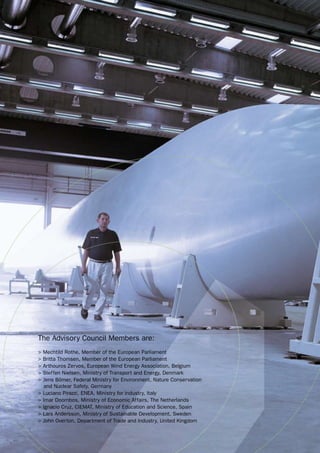
The Advisory Council Members are: 
> Mechtild Rothe, Member of the European Parliament 
> Britta Thomsen, Member of the European Parliament 
> Arthouros Zervos, European Wind Energy Association, Belgium 
> Steffen Nielsen, Ministry of Transport and Energy, Denmark 
> Jens Bömer, Federal Ministry for Environment, Nature Conservation 
and Nuclear Safety, Germany 
> Luciano Pirazzi, ENEA, Ministry for Industry, Italy 
> Imar Doornbos, Ministry of Economic Affairs, The Netherlands 
> Ignacio Cruz, CIEMAT, Ministry of Education and Science, Spain 
> Lars Andersson, Ministry of Sustainable Development, Sweden 
> John Overton, Department of Trade and Industry, United Kingdom
# 
Wind Energy: 
A Vision for Europe in 2030 
Table of Contents page 
Foreword #2 
Executive Summary #3 
1. Wind Energy Today #6 
2. Wind Energy in 2030 #8 
3. What Will This Mean for Europe? #10 
4. The European Wind Energy #14 
Technology Platform 
5. How Will it Work? #16 
6. An Industry Initiative #19 
Prepared by the Advisory Council of the 
European Wind Energy Technology Platform 
September 2006 
Contact: secretariat@windplatform.eu
# 
Foreword 
Wind energy is a European success story, but it is still just a shadow 
of what it could be. An enormous amount of fundamental, long term 
R&D, and policy development to build markets in the shorter term 
must be undertaken if wind energy is to become a major contributor 
to European elelctricity supply. 
Global competition is putting at risk European leadership in wind 
energy technology. For the moment, the EU leads wind energy 
development worldwide, but this lead has reduced in recent years as 
other regions of the world are discovering the economic potential of 
the technology. Once Europe loses this competitive advantage it may 
prove impossible to regain, and objectives under the Lisbon Action 
Plan, to make our continent the Number One knowledge based global 
economy, will be that much harder to attain. 
Wind energy is not a “drawing-board” technology. It is already showing 
its value, providing nearly 3% of European electricity. But this is not 
a reason to rest on our laurels. A European Technology Platform for 
wind energy is an essential step to enable us to build on success to 
date, through collaborative technology and market development. 
The Advisory Council of the European Wind Energy Technology 
Platform calls for the wind industry, Member State governments, EU 
institutions, R&D organisations, and the whole range of actors to 
work together to develop a Strategic Research Agenda and a Market 
Deployment Strategy that will guide wind energy towards meeting its 
full potential. 
I believe that the platform has the potential to boost wind energy 
development and to bring together private and public actors into an 
effective partnership for the future of wind energy and for Europe as 
a whole. 
Arthouros Zervos, President, EWEA.
# 
Europe today is the centre of an energy revolution 
that will impact the way we think about electricity 
as fundamentally as did the emergence of coal 
in the past. It is driven by the desire of European 
peoples to have cleaner, safer, more secure power 
to supply their needs, in contrast to the constrained 
fossil fuels of yesterday. 
Wind energy has the potential to be the cheapest 
power source in Europe, but like any emerging 
technology, it faces significant barriers. The existing 
market has developed around heavily subsidised 
and monopolistically-managed energy sources with 
very different characteristics: if wind energy is to 
penetrate European supply to a significant degree, 
its development must be viewed strategically. 
A strong wind energy sector does not only mean 
reduced CO2, cleaner air, and secure biodiversity. 
Sustainable economic growth, reduced energy 
import dependence, high quality jobs, technology 
development, global competitiveness, and 
European industrial and research leadership – 
wind is in the rare position of being able to satisfy 
all these requirements. Indeed wind energy can 
help significantly across the whole range of goals 
in the Lisbon Strategy to make Europe the world’s 
most dynamic and competitive knowledge based 
economy. 
Wind energy is sometimes mistakenly considered 
by some to be sufficiently “close to market” that 
it can be ignored. This is only true in that the 
“leading edge” of the technology, in cost terms, 
can be commercially competitive with newly 
built conventional technologies under certain 
conditions. 
However, technological research into wind energy 
has certainly not left the fundamental stage. It is 
rather the case that new ideas, with the promise 
of great returns in efficiency and cost in the long 
term, are starved of support because of short term 
imperatives. 
This Vision Document sets out the status of 
today’s wind energy industry and demonstrates 
the industry’s vision for what wind energy could do 
for Europe by 2030, if sufficient effort is applied to 
its development through the European Wind Energy 
Technology Platform (TPWind). 
The European Policy Context 
The Green Paper “A European Strategy for 
Sustainable, Competitive and Secure Energy”, 
produced by the European Commission in March 
2006 recognised the need for action: 
“For renewable energy to fulfil its potential, 
the policy framework needs to be supportive 
and in particular to stimulate increasing 
competitiveness of such energy sources (…) 
such as offshore wind. 
The full potential of renewable energy will only 
be realised through a long term commitment to 
develop and install renewable energy.” 
In turn, Commissioner Piebalgs recognised 
recently (Speech visiting Scotland, July 2006) 
that : 
“For me it is self-evident that the further 
development of renewable energy has to be 
one of the cornerstones of the EU’s future 
energy policy.” 
TPWind will be fundamental in ensuring that policy 
support is designed with clear understanding of 
the characterstics of wind energy, encouraging the 
development of least cost, maximum efficiency 
technology. 
Europe has the lead in wind energy development. 
To keep it, she must be able to fend off increased 
competition from countries with a significantly 
higher R&D investment spend, such as Japan and 
the USA, with 3% and 2.7% of their GDP respectively 
in 2000, compared with 1.9% in the EU. 
Such a view was endorsed in July 2004 by the 
Chairman of the Informal Competitiveness Council, 
Dutch Economy Minister Laurens Brinkhorst, who 
called for: 
“a limited number of platforms for precisely 
those areas in which Europe is successful, such 
as nanotechnology and wind power.” 
Executive Summary
# 
Participants of the Dutch EU Presidency’s Policy 
Workshop on the Development of Offshore Wind 
Energy, in Egmond, the Netherlands agreed that: 
“[Offshore] wind energy will contribute 
significantly to the Lisbon Strategy and EU 
objectives on technological development, 
exports, employment and regional development.” 
“Participants emphasise the need for setting up 
a Wind Energy Technology Platform within the 
framework of FP7, as proposed by the Informal 
Competitiveness Council.” 
At the follow up meeting in Copenhagen, in 
October 2005, participants in the policy workshop, 
including a dozen Member States, representatives 
of Transmission System Operators, the European 
Commission and industry, reiterated this call. 
“There is enormous potential and benefits of 
enhanced, EU-wide and global collaboration in 
wind power related research and development. 
Participants recommend the establishment under 
the 7th Framework programme of a Technology 
Platform for Wind Energy.” 
The EU’s RES-E Directive issued in 2001, on the 
promotion of electricity produced from renewable 
energy sources, targets the production in the EU- 
25 of 21% of all electricity from renewable energy. 
However, as stated in the green paper referred to 
above, under current trends, the EU will miss this 
target. 
Not all countries are under-performing however. 
If more collaboration across national borders is 
encouraged – one of the primary objectives of 
TPWind – expertise from countries further along 
the development pathway in wind energy terms 
can be transferred to those in the rear. It is for 
this reason that the most important wind energy 
Member States are already intimately involved in 
the work of TPWind, through the Advisory Council.
# 
A Coherent and Cogent Vision 
for Wind Energy Research and 
Development 
Research Commissioner, Janez Potocnik, stated in 
response to a written question from the European 
Parliament in 2005: 
“The Commission is concerned by the decreasing 
trend of the RTD spending in the field of renewable 
energy sources these last twenty years both at 
the national and European levels. If this trend is 
not reversed by a substantial increase of funding 
in the future, it could hamper the progress of 
renewable energies in the EU energy mix.” 
Research and development in the wind energy 
sector can be characterised by the following 
factors: 
• A core of experience concentrated in just a 
few countries 
• Very limited long term research resources 
• A near competitive “leading edge” to the 
industry, in cost terms, which overshadows 
collaborative, fundamental research 
• A dispersed collaborative research and 
development effort. 
TPWind will endeavour to spread wind energy 
experience across the EU region through direct 
interaction among Member State Governments. To 
expand research budgets, it will investigate new 
opportunities for funding at national and EU levels 
and draw in increased funding from private industry, 
encouraging more attention on long term R&D. 
TPWind will identify the “must-haves” research 
tasks, communicate their importance to policy 
makers and encourage private industry to address 
them to facilitate step change. 
To mitigate the dispersed nature of the present 
research effort, the platform will gather together 
all elements of the wind energy sector, public and 
private, national and EU, to address how best to 
renew fundamental technology and policy research 
and development. 
Support for the initiative is strong. The wind sector 
has expressed the need for TPWind repeatedly, 
while Member State Ministries make up the core of 
the Advisory Council, established earlier this year. 
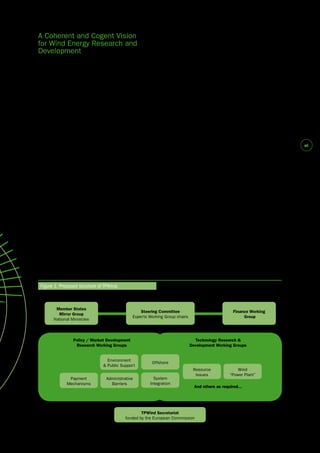
Figure 1: Proposed structure of TPWind. 
Environment 
& Public Support 
Offshore 
Administrative 
Barriers 
System 
Integration 
Payment 
Mechanisms 
Wind 
“Power Plant” 
Resource 
Issues 
TPWind Secretariat 
funded by the European Commission 
Member States 
Mirror Group 
National Ministries 
Steering Committee 
Experts Working Group chairs 
Finance Working 
Group 
Policy / Market Development 
Research Working Groups 
Technology Research & 
Development Working Groups 
And others as required...
# 
Wind energy has come a long way in the last 
two decades. At a given site, a single modern 
wind turbine annually produces 180 times more 
electricity and at less than half the cost per kilowatt-hour 
(kWh) than its equivalent of 20 years ago. 
Today, Europe leads the world in terms of 
manufacturing and development of wind farms. In 
1994, there were 1,683 megawatts (MW) of wind 
energy installed across the EU. By the end of 2005, 
installed capacity had increased 24 times and 
some 40 gigawatts (GW) of cumulative installed 
capacity were providing about 2.8% of European 
electricity consumption. Still, the potential of wind 
energy is far greater. 
European companies are world champions in 
the manufacturing of wind turbines and their 
components. Seven of the top ten turbine 
manufacturing companies are based in Europe. In 
2004 they accounted for 82% of the global market, 
supplying the turbines that established growing 
markets in India and USA for example. In turn, 
European developers also go ahead in setting up 
wind farms and are responsible for building 69% of 
them worldwide. 
But this position is at risk. The emergence of 
domestic suppliers in those countries, and in 
countries where intellectual property rights are less 
rigorously upheld, means that European exporters 
must increase innovation in order to stay ahead of 
the market. 
TPWind is to counteract this emerging problem: 
R&D funding should be based on the potential 
for further technology advances and commercial 
opportunities of a technology. Offshore wind energy 
is probably ten years behind onshore wind power 
and only limited development has taken place. But 
the future potential is almost boundless if further 
research and development is carried out. 
A Great Story 
The story of wind energy’s development to date 
is a remarkable one but it is far from finished. 
Fundamental research challenges in a number 
of disciplines remain, from understanding the 
wind energy resource, to developing high strength 
to mass ratio materials, to power electronics 
for quality output at low cost, and even more 
spectacular achievements will result. 
1. Wind Energy Today 
m) (diameter 112 m Ø 
Rotor 15 m Ø 
? 1st year of operation 
126 m Ø 
160 m Ø 
'85 '87 '89 '91 '93 '95 '97 '99 '01 '03 '05 
.05 .3 .5 1.3 1.6 2 4.5 5 8/10 MW 
? 
installed power 
Figure 2: The size of wind turbines at market introduction. 
1 See http://www.ewea.org/fileadmin/ewea_documents/documents/ 
projects/SRA/SRA_final.pdf 
Source: Jos Beuskens, ECN
# 
These challenges are illustrated in the sector’s 
recent Strategic Research Agenda1, developed by 
the FP5 funded Wind Energy Thematic Network. 
TPWind will build on this draft, to provide a much 
more detailed analysis of which tasks should 
take priority, to make best use of limited financial 
resources; and to reflect the importance of 
fundamental research to the wind energy sector, 
TPWind will continue to collaborate closely with DG 
Research. 
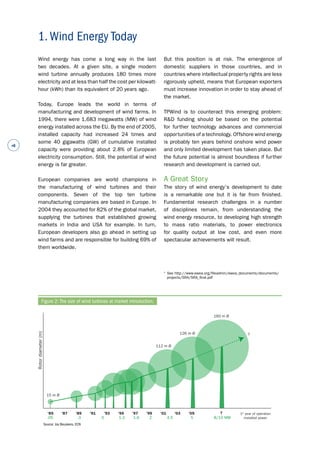
The size of commercially available grid connected 
horizontal axis wind turbines has evolved from 
about 0.022 MW in the early nineteen eighties 
to about 6 MW today. These larger machines are 
being developed principally, though not solely, 
through the drive to take the technology offshore. 
However, the notoriety of “big-wind” technology 
should not be allowed to eclipse the fact that 
other paths continue to be developed, from the 
smaller 600 kW, off-grid application turbines, right 
down to turbines of just a few kilowatts or less, 
which can provide essential power for isolated 
communities, lighting for individual homes and 
power for schools and hospitals, not least in many 
developing countries where electricity is still not 
part of everyday life for many citizens. 
Many different design concepts are in use, the 
most common among larger turbines being three-bladed, 
pitch regulated, horizontal axis machines. 
As “big wind” has grown larger and larger, the 
way in which important design parameters have 
changed with size can be used to predict how 
turbines may develop in the future. For various 
design parameters these trends can be used to 
establish key challenges for the industry. 
Going Offshore 
Currently, offshore installations only constitute a 
very small part of the market, but their future looks 
bright and therefore constitutes the main driver for 
large turbine technology development. 
The existence of energy interests already offshore 
does not mean that offshore wind technology is 
just an “add-on” – far from it. Although a mature 
European offshore industry exists in the context of 
oil and gas recovery, the demands of offshore wind 
farms are quite specific and ongoing development is 
expected in the areas of foundations, access, wind 
farm electrics, transportation and erection. In the 
oil and gas industry, maintaining production is of 
overriding importance and justifies high capital cost 
solutions. In the wind industry, production is also 
vital, but so also is minimisation of capital costs. 
Oil rigs are massive one-off constructions whereas 
a large offshore wind farm may have hundreds 
of turbine units. So while the existing offshore 
industry possesses knowledge and experience of 
considerable value to the wind industry, it can not 
provide “off-the-shelf” equipment that is optimum 
for wind farm establishment.
# 
A wind-powered future would mean reduced risks 
associated with fossil and nuclear fuels. Wind 
power entails no geo-political risk, reduces external 
energy dependence, reduces the need for energy 
imports, has no fuel costs, no fuel price risk, no 
resource constraints, no CO2 and other harmful 
emissions and no radioactive waste. 
Reliable, clean power for European domestic consumers 
and reduced power costs for increasingly high energy 
use industries can be obtained, and more cheaply than 
today. Energy is fundamental to any economy; wind 
energy can be a driver for European growth. 
With the right kind of collaboration and investment, 
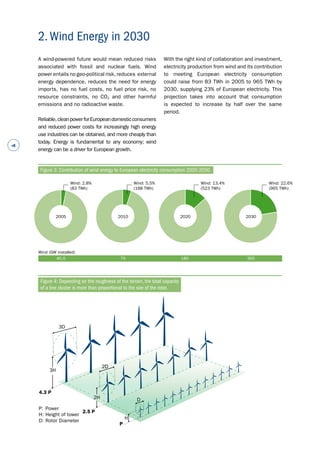
electricity production from wind and its contribution 
to meeting European electricity consumption 
could raise from 83 TWh in 2005 to 965 TWh by 
2030, supplying 23% of European electricity. This 
projection takes into account that consumption 
is expected to increase by half over the same 
period. 
2. Wind Energy in 2030 
Wind: 2.8% 
(83 TWh) 
Wind: 5.5% 
(188 TWh) 
Wind: 13.4% 
(523 TWh) 
2005 2010 2020 2030 
Wind (GW installed) 
40.5 75 180 300 
Wind: 22.6% 
(965 TWh) 
Figure 3: Contribution of wind energy to European electricity consumption 2005-2030. 
Figure 4: Depending on the roughness of the terrain, the total capacity 
of a line cluster is more than proportional to the size of the rotor. 
3H 
2H 
H 
2D 
3D 
D 
P: Power 
H: Height of tower 
D: Rotor Diameter 
P 
2.5 P 
4.3 P
# 
Twice the Turbines and 
Twelve Times the Power 
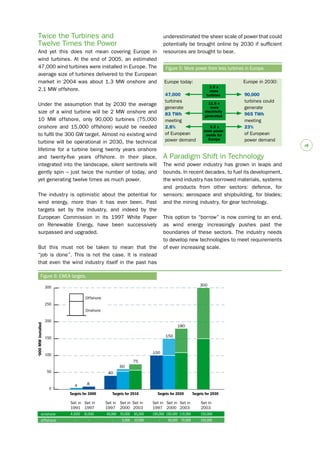
And yet this does not mean covering Europe in 
wind turbines. At the end of 2005, an estimated 
47,000 wind turbines were installed in Europe. The 
average size of turbines delivered to the European 
market in 2004 was about 1.3 MW onshore and 
2.1 MW offshore. 
Under the assumption that by 2030 the average 
size of a wind turbine will be 2 MW onshore and 
10 MW offshore, only 90,000 turbines (75,000 
onshore and 15,000 offshore) would be needed 
to fulfil the 300 GW target. Almost no existing wind 
turbine will be operational in 2030, the technical 
lifetime for a turbine being twenty years onshore 
and twenty-five years offshore. In their place, 
integrated into the landscape, silent sentinels will 
gently spin – just twice the number of today, and 
yet generating twelve times as much power. 
The industry is optimistic about the potential for 
wind energy, more than it has ever been. Past 
targets set by the industry, and indeed by the 
European Commission in its 1997 White Paper 
on Renewable Energy, have been successively 
surpassed and upgraded. 
But this must not be taken to mean that the 
“job is done”. This is not the case. It is instead 
that even the wind industry itself in the past has 
300 
250 
200 
150 
100 
50 
0 
Figure 5: More power from less turbines in Europe. 
Europe today: Europe in 2030: 
47,000 
turbines 
generate 
83 TWh 
meeting 
2,8% 
of European 
power demand 
1.9 x 
more 
turbines 
11.6 x 
more 
electricity 
generated 
8.2 x 
more power 
needs for 
Europe 
Targets for 2000 Targets for 2010 Targets for 2020 Targets for 2030 
Set in Set in 
Set in Set in Set in 
1991 1997 
1997 2000 2003 
1997 2000 2003 
4,000 8,000 
40,000 55,000 65,000 
100,000 100,000 110,000 
– – 
– 5,000 10,000 
– 50,000 70,000 
onshore 
offshore 
Set in 
2003 
150,000 
150,000 
4 8 
40 
60 
75 
100 
150 
180 
300 
‘000 MW installed 
Offshore 
Onshore 
underestimated the sheer scale of power that could 
potentially be brought online by 2030 if sufficient 
resources are brought to bear. 
90,000 
turbines could 
generate 
965 TWh 
meeting 
23% 
of European 
power demand 
A Paradigm Shift in Technology 
The wind power industry has grown in leaps and 
bounds. In recent decades, to fuel its development, 
the wind industry has borrowed materials, systems 
and products from other sectors: defence, for 
sensors; aerospace and shipbuilding, for blades; 
and the mining industry, for gear technology. 
This option to “borrow” is now coming to an end, 
as wind energy increasingly pushes past the 
boundaries of these sectors. The industry needs 
to develop new technologies to meet requirements 
of ever increasing scale. 
Figure 6: EWEA targets.
#10 
3. What Will This Mean For Europe? 
More Secure Electricity Supply 
On 8 March 2006, the European Commission 
released its Green paper “A European Strategy 
for Sustainable, Competitive and Secure Energy.” 
Energy is one of the most important raw materials 
of any economy, and will continue to be unless it 
is decoupled from economic growth. Its secure 
supply to meet European needs is one of the 
greatest challenges of the 21st Century. 
Conventional fossil and nuclear fuels are 
increasingly in short or constricted supply, sourced 
in just a few countries, many of them subject to 
unstable regimes, or hindered in export terms by 
their geography. The oil price has peaked above 
USD 70 per barrel, and will continue to rise 
dragging gas prices with it. The IEA predicts that by 
2030 Europe will rely on foreign imports for 70% of 
its energy needs, making reliance on such sources 
even less desirable. Crystallisation of research 
efforts to maximise the use of Europe’s own, 
indigenous wind energy source will strengthen the 
foundations of the European economy. 
European Trade 
Wind energy can help the European balance of 
trade not only by reducing the need for imported 
energy fuels, but through increased exports. It 
is not only Europe that is waking up to the need 
for increased energy independence, worldwide 
markets are opening up from which Europe is in 
a unique position to benefit if it acts now. TPWind 
will provide the “critical mass” of expertise and 
the collaborative approach needed to ensure EU 
export markets are reinforced. 
Private Sector Involvement & the 
‘Barcelona Objective’ 
The EU’s Integrated Guidelines for Growth and Jobs 
state that a major reason for decreased growth in 
European productivity is due to: 
“low business investment and a slowdown in the 
rate of technological progress and innovation…” 
Wind industry investment in R&D in some cases 
already exceeds 3% of revenue, mirroring the target 
set by the EU at the Barcelona European summit in 
2002, to plough 3% of GDP into research. 
But the imperative of the Barcelona Objective 
overshadows an important factor: it is not merely 
a question of the percentage of GDP that is 
ploughed back into research; the timescale is 
equally important. R&D must target the long term. 
Or - once the low hanging fruit accessible through 
short term research are harvested - innovation 
may dry up. 
By way of example, the sector has had to leave 
unexplored a number of development pathways that 
could yield very great returns for the technology. 
One has only to look at the diversity of turbine 
types and materials of twenty years ago to see this. 
The standard three-bladed upwind turbine of today 
became the norm partly because the sector has 
had to establish standards in order for the market 
to develop; and other technology pathways have 
consequently withered away for lack of funds. The 
small wind energy sector is just one example of a 
leviathan starved for lack of long term research 
attention. 
The existing need to focus on the short term is 
nonetheless justified to an extent. Manufacturers, 
responsible to shareholders, need to get their 
products to market as quickly as possible, to 
generate profit. Only a certain amount of this 
revenue will be available to fund R&D, and, to 
minimise risk and lead times, this is generally 
focused on the short term.
#1 
Through its Strategic Research Agenda, TPWind 
will encourage the industry to intensify its research 
efforts in line with, or exceeding, the overall EU 3% 
objective, while increasing the focus on the long 
term view, and it will encourage the uptake of long 
term research findings in the development of new 
prototypes. 
Through the Market Deployment Strategy, Member 
States, EU institutions and the industry will be 
able to tailor policy development against the 
changing needs of the technology as it matures. 
TPWind recognises the importance of addressing 
market and technology development concurrently. 
To prevent long term research from remaining on 
the “drawing board” it is essential that sufficient 
support exists to test prototypes and encourage 
their market entry. 
Looking Out for SMEs 
The tendency towards focus on the low hanging 
fruit, in research terms, is exacerbated by the fact 
that the majority of wind energy sector companies 
are SMEs, and lack the necessary reserves to 
sustain them over the long lead times, or in the 
eventuality that costly, lengthy research proves in 
the end to be fruitless - not an uncommon event in 
emerging technology sectors. 
TPWind can be instrumental in enabling wind 
energy SMEs to access existing R&D funds, and 
share financial risk. 
High Quality Jobs 
Wind sector employment has increased considerably 
in the last two decades, but only in a few countries, 
while the potential exists in many. Within the EU 
(at end 2003) 90% of employment in turbine 
and component manufacturing was restricted to 
Germany, Spain and Denmark. According to the 
figures that exist, the wind power sector currently 
employs around 64,000 people in Germany (BWE, 
2006); around 21,000 in Denmark (DWIA, 2006) 
and 35,000 in Spain (AEE, 2006). These figures 
only reflect some types of direct employment and 
therefore underestimate the total impact that 
wind energy has on related and complementary 
sectors. 
More wind generated electricity in the European 
system will yield a net increase in jobs, even 
after taking into account the number of displaced 
jobs related to conventional energy. Moreover, 
employment will be dispersed around Europe, 
concentrated approximately in areas with the 
highest wind resource, including rural, mountainous 
and marginalised areas. 
The MITRE study, carried out under the ALTENER 
Programme, rates the opportunities for wind 
energy employment very highly. Under its Advanced 
Renewable Strategy, assuming increased 
technology and policy development, by 2010 wind 
energy could be employing 282,000 people; and 
by 2020, as many as 368,000. In both scenarios, 
new jobs from wind energy constitute about 25% of 
new renewable energy employment.
#12 
The difference in employment under the two 
scenarios is not only that of nearly 100,000 jobs. 
In the advanced scenario, benefiting from more 
proactive efforts, around 55% of employment is 
to be had from offshore wind, as opposed to just 
35-45% from offshore under the existing support 
scenario. This reflects very precisely the need 
for TPWind because without it, wind energy could 
remain stagnated within the boundaries of existing 
technology. 
Education of a New Workforce 
Given the high-tech nature of wind energy 
technology, increased employment from wind 
energy will raise the European skills standard, 
as targeted in the Lisbon Action Plan. To do this, 
those who fully understand the needs must come 
together to develop curricula and precisely identify 
the needs for the industry. 
TPWind will gather those in the sector already 
involved in the education of new staff, to exchange 
needs and develop curricula; and moreover 
will enable dialogue between such academic 
institutions and industry itself, so that employment 
needs can be precisely identified and catered for. 
A Healthy Environment 
According to the conclusions of “Energy and 
Environment in the European Union - Tracking 
Progress Towards Integration”, a new report from 
the European Environment Agency, more action 
is required to reduce energy consumption and 
to encourage the introduction of technologies 
with low environmental impacts. In particular, 
it recommends greater use of renewable energy 
sources and reiterates the need for long term 
targets (beyond 2010), to provide a clear direction 
for EU energy policy. The publication highlights 
the need for governments around the world 
to encourage investment in renewable energy 
technologies. 
The successful meeting of wind energy targets 
for 2020 and 2030 will be instrumental in a large 
proportion of the drive to decouple economic growth 
from environmental degradation. A dedicated 
Working Group on environment and public opinion 
will assess what needs to be done to effectively 
address potential single and cumulative impacts 
on avian, terrestrial and marine ecosystems. 
TPWind objectives are closely aligned with those of 
the Environmental Technologies Action Plan (ETAP): 
“Getting from Research to Markets; Improving 
Market Conditions” and “Acting Globally.” The 
Environment and Public Support Working Group 
will place emphasis on environmental impacts of 
wind energy development, maintaining close links 
with environmental NGOs. 
Slowing Climate Change 
Environmental pollution and the emission of CO2 
from the use of fossil fuels constitute a threat to 
health, the environment and sustainable economic 
growth. The use of fossil fuels is responsible for 
70% of greenhouse gas emissions. 
The climate change challenge must include a shift 
in the way we produce and consume energy. Many 
solutions and approaches are being developed 
to reduce emissions, e.g. emissions trading 
and the flexible mechanisms under the Kyoto 
Protocol. However, it is important to acknowledge 
that the cheapest solution in the short run is not 
necessarily the cheapest long term solution. In the 
long term, Europe must accelerate its transition to 
non-conventional sources of energy. 
Wind power can make a substantial contribution to 
the EU emission reduction targets under the Kyoto 
Protocol. With sufficient emphasis on technological 
R&D and market development, wind could meet 
30% of the Union’s obligation by 2010.
#13 
The European Environment Agency (EEA) 
assessment on greenhouse gas emission trends in 
Europe concluded that “the promotion of renewable 
energy has the greatest impact on emissions in 
most EU Member States for both implemented 
and planned policies”. In 2001, the European 
Commission listed 42 cost-effective reduction 
options, among which the EEA then identified 6 of 
the most promising ones: renewable energy was 
ranked in first place. 
Regional Development 
From the regional perspective, wind energy is very 
different from conventional technologies. The wind 
energy resource is not limited to coastal areas 
and industrial centres. Regions like Jylland in 
Denmark, and Galicia in Spain are leading global 
wind energy development and grid integration, 
and factories are being built in areas with the 
most promising resources. This means increased 
employment in otherwise potentially marginalised 
areas. Wind farms provide further employment in 
operations and maintenance in rural areas, as well 
as valuable opportunities for farming communities 
to supplement their incomes in times of low 
agricultural prices, such as in the hill sheep-farming 
communities of west Wales in Great Britain. 
New Member States are rapidly increasing their 
energy consumption as comfort levels and 
aspirations rise, and urgent attention to wind 
energy cost reductions and deeper understanding 
of the environmental benefits of wind energy are 
vital if such countries are to be encouraged to 
embrace it when developing new capacity. 
Levelling the Playing Field in 
the Internal Electricity Market 
In March 2006, Energy Commissioner Andris 
Piebalgs said: 
“It is clear that today there remains too many 
barriers to competition and too many differences 
between the rules of the game in the different 
Member States. Markets remain national in scope 
and there is no level playing field. Half finished 
liberalisation in these sectors will not bring all 
the benefits to EU citizens and industry that we 
have set out to achieve, and the Commission is 
deeply committed to resolving this.” 
Well, much work still remains to be done. Since 
2001, the European Commission has monitored 
the development of market opening and competition 
in the power market through the so-called 
“Benchmarking Reports”. Member States’ varying 
degrees of success in market opening have led to 
significant distortions of competition. An uneven 
playing field exists for companies from different 
countries. In other words the national, somewhat 
patchwork approach is so far failing to lead to the 
development of a competitive, integrated internal 
energy market. 
As the Commission’s findings demonstrate, wind 
energy is seeking to gain access to a seriously 
distorted, monopolistic, established market where 
vested interests exist that will hinder access. 
TPWind will specifically address how Member 
States can increase competition, encourage 
third party access to the infrastructure and avoid 
distortion. It is essential that TPWind be able to 
represent the combined benefits wind energy can 
bring consumers, with a voice loud enough to be 
heard above that of vested interests.
#14 
4. The European Wind Energy Technology Platform 
The European Wind Energy Technology Platform 
(TPWind) will be the indispensable forum for the 
crystallisation of policy and technology research 
and development pathways for the wind energy 
sector; as well as a new opportunity for informal 
collaboration among Member States, including 
those less developed in wind energy terms. 
The overarching objective of TPWind is to drive wind 
power cost reductions down to parity with currently 
cheaper alternatives. That is not taking into 
account the external costs of conventional power 
generation, or the very great subsidies accorded to 
those technologies, estimated to be in the region 
of USD 250 – 300 billion per annum, globally. 
Historically, the principal drivers for wind energy 
cost reductions have been R&D, for approximately 
40%; and economies of scale, for around 60%. The 
scope of TPWind mirrors this duality. TPWind will 
focus not only on short to long term technological 
R&D, as is the case with other existing platforms, 
but also on potential market development 
“showstoppers”, through a number of Policy 
Working Groups. 
R&D in the wind energy sector is characterised 
by a core of experience concentrated in just a 
few countries; very limited long term research 
resources; a highly competitive “leading edge” to 
the industry, in cost terms, which overshadows 
collaborative, fundamental research; and a very 
dispersed collaborative research and development 
effort. 
Thus the need for: 
• Diffusion of expertise around the European 
Union, to areas with great potential and limited 
activity, and shared access to infrastructure 
• Identifying and mobilising increased funding, 
as well more efficient use of existing funds 
• A method of gathering together on-going 
projects to share outcomes and generate 
useful further actions 
• Development of clear, shared long term 
priorities, taking into account concerns 
regarding intellectual property rights and 
confidentiality issues, which can be addressed 
by the wind energy sector as a whole, leading 
to fundamental innovation and step-change.
#15 
Diffusion of Expertise 
91% of cumulative installed wind energy capacity 
at the end of 2005 was located in just seven 
EU countries, and 70% in just two: Germany and 
Spain. Less than 0.005% was installed in the 
newer Member States that joined in 2004. In the 
absence of market mechanisms that internalise 
the environmental damage caused by different 
electricity sources, the vast majority of wind energy 
know-how exists in European states, benefiting 
from higher wealth per capita. This will remain the 
norm in the absence of long term research aimed 
at cost reduction. 
While TPWind will be instrumental in accelerated 
cost reductions; equally important to wind 
energy deployment, it will seek out actors in 
transition economies who can catalyse their own 
development. It is doubly important that wind 
energy is encouraged in such countries. Fossil fuel 
energy use is soaring, with disastrous effects in 
environmental terms. If those countries can be 
encouraged to develop wind energy to supply this 
new demand, a great pre-emptive strike will have 
been made against increased pollution. 
It is not just installed capacity that is confined 
to just a small number of States, but research 
infrastructure also. Very few blade-testing facilities, 
wind tunnels, and other testing facilities exist, 
and even fewer that are able to accommodate 
the ever increasing scale of wind turbines. Such 
facilities can be prohibitively expensive. The 
sector should share what it has, necessitating 
increased collaboration towards agreed, pre-competitive 
goals. The Member State Mirror Group 
can facilitate the complementary development of 
national research programmes to avoid duplication 
of efforts and assign tasks according to varying 
national resources, infrastructure, and expertise. 
Central Point of Reference 
TPWind will develop sector sensitivity. It will 
prioritise research and development tasks on the 
basis of “must haves” versus “nice to haves”. The 
platform will prepare coherent recommendations 
detailing specific tasks, including pilot projects, 
approaches, actors and necessary infrastructure 
for new research. 
Too often the findings of individual projects gather 
dust and are underused, effectively wasting scarce 
financial resources. TPWind will bring projects and 
their stakeholders together, to synergise their 
activities and extrapolate areas where further work 
is required, a force to strengthen the European 
Research Area. 
There are a number of recent and existing projects 
and research initiatives in the wind energy sector, 
at both national and EU levels. TPWind will act as a 
“docking station” providing a common feed in point 
for their findings, and will use this information to 
refine its research strategies. At the EU level, 
these projects include among others the UpWind 
integrated project, the DOWNVInD integrated 
project, the POW’WOW network, ANEMOS, the 
Hogsara Island Project, STANDICE, Windlider 2015, 
TradeWind and the European Wind Integration 
Study.
#16 
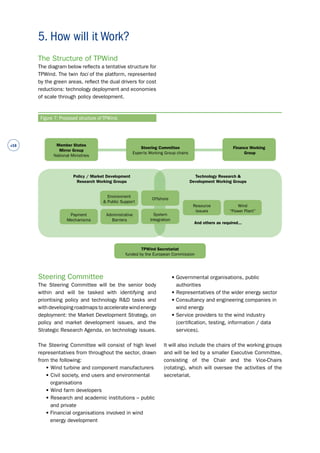
The Structure of TPWind 
The diagram below reflects a tentative structure for 
TPWind. The twin foci of the platform, represented 
by the green areas, reflect the dual drivers for cost 
reductions: technology deployment and economies 
of scale through policy development. 
Steering Committee 
The Steering Committee will be the senior body 
within and will be tasked with identifying and 
prioritising policy and technology R&D tasks and 
with developing roadmaps to accelerate wind energy 
deployment: the Market Development Strategy, on 
policy and market development issues, and the 
Strategic Research Agenda, on technology issues. 
The Steering Committee will consist of high level 
representatives from throughout the sector, drawn 
from the following: 
• Wind turbine and component manufacturers 
• Civil society, end users and environmental 
organisations 
• Wind farm developers 
• Research and academic institutions – public 
and private 
• Financial organisations involved in wind 
energy development 
• Governmental organisations, public 
authorities 
• Representatives of the wider energy sector 
• Consultancy and engineering companies in 
wind energy 
• Service providers to the wind industry 
(certification, testing, information / data 
services). 
It will also include the chairs of the working groups 
and will be led by a smaller Executive Committee, 
consisting of the Chair and the Vice-Chairs 
(rotating), which will oversee the activities of the 
secretariat. 
5. How will it Work? 
Figure 7: Proposed structure of TPWind. 
Environment 
& Public Support 
Offshore 
Administrative 
Barriers 
System 
Integration 
Payment 
Mechanisms 
Wind 
“Power Plant” 
Resource 
Issues 
TPWind Secretariat 
funded by the European Commission 
Member States 
Mirror Group 
National Ministries 
Steering Committee 
Experts Working Group chairs 
Finance Working 
Group 
Policy / Market Development 
Research Working Groups 
Technology Research & 
Development Working Groups 
And others as required...
#17 
Member States Mirror Group (MSMG) 
This will comprise the relevant ministries and 
energy agencies of Member States that wish to 
participate. The seven Member States with the 
greatest installed capacity are already part of 
TPWind through the Advisory Council, and the 
involvement of some others is pending. 
The MSMG is fundamental to the success of the 
Technology Platform for Wind Energy. It will provide 
an opportunity to tailor national R&D activities to 
complement EU activities, and vice versa, and to 
develop synergies. It is also an opportunity for 
Member States to collaborate in pushing forward 
some of the short term operational issues facing 
wind energy, such as those described in the 
Copenhagen Declaration. 
Technology and Policy 
R&D Working Groups 
Working groups will be established to handle 
particular facets related to accelerated and 
innovative wind energy R&D. 
Technology Working Groups will address the 
complete range of short, medium and long term 
issues from resource assessment to power output, 
including their findings in the Strategic Research 
Agenda. Policy Working Groups will develop the 
Market Development Strategy, which will detail 
the tasks facing the wind sector in the short to 
medium term. 
Groups will include the following, with the initiation 
of others as the need arises: 
1. Wind resource and site assessment, micro-siting, 
measurement and prediction, including 
offshore, complex and extreme conditions 
2. Wind “Power Plants”, including turbine 
components, turbines, new wind farm 
concepts, and small wind energy technology 
3. System Integration: the input into the 
European electricity system of maximum 
quality, highly reliable power 
4. Innovation for dedicated offshore technology, 
and the development of a European policy for 
offshore wind energy 
5. Environmental issues focusing in particular on 
potential cumulative environmental impacts 
on marine, avian and terrestrial ecosystems, 
and public support 
6. Payment mechanisms for wind energy, taking 
into account the possibility of a harmonised 
European payment mechanism for renewable 
energy 
7. Administrative barriers to wind energy. 
Finance Working Group 
One of the key concerns of the platform is the 
assessment and procurement of sufficient funds to 
pay for the innovation and R&D tasks it identifies. 
The Finance Working Group will explore and quantify 
the complete range of opportunities for research 
funding, which can then be matched to the tasks 
as prioritised by the Steering Committee. 
The Finance Working Group will endeavour to build 
up the role of private industry in collaborative R&D, 
and to identify new sources of investment in the 
public sector through, for example, the Structural 
Funds. It will also investigate opportunities to be 
had through the new initiative of the European 
Investment Bank (EIB) and the European 
Commission—the Risk-Sharing Finance Facility— 
to leverage EIB loan investments in large European 
R&D projects and infrastructures. 
Working With Other Sectors 
to Create New Synergies 
TPWind will not operate in isolation. It will build 
up synergies and links with actors throughout the 
wider energy sector, including adjacent technology 
platforms. There are many opportunities for 
collaboration where research is less encumbered 
by competition concerns, to share essential 
infrastructures, for example, and facilities for 
fundamental, basic research in new areas. 
The issue of integrating wind energy into the 
European electricity system is a case in point. As 
explained above, wind energy technology is not a 
“finished product”. It is not a module of electricity 
generation that can be “inserted” into models of 
future grid development. Fundamental research is 
ongoing into improving the quality and reliability 
of wind farms that will impact on its requirements 
and the benefits it offers. 
Both technology and policy related to system 
integration are addressed through a specific TPWind 
Working Group, whose objective is to maximise 
reliability and quality of electrical output.
#18 
This working group has the competence to identify 
how to generate high quality power for inclusion in 
the electricity supply system. 
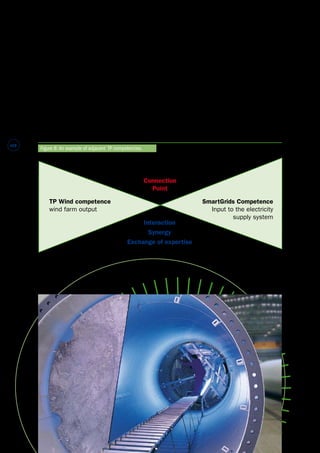
On the other side of the connection point, where 
wind generated electricity flows into the supply 
system, the SmartGrids platform will have the 
competence to deliberate upon the most efficient 
way of transporting the power to the consumer. 
This distinction in the tasks of adjacent platforms 
is summarised in the diagram below. 
TPWind will interact with a number of platforms 
(SmartGrids, photovoltaics, aeronautics, hydrogen 
and fuel cells, etc.), where existing and potential 
synergies are identified. 
The interaction, on the part of TPWind, will not be 
passive. As well as sharing its findings with the 
technology platforms listed above, the TPWind 
Steering Committee will be keen to “exchange” 
members to participate in the Steering Committees 
and Working Groups of these platforms, in order to 
facilitate interaction. 
Figure 8: An example of adjacent TP competencies. 
Connection 
Point 
TP Wind competence 
wind farm output 
SmartGrids Competence 
Input to the electricity 
supply system 
Interaction 
Synergy 
Exchange of expertise
#19 
TPWind has been an initiative of the European 
industry since its inception, led by the European 
Wind Energy Association (EWEA). EWEA is the 
voice of the wind industry including manufacturers 
covering 98% of the global wind power market, as 
well as component suppliers, research institutes, 
national wind and renewables associations, 
developers, electricity providers, finance and 
insurance companies and consultants. 
In 2001, with the support of the European 
Commission, and in collaboration with 
manufacturers, end users, developers, financiers, 
insurers, and R&D institutions, EWEA established 
the Wind Energy R&D Thematic Network to identify 
research tasks facing the industry in the decades 
ahead. In a series of reports over four years, the 
project identified a range of tasks falling into nine 
research themes. 
The thematic network first made its call for a 
European Wind Energy Technology Platform 
publicly in January 2004, when it launched 
“The European Wind Industry Strategic Plan 
for Research and Development,” with special 
guests Ole Gunneskov, R&D Director of 
NEG Micon (since merged with Vestas) and 
then Commissioner for Research, Philippe 
Busquin. 
“The power plant cost curve has to be 
broken, not once, but several times involving 
significant technology or concept changes. 
If this is not accomplished larger turbines 
may miss the target of reduced generation 
costs. Single turbine manufacturers cannot 
take on these R&D activities which have 
to be started or restarted in the scientific 
community now.” 
Ole Gunneskov, R&D Director, NEG Micon. 
“Wind power is a prime example of how an 
ambitious European research effort can give 
Europe a very strong leadership. [...The R&D 
strategy] contributes both to our research policy 
objective of reaching 3% of GDP for research 
investment by 2010, and to our energy policy 
objective of reaching 12% of renewable energy 
by the same date.” 
Philippe Busquin, Commissioner for Research. 
The Wind Energy Thematic network subsequently 
established the Think Tank on Integrated Projects, 
gathering together key industry and research 
stakeholders with a view to proposing an integrated 
project on design tools to develop a new generation 
of wind turbines to be built after 2010. This 
initiative led to the establishment of the UpWind 
project, involving 40 partners from private industry 
and research organisations. 
6. An Industry Initiative
#20 
The Wind Energy Thematic Network came to a close 
in 2005 with the publication of “Prioritising Wind 
Energy Research”, the first Strategic Research 
Agenda of the wind energy sector. This initial draft 
looks towards 2020. The new draft to be developed 
as an early outcome of the Steering Committee of 
TPWind in 2007 will address a longer time scale, 
up to 2030. 
The Strategic Research Agenda represents only a 
first visitation of the needs of the sector. Although 
it covers a great deal of the tasks facing the sector, 
it is not fully comprehensive as it represents the 
views of a smaller group of stakeholders than will 
TPWind. 
Also, in so far as prioritising the tasks, it 
does so only in terms of “show-stoppers”, 
“barriers” and “bottlenecks.” While these 
are useful distinctions, they are far from 
sufficient compared to the level of detail 
needed to adequately draw up research 
road maps, assign tasks to stakeholders, 
and ascertain the degree and sources of 
the required funding. Such are the next 
challenges of TPWind.
#21 
Acknowledgements 
Design: Martin Dieryck, mardi.be 
Photography: EWEA, GE, Risoe National Laboratory, Vestas Wind Systems.
About TPWind 
The European Wind Energy 
Technology Platform (TPWind) will 
be the indispensable forum for the 
crystallisation of policy and technology 
research and development pathways 
for the wind energy sector; as well 
as a new opportunity for informal 
collaboration among Member States, 
including those less developed in 
wind energy terms. 
The overarching objective of TPWind 
is to drive wind power cost reductions 
down to parity with currently cheaper 
alternatives. 
TPWind Secretariat 
Renewable Energy House 
Rue d’Arlon 63-65 
1040 Brussels – Belgium 
secretariat@windplatform.eu 
Supported by 
the European Commission

061003 vision final

  • 1.
    Wind Energy: AVision for Europe in 2030 Prepared by the TPWind Advisory Council
  • 2.
    The Advisory CouncilMembers are: > Mechtild Rothe, Member of the European Parliament > Britta Thomsen, Member of the European Parliament > Arthouros Zervos, European Wind Energy Association, Belgium > Steffen Nielsen, Ministry of Transport and Energy, Denmark > Jens Bömer, Federal Ministry for Environment, Nature Conservation and Nuclear Safety, Germany > Luciano Pirazzi, ENEA, Ministry for Industry, Italy > Imar Doornbos, Ministry of Economic Affairs, The Netherlands > Ignacio Cruz, CIEMAT, Ministry of Education and Science, Spain > Lars Andersson, Ministry of Sustainable Development, Sweden > John Overton, Department of Trade and Industry, United Kingdom
  • 3.
    # Wind Energy: A Vision for Europe in 2030 Table of Contents page Foreword #2 Executive Summary #3 1. Wind Energy Today #6 2. Wind Energy in 2030 #8 3. What Will This Mean for Europe? #10 4. The European Wind Energy #14 Technology Platform 5. How Will it Work? #16 6. An Industry Initiative #19 Prepared by the Advisory Council of the European Wind Energy Technology Platform September 2006 Contact: secretariat@windplatform.eu
  • 4.
    # Foreword Windenergy is a European success story, but it is still just a shadow of what it could be. An enormous amount of fundamental, long term R&D, and policy development to build markets in the shorter term must be undertaken if wind energy is to become a major contributor to European elelctricity supply. Global competition is putting at risk European leadership in wind energy technology. For the moment, the EU leads wind energy development worldwide, but this lead has reduced in recent years as other regions of the world are discovering the economic potential of the technology. Once Europe loses this competitive advantage it may prove impossible to regain, and objectives under the Lisbon Action Plan, to make our continent the Number One knowledge based global economy, will be that much harder to attain. Wind energy is not a “drawing-board” technology. It is already showing its value, providing nearly 3% of European electricity. But this is not a reason to rest on our laurels. A European Technology Platform for wind energy is an essential step to enable us to build on success to date, through collaborative technology and market development. The Advisory Council of the European Wind Energy Technology Platform calls for the wind industry, Member State governments, EU institutions, R&D organisations, and the whole range of actors to work together to develop a Strategic Research Agenda and a Market Deployment Strategy that will guide wind energy towards meeting its full potential. I believe that the platform has the potential to boost wind energy development and to bring together private and public actors into an effective partnership for the future of wind energy and for Europe as a whole. Arthouros Zervos, President, EWEA.
  • 5.
    # Europe todayis the centre of an energy revolution that will impact the way we think about electricity as fundamentally as did the emergence of coal in the past. It is driven by the desire of European peoples to have cleaner, safer, more secure power to supply their needs, in contrast to the constrained fossil fuels of yesterday. Wind energy has the potential to be the cheapest power source in Europe, but like any emerging technology, it faces significant barriers. The existing market has developed around heavily subsidised and monopolistically-managed energy sources with very different characteristics: if wind energy is to penetrate European supply to a significant degree, its development must be viewed strategically. A strong wind energy sector does not only mean reduced CO2, cleaner air, and secure biodiversity. Sustainable economic growth, reduced energy import dependence, high quality jobs, technology development, global competitiveness, and European industrial and research leadership – wind is in the rare position of being able to satisfy all these requirements. Indeed wind energy can help significantly across the whole range of goals in the Lisbon Strategy to make Europe the world’s most dynamic and competitive knowledge based economy. Wind energy is sometimes mistakenly considered by some to be sufficiently “close to market” that it can be ignored. This is only true in that the “leading edge” of the technology, in cost terms, can be commercially competitive with newly built conventional technologies under certain conditions. However, technological research into wind energy has certainly not left the fundamental stage. It is rather the case that new ideas, with the promise of great returns in efficiency and cost in the long term, are starved of support because of short term imperatives. This Vision Document sets out the status of today’s wind energy industry and demonstrates the industry’s vision for what wind energy could do for Europe by 2030, if sufficient effort is applied to its development through the European Wind Energy Technology Platform (TPWind). The European Policy Context The Green Paper “A European Strategy for Sustainable, Competitive and Secure Energy”, produced by the European Commission in March 2006 recognised the need for action: “For renewable energy to fulfil its potential, the policy framework needs to be supportive and in particular to stimulate increasing competitiveness of such energy sources (…) such as offshore wind. The full potential of renewable energy will only be realised through a long term commitment to develop and install renewable energy.” In turn, Commissioner Piebalgs recognised recently (Speech visiting Scotland, July 2006) that : “For me it is self-evident that the further development of renewable energy has to be one of the cornerstones of the EU’s future energy policy.” TPWind will be fundamental in ensuring that policy support is designed with clear understanding of the characterstics of wind energy, encouraging the development of least cost, maximum efficiency technology. Europe has the lead in wind energy development. To keep it, she must be able to fend off increased competition from countries with a significantly higher R&D investment spend, such as Japan and the USA, with 3% and 2.7% of their GDP respectively in 2000, compared with 1.9% in the EU. Such a view was endorsed in July 2004 by the Chairman of the Informal Competitiveness Council, Dutch Economy Minister Laurens Brinkhorst, who called for: “a limited number of platforms for precisely those areas in which Europe is successful, such as nanotechnology and wind power.” Executive Summary
  • 6.
    # Participants ofthe Dutch EU Presidency’s Policy Workshop on the Development of Offshore Wind Energy, in Egmond, the Netherlands agreed that: “[Offshore] wind energy will contribute significantly to the Lisbon Strategy and EU objectives on technological development, exports, employment and regional development.” “Participants emphasise the need for setting up a Wind Energy Technology Platform within the framework of FP7, as proposed by the Informal Competitiveness Council.” At the follow up meeting in Copenhagen, in October 2005, participants in the policy workshop, including a dozen Member States, representatives of Transmission System Operators, the European Commission and industry, reiterated this call. “There is enormous potential and benefits of enhanced, EU-wide and global collaboration in wind power related research and development. Participants recommend the establishment under the 7th Framework programme of a Technology Platform for Wind Energy.” The EU’s RES-E Directive issued in 2001, on the promotion of electricity produced from renewable energy sources, targets the production in the EU- 25 of 21% of all electricity from renewable energy. However, as stated in the green paper referred to above, under current trends, the EU will miss this target. Not all countries are under-performing however. If more collaboration across national borders is encouraged – one of the primary objectives of TPWind – expertise from countries further along the development pathway in wind energy terms can be transferred to those in the rear. It is for this reason that the most important wind energy Member States are already intimately involved in the work of TPWind, through the Advisory Council.
  • 7.
    # A Coherentand Cogent Vision for Wind Energy Research and Development Research Commissioner, Janez Potocnik, stated in response to a written question from the European Parliament in 2005: “The Commission is concerned by the decreasing trend of the RTD spending in the field of renewable energy sources these last twenty years both at the national and European levels. If this trend is not reversed by a substantial increase of funding in the future, it could hamper the progress of renewable energies in the EU energy mix.” Research and development in the wind energy sector can be characterised by the following factors: • A core of experience concentrated in just a few countries • Very limited long term research resources • A near competitive “leading edge” to the industry, in cost terms, which overshadows collaborative, fundamental research • A dispersed collaborative research and development effort. TPWind will endeavour to spread wind energy experience across the EU region through direct interaction among Member State Governments. To expand research budgets, it will investigate new opportunities for funding at national and EU levels and draw in increased funding from private industry, encouraging more attention on long term R&D. TPWind will identify the “must-haves” research tasks, communicate their importance to policy makers and encourage private industry to address them to facilitate step change. To mitigate the dispersed nature of the present research effort, the platform will gather together all elements of the wind energy sector, public and private, national and EU, to address how best to renew fundamental technology and policy research and development. Support for the initiative is strong. The wind sector has expressed the need for TPWind repeatedly, while Member State Ministries make up the core of the Advisory Council, established earlier this year. Figure 1: Proposed structure of TPWind. Environment & Public Support Offshore Administrative Barriers System Integration Payment Mechanisms Wind “Power Plant” Resource Issues TPWind Secretariat funded by the European Commission Member States Mirror Group National Ministries Steering Committee Experts Working Group chairs Finance Working Group Policy / Market Development Research Working Groups Technology Research & Development Working Groups And others as required...
  • 8.
    # Wind energyhas come a long way in the last two decades. At a given site, a single modern wind turbine annually produces 180 times more electricity and at less than half the cost per kilowatt-hour (kWh) than its equivalent of 20 years ago. Today, Europe leads the world in terms of manufacturing and development of wind farms. In 1994, there were 1,683 megawatts (MW) of wind energy installed across the EU. By the end of 2005, installed capacity had increased 24 times and some 40 gigawatts (GW) of cumulative installed capacity were providing about 2.8% of European electricity consumption. Still, the potential of wind energy is far greater. European companies are world champions in the manufacturing of wind turbines and their components. Seven of the top ten turbine manufacturing companies are based in Europe. In 2004 they accounted for 82% of the global market, supplying the turbines that established growing markets in India and USA for example. In turn, European developers also go ahead in setting up wind farms and are responsible for building 69% of them worldwide. But this position is at risk. The emergence of domestic suppliers in those countries, and in countries where intellectual property rights are less rigorously upheld, means that European exporters must increase innovation in order to stay ahead of the market. TPWind is to counteract this emerging problem: R&D funding should be based on the potential for further technology advances and commercial opportunities of a technology. Offshore wind energy is probably ten years behind onshore wind power and only limited development has taken place. But the future potential is almost boundless if further research and development is carried out. A Great Story The story of wind energy’s development to date is a remarkable one but it is far from finished. Fundamental research challenges in a number of disciplines remain, from understanding the wind energy resource, to developing high strength to mass ratio materials, to power electronics for quality output at low cost, and even more spectacular achievements will result. 1. Wind Energy Today m) (diameter 112 m Ø Rotor 15 m Ø ? 1st year of operation 126 m Ø 160 m Ø '85 '87 '89 '91 '93 '95 '97 '99 '01 '03 '05 .05 .3 .5 1.3 1.6 2 4.5 5 8/10 MW ? installed power Figure 2: The size of wind turbines at market introduction. 1 See http://www.ewea.org/fileadmin/ewea_documents/documents/ projects/SRA/SRA_final.pdf Source: Jos Beuskens, ECN
  • 9.
    # These challengesare illustrated in the sector’s recent Strategic Research Agenda1, developed by the FP5 funded Wind Energy Thematic Network. TPWind will build on this draft, to provide a much more detailed analysis of which tasks should take priority, to make best use of limited financial resources; and to reflect the importance of fundamental research to the wind energy sector, TPWind will continue to collaborate closely with DG Research. The size of commercially available grid connected horizontal axis wind turbines has evolved from about 0.022 MW in the early nineteen eighties to about 6 MW today. These larger machines are being developed principally, though not solely, through the drive to take the technology offshore. However, the notoriety of “big-wind” technology should not be allowed to eclipse the fact that other paths continue to be developed, from the smaller 600 kW, off-grid application turbines, right down to turbines of just a few kilowatts or less, which can provide essential power for isolated communities, lighting for individual homes and power for schools and hospitals, not least in many developing countries where electricity is still not part of everyday life for many citizens. Many different design concepts are in use, the most common among larger turbines being three-bladed, pitch regulated, horizontal axis machines. As “big wind” has grown larger and larger, the way in which important design parameters have changed with size can be used to predict how turbines may develop in the future. For various design parameters these trends can be used to establish key challenges for the industry. Going Offshore Currently, offshore installations only constitute a very small part of the market, but their future looks bright and therefore constitutes the main driver for large turbine technology development. The existence of energy interests already offshore does not mean that offshore wind technology is just an “add-on” – far from it. Although a mature European offshore industry exists in the context of oil and gas recovery, the demands of offshore wind farms are quite specific and ongoing development is expected in the areas of foundations, access, wind farm electrics, transportation and erection. In the oil and gas industry, maintaining production is of overriding importance and justifies high capital cost solutions. In the wind industry, production is also vital, but so also is minimisation of capital costs. Oil rigs are massive one-off constructions whereas a large offshore wind farm may have hundreds of turbine units. So while the existing offshore industry possesses knowledge and experience of considerable value to the wind industry, it can not provide “off-the-shelf” equipment that is optimum for wind farm establishment.
  • 10.
    # A wind-poweredfuture would mean reduced risks associated with fossil and nuclear fuels. Wind power entails no geo-political risk, reduces external energy dependence, reduces the need for energy imports, has no fuel costs, no fuel price risk, no resource constraints, no CO2 and other harmful emissions and no radioactive waste. Reliable, clean power for European domestic consumers and reduced power costs for increasingly high energy use industries can be obtained, and more cheaply than today. Energy is fundamental to any economy; wind energy can be a driver for European growth. With the right kind of collaboration and investment, electricity production from wind and its contribution to meeting European electricity consumption could raise from 83 TWh in 2005 to 965 TWh by 2030, supplying 23% of European electricity. This projection takes into account that consumption is expected to increase by half over the same period. 2. Wind Energy in 2030 Wind: 2.8% (83 TWh) Wind: 5.5% (188 TWh) Wind: 13.4% (523 TWh) 2005 2010 2020 2030 Wind (GW installed) 40.5 75 180 300 Wind: 22.6% (965 TWh) Figure 3: Contribution of wind energy to European electricity consumption 2005-2030. Figure 4: Depending on the roughness of the terrain, the total capacity of a line cluster is more than proportional to the size of the rotor. 3H 2H H 2D 3D D P: Power H: Height of tower D: Rotor Diameter P 2.5 P 4.3 P
  • 11.
    # Twice theTurbines and Twelve Times the Power And yet this does not mean covering Europe in wind turbines. At the end of 2005, an estimated 47,000 wind turbines were installed in Europe. The average size of turbines delivered to the European market in 2004 was about 1.3 MW onshore and 2.1 MW offshore. Under the assumption that by 2030 the average size of a wind turbine will be 2 MW onshore and 10 MW offshore, only 90,000 turbines (75,000 onshore and 15,000 offshore) would be needed to fulfil the 300 GW target. Almost no existing wind turbine will be operational in 2030, the technical lifetime for a turbine being twenty years onshore and twenty-five years offshore. In their place, integrated into the landscape, silent sentinels will gently spin – just twice the number of today, and yet generating twelve times as much power. The industry is optimistic about the potential for wind energy, more than it has ever been. Past targets set by the industry, and indeed by the European Commission in its 1997 White Paper on Renewable Energy, have been successively surpassed and upgraded. But this must not be taken to mean that the “job is done”. This is not the case. It is instead that even the wind industry itself in the past has 300 250 200 150 100 50 0 Figure 5: More power from less turbines in Europe. Europe today: Europe in 2030: 47,000 turbines generate 83 TWh meeting 2,8% of European power demand 1.9 x more turbines 11.6 x more electricity generated 8.2 x more power needs for Europe Targets for 2000 Targets for 2010 Targets for 2020 Targets for 2030 Set in Set in Set in Set in Set in Set in Set in Set in 1991 1997 1997 2000 2003 1997 2000 2003 4,000 8,000 40,000 55,000 65,000 100,000 100,000 110,000 – – – 5,000 10,000 – 50,000 70,000 onshore offshore Set in 2003 150,000 150,000 4 8 40 60 75 100 150 180 300 ‘000 MW installed Offshore Onshore underestimated the sheer scale of power that could potentially be brought online by 2030 if sufficient resources are brought to bear. 90,000 turbines could generate 965 TWh meeting 23% of European power demand A Paradigm Shift in Technology The wind power industry has grown in leaps and bounds. In recent decades, to fuel its development, the wind industry has borrowed materials, systems and products from other sectors: defence, for sensors; aerospace and shipbuilding, for blades; and the mining industry, for gear technology. This option to “borrow” is now coming to an end, as wind energy increasingly pushes past the boundaries of these sectors. The industry needs to develop new technologies to meet requirements of ever increasing scale. Figure 6: EWEA targets.
  • 12.
    #10 3. WhatWill This Mean For Europe? More Secure Electricity Supply On 8 March 2006, the European Commission released its Green paper “A European Strategy for Sustainable, Competitive and Secure Energy.” Energy is one of the most important raw materials of any economy, and will continue to be unless it is decoupled from economic growth. Its secure supply to meet European needs is one of the greatest challenges of the 21st Century. Conventional fossil and nuclear fuels are increasingly in short or constricted supply, sourced in just a few countries, many of them subject to unstable regimes, or hindered in export terms by their geography. The oil price has peaked above USD 70 per barrel, and will continue to rise dragging gas prices with it. The IEA predicts that by 2030 Europe will rely on foreign imports for 70% of its energy needs, making reliance on such sources even less desirable. Crystallisation of research efforts to maximise the use of Europe’s own, indigenous wind energy source will strengthen the foundations of the European economy. European Trade Wind energy can help the European balance of trade not only by reducing the need for imported energy fuels, but through increased exports. It is not only Europe that is waking up to the need for increased energy independence, worldwide markets are opening up from which Europe is in a unique position to benefit if it acts now. TPWind will provide the “critical mass” of expertise and the collaborative approach needed to ensure EU export markets are reinforced. Private Sector Involvement & the ‘Barcelona Objective’ The EU’s Integrated Guidelines for Growth and Jobs state that a major reason for decreased growth in European productivity is due to: “low business investment and a slowdown in the rate of technological progress and innovation…” Wind industry investment in R&D in some cases already exceeds 3% of revenue, mirroring the target set by the EU at the Barcelona European summit in 2002, to plough 3% of GDP into research. But the imperative of the Barcelona Objective overshadows an important factor: it is not merely a question of the percentage of GDP that is ploughed back into research; the timescale is equally important. R&D must target the long term. Or - once the low hanging fruit accessible through short term research are harvested - innovation may dry up. By way of example, the sector has had to leave unexplored a number of development pathways that could yield very great returns for the technology. One has only to look at the diversity of turbine types and materials of twenty years ago to see this. The standard three-bladed upwind turbine of today became the norm partly because the sector has had to establish standards in order for the market to develop; and other technology pathways have consequently withered away for lack of funds. The small wind energy sector is just one example of a leviathan starved for lack of long term research attention. The existing need to focus on the short term is nonetheless justified to an extent. Manufacturers, responsible to shareholders, need to get their products to market as quickly as possible, to generate profit. Only a certain amount of this revenue will be available to fund R&D, and, to minimise risk and lead times, this is generally focused on the short term.
  • 13.
    #1 Through itsStrategic Research Agenda, TPWind will encourage the industry to intensify its research efforts in line with, or exceeding, the overall EU 3% objective, while increasing the focus on the long term view, and it will encourage the uptake of long term research findings in the development of new prototypes. Through the Market Deployment Strategy, Member States, EU institutions and the industry will be able to tailor policy development against the changing needs of the technology as it matures. TPWind recognises the importance of addressing market and technology development concurrently. To prevent long term research from remaining on the “drawing board” it is essential that sufficient support exists to test prototypes and encourage their market entry. Looking Out for SMEs The tendency towards focus on the low hanging fruit, in research terms, is exacerbated by the fact that the majority of wind energy sector companies are SMEs, and lack the necessary reserves to sustain them over the long lead times, or in the eventuality that costly, lengthy research proves in the end to be fruitless - not an uncommon event in emerging technology sectors. TPWind can be instrumental in enabling wind energy SMEs to access existing R&D funds, and share financial risk. High Quality Jobs Wind sector employment has increased considerably in the last two decades, but only in a few countries, while the potential exists in many. Within the EU (at end 2003) 90% of employment in turbine and component manufacturing was restricted to Germany, Spain and Denmark. According to the figures that exist, the wind power sector currently employs around 64,000 people in Germany (BWE, 2006); around 21,000 in Denmark (DWIA, 2006) and 35,000 in Spain (AEE, 2006). These figures only reflect some types of direct employment and therefore underestimate the total impact that wind energy has on related and complementary sectors. More wind generated electricity in the European system will yield a net increase in jobs, even after taking into account the number of displaced jobs related to conventional energy. Moreover, employment will be dispersed around Europe, concentrated approximately in areas with the highest wind resource, including rural, mountainous and marginalised areas. The MITRE study, carried out under the ALTENER Programme, rates the opportunities for wind energy employment very highly. Under its Advanced Renewable Strategy, assuming increased technology and policy development, by 2010 wind energy could be employing 282,000 people; and by 2020, as many as 368,000. In both scenarios, new jobs from wind energy constitute about 25% of new renewable energy employment.
  • 14.
    #12 The differencein employment under the two scenarios is not only that of nearly 100,000 jobs. In the advanced scenario, benefiting from more proactive efforts, around 55% of employment is to be had from offshore wind, as opposed to just 35-45% from offshore under the existing support scenario. This reflects very precisely the need for TPWind because without it, wind energy could remain stagnated within the boundaries of existing technology. Education of a New Workforce Given the high-tech nature of wind energy technology, increased employment from wind energy will raise the European skills standard, as targeted in the Lisbon Action Plan. To do this, those who fully understand the needs must come together to develop curricula and precisely identify the needs for the industry. TPWind will gather those in the sector already involved in the education of new staff, to exchange needs and develop curricula; and moreover will enable dialogue between such academic institutions and industry itself, so that employment needs can be precisely identified and catered for. A Healthy Environment According to the conclusions of “Energy and Environment in the European Union - Tracking Progress Towards Integration”, a new report from the European Environment Agency, more action is required to reduce energy consumption and to encourage the introduction of technologies with low environmental impacts. In particular, it recommends greater use of renewable energy sources and reiterates the need for long term targets (beyond 2010), to provide a clear direction for EU energy policy. The publication highlights the need for governments around the world to encourage investment in renewable energy technologies. The successful meeting of wind energy targets for 2020 and 2030 will be instrumental in a large proportion of the drive to decouple economic growth from environmental degradation. A dedicated Working Group on environment and public opinion will assess what needs to be done to effectively address potential single and cumulative impacts on avian, terrestrial and marine ecosystems. TPWind objectives are closely aligned with those of the Environmental Technologies Action Plan (ETAP): “Getting from Research to Markets; Improving Market Conditions” and “Acting Globally.” The Environment and Public Support Working Group will place emphasis on environmental impacts of wind energy development, maintaining close links with environmental NGOs. Slowing Climate Change Environmental pollution and the emission of CO2 from the use of fossil fuels constitute a threat to health, the environment and sustainable economic growth. The use of fossil fuels is responsible for 70% of greenhouse gas emissions. The climate change challenge must include a shift in the way we produce and consume energy. Many solutions and approaches are being developed to reduce emissions, e.g. emissions trading and the flexible mechanisms under the Kyoto Protocol. However, it is important to acknowledge that the cheapest solution in the short run is not necessarily the cheapest long term solution. In the long term, Europe must accelerate its transition to non-conventional sources of energy. Wind power can make a substantial contribution to the EU emission reduction targets under the Kyoto Protocol. With sufficient emphasis on technological R&D and market development, wind could meet 30% of the Union’s obligation by 2010.
  • 15.
    #13 The EuropeanEnvironment Agency (EEA) assessment on greenhouse gas emission trends in Europe concluded that “the promotion of renewable energy has the greatest impact on emissions in most EU Member States for both implemented and planned policies”. In 2001, the European Commission listed 42 cost-effective reduction options, among which the EEA then identified 6 of the most promising ones: renewable energy was ranked in first place. Regional Development From the regional perspective, wind energy is very different from conventional technologies. The wind energy resource is not limited to coastal areas and industrial centres. Regions like Jylland in Denmark, and Galicia in Spain are leading global wind energy development and grid integration, and factories are being built in areas with the most promising resources. This means increased employment in otherwise potentially marginalised areas. Wind farms provide further employment in operations and maintenance in rural areas, as well as valuable opportunities for farming communities to supplement their incomes in times of low agricultural prices, such as in the hill sheep-farming communities of west Wales in Great Britain. New Member States are rapidly increasing their energy consumption as comfort levels and aspirations rise, and urgent attention to wind energy cost reductions and deeper understanding of the environmental benefits of wind energy are vital if such countries are to be encouraged to embrace it when developing new capacity. Levelling the Playing Field in the Internal Electricity Market In March 2006, Energy Commissioner Andris Piebalgs said: “It is clear that today there remains too many barriers to competition and too many differences between the rules of the game in the different Member States. Markets remain national in scope and there is no level playing field. Half finished liberalisation in these sectors will not bring all the benefits to EU citizens and industry that we have set out to achieve, and the Commission is deeply committed to resolving this.” Well, much work still remains to be done. Since 2001, the European Commission has monitored the development of market opening and competition in the power market through the so-called “Benchmarking Reports”. Member States’ varying degrees of success in market opening have led to significant distortions of competition. An uneven playing field exists for companies from different countries. In other words the national, somewhat patchwork approach is so far failing to lead to the development of a competitive, integrated internal energy market. As the Commission’s findings demonstrate, wind energy is seeking to gain access to a seriously distorted, monopolistic, established market where vested interests exist that will hinder access. TPWind will specifically address how Member States can increase competition, encourage third party access to the infrastructure and avoid distortion. It is essential that TPWind be able to represent the combined benefits wind energy can bring consumers, with a voice loud enough to be heard above that of vested interests.
  • 16.
    #14 4. TheEuropean Wind Energy Technology Platform The European Wind Energy Technology Platform (TPWind) will be the indispensable forum for the crystallisation of policy and technology research and development pathways for the wind energy sector; as well as a new opportunity for informal collaboration among Member States, including those less developed in wind energy terms. The overarching objective of TPWind is to drive wind power cost reductions down to parity with currently cheaper alternatives. That is not taking into account the external costs of conventional power generation, or the very great subsidies accorded to those technologies, estimated to be in the region of USD 250 – 300 billion per annum, globally. Historically, the principal drivers for wind energy cost reductions have been R&D, for approximately 40%; and economies of scale, for around 60%. The scope of TPWind mirrors this duality. TPWind will focus not only on short to long term technological R&D, as is the case with other existing platforms, but also on potential market development “showstoppers”, through a number of Policy Working Groups. R&D in the wind energy sector is characterised by a core of experience concentrated in just a few countries; very limited long term research resources; a highly competitive “leading edge” to the industry, in cost terms, which overshadows collaborative, fundamental research; and a very dispersed collaborative research and development effort. Thus the need for: • Diffusion of expertise around the European Union, to areas with great potential and limited activity, and shared access to infrastructure • Identifying and mobilising increased funding, as well more efficient use of existing funds • A method of gathering together on-going projects to share outcomes and generate useful further actions • Development of clear, shared long term priorities, taking into account concerns regarding intellectual property rights and confidentiality issues, which can be addressed by the wind energy sector as a whole, leading to fundamental innovation and step-change.
  • 17.
    #15 Diffusion ofExpertise 91% of cumulative installed wind energy capacity at the end of 2005 was located in just seven EU countries, and 70% in just two: Germany and Spain. Less than 0.005% was installed in the newer Member States that joined in 2004. In the absence of market mechanisms that internalise the environmental damage caused by different electricity sources, the vast majority of wind energy know-how exists in European states, benefiting from higher wealth per capita. This will remain the norm in the absence of long term research aimed at cost reduction. While TPWind will be instrumental in accelerated cost reductions; equally important to wind energy deployment, it will seek out actors in transition economies who can catalyse their own development. It is doubly important that wind energy is encouraged in such countries. Fossil fuel energy use is soaring, with disastrous effects in environmental terms. If those countries can be encouraged to develop wind energy to supply this new demand, a great pre-emptive strike will have been made against increased pollution. It is not just installed capacity that is confined to just a small number of States, but research infrastructure also. Very few blade-testing facilities, wind tunnels, and other testing facilities exist, and even fewer that are able to accommodate the ever increasing scale of wind turbines. Such facilities can be prohibitively expensive. The sector should share what it has, necessitating increased collaboration towards agreed, pre-competitive goals. The Member State Mirror Group can facilitate the complementary development of national research programmes to avoid duplication of efforts and assign tasks according to varying national resources, infrastructure, and expertise. Central Point of Reference TPWind will develop sector sensitivity. It will prioritise research and development tasks on the basis of “must haves” versus “nice to haves”. The platform will prepare coherent recommendations detailing specific tasks, including pilot projects, approaches, actors and necessary infrastructure for new research. Too often the findings of individual projects gather dust and are underused, effectively wasting scarce financial resources. TPWind will bring projects and their stakeholders together, to synergise their activities and extrapolate areas where further work is required, a force to strengthen the European Research Area. There are a number of recent and existing projects and research initiatives in the wind energy sector, at both national and EU levels. TPWind will act as a “docking station” providing a common feed in point for their findings, and will use this information to refine its research strategies. At the EU level, these projects include among others the UpWind integrated project, the DOWNVInD integrated project, the POW’WOW network, ANEMOS, the Hogsara Island Project, STANDICE, Windlider 2015, TradeWind and the European Wind Integration Study.
  • 18.
    #16 The Structureof TPWind The diagram below reflects a tentative structure for TPWind. The twin foci of the platform, represented by the green areas, reflect the dual drivers for cost reductions: technology deployment and economies of scale through policy development. Steering Committee The Steering Committee will be the senior body within and will be tasked with identifying and prioritising policy and technology R&D tasks and with developing roadmaps to accelerate wind energy deployment: the Market Development Strategy, on policy and market development issues, and the Strategic Research Agenda, on technology issues. The Steering Committee will consist of high level representatives from throughout the sector, drawn from the following: • Wind turbine and component manufacturers • Civil society, end users and environmental organisations • Wind farm developers • Research and academic institutions – public and private • Financial organisations involved in wind energy development • Governmental organisations, public authorities • Representatives of the wider energy sector • Consultancy and engineering companies in wind energy • Service providers to the wind industry (certification, testing, information / data services). It will also include the chairs of the working groups and will be led by a smaller Executive Committee, consisting of the Chair and the Vice-Chairs (rotating), which will oversee the activities of the secretariat. 5. How will it Work? Figure 7: Proposed structure of TPWind. Environment & Public Support Offshore Administrative Barriers System Integration Payment Mechanisms Wind “Power Plant” Resource Issues TPWind Secretariat funded by the European Commission Member States Mirror Group National Ministries Steering Committee Experts Working Group chairs Finance Working Group Policy / Market Development Research Working Groups Technology Research & Development Working Groups And others as required...
  • 19.
    #17 Member StatesMirror Group (MSMG) This will comprise the relevant ministries and energy agencies of Member States that wish to participate. The seven Member States with the greatest installed capacity are already part of TPWind through the Advisory Council, and the involvement of some others is pending. The MSMG is fundamental to the success of the Technology Platform for Wind Energy. It will provide an opportunity to tailor national R&D activities to complement EU activities, and vice versa, and to develop synergies. It is also an opportunity for Member States to collaborate in pushing forward some of the short term operational issues facing wind energy, such as those described in the Copenhagen Declaration. Technology and Policy R&D Working Groups Working groups will be established to handle particular facets related to accelerated and innovative wind energy R&D. Technology Working Groups will address the complete range of short, medium and long term issues from resource assessment to power output, including their findings in the Strategic Research Agenda. Policy Working Groups will develop the Market Development Strategy, which will detail the tasks facing the wind sector in the short to medium term. Groups will include the following, with the initiation of others as the need arises: 1. Wind resource and site assessment, micro-siting, measurement and prediction, including offshore, complex and extreme conditions 2. Wind “Power Plants”, including turbine components, turbines, new wind farm concepts, and small wind energy technology 3. System Integration: the input into the European electricity system of maximum quality, highly reliable power 4. Innovation for dedicated offshore technology, and the development of a European policy for offshore wind energy 5. Environmental issues focusing in particular on potential cumulative environmental impacts on marine, avian and terrestrial ecosystems, and public support 6. Payment mechanisms for wind energy, taking into account the possibility of a harmonised European payment mechanism for renewable energy 7. Administrative barriers to wind energy. Finance Working Group One of the key concerns of the platform is the assessment and procurement of sufficient funds to pay for the innovation and R&D tasks it identifies. The Finance Working Group will explore and quantify the complete range of opportunities for research funding, which can then be matched to the tasks as prioritised by the Steering Committee. The Finance Working Group will endeavour to build up the role of private industry in collaborative R&D, and to identify new sources of investment in the public sector through, for example, the Structural Funds. It will also investigate opportunities to be had through the new initiative of the European Investment Bank (EIB) and the European Commission—the Risk-Sharing Finance Facility— to leverage EIB loan investments in large European R&D projects and infrastructures. Working With Other Sectors to Create New Synergies TPWind will not operate in isolation. It will build up synergies and links with actors throughout the wider energy sector, including adjacent technology platforms. There are many opportunities for collaboration where research is less encumbered by competition concerns, to share essential infrastructures, for example, and facilities for fundamental, basic research in new areas. The issue of integrating wind energy into the European electricity system is a case in point. As explained above, wind energy technology is not a “finished product”. It is not a module of electricity generation that can be “inserted” into models of future grid development. Fundamental research is ongoing into improving the quality and reliability of wind farms that will impact on its requirements and the benefits it offers. Both technology and policy related to system integration are addressed through a specific TPWind Working Group, whose objective is to maximise reliability and quality of electrical output.
  • 20.
    #18 This workinggroup has the competence to identify how to generate high quality power for inclusion in the electricity supply system. On the other side of the connection point, where wind generated electricity flows into the supply system, the SmartGrids platform will have the competence to deliberate upon the most efficient way of transporting the power to the consumer. This distinction in the tasks of adjacent platforms is summarised in the diagram below. TPWind will interact with a number of platforms (SmartGrids, photovoltaics, aeronautics, hydrogen and fuel cells, etc.), where existing and potential synergies are identified. The interaction, on the part of TPWind, will not be passive. As well as sharing its findings with the technology platforms listed above, the TPWind Steering Committee will be keen to “exchange” members to participate in the Steering Committees and Working Groups of these platforms, in order to facilitate interaction. Figure 8: An example of adjacent TP competencies. Connection Point TP Wind competence wind farm output SmartGrids Competence Input to the electricity supply system Interaction Synergy Exchange of expertise
  • 21.
    #19 TPWind hasbeen an initiative of the European industry since its inception, led by the European Wind Energy Association (EWEA). EWEA is the voice of the wind industry including manufacturers covering 98% of the global wind power market, as well as component suppliers, research institutes, national wind and renewables associations, developers, electricity providers, finance and insurance companies and consultants. In 2001, with the support of the European Commission, and in collaboration with manufacturers, end users, developers, financiers, insurers, and R&D institutions, EWEA established the Wind Energy R&D Thematic Network to identify research tasks facing the industry in the decades ahead. In a series of reports over four years, the project identified a range of tasks falling into nine research themes. The thematic network first made its call for a European Wind Energy Technology Platform publicly in January 2004, when it launched “The European Wind Industry Strategic Plan for Research and Development,” with special guests Ole Gunneskov, R&D Director of NEG Micon (since merged with Vestas) and then Commissioner for Research, Philippe Busquin. “The power plant cost curve has to be broken, not once, but several times involving significant technology or concept changes. If this is not accomplished larger turbines may miss the target of reduced generation costs. Single turbine manufacturers cannot take on these R&D activities which have to be started or restarted in the scientific community now.” Ole Gunneskov, R&D Director, NEG Micon. “Wind power is a prime example of how an ambitious European research effort can give Europe a very strong leadership. [...The R&D strategy] contributes both to our research policy objective of reaching 3% of GDP for research investment by 2010, and to our energy policy objective of reaching 12% of renewable energy by the same date.” Philippe Busquin, Commissioner for Research. The Wind Energy Thematic network subsequently established the Think Tank on Integrated Projects, gathering together key industry and research stakeholders with a view to proposing an integrated project on design tools to develop a new generation of wind turbines to be built after 2010. This initiative led to the establishment of the UpWind project, involving 40 partners from private industry and research organisations. 6. An Industry Initiative
  • 22.
    #20 The WindEnergy Thematic Network came to a close in 2005 with the publication of “Prioritising Wind Energy Research”, the first Strategic Research Agenda of the wind energy sector. This initial draft looks towards 2020. The new draft to be developed as an early outcome of the Steering Committee of TPWind in 2007 will address a longer time scale, up to 2030. The Strategic Research Agenda represents only a first visitation of the needs of the sector. Although it covers a great deal of the tasks facing the sector, it is not fully comprehensive as it represents the views of a smaller group of stakeholders than will TPWind. Also, in so far as prioritising the tasks, it does so only in terms of “show-stoppers”, “barriers” and “bottlenecks.” While these are useful distinctions, they are far from sufficient compared to the level of detail needed to adequately draw up research road maps, assign tasks to stakeholders, and ascertain the degree and sources of the required funding. Such are the next challenges of TPWind.
  • 23.
    #21 Acknowledgements Design:Martin Dieryck, mardi.be Photography: EWEA, GE, Risoe National Laboratory, Vestas Wind Systems.
  • 24.
    About TPWind TheEuropean Wind Energy Technology Platform (TPWind) will be the indispensable forum for the crystallisation of policy and technology research and development pathways for the wind energy sector; as well as a new opportunity for informal collaboration among Member States, including those less developed in wind energy terms. The overarching objective of TPWind is to drive wind power cost reductions down to parity with currently cheaper alternatives. TPWind Secretariat Renewable Energy House Rue d’Arlon 63-65 1040 Brussels – Belgium secretariat@windplatform.eu Supported by the European Commission