BUSINESS COUNCIL of MONGOLIA
NewsWire
www.bcmongolia.org
info@bcmongolia.org
Issue 202-203 – January 6, 2012
OUR FIRST 2012 ISSUE, A “DOUBLE” ISSUE, INCLUDES SEVERAL STORIES FROM LATE
DECEMBER.
NEWS HIGHLIGHTS:
Business
 MMC surpasses its 2012 target for coal production;
 Grieved workers detain SouthGobi Sands chief operating officer;
 EBRD finances Vitafit’s improved production capabilities;
 Guildford Coal catches the eye of global miners;
 Commodities giant Trafigura in market for Mongolian coal assets;
 Major Asian conglomerate acquires 7 percent interest in Haranga;
 Prophecy to produce up to 500,000 tons with increasing sales to Russia;
 FeOre lists on ASX;
 Draig relists on ASX, prepares for 2012 exploration program;
 Origo Partners raises USD 32.5 million through equity placement;
 Mobicom signs deal with Russian communications giant;
 MAK awards FLSmidth USD 105 million contract for copper concentrator:
 Bayankhongor: Mongolian Airlines first destination for 2012;
 Mongolian Airlines to obtain two Airbus A-319 aircraft;
 Prophecy to borrow USD 7 million for Chandgana;
 Gateway unveils Mongolia's first ThermoBlock home;
 Petro Matad foresees new opportunities;
 Australian millionairess acquires stakes in Aspire and Guildford;
 Ivanhoe Mines shares up 9.7 percent;
 Erdenet leads, but MCS covers the spread on top taxpayers list;
 Eurasia Capital wins three investment bank awards in 2011;
 Ontario court sets date for Khan Resources hearing;
 Boroo funds new UB maternity hospital;
 Mongolia celebrates its entrepreneurs;
 Noble faces dire straits;
 Codelco battles Anglo American, attempts stake in shared copper assets.
Economy
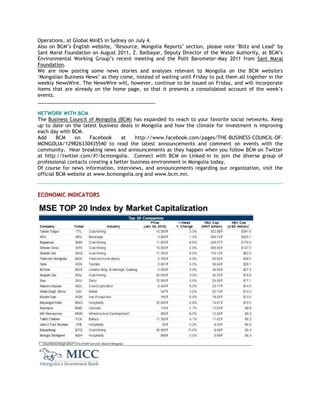
 MSE is second highest performing stock exchange in the world in 2011;
 S&P raises Mongolia's outlook to “positive”;
 Central Bank vows not to increase policy rates;
 MSE heading for international standards in three years, says LSE official;
 Two nuclear processing plants planned for Dornod Aimag;
 Estimated gold reserves raised by 35 tons;
 Mongolia exceeds goal for 2011 “Year of Employment”;
 IMF warns against spending with looming commodities bust;
 Shiny prospects;
 Macau could overtake Mongolia in GDP growth;
 China leads in tourism to Mongolia;
 2012: test of investors' faith in commodities;
 Marketing for Mongolia targets Japan;
 Audit reveals over MNT 700 billion in taxes paid in 2009;
 Poor air quality leads to health problems among capital's poorest;
 Public buses receive gas-fueled engines;
 Pollution affects air traffic at Chinggis Khan airport;
 3,000 km of concrete roads to be built in 2012;
 Narnii Guur Bridge due for completion ahead of schedule;
 Centerra Gold sees continued pressure from wage Inflation, higher oil prices;
 Executives acknowledge possibility of minerals scarcity;
 Projections induce price drops for gold;
 Volatility to rare earth prices effects production outside of China;
 China's New Year's resolution for growth;
 Euro anxieties throw gold out and U.S. dollars in to investors' hands.
Politics
 DP to exit coalition government for election campaign;
 Ban on exploration licenses extended pending new Minerals Law;
 Prime Minister makes bold promises for economic development;
 Government debates free-trade zones;
 Mongolian democracy ranked lower by Economist Magazine in 2011;
 Finance Ministry announces top 10 major events of 2011;
 MPP unveils 20 year plan;
 Mongolian citizens name their favorite female politicans;
 Mongolia to introduce new passports;
 Mongolia opens consulate office in Shanghai;
 Japan and Mongolia make greater commitments towards partnership;
 Parliament ends its discussion for iron ore and coal export taxes;
 Teachers' strike ends;
 Standing Committee calls for more control over exploration license holders;
 Committee urges Parliament to enforce mining ban at prohibited areas;
 Ministry submits new draft environmental laws;
 Re-election concerns trump prohibited mining zone controversy, says MNMA president;
 Mongolian doctor receives good blood work experience;
 Texas lawyers share legal expertise with law students;
 No Arab Spring in Russia, says Putin;
 Analysis shows widespread voter fraud likely in Russia.
*Click on titles above to link to articles.
SPONSORS
Khan Bank Eznis Airways
Kempinski Hotel Khan Palace Mongolian National Broadcasting
Mongolian Star Melchers Breakthrough PR
Mongolian Properties Oxford Business Group
BUSINESS
MMC SURPASSES ITS 2012 TARGET FOR COAL PRODUCTION
Mongolian Mining Corporation (MMC) surpassed its 7 million-ton annual production target in December
at its Ukhaa Khudag coal mine at Tavan Tolgoi.
The company considers this 79 percent increase of 3.9 million tons from 2010 a significant
achievement. Moreover, as last quarter's average monthly production at the UHG deposit reached
approximately 900,000 tons of ROM coal, Mongolian Mining is confident that it will be able to achieve
its target of approximately 10.7 million tons by 31 December 2012.
In August 2006 the government granted the company its license for the Ukhaa Khudag coking coal
deposit, covering an area of 2,960 hectares. Mining began in 2008, while in June 2011 the company
acquired 100 percent interests in QGX Coal Ltd. and its indirectly owned subsidiary Khangod Exploration
LLC, the holder of a mining license for Baruun Naran coking coal deposit. Leighton Asia and Sedgman
from Australia are mining contractors hired by MMC for both deposits in South Gobi Mongolia.
Source: Indonesia Today
GRIEVED WORKERS DETAIN SOUTHGOBI SANDS CHIEF OPERATING OFFICER
Some 20 demonstrators of the 49 workers recently fired by SouthGobi Sands LLC protested by keeping
the company‘s chief operating officer in his car.
The demonstrators surrounded a car with Curt Church, the chief operating officer, this week. The
workers said the company could not legally fire so many workers, as it did on 20 December when it
released 49 workers from their duties. Management from the company has agreed to officially answer
the demonstrators' demands soon.
Source: Zuunii Medee
EBRD FINANCES VITAFIT‟S IMPROVED PRODUCTION CAPABILITIES
The beverage and distribution firm Vitafit Group will be able to acquire new equipment to improve the
quality of its products and increase production capacity through a USD 6.5 million loan by the European
Bank for Reconstruction and Development (EBRD).
The company will use the loan to purchase an aseptic filling line for fruit juice and fresh milk bottling
to replace its older equipment and eliminate capacity bottlenecks. This would allow the company to
expand its product range and offer new ones of higher standards to consumers.
The group was one of the EBRD's first clients in Mongolia, and this loan is the fourth deal between it
and Vitafit since 2007. The loan is provided throughout the bank's early transition countries initiatives.
Source: The Financial
GUILDFORD COAL CATCHES THE EYE OF GLOBAL MINERS
After successful buyouts of Hunnu Coal and QGX's coking coal assets over the past six months, the latest
company with Mongolian coal deposits to move into the crosshairs of acquirers is Guildford Coal's Terra
Energy unit.
Newcastle-based Guildford Coal originally planned to list Terra Energy, which is expected to produce its
first coal from the South Gobi project in Mongolia in the first half of next year, on the Australian
Securities Exchange (ASX) and hired UBS to advise on the process. However, unnamed parties have
expressed interest in acquiring some or its entire 70 percent stake in Terra Energy.
―It's from global players and we've had a lot of interest,‖ said Craig Ransley, Guildford Coal's non-
executive chairman. They are being evaluated.‖
Guildford Coal has held off from engaging a financial advisor to consider the approaches. Instead, the
company is waiting to receive its mining licenses from the Mongolian government, due within weeks,
for a boost in the company's value.
―We're the only ones that are close to actually producing, so I expect that interest will probably ramp
up once the mining licenses are granted,‖ Ransley said. ―We'll be the only junior in Mongolia that will
actually be mining.‖
Read more…
Developing coal deposits in Mongolia is expensive and technically challenging as they are located far
from railroads that can bring in heavy mining equipment and provide an export route for the coal.
Terra Energy's resource is located around 30 miles east of two operating mines, including one owned by
Hong Kong-listed SouthGobi Resources, producing a combined 5 million tons of coal annually that is sold
to customers in northern China.
Guildford Coal says a mine with an annual production capacity between one million and two million
tons of coal could be built at the south Gobi development site. It would produce a mix of coking coal,
used in steel production, and thermal coal for power generation. Earlier this month, Guildford released
a maiden resource estimate of 221 million tons of thermal coal on an indicated and inferred basis for its
Middle Gobi project, located to the north of the South Gobi site.
Source: Wall Street Journal
COMMODITIES GIANT TRAFIGURA IN MARKET FOR MONGOLIAN COAL ASSETS
Looking to capitalize on Mongolia‘s growing importance as a strategic raw materials supplier to
resource-hungry China, private commodities company Trafigura is actively expanding its already
significant position in the global resource market and its subsidiary, Trafigura Coal, could become a top
global supplier of thermal coal, coking coal, and coke products.
The Dutch company has already established itself as a supplier of ferrous raw materials—including iron
ore, coking coal, PCI coal, metallurgical coke, and ferro-alloys—to the steel industry worldwide. The
company maintains a strong position in China, where it has a trading license that will allow it to store
imported ferrous raw materials and source and trade domestic materials.
Already having invested in a trucking company in Mongolia to transport coal from producing mines to
China, Trafigura's recent joint venture agreement with Origo Partners Plc (a Beijing-based private
equity investment company) to invest in coal and iron ore opportunities in Mongolia is a good sign that
well-propertied coal and iron mining firms in Central Asia may be next on the commodities trader‘s
shopping list.
―Trafigura-Origo MGL will invest in a number of Mongolian iron ore and high-quality coking coal
exploration projects and target further high-grade deposits,‖ reported Reuters. ―The venture is looking
to invest USD 5 million to USD 30 million per project, and these are likely to be open-cast mines in the
five northern provinces of Mongolia.‖
The joint venture expects to export several million tons of coking coal and iron ore to China per year
and is also considering expansion into Kazakhstan and Russia. Trafigura is expected to commence the
offer and mail out its take-over bid to shareholders by the end of the year.
Read more…
The world's third largest independent oil trader and second largest independent trader in the non-
ferrous concentrates market, Trafigura posted revenues of USD 88.512 billion in the first three quarters
of the 2010-2011 fiscal year. In keeping with its business model—maintaining ―investment in, and
access to, key physical assets around the world‖—the company has been making investments directly
into publicly-listed junior and mid-tier mining companies as well as privately-held companies to further
strengthen its position in the global marketplace.
Source: Resource Investing News
MAJOR ASIAN CONGLOMERATE ACQUIRES 7 PERCENT INTEREST IN HARANGA
The Lippo Group has become a substantial holder of Haranga Resources Limited by acquiring 14.47
million shares in December through its subsidiary Gold Rain Holdings Limited. Lippo currently holds 7.35
percent interest in Haranga.
The Indonesian-based firm is one of the largest Asian conglomerates and has assets worth USD 22
billion. Having a large company such as Lippo back Haranga could help the young company develop into
a major iron ore competitor on the Mongolian market.
Source: CPSI Newswire
PROPHECY TO PRODUCE UP TO 500,000 TONS WITH INCREASING SALES TO RUSSIA
Prophecy Coal said it expects its Ulaan Ovoo project to produce between 300,000 to 500,000 tons of
coal in 2012, with increasing sales to Russia and at higher selling prices.
In the fourth quarter of 2011, Prophecy signed several sales agreements for 90,000 tons of coal, with
buyers from both Russia and Mongolia. The company said it expects the Russian border crossing at
Zeltura, located about 10 kilometers from the mine, to open in 2012, which would reduce
transportation costs. While selling coal through the Russian eastern seaports has been complex and
difficult, Prophecy said it will pursue this option further, once it has finished with its focus on its
Chandgana power plant.
In November Prophecy received a construction license for its 600 megawatt power plant—the first in
Mongolian history. The plant will be located at the mouth of the Chandgana Tal coal mine, which the
firm secured a mining license for in 2011.
Construction for the plant is expected to start in 2013, with completion slated for 2016. Prophecy said
it plans on securing up to 80 percent of the required capital through debt financing from Chinese policy
banks. To raise the remaining capital in equity, the company said it will rely on the financial model
from the completed Evonik-Steag power plant feasibility study.
Source: Proactive Investors
FEORE LISTS ON ASX
The iron ore miner FeOre has listed on the Australian Securities Exchange (ASX).
Share prices rose from USD 0.25 to USD 0.26 by the afternoon on the day of the release of the firm's
initial public offering (IPO). The firm sold 873,000 shares of a total 140 million offered to the public for
a planned capital raise of USD 35 million.
FeOre will use its raised funds raised from the IPO for exploration and development of the 108.7
million-ton Ereeny iron ore project, located 60 kilometers from the major trans-Mongolian railway line
between Russia and China.
The company said it aims to ship 108.7 million tons of iron ore over the railways within the next two
years. It also plans to strike a deal with the China Railway Group subsidiary of CRMI to establish a
logistics agreement for 10 years.
Source: Unuudur, Proactive Investors
DRAIG RELISTS ON ASX, PREPARES FOR 2012 EXPLORATION PROGRAM
Domestic coal explorer Draig Resources Ltd. has re-listed its shares on the Australian Securities
Exchange (ASX), following the completion of a raise of capital and the acquisition of eight coal licenses
in Uvurkhangai and Umnugobi Aimag.
Draig raised USD 17 million in capital by through the issuance of 34 million shares. The firm used its
raised funds to purchase eight Mongolian coal licenses through its acquisition of BDBL LLC., a former
subsidiary of Peabody-Winsway.
The funds are for the company to open an exploration program for 2012 and pursue other coal
acquisition.
―We now have the financial capacity to move forward with the development of what we believe will be
a very good quality coal project,‖ said Managing Director Mark Earley. ―We will continue drilling
through the coming Mongolian winter months, with the aim of establishing a JORC compliant resource
on the project early this year.‖
Draig recently announced that it had commenced a geophysical survey to identify the potential black
coal extensions within the Teeg license, located in Uvurkhangai. The survey is currently being
undertaken, having stopped briefly for the holiday season, and will give the company time to identify
key drilling targets for its 2012 exploration program. It intends to begin that program as soon as it
completes its geophysics analysis work.
Source: Draig Resources Ltd.
ORIGO PARTNERS RAISES USD 32.5 MILLION THROUGH EQUITY PLACEMENT
Origo Partners Plc raised approximately USD 32.5 million through its placement of about 57.8 million
shares at 36p (USD 0.56) each, before commissions and expenses.
Origo will apply for admission of the placing shares to trading on AIM, a market of the London Stock
Exchange. Trading commenced on 23 December. Origo is a Beijing-based private equity investment
company.
Source: Origo Partners PLC
MOBICOM SIGNS DEAL WITH RUSSIAN COMMUNICATIONS GIANT
Russian national operator Rostelecom signed a partnership agreement with domestic operator Mobicom.
The operators will deploy a new cross-border link using DWDM equipment. Construction is planned to be
completed in August 2012.
The new link will enable interconnection between Mongolia and Russia, and also connect Mongolia to
Europe, Japan, and eventually the United States. Mongolia is the only neighboring country without a
direct link to the network Rostelecom.
Source: Telecompaper
MAK AWARDS FLSMIDTH USD 105 MILLION CONTRACT FOR COPPER CONCENTRATOR
The domestic firm Mongolyn Alt (MAK) Group has awarded FLSmidth with a USD 105 million contract to
supply a greenfield copper concentrator for a mine some 500 kilometers from Ulaanbaatar.
FLSmidth will supply MAK with a 40,000-tons-a-day copper concentrator including proprietary FLSmidth
technology for all processes in the plant. The recently acquired Knelson Dswik fine grinding mill will be
utilized for concentrate re-grind. The supplier will also give an automated control system, basic and
detailed plant and process engineering (and related supervision), and start-up and commissioning
services.
―Mongolia holds vast deposits of natural resources and being able to deliver state-of-the-art
technology, as with this contract, we are able to strengthen our position and footprint in this
increasingly important market,‖ said Jorgen Huno Rasmussen, FLSmidth chief executive officer.
FLSmidth will also open a new materials supply center in both the capital and the Gobi Desert, as it
enters the Mongolian market to bridge a supply gap between China and Mongolia.
Source: FLSmidth
BAYANKHONGOR: MONGOLIAN AIRLINES FIRST DESTINATION FOR 2012
Mongolian Airlines Group made its first flight of 2012 to Bayankhongor Aimag. The 620-kilometer trip to
the southern province was made in one of its Fokker-50 airplanes.
The flight reduced the 10 hour-trip by car to just one hour and 30 minutes. The Fokker-50 is a
turboprop-powered airliner, designed as a successor to the highly successful Fokker F27 Friendship.
Fokker—50 planes have 50 seats, 42 of which were filled for the flight to Bayankhongor, and all of
which were full during the return flight. By increasing the number of flights that service the area, the
cost would be reduced by 20 to 30 percent.
―We are going to fly every Monday and Friday with the Fokker-50, whether or not we have passengers,‖
said E. Margad, chief of the Policy, Strategy and Projection Department of Mongolian Airlines. ―Citizens
have had an overall positive response to the new flights.‖
Source: UB Post
MONGOLIAN AIRLINES TO OBTAIN TWO AIRBUS A-319 AIRCRAFT
Mongolian Airlines Group plans to purchase two Airbus A-319 aircraft from the United States. The
aircraft has the capacity of 124 passengers and flies in middle distance with jet engines, constructed
under modern technology.
The company intends to fly these crafts for domestic and international destinations, and will begin
their service at the start of the summer flight schedule in March 2012.
―Needs are arising to invest in the aviation sector, following the growth of the Mongolian economy,‖
said a director of the firm. ―We plan to increase the number of our aircraft in the future.‖
Mongolian Airlines currently plans to offer domestic flights to Dalanzadgad, Khovd, Murun, and
Choibalsan Soum. It plans to offer flights to Khuvsgul, Bayankhongor, and Dornod Aimag with its Fokker-
50 aircrafts, in addition to Khovd and Uvurkhangai Aimag beginning February this year. It operates from
Chinggis Khan International Airport.
Source: News.mn
PROPHECY TO BORROW USD 7 MILLION FOR CHANDGANA
Prophecy Coal Corp. plans to borrow up to USD 7 million to finance its Chandgana power plant, which
was recently approved by the government. It will execute a secured debt facility of up to USD 5 million
and a USD 2 million inter-company loan facility agreement with its controlled affiliate, Prophecy
Platinum Corp.
―These facilities should carry Prophecy Coal towards completing power plant project financing in
2012,‖ said John Lee, chairman and chief executive officer of Prophecy Coal. ―The company currently
has no debt and over USD 120 million in assets.‖
The debt facility is due fourteen months after its drawdown and bears interest at 10 percent annually,
and compounds quarterly. The inter-company facility would provide Prophecy Coal and Prophecy
Platinum with the ability to request a demand loan from the other of up to USD 2 million at an interest
rate of 14.4 percent annually. Special committees of independent directors from both companies
reviewed and approved the partnership. The size and nature of it exempts it from related party
transaction rules including minority shareholder approvals.
Source: Prophecy Coal Corp.
GATEWAY UNVEILS MONGOLIA'S FIRST THERMOBLOCK HOME
Gateway Development Mongolia (GDM) showcased the first ThermoBlock house in December in the
Yarmag District.
―I welcome the fact that an American business, in conjunction with Mongolian partners, is the catalyst
for this joint venture and the new technology that comes with it,‖ said U.S. Ambassador to Mongolia
Jonathan Addleton.
ThermoBlock is a locally manufactured insulated concrete material that has been used throughout the
United States and Canada. GDM claims that the blocks are stronger, warmer, faster to construct,
healthier, and cheaper than comparable materials. In 2011, ThermoBlock obtained a national standard.
GDM is a U.S.-Mongolian joint venture that aims to create more efficient and greener technologies in
Mongolia. The company also produces products for insulating buildings, fortifying roads, and water
sanitation.
Source: Gateway Development Mongolia
PETRO MATAD FORESEES NEW OPPORTUNITIES
Petro Matad's 2011 work program significantly reduced the size of the potentially producible reserves in
the Davsan Tolgoi area, but added to the prospective of the other areas of the company's acreage.
During 2011 Petro Matad discovered a new petroleum system in the Tugrug basin at its Block V site, as
well as greater opportunities at other areas of the site.
Source: Westhouse Securities
AUSTRALIAN MILLIONAIRESS ACQUIRES STAKES IN ASPIRE AND GUILDFORD
Gina Rineheart, Australia's richest person, has taken positions in the Australian Securities Exchange
(ASX)-listed Mongolian explorers Aspire Mining and Guildford Coal.
Mongolia's coal mining industry has grown rapidly in recent years on the back of a number of substantial
discoveries, with the country's proximity to China meaning it is set to become one of the world's biggest
exporters of coal. The share registry search results show that Rinehart in September bought 812,681
shares in Guildford, representing a 0.19 percent interest in the company. In October, she bought almost
4.4 million shares, or 0.7 percent, of Aspire Mining.
Rinehart's stake in Guildford is now worth USD 524,000 while the Aspire shares are currently worth just
under USD 1.3 million. While the interests in Guildford and Aspire are small in the context of
Rineheart's estimated USD 9 billion business empire, the purchases do reflect the normally low-profile
billionaire's delivery of a warning that investors would increasingly bypass Australia for opportunities
overseas. She warned the government's carbon tax and mining tax would increasingly drive investors
away from Australia, and singled out Mongolia as a country that would benefit from increased
investment.
Perth-based Aspire is exploring the Ovoot coking coal project in northern Mongolia, with the company
having already identified a 330.7 million-ton resource of high-quality coking coal. Last month Aspire
entered into an alliance agreement with Hong-Kong based commodities trader Noble Group to cover the
supply chain logistics and the marketing of coal from Aspire's Ovoot coking coal project. Noble has
bought a 10.1 percent stake in Aspire on market, adding to its existing 9.9 percent stake in an alliance
with fellow coking coal explorer, Xanadu Mines.
Newcastle-based Guildford Coal, meanwhile, owns coking and thermal coal resources in central and
southern Mongolia. The company has been investigating a spin-off of those assets into a new entity,
which would leave Guildford to focus on its coal exploration projects in Queensland.
Source: The Australian
IVANHOE MINES SHARES UP 9.7 PERCENT
Ivanhoe Mines is on the rise, up 6.1 percent at the end of the year followed by another gain of 3.6
percent this week.
At the end of the year, Ivanhoe Mines shares crossed bullishly above their 10-day moving average of
USD 17.46 on a volume of 1.6 million shares, trading 6.1 percent higher. Ivanhoe Mines is the 66
percent stakeholder of the Oyu Tolgoi copper and gold project and Toronto-based minerals explorer.
Ivanhoe Mines has overhead space with shares priced at USD 18.36, or 24.9 percent below the average
consensus analyst price target of USD 24.44. The firm's shares should first meet resistance at the 50-day
moving average of USD 19.40 and again find additional resistance at the 200-day moving average of USD
22.15.
In the past 52 weeks, Ivanhoe Mines share prices have been bracketed by a low of USD 12.11 and a high
USD 29.29 and are now USD 18.36, 52 percent above that low. Over the last five market days, the 200-
day moving average has gone down 0.7 percent, while the 50-day moving average has remained
constant.
Potential upside of 37.8 percent exists for Ivanhoe Mines, based on a current level of USD 17.73 and
analysts' average consensus price target of USD 24.44.
Source: FNNO.com
ERDENET LEADS, BUT MCS COVERS THE SPREAD ON TOP TAXPAYERS LIST
Erdenet Copper Mine continues to lead the country in taxes paid, as the number tax payer on the list of
Mongolia's top 100 taxpayers.
Although Erdenet leads the list, the large conglomerate MCS Group is represented on the list repeatedly
through its subsidiaries Energy Resources (sixth), Energy Resources Mining (13th), and Spirt Bal Buram
(18). Tavan Tolgoi stood at number two, and serves as the top company from those listed on the
Mongolian Stock Exchange (MSE), followed by APU at fourth place.
Other mentionable include SouthGobi sands, the wholly owned subsidiary of South Gobi Energy stood at
seventh place after more than doubling its revenues; and Mobicom, Mongolia's largest mobile phone
operator, stood at number eight, and has contributed substantially to a number of sectors for economic
expansion.
Source: Frontier Securities
EURASIA CAPITAL WINS THREE INVESTMENT BANK AWARDS IN 2011
Eurasia Capital received three awards for its achievements in its investment banking operations in
Mongolia. This year the firm achieved record financial results, underpinned by strong equity capital
raising transactions.
Eurasia Capital won ―Best Investment Bank in Mongolia 2011 Award for Excellence‖ from Euromoney, a
prominent global financial markets magazine; ―Best Investment Bank in Mongolia‖ from EMEA Finance,
a leading capital markets magazine focused on Europe, the Middle East, and Africa; and ―Best Local
Investment Bank‖ by Business New Europe, a business & finance magazine, covering emerging Europe
and Eurasian countries.
―Recognizing the potential of Mongolia's dynamically growing investment banking industry... each
[publication] introduced for the first time, maiden investment bank award category for Mongolia this
year in its respective annual regional award program,‖ said Alisher Ali, the capital chairman of the
firm.
Eurasia Capital is an investment bank focused on Mongolia and other resource-rich Asian countries. The
firm has major emphasis on the resource sector, including key commodities such as gold, copper, coal,
iron ore, and oil and gas.
Source: Eurasia Capital
ONTARIO COURT SETS DATE FOR KHAN RESOURCES HEARING
The Ontario Superior Court has scheduled a hearing for the CAD 300 million (USD 295.5 million) lawsuit
by Canadian uranium exploration and development firm Khan Resources against rival Russian uranium
producer Atomredmetzoloto JSC (ARMZ).
Khan Resources embarked on a joint venture with ARMZ to develop a uranium mining area at the
Dornod fields. Khan Resources had a 58 percent share in the joint venture, and ARMZ had 21 percent.
However, Khan Resources claims that ARMZ later sought to exclude the former of its interests by
entering into another joint venture with the Mongolian government to develop the same land. ARMZ
took steps to cancel Khan's mining license so they could proceed with their new joint venture with the
Mongolian government.
In November 2009 ARMZ began an ultimately unsuccessful hostile takeover bid for Khan Resources,
which was rejected by the Canadian firm. Khan Resources also filed a suit against the Mongolian
government with the international arbitration court in January 2011. Khan Resources said the
international arbitration court is expected to consider in May 2012 whether the case falls within its
jurisdiction, after which the lawsuit is expected to be considered on its merits.
Source: Google Finance
BOROO FUNDS NEW UB MATERNITY HOSPITAL
Boroo Gold LLC has provided MNT 8 billion for construction of (to demolish and rebuild) a maternity
hospital and its equipment. John Kazakoff, the president and chief executive officer, said construction
on the Maternity Hospital No. 1 is going well.
The executive said he has a close personal tie to the project because his son was born at the same
hospital.
―I was in Maternity Hospital No. 1 when my son was born,‖ he said. ―At that time I got to know the
maternity hospital in Mongolia and learned that both their equipment and buildings needed urgent
upgrades.‖
The company has used its MNT 8 million towards the reconstruction of the building with an additional
wing. The hospital will be fully equipped and feature modern designs, with 100 beds for mothers and 50
beds for newborn children.
In addition to this hospital project, Boroo is responsible for the projects at Bayangol and Mandal Soum
in Selenge Aimag. At Sukhbaatar Soum, the provincial capital of Selenge, Boroo has led numerous other
local and national projects. Between January 2005 and September 2011, Boroo has paid MNT 221 billion
in state taxes and was selected as the ―Leading Tax Payer.‖
Source: Niislel Times
MONGOLIA CELEBRATES ITS ENTREPRENEURS
Local and international partners celebrated Global Entrepreneur Week (GEW) in November. The event
included 10 events and over 700 participants.
SWMONGOLIA led a team of 25 partners and eight sponsors for the event. The event gave Mongolians
the opportunity to learn about, debate, and discuss entrepreneurship and running a small business.
Events included lectures, competitions, special talks, and network gatherings.
Judges of the CarPoolPitch and CodeForMongolia competition will soon be selecting its winners.
Winners from the former will meet with top chief executive officers in the second round.
Source: SWMONGOLIA
NOBLE FACES DIRE STRAITS
For years, Noble Group, the Hong Kong-based commodities house and supply chain manager, has been
the darling of investors. It rode the China wave, increasing its sales to almost USD 57 billion in 2010
from zero 25 years earlier and selling a large stake to China's sovereign wealth fund and a much smaller
stake to the Korean Investment Corp along the way. In Mongolia, Noble Group has actively sought out
opportunities for coal production, which led to the coking coal joint venture agreement with Xanadu
Mines Ltd.
Today, however, Noble is under pressure. Its Singapore-listed listed share price has almost halved in
2011, the rating agencies have negative outlooks on its credit, the company's financial profile is weak,
and its leadership in flux. Noble explained its third-quarter loss in November—the group's first quarterly
loss in 14 years—with unpromising prospects partly due to the unexpected downturn in commodities
cycle. However, other commodity traders have performed better—including Trafigura and Glencore,
which also operate in Mongolia. Unique to Noble, however is its company's founder, Richard Elman, who
is now in his 70s but is reluctant to relinquish control.
China Investment Corp (CIC), which has 15 percent interest in Noble, has been a passive investor, but
recent activity has observers wondering if it might up its stake and play a larger role. In the past,
Elman has hinted interest in selling at least part of his 22 percent stake. His current feelings are
unknown, while critics posit it might be better for CIC to take a more active role.
The sense of drift at Noble comes after it began to embrace a more asset-heavy model involving bold
acquisitions. Now some of those acquisitions, such as USD 1 billion spent on Brazilian sugar mills, look
as if they may have been too expensive and the return on equity disappointing.
Uncertainty also reflects rapid turnover in Noble's executive ranks. The firm's heavy debt load (relative
to its rating) is worrying some credit analysts as well. Regardless of what happens with Elman's shares,
the next chapter in Noble's history is likely to be less happy than earlier ones.
Source: Financial Times
CODELCO BATTLES ANGLO AMERICAN, ATTEMPTS STAKE IN SHARED COPPER ASSETS
Chile's Codelco, the current largest producer of copper in the world, escalated the months-long battle
with Anglo American by formally exercising its rights to buy 49 percent of the multinational miner's best
assets in Chile for some USD 6 billion, a discount to market prices, saying it had ―right on our side.‖
While Codelco would pose as Oyu Tolgoi LLC's greatest competitor in copper production, the incident is
also a similar scenario of resource nationalism to when 20 members of Parliament demanded an
increase to the government's stake in Oyu Tolgoi that would bring it to 50 percent.
This week Codelco told the Santiago stock market that it ―has exercised its right to buy shares in Anglo
American Sur,‖ a suite of copper assets centered on the Los Bronces mine, where Anglo has recently
completed a costly expansion. Codelco said its rights extended to 49 percent of shares in Anglo
American Sur, which also includes a smelter and exploration properties.
Anglo, which last month filed a wide-ranging suit in a Santiago court, is alleging multiple breaches of
contract and seeking to block Codelco from exercising the option, immediately hit back by refusing to
grant the option.
Codelco's statement of non-negotiable rights over a full 49 percent stake is now set to be tested in
Chilean courts and could relegate Anglo to a minority 26.5 percent stake in its most productive Chilean
mine.
Codelco said it expects to pay about USD 6 billion for the stake. But Anglo, it added, had not yet
provided the information necessary to establish the definitive price and should do so promptly. Gerardo
Jofré, the company president, said that the most important aim is for Chile to take the economic value
behind the option, but added that the firm could be willing to take lower-share participation and have
the rest in cash if an appropriate offer was made.
Source: Financial Times
ECONOMY
MSE IS SECOND HIGHEST PERFORMING STOCK EXCHANGE IN THE WORLD IN 2011
The Mongolian Stock Exchange (MSE) has slipped from the first to the second highest performing stock
exchange in the world, reported businessinsider.com.
The MSE ended 2011, up 32.6 percent, second only to the Venezuela Caracas Stock exchange, which
rose 80.8 percent. While most of the world is still reeling from the global economic crisis instigated by
debt issues in the euro zone, slow growth in the United States, and the threat of a hard landing in
China, the Dow Jones Industrial average is up a reportedly healthy 6 percent.
The website calculated yearly returns for some 100 global indexes to see how indexes compared to one
another. It found that less than 15 percent of markets are in the positive range.
Source: BusinessInsider.com
S&P RAISES MONGOLIA'S OUTLOOK TO “POSITIVE”
Standards & Poor's Rating Services (S&P) revised Mongolia's outlook to positive from stable and affirmed
its nation's sovereign ratings, citing its growth prospects are more mines begin operations. The rating
has a crucial influence on the ratings of banking agencies, which accounts for a similar boost to Golomt
Bank's rating.
Mongolia‘s long-term sovereign rating remains ―BB-‖ and its short-term rating ―B‖, S&P said. The
outlook revision reflects expectations for a ―significant‖ increase in real per capital gross domestic
product through at least 2014, with S&P estimating the measure may more than double to $6,560 by
2014 from $2,973 this year, according to the statement. The credit rater also affirmed its ratings of
―B+‖ for long term and ―B‖ for short term for Golomt Bank. However, the credit rater did not factor
support from the government into its rating for Golomt because the bank's ―stand-alone credit profile‖
closely resembles the local currency rating on the Mongolian government. However, a raise in the
sovereign rating would open the possibility for a higher rating for Golomt.
The nation's Mongolian Stock Exchange (MSE) TOP 20 stock index gained 2.8 percent following the
report, the biggest one-day increase in months. S&P said it may raise Mongolia's sovereign rating if its
fiscal and external debt metrics continue to improve; or if improvements in fiscal, monetary, and
banking sector politics materially reduce vulnerabilities in these areas, S&P said.
The rating may stabilize or come under downward pressure if macroeconomic stability and public
finances come under renewed threat from ―extravagant‖ fiscal expansion, or the fiscal cost of
intervention from further unexpected banking sector losses, S&P said. Excessive borrowing could also
push down the rating as it move would adversely affect Mongolia's favorable debt interests and
maturity structure, the firm said. A weak policy environment and its resources-based economy are also
acting as constraints on Mongolia's ratings, said S&P.
Source: Bloomberg, Standard & Poor's Rating Services
CENTRAL BANK VOWS NOT TO INCREASE POLICY RATES
Bank of Mongolia officials announced that it would not increase its current interest rate of 12.25
percent. The rate had been raised three times in 2011.
The bank's director of foreign currency said the value of the tugrug has fallen on international markets
in recent months, which has resulted in an outflow of foreign currency from Mongolia. However, the
problem is not serious, and the bank will take measures to prevent the currency from falling any
further.
Source: News.mn
MSE HEADING FOR INTERNATIONAL STANDARDS IN THREE YEARS, SAYS LSE OFFICIAL
A top official from the London Stock Exchange (LSE) Group said that the market in Ulaanbaatar would
need three years to meet international standards at the recent Mongolia Investment Summit in London.
Tracey Pierce, director of equity primary markets at the LSE, said the group is currently involved in a
bill that would establish membership requirements and how the market would operate. She also said
the Millennium Exchange software is in the final stage of testing and should be completed by the year's
end.
―The partnership of both our stock exchanges is not only limited to management but also there are
being organized other activities as trainings and professional advice on initial market, technology and
payment,‖ she said.
What interests me is how Mongolia‘s Stock Exchange will look like in two years, like London Stock
Exchange or Hong Kong Stock Exchange. We promised Mongolians a stock exchange meeting the world
standard.
Pierce said that at the project's end, many more foreign and domestic investors and companies would
participate on the market. If ties between both capital markets are expanded, the partnership could
improve the streams of investment for both. In three years the MSE would reach the level of the LSE or
Hong Kong Exchange (HKEx), but development would surely continue.
Read more…
The Development Bank is issuing bonds. Tavan Tolgoi intends to issue the IPO shares for citizens soon.
In general Mongolians are becoming more aware of things to which the stock market relates. Could you
feel it?
She said the Tavan Tolgoi stock promised to investors will offer an opportunity for citizens to become
more aware of the market, and more public awareness would help develop the market more quickly.
The sovereign bonds to be sold in Singapore are a step in the right direction, she said, but she hopes
that in the future bonds will be able to be sold at home.
Officials from the MSE and LSE will meet to discuss ways to open new opportunities for investors and
companies to participate on the market. In March will be another meeting for investors interested in
trading on the MSE as well. Already some well known investors have applied to attend the March
meeting.
Source: Unuudur
TWO NUCLEAR PROCESSING PLANTS PLANNED FOR DORNOD AIMAG
The Nuclear Energy Authority announced its plan to build two uranium processing facilities in Dornod
Aimag. It said construction preparation work is already underway.
The factories will export uranium products to France and Kazakhstan. Uranium exploration efforts
began in Mongolia in 2009, and the Nuclear Energy Authority is planning to intensify exploration efforts.
The work to establish uranium mines in Dornod and Dundgobi Aimag has already begun.
Source: News.mn
ESTIMATED MONGOLIAN GOLD RESERVES RAISED BY 35 TONS
The Mineral Council of Mongolia has raised its estimated reserves for coal, gold, iron, and wolfram after
accepting reserve estimates from 112 deposits throughout the country.
The agency raised its estimate of coal by 8.4 billion tons, gold by 35 tons, iron by 30 million tons, and
wolfram by 60,000 tons. Mongolian receives MNT 235 billion in private investment for exploration work
this year. The extent of exploration in the country rose by 10 percent from the last year, comprising
2,430 licensed areas.
Source: Unuudur
MONGOLIA EXCEEDS GOAL FOR 2011 “YEAR OF EMPLOYMENT”
Having declared 2011 as the ―Year of Employment,‖ the government created over 72,000 new jobs last
year.
The government created a total of 72,080, surpassing its original goal of 60,000 jobs for 2011. Large
national private companies were responsible for creating even more positions. MCS Group created
1,768 jobs, Energy Resources 765 jobs, Altain Khuder 768 jobs, and Max Group 453 jobs. More jobs in
the private sector mean more production, reduced prices for consumer foods, and less poverty. The
companies are also known for their high wages, and high output from their employees.
Source: Udriin Sonin
IMF WARNS AGAINST SPENDING WITH LOOMING COMMODITIES BUST
Mongolia's economy, which grew 20.8 percent last quarter, risks contraction along with a global
downturn in commodity prices partly due to a surge in state spending, said the International Monetary
Fund (IMF). Steve Barnett, IMF's Assistant Director of Asia and Pacific, warned of the dangers the
current global economic crisis posed against what he characterized as a ―boom-bust‖ policies.
Government spending jumped 50 percent in real terms to 6.3 trillion in 2011, pushing inflation in the
8.4 billion economy to 14 percent, Steve Barnett, IMF's head of Mongolia coverage, said. That may drive
up borrowing costs and cut the profitability of mining projects, he said.
―The global economy is in a dangerous phase and what that means for Mongolia is a higher-than-normal
chance that commodity prices fall,‖ Barnett said. ―Their spending plans could not be realistically
financed if there was a repeat of the 2008 shock. They‘d have to cut spending. This is ‗boom-bust‘
policy- making.‖
Mongolia, which plans to invest USD 68 billion within four years for infrastructure, contracted by 1.3
percent in 2009 due to the global economic crisis. Mongolia turned to the IMF for a USD 224 million loan
to help survive the 2008 global economic crisis, and it seems Mongolia is now heading towards a similar
path as it did then. The rise in state spending, which now accounts for two-thirds of Mongolia's
economy outside of mining, comes ahead of parliamentary elections in June and profits from big mines.
Government spending could accelerate inflation to an average 18.7 percent in 2012 from 10.2 percent
this year, and wages by 80 percent over three years through 2012, Bennett said.
The Mongolian Stock Exchange (MSE) has fallen from being the world's best performer in the 12-months
to April, as the MSE Top 20 Index has since plunged 18 percent. The tugrug, the second-biggest gainer
against the dollar in the year to 1 April, fell 13.6 percent since then as well. Standards & Poor's Rating
Services recently praised Mongolia for introducing a fiscal responsibility law, which would limit budget
deficits to 2 percent of gross domestic product from 2013. However, Barnett said this would be difficult
to achieve.
Source: Bloomberg
SHINY PROSPECTS
Mongolia's metals and coal-related boom shows no sign of abating, with recent state figures confirming
healthy growth across the economy. However, concerns over a demand slump in China and the timing
of a major mine listing continues to keep investors wary.
In the first 10 months of 2011 government revenues rose to MNT 3.47 trillion while total expenditures
and net lending amounted to MNT 3.29 trillion, creating a surplus of MNT 189.7 billion. The swell of
economic activity tallies to gross domestic product (GDP) growth of 17.3 percent in the second quarter
of 2011—the fastest in the world.
When production at the Oyu Tolgoi copper and gold project reaches peak production between 2013 and
204, it is expected to boost GDP by 20 percent to 30 percent. Oyu Tolgoi is scheduled to produce some
450,000 tons of copper and 650,000 ounces of gold a year in its first decade. The Tavan Tolgoi coal
deposit has an estimated production life of more than 30 years, with annual production of 15 million
tons. A planned initial public offering (IPO) of Erdenes-Tavan Tolgoi, the state-owned entity charged
with developing the project, is expected to raise USD 3 billion.
The International Monetary Fund (IMF) sent a delegation to the country in August. It aimed to both
offer technical assistance and help adapt international standards to improve local tax collection.
―Our economy is quite vulnerable as it depends on the export of one or two raw materials,‖ said Prime
Minister S. Batbold. ―We would like to address these issues by diversifying our economy.‖
Read more…
External factors such as prices and a possible slowdown in demand for the country's vast resources
could hinder expansion. Delays in the Erdenes-Tavan Tolgoi IPO have also worried investors. Thus far
the government has failed to reach a final decision on an investment agreement for the project's
western block. With Chinese, Russian, U.S., Japanese, and South Korean groups among the major
bidders, the deal has taken on geopolitical aspects, putting pressure on the Batbold administration
ahead of June 2012 elections.
Source: Oxford Business Group
MACAU COULD OVERTAKE MONGOLIA IN GDP GROWTH
Mongolia may take second place in the rankings of fastest growing economies in the world, as the
Economist Intelligence Unit puts Macau ahead of Mongolia in 2012. The EIU forecasts growth in Macau
to reach 15 percent in 2012, compared to Mongolia's 14.8 percent growth.
While still ahead of other nations, 15 percent growth in Macau would be a reported cooling for the local
economy. In the first three quarters of 2011, its GDP grew by 21.8 percent year-on-year (y-o-y) in real
terms. That figures is down from the 26.2 percent registered in 2010. For China, the EIU expects
growth to reach a healthy 8.2 percent this year, although it is worried about growing debt there.
In Macau the local economy boomed in 2010, but it was outside investors who had the best year. Data
released by the Statistics and Census Services confirms that casinos are the dominant industry in the
city, as gaming contributed 40.9 percent to the economy.
Source: Macau Daily Times
CHINA LEADS IN TOURISM TO MONGOLIA
China was the number one source for tourism to Mongolia in 2011, reported Chinese media. Mongolian
tourism officials have reported a 0.7 percent increase in tourism in 2011 of some 460,000 tourists.
Chinese tourists made up 40 percent of all tourists in Mongolia, followed second by Russians. A tourism
official said some 460,000 tourists visited Mongolian in 2011, up 0.7 percent from the previous year.
Total revenue from tourism has been estimated at USD 190.7 million.
Revenue from tourism has been estimated at USD 190.7 million for 2011. Other major sources for
tourism include South Korea, Japan, the United States, Germany, and Great Britain. The Ministry of
Nature, Environment, and tourism attempted to increase tourism by taking part in an international
tourism exhibit in South Korea. The ministry hopes to attract one million tourists by 2015, while the
government plans to develop the tourism industry through such endeavors as the Tea road and the
Kharkhorum projects.
Mongolia's vast steppe and untapped natural landscape are major draws during the warm summer
months.
Source: Xinhuanet, News.mn
2012: TEST OF INVESTORS‟ FAITH IN COMMODITIES
Commodities essential to the Mongolian economy, such as iron ore and copper, will face a test of faith
in 2012 to lure back investors. Investors are worried because hedge funds cut commodities exposure by
50 percent from May to December, reported Barclays. During this period the Dow Jones-UBS Commodity
Index fell 19 percent.
In addition to a weaker demand for commodities, Europe's troubles have caused European banks to cut
back on financing that would keep the commodities engine chugging along. Lower demand for imports
in Europe also means weaker activity in countries like China, where manufacturing activity shows signs
of contracting. China's faltering property market could also dampen construction growth there, and
hence demand for metals.
Industrial metals have fallen 25 percent since late July; agricultural products are down 21 percent since
late August. If the macro backdrop worsens, some commodities may have further to fall than others.
Copper, for example, is still 85 percent above the cost of production, while aluminum is 22 percent
below the industry's marginal cost. Similarly, any crude-oil price declines may be arrested by supply
cuts in producing countries. Intervention from the Organization of Petroleum Exporting Countries
(OPEC) could complicate matters.
Unpredictable factors will continue to buffet individual commodities. A repeat of last winter's harsh
weather could push grain, coal, and iron-ore prices higher. Strikes at two of the world's largest copper
mines helped support that metal in 2011. Oil will continue to the rhythms of geopolitics and threats of
war as well. However, a move sustained rise for commodities will require a swift resolution of the euro-
zone crisis and evidence the Chinese economy will manage a soft landing.
Source: Wall Street Journal
MARKETING FOR MONGOLIA TARGETS JAPAN
A new exhibition to introduce Mongolia to the Japanese public will be held in Tokyo next year on 22 to
24 February.
The program entitled, ―Welcome to Natural Mongolia‖ will be led by Mongolia's Foreign Affairs Ministry;
the National Chamber of Commerce and Industry; the Mongolian Embassy to Japan; and the Japanese
Ministry of Economics, Trade, and Industry. The aim of the event is to showcase the products from
Mongolia to grab the interests of Japanese consumers and investors. The exhibition will feature organic
foods, wool and cashmere products, leather materials and goods, souvenirs, tourist attractions, and
opportunities from the mining sector.
The Japanese public is apparently most interested in environmental research, information on
investment to the environment, organic production and processing, and the mining sector.
Source: Unuudur
AUDIT REVEALS OVER MNT 700 BILLION IN TAXES PAID IN 2009
In 2009, the government audited 363 mining companies, in addition to 23 ministries and agencies, 26
budgetary organizations, and the governor offices of 20 provinces and six districts.
Information gathered from the audit indicates that MNT 737.8 billion in taxes, fees, and donations were
collected in 2009, with the Erdenet factory paying 503.3 percent of that total. Erdenet Factory paid
MNT 358.8 billion in state taxes in 2009, Ivanhoe Mines 142 billion, and Boroo Gold MNT 38.8 billion.
The 2010 audit is expected to be released soon. The audit included 274 companies; 177 of which are
active and 87 are exploring.
Source: Extractive Industries Transparency Initiative
POOR AIR QUALITY LEADS TO HEALTH PROBLEMS AMONG THE CAPITAL'S POOREST
Recently released research conducted by the World Bank in 1998 has shown that the air quality in
Mongolia is up to 25 times worse than it ought to be, according to World Bank standards.
The concentration of pollution in the air in Ulaanbaatar has been recorded at levels 10 to 25 times
more than the recommended air quality standards. Additionally, many city residents have been
diagnosed with cardiovascular disease, chronic bronchitis, and respiratory complications due to the
poor air they breathe. Studies found excessive concentration of particulate matter in the ger districts,
especially during winter. These conditions seem to be the source of the above named conditions, which
can lead to deaths.
Source: Undesnii Shuudan
PUBLIC BUSES RECEIVE GAS-FUELED ENGINES
The National Committee to Reduce Air Pollution has begun its program to install gas engines in 400
buses for public transport.
The gas engines produced by the Daewoo automobile company will serve as an alternative to the
diesel-fueled engines. For the first phase, 120 buses of the Bus-1 company, 80 buses of Bus-3, and five
buses of Electric Transportation have switched from diesel to gas fuel. The buses are able to hold 105
liters of gas and can run for 700 to 800 kilometers from a full tank of gas. At present, mobile gas station
will be uses in addition to gas stations that will be installed within the compounds of the larger bus
companies.
Diesel fuel never completely burns when used as a fuel, adding to the pollution content in the air.
However, when mixed with gas, the diesel fuel can burn completely. The use of gas fuel would reduce
air pollution by 15 percent and add to the life spans of engines.
Source: Undesnii Shuudan
POLLUTION AFFECTS AIR TRAFFIC AT CHINGGIS KHAN AIRPORT
Heavy air pollution in Mongolia's smog-filled capital has caused flight delays and cancellations in recent
days.
During the last week, many flights were disrupted for six days except Thursday. A total of 13 flights had
been delayed or canceled this month due to air pollution, a 160 percent increase from last year.
With temperatures dropping sharply in December, thousands of residents living in ger districts near the
airport have begun to burn large quantities of coal and firewood to get warm, and power plants are
also operating at full steam to meet high demand for electricity for heating, causing a thick smog
around the airport.
―Ulaanbaatar as well as the airport are located in a basin with mountains surrounded, so the smoke is
blocked by the mountains and cannot dissipate. Wind also is very rare during winter time which worsens
the air pollution here,‖ said an official from China's Mongolia Bureau.
The new residents live in ger districts in the suburbs, and due to the lack of access to central heating
systems, they burn coal, firewood and garbage, which causes severe air pollution. Air pollution kills
about 1,600 people in the capital every year. A report released this month by the World Health
Organization (WHO) showed that the concentration of dust particles in the air was 35 times the
standard recommended by the WHO.
Source: Xinuanet
3,000 KM OF CONCRETE ROADS TO BE BUILT IN 2012
Private and public organizations contributed to a record of 1,100 kilometers of concrete roads and
1,000 meters of bridges built in 2011.
This year's additions bring a total of 3,700 kilometers of paved roads to Mongolia. Foreign aid financed
13.5 percent of the projects, while 37.5 percent came from the state budget, and the rest from private
investment.
The government anticipates the construction of an additional 3,000 kilometers of concrete roads in
2012. Total cost of construction is estimated at MNT 340 billion.
Source: Unuudur
NARNII GUUR BRIDGE DUE FOR COMPLETION AHEAD OF SCHEDULE
The Narnii Guur bridge planned for Ulaanbaatar is ahead of schedule and should be opened sooner than
originally planned, said Kh. Ganbold, a senior specialist of the policy department from the Ministry of
Roads, Transportation, Construction, and Urban Development.
The main part of the bridge is already complete, said Ganbold. He said the ministry plans to open the
bridge before its original due date of November 2012, and that when it opens some it would
significantly reduce city traffic, especially in the Peace Bridge area of the city.
Financing from the bridge has come from Japanese aid of USD 30 million, while Mongolia has
contributed the bridge's construction.
Source: Udriin Sonin
CENTERRA GOLD SEES CONTINUED PRESSURE FROM WAGE INFLATION, HIGHER OIL PRICES
Continued pressure from wage inflation and high oil prices will likely effect a rise in production costs
for gold, say Centerra Gold, a Toronto-based gold miner that operates at Boroo mine.
―The biggest cost impact for us is wages, due to inflation,‖ John Pearson, vice president of investor
relations said. ―Diesel prices are a big impact now... [The Kyrgyz Republic and Mongolia] get fuel at a
price that is at a slight discount to world prices. What we try to do is contain our costs.‖
Despite no sign of threat from the global economic front, Centerra upped its consolidated gold
production guidance to a range between 640,000 to 660,000 ounces from 600,000 to 650,000 ounces for
2011. At the Boroo mine, gold production is forecast to be approximately 60,000 ounces, higher than
the previous estimate of about 50,000 ounces.
Pearson said he could not give a timeline regarding when the government would give the green light for
Centerra's Gatsuurt facility to start mining. Centerra ceased at Gatsuurt, a site adjacent to Boroo, in
December 2010 and currently processes stockpiled material there.
―We are waiting for the final approval to commence mining there,‖ he said. ―I do not have a timetable
to give you. We are awaiting issuance of the first operating permit from the Mongolian government...If
those amendments [to the laws prohibiting mining at restricted areas] are approved, we can get to
work pretty quickly. It is up to the parliamentary agenda.‖
Read more…
In the third quarter of 2011, revenue rose to USD 278.4 million from USD 119.9 million at the same time
a year ago, as the price of gold rose sharply. Centerra realized an average gold price of USD 1,705 per
ounce for the third quarter of 2011, an increase from the USD 1,237 per ounce realizes in the same
quarter of 2010. The median estimate in a Bloomberg survey of 44 traders and analysts is for gold
prices to rally as much as 40 percent to USD 2,140 an ounce in 2012.
Source: Gold Investing News
EXECUTIVES ACKNOWLEDGE POSSIBILITY OF MINERALS SCARCITY
A scarcity of metals and minerals will become more severe in the next five years, with the automotive,
chemicals, and energy industries likely to be hit hardest, according to a global survey of company
executives by PricewaterhouseCoopers (PwC). As raw materials become scarcer, Mongolia stands to
benefit (as well as suffer from the same pressures) from greater demand for materials such as
fluorspar.
The survey of 69 executives across seven sectors founded that European companies were most
concerned about a shortage, with 71 percent of respondents seeing scarcity as a risk, compared with 53
percent in Asia Pacific and 50 percent in the Americas.
Companies pinpointed growing demand for materials and political issues, such as China's export
restrictions on rare earth metals, as the main drivers of scarcity. The report suggested that some
industries might use scarcity to their competitive advantage. Some 43 percent of respondents said
scarcity offered an opportunity at present, while 59 percent said opportunities would increase in the
next five years, with the automotive sector most positive.
Despite abundant material reserves in Asia, Asian firms still expect substantial problems as explosive
growth in emerging markets puts pressure on supplies. PwC listed 14 materials as critical; including
fluorspar and iron, two materials produced in Mongolia.
Read more…
Overall, 83 percent of surveyed firms said their suppliers considered metal scarcity to be an important
issue, but only 61 percent said they thought their customers were concerned about it. In Europe, 96
percent of executives said their governments were aware of the problem, compared with 58 percent in
Asia and 54 percent in the Americas. Nearly half of companies rated their preparedness for scarcity as
―high‖ to ―very high.‖ The renewable energy sector had the highest percentage at 67 percent who
were highly confident about their plans to combat a supply shortage, while just 33 percent of
companies in the chemical and high-tech sectors rated their preparedness as ―high‖ to ―very high.‖
Source: Reuters
PROJECTIONS INDUCE PRICE DROPS FOR GOLD
Recent activity in the gold market has revealed significant influence technical analysis has had on it,
turning at least one skeptic into a believer.
When gold prices first collapsed in September, their apparently unstoppable decline was halted by a
wave of buying started in the mid-USD 1,500s. At the time, the 200dma stood just above USD 1,500.
This week, the 200dma has acted as a gravitational pull downwards on the gold price. Now gold has
finally broken below the marker this week, for the first time in almost three years.
It seems the projections have become a self fulfilling prophecy: the more traders fixate on the 200dma,
the more significance it has attained for the market. After breaching the 200dma market, the gold
price promptly fell another USD 60.
The underlying cause can be traced from liquidity in the system drying up, putting gold on the wrong
side of a ―dash for cash‖ trade among European banks and hedge funds. More importantly, demand
from emerging economies, has gone soft. Now the critical question is whether recent price falls will
inspire a return.
Source: Financial Times
VOLATILITY TO RARE EARTH PRICES EFFECTS PRODUCTION OUTSIDE OF CHINA
Low demand during 2011 for rare earths following an explosion in 2010 was caused by high rare earths
prices from both heavy and light rare earths metals, which despite their fluttering prices, remain
historically high. Although prices were unstable throughout 2011, there is some expectation that rare
earth prices might become more stable in 2012. Mongolia has been thought of as one destination to
procure rare earth metals, leading to a deal with Siemens AG to look into opportunities for the market.
―I think that rare earth metals, they tend to be more strategic in nature and supply versus demand
remains quite balanced in favor of prices being stronger in 2012,‖ said Mike Frawley, global head of
metals at Newedge Group. ―The pace of consumption in mainland China is a critical component of
demand, prices.‖
China controls most of the rare earths supply, but Chinese exports are extremely low, dropping 65
percent in 2011. Reports suggested that Beijing may change regulations that would circumvent Chinese
producers who have cut their supply while keeping prices high. A heavy rare earth such as dysprosium,
which is commonly used in television and lasers, reached a market high of USD 2,800 per kilogram while
its current price is USD 2,000. Some light rare earths come at substantially cheaper prices. Neodymium,
which is used in magnets, peaked at USD 410 per kilogram and currently sits at USD 270.
―Demand has gone down (in 2011, but I also think that they haven't really been able to replace rare
earth metals,‖ said Arnett Waters, chairman of A.L. Waters Capital. ―I think that part of what's going
on is that businesses are spending less money on more expensive stuff.‖
The current economic crisis is also expected to weaken demand in 2012.
While China holds most of the processing capacity for rare earth metals, new plants are undergoing
construction in places like Malaysia. While Lynas Corporation Ltd. and Molycorp Inc. lead the way to
new rare earth processing plants, other larger companies will gain more control of mines and
production.
Source: Forbes
CHINA'S NEW YEAR'S RESOLUTION FOR GROWTH
China has guaranteed growth in the face of an ―extremely grim‖ outlook for the global economy next
year, rounding off its annual economic policy-setting conference last week on Wednesday with a series
of commitments to deliver economic stability. Mongolia's dependence on Chinese consumption of
Mongolian imports means a hard landing for the Chinese economy would throw the Mongolian economy
into disarray as well.
Laying out a blueprint for the year ahead, Beijing promised to keep monetary policy ―prudent,‖ fiscal
policy ―proactive‖ and consumer prices stable. Economists said the rhetoric suggested that Beijing
preferred fine-tuning current economic policies, rather than striving for monetary easing to shore up
growth. Many analysts expect growth to slip below 9 percent next year for the first time in over a
decade.
―It seems the government, at least for now, is not ready to conduct a blanket policy relaxation,‖ said
Tang Yunfei, an economist with Founder Securities in Beijing. ―But it also made clear that the policies
will be flexible, which means the government will react when slowdown trends are clear.‖
Hoping to play down the risks global economic downturn would have on China, authorities said they
would keep the renminbi ―basically stable;,‖ continue adjustments to interest and exchange rates;
implement measures for a calmer property market; and hold exports steady while imports increase to
balance trade. Economists say policy fine-tuning is already underway, as the government loosens
credit. Controlling credit is China's way to steers economic growth and controls inflation. However, as
Beijing puts growth ahead of inflation risks, some analysts worry inflation could rebound.
Despite the statements made, many private-sector economists believe China's decision in December to
cut bank reserve requirements for the first time in three years was a tacit shift to a pro-growth policy
stance.
Source: New York Times
EURO ANXIETIES THROW GOLD OUT AND U.S. DOLLARS IN TO INVESTORS' HANDS
The impetus behind the risk-aversion attitude was news that the European Central Bank's (ECB's)
lending to banks has increased significantly, suggesting that its recent stimulus measures may be
stumbling. The ECB balance sheet had reached a record high, and it remains to be seen whether the
extra cash will reduce sovereign-debt problems.
―We maintain that a liquidity squeeze brought on by the ongoing debt problems in the euro zone would
be one of the greatest threats to commodities,‖ Marc Ground, an analyst at Standard Bank, said.
A liquidity squeeze like that seen in 2008 would force cash-strapped investors to sell their stakes in
commodities, and would likely curtail the credit lines banks make available for commodity deals. It
seems worries over the euro and poor employment statistics are keeping gold trades active. Market
participants have attributed some of gold's recent weakness to year-end positioning, as money
managers finance bets on other commodities or make up for losses by selling their gold. Gold was still
up by 8.4 percent in 2011, the only precious metal likely to end the year with a gain.
Gold prices this year hit a series of record highs on the way to extending its winning streak for an 11th
year, making some traders reluctant to bet against the metal. Increased demand for dollars, however,
has turned the momentum for the gold market negative. Silver and gold are valued for their perceived
ability to maintain value during economic turmoil. But that view has broken down as the euro zone's
two-year fight to contain its debt crisis has investors fearing another global financial crisis.
Source: Wall Street Journal
POLITICS
DP TO EXIT COALITION GOVERNMENT FOR ELECTION CAMPAIGN
Democratic Party (DP) Chairman N. Altankhuyag announced Thursday that he would withdraw his party
from the coalition government led by Prime Minister S. Batbold. Altankhuyag, also the country's first
deputy prime minister, made the announcement during the regular weekly news conference held with
the party leaders.
―I have informed the prime minister about the decision to pull out from the coalition,‖ said
Altankhuyag. ―We will work with the prime minister until he finds replacements for the ministers and
cabinet members from the [DP].‖
Altankhuyag attributed the decision to the election campaign of the DP for the parliamentary and local
council elections to be held in June 2012. The current coalition government led by Batbold, who is also
chairman of the ruling Mongolian People's Party, was formed following the post-election riot on 1 July
2008. Six members of the DP are working as cabinet members and ministers of the government.
―By having a coalition government, Mongolia was able to have a stable political life and overcome the
global financial and economic crisis with less damage,‖ Altankhuyag said. ―Now we believe the [DP] has
fulfilled its historic role and it is time to pull out from the coalition government.‖
The party's decision will have to be validated by the party's National Consultative Committee meeting,
the ruling body of the DP.
Source: Xinhuanet
BAN ON EXPLORATION LICENSES EXTENDED PENDING NEW MINERALS LAW
Government has ultimately decided to extend its ban on new licenses for mining exploration.
The Democratic Party has opted to extend the ban on the issuance of special licenses for mining
exploration following the expiration of the law on 31 December. However, members of the group
decided that the ban shall only extend until the passage of a new Minerals Law.
Parliament has promised to adopt the new Minerals Law in the near future. It also urged the standing
committee responsible to submit a draft for the law immediately. In response, D. Battulga, the head of
the Office of the President, said a draft will soon be ready for submission.
Source: Udriin Sonin
PRIME MINISTER MAKES BOLD PROMISES FOR ECONOMIC DEVELOPMENT
Government officials spoke nostalgically on the history of Mongolia, and gave a few bold promises,
including the goal to reach the status of a developed nation within two decades in a recent
independence celebration. Mongolia celebrated the centennial of its independence from China in a
ceremony led by Parliament where MPs, as well as foreign and national diplomats, assembled and gave
speeches on the meaning of the revolution and what the future holds for the nation.
Prime Minister S. Batbold highlighted the establishment of the five ministries of government and their
accomplishments throughout the revolutions of 1921 and 1911. He spoke warmly about the path of
economic development the nation is on, citing the difference in the per capita gross domestic product
of USD 300 10 years ago and today of USD 3,000. He said the government plans to bring the per capita
GDP to USD 10,000 by 2015, and bring Mongolia to the level of a developed nation in 20-years time.
President Ts. Elbegdorj gave a two-hour speech, repeatedly transitioning, between the distant past,
recent history, and present times. During his speech, Elbegdorj included a solemn remark about the 1
July 2008 riots, which erupted following election results that angered the populace. He apologized to
all Mongolians, saying he failed to uphold the human rights of his citizens on that day.
Source: UB Post
GOVERNMENT DEBATES FREE-TRADE ZONES
The government has opted to establish new free-trade zones at Zamiin-Uud Soum in Dornogobi Aimag,
reported N. Altankhuyag, first Deputy Prime Minister.
For the Committee on Security and Foreign Policy, Altankhuyag reported on plans to establish free
trade zones at Altan Bulag Soum in Selenge Aimag, Tsaagan Nuur Soum in Baya-Ulgii Aimag, and Choir
in Dornogobi Aimag, in addition to Zamiin-Uud. He explained that the establishment of the free-trade
zones had been delayed by inexperience and complications with existing laws. He also said the state
has constructed building in the zones, but infrastructure is still lacking. Construction for a new road
will begin next spring, he said.
MP Sh. Saikhansambuu proposed to build a casino at Zamiin-Uud instead of establishing a free trade
zone. The member argued that productivity in China would make it difficult for a free trade zone to
succeed there. If Parliament builds a casino there, private business would help build the infrastructure
needed there, he said.
Source: News.mn
MONGOLIAN DEMOCRACY RANKED LOWER BY ECONOMIST MAGAZINE IN 2011
Mongolia was ranked at 69th place and declared a ―flawed democracy‖ on the Democracy Index 2011
by the Economist Intelligence Unit of The Economist magazine. It fell five places from its ranking of last
year.
The Democracy index is based on 60 indicators grouped in five different categories: ―electoral process
and pluralism‖, ―civil liberties‖, ―functionality of government‖, ―political participation,‖ and ―political
culture.‖ The group measures 167 countries, with each placed into one of four levels: ―full
democracy,‖ ―flawed democracy,‖ ―hybrid regimes,‖ and ―authoritarian regimes.‖
Norway scored highest with a total score of 9.8 on a scale from 0 to ten, while North Korea scored the
lowest. Mongolia was placed under the ―flawed democracy‖ category, scoring 6.23 at 69th place. It fell
five places from its rank of 64 in 2010.
On the list, 25 countries were rated as ―full democracies,‖ 53 countries as ―flawed democracies,‖ 37 as
―hybrid regimes,‖ and 52 as authoritarian regimes.
Source: Unuudur
FINANCE MINISTRY ANNOUNCES TOP 10 MAJOR EVENTS OF 2011
The Finance Ministry celebrated its centennial last week, and for the occasion listed 10 major events
from 2011.
Number one on its list was Mongolia's ascendance to a ―middle-income economy,‖ as deemed by the
World Bank; followed by the passage of the Law on Budget; amendments to the law on Purchased
Goods and Services by state and local government for its efforts to decentralize government; and
Mongolia's 34 agreements while negotiating a loans totaling USD 1.305 billion from a number of
international financial organizations and countries. Fifth on the ministry's list was the adoption of the
Development Bank of Mongolia, which is now run with the assistance of the Korean Development Bank
and recently managed the release of USD 600 worth of euro-denominated sovereign bonds that are to
be sold through the Singapore Stock Exchange (SGX).
Next, ministry officials acknowledged the fifth meeting of leading finance and economic workers in
Ulaanbaatar; followed by the introduction of a medium-term debt management strategy (MTDS) Tool
program to help the nation manage its debt; the introduction of an electronic procurement system as
funded by the Korean International Cooperation Agency (KOICA); as well as the electronic database
funded by the South Korean Government at number nine. Finally, the ministry ended its list at number
10 with the 100 year anniversary events organized in the capital and provinces of the nation.
Source: Udriin Sonin
MPP UNVEILS 20 YEAR PLAN
Prime Minister and party leader of the Mongolian People's Party (MPP) S. Batbold outlined his party's
agenda for the next twenty years during a meeting with reporters this week.
Batbold said development in Mongolia has been rapid, but the country still faces many issues, including
corruption, unemployment and poverty. He added that road construction program should be used to
promote regional development.
The prime minister said that cooperation between the public and private sector is crucial to the
country's development. According to estimates, per capita gross domestic product (GDP) is set to rise
from its current standing at USD 3,000 to USD 5,000 in 2012. He said the MPP's policy is to benefit all
levels of society from the economic growth of the nation. He also said good governance is an issue as
long as corruption and bribery continue to undermine society's confidence in the state.
Batbold outlined the party's plan in three phases, spanning from the periods between 2012 to 2016,
2016 to 2021, and 2021 to 2031. The MPP aims to strengthen corporate oversight, create an open and
transparent system of governance, and to reduce air pollution by switching to cleaner-burning fuel
sources. The party also said that it is unjust that a great deal of society remains poor, while a small
segment gets rich. According to the party's plan, Mongolia would develop to the level of Poland and
Turkey by 2016.
Source: News.mn
MONGOLIAN CITIZENS NAME THEIR FAVORITE FEMALE POLITICANS
T. Gandi, the Minister of Labor and Social Welfare, has been honored as the best female politician in a
public opinion poll ranking Mongolia's most competent females in government.
The Shine Erin Ue association and its partners released a poll to determine the most popular female
workers in government, as decided by the populace. Following Gandi was MP S. Oyun and MP D. Arvin in
third.
Source: Udriin Sonin
MONGOLIA TO INTRODUCE NEW PASSPORTS
President Ts Elbegdorj reviewed a sample for the new electronic passport to be issued to Mongolian
citizens last week.
The new passport conforms to the international standards of the International Civil Aviation
Organization, as well as Mongolia's national security and foreign policy goals, said G. Zandanshatar,
Minister of Foreign Affairs and Trade. He said the new passport will make it easier for Mongolians to
travel abroad and contains the latest technology, including anti-counterfeit measures. The passport
contains 27 security features, he added.
The Ministry of Foreign Affairs and Trade plans to introduce the new passport in 2012 when Mongolia
celebrates its centennial of the establishment of its diplomatic services.
Source: News.mn
MONGOLIA OPENS CONSULATE OFFICE IN SHANGHAI
An opening ceremony for a consulate in Shanghai was held on 23 December. D. Gankhuyag, director of
the Consular Department of the Ministry of Foreign Affairs, and other officials from that ministry
attended the events along with representatives of the Jiangsu and Zhenjiang provinces to Shanghai, in
addition to consular representatives from other nations.
D. Davaasuren, the consul of Mongolia, opened the ceremony with expressions of gratitude towards the
Foreign Ministry of China the administration leading government at Shanghai. Davaasuren promised to
direct his efforts towards cooperation with china in economics, culture, education, tourism, and in the
interests of Mongolians living in the consular zone.
Sha Hailin, Deputy Government Secretary of Shanghai remarked that the opening of the consulate in
Shanghai would provide new opportunities to bridge ties between the city of Shanghai and the nation of
Mongolia.
Source: Montsame
JAPAN AND MONGOLIA MAKE GREATER COMMITMENTS TOWARDS PARTNERSHIP
Parliament Speaker D. Demberel commended Japanese officials for widening of inter-parliamentary ties
between Mongolia and Japan at a recent meeting attended by a Japanese delegation. This week
Demberel met with the Japanese delegation led by S. Eda, a leader of the Japanese-Mongolia friendship
group at Japan's House of Representative.
This year marks the 40th anniversary of Mongolian and Japanese diplomatic relations. The parliament
speaker said both parties have gone to great lengths to deepen one another's mutual understandings
and confidence since then. In gratitude, Eda said the meeting with Demberel was a beneficial one and
thanked Mongolia for its assistance given after the tsunami disaster last year. To reach a partnership
level, both countries will have to discuss the details of their collaboration in greater depth, he said.
Furthermore, Eda proposed collaboration between the two nations to reduce air pollution in
Ulaanbaatar; and said, ―In the 1970s, we tackled this problem through technical progress, Eda said.
Source: Montsame
PARLIAMENT ENDS ITS DISCUSSION FOR IRON ORE AND COAL EXPORT TAXES
Last week the government ended its talks on a bill that would create and export tax on coal and iron
ore products. Parliament rejected the law because, as members pointed out, companies are already
responsible for income taxes, value-added taxes, taxes for exploiting mineral resources, and royalty
taxes.
MPs decided that discussion on the bill should be the responsibility of the Customs tariff council.
Source: News.mn
TEACHERS' STRIKE ENDS
Trade Union officials have reported that the teachers‘ strike has ended. Schools and kindergartens
resumed their normal operations following the announcement in December.
Prime Minister S. Batbold met with S. Ganbaatar, president of the Confederation of Trade Unions and
the working group responsible for handling the grievances of teachers. Batbold said the government will
submit a proposal to Parliament to compensate salaries during the strike, and raise teachers' salaries in
two phases on 1 February and 1 March.
The strike began after the government decided it would not honor its promise to raise teachers‘
salaries in January of the new year. Workers from cultural, arts, and trade unions threatened to join
the strike if the demands were not met. This would have included health care workers, police officers,
and emergency service providers.
Source: Unuudur, Udriin Sonin
STANDING COMMITTEE CALLS FOR MORE CONTROL OVER EXPLORATION LICENSE HOLDERS
Members from the Standing Committee on Economy have advised stronger controls on license transfer,
in addition to the ban on special licenses.
―Our land is classified as agricultural, forest, and state protected areas,‖ MP. D. Baldan-Ochir said.
―Yet, minerals exploration licenseshave been granted already without much consideration.
The head of the Office of the President, D. Batulga, responded that licenses would be regulated under
the new law proposed by the president. It aims to reduce exploration licenses to just 10 percent of
Mongolia's territory. He added that a need for a control for companies already holding exploration
licenses is indeed needed as well. Parliament plans to further discuss the issue with the coming new
draft Minerals Law.
Source: Udriin Sonin
COMMITTEE URGES PARLIAMENT TO ENFORCE MINING BAN AT PROHIBITED AREAS
A trilateral national committee has recommended that the government intensify its efforts to enforce
its laws restricting mining activities at prohibited zones.
Head of the Cabinet Secretariat Ch. Khurelbaatar introduced the proposal to the cabinet, imploring
ministers with authority in this area to take the measures necessary for intensified activity in support
of the law. The committee said it was important that the General Agency of Specialized Inspection
(GASI) stop mining at the prohibited areas and monitor the environment.
All activities, except or rehabilitation and monitoring, related to mining has been halted at certain
prohibited areas, as dictated by the Law on Prohibiting the Exploration and Exploitation of Mineral
Resources at Sources of Rivers, Water, and Forestry. The organization also urged government to follow
through with its promise to take away the special licenses of companies that do not rehabilitate the
land.
The group also advised that community and specialized organization partake in the monitoring of
companies' rehabilitation efforts.
Source: Montsame
MINISTRY SUBMITS NEW DRAFT ENVIRONMENTAL LAWS
Revisions by the Ministry of Nature, Environment and Tourism has consolidated the number of draft
laws from 18 to 10, said the ministry head. The draft laws will be submitted to Parliament for review
and debate.
Redundancies in the laws have been reduced with the submissions in the new draft laws, said Ts.
Banzragch, director of the ministry. For example, fees for permissions regarding plants, game animals,
and water usage all be under the umbrellas of a single payment law, he said.
Between the years 1990 through 2010, laws aimed to help faciliate Mongolia's transition to a free
market economy, but now that the transiation period is over, the mining sector will apparently lead the
economy, said the ministry head. He advised that Mongolia should learn from the experiences of foreign
nations, where mining development has come at the cost of severe destruction to the environment and
expensive costs for rehabilitating the land once mined.
The draft includes two new laws; one of which is a penalty fee for pollution to water sources. If water
levels are found to breach a certain level of allowed pollution, the government will impose heavy of up
MNT 10 billion, compared to past penalties amounting to MNT 200,000. The penalty would likely
bankrupt a number of businesses, said Banzragch.
The laws would also establish procedures for measuring the impact companies have had at a site, called
the Strategic Environmental Assessment. Analysis would be required from both gold and uranium
companies because of the severe impact their activities can have on the environment.
Source: Zuunii Medee
RE-ELECTION CONCERNS TRUMP PROHIBITED MINING ZONE CONTROVERSY, SAYS MNMA PRESIDENT
The President of the Mongolian National Mining Association (MNMA) vowed to combat the law that has
led to the revocation of a number of mining licenses. In 2009 Parliament passed a controversial law
that prohibits mining activities at certain prohibited zones near water sources and forestry.
D. Damba, President of the MNMA, said the law has cost companies that have already established their
infrastructure. Many are suffering major losses, while the government has failed to compensate
companies for these losses. He said as long as economic organizations and companies oppose the laws
and the government fails to pay its concessions, his organization will take measures to oppose the law.
He further criticized policymakers for focusing too much on getting re-elected instead of their duty to
settle this dispute. "Last spring some MPs developed a new draft law for the implementation of the
long-named law,‖ he said. ―Until now, there was hope that this law might be adopted. Unfortunately,
those MPs have no time to discuss the draft law because they are busy with preparations for the
upcoming elections.‖
Damba said the work of independent artisan miners would pose a far greater threat to the environment
than mining companies, who operate in accordance with the law. The unskilled and untrained so-called
―ninja miners‖ have already begun working at the abandoned sites, while the government does nothing
to stop their activities, he said. He referenced a gold mine at Uyanga Soum in Uvurkhangai Aimag,
where ―ninja miners‖ took over and destroyed the land after the exit of the Erel Mining Company as a
likely outcome of this law.
Source: Ugluuni Sonin
MONGOLIAN DOCTOR RECEIVES GOOD BLOOD WORK EXPERIENCE
A doctor praised Taiwan's efforts in achieving a high blood donation rate and pledged to bring the
valuable experience back to Mongolia.
T. Tseesuren, head of the Mongolian blood transfusion Center's blood collection department, said the
high rate in Taiwan can be attributed to the quality of service offered at blood drives and various
promotional activities held to recruit volunteer donors. Tseesuren is participating in a two-week
training program at the Taipei Blood Center and is one of 15 doctors sent by the Mongolian government
to the island for medical training.
―The blood donation rate is relatively low in Mongolia,‖ Tseesuren said.
Out of the country's three million, only 22,000 people give blood, a rate of 0.7 donors per 100 people,
she said. Taiwan on the other hand, boasts one of the world's highest blood donation rates, with 7.8
donors per 100 persons.
Tseesuren said that while both countries run low on blood inventories from time to time, events are
held regularly in Taiwan to encourage volunteers to show up at blood centers.
Source: Central News Agency
TEXAS LAWYERS SHARE LEGAL EXPERTISE WITH LAW STUDENTS
Educating Mongolian leaders on the United States' court system was the purpose of a delegation from
the Texas Wesleyan University (TWU) School of Law on a recent 10-day trip to Mongolia.
The law school's Asian Judicial Institute has been working with the country since shortly after the Soviet
bloc dissolved and a bloodless revolution led to the creation of a Democratic country in 1992. Part of
that work has been to assist with the creation of a court system similar to the United States.
Judge Justin Lewis hosted a fact-finding Mongolian delegation at the Hill Country Courthouse last year
to discuss how small claims courts operate in Mongolia.
―I presented information to the future lawyers of the country,‖ Lewis explained. ―Hopefully we can
work together to find solutions to judicial reform in the country.‖
Law students learned about legalities that have existed in the United States for over two centuries, but
have only existed in Mongolia for about two decades, such as purchasing property.
Each participant on the trip was responsible for their airfare, but lodging was either provided by the
government or an apartment was utilized that is owned by two TWU law-school alumni who do business
in Mongolia. The group journeyed outside of the capital for an overnight stay in Terelj National Park.
They also visited the 13-story tall statue of Chinggis Khan on horseback and saw gers, the traditional
Mongolian dwelling.
Source: Hillsboro Reporter
NO ARAB SPRING IN RUSSIA, SAYS PUTIN
Though Putin has made it clear he would not consider nullifying the results of the elections, as
protesters have demanded, Putin has promised safety measures to ensure more credibility for the
upcoming presidential election. Tens of thousands of Russians have taken to the streets following
allegations of massive fraud—backed up by findings from local and international vote observer,
triggering the biggest mass protests against the Kremlin in more than a decade.
Putin conceded to considering the installation of 90,000 polling places to guard against falsifications in
the March presidential election and restoring the direct election of governors, a right scrapped under
Putin's first presidency. He also allowed presidential candidates to go to a popular vote, but only after
they have been approved by a so-called ―presidential filter.‖
Putin derided U.S. Senator John McCain, who claimed an Arab Spring-style uprising was now at hand in
Russia, as a crazy person and denied an incident at a mixed martial arts event where the crowd booed
him, saying he did not hear the jeers himself. Putin said the boos could have been an effect of an
audience who has grown weary of seeing his face on television, an outcry toward Jeff Monson (a U.S.
Wrestlers who had just been defeated), or a feeling that the event was fixed.
Although the modest concessions are unlikely to satisfy the growing ranks of his critics, Putin is widely
expected to win the 4 March elections. In addition to the usual array of communists, socialists and
nationalist challengers who have drawn relatively little support in the recent election, billionaire
Mikhail Prokhorov has formally kicked off his own campaign, hoping to capitalize on the turn in
sympathy among the populace.
With no serious competitors in the campaign, ―it's not a question of whether it's enough to win the
election,‖ said Boris Makarenko, an analyst at the Center for Political Technologies. ―The question is do
the authorities understand society's demands well enough to be able to rule for six years.‖
Source: Wall Street Journal
ANALYSIS SHOWS WIDESPREAD VOTER FRAUD LIKELY IN RUSSIA
A comprehensive examination of the full results from Russia's nearly 100,00 voting precincts reveals
statistical anomalies that experts say are consistent with widespread vote rigging. These irregularities
could cast doubt, by one rough measure, over as many as 14 million of the 65.7 million votes reportedly
cast.
Prime Minister Vladimir Putin's ruling United Russia party captured a high share of voters—far above the
49.3 it received nationwide—in precincts where voter turnout was reported to be well above the
national average, according to the analysis. That suggests ballot-stuffing, said experts. The analysis
also revealed a second anomalous pattern they said is also consistent with doctored results. Although
the analysis does not prove fraud itself, it follows weeks of reports of ballot-box stuffing by
international observers. The source designed its own computer program to assemble this month's
official voting totals from the 95.228 electoral precincts across Russia. A subsequent statistical analysis
revealed phenomena that scholars who study vote data analysis are suggestive of vote-rigging.
―These are sometimes called the fingerprints of fraud,‖ said Alberto Simpser, a professor of political
Science at the University of Chicago. ―If they all point in the same direction, he said, referring to
statistical as well as observer and other evidence, ―that's a very strong case.‖
In addition, United Russia's share of the vote at the numerous precincts that recorded voter turnout
significantly higher than the national level of 60.2 percent—over 65 percent and , in thousands of cases,
100 percent—was dramatically higher than it was at precincts where turnout was closer to average.
Although the statistical studies can't prove vote fraud, foreign and Russian observers reported a range
of violations. The statistics cannot be used to calculate the number of falsified votes either, but rough
calculations that eliminate unusually high levels of support for United Russia at precincts with unusually
high turnout raises questions for about 14 million of the 32.4 million votes that United Russia claimed.
That would still have put the pro-Kremlin party in first place, but would have left it well short of a
majority.
Source: Wall Street Journal
NEW MONGOLIAN LAWS AND REGULATIONS
The following amendments addendum to laws and a regulation were published in the latest weekly
Government bulletin. Unless otherwise decided by Parliament, they will take effect ten (10) days after
publication.
Date Amendments and Addendum to Laws
17.12.2011 Amendments to Law on Excise Tax
Amendments to Law on Corporate Income Tax
Addendum to Law on Personal Income Tax
Regulation on Abiding Law on Regulation to Amend the Constitution of Mongolia
Please visit BCM's website, Legislative Working Group, for a summary of new Mongolian laws. BCM
members who wish to access complete versions of the laws and regulations in Mongolian language are
welcome to email the BCM office: info@bcmongolia.org.
ANNOUNCEMENTS
ON-LINE MONGOLIAN COURSE, JANUARY 9 TO MAY 5, 2012
The American Center for Mongolian Studies (ACMS) is pleased to announce the spring semester of Mon
102: Introduction to Mongolian Language and Culture, an online Mongolian course will be offered at the
University of Maine at Augusta (UMA) from January 9 to May 5, 2012.
The course is co-organized by UMA, University of Alaska Fairbanks (UAF), and ACMS. The course is open
to anyone (you do not need to be a student at UMA or UAF to participate), and it is the second
semester in a two semester offering of beginner Mongolian.
The class is divided into two cohorts: (1) the first cohort, having participated in a previous semester of
the course, builds on the previous semester's work with 13 new lessons and two exams aimed at
reaching the high-beginner/low-intermediate level; (2) the second cohort, having participated in no
previous semester of the course, begins with lesson one of the course completing 13 lessons and two
exams in all to gain an introductory understanding of the Mongolian language in preparation for the
second semester.
For further details visit: http://www.mongoliacenter.org/mon101.
___________________________________________
COAL MONGOLIA, 9-10 FEBRUARY, ULAANBAATAR
The Coal Mongolia Conference will be held to attract technical and financial investments into the coal
sector of Mongolia in Ulaanbaatar at the SS Convention Center on 9-10 February.
The conference will cover topics for both extractive and mineral processing industries. Presenters will
introduce advanced environmental and technical practices they believe Mongolia should embrace. The
producers also hope the conference can be used to build corporate ties to ultimately strengthen
Mongolia's competitiveness in the region and develop personal networks.
The event is intended for public sector representatives, coal prospecting and mining companies,
investment funds, banking and financial institutions, engineering and consulting firms, suppliers and
vendors, and professional associations. Attendees can expect seminars and workshops, exhibition
showcasing various projects and companies, a plenary session, an awards presentation dinner in honor
of best performers of the coal sector, and a site visit.
BCM is an Official Supporting Organization for the event. We are pleased to inform you that BCM will
provide a complementary 10% discount to its members registering for Coal Mongolia 2012. With this
offer, you'll receive the following discount:
Before 15th January:
Red Badge is USD1040, with BCM discount USD936.
White Badge is USD560, with BCM discount USD504.
After 15th January:
Red Badge is USD1300, with BCM discount USD1170.
White Badge is USD700, with BCM discount USD630.
To be eligible for this offer, please pick up a PROMOTIONAL CODE by contacting 317027 or email
saruul@bcmongolia.org. Please note that the number of discounted badges is limited.
___________________________________________
PDAC 2012 IN TORONTO, 4-7 MARCH
The Business Council of Mongolia with support from the Trade Department of the Canadian Embassy is
now registering its Mongolian business delegation to participate in the International Mining Investment,
Services and Equipment Trade Fair, PDAC 2012. The event will be held in Toronto, Canada from 4 to 7
March 2012.
This four-day annual convention held in Toronto, Canada has grown in size, stature and influence since
it began in 1932. Today it is the event of choice for the world‘s mineral industry. In addition to meeting
over 1,000 exhibitors and 27,700 attendees from 120 countries, participants will have the opportunity
to attend technical sessions, short courses, as well as social and networking events.
Please call 317027 or email saruul@bcmongolia.org or undral@bcmongolia.org for registration and
additional information about the event.
Registration deadline is 6:00 PM, 27 January 2012.
___________________________________________
MINES AND MONEY HONG KONG 2012, 19-23 MARCH
The early-bird discount for Mines and Money Hong Kong 2012 to be held on 19-23 March has expired,
but all BCM members can still receive their 15 percent discount as BCM is again a Supporting
Organization of the event.
Joining the ever-growing speaker line up are five individuals responsible for investing in and trading
billions of dollars worth of mining commodities. These five key players join a speaker list already
containing some high-profile names in mining, such as Robert Friedland of Ivanhoe Mines, Peter
Kukielski of Arcelor Mittal. and Graeme Hancock of Erdenes-Tavan Tolgoi. In addition, the five-day
conference program features over 100 10-minute mining company spotlight presentations.
To register or for more information, visit minesandmoney.com or call +852 2219 0111.
___________________________________________
“MM TODAY” ON MNB-TV, FRIDAYS AT 21:15
BCM is pleased to announce that Mongolian National Broadcasting continues its cooperation with BCM
on ―MM Today‖. This English news program is aired every Friday for 10 minutes and is scheduled for
21:15 tonight. Tune in to watch this program that reports stories from today‘s BCM NewsWire.
___________________________________________
“BSPOT” ON B-TV, MONDAY TO FRIDAY AT 21:30
B-TV (Business TV) now telecasts a 10-minute English-language news program called BSPOT every
evening from Monday to Friday at 21:30, taking most of the stories from the BCM NewsWire.
___________________________________________
POSTINGS ON BCM‟S ENGLISH WEBSITE 'PRESENTATIONS' AND 'MONGOLIA REPORTS' SECTIONS AND
BCM‟S MONGOLIAN WEBSITE „PRESENTATIONS‟ AND „NEWS‟ SECTIONS
New for 2012 is a ‗Presentations‘ section on the BCM Mongolian website which can be reached via link
to bcm.mn/itgeluud. About 10 presentations already posted!
As a key component of BCM‘s Mongolian website, ‗News‘ section, articles from the Government‘s
―Open-Government.mn‖ site are regularly posted.
On BCM‘s English website, ‗Resource, Presentations‘ section, for your review are 7 speeches from the
Mongolian Investment Summit on December 8-9 in London, several speeches at the Risk Management
Forum on November 8 co-organized by BCM and Mandal Insurance, speeches at Discover Mongolia 2011,
speeches from BCM‘s 10 monthly meetings in 2011, and the address by Peter Nicholls, OT‘s VP-
Operations, at Global MInES in Sydney on July 4.
Also on BCM‘s English website, ‗Resource, Mongolia Reports‘ section, please note "Blitz and Lead" by
Sant Maral Foundation on August 2011, Z. Batbayar, Deputy Director of the Water Authority, at BCM‘s
Environmental Working Group‘s recent meeting and the Polit Barometer-May 2011 from Sant Maral
Foundation.
We are now posting some news stories and analyses relevant to Mongolia on the BCM website's
‗Mongolian Business News‘ as they come, instead of waiting until Friday to put them all together in the
weekly NewsWire. The NewsWire will, however, continue to be issued on Friday, and will incorporate
items that are already on the home page, so that it presents a consolidated account of the week‘s
events.
___________________________________________
NETWORK WITH BCM
The Business Council of Mongolia (BCM) has expanded its reach to your favorite social networks. Keep
up to date on the latest business deals in Mongolia and how the climate for investment is improving
each day with BCM.
Add BCM on Facebook at http://www.facebook.com/pages/THE-BUSINESS-COUNCIL-OF-
MONGOLIA/129826330435540 to read the latest announcements and comment on events with the
community. Hear breaking news and announcements as they happen when you follow BCM on Twitter
at http://twitter.com/#!/bcmongolia. Connect with BCM on Linked-in to join the diverse group of
professional contacts creating a better business environment in Mongolia today.
Of course for news information, interviews, and announcements regarding our organization, visit the
official BCM website at www.bcmongolia.org and www.bcm.mn.
ECONOMIC INDICATORS
INFLATION
Year 2006 6.0% [source: National Statistical Office of Mongolia (NSOM)]
Year 2007 *15.1% [source: NSOM]
Year 2008 *22.1% [source: NSOM]
Year 2009 *4.2% [source: NSOM]
Year 2010 *13.0% [source: NSOM]
November 30, 2011 *10.8% [source: NSOM]
*Year-over-year (y-o-y)
CENTRAL BANK POLICY RATE
December 31, 2008 9.75% [source: IMF]
March 11, 2009 14.00% [source: IMF]
May 12, 2009 12.75% [source: IMF]
June 12, 2009 11.50% [source: IMF]
September 30, 2009 10.00% [source: IMF]
May 12, 2010 11.00% [source: IMF]
April 28, 2011 11.50% [source: IMF]
August 25, 2011 11.75% [source: IMF]
October 25, 2011 12.25% [source: IMF]
CURRENCY RATES – January 5, 2012
Currency Name Currency Rate
U.S. dollar USD 1,412.25
Euro EUR 1,841.72
Japanese yen JPY 18.42
British pound GBP 2,209.39
Hong Kong dollar HKD 181.77
Chinese yuan CNY 224.36
Russian ruble RUB 44.58
South Korean won KRW 1.23
Disclaimer: Except for reporting on BCM‘s activities, all information in the BCM NewsWire is selected
from various news sources. Opinions are those of the respective news sources.

06.01.2012, NEWSWIRE, Issues 202-203

  • 1.
    BUSINESS COUNCIL ofMONGOLIA NewsWire www.bcmongolia.org info@bcmongolia.org Issue 202-203 – January 6, 2012 OUR FIRST 2012 ISSUE, A “DOUBLE” ISSUE, INCLUDES SEVERAL STORIES FROM LATE DECEMBER. NEWS HIGHLIGHTS: Business  MMC surpasses its 2012 target for coal production;  Grieved workers detain SouthGobi Sands chief operating officer;  EBRD finances Vitafit’s improved production capabilities;  Guildford Coal catches the eye of global miners;  Commodities giant Trafigura in market for Mongolian coal assets;  Major Asian conglomerate acquires 7 percent interest in Haranga;  Prophecy to produce up to 500,000 tons with increasing sales to Russia;  FeOre lists on ASX;  Draig relists on ASX, prepares for 2012 exploration program;  Origo Partners raises USD 32.5 million through equity placement;  Mobicom signs deal with Russian communications giant;  MAK awards FLSmidth USD 105 million contract for copper concentrator:  Bayankhongor: Mongolian Airlines first destination for 2012;  Mongolian Airlines to obtain two Airbus A-319 aircraft;  Prophecy to borrow USD 7 million for Chandgana;  Gateway unveils Mongolia's first ThermoBlock home;  Petro Matad foresees new opportunities;  Australian millionairess acquires stakes in Aspire and Guildford;  Ivanhoe Mines shares up 9.7 percent;  Erdenet leads, but MCS covers the spread on top taxpayers list;  Eurasia Capital wins three investment bank awards in 2011;  Ontario court sets date for Khan Resources hearing;  Boroo funds new UB maternity hospital;  Mongolia celebrates its entrepreneurs;  Noble faces dire straits;  Codelco battles Anglo American, attempts stake in shared copper assets. Economy  MSE is second highest performing stock exchange in the world in 2011;  S&P raises Mongolia's outlook to “positive”;  Central Bank vows not to increase policy rates;  MSE heading for international standards in three years, says LSE official;  Two nuclear processing plants planned for Dornod Aimag;  Estimated gold reserves raised by 35 tons;
  • 2.
     Mongolia exceedsgoal for 2011 “Year of Employment”;  IMF warns against spending with looming commodities bust;  Shiny prospects;  Macau could overtake Mongolia in GDP growth;  China leads in tourism to Mongolia;  2012: test of investors' faith in commodities;  Marketing for Mongolia targets Japan;  Audit reveals over MNT 700 billion in taxes paid in 2009;  Poor air quality leads to health problems among capital's poorest;  Public buses receive gas-fueled engines;  Pollution affects air traffic at Chinggis Khan airport;  3,000 km of concrete roads to be built in 2012;  Narnii Guur Bridge due for completion ahead of schedule;  Centerra Gold sees continued pressure from wage Inflation, higher oil prices;  Executives acknowledge possibility of minerals scarcity;  Projections induce price drops for gold;  Volatility to rare earth prices effects production outside of China;  China's New Year's resolution for growth;  Euro anxieties throw gold out and U.S. dollars in to investors' hands. Politics  DP to exit coalition government for election campaign;  Ban on exploration licenses extended pending new Minerals Law;  Prime Minister makes bold promises for economic development;  Government debates free-trade zones;  Mongolian democracy ranked lower by Economist Magazine in 2011;  Finance Ministry announces top 10 major events of 2011;  MPP unveils 20 year plan;  Mongolian citizens name their favorite female politicans;  Mongolia to introduce new passports;  Mongolia opens consulate office in Shanghai;  Japan and Mongolia make greater commitments towards partnership;  Parliament ends its discussion for iron ore and coal export taxes;  Teachers' strike ends;  Standing Committee calls for more control over exploration license holders;  Committee urges Parliament to enforce mining ban at prohibited areas;  Ministry submits new draft environmental laws;  Re-election concerns trump prohibited mining zone controversy, says MNMA president;  Mongolian doctor receives good blood work experience;  Texas lawyers share legal expertise with law students;  No Arab Spring in Russia, says Putin;  Analysis shows widespread voter fraud likely in Russia. *Click on titles above to link to articles.
  • 3.
    SPONSORS Khan Bank EznisAirways Kempinski Hotel Khan Palace Mongolian National Broadcasting Mongolian Star Melchers Breakthrough PR Mongolian Properties Oxford Business Group BUSINESS MMC SURPASSES ITS 2012 TARGET FOR COAL PRODUCTION Mongolian Mining Corporation (MMC) surpassed its 7 million-ton annual production target in December at its Ukhaa Khudag coal mine at Tavan Tolgoi. The company considers this 79 percent increase of 3.9 million tons from 2010 a significant achievement. Moreover, as last quarter's average monthly production at the UHG deposit reached approximately 900,000 tons of ROM coal, Mongolian Mining is confident that it will be able to achieve its target of approximately 10.7 million tons by 31 December 2012. In August 2006 the government granted the company its license for the Ukhaa Khudag coking coal deposit, covering an area of 2,960 hectares. Mining began in 2008, while in June 2011 the company acquired 100 percent interests in QGX Coal Ltd. and its indirectly owned subsidiary Khangod Exploration LLC, the holder of a mining license for Baruun Naran coking coal deposit. Leighton Asia and Sedgman from Australia are mining contractors hired by MMC for both deposits in South Gobi Mongolia. Source: Indonesia Today GRIEVED WORKERS DETAIN SOUTHGOBI SANDS CHIEF OPERATING OFFICER Some 20 demonstrators of the 49 workers recently fired by SouthGobi Sands LLC protested by keeping the company‘s chief operating officer in his car. The demonstrators surrounded a car with Curt Church, the chief operating officer, this week. The workers said the company could not legally fire so many workers, as it did on 20 December when it released 49 workers from their duties. Management from the company has agreed to officially answer
  • 4.
    the demonstrators' demandssoon. Source: Zuunii Medee EBRD FINANCES VITAFIT‟S IMPROVED PRODUCTION CAPABILITIES The beverage and distribution firm Vitafit Group will be able to acquire new equipment to improve the quality of its products and increase production capacity through a USD 6.5 million loan by the European Bank for Reconstruction and Development (EBRD). The company will use the loan to purchase an aseptic filling line for fruit juice and fresh milk bottling to replace its older equipment and eliminate capacity bottlenecks. This would allow the company to expand its product range and offer new ones of higher standards to consumers. The group was one of the EBRD's first clients in Mongolia, and this loan is the fourth deal between it and Vitafit since 2007. The loan is provided throughout the bank's early transition countries initiatives. Source: The Financial GUILDFORD COAL CATCHES THE EYE OF GLOBAL MINERS After successful buyouts of Hunnu Coal and QGX's coking coal assets over the past six months, the latest company with Mongolian coal deposits to move into the crosshairs of acquirers is Guildford Coal's Terra Energy unit. Newcastle-based Guildford Coal originally planned to list Terra Energy, which is expected to produce its first coal from the South Gobi project in Mongolia in the first half of next year, on the Australian Securities Exchange (ASX) and hired UBS to advise on the process. However, unnamed parties have expressed interest in acquiring some or its entire 70 percent stake in Terra Energy. ―It's from global players and we've had a lot of interest,‖ said Craig Ransley, Guildford Coal's non- executive chairman. They are being evaluated.‖ Guildford Coal has held off from engaging a financial advisor to consider the approaches. Instead, the company is waiting to receive its mining licenses from the Mongolian government, due within weeks, for a boost in the company's value. ―We're the only ones that are close to actually producing, so I expect that interest will probably ramp up once the mining licenses are granted,‖ Ransley said. ―We'll be the only junior in Mongolia that will actually be mining.‖ Read more… Developing coal deposits in Mongolia is expensive and technically challenging as they are located far from railroads that can bring in heavy mining equipment and provide an export route for the coal. Terra Energy's resource is located around 30 miles east of two operating mines, including one owned by Hong Kong-listed SouthGobi Resources, producing a combined 5 million tons of coal annually that is sold to customers in northern China. Guildford Coal says a mine with an annual production capacity between one million and two million tons of coal could be built at the south Gobi development site. It would produce a mix of coking coal, used in steel production, and thermal coal for power generation. Earlier this month, Guildford released a maiden resource estimate of 221 million tons of thermal coal on an indicated and inferred basis for its Middle Gobi project, located to the north of the South Gobi site. Source: Wall Street Journal COMMODITIES GIANT TRAFIGURA IN MARKET FOR MONGOLIAN COAL ASSETS Looking to capitalize on Mongolia‘s growing importance as a strategic raw materials supplier to resource-hungry China, private commodities company Trafigura is actively expanding its already significant position in the global resource market and its subsidiary, Trafigura Coal, could become a top global supplier of thermal coal, coking coal, and coke products. The Dutch company has already established itself as a supplier of ferrous raw materials—including iron ore, coking coal, PCI coal, metallurgical coke, and ferro-alloys—to the steel industry worldwide. The company maintains a strong position in China, where it has a trading license that will allow it to store imported ferrous raw materials and source and trade domestic materials. Already having invested in a trucking company in Mongolia to transport coal from producing mines to China, Trafigura's recent joint venture agreement with Origo Partners Plc (a Beijing-based private equity investment company) to invest in coal and iron ore opportunities in Mongolia is a good sign that well-propertied coal and iron mining firms in Central Asia may be next on the commodities trader‘s
  • 5.
    shopping list. ―Trafigura-Origo MGLwill invest in a number of Mongolian iron ore and high-quality coking coal exploration projects and target further high-grade deposits,‖ reported Reuters. ―The venture is looking to invest USD 5 million to USD 30 million per project, and these are likely to be open-cast mines in the five northern provinces of Mongolia.‖ The joint venture expects to export several million tons of coking coal and iron ore to China per year and is also considering expansion into Kazakhstan and Russia. Trafigura is expected to commence the offer and mail out its take-over bid to shareholders by the end of the year. Read more… The world's third largest independent oil trader and second largest independent trader in the non- ferrous concentrates market, Trafigura posted revenues of USD 88.512 billion in the first three quarters of the 2010-2011 fiscal year. In keeping with its business model—maintaining ―investment in, and access to, key physical assets around the world‖—the company has been making investments directly into publicly-listed junior and mid-tier mining companies as well as privately-held companies to further strengthen its position in the global marketplace. Source: Resource Investing News MAJOR ASIAN CONGLOMERATE ACQUIRES 7 PERCENT INTEREST IN HARANGA The Lippo Group has become a substantial holder of Haranga Resources Limited by acquiring 14.47 million shares in December through its subsidiary Gold Rain Holdings Limited. Lippo currently holds 7.35 percent interest in Haranga. The Indonesian-based firm is one of the largest Asian conglomerates and has assets worth USD 22 billion. Having a large company such as Lippo back Haranga could help the young company develop into a major iron ore competitor on the Mongolian market. Source: CPSI Newswire PROPHECY TO PRODUCE UP TO 500,000 TONS WITH INCREASING SALES TO RUSSIA Prophecy Coal said it expects its Ulaan Ovoo project to produce between 300,000 to 500,000 tons of coal in 2012, with increasing sales to Russia and at higher selling prices. In the fourth quarter of 2011, Prophecy signed several sales agreements for 90,000 tons of coal, with buyers from both Russia and Mongolia. The company said it expects the Russian border crossing at Zeltura, located about 10 kilometers from the mine, to open in 2012, which would reduce transportation costs. While selling coal through the Russian eastern seaports has been complex and difficult, Prophecy said it will pursue this option further, once it has finished with its focus on its Chandgana power plant. In November Prophecy received a construction license for its 600 megawatt power plant—the first in Mongolian history. The plant will be located at the mouth of the Chandgana Tal coal mine, which the firm secured a mining license for in 2011. Construction for the plant is expected to start in 2013, with completion slated for 2016. Prophecy said it plans on securing up to 80 percent of the required capital through debt financing from Chinese policy banks. To raise the remaining capital in equity, the company said it will rely on the financial model from the completed Evonik-Steag power plant feasibility study. Source: Proactive Investors FEORE LISTS ON ASX The iron ore miner FeOre has listed on the Australian Securities Exchange (ASX). Share prices rose from USD 0.25 to USD 0.26 by the afternoon on the day of the release of the firm's initial public offering (IPO). The firm sold 873,000 shares of a total 140 million offered to the public for a planned capital raise of USD 35 million. FeOre will use its raised funds raised from the IPO for exploration and development of the 108.7 million-ton Ereeny iron ore project, located 60 kilometers from the major trans-Mongolian railway line between Russia and China. The company said it aims to ship 108.7 million tons of iron ore over the railways within the next two years. It also plans to strike a deal with the China Railway Group subsidiary of CRMI to establish a logistics agreement for 10 years. Source: Unuudur, Proactive Investors
  • 6.
    DRAIG RELISTS ONASX, PREPARES FOR 2012 EXPLORATION PROGRAM Domestic coal explorer Draig Resources Ltd. has re-listed its shares on the Australian Securities Exchange (ASX), following the completion of a raise of capital and the acquisition of eight coal licenses in Uvurkhangai and Umnugobi Aimag. Draig raised USD 17 million in capital by through the issuance of 34 million shares. The firm used its raised funds to purchase eight Mongolian coal licenses through its acquisition of BDBL LLC., a former subsidiary of Peabody-Winsway. The funds are for the company to open an exploration program for 2012 and pursue other coal acquisition. ―We now have the financial capacity to move forward with the development of what we believe will be a very good quality coal project,‖ said Managing Director Mark Earley. ―We will continue drilling through the coming Mongolian winter months, with the aim of establishing a JORC compliant resource on the project early this year.‖ Draig recently announced that it had commenced a geophysical survey to identify the potential black coal extensions within the Teeg license, located in Uvurkhangai. The survey is currently being undertaken, having stopped briefly for the holiday season, and will give the company time to identify key drilling targets for its 2012 exploration program. It intends to begin that program as soon as it completes its geophysics analysis work. Source: Draig Resources Ltd. ORIGO PARTNERS RAISES USD 32.5 MILLION THROUGH EQUITY PLACEMENT Origo Partners Plc raised approximately USD 32.5 million through its placement of about 57.8 million shares at 36p (USD 0.56) each, before commissions and expenses. Origo will apply for admission of the placing shares to trading on AIM, a market of the London Stock Exchange. Trading commenced on 23 December. Origo is a Beijing-based private equity investment company. Source: Origo Partners PLC MOBICOM SIGNS DEAL WITH RUSSIAN COMMUNICATIONS GIANT Russian national operator Rostelecom signed a partnership agreement with domestic operator Mobicom. The operators will deploy a new cross-border link using DWDM equipment. Construction is planned to be completed in August 2012. The new link will enable interconnection between Mongolia and Russia, and also connect Mongolia to Europe, Japan, and eventually the United States. Mongolia is the only neighboring country without a direct link to the network Rostelecom. Source: Telecompaper MAK AWARDS FLSMIDTH USD 105 MILLION CONTRACT FOR COPPER CONCENTRATOR The domestic firm Mongolyn Alt (MAK) Group has awarded FLSmidth with a USD 105 million contract to supply a greenfield copper concentrator for a mine some 500 kilometers from Ulaanbaatar. FLSmidth will supply MAK with a 40,000-tons-a-day copper concentrator including proprietary FLSmidth technology for all processes in the plant. The recently acquired Knelson Dswik fine grinding mill will be utilized for concentrate re-grind. The supplier will also give an automated control system, basic and detailed plant and process engineering (and related supervision), and start-up and commissioning services. ―Mongolia holds vast deposits of natural resources and being able to deliver state-of-the-art technology, as with this contract, we are able to strengthen our position and footprint in this increasingly important market,‖ said Jorgen Huno Rasmussen, FLSmidth chief executive officer. FLSmidth will also open a new materials supply center in both the capital and the Gobi Desert, as it enters the Mongolian market to bridge a supply gap between China and Mongolia. Source: FLSmidth BAYANKHONGOR: MONGOLIAN AIRLINES FIRST DESTINATION FOR 2012 Mongolian Airlines Group made its first flight of 2012 to Bayankhongor Aimag. The 620-kilometer trip to the southern province was made in one of its Fokker-50 airplanes. The flight reduced the 10 hour-trip by car to just one hour and 30 minutes. The Fokker-50 is a
  • 7.
    turboprop-powered airliner, designedas a successor to the highly successful Fokker F27 Friendship. Fokker—50 planes have 50 seats, 42 of which were filled for the flight to Bayankhongor, and all of which were full during the return flight. By increasing the number of flights that service the area, the cost would be reduced by 20 to 30 percent. ―We are going to fly every Monday and Friday with the Fokker-50, whether or not we have passengers,‖ said E. Margad, chief of the Policy, Strategy and Projection Department of Mongolian Airlines. ―Citizens have had an overall positive response to the new flights.‖ Source: UB Post MONGOLIAN AIRLINES TO OBTAIN TWO AIRBUS A-319 AIRCRAFT Mongolian Airlines Group plans to purchase two Airbus A-319 aircraft from the United States. The aircraft has the capacity of 124 passengers and flies in middle distance with jet engines, constructed under modern technology. The company intends to fly these crafts for domestic and international destinations, and will begin their service at the start of the summer flight schedule in March 2012. ―Needs are arising to invest in the aviation sector, following the growth of the Mongolian economy,‖ said a director of the firm. ―We plan to increase the number of our aircraft in the future.‖ Mongolian Airlines currently plans to offer domestic flights to Dalanzadgad, Khovd, Murun, and Choibalsan Soum. It plans to offer flights to Khuvsgul, Bayankhongor, and Dornod Aimag with its Fokker- 50 aircrafts, in addition to Khovd and Uvurkhangai Aimag beginning February this year. It operates from Chinggis Khan International Airport. Source: News.mn PROPHECY TO BORROW USD 7 MILLION FOR CHANDGANA Prophecy Coal Corp. plans to borrow up to USD 7 million to finance its Chandgana power plant, which was recently approved by the government. It will execute a secured debt facility of up to USD 5 million and a USD 2 million inter-company loan facility agreement with its controlled affiliate, Prophecy Platinum Corp. ―These facilities should carry Prophecy Coal towards completing power plant project financing in 2012,‖ said John Lee, chairman and chief executive officer of Prophecy Coal. ―The company currently has no debt and over USD 120 million in assets.‖ The debt facility is due fourteen months after its drawdown and bears interest at 10 percent annually, and compounds quarterly. The inter-company facility would provide Prophecy Coal and Prophecy Platinum with the ability to request a demand loan from the other of up to USD 2 million at an interest rate of 14.4 percent annually. Special committees of independent directors from both companies reviewed and approved the partnership. The size and nature of it exempts it from related party transaction rules including minority shareholder approvals. Source: Prophecy Coal Corp. GATEWAY UNVEILS MONGOLIA'S FIRST THERMOBLOCK HOME Gateway Development Mongolia (GDM) showcased the first ThermoBlock house in December in the Yarmag District. ―I welcome the fact that an American business, in conjunction with Mongolian partners, is the catalyst for this joint venture and the new technology that comes with it,‖ said U.S. Ambassador to Mongolia Jonathan Addleton. ThermoBlock is a locally manufactured insulated concrete material that has been used throughout the United States and Canada. GDM claims that the blocks are stronger, warmer, faster to construct, healthier, and cheaper than comparable materials. In 2011, ThermoBlock obtained a national standard. GDM is a U.S.-Mongolian joint venture that aims to create more efficient and greener technologies in Mongolia. The company also produces products for insulating buildings, fortifying roads, and water sanitation. Source: Gateway Development Mongolia PETRO MATAD FORESEES NEW OPPORTUNITIES Petro Matad's 2011 work program significantly reduced the size of the potentially producible reserves in the Davsan Tolgoi area, but added to the prospective of the other areas of the company's acreage.
  • 8.
    During 2011 PetroMatad discovered a new petroleum system in the Tugrug basin at its Block V site, as well as greater opportunities at other areas of the site. Source: Westhouse Securities AUSTRALIAN MILLIONAIRESS ACQUIRES STAKES IN ASPIRE AND GUILDFORD Gina Rineheart, Australia's richest person, has taken positions in the Australian Securities Exchange (ASX)-listed Mongolian explorers Aspire Mining and Guildford Coal. Mongolia's coal mining industry has grown rapidly in recent years on the back of a number of substantial discoveries, with the country's proximity to China meaning it is set to become one of the world's biggest exporters of coal. The share registry search results show that Rinehart in September bought 812,681 shares in Guildford, representing a 0.19 percent interest in the company. In October, she bought almost 4.4 million shares, or 0.7 percent, of Aspire Mining. Rinehart's stake in Guildford is now worth USD 524,000 while the Aspire shares are currently worth just under USD 1.3 million. While the interests in Guildford and Aspire are small in the context of Rineheart's estimated USD 9 billion business empire, the purchases do reflect the normally low-profile billionaire's delivery of a warning that investors would increasingly bypass Australia for opportunities overseas. She warned the government's carbon tax and mining tax would increasingly drive investors away from Australia, and singled out Mongolia as a country that would benefit from increased investment. Perth-based Aspire is exploring the Ovoot coking coal project in northern Mongolia, with the company having already identified a 330.7 million-ton resource of high-quality coking coal. Last month Aspire entered into an alliance agreement with Hong-Kong based commodities trader Noble Group to cover the supply chain logistics and the marketing of coal from Aspire's Ovoot coking coal project. Noble has bought a 10.1 percent stake in Aspire on market, adding to its existing 9.9 percent stake in an alliance with fellow coking coal explorer, Xanadu Mines. Newcastle-based Guildford Coal, meanwhile, owns coking and thermal coal resources in central and southern Mongolia. The company has been investigating a spin-off of those assets into a new entity, which would leave Guildford to focus on its coal exploration projects in Queensland. Source: The Australian IVANHOE MINES SHARES UP 9.7 PERCENT Ivanhoe Mines is on the rise, up 6.1 percent at the end of the year followed by another gain of 3.6 percent this week. At the end of the year, Ivanhoe Mines shares crossed bullishly above their 10-day moving average of USD 17.46 on a volume of 1.6 million shares, trading 6.1 percent higher. Ivanhoe Mines is the 66 percent stakeholder of the Oyu Tolgoi copper and gold project and Toronto-based minerals explorer. Ivanhoe Mines has overhead space with shares priced at USD 18.36, or 24.9 percent below the average consensus analyst price target of USD 24.44. The firm's shares should first meet resistance at the 50-day moving average of USD 19.40 and again find additional resistance at the 200-day moving average of USD 22.15. In the past 52 weeks, Ivanhoe Mines share prices have been bracketed by a low of USD 12.11 and a high USD 29.29 and are now USD 18.36, 52 percent above that low. Over the last five market days, the 200- day moving average has gone down 0.7 percent, while the 50-day moving average has remained constant. Potential upside of 37.8 percent exists for Ivanhoe Mines, based on a current level of USD 17.73 and analysts' average consensus price target of USD 24.44. Source: FNNO.com ERDENET LEADS, BUT MCS COVERS THE SPREAD ON TOP TAXPAYERS LIST Erdenet Copper Mine continues to lead the country in taxes paid, as the number tax payer on the list of Mongolia's top 100 taxpayers. Although Erdenet leads the list, the large conglomerate MCS Group is represented on the list repeatedly through its subsidiaries Energy Resources (sixth), Energy Resources Mining (13th), and Spirt Bal Buram (18). Tavan Tolgoi stood at number two, and serves as the top company from those listed on the Mongolian Stock Exchange (MSE), followed by APU at fourth place. Other mentionable include SouthGobi sands, the wholly owned subsidiary of South Gobi Energy stood at
  • 9.
    seventh place aftermore than doubling its revenues; and Mobicom, Mongolia's largest mobile phone operator, stood at number eight, and has contributed substantially to a number of sectors for economic expansion. Source: Frontier Securities EURASIA CAPITAL WINS THREE INVESTMENT BANK AWARDS IN 2011 Eurasia Capital received three awards for its achievements in its investment banking operations in Mongolia. This year the firm achieved record financial results, underpinned by strong equity capital raising transactions. Eurasia Capital won ―Best Investment Bank in Mongolia 2011 Award for Excellence‖ from Euromoney, a prominent global financial markets magazine; ―Best Investment Bank in Mongolia‖ from EMEA Finance, a leading capital markets magazine focused on Europe, the Middle East, and Africa; and ―Best Local Investment Bank‖ by Business New Europe, a business & finance magazine, covering emerging Europe and Eurasian countries. ―Recognizing the potential of Mongolia's dynamically growing investment banking industry... each [publication] introduced for the first time, maiden investment bank award category for Mongolia this year in its respective annual regional award program,‖ said Alisher Ali, the capital chairman of the firm. Eurasia Capital is an investment bank focused on Mongolia and other resource-rich Asian countries. The firm has major emphasis on the resource sector, including key commodities such as gold, copper, coal, iron ore, and oil and gas. Source: Eurasia Capital ONTARIO COURT SETS DATE FOR KHAN RESOURCES HEARING The Ontario Superior Court has scheduled a hearing for the CAD 300 million (USD 295.5 million) lawsuit by Canadian uranium exploration and development firm Khan Resources against rival Russian uranium producer Atomredmetzoloto JSC (ARMZ). Khan Resources embarked on a joint venture with ARMZ to develop a uranium mining area at the Dornod fields. Khan Resources had a 58 percent share in the joint venture, and ARMZ had 21 percent. However, Khan Resources claims that ARMZ later sought to exclude the former of its interests by entering into another joint venture with the Mongolian government to develop the same land. ARMZ took steps to cancel Khan's mining license so they could proceed with their new joint venture with the Mongolian government. In November 2009 ARMZ began an ultimately unsuccessful hostile takeover bid for Khan Resources, which was rejected by the Canadian firm. Khan Resources also filed a suit against the Mongolian government with the international arbitration court in January 2011. Khan Resources said the international arbitration court is expected to consider in May 2012 whether the case falls within its jurisdiction, after which the lawsuit is expected to be considered on its merits. Source: Google Finance BOROO FUNDS NEW UB MATERNITY HOSPITAL Boroo Gold LLC has provided MNT 8 billion for construction of (to demolish and rebuild) a maternity hospital and its equipment. John Kazakoff, the president and chief executive officer, said construction on the Maternity Hospital No. 1 is going well. The executive said he has a close personal tie to the project because his son was born at the same hospital. ―I was in Maternity Hospital No. 1 when my son was born,‖ he said. ―At that time I got to know the maternity hospital in Mongolia and learned that both their equipment and buildings needed urgent upgrades.‖ The company has used its MNT 8 million towards the reconstruction of the building with an additional wing. The hospital will be fully equipped and feature modern designs, with 100 beds for mothers and 50 beds for newborn children. In addition to this hospital project, Boroo is responsible for the projects at Bayangol and Mandal Soum in Selenge Aimag. At Sukhbaatar Soum, the provincial capital of Selenge, Boroo has led numerous other local and national projects. Between January 2005 and September 2011, Boroo has paid MNT 221 billion in state taxes and was selected as the ―Leading Tax Payer.‖
  • 10.
    Source: Niislel Times MONGOLIACELEBRATES ITS ENTREPRENEURS Local and international partners celebrated Global Entrepreneur Week (GEW) in November. The event included 10 events and over 700 participants. SWMONGOLIA led a team of 25 partners and eight sponsors for the event. The event gave Mongolians the opportunity to learn about, debate, and discuss entrepreneurship and running a small business. Events included lectures, competitions, special talks, and network gatherings. Judges of the CarPoolPitch and CodeForMongolia competition will soon be selecting its winners. Winners from the former will meet with top chief executive officers in the second round. Source: SWMONGOLIA NOBLE FACES DIRE STRAITS For years, Noble Group, the Hong Kong-based commodities house and supply chain manager, has been the darling of investors. It rode the China wave, increasing its sales to almost USD 57 billion in 2010 from zero 25 years earlier and selling a large stake to China's sovereign wealth fund and a much smaller stake to the Korean Investment Corp along the way. In Mongolia, Noble Group has actively sought out opportunities for coal production, which led to the coking coal joint venture agreement with Xanadu Mines Ltd. Today, however, Noble is under pressure. Its Singapore-listed listed share price has almost halved in 2011, the rating agencies have negative outlooks on its credit, the company's financial profile is weak, and its leadership in flux. Noble explained its third-quarter loss in November—the group's first quarterly loss in 14 years—with unpromising prospects partly due to the unexpected downturn in commodities cycle. However, other commodity traders have performed better—including Trafigura and Glencore, which also operate in Mongolia. Unique to Noble, however is its company's founder, Richard Elman, who is now in his 70s but is reluctant to relinquish control. China Investment Corp (CIC), which has 15 percent interest in Noble, has been a passive investor, but recent activity has observers wondering if it might up its stake and play a larger role. In the past, Elman has hinted interest in selling at least part of his 22 percent stake. His current feelings are unknown, while critics posit it might be better for CIC to take a more active role. The sense of drift at Noble comes after it began to embrace a more asset-heavy model involving bold acquisitions. Now some of those acquisitions, such as USD 1 billion spent on Brazilian sugar mills, look as if they may have been too expensive and the return on equity disappointing. Uncertainty also reflects rapid turnover in Noble's executive ranks. The firm's heavy debt load (relative to its rating) is worrying some credit analysts as well. Regardless of what happens with Elman's shares, the next chapter in Noble's history is likely to be less happy than earlier ones. Source: Financial Times CODELCO BATTLES ANGLO AMERICAN, ATTEMPTS STAKE IN SHARED COPPER ASSETS Chile's Codelco, the current largest producer of copper in the world, escalated the months-long battle with Anglo American by formally exercising its rights to buy 49 percent of the multinational miner's best assets in Chile for some USD 6 billion, a discount to market prices, saying it had ―right on our side.‖ While Codelco would pose as Oyu Tolgoi LLC's greatest competitor in copper production, the incident is also a similar scenario of resource nationalism to when 20 members of Parliament demanded an increase to the government's stake in Oyu Tolgoi that would bring it to 50 percent. This week Codelco told the Santiago stock market that it ―has exercised its right to buy shares in Anglo American Sur,‖ a suite of copper assets centered on the Los Bronces mine, where Anglo has recently completed a costly expansion. Codelco said its rights extended to 49 percent of shares in Anglo American Sur, which also includes a smelter and exploration properties. Anglo, which last month filed a wide-ranging suit in a Santiago court, is alleging multiple breaches of contract and seeking to block Codelco from exercising the option, immediately hit back by refusing to grant the option. Codelco's statement of non-negotiable rights over a full 49 percent stake is now set to be tested in Chilean courts and could relegate Anglo to a minority 26.5 percent stake in its most productive Chilean mine. Codelco said it expects to pay about USD 6 billion for the stake. But Anglo, it added, had not yet
  • 11.
    provided the informationnecessary to establish the definitive price and should do so promptly. Gerardo Jofré, the company president, said that the most important aim is for Chile to take the economic value behind the option, but added that the firm could be willing to take lower-share participation and have the rest in cash if an appropriate offer was made. Source: Financial Times ECONOMY MSE IS SECOND HIGHEST PERFORMING STOCK EXCHANGE IN THE WORLD IN 2011 The Mongolian Stock Exchange (MSE) has slipped from the first to the second highest performing stock exchange in the world, reported businessinsider.com. The MSE ended 2011, up 32.6 percent, second only to the Venezuela Caracas Stock exchange, which rose 80.8 percent. While most of the world is still reeling from the global economic crisis instigated by debt issues in the euro zone, slow growth in the United States, and the threat of a hard landing in China, the Dow Jones Industrial average is up a reportedly healthy 6 percent. The website calculated yearly returns for some 100 global indexes to see how indexes compared to one another. It found that less than 15 percent of markets are in the positive range. Source: BusinessInsider.com S&P RAISES MONGOLIA'S OUTLOOK TO “POSITIVE” Standards & Poor's Rating Services (S&P) revised Mongolia's outlook to positive from stable and affirmed its nation's sovereign ratings, citing its growth prospects are more mines begin operations. The rating has a crucial influence on the ratings of banking agencies, which accounts for a similar boost to Golomt Bank's rating. Mongolia‘s long-term sovereign rating remains ―BB-‖ and its short-term rating ―B‖, S&P said. The outlook revision reflects expectations for a ―significant‖ increase in real per capital gross domestic product through at least 2014, with S&P estimating the measure may more than double to $6,560 by 2014 from $2,973 this year, according to the statement. The credit rater also affirmed its ratings of ―B+‖ for long term and ―B‖ for short term for Golomt Bank. However, the credit rater did not factor support from the government into its rating for Golomt because the bank's ―stand-alone credit profile‖ closely resembles the local currency rating on the Mongolian government. However, a raise in the sovereign rating would open the possibility for a higher rating for Golomt. The nation's Mongolian Stock Exchange (MSE) TOP 20 stock index gained 2.8 percent following the report, the biggest one-day increase in months. S&P said it may raise Mongolia's sovereign rating if its fiscal and external debt metrics continue to improve; or if improvements in fiscal, monetary, and banking sector politics materially reduce vulnerabilities in these areas, S&P said. The rating may stabilize or come under downward pressure if macroeconomic stability and public finances come under renewed threat from ―extravagant‖ fiscal expansion, or the fiscal cost of intervention from further unexpected banking sector losses, S&P said. Excessive borrowing could also push down the rating as it move would adversely affect Mongolia's favorable debt interests and maturity structure, the firm said. A weak policy environment and its resources-based economy are also acting as constraints on Mongolia's ratings, said S&P. Source: Bloomberg, Standard & Poor's Rating Services CENTRAL BANK VOWS NOT TO INCREASE POLICY RATES Bank of Mongolia officials announced that it would not increase its current interest rate of 12.25 percent. The rate had been raised three times in 2011. The bank's director of foreign currency said the value of the tugrug has fallen on international markets in recent months, which has resulted in an outflow of foreign currency from Mongolia. However, the problem is not serious, and the bank will take measures to prevent the currency from falling any further. Source: News.mn MSE HEADING FOR INTERNATIONAL STANDARDS IN THREE YEARS, SAYS LSE OFFICIAL A top official from the London Stock Exchange (LSE) Group said that the market in Ulaanbaatar would need three years to meet international standards at the recent Mongolia Investment Summit in London.
  • 12.
    Tracey Pierce, directorof equity primary markets at the LSE, said the group is currently involved in a bill that would establish membership requirements and how the market would operate. She also said the Millennium Exchange software is in the final stage of testing and should be completed by the year's end. ―The partnership of both our stock exchanges is not only limited to management but also there are being organized other activities as trainings and professional advice on initial market, technology and payment,‖ she said. What interests me is how Mongolia‘s Stock Exchange will look like in two years, like London Stock Exchange or Hong Kong Stock Exchange. We promised Mongolians a stock exchange meeting the world standard. Pierce said that at the project's end, many more foreign and domestic investors and companies would participate on the market. If ties between both capital markets are expanded, the partnership could improve the streams of investment for both. In three years the MSE would reach the level of the LSE or Hong Kong Exchange (HKEx), but development would surely continue. Read more… The Development Bank is issuing bonds. Tavan Tolgoi intends to issue the IPO shares for citizens soon. In general Mongolians are becoming more aware of things to which the stock market relates. Could you feel it? She said the Tavan Tolgoi stock promised to investors will offer an opportunity for citizens to become more aware of the market, and more public awareness would help develop the market more quickly. The sovereign bonds to be sold in Singapore are a step in the right direction, she said, but she hopes that in the future bonds will be able to be sold at home. Officials from the MSE and LSE will meet to discuss ways to open new opportunities for investors and companies to participate on the market. In March will be another meeting for investors interested in trading on the MSE as well. Already some well known investors have applied to attend the March meeting. Source: Unuudur TWO NUCLEAR PROCESSING PLANTS PLANNED FOR DORNOD AIMAG The Nuclear Energy Authority announced its plan to build two uranium processing facilities in Dornod Aimag. It said construction preparation work is already underway. The factories will export uranium products to France and Kazakhstan. Uranium exploration efforts began in Mongolia in 2009, and the Nuclear Energy Authority is planning to intensify exploration efforts. The work to establish uranium mines in Dornod and Dundgobi Aimag has already begun. Source: News.mn ESTIMATED MONGOLIAN GOLD RESERVES RAISED BY 35 TONS The Mineral Council of Mongolia has raised its estimated reserves for coal, gold, iron, and wolfram after accepting reserve estimates from 112 deposits throughout the country. The agency raised its estimate of coal by 8.4 billion tons, gold by 35 tons, iron by 30 million tons, and wolfram by 60,000 tons. Mongolian receives MNT 235 billion in private investment for exploration work this year. The extent of exploration in the country rose by 10 percent from the last year, comprising 2,430 licensed areas. Source: Unuudur MONGOLIA EXCEEDS GOAL FOR 2011 “YEAR OF EMPLOYMENT” Having declared 2011 as the ―Year of Employment,‖ the government created over 72,000 new jobs last year. The government created a total of 72,080, surpassing its original goal of 60,000 jobs for 2011. Large national private companies were responsible for creating even more positions. MCS Group created 1,768 jobs, Energy Resources 765 jobs, Altain Khuder 768 jobs, and Max Group 453 jobs. More jobs in the private sector mean more production, reduced prices for consumer foods, and less poverty. The companies are also known for their high wages, and high output from their employees. Source: Udriin Sonin
  • 13.
    IMF WARNS AGAINSTSPENDING WITH LOOMING COMMODITIES BUST Mongolia's economy, which grew 20.8 percent last quarter, risks contraction along with a global downturn in commodity prices partly due to a surge in state spending, said the International Monetary Fund (IMF). Steve Barnett, IMF's Assistant Director of Asia and Pacific, warned of the dangers the current global economic crisis posed against what he characterized as a ―boom-bust‖ policies. Government spending jumped 50 percent in real terms to 6.3 trillion in 2011, pushing inflation in the 8.4 billion economy to 14 percent, Steve Barnett, IMF's head of Mongolia coverage, said. That may drive up borrowing costs and cut the profitability of mining projects, he said. ―The global economy is in a dangerous phase and what that means for Mongolia is a higher-than-normal chance that commodity prices fall,‖ Barnett said. ―Their spending plans could not be realistically financed if there was a repeat of the 2008 shock. They‘d have to cut spending. This is ‗boom-bust‘ policy- making.‖ Mongolia, which plans to invest USD 68 billion within four years for infrastructure, contracted by 1.3 percent in 2009 due to the global economic crisis. Mongolia turned to the IMF for a USD 224 million loan to help survive the 2008 global economic crisis, and it seems Mongolia is now heading towards a similar path as it did then. The rise in state spending, which now accounts for two-thirds of Mongolia's economy outside of mining, comes ahead of parliamentary elections in June and profits from big mines. Government spending could accelerate inflation to an average 18.7 percent in 2012 from 10.2 percent this year, and wages by 80 percent over three years through 2012, Bennett said. The Mongolian Stock Exchange (MSE) has fallen from being the world's best performer in the 12-months to April, as the MSE Top 20 Index has since plunged 18 percent. The tugrug, the second-biggest gainer against the dollar in the year to 1 April, fell 13.6 percent since then as well. Standards & Poor's Rating Services recently praised Mongolia for introducing a fiscal responsibility law, which would limit budget deficits to 2 percent of gross domestic product from 2013. However, Barnett said this would be difficult to achieve. Source: Bloomberg SHINY PROSPECTS Mongolia's metals and coal-related boom shows no sign of abating, with recent state figures confirming healthy growth across the economy. However, concerns over a demand slump in China and the timing of a major mine listing continues to keep investors wary. In the first 10 months of 2011 government revenues rose to MNT 3.47 trillion while total expenditures and net lending amounted to MNT 3.29 trillion, creating a surplus of MNT 189.7 billion. The swell of economic activity tallies to gross domestic product (GDP) growth of 17.3 percent in the second quarter of 2011—the fastest in the world. When production at the Oyu Tolgoi copper and gold project reaches peak production between 2013 and 204, it is expected to boost GDP by 20 percent to 30 percent. Oyu Tolgoi is scheduled to produce some 450,000 tons of copper and 650,000 ounces of gold a year in its first decade. The Tavan Tolgoi coal deposit has an estimated production life of more than 30 years, with annual production of 15 million tons. A planned initial public offering (IPO) of Erdenes-Tavan Tolgoi, the state-owned entity charged with developing the project, is expected to raise USD 3 billion. The International Monetary Fund (IMF) sent a delegation to the country in August. It aimed to both offer technical assistance and help adapt international standards to improve local tax collection. ―Our economy is quite vulnerable as it depends on the export of one or two raw materials,‖ said Prime Minister S. Batbold. ―We would like to address these issues by diversifying our economy.‖ Read more… External factors such as prices and a possible slowdown in demand for the country's vast resources could hinder expansion. Delays in the Erdenes-Tavan Tolgoi IPO have also worried investors. Thus far the government has failed to reach a final decision on an investment agreement for the project's western block. With Chinese, Russian, U.S., Japanese, and South Korean groups among the major bidders, the deal has taken on geopolitical aspects, putting pressure on the Batbold administration ahead of June 2012 elections. Source: Oxford Business Group MACAU COULD OVERTAKE MONGOLIA IN GDP GROWTH Mongolia may take second place in the rankings of fastest growing economies in the world, as the
  • 14.
    Economist Intelligence Unitputs Macau ahead of Mongolia in 2012. The EIU forecasts growth in Macau to reach 15 percent in 2012, compared to Mongolia's 14.8 percent growth. While still ahead of other nations, 15 percent growth in Macau would be a reported cooling for the local economy. In the first three quarters of 2011, its GDP grew by 21.8 percent year-on-year (y-o-y) in real terms. That figures is down from the 26.2 percent registered in 2010. For China, the EIU expects growth to reach a healthy 8.2 percent this year, although it is worried about growing debt there. In Macau the local economy boomed in 2010, but it was outside investors who had the best year. Data released by the Statistics and Census Services confirms that casinos are the dominant industry in the city, as gaming contributed 40.9 percent to the economy. Source: Macau Daily Times CHINA LEADS IN TOURISM TO MONGOLIA China was the number one source for tourism to Mongolia in 2011, reported Chinese media. Mongolian tourism officials have reported a 0.7 percent increase in tourism in 2011 of some 460,000 tourists. Chinese tourists made up 40 percent of all tourists in Mongolia, followed second by Russians. A tourism official said some 460,000 tourists visited Mongolian in 2011, up 0.7 percent from the previous year. Total revenue from tourism has been estimated at USD 190.7 million. Revenue from tourism has been estimated at USD 190.7 million for 2011. Other major sources for tourism include South Korea, Japan, the United States, Germany, and Great Britain. The Ministry of Nature, Environment, and tourism attempted to increase tourism by taking part in an international tourism exhibit in South Korea. The ministry hopes to attract one million tourists by 2015, while the government plans to develop the tourism industry through such endeavors as the Tea road and the Kharkhorum projects. Mongolia's vast steppe and untapped natural landscape are major draws during the warm summer months. Source: Xinhuanet, News.mn 2012: TEST OF INVESTORS‟ FAITH IN COMMODITIES Commodities essential to the Mongolian economy, such as iron ore and copper, will face a test of faith in 2012 to lure back investors. Investors are worried because hedge funds cut commodities exposure by 50 percent from May to December, reported Barclays. During this period the Dow Jones-UBS Commodity Index fell 19 percent. In addition to a weaker demand for commodities, Europe's troubles have caused European banks to cut back on financing that would keep the commodities engine chugging along. Lower demand for imports in Europe also means weaker activity in countries like China, where manufacturing activity shows signs of contracting. China's faltering property market could also dampen construction growth there, and hence demand for metals. Industrial metals have fallen 25 percent since late July; agricultural products are down 21 percent since late August. If the macro backdrop worsens, some commodities may have further to fall than others. Copper, for example, is still 85 percent above the cost of production, while aluminum is 22 percent below the industry's marginal cost. Similarly, any crude-oil price declines may be arrested by supply cuts in producing countries. Intervention from the Organization of Petroleum Exporting Countries (OPEC) could complicate matters. Unpredictable factors will continue to buffet individual commodities. A repeat of last winter's harsh weather could push grain, coal, and iron-ore prices higher. Strikes at two of the world's largest copper mines helped support that metal in 2011. Oil will continue to the rhythms of geopolitics and threats of war as well. However, a move sustained rise for commodities will require a swift resolution of the euro- zone crisis and evidence the Chinese economy will manage a soft landing. Source: Wall Street Journal MARKETING FOR MONGOLIA TARGETS JAPAN A new exhibition to introduce Mongolia to the Japanese public will be held in Tokyo next year on 22 to 24 February. The program entitled, ―Welcome to Natural Mongolia‖ will be led by Mongolia's Foreign Affairs Ministry; the National Chamber of Commerce and Industry; the Mongolian Embassy to Japan; and the Japanese
  • 15.
    Ministry of Economics,Trade, and Industry. The aim of the event is to showcase the products from Mongolia to grab the interests of Japanese consumers and investors. The exhibition will feature organic foods, wool and cashmere products, leather materials and goods, souvenirs, tourist attractions, and opportunities from the mining sector. The Japanese public is apparently most interested in environmental research, information on investment to the environment, organic production and processing, and the mining sector. Source: Unuudur AUDIT REVEALS OVER MNT 700 BILLION IN TAXES PAID IN 2009 In 2009, the government audited 363 mining companies, in addition to 23 ministries and agencies, 26 budgetary organizations, and the governor offices of 20 provinces and six districts. Information gathered from the audit indicates that MNT 737.8 billion in taxes, fees, and donations were collected in 2009, with the Erdenet factory paying 503.3 percent of that total. Erdenet Factory paid MNT 358.8 billion in state taxes in 2009, Ivanhoe Mines 142 billion, and Boroo Gold MNT 38.8 billion. The 2010 audit is expected to be released soon. The audit included 274 companies; 177 of which are active and 87 are exploring. Source: Extractive Industries Transparency Initiative POOR AIR QUALITY LEADS TO HEALTH PROBLEMS AMONG THE CAPITAL'S POOREST Recently released research conducted by the World Bank in 1998 has shown that the air quality in Mongolia is up to 25 times worse than it ought to be, according to World Bank standards. The concentration of pollution in the air in Ulaanbaatar has been recorded at levels 10 to 25 times more than the recommended air quality standards. Additionally, many city residents have been diagnosed with cardiovascular disease, chronic bronchitis, and respiratory complications due to the poor air they breathe. Studies found excessive concentration of particulate matter in the ger districts, especially during winter. These conditions seem to be the source of the above named conditions, which can lead to deaths. Source: Undesnii Shuudan PUBLIC BUSES RECEIVE GAS-FUELED ENGINES The National Committee to Reduce Air Pollution has begun its program to install gas engines in 400 buses for public transport. The gas engines produced by the Daewoo automobile company will serve as an alternative to the diesel-fueled engines. For the first phase, 120 buses of the Bus-1 company, 80 buses of Bus-3, and five buses of Electric Transportation have switched from diesel to gas fuel. The buses are able to hold 105 liters of gas and can run for 700 to 800 kilometers from a full tank of gas. At present, mobile gas station will be uses in addition to gas stations that will be installed within the compounds of the larger bus companies. Diesel fuel never completely burns when used as a fuel, adding to the pollution content in the air. However, when mixed with gas, the diesel fuel can burn completely. The use of gas fuel would reduce air pollution by 15 percent and add to the life spans of engines. Source: Undesnii Shuudan POLLUTION AFFECTS AIR TRAFFIC AT CHINGGIS KHAN AIRPORT Heavy air pollution in Mongolia's smog-filled capital has caused flight delays and cancellations in recent days. During the last week, many flights were disrupted for six days except Thursday. A total of 13 flights had been delayed or canceled this month due to air pollution, a 160 percent increase from last year. With temperatures dropping sharply in December, thousands of residents living in ger districts near the airport have begun to burn large quantities of coal and firewood to get warm, and power plants are also operating at full steam to meet high demand for electricity for heating, causing a thick smog around the airport. ―Ulaanbaatar as well as the airport are located in a basin with mountains surrounded, so the smoke is blocked by the mountains and cannot dissipate. Wind also is very rare during winter time which worsens the air pollution here,‖ said an official from China's Mongolia Bureau. The new residents live in ger districts in the suburbs, and due to the lack of access to central heating
  • 16.
    systems, they burncoal, firewood and garbage, which causes severe air pollution. Air pollution kills about 1,600 people in the capital every year. A report released this month by the World Health Organization (WHO) showed that the concentration of dust particles in the air was 35 times the standard recommended by the WHO. Source: Xinuanet 3,000 KM OF CONCRETE ROADS TO BE BUILT IN 2012 Private and public organizations contributed to a record of 1,100 kilometers of concrete roads and 1,000 meters of bridges built in 2011. This year's additions bring a total of 3,700 kilometers of paved roads to Mongolia. Foreign aid financed 13.5 percent of the projects, while 37.5 percent came from the state budget, and the rest from private investment. The government anticipates the construction of an additional 3,000 kilometers of concrete roads in 2012. Total cost of construction is estimated at MNT 340 billion. Source: Unuudur NARNII GUUR BRIDGE DUE FOR COMPLETION AHEAD OF SCHEDULE The Narnii Guur bridge planned for Ulaanbaatar is ahead of schedule and should be opened sooner than originally planned, said Kh. Ganbold, a senior specialist of the policy department from the Ministry of Roads, Transportation, Construction, and Urban Development. The main part of the bridge is already complete, said Ganbold. He said the ministry plans to open the bridge before its original due date of November 2012, and that when it opens some it would significantly reduce city traffic, especially in the Peace Bridge area of the city. Financing from the bridge has come from Japanese aid of USD 30 million, while Mongolia has contributed the bridge's construction. Source: Udriin Sonin CENTERRA GOLD SEES CONTINUED PRESSURE FROM WAGE INFLATION, HIGHER OIL PRICES Continued pressure from wage inflation and high oil prices will likely effect a rise in production costs for gold, say Centerra Gold, a Toronto-based gold miner that operates at Boroo mine. ―The biggest cost impact for us is wages, due to inflation,‖ John Pearson, vice president of investor relations said. ―Diesel prices are a big impact now... [The Kyrgyz Republic and Mongolia] get fuel at a price that is at a slight discount to world prices. What we try to do is contain our costs.‖ Despite no sign of threat from the global economic front, Centerra upped its consolidated gold production guidance to a range between 640,000 to 660,000 ounces from 600,000 to 650,000 ounces for 2011. At the Boroo mine, gold production is forecast to be approximately 60,000 ounces, higher than the previous estimate of about 50,000 ounces. Pearson said he could not give a timeline regarding when the government would give the green light for Centerra's Gatsuurt facility to start mining. Centerra ceased at Gatsuurt, a site adjacent to Boroo, in December 2010 and currently processes stockpiled material there. ―We are waiting for the final approval to commence mining there,‖ he said. ―I do not have a timetable to give you. We are awaiting issuance of the first operating permit from the Mongolian government...If those amendments [to the laws prohibiting mining at restricted areas] are approved, we can get to work pretty quickly. It is up to the parliamentary agenda.‖ Read more… In the third quarter of 2011, revenue rose to USD 278.4 million from USD 119.9 million at the same time a year ago, as the price of gold rose sharply. Centerra realized an average gold price of USD 1,705 per ounce for the third quarter of 2011, an increase from the USD 1,237 per ounce realizes in the same quarter of 2010. The median estimate in a Bloomberg survey of 44 traders and analysts is for gold prices to rally as much as 40 percent to USD 2,140 an ounce in 2012. Source: Gold Investing News EXECUTIVES ACKNOWLEDGE POSSIBILITY OF MINERALS SCARCITY A scarcity of metals and minerals will become more severe in the next five years, with the automotive, chemicals, and energy industries likely to be hit hardest, according to a global survey of company executives by PricewaterhouseCoopers (PwC). As raw materials become scarcer, Mongolia stands to
  • 17.
    benefit (as wellas suffer from the same pressures) from greater demand for materials such as fluorspar. The survey of 69 executives across seven sectors founded that European companies were most concerned about a shortage, with 71 percent of respondents seeing scarcity as a risk, compared with 53 percent in Asia Pacific and 50 percent in the Americas. Companies pinpointed growing demand for materials and political issues, such as China's export restrictions on rare earth metals, as the main drivers of scarcity. The report suggested that some industries might use scarcity to their competitive advantage. Some 43 percent of respondents said scarcity offered an opportunity at present, while 59 percent said opportunities would increase in the next five years, with the automotive sector most positive. Despite abundant material reserves in Asia, Asian firms still expect substantial problems as explosive growth in emerging markets puts pressure on supplies. PwC listed 14 materials as critical; including fluorspar and iron, two materials produced in Mongolia. Read more… Overall, 83 percent of surveyed firms said their suppliers considered metal scarcity to be an important issue, but only 61 percent said they thought their customers were concerned about it. In Europe, 96 percent of executives said their governments were aware of the problem, compared with 58 percent in Asia and 54 percent in the Americas. Nearly half of companies rated their preparedness for scarcity as ―high‖ to ―very high.‖ The renewable energy sector had the highest percentage at 67 percent who were highly confident about their plans to combat a supply shortage, while just 33 percent of companies in the chemical and high-tech sectors rated their preparedness as ―high‖ to ―very high.‖ Source: Reuters PROJECTIONS INDUCE PRICE DROPS FOR GOLD Recent activity in the gold market has revealed significant influence technical analysis has had on it, turning at least one skeptic into a believer. When gold prices first collapsed in September, their apparently unstoppable decline was halted by a wave of buying started in the mid-USD 1,500s. At the time, the 200dma stood just above USD 1,500. This week, the 200dma has acted as a gravitational pull downwards on the gold price. Now gold has finally broken below the marker this week, for the first time in almost three years. It seems the projections have become a self fulfilling prophecy: the more traders fixate on the 200dma, the more significance it has attained for the market. After breaching the 200dma market, the gold price promptly fell another USD 60. The underlying cause can be traced from liquidity in the system drying up, putting gold on the wrong side of a ―dash for cash‖ trade among European banks and hedge funds. More importantly, demand from emerging economies, has gone soft. Now the critical question is whether recent price falls will inspire a return. Source: Financial Times VOLATILITY TO RARE EARTH PRICES EFFECTS PRODUCTION OUTSIDE OF CHINA Low demand during 2011 for rare earths following an explosion in 2010 was caused by high rare earths prices from both heavy and light rare earths metals, which despite their fluttering prices, remain historically high. Although prices were unstable throughout 2011, there is some expectation that rare earth prices might become more stable in 2012. Mongolia has been thought of as one destination to procure rare earth metals, leading to a deal with Siemens AG to look into opportunities for the market. ―I think that rare earth metals, they tend to be more strategic in nature and supply versus demand remains quite balanced in favor of prices being stronger in 2012,‖ said Mike Frawley, global head of metals at Newedge Group. ―The pace of consumption in mainland China is a critical component of demand, prices.‖ China controls most of the rare earths supply, but Chinese exports are extremely low, dropping 65 percent in 2011. Reports suggested that Beijing may change regulations that would circumvent Chinese producers who have cut their supply while keeping prices high. A heavy rare earth such as dysprosium, which is commonly used in television and lasers, reached a market high of USD 2,800 per kilogram while its current price is USD 2,000. Some light rare earths come at substantially cheaper prices. Neodymium, which is used in magnets, peaked at USD 410 per kilogram and currently sits at USD 270. ―Demand has gone down (in 2011, but I also think that they haven't really been able to replace rare
  • 18.
    earth metals,‖ saidArnett Waters, chairman of A.L. Waters Capital. ―I think that part of what's going on is that businesses are spending less money on more expensive stuff.‖ The current economic crisis is also expected to weaken demand in 2012. While China holds most of the processing capacity for rare earth metals, new plants are undergoing construction in places like Malaysia. While Lynas Corporation Ltd. and Molycorp Inc. lead the way to new rare earth processing plants, other larger companies will gain more control of mines and production. Source: Forbes CHINA'S NEW YEAR'S RESOLUTION FOR GROWTH China has guaranteed growth in the face of an ―extremely grim‖ outlook for the global economy next year, rounding off its annual economic policy-setting conference last week on Wednesday with a series of commitments to deliver economic stability. Mongolia's dependence on Chinese consumption of Mongolian imports means a hard landing for the Chinese economy would throw the Mongolian economy into disarray as well. Laying out a blueprint for the year ahead, Beijing promised to keep monetary policy ―prudent,‖ fiscal policy ―proactive‖ and consumer prices stable. Economists said the rhetoric suggested that Beijing preferred fine-tuning current economic policies, rather than striving for monetary easing to shore up growth. Many analysts expect growth to slip below 9 percent next year for the first time in over a decade. ―It seems the government, at least for now, is not ready to conduct a blanket policy relaxation,‖ said Tang Yunfei, an economist with Founder Securities in Beijing. ―But it also made clear that the policies will be flexible, which means the government will react when slowdown trends are clear.‖ Hoping to play down the risks global economic downturn would have on China, authorities said they would keep the renminbi ―basically stable;,‖ continue adjustments to interest and exchange rates; implement measures for a calmer property market; and hold exports steady while imports increase to balance trade. Economists say policy fine-tuning is already underway, as the government loosens credit. Controlling credit is China's way to steers economic growth and controls inflation. However, as Beijing puts growth ahead of inflation risks, some analysts worry inflation could rebound. Despite the statements made, many private-sector economists believe China's decision in December to cut bank reserve requirements for the first time in three years was a tacit shift to a pro-growth policy stance. Source: New York Times EURO ANXIETIES THROW GOLD OUT AND U.S. DOLLARS IN TO INVESTORS' HANDS The impetus behind the risk-aversion attitude was news that the European Central Bank's (ECB's) lending to banks has increased significantly, suggesting that its recent stimulus measures may be stumbling. The ECB balance sheet had reached a record high, and it remains to be seen whether the extra cash will reduce sovereign-debt problems. ―We maintain that a liquidity squeeze brought on by the ongoing debt problems in the euro zone would be one of the greatest threats to commodities,‖ Marc Ground, an analyst at Standard Bank, said. A liquidity squeeze like that seen in 2008 would force cash-strapped investors to sell their stakes in commodities, and would likely curtail the credit lines banks make available for commodity deals. It seems worries over the euro and poor employment statistics are keeping gold trades active. Market participants have attributed some of gold's recent weakness to year-end positioning, as money managers finance bets on other commodities or make up for losses by selling their gold. Gold was still up by 8.4 percent in 2011, the only precious metal likely to end the year with a gain. Gold prices this year hit a series of record highs on the way to extending its winning streak for an 11th year, making some traders reluctant to bet against the metal. Increased demand for dollars, however, has turned the momentum for the gold market negative. Silver and gold are valued for their perceived ability to maintain value during economic turmoil. But that view has broken down as the euro zone's two-year fight to contain its debt crisis has investors fearing another global financial crisis. Source: Wall Street Journal
  • 19.
    POLITICS DP TO EXITCOALITION GOVERNMENT FOR ELECTION CAMPAIGN Democratic Party (DP) Chairman N. Altankhuyag announced Thursday that he would withdraw his party from the coalition government led by Prime Minister S. Batbold. Altankhuyag, also the country's first deputy prime minister, made the announcement during the regular weekly news conference held with the party leaders. ―I have informed the prime minister about the decision to pull out from the coalition,‖ said Altankhuyag. ―We will work with the prime minister until he finds replacements for the ministers and cabinet members from the [DP].‖ Altankhuyag attributed the decision to the election campaign of the DP for the parliamentary and local council elections to be held in June 2012. The current coalition government led by Batbold, who is also chairman of the ruling Mongolian People's Party, was formed following the post-election riot on 1 July 2008. Six members of the DP are working as cabinet members and ministers of the government. ―By having a coalition government, Mongolia was able to have a stable political life and overcome the global financial and economic crisis with less damage,‖ Altankhuyag said. ―Now we believe the [DP] has fulfilled its historic role and it is time to pull out from the coalition government.‖ The party's decision will have to be validated by the party's National Consultative Committee meeting, the ruling body of the DP. Source: Xinhuanet BAN ON EXPLORATION LICENSES EXTENDED PENDING NEW MINERALS LAW Government has ultimately decided to extend its ban on new licenses for mining exploration. The Democratic Party has opted to extend the ban on the issuance of special licenses for mining exploration following the expiration of the law on 31 December. However, members of the group decided that the ban shall only extend until the passage of a new Minerals Law. Parliament has promised to adopt the new Minerals Law in the near future. It also urged the standing committee responsible to submit a draft for the law immediately. In response, D. Battulga, the head of the Office of the President, said a draft will soon be ready for submission. Source: Udriin Sonin PRIME MINISTER MAKES BOLD PROMISES FOR ECONOMIC DEVELOPMENT Government officials spoke nostalgically on the history of Mongolia, and gave a few bold promises, including the goal to reach the status of a developed nation within two decades in a recent independence celebration. Mongolia celebrated the centennial of its independence from China in a ceremony led by Parliament where MPs, as well as foreign and national diplomats, assembled and gave speeches on the meaning of the revolution and what the future holds for the nation. Prime Minister S. Batbold highlighted the establishment of the five ministries of government and their accomplishments throughout the revolutions of 1921 and 1911. He spoke warmly about the path of economic development the nation is on, citing the difference in the per capita gross domestic product of USD 300 10 years ago and today of USD 3,000. He said the government plans to bring the per capita GDP to USD 10,000 by 2015, and bring Mongolia to the level of a developed nation in 20-years time. President Ts. Elbegdorj gave a two-hour speech, repeatedly transitioning, between the distant past, recent history, and present times. During his speech, Elbegdorj included a solemn remark about the 1 July 2008 riots, which erupted following election results that angered the populace. He apologized to all Mongolians, saying he failed to uphold the human rights of his citizens on that day. Source: UB Post GOVERNMENT DEBATES FREE-TRADE ZONES The government has opted to establish new free-trade zones at Zamiin-Uud Soum in Dornogobi Aimag, reported N. Altankhuyag, first Deputy Prime Minister. For the Committee on Security and Foreign Policy, Altankhuyag reported on plans to establish free trade zones at Altan Bulag Soum in Selenge Aimag, Tsaagan Nuur Soum in Baya-Ulgii Aimag, and Choir in Dornogobi Aimag, in addition to Zamiin-Uud. He explained that the establishment of the free-trade zones had been delayed by inexperience and complications with existing laws. He also said the state has constructed building in the zones, but infrastructure is still lacking. Construction for a new road will begin next spring, he said.
  • 20.
    MP Sh. Saikhansambuuproposed to build a casino at Zamiin-Uud instead of establishing a free trade zone. The member argued that productivity in China would make it difficult for a free trade zone to succeed there. If Parliament builds a casino there, private business would help build the infrastructure needed there, he said. Source: News.mn MONGOLIAN DEMOCRACY RANKED LOWER BY ECONOMIST MAGAZINE IN 2011 Mongolia was ranked at 69th place and declared a ―flawed democracy‖ on the Democracy Index 2011 by the Economist Intelligence Unit of The Economist magazine. It fell five places from its ranking of last year. The Democracy index is based on 60 indicators grouped in five different categories: ―electoral process and pluralism‖, ―civil liberties‖, ―functionality of government‖, ―political participation,‖ and ―political culture.‖ The group measures 167 countries, with each placed into one of four levels: ―full democracy,‖ ―flawed democracy,‖ ―hybrid regimes,‖ and ―authoritarian regimes.‖ Norway scored highest with a total score of 9.8 on a scale from 0 to ten, while North Korea scored the lowest. Mongolia was placed under the ―flawed democracy‖ category, scoring 6.23 at 69th place. It fell five places from its rank of 64 in 2010. On the list, 25 countries were rated as ―full democracies,‖ 53 countries as ―flawed democracies,‖ 37 as ―hybrid regimes,‖ and 52 as authoritarian regimes. Source: Unuudur FINANCE MINISTRY ANNOUNCES TOP 10 MAJOR EVENTS OF 2011 The Finance Ministry celebrated its centennial last week, and for the occasion listed 10 major events from 2011. Number one on its list was Mongolia's ascendance to a ―middle-income economy,‖ as deemed by the World Bank; followed by the passage of the Law on Budget; amendments to the law on Purchased Goods and Services by state and local government for its efforts to decentralize government; and Mongolia's 34 agreements while negotiating a loans totaling USD 1.305 billion from a number of international financial organizations and countries. Fifth on the ministry's list was the adoption of the Development Bank of Mongolia, which is now run with the assistance of the Korean Development Bank and recently managed the release of USD 600 worth of euro-denominated sovereign bonds that are to be sold through the Singapore Stock Exchange (SGX). Next, ministry officials acknowledged the fifth meeting of leading finance and economic workers in Ulaanbaatar; followed by the introduction of a medium-term debt management strategy (MTDS) Tool program to help the nation manage its debt; the introduction of an electronic procurement system as funded by the Korean International Cooperation Agency (KOICA); as well as the electronic database funded by the South Korean Government at number nine. Finally, the ministry ended its list at number 10 with the 100 year anniversary events organized in the capital and provinces of the nation. Source: Udriin Sonin MPP UNVEILS 20 YEAR PLAN Prime Minister and party leader of the Mongolian People's Party (MPP) S. Batbold outlined his party's agenda for the next twenty years during a meeting with reporters this week. Batbold said development in Mongolia has been rapid, but the country still faces many issues, including corruption, unemployment and poverty. He added that road construction program should be used to promote regional development. The prime minister said that cooperation between the public and private sector is crucial to the country's development. According to estimates, per capita gross domestic product (GDP) is set to rise from its current standing at USD 3,000 to USD 5,000 in 2012. He said the MPP's policy is to benefit all levels of society from the economic growth of the nation. He also said good governance is an issue as long as corruption and bribery continue to undermine society's confidence in the state. Batbold outlined the party's plan in three phases, spanning from the periods between 2012 to 2016, 2016 to 2021, and 2021 to 2031. The MPP aims to strengthen corporate oversight, create an open and transparent system of governance, and to reduce air pollution by switching to cleaner-burning fuel sources. The party also said that it is unjust that a great deal of society remains poor, while a small segment gets rich. According to the party's plan, Mongolia would develop to the level of Poland and
  • 21.
    Turkey by 2016. Source:News.mn MONGOLIAN CITIZENS NAME THEIR FAVORITE FEMALE POLITICANS T. Gandi, the Minister of Labor and Social Welfare, has been honored as the best female politician in a public opinion poll ranking Mongolia's most competent females in government. The Shine Erin Ue association and its partners released a poll to determine the most popular female workers in government, as decided by the populace. Following Gandi was MP S. Oyun and MP D. Arvin in third. Source: Udriin Sonin MONGOLIA TO INTRODUCE NEW PASSPORTS President Ts Elbegdorj reviewed a sample for the new electronic passport to be issued to Mongolian citizens last week. The new passport conforms to the international standards of the International Civil Aviation Organization, as well as Mongolia's national security and foreign policy goals, said G. Zandanshatar, Minister of Foreign Affairs and Trade. He said the new passport will make it easier for Mongolians to travel abroad and contains the latest technology, including anti-counterfeit measures. The passport contains 27 security features, he added. The Ministry of Foreign Affairs and Trade plans to introduce the new passport in 2012 when Mongolia celebrates its centennial of the establishment of its diplomatic services. Source: News.mn MONGOLIA OPENS CONSULATE OFFICE IN SHANGHAI An opening ceremony for a consulate in Shanghai was held on 23 December. D. Gankhuyag, director of the Consular Department of the Ministry of Foreign Affairs, and other officials from that ministry attended the events along with representatives of the Jiangsu and Zhenjiang provinces to Shanghai, in addition to consular representatives from other nations. D. Davaasuren, the consul of Mongolia, opened the ceremony with expressions of gratitude towards the Foreign Ministry of China the administration leading government at Shanghai. Davaasuren promised to direct his efforts towards cooperation with china in economics, culture, education, tourism, and in the interests of Mongolians living in the consular zone. Sha Hailin, Deputy Government Secretary of Shanghai remarked that the opening of the consulate in Shanghai would provide new opportunities to bridge ties between the city of Shanghai and the nation of Mongolia. Source: Montsame JAPAN AND MONGOLIA MAKE GREATER COMMITMENTS TOWARDS PARTNERSHIP Parliament Speaker D. Demberel commended Japanese officials for widening of inter-parliamentary ties between Mongolia and Japan at a recent meeting attended by a Japanese delegation. This week Demberel met with the Japanese delegation led by S. Eda, a leader of the Japanese-Mongolia friendship group at Japan's House of Representative. This year marks the 40th anniversary of Mongolian and Japanese diplomatic relations. The parliament speaker said both parties have gone to great lengths to deepen one another's mutual understandings and confidence since then. In gratitude, Eda said the meeting with Demberel was a beneficial one and thanked Mongolia for its assistance given after the tsunami disaster last year. To reach a partnership level, both countries will have to discuss the details of their collaboration in greater depth, he said. Furthermore, Eda proposed collaboration between the two nations to reduce air pollution in Ulaanbaatar; and said, ―In the 1970s, we tackled this problem through technical progress, Eda said. Source: Montsame PARLIAMENT ENDS ITS DISCUSSION FOR IRON ORE AND COAL EXPORT TAXES Last week the government ended its talks on a bill that would create and export tax on coal and iron ore products. Parliament rejected the law because, as members pointed out, companies are already responsible for income taxes, value-added taxes, taxes for exploiting mineral resources, and royalty taxes.
  • 22.
    MPs decided thatdiscussion on the bill should be the responsibility of the Customs tariff council. Source: News.mn TEACHERS' STRIKE ENDS Trade Union officials have reported that the teachers‘ strike has ended. Schools and kindergartens resumed their normal operations following the announcement in December. Prime Minister S. Batbold met with S. Ganbaatar, president of the Confederation of Trade Unions and the working group responsible for handling the grievances of teachers. Batbold said the government will submit a proposal to Parliament to compensate salaries during the strike, and raise teachers' salaries in two phases on 1 February and 1 March. The strike began after the government decided it would not honor its promise to raise teachers‘ salaries in January of the new year. Workers from cultural, arts, and trade unions threatened to join the strike if the demands were not met. This would have included health care workers, police officers, and emergency service providers. Source: Unuudur, Udriin Sonin STANDING COMMITTEE CALLS FOR MORE CONTROL OVER EXPLORATION LICENSE HOLDERS Members from the Standing Committee on Economy have advised stronger controls on license transfer, in addition to the ban on special licenses. ―Our land is classified as agricultural, forest, and state protected areas,‖ MP. D. Baldan-Ochir said. ―Yet, minerals exploration licenseshave been granted already without much consideration. The head of the Office of the President, D. Batulga, responded that licenses would be regulated under the new law proposed by the president. It aims to reduce exploration licenses to just 10 percent of Mongolia's territory. He added that a need for a control for companies already holding exploration licenses is indeed needed as well. Parliament plans to further discuss the issue with the coming new draft Minerals Law. Source: Udriin Sonin COMMITTEE URGES PARLIAMENT TO ENFORCE MINING BAN AT PROHIBITED AREAS A trilateral national committee has recommended that the government intensify its efforts to enforce its laws restricting mining activities at prohibited zones. Head of the Cabinet Secretariat Ch. Khurelbaatar introduced the proposal to the cabinet, imploring ministers with authority in this area to take the measures necessary for intensified activity in support of the law. The committee said it was important that the General Agency of Specialized Inspection (GASI) stop mining at the prohibited areas and monitor the environment. All activities, except or rehabilitation and monitoring, related to mining has been halted at certain prohibited areas, as dictated by the Law on Prohibiting the Exploration and Exploitation of Mineral Resources at Sources of Rivers, Water, and Forestry. The organization also urged government to follow through with its promise to take away the special licenses of companies that do not rehabilitate the land. The group also advised that community and specialized organization partake in the monitoring of companies' rehabilitation efforts. Source: Montsame MINISTRY SUBMITS NEW DRAFT ENVIRONMENTAL LAWS Revisions by the Ministry of Nature, Environment and Tourism has consolidated the number of draft laws from 18 to 10, said the ministry head. The draft laws will be submitted to Parliament for review and debate. Redundancies in the laws have been reduced with the submissions in the new draft laws, said Ts. Banzragch, director of the ministry. For example, fees for permissions regarding plants, game animals, and water usage all be under the umbrellas of a single payment law, he said. Between the years 1990 through 2010, laws aimed to help faciliate Mongolia's transition to a free market economy, but now that the transiation period is over, the mining sector will apparently lead the economy, said the ministry head. He advised that Mongolia should learn from the experiences of foreign nations, where mining development has come at the cost of severe destruction to the environment and expensive costs for rehabilitating the land once mined.
  • 23.
    The draft includestwo new laws; one of which is a penalty fee for pollution to water sources. If water levels are found to breach a certain level of allowed pollution, the government will impose heavy of up MNT 10 billion, compared to past penalties amounting to MNT 200,000. The penalty would likely bankrupt a number of businesses, said Banzragch. The laws would also establish procedures for measuring the impact companies have had at a site, called the Strategic Environmental Assessment. Analysis would be required from both gold and uranium companies because of the severe impact their activities can have on the environment. Source: Zuunii Medee RE-ELECTION CONCERNS TRUMP PROHIBITED MINING ZONE CONTROVERSY, SAYS MNMA PRESIDENT The President of the Mongolian National Mining Association (MNMA) vowed to combat the law that has led to the revocation of a number of mining licenses. In 2009 Parliament passed a controversial law that prohibits mining activities at certain prohibited zones near water sources and forestry. D. Damba, President of the MNMA, said the law has cost companies that have already established their infrastructure. Many are suffering major losses, while the government has failed to compensate companies for these losses. He said as long as economic organizations and companies oppose the laws and the government fails to pay its concessions, his organization will take measures to oppose the law. He further criticized policymakers for focusing too much on getting re-elected instead of their duty to settle this dispute. "Last spring some MPs developed a new draft law for the implementation of the long-named law,‖ he said. ―Until now, there was hope that this law might be adopted. Unfortunately, those MPs have no time to discuss the draft law because they are busy with preparations for the upcoming elections.‖ Damba said the work of independent artisan miners would pose a far greater threat to the environment than mining companies, who operate in accordance with the law. The unskilled and untrained so-called ―ninja miners‖ have already begun working at the abandoned sites, while the government does nothing to stop their activities, he said. He referenced a gold mine at Uyanga Soum in Uvurkhangai Aimag, where ―ninja miners‖ took over and destroyed the land after the exit of the Erel Mining Company as a likely outcome of this law. Source: Ugluuni Sonin MONGOLIAN DOCTOR RECEIVES GOOD BLOOD WORK EXPERIENCE A doctor praised Taiwan's efforts in achieving a high blood donation rate and pledged to bring the valuable experience back to Mongolia. T. Tseesuren, head of the Mongolian blood transfusion Center's blood collection department, said the high rate in Taiwan can be attributed to the quality of service offered at blood drives and various promotional activities held to recruit volunteer donors. Tseesuren is participating in a two-week training program at the Taipei Blood Center and is one of 15 doctors sent by the Mongolian government to the island for medical training. ―The blood donation rate is relatively low in Mongolia,‖ Tseesuren said. Out of the country's three million, only 22,000 people give blood, a rate of 0.7 donors per 100 people, she said. Taiwan on the other hand, boasts one of the world's highest blood donation rates, with 7.8 donors per 100 persons. Tseesuren said that while both countries run low on blood inventories from time to time, events are held regularly in Taiwan to encourage volunteers to show up at blood centers. Source: Central News Agency TEXAS LAWYERS SHARE LEGAL EXPERTISE WITH LAW STUDENTS Educating Mongolian leaders on the United States' court system was the purpose of a delegation from the Texas Wesleyan University (TWU) School of Law on a recent 10-day trip to Mongolia. The law school's Asian Judicial Institute has been working with the country since shortly after the Soviet bloc dissolved and a bloodless revolution led to the creation of a Democratic country in 1992. Part of that work has been to assist with the creation of a court system similar to the United States. Judge Justin Lewis hosted a fact-finding Mongolian delegation at the Hill Country Courthouse last year to discuss how small claims courts operate in Mongolia. ―I presented information to the future lawyers of the country,‖ Lewis explained. ―Hopefully we can work together to find solutions to judicial reform in the country.‖
  • 24.
    Law students learnedabout legalities that have existed in the United States for over two centuries, but have only existed in Mongolia for about two decades, such as purchasing property. Each participant on the trip was responsible for their airfare, but lodging was either provided by the government or an apartment was utilized that is owned by two TWU law-school alumni who do business in Mongolia. The group journeyed outside of the capital for an overnight stay in Terelj National Park. They also visited the 13-story tall statue of Chinggis Khan on horseback and saw gers, the traditional Mongolian dwelling. Source: Hillsboro Reporter NO ARAB SPRING IN RUSSIA, SAYS PUTIN Though Putin has made it clear he would not consider nullifying the results of the elections, as protesters have demanded, Putin has promised safety measures to ensure more credibility for the upcoming presidential election. Tens of thousands of Russians have taken to the streets following allegations of massive fraud—backed up by findings from local and international vote observer, triggering the biggest mass protests against the Kremlin in more than a decade. Putin conceded to considering the installation of 90,000 polling places to guard against falsifications in the March presidential election and restoring the direct election of governors, a right scrapped under Putin's first presidency. He also allowed presidential candidates to go to a popular vote, but only after they have been approved by a so-called ―presidential filter.‖ Putin derided U.S. Senator John McCain, who claimed an Arab Spring-style uprising was now at hand in Russia, as a crazy person and denied an incident at a mixed martial arts event where the crowd booed him, saying he did not hear the jeers himself. Putin said the boos could have been an effect of an audience who has grown weary of seeing his face on television, an outcry toward Jeff Monson (a U.S. Wrestlers who had just been defeated), or a feeling that the event was fixed. Although the modest concessions are unlikely to satisfy the growing ranks of his critics, Putin is widely expected to win the 4 March elections. In addition to the usual array of communists, socialists and nationalist challengers who have drawn relatively little support in the recent election, billionaire Mikhail Prokhorov has formally kicked off his own campaign, hoping to capitalize on the turn in sympathy among the populace. With no serious competitors in the campaign, ―it's not a question of whether it's enough to win the election,‖ said Boris Makarenko, an analyst at the Center for Political Technologies. ―The question is do the authorities understand society's demands well enough to be able to rule for six years.‖ Source: Wall Street Journal ANALYSIS SHOWS WIDESPREAD VOTER FRAUD LIKELY IN RUSSIA A comprehensive examination of the full results from Russia's nearly 100,00 voting precincts reveals statistical anomalies that experts say are consistent with widespread vote rigging. These irregularities could cast doubt, by one rough measure, over as many as 14 million of the 65.7 million votes reportedly cast. Prime Minister Vladimir Putin's ruling United Russia party captured a high share of voters—far above the 49.3 it received nationwide—in precincts where voter turnout was reported to be well above the national average, according to the analysis. That suggests ballot-stuffing, said experts. The analysis also revealed a second anomalous pattern they said is also consistent with doctored results. Although the analysis does not prove fraud itself, it follows weeks of reports of ballot-box stuffing by international observers. The source designed its own computer program to assemble this month's official voting totals from the 95.228 electoral precincts across Russia. A subsequent statistical analysis revealed phenomena that scholars who study vote data analysis are suggestive of vote-rigging. ―These are sometimes called the fingerprints of fraud,‖ said Alberto Simpser, a professor of political Science at the University of Chicago. ―If they all point in the same direction, he said, referring to statistical as well as observer and other evidence, ―that's a very strong case.‖ In addition, United Russia's share of the vote at the numerous precincts that recorded voter turnout significantly higher than the national level of 60.2 percent—over 65 percent and , in thousands of cases, 100 percent—was dramatically higher than it was at precincts where turnout was closer to average. Although the statistical studies can't prove vote fraud, foreign and Russian observers reported a range of violations. The statistics cannot be used to calculate the number of falsified votes either, but rough calculations that eliminate unusually high levels of support for United Russia at precincts with unusually
  • 25.
    high turnout raisesquestions for about 14 million of the 32.4 million votes that United Russia claimed. That would still have put the pro-Kremlin party in first place, but would have left it well short of a majority. Source: Wall Street Journal NEW MONGOLIAN LAWS AND REGULATIONS The following amendments addendum to laws and a regulation were published in the latest weekly Government bulletin. Unless otherwise decided by Parliament, they will take effect ten (10) days after publication. Date Amendments and Addendum to Laws 17.12.2011 Amendments to Law on Excise Tax Amendments to Law on Corporate Income Tax Addendum to Law on Personal Income Tax Regulation on Abiding Law on Regulation to Amend the Constitution of Mongolia Please visit BCM's website, Legislative Working Group, for a summary of new Mongolian laws. BCM members who wish to access complete versions of the laws and regulations in Mongolian language are welcome to email the BCM office: info@bcmongolia.org. ANNOUNCEMENTS ON-LINE MONGOLIAN COURSE, JANUARY 9 TO MAY 5, 2012 The American Center for Mongolian Studies (ACMS) is pleased to announce the spring semester of Mon 102: Introduction to Mongolian Language and Culture, an online Mongolian course will be offered at the University of Maine at Augusta (UMA) from January 9 to May 5, 2012. The course is co-organized by UMA, University of Alaska Fairbanks (UAF), and ACMS. The course is open to anyone (you do not need to be a student at UMA or UAF to participate), and it is the second semester in a two semester offering of beginner Mongolian. The class is divided into two cohorts: (1) the first cohort, having participated in a previous semester of the course, builds on the previous semester's work with 13 new lessons and two exams aimed at reaching the high-beginner/low-intermediate level; (2) the second cohort, having participated in no previous semester of the course, begins with lesson one of the course completing 13 lessons and two exams in all to gain an introductory understanding of the Mongolian language in preparation for the second semester. For further details visit: http://www.mongoliacenter.org/mon101. ___________________________________________ COAL MONGOLIA, 9-10 FEBRUARY, ULAANBAATAR The Coal Mongolia Conference will be held to attract technical and financial investments into the coal sector of Mongolia in Ulaanbaatar at the SS Convention Center on 9-10 February. The conference will cover topics for both extractive and mineral processing industries. Presenters will introduce advanced environmental and technical practices they believe Mongolia should embrace. The producers also hope the conference can be used to build corporate ties to ultimately strengthen Mongolia's competitiveness in the region and develop personal networks. The event is intended for public sector representatives, coal prospecting and mining companies, investment funds, banking and financial institutions, engineering and consulting firms, suppliers and vendors, and professional associations. Attendees can expect seminars and workshops, exhibition showcasing various projects and companies, a plenary session, an awards presentation dinner in honor of best performers of the coal sector, and a site visit. BCM is an Official Supporting Organization for the event. We are pleased to inform you that BCM will provide a complementary 10% discount to its members registering for Coal Mongolia 2012. With this offer, you'll receive the following discount: Before 15th January:
  • 26.
    Red Badge isUSD1040, with BCM discount USD936. White Badge is USD560, with BCM discount USD504. After 15th January: Red Badge is USD1300, with BCM discount USD1170. White Badge is USD700, with BCM discount USD630. To be eligible for this offer, please pick up a PROMOTIONAL CODE by contacting 317027 or email saruul@bcmongolia.org. Please note that the number of discounted badges is limited. ___________________________________________ PDAC 2012 IN TORONTO, 4-7 MARCH The Business Council of Mongolia with support from the Trade Department of the Canadian Embassy is now registering its Mongolian business delegation to participate in the International Mining Investment, Services and Equipment Trade Fair, PDAC 2012. The event will be held in Toronto, Canada from 4 to 7 March 2012. This four-day annual convention held in Toronto, Canada has grown in size, stature and influence since it began in 1932. Today it is the event of choice for the world‘s mineral industry. In addition to meeting over 1,000 exhibitors and 27,700 attendees from 120 countries, participants will have the opportunity to attend technical sessions, short courses, as well as social and networking events. Please call 317027 or email saruul@bcmongolia.org or undral@bcmongolia.org for registration and additional information about the event. Registration deadline is 6:00 PM, 27 January 2012. ___________________________________________ MINES AND MONEY HONG KONG 2012, 19-23 MARCH The early-bird discount for Mines and Money Hong Kong 2012 to be held on 19-23 March has expired, but all BCM members can still receive their 15 percent discount as BCM is again a Supporting Organization of the event. Joining the ever-growing speaker line up are five individuals responsible for investing in and trading billions of dollars worth of mining commodities. These five key players join a speaker list already containing some high-profile names in mining, such as Robert Friedland of Ivanhoe Mines, Peter Kukielski of Arcelor Mittal. and Graeme Hancock of Erdenes-Tavan Tolgoi. In addition, the five-day conference program features over 100 10-minute mining company spotlight presentations. To register or for more information, visit minesandmoney.com or call +852 2219 0111. ___________________________________________ “MM TODAY” ON MNB-TV, FRIDAYS AT 21:15 BCM is pleased to announce that Mongolian National Broadcasting continues its cooperation with BCM on ―MM Today‖. This English news program is aired every Friday for 10 minutes and is scheduled for 21:15 tonight. Tune in to watch this program that reports stories from today‘s BCM NewsWire. ___________________________________________ “BSPOT” ON B-TV, MONDAY TO FRIDAY AT 21:30 B-TV (Business TV) now telecasts a 10-minute English-language news program called BSPOT every evening from Monday to Friday at 21:30, taking most of the stories from the BCM NewsWire. ___________________________________________ POSTINGS ON BCM‟S ENGLISH WEBSITE 'PRESENTATIONS' AND 'MONGOLIA REPORTS' SECTIONS AND BCM‟S MONGOLIAN WEBSITE „PRESENTATIONS‟ AND „NEWS‟ SECTIONS New for 2012 is a ‗Presentations‘ section on the BCM Mongolian website which can be reached via link to bcm.mn/itgeluud. About 10 presentations already posted! As a key component of BCM‘s Mongolian website, ‗News‘ section, articles from the Government‘s ―Open-Government.mn‖ site are regularly posted. On BCM‘s English website, ‗Resource, Presentations‘ section, for your review are 7 speeches from the Mongolian Investment Summit on December 8-9 in London, several speeches at the Risk Management Forum on November 8 co-organized by BCM and Mandal Insurance, speeches at Discover Mongolia 2011, speeches from BCM‘s 10 monthly meetings in 2011, and the address by Peter Nicholls, OT‘s VP-
  • 27.
    Operations, at GlobalMInES in Sydney on July 4. Also on BCM‘s English website, ‗Resource, Mongolia Reports‘ section, please note "Blitz and Lead" by Sant Maral Foundation on August 2011, Z. Batbayar, Deputy Director of the Water Authority, at BCM‘s Environmental Working Group‘s recent meeting and the Polit Barometer-May 2011 from Sant Maral Foundation. We are now posting some news stories and analyses relevant to Mongolia on the BCM website's ‗Mongolian Business News‘ as they come, instead of waiting until Friday to put them all together in the weekly NewsWire. The NewsWire will, however, continue to be issued on Friday, and will incorporate items that are already on the home page, so that it presents a consolidated account of the week‘s events. ___________________________________________ NETWORK WITH BCM The Business Council of Mongolia (BCM) has expanded its reach to your favorite social networks. Keep up to date on the latest business deals in Mongolia and how the climate for investment is improving each day with BCM. Add BCM on Facebook at http://www.facebook.com/pages/THE-BUSINESS-COUNCIL-OF- MONGOLIA/129826330435540 to read the latest announcements and comment on events with the community. Hear breaking news and announcements as they happen when you follow BCM on Twitter at http://twitter.com/#!/bcmongolia. Connect with BCM on Linked-in to join the diverse group of professional contacts creating a better business environment in Mongolia today. Of course for news information, interviews, and announcements regarding our organization, visit the official BCM website at www.bcmongolia.org and www.bcm.mn. ECONOMIC INDICATORS
  • 28.
    INFLATION Year 2006 6.0%[source: National Statistical Office of Mongolia (NSOM)] Year 2007 *15.1% [source: NSOM] Year 2008 *22.1% [source: NSOM] Year 2009 *4.2% [source: NSOM] Year 2010 *13.0% [source: NSOM] November 30, 2011 *10.8% [source: NSOM] *Year-over-year (y-o-y) CENTRAL BANK POLICY RATE December 31, 2008 9.75% [source: IMF] March 11, 2009 14.00% [source: IMF] May 12, 2009 12.75% [source: IMF] June 12, 2009 11.50% [source: IMF] September 30, 2009 10.00% [source: IMF] May 12, 2010 11.00% [source: IMF] April 28, 2011 11.50% [source: IMF] August 25, 2011 11.75% [source: IMF] October 25, 2011 12.25% [source: IMF]
  • 29.
    CURRENCY RATES –January 5, 2012 Currency Name Currency Rate U.S. dollar USD 1,412.25 Euro EUR 1,841.72 Japanese yen JPY 18.42 British pound GBP 2,209.39 Hong Kong dollar HKD 181.77 Chinese yuan CNY 224.36 Russian ruble RUB 44.58 South Korean won KRW 1.23 Disclaimer: Except for reporting on BCM‘s activities, all information in the BCM NewsWire is selected from various news sources. Opinions are those of the respective news sources.