PAIN
Prof. Ashraf Husain
3
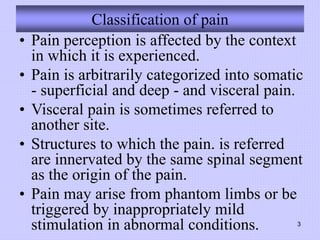
Classification of pain
• Pain perception is affected by the context
in which it is experienced.
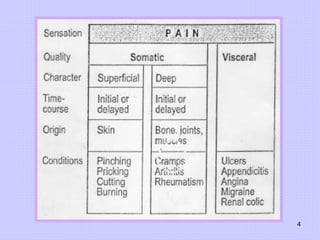
• Pain is arbitrarily categorized into somatic
- superficial and deep - and visceral pain.
• Visceral pain is sometimes referred to
another site.
• Structures to which the pain. is referred
are innervated by the same spinal segment
as the origin of the pain.
• Pain may arise from phantom limbs or be
triggered by inappropriately mild
stimulation in abnormal conditions.
4
5
6
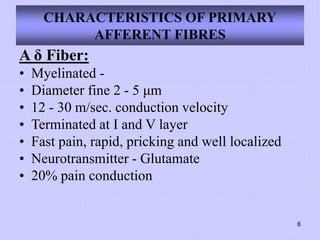
CHARACTERISTICS OF PRIMARY
AFFERENT FIBRES
A δ Fiber:
• Myelinated -
• Diameter fine 2 - 5 μm
• 12 - 30 m/sec. conduction velocity
• Terminated at I and V layer
• Fast pain, rapid, pricking and well localized
• Neurotransmitter - Glutamate
• 20% pain conduction
7
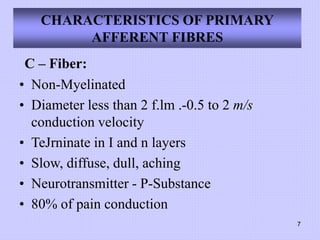
• Non-Myelinated
• Diameter less than 2 f.lm .-0.5 to 2 m/s
conduction velocity
• TeJrninate in I and n layers
• Slow, diffuse, dull, aching
• Neurotransmitter - P-Substance
• 80% of pain conduction
CHARACTERISTICS OF PRIMARY
AFFERENT FIBRES
C – Fiber:
8
TYPES:
1. HIGH TRHESHOLD
MECHANORECEPTOR(HTM) NNERVATED BY
- TIHN MYELINATED A FIBERS
2. POLYMODAL NOCICEPTORS(PMN)
INNERVATED BY UNMYELINATED C FIBRES
NOCICEPTOR: PAIN RECEPTOR
9
DAMAGE AND INFLAMMATION
RELEASE CHEMICAL MEDIATORS WICH ACTIVATE
OR
SENSITISE THE RECEPTOR ENDINGS
CYTOKlNES BRADYKININ, PROSTAGLANDIN, P - SUBSTANCE
RESULTS IN TRANSDUCTION
CONDUCTION OF NERVE IMPULSE
10
DORSAL HORN GATING MECHANISM
11
A MODAL OF “GATING” OF PAIN
12
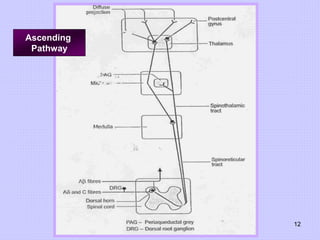
Ascending
Pathway
13
Descending
Analgesic
Pathway
14
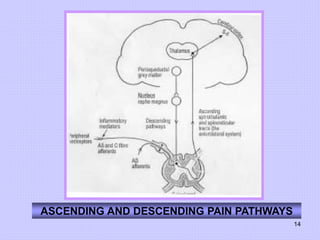
ASCENDING AND DESCENDING PAIN PATHWAYS
15
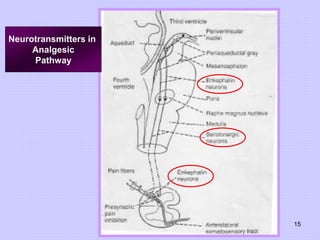
Neurotransmitters in
Analgesic
Pathway
16
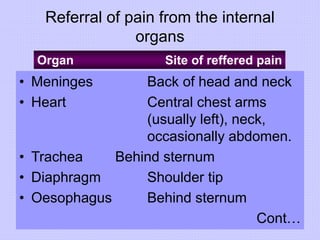
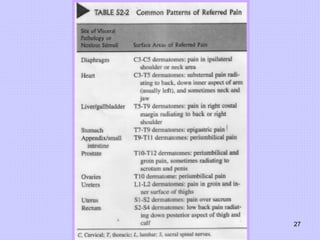
Referral of pain from the internal
organs
• Meninges Back of head and neck
• Heart Central chest arms
(usually left), neck,
occasionally abdomen.
• Trachea Behind sternum
• Diaphragm Shoulder tip
• Oesophagus Behind sternum
Cont…
Organ Site of reffered pain
17
• Stomach, duodenum Upper abdomen,
epigastrium
• Small bowel, pancreas Around umbilicus
• Large bowel, bladder Lower abdomen
above pubic bone
Organ Site of reffered pain
18
19
VISCERAL PAIN
20
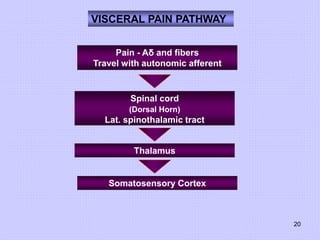
VISCERAL PAIN PATHWAY
Pain - Aδ and fibers
Travel with autonomic afferent
Spinal cord
(Dorsal Horn)
Lat. spinothalamic tract
Thalamus
Somatosensory Cortex
21
• Poorly localized
• Associated with nausea and autonomic
disturbance
• Often referred to another part of the body
• Cutting, crushing are not painful when applied
to viscera
• Pain is caused by distension, ischemia and
inflammation
CHARACTERSITICS OF VISCERAL PAIN
22
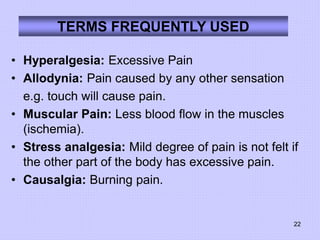
• Hyperalgesia: Excessive Pain
• Allodynia: Pain caused by any other sensation
e.g. touch will cause pain.
• Muscular Pain: Less blood flow in the muscles
(ischemia).
• Stress analgesia: Mild degree of pain is not felt if
the other part of the body has excessive pain.
• Causalgia: Burning pain.
TERMS FREQUENTLY USED
23
Thalamic Syndrome
.Obstruction of the thalmogeniculate branch of
the posterior cerebral artery Affects posterior
thalamic nuclei.
. Prolonged severe pain.
TERMS FREQUENTLY USED
24
25
SITES & MECHANISM OF PAIN RELIEF
26
Trans Coetaneous
Electrical Nerve Stimulation
(TENS)
27
28
29

04-Pain pathway

  • 2.
  • 3.
    3 Classification of pain •Pain perception is affected by the context in which it is experienced. • Pain is arbitrarily categorized into somatic - superficial and deep - and visceral pain. • Visceral pain is sometimes referred to another site. • Structures to which the pain. is referred are innervated by the same spinal segment as the origin of the pain. • Pain may arise from phantom limbs or be triggered by inappropriately mild stimulation in abnormal conditions.
  • 4.
  • 5.
  • 6.
    6 CHARACTERISTICS OF PRIMARY AFFERENTFIBRES A δ Fiber: • Myelinated - • Diameter fine 2 - 5 μm • 12 - 30 m/sec. conduction velocity • Terminated at I and V layer • Fast pain, rapid, pricking and well localized • Neurotransmitter - Glutamate • 20% pain conduction
  • 7.
    7 • Non-Myelinated • Diameterless than 2 f.lm .-0.5 to 2 m/s conduction velocity • TeJrninate in I and n layers • Slow, diffuse, dull, aching • Neurotransmitter - P-Substance • 80% of pain conduction CHARACTERISTICS OF PRIMARY AFFERENT FIBRES C – Fiber:
  • 8.
    8 TYPES: 1. HIGH TRHESHOLD MECHANORECEPTOR(HTM)NNERVATED BY - TIHN MYELINATED A FIBERS 2. POLYMODAL NOCICEPTORS(PMN) INNERVATED BY UNMYELINATED C FIBRES NOCICEPTOR: PAIN RECEPTOR
  • 9.
    9 DAMAGE AND INFLAMMATION RELEASECHEMICAL MEDIATORS WICH ACTIVATE OR SENSITISE THE RECEPTOR ENDINGS CYTOKlNES BRADYKININ, PROSTAGLANDIN, P - SUBSTANCE RESULTS IN TRANSDUCTION CONDUCTION OF NERVE IMPULSE
  • 10.
  • 11.
    11 A MODAL OF“GATING” OF PAIN
  • 12.
  • 13.
  • 14.
  • 15.
  • 16.
    16 Referral of painfrom the internal organs • Meninges Back of head and neck • Heart Central chest arms (usually left), neck, occasionally abdomen. • Trachea Behind sternum • Diaphragm Shoulder tip • Oesophagus Behind sternum Cont… Organ Site of reffered pain
  • 17.
    17 • Stomach, duodenumUpper abdomen, epigastrium • Small bowel, pancreas Around umbilicus • Large bowel, bladder Lower abdomen above pubic bone Organ Site of reffered pain
  • 18.
  • 19.
  • 20.
    20 VISCERAL PAIN PATHWAY Pain- Aδ and fibers Travel with autonomic afferent Spinal cord (Dorsal Horn) Lat. spinothalamic tract Thalamus Somatosensory Cortex
  • 21.
    21 • Poorly localized •Associated with nausea and autonomic disturbance • Often referred to another part of the body • Cutting, crushing are not painful when applied to viscera • Pain is caused by distension, ischemia and inflammation CHARACTERSITICS OF VISCERAL PAIN
  • 22.
    22 • Hyperalgesia: ExcessivePain • Allodynia: Pain caused by any other sensation e.g. touch will cause pain. • Muscular Pain: Less blood flow in the muscles (ischemia). • Stress analgesia: Mild degree of pain is not felt if the other part of the body has excessive pain. • Causalgia: Burning pain. TERMS FREQUENTLY USED
  • 23.
    23 Thalamic Syndrome .Obstruction ofthe thalmogeniculate branch of the posterior cerebral artery Affects posterior thalamic nuclei. . Prolonged severe pain. TERMS FREQUENTLY USED
  • 24.
  • 25.
    25 SITES & MECHANISMOF PAIN RELIEF
  • 26.
  • 27.
  • 28.
  • 29.