September 1913
             W.B. Yeats
Published in ‘Responsibilities’ (1914)
Historical Context 1
Yeats wrote several poems in response to the
public controversy stirred by Sir Hugh Lane's
offer of his collection of paintings to the city of
Dublin and the Dublin Lock-out of 1913-14.

Of these ‘September 1913’ is the best known
and the most significant.

Sir Hugh Lane was a friend of Yeats’s and
related to Lady Gregory, one of his patrons.


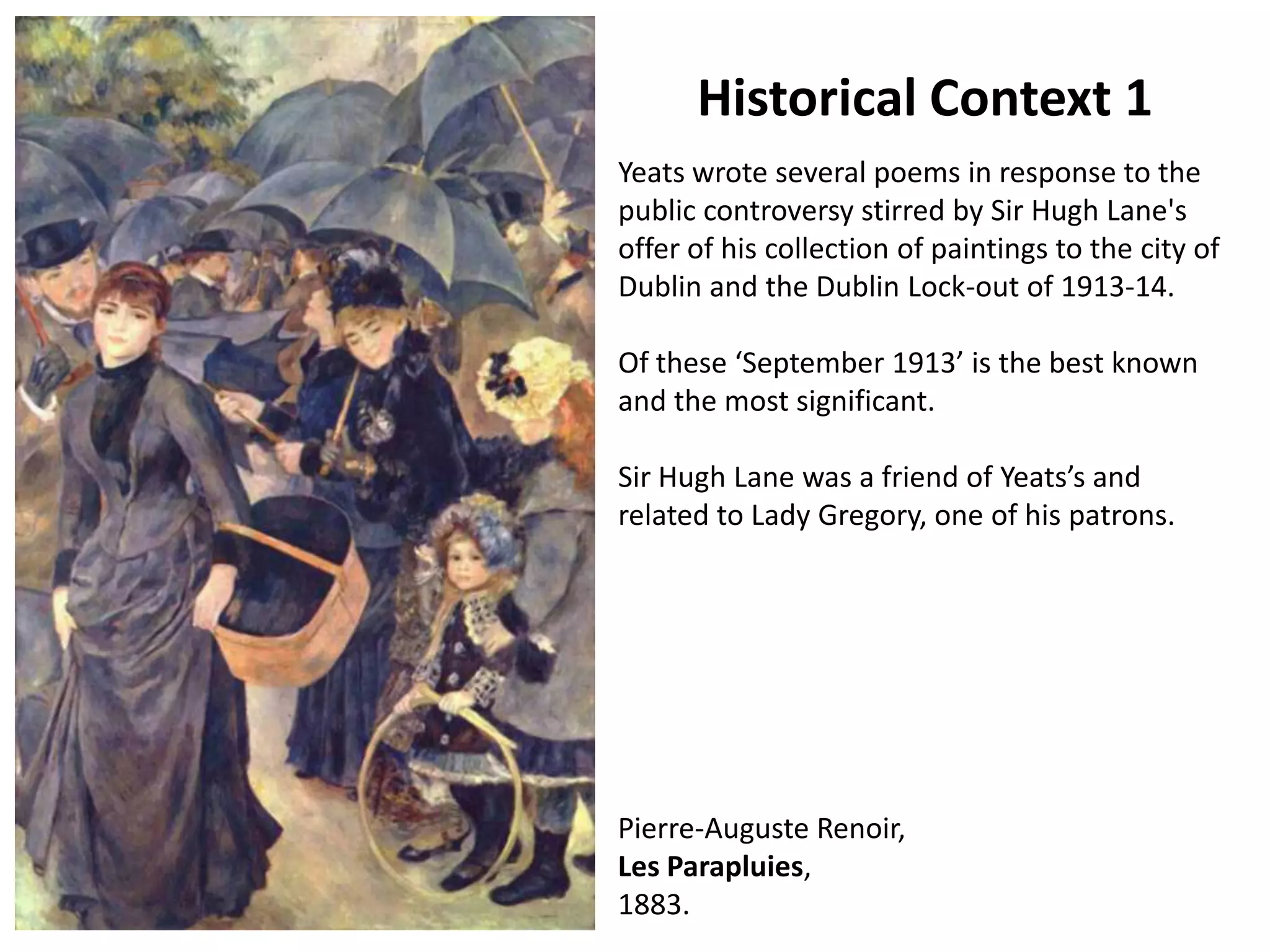
Pierre-Auguste Renoir,
Les Parapluies,
1883.
Historical Context 2
                   The Dublin Lock-out was a major industrial dispute between
                   approximately 20,000 workers and 300 employers which took
                   place in Ireland's capital city. The dispute lasted from 26 August
                   1913 to 18 January 1914, and is often viewed as the most severe
                   and significant industrial dispute in Irish history. Central to the
                   dispute was the workers' right to unionise.
                   One of the major factors which contributed to the ignition of the
                   dispute was the dire circumstances in which the city's poor lived. In
                   1913, one third of Dublin's population lived in slums. The infant
                   mortality rate amongst the poor was 142 per 1000 births (in 2005
                   it was 6 per 1000). The situation was made worse by the high rate
Q. What do these   of disease in the slums, which was the result of a lack of health
notes suggest      care and cramped living conditions. The most prevalent disease
about the likely   was tuberculosis (TB), which spread through tenements quickly
tone of the        and caused many deaths. A report published in 1912 claimed that
poem?              TB-related deaths in Ireland were 50% higher than in England or
                   Scotland, and the vast majority of TB-related deaths in Ireland
                   occurred amongst the poor.
                   Source; Wikipedia.
September 1913

What need you, being come to sense,
But fumble in a greasy till
And add the halfpence to the pence
And prayer to shivering prayer, until
You have dried the marrow from the bone;     5
For men were born to pray and save:
Romantic Ireland’s dead and gone,
It’s with O’Leary in the grave.

Yet they were of a different kind
The names that stilled your childish play,       10
They have gone about the world like wind,
But little time had they to pray
For whom the hangman’s rope was spun,
And what, God help us, could they save:
Romantic Ireland’s dead and gone,                15
It’s with O’Leary in the grave.
Was it for this the wild geese spread
The grey wing upon every tide;
For this that all that blood was shed,
For this Edward Fitzgerald died,          20
And Robert Emmet and Wolfe Tone,
All that delirium of the brave;
Romantic Ireland’s dead and gone,
It’s with O’Leary in the grave.

Yet could we turn the years again,        25
And call those exiles as they were,
In all their loneliness and pain
You’d cry ‘Some woman’s yellow hair
Has maddened every mother’s son’:
They weighed so lightly what they gave,   30
But let them be, they’re dead and gone,
They’re with O’Leary in the grave
Q. Close textual analysis: FORM – STRUCTURE – LANGUAGE.

What was the ‘form’ of ‘The Stolen Child’? What ‘form’ does this poem take? How
might it be significant?

Work out the rhythm, metre and rhyme scheme – make a note of the structure of the
poem. How does the structure help shape our response?

Look at Yeats’s use of language. How do the various techniques help shape our
response to the poem?

What connections can you make between the poems you’ve studied so far?
Connections – Still in a Celtic Twilight?
If ‘The Stolen Child’ looked into Ireland’s
magical past what does ‘September
1913’ directly refer to?

To what extent does ‘September 1913’
echo ‘the cry of the heart against
necessity’ - a poem about ‘longing and
complaint’?
Connections – Still in a Celtic Twilight?
                            WARNING – MAUDLIN IRISH BALLAD ALERT
  Be aware that the songs you are about to listen to may remind you of ‘the auld country’. If taken with either a
   glass ‘o’the black stuff’ or whiskey (note the correct spelling) they may induce tears, staring fondly into the
          middle distance or dreams of rolling green mountains, leafy forest glades and rain. Lots of rain.


Listen to the song ‘By Memory Inspired’ based on an Anonymous poem first published
by Yeats’s publishers the Cuala Press in 1907 and read the note on the next slide.

How does this help us understand the poem ‘September 1913’?


    http://www.youtube.com/watch?gl=GB&v=srAv8S3ywzs

    http://www.youtube.com/watch?v=g7MAxced0Uw&feature=related
Yeats and the Ballad
   In a letter to his friend Lady Dorothy Wellesley during the period when
   Yeats was writing the ballads of Last Poems (1938) at the end of his life
   Yeats insisted that rhyme was crucial to capturing the authentic:

   ‘folk lilt of the Irish accent…Look through any old book of ballads and you
   will find that they have all perfectly regular rhyme schemes…Regular
   rhyme is needed in this kind of work…The swing of the sentence makes
   the reader expect it…The fundamental sing-song.’
   Letters on Poetry from W.B. Yeats to Lady Dorothy Wellesley (1964)


Q. What do the biographies of the ‘Romantic’ Irish patriots mentioned in the poem add
to our understanding of the poem?
John O'Leary converted Yeats to the cause of Irish cultural
                           nationalism and was, in fact, responsible for Yeats
                           becoming an ‘Irish’ writer. A man of great moral
                           rectitude, a vehement patriot and active Fenian, he
                           suffered long years of prison and exile in behalf of an
                           ideal, if somewhat imaginary, Ireland. To Yeats, he
                           seemed the embodiment of the romantic conception of
                           Ireland and of Irish nationalism. O'Leary recommended to
                           Yeats the writings of the Young Irelanders (rebels from
                           the mid-19th century), maintaining that the nature and
                           intensity of the feeling they had inspired had been of
                           great political value. However, he never claimed that they
                           were noteworthy for quality. In fact, despite his stress on
                           the importance of a nationalistic purpose to aspiring Irish
                           writers, O'Leary insisted that poetics should never be
                           sacrificed to politics, nor aesthetics to argument. In his
                           essay ‘Poetry and Tradition’ (1907) Yeats recalls O'Leary
                           insisting that a ‘writer must not write badly, or ignore the
                           examples of the great Masters in the fancied or real
                           service of a cause, ... [just as] he must not lie for it or
                           grow hysterical". Hoping to promote an Irish literature of
                           the greatest kind, he supported Yeats in his refusal to
                           praise second-rate literature in order to strengthen the
                           cause of Irish nationalism. Thus Yeats associated O'Leary
                           not only with Irish cultural nationalism but with an
                           insistence on the highest standards of artistic excellence.
                           Yeats had faith that O'Leary, like himself, would have
                           recognized the intrinsic quality of the Lane Collection and
John O’Leary (1830-1907)   deplored the nationalism which led to its loss.
Irish aristocrat and revolutionary.
                                       He was the fifth son of the 1st
                                       Duke of Leinster. He died of
                                       wounds received in resisting arrest
                                       on charge of treason following the
                                       1798 rebellion.

Lord Edward Fitzgerald (1763 – 1798)
Irish nationalist and Republican and rebel
                           leader born in Dublin, he led an abortive
                           rebellion against British rule in 1803 and was
                           captured, tried and executed by hanging,
                           drawing and quartering for high treason. His
                           last recorded words were made in a now
                           famous speech on the eve of his execution:

                           ‘Let no man write my epitaph; for as no man who
                           knows my motives dare now vindicate them, let
                           not prejudice or ignorance, asperse them. Let them
                           and me rest in obscurity and peace, and my tomb
                           remain uninscribed, and my memory in oblivion,
                           until other times and other men can do justice to
                           my character. When my country takes her place
                           among the nations of the earth, then and not till
                           then, let my epitaph be written. I have done.’
Robert Emmet (1778-1803)
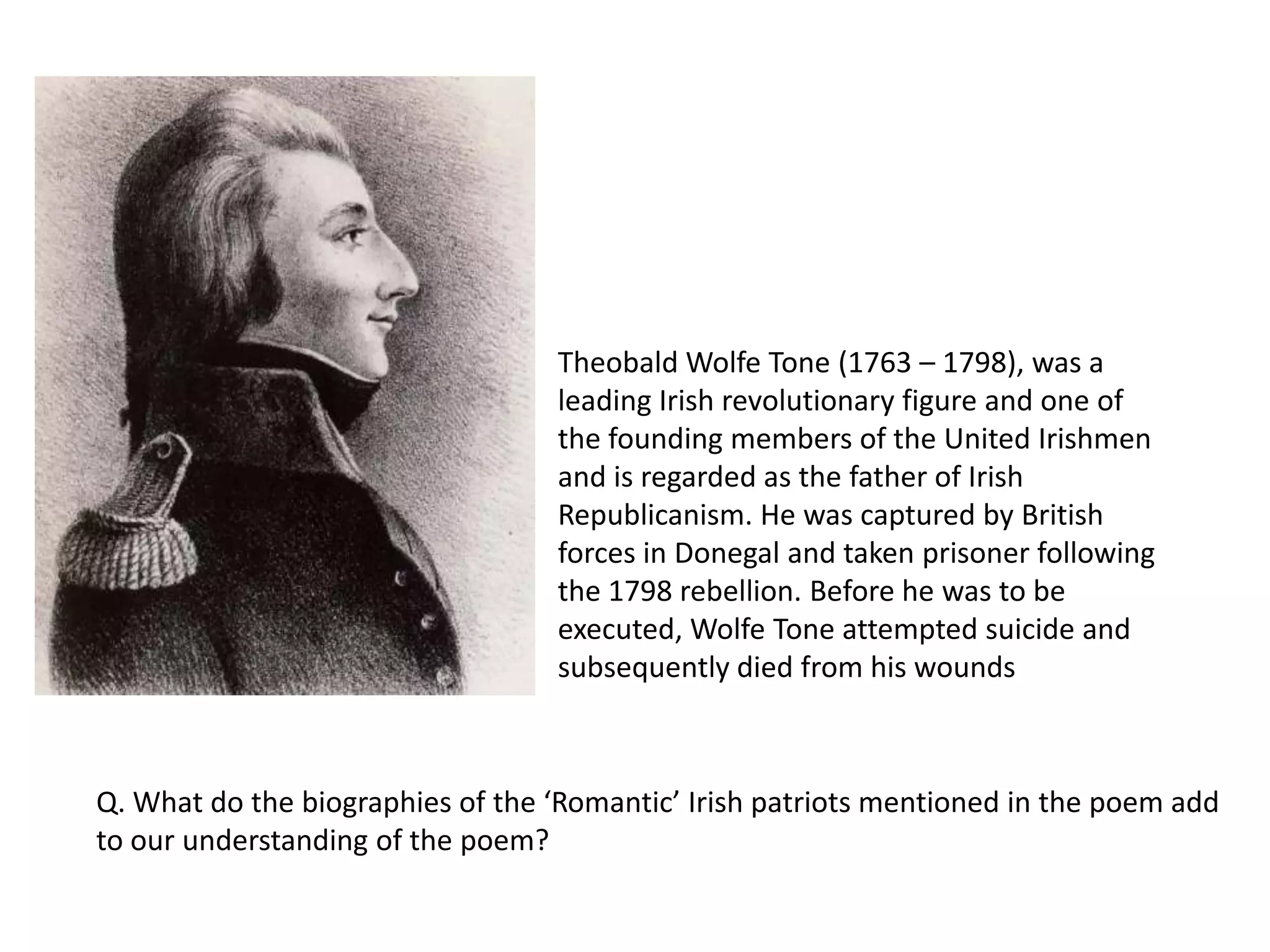
Theobald Wolfe Tone (1763 – 1798), was a
                                  leading Irish revolutionary figure and one of
                                  the founding members of the United Irishmen
                                  and is regarded as the father of Irish
                                  Republicanism. He was captured by British
                                  forces in Donegal and taken prisoner following
                                  the 1798 rebellion. Before he was to be
                                  executed, Wolfe Tone attempted suicide and
                                  subsequently died from his wounds


Q. What do the biographies of the ‘Romantic’ Irish patriots mentioned in the poem add
to our understanding of the poem?
‘In the thirty years or so during which I have been reading Irish newspapers, three public
controversies have stirred my imagination. The first was the Parnell controversy…another
was the dispute over The Playboy *of the Western World+…The third prepared for the
Corporation’s refusal of a building for Sir Hugh Lane’s famous collection of pictures …
These controversies, political, literary, and artistic, have showed that neither religion nor
politics can of itself create minds with enough receptivity to become wise, or just and
generous enough to make a nation … In Ireland I am constantly reminded of that fable of
the futility of all discipline that is not of the whole being…Against all this we have but a
few educated men and all the remnants of an old traditional culture among the poor. Both
were stronger forty years ago, before the rise of our new middle class which ... [shows]
how base, at moment of excitement, are minds without culture. ’
WB Yeats, Notes on second edition of ‘Responsibilities’ (1916)


‘Power passed to small shopkeepers, to clerks, to                Q. What do these
that very class who had seemed to John O'Leary so                extracts reveal of
ready to bend to the power of others, to men who                 Yeats’s attitude to
had risen above the traditions of the countryman,                some of his fellow
without learning those of cultivated life, or even               countrymen? How
educating themselves, and who because of their                   does this tally with
poverty, their ignorance, their superstitious piety,             the opening stanza of
are much subject to all kinds of fear.’                          the poem?
WB Yeats ‘Poetry and Tradition’ (1907).
Yeats and the creation of an Irish Literature

    Q. What does the following extract reveal of Yeats’s thinking
    about Ireland as a country? How does this tally with your reading
    of ‘September 1913’?

‘You cannot keep the idea of a nation alive where there are no national
institutions to reverence, no national success to admire, without a model of it
in the mind of the people. You can call it ‘Caitlín Ní Uallacháin’ (the title of a
play Yeats wrote in 1902 – ‘Kathleen ni-Houlihan’) or ‘Sean-Bhean Bhocht’
(the poor old woman) in a mood of simple feeling and love that image, but for
the general purposes of life you must have a complex mass of images, making
up a model like an architect's model. The Young Ireland poets created this
with certain images rather simple in their conception that filled the mind of
the young-Wolfe Tone, King Brian, Emmet, Owen Roe, Sarsfield, the Fisherman
of Kinsale . . . its most powerful work was this creation of sensible images for
the affections vivid enough to follow men to the scaffold.’
WB Yeats, March 12, 1909
In May 1902, Yeats wrote of his play:

‘My subject is Ireland and its struggle for independence. The scene is laid in the West of
Ireland at the time of the French landing. I have described a household preparing for the
wedding of the son of the house. Everyone expects some good thing from the wedding.
The bridegroom is thinking of his bride, the father of the fortune which will make them all
more prosperous, and the mother of a plan of turning this prosperity to account by making
her youngest son a priest, and the youngest son of a greyhound pup the bride promised to
give him when she marries. Into this household comes Kathleen Ni Houlihan herself, and
the bridegroom leaves his bride, and all the hopes come to nothing. It is the perpetual
struggle of the cause of Ireland and every other ideal cause against private hopes and
dreams, against all that we mean when we say the world. I have put into the mouth of
Kathleen Ni Houlihan verses about those who have died or are about to die for her, and
these verses are the key of the rest. . . .’


         Q. What has Kathleen come to symbolise? What does the
         rejection of the Lane bequest or the Dublin Lock-out symbolise to
         Yeats?
Yeats and the creation of an Irish Literature
In 1903 Yeats wrote to Lady Gregory (in a dedication of a volume of his plays to her),

‘One night I had a dream almost as distinct as a vision, of a cottage where there was well-
being and firelight and talk of a marriage, and into the midst of that cottage there came an
old woman in a long cloak. She was Ireland herself, that Kathleen Ni Houlihan for whom so
many songs have been sung and about whom so many stories have been told and for
whose sake so many have gone to their death. I thought if I could write this out as a little
play I could make others see my dream as I had seen it, but I could not get down out of
that high window of dramatic verse, and in spite of all you had done for me I had not the
country speech. One has to live among the people . . . before one can think the thoughts of
the people and speak with their tongue. We turned my dream into the little play, `Kathleen
Ni Houlihan,' and when we gave it to the little theatre in Dublin (the Abbey theatre he co-
founded) and found that the working people liked it, you helped me to put my other
dramatic fables into speech . . . .’

         Q. What does this dedication say about Yeats’s intentions with his
         play and with his earlier intention to ‘write poetry of insight and
         knowledge’?
Connections – Yeats’s Poetry

                    A Coat (1912)

                    I made my song a coat
                    Covered with embroideries
                    Out of old mythologies
                    From heel to throat;
                    But the fools caught it,               5
                    Wore it in the world’s eyes
                    As though they’d wrought it.
                    Song, let them take it
                    For there’s more enterprise
                    In walking naked.                     10


Q. What connects the tone of ‘September 1913’ with ‘A Coat’? What coat is Yeats
beginning to divest himself of in this poem?
‘O’Leary has influenced all I
‘…in dreams begin responsibility.’                                            have set my hand to since.’
Epigraph to the anthology ‘Responsibilities’ (1914)
                                                                                          WB Yeats


                                                  ‘How am I fallen from myself, for a long time now
  ‘Responsibilities’ marked a
                                                  I have not seen the Prince of Chang in my dreams.’
    turning point in Yeats’s                      Epigraph to the anthology ‘Responsibilities’ (1914)
      poetic career as he
 abandons ‘old mythologies’
 not all mythologies, only old
    ones.’ (Greening 2005)                 Yeats’s great poetry is ‘based upon antinomies - Ireland
                                           and Byzantium, youth and age, fecund life and stylized
                                           art, action and contemplation, love and war, violent
                                           energy and decadent civilization - which gain definition
                                           from one another without ever reaching, or seriously
                                           seeking, reconciliation’.
                                           Seamus Deane, A Short History of Irish Literature (1986)


  Q. Write a short paragraph explaining how each of these quotes relate (or doesn’t
  relate) to your understanding of the poem ‘September 1913’.

04 yeats september 1913

  • 1.
    September 1913 W.B. Yeats Published in ‘Responsibilities’ (1914)
  • 2.
    Historical Context 1 Yeatswrote several poems in response to the public controversy stirred by Sir Hugh Lane's offer of his collection of paintings to the city of Dublin and the Dublin Lock-out of 1913-14. Of these ‘September 1913’ is the best known and the most significant. Sir Hugh Lane was a friend of Yeats’s and related to Lady Gregory, one of his patrons. Pierre-Auguste Renoir, Les Parapluies, 1883.
  • 3.
    Historical Context 2 The Dublin Lock-out was a major industrial dispute between approximately 20,000 workers and 300 employers which took place in Ireland's capital city. The dispute lasted from 26 August 1913 to 18 January 1914, and is often viewed as the most severe and significant industrial dispute in Irish history. Central to the dispute was the workers' right to unionise. One of the major factors which contributed to the ignition of the dispute was the dire circumstances in which the city's poor lived. In 1913, one third of Dublin's population lived in slums. The infant mortality rate amongst the poor was 142 per 1000 births (in 2005 it was 6 per 1000). The situation was made worse by the high rate Q. What do these of disease in the slums, which was the result of a lack of health notes suggest care and cramped living conditions. The most prevalent disease about the likely was tuberculosis (TB), which spread through tenements quickly tone of the and caused many deaths. A report published in 1912 claimed that poem? TB-related deaths in Ireland were 50% higher than in England or Scotland, and the vast majority of TB-related deaths in Ireland occurred amongst the poor. Source; Wikipedia.
  • 4.
    September 1913 What needyou, being come to sense, But fumble in a greasy till And add the halfpence to the pence And prayer to shivering prayer, until You have dried the marrow from the bone; 5 For men were born to pray and save: Romantic Ireland’s dead and gone, It’s with O’Leary in the grave. Yet they were of a different kind The names that stilled your childish play, 10 They have gone about the world like wind, But little time had they to pray For whom the hangman’s rope was spun, And what, God help us, could they save: Romantic Ireland’s dead and gone, 15 It’s with O’Leary in the grave.
  • 5.
    Was it forthis the wild geese spread The grey wing upon every tide; For this that all that blood was shed, For this Edward Fitzgerald died, 20 And Robert Emmet and Wolfe Tone, All that delirium of the brave; Romantic Ireland’s dead and gone, It’s with O’Leary in the grave. Yet could we turn the years again, 25 And call those exiles as they were, In all their loneliness and pain You’d cry ‘Some woman’s yellow hair Has maddened every mother’s son’: They weighed so lightly what they gave, 30 But let them be, they’re dead and gone, They’re with O’Leary in the grave
  • 6.
    Q. Close textualanalysis: FORM – STRUCTURE – LANGUAGE. What was the ‘form’ of ‘The Stolen Child’? What ‘form’ does this poem take? How might it be significant? Work out the rhythm, metre and rhyme scheme – make a note of the structure of the poem. How does the structure help shape our response? Look at Yeats’s use of language. How do the various techniques help shape our response to the poem? What connections can you make between the poems you’ve studied so far?
  • 7.
    Connections – Stillin a Celtic Twilight? If ‘The Stolen Child’ looked into Ireland’s magical past what does ‘September 1913’ directly refer to? To what extent does ‘September 1913’ echo ‘the cry of the heart against necessity’ - a poem about ‘longing and complaint’?
  • 8.
    Connections – Stillin a Celtic Twilight? WARNING – MAUDLIN IRISH BALLAD ALERT Be aware that the songs you are about to listen to may remind you of ‘the auld country’. If taken with either a glass ‘o’the black stuff’ or whiskey (note the correct spelling) they may induce tears, staring fondly into the middle distance or dreams of rolling green mountains, leafy forest glades and rain. Lots of rain. Listen to the song ‘By Memory Inspired’ based on an Anonymous poem first published by Yeats’s publishers the Cuala Press in 1907 and read the note on the next slide. How does this help us understand the poem ‘September 1913’? http://www.youtube.com/watch?gl=GB&v=srAv8S3ywzs http://www.youtube.com/watch?v=g7MAxced0Uw&feature=related
  • 9.
    Yeats and theBallad In a letter to his friend Lady Dorothy Wellesley during the period when Yeats was writing the ballads of Last Poems (1938) at the end of his life Yeats insisted that rhyme was crucial to capturing the authentic: ‘folk lilt of the Irish accent…Look through any old book of ballads and you will find that they have all perfectly regular rhyme schemes…Regular rhyme is needed in this kind of work…The swing of the sentence makes the reader expect it…The fundamental sing-song.’ Letters on Poetry from W.B. Yeats to Lady Dorothy Wellesley (1964) Q. What do the biographies of the ‘Romantic’ Irish patriots mentioned in the poem add to our understanding of the poem?
  • 10.
    John O'Leary convertedYeats to the cause of Irish cultural nationalism and was, in fact, responsible for Yeats becoming an ‘Irish’ writer. A man of great moral rectitude, a vehement patriot and active Fenian, he suffered long years of prison and exile in behalf of an ideal, if somewhat imaginary, Ireland. To Yeats, he seemed the embodiment of the romantic conception of Ireland and of Irish nationalism. O'Leary recommended to Yeats the writings of the Young Irelanders (rebels from the mid-19th century), maintaining that the nature and intensity of the feeling they had inspired had been of great political value. However, he never claimed that they were noteworthy for quality. In fact, despite his stress on the importance of a nationalistic purpose to aspiring Irish writers, O'Leary insisted that poetics should never be sacrificed to politics, nor aesthetics to argument. In his essay ‘Poetry and Tradition’ (1907) Yeats recalls O'Leary insisting that a ‘writer must not write badly, or ignore the examples of the great Masters in the fancied or real service of a cause, ... [just as] he must not lie for it or grow hysterical". Hoping to promote an Irish literature of the greatest kind, he supported Yeats in his refusal to praise second-rate literature in order to strengthen the cause of Irish nationalism. Thus Yeats associated O'Leary not only with Irish cultural nationalism but with an insistence on the highest standards of artistic excellence. Yeats had faith that O'Leary, like himself, would have recognized the intrinsic quality of the Lane Collection and John O’Leary (1830-1907) deplored the nationalism which led to its loss.
  • 11.
    Irish aristocrat andrevolutionary. He was the fifth son of the 1st Duke of Leinster. He died of wounds received in resisting arrest on charge of treason following the 1798 rebellion. Lord Edward Fitzgerald (1763 – 1798)
  • 12.
    Irish nationalist andRepublican and rebel leader born in Dublin, he led an abortive rebellion against British rule in 1803 and was captured, tried and executed by hanging, drawing and quartering for high treason. His last recorded words were made in a now famous speech on the eve of his execution: ‘Let no man write my epitaph; for as no man who knows my motives dare now vindicate them, let not prejudice or ignorance, asperse them. Let them and me rest in obscurity and peace, and my tomb remain uninscribed, and my memory in oblivion, until other times and other men can do justice to my character. When my country takes her place among the nations of the earth, then and not till then, let my epitaph be written. I have done.’ Robert Emmet (1778-1803)
  • 13.
    Theobald Wolfe Tone(1763 – 1798), was a leading Irish revolutionary figure and one of the founding members of the United Irishmen and is regarded as the father of Irish Republicanism. He was captured by British forces in Donegal and taken prisoner following the 1798 rebellion. Before he was to be executed, Wolfe Tone attempted suicide and subsequently died from his wounds Q. What do the biographies of the ‘Romantic’ Irish patriots mentioned in the poem add to our understanding of the poem?
  • 14.
    ‘In the thirtyyears or so during which I have been reading Irish newspapers, three public controversies have stirred my imagination. The first was the Parnell controversy…another was the dispute over The Playboy *of the Western World+…The third prepared for the Corporation’s refusal of a building for Sir Hugh Lane’s famous collection of pictures … These controversies, political, literary, and artistic, have showed that neither religion nor politics can of itself create minds with enough receptivity to become wise, or just and generous enough to make a nation … In Ireland I am constantly reminded of that fable of the futility of all discipline that is not of the whole being…Against all this we have but a few educated men and all the remnants of an old traditional culture among the poor. Both were stronger forty years ago, before the rise of our new middle class which ... [shows] how base, at moment of excitement, are minds without culture. ’ WB Yeats, Notes on second edition of ‘Responsibilities’ (1916) ‘Power passed to small shopkeepers, to clerks, to Q. What do these that very class who had seemed to John O'Leary so extracts reveal of ready to bend to the power of others, to men who Yeats’s attitude to had risen above the traditions of the countryman, some of his fellow without learning those of cultivated life, or even countrymen? How educating themselves, and who because of their does this tally with poverty, their ignorance, their superstitious piety, the opening stanza of are much subject to all kinds of fear.’ the poem? WB Yeats ‘Poetry and Tradition’ (1907).
  • 15.
    Yeats and thecreation of an Irish Literature Q. What does the following extract reveal of Yeats’s thinking about Ireland as a country? How does this tally with your reading of ‘September 1913’? ‘You cannot keep the idea of a nation alive where there are no national institutions to reverence, no national success to admire, without a model of it in the mind of the people. You can call it ‘Caitlín Ní Uallacháin’ (the title of a play Yeats wrote in 1902 – ‘Kathleen ni-Houlihan’) or ‘Sean-Bhean Bhocht’ (the poor old woman) in a mood of simple feeling and love that image, but for the general purposes of life you must have a complex mass of images, making up a model like an architect's model. The Young Ireland poets created this with certain images rather simple in their conception that filled the mind of the young-Wolfe Tone, King Brian, Emmet, Owen Roe, Sarsfield, the Fisherman of Kinsale . . . its most powerful work was this creation of sensible images for the affections vivid enough to follow men to the scaffold.’ WB Yeats, March 12, 1909
  • 16.
    In May 1902,Yeats wrote of his play: ‘My subject is Ireland and its struggle for independence. The scene is laid in the West of Ireland at the time of the French landing. I have described a household preparing for the wedding of the son of the house. Everyone expects some good thing from the wedding. The bridegroom is thinking of his bride, the father of the fortune which will make them all more prosperous, and the mother of a plan of turning this prosperity to account by making her youngest son a priest, and the youngest son of a greyhound pup the bride promised to give him when she marries. Into this household comes Kathleen Ni Houlihan herself, and the bridegroom leaves his bride, and all the hopes come to nothing. It is the perpetual struggle of the cause of Ireland and every other ideal cause against private hopes and dreams, against all that we mean when we say the world. I have put into the mouth of Kathleen Ni Houlihan verses about those who have died or are about to die for her, and these verses are the key of the rest. . . .’ Q. What has Kathleen come to symbolise? What does the rejection of the Lane bequest or the Dublin Lock-out symbolise to Yeats?
  • 17.
    Yeats and thecreation of an Irish Literature In 1903 Yeats wrote to Lady Gregory (in a dedication of a volume of his plays to her), ‘One night I had a dream almost as distinct as a vision, of a cottage where there was well- being and firelight and talk of a marriage, and into the midst of that cottage there came an old woman in a long cloak. She was Ireland herself, that Kathleen Ni Houlihan for whom so many songs have been sung and about whom so many stories have been told and for whose sake so many have gone to their death. I thought if I could write this out as a little play I could make others see my dream as I had seen it, but I could not get down out of that high window of dramatic verse, and in spite of all you had done for me I had not the country speech. One has to live among the people . . . before one can think the thoughts of the people and speak with their tongue. We turned my dream into the little play, `Kathleen Ni Houlihan,' and when we gave it to the little theatre in Dublin (the Abbey theatre he co- founded) and found that the working people liked it, you helped me to put my other dramatic fables into speech . . . .’ Q. What does this dedication say about Yeats’s intentions with his play and with his earlier intention to ‘write poetry of insight and knowledge’?
  • 18.
    Connections – Yeats’sPoetry A Coat (1912) I made my song a coat Covered with embroideries Out of old mythologies From heel to throat; But the fools caught it, 5 Wore it in the world’s eyes As though they’d wrought it. Song, let them take it For there’s more enterprise In walking naked. 10 Q. What connects the tone of ‘September 1913’ with ‘A Coat’? What coat is Yeats beginning to divest himself of in this poem?
  • 19.
    ‘O’Leary has influencedall I ‘…in dreams begin responsibility.’ have set my hand to since.’ Epigraph to the anthology ‘Responsibilities’ (1914) WB Yeats ‘How am I fallen from myself, for a long time now ‘Responsibilities’ marked a I have not seen the Prince of Chang in my dreams.’ turning point in Yeats’s Epigraph to the anthology ‘Responsibilities’ (1914) poetic career as he abandons ‘old mythologies’ not all mythologies, only old ones.’ (Greening 2005) Yeats’s great poetry is ‘based upon antinomies - Ireland and Byzantium, youth and age, fecund life and stylized art, action and contemplation, love and war, violent energy and decadent civilization - which gain definition from one another without ever reaching, or seriously seeking, reconciliation’. Seamus Deane, A Short History of Irish Literature (1986) Q. Write a short paragraph explaining how each of these quotes relate (or doesn’t relate) to your understanding of the poem ‘September 1913’.