@Remotephysics
2020
PK
WANDERA
𝐏𝐑𝐄𝐒𝐒𝐔𝐑𝐄
@Remotephysics 2020 PK WANDERA
Definition of Pressure
 Pressure refers to force acting perpendicularly per unit
area.
 Since force is measured in newtons and area in square
meter, then the SI unit of pressure is the newton per
square meter (N/m2
) or the pascal (Pa). 1 newton per
square meter (N/m2
) = 1 pascal (Pa)
@Remotephysics 2020 PK WANDERA
Pressure in Solids
Force exerted by a solid resting on a surface is
equal to the weight the object.
@Remotephysics 2020 PK WANDERA
Pressure in Solids
Force exerted by a solid resting on a surface is
equal to the weight the object.
@Remotephysics 2020 PK WANDERA
Factors Affecting Pressure in Solids
Weight of the solid (force)
If the area of contact between solid and surface is
constant, pressure increases with weight.
Area of contact of the solid with surface.
The smaller the area, the higher the pressure if same
force is applied. Therefore pressure can be reduced
by increasing the area of contact.
@Remotephysics 2020 PK WANDERA
Examples
1. A block of a soap stone of dimension 4m by 2m by 3m is 48kg
and is made to rest on a smooth horizontal surface
a. Calculate the minimum pressure it exerts on the surface.
b. Calculate the maximum pressure it will exert on the surface
@Remotephysics 2020 PK WANDERA
b)
@Remotephysics 2020 PK WANDERA
2. An object whose area of contact with the floor is 5m2
exerts a pressure of 900 pascal. Calculate its mass
@Remotephysics 2020 PK WANDERA
Solution
@Remotephysics 2020 PK WANDERA
3. Tracks which carry heavy loads have many wheels. Explain.
@Remotephysics 2020 PK WANDERA
Ans.
Many wheels increase the area of contact with the ground thereby
reducing pressure exerted on the road. This prevents damage of the
roads by tracks.
@Remotephysics 2020 PK WANDERA
4. A block of copper of density 9g/cm3
measures 5cm by 3cm by 2cm.
Given that g is 10N/kg, determine:
a)The maximum pressure
@Remotephysics 2020 PK WANDERA
b)The minimum pressure that it can exert on a horizontal
surface.
@Remotephysics 2020 PK WANDERA
5. It is painful if one tries to lift a heavy load by a thin string
@Remotephysics 2020 PK WANDERA
Ans.
There is a small area of contact with the fingers when a thin string is
used. As a result, more pressure is generated and this is painful
@Remotephysics 2020 PK WANDERA
1. A pick up carrying stones weighs 40,000N. The weight is evenly spread
across the 4 types. The area of contact of each tire with the ground is
0.05m2
. Calculate the pressure exerted by each tire on the ground.
2. A thumb is used to push a thumb pin into a piece of wood. Explain in terms
of pressure why the pressure on wood is greater than the pressure on the
thumb.
3. An elephant of mass 2800kg has feet of average area of 200 cm2
. A vulture
of mass 12 kg walks beside the elephant on a muddy area, the average
area of the feet of the vulture is 2.0 cm2.
Which one is likely to sink? Explain
your answer showing any necessary calculations.
Excercise
@Remotephysics 2020 PK WANDERA
4. A girl standing upright exerts a pressure of 15000 N/m2
on the
floor. Given that the total area of contact of shoes and the floor is
0.02m2.
a)Determine the mass of the girl.
b)Determine the pressure she would exert on the floor if she stood
on one foot.
5. A block of copper of density 8.9 g/cm3
measures Given that the
force of gravity is 10Nkg-1
, determine:
a)The maximum pressure.
b)The minimum pressure that it can exert on a horizontal surface.
@Remotephysics 2020 PK WANDERA
Pressure in Liquids
Factors Affecting Pressure in Liquids
 Depth of the Liquid
• Pressure in liquids increases with depth.
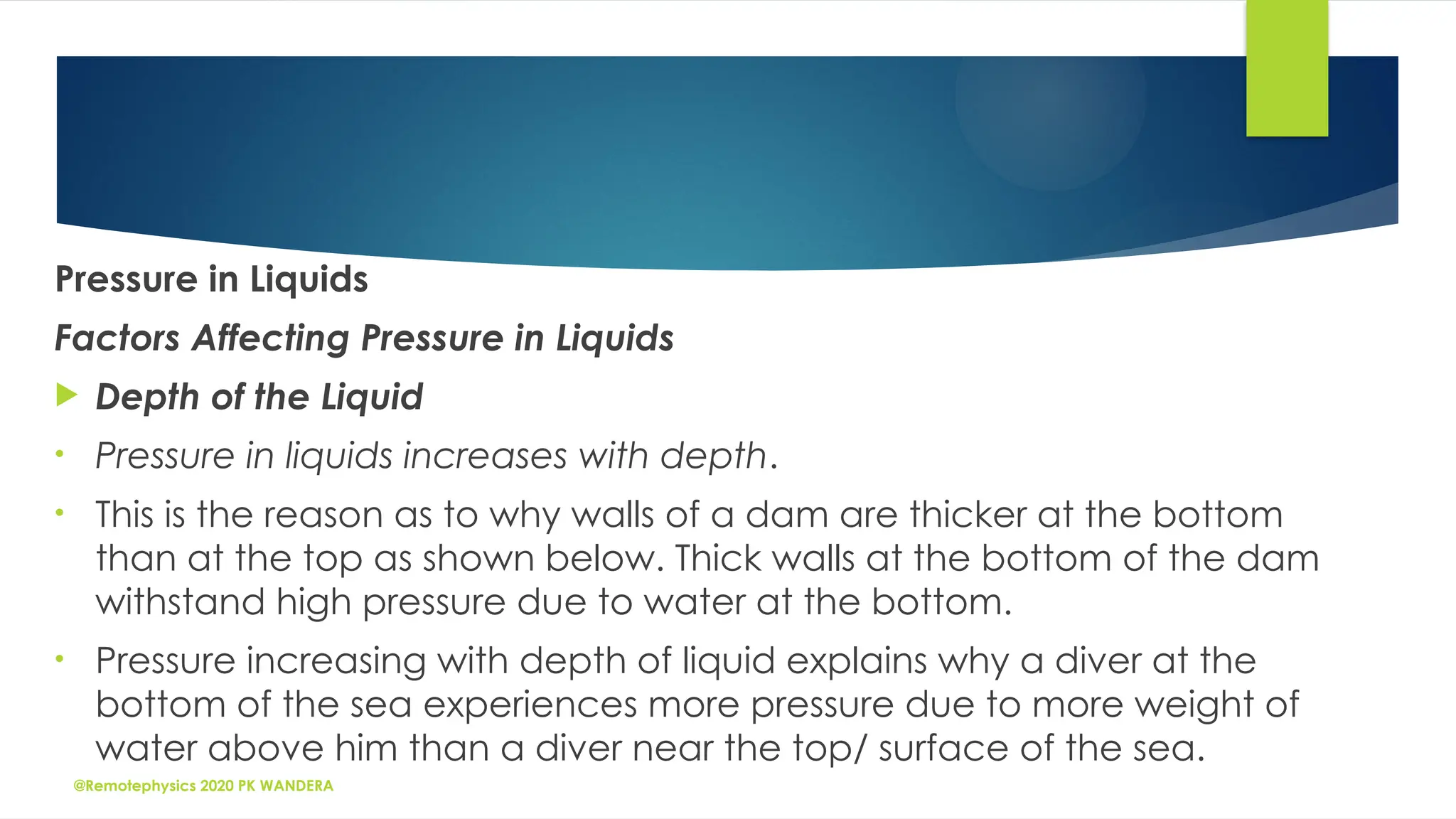
• This is the reason as to why walls of a dam are thicker at the bottom
than at the top as shown below. Thick walls at the bottom of the dam
withstand high pressure due to water at the bottom.
• Pressure increasing with depth of liquid explains why a diver at the
bottom of the sea experiences more pressure due to more weight of
water above him than a diver near the top/ surface of the sea.
@Remotephysics 2020 PK WANDERA
2. Density of the Liquid
Pressure in liquids increases with density of the liquid.
Consider two identical cylinders filled with water (of density
1000kg/m3
) and glycerine (of density 1260kg/m3
) respectively.
Pressure at point B is greater than pressure at point A because
glycerine is denser than water and therefore exerts more pressure
than water.
@Remotephysics 2020 PK WANDERA
To Demonstrate Variation of Pressure with Depth of Liquids
•Consider a tall tin with holes A, B and C equally spaced on one side
along a vertical line as shown below.
•When the tin is filled with water, the water jets out of the holes with
that from hole A thrown farthest followed by that from hole B and
lastly from hole C.
•This means that pressure of water at A is greater than pressure at B
and pressure at B is greater than pressure at C. Hence, Pressure in
liquids increases with depth.
@Remotephysics 2020 PK WANDERA
To Demonstrate Variation of Pressure with Depth and
Density of Liquids
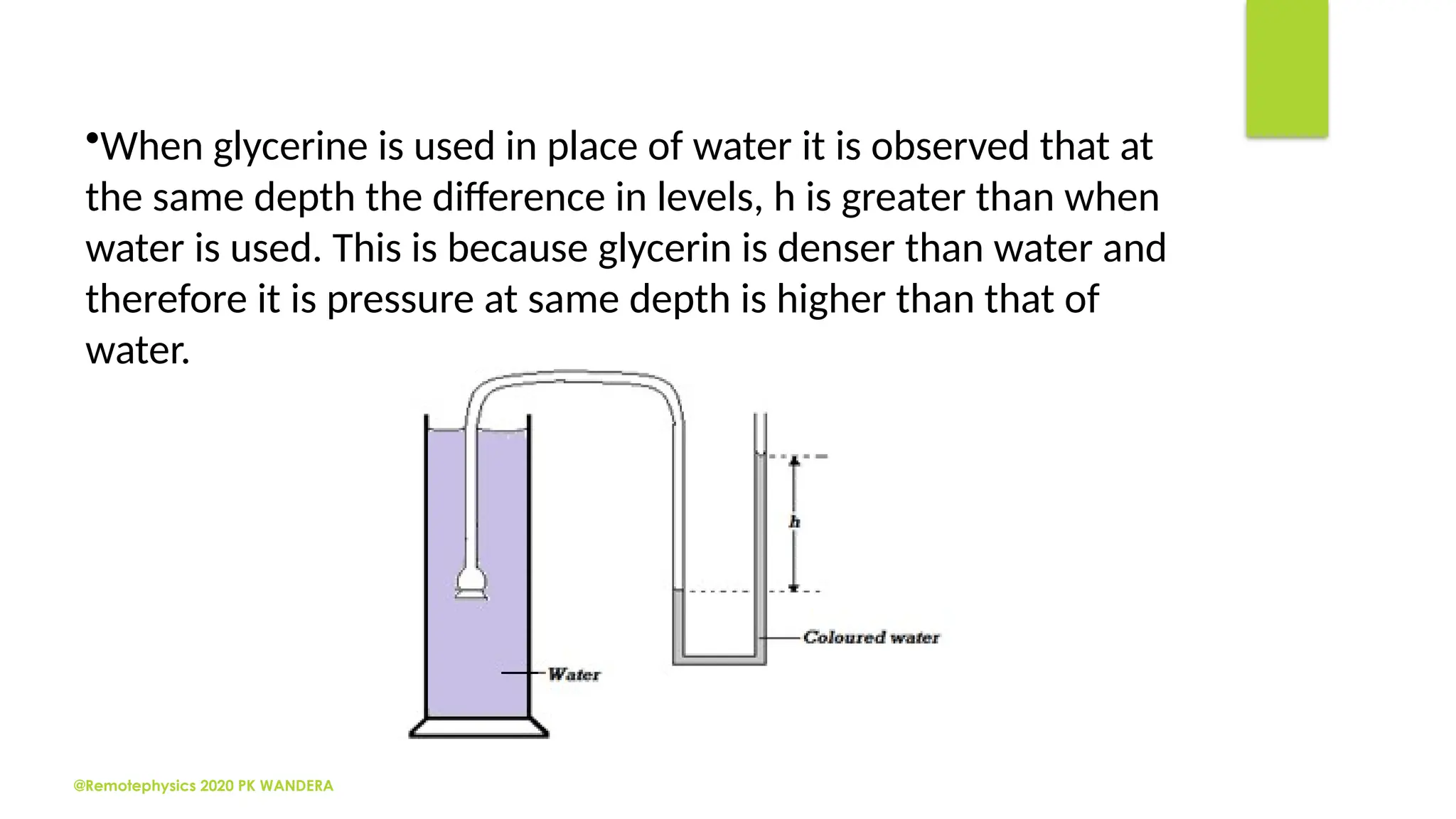
•Consider a transparent glass vessel filled with water and a
thistle funnel connected to a u-tube filled with colored water
to some level dipped into it.
It is observed that the deeper the
funnel goes below the surface of
water, the greater the difference in
levels of water in the two limbs of the
u- tube, h. This is due to increase in
pressure with depth.
@Remotephysics 2020 PK WANDERA
•When glycerine is used in place of water it is observed that at
the same depth the difference in levels, h is greater than when
water is used. This is because glycerin is denser than water and
therefore it is pressure at same depth is higher than that of
water.
@Remotephysics 2020 PK WANDERA
To Demonstrate that Pressure at Equal Depth, Acts Equally in All
Directions
•Consider a tin with two similar holes on its side at same height as shown
alongside.
•When the tin is filled with water, it is observed that water travels out of
the holes equal horizontal distances from the can. Therefore pressure
exerted at equal depth is same in all directions.
@Remotephysics 2020 PK WANDERA
Fluid Pressure Formula
 Consider a container with cross- section area, A, filled with a liquid
of density, ρ, to the height, h, as shown alongside
@Remotephysics 2020 PK WANDERA
The pressure p, exerted at the bottom (base) of the container
by the weight of the liquid above it is given by:
From the formula it is clear that pressure in fluids does not
depend on cross- section area of the container holding the liquid
@Remotephysics 2020 PK WANDERA
Examples
1)A diver working under water is 15 m below the surface of
the sea. Calculate the pressure due to water experienced by
the diver (take g=10N/kg) and density of sea water to be
equal to 1.03g/cm3
.
@Remotephysics 2020 PK WANDERA
1)The figure below shows a liquid in a pail.
If the liquid has a density of 0.79 g/cm3
, determine the pressure
exerted at the bottom of the pail by the liquid.
@Remotephysics 2020 PK WANDERA
b) Suggest a reason why pail manufactures prefer the shape shown to other shapes
@Remotephysics 2020 PK WANDERA
To reduce the height of the pail but maintain the capacity.
This reduces the pressure exerted by the liquid at the
bottom of the pail.
@Remotephysics 2020 PK WANDERA
1) Calculate the pressure exerted by 76 mm column of
mercury given that its density is 13.6g/cm3
@Remotephysics 2020 PK WANDERA
1) A column of glycerin 8.20m high, a column of sea water
10.08m high, a column of mercury 0.76m high and column
of fresh water 10.34 m high exert the same pressure at the
bottom of a container. Arrange these substances in
decreasing order of their densities.
@Remotephysics 2020 PK WANDERA
Mercury, glycerine, sea water, fresh water
@Remotephysics 2020 PK WANDERA
Pascal’s Principle (The Principle of
Transmission of Pressure in Liquids)
Pascal’s principle states that pressure applied at
one part in a liquid is transmitted equally to all
other parts of the enlarged liquid.
Demonstrating Pascal’s Principle
 Consider a liquid under pressure due to force, F,
acting on the plunger as shown below.
Note: The holes are of equal diameter.
@Remotephysics 2020 PK WANDERA
When the plunger is pushed in, water squirts out of the holes with
equal force. This shows that pressure generated by the piston on the
water is transmitted equally to all other parts of the liquid.
@Remotephysics 2020 PK WANDERA
Applications of Pascal’s Principle
Pascal’s Principle is applied in the working of the hydraulic
machines. These machines include:
a)Hydraulic press used to compress textile products like blankets for
packing.
b)Hydraulic lift used to hoist cars in garages.
c) Hydraulic brake system used for braking in cars.
Pressure Transmission in Hydraulic Machines
Note that pressure at same level in the liquid is the same as seen
earlier.
Consider the hydraulic machine below consisting of a small piston,
S, and a large piston, L,of cross- section as shown alongside.
@Remotephysics 2020 PK WANDERA
Pressure exerted on the liquid by
piston, S due to force, FS, is PS.
By Pascal’s principle this
pressurePSis equal to pressure
PLexerted by liquid on piston, L.
@Remotephysics 2020 PK WANDERA
Example
1. The figure below shows two masses placed on light pistons. The pistons
are held stationary by the liquid whose density 0.8g/cm3
. Determine
the force F.
@Remotephysics 2020 PK WANDERA
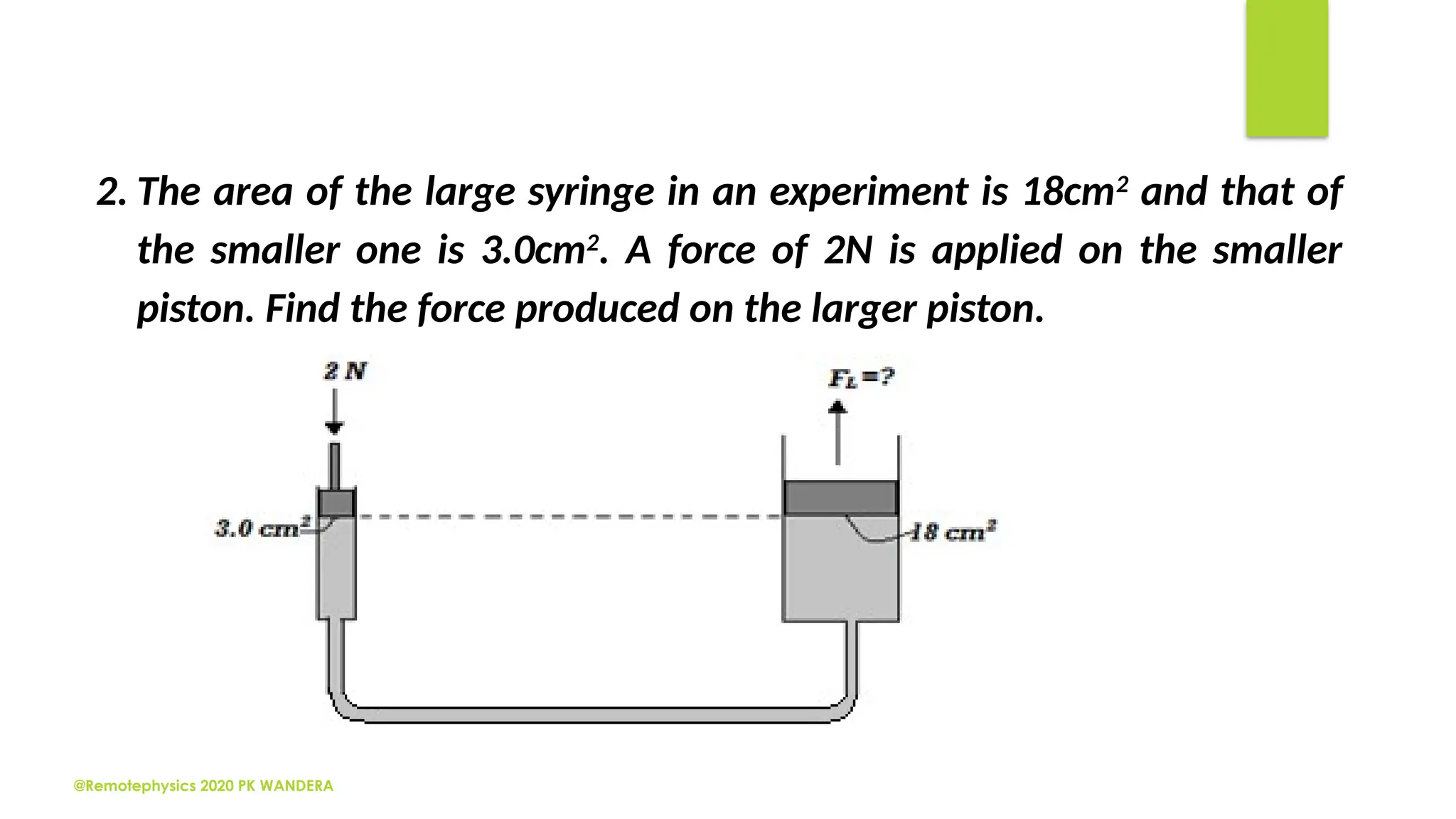
2. The area of the large syringe in an experiment is 18cm2
and that of
the smaller one is 3.0cm2
. A force of 2N is applied on the smaller
piston. Find the force produced on the larger piston.
@Remotephysics 2020 PK WANDERA
3. The diagram below shows a u- tube filled two liquids, x and y.
If the density of liquid y is 1.00 g/cm3
, determine the density
of liquid x.
@Remotephysics 2020 PK WANDERA
hρg =
0.40 m×ρx×10Nkg=0.30 m×1000kgm3×10 N/kg
4.0Nmkg× ρx=3000 Nm2
ρx=750kgm3
@Remotephysics 2020 PK WANDERA
Hydraulic Brake System
 The hydraulic brake system uses the principle of
transmission of pressure in liquids (Pascal’s
principle) in its operation.
@Remotephysics 2020 PK WANDERA
Mode of Operation of Hydraulic Brake System
When a small force is applied on the brake pedal, it pushes the
piston of the master cylinder inwards. This produces a pressure that
is equally transmitted to the pistons in the slave cylinders. The
pressure generates a force which pushes the pistons of the slave
cylinder outwards. The pistons then push the brake shoes and
therefore the brake lining outwards. The brake lining touches and
stops rotating wheel drum.
The return spring returns the brake shoes into their original position
after force on brake pedal has been removed.
@Remotephysics 2020 PK WANDERA
Properties of the Hydraulic Brake Fluid
(a)It should not corrode parts of the system
(b)It should be highly incompressible
(c)It should have a low freezing point and high boiling point.
@Remotephysics 2020 PK WANDERA
Atmospheric Pressure
 This is the pressure exerted on the earth’s surface by the column
of air around it.
 To Demonstrate Existence of AtmosphericPressure(Crushing Can
Experiment)
 Consider a tin container with some water in it. The container is
heated for some time while open and closed after withdrawing
heating. Cold water is then poured on it immediately.
@Remotephysics 2020 PK WANDERA
It is observed that the container
crushes inwards when cold water is
poured on it. This is because steam
from boiling water drives out the air
inside the container and a partial
vacuum is created when the container
is cooled. The higher atmospheric
pressure from the outside crushes the
container inwards.
@Remotephysics 2020 PK WANDERA
Example
A sea diver is 18 m below the surface of sea water. If
the density of sea water is 1.03g/cm3
and g is 10N/ kg,
determine the total pressure on him. (Take atmospheric
pressure pa = 103 000N/m2
).
@Remotephysics 2020 PK WANDERA
Measurement of Pressure
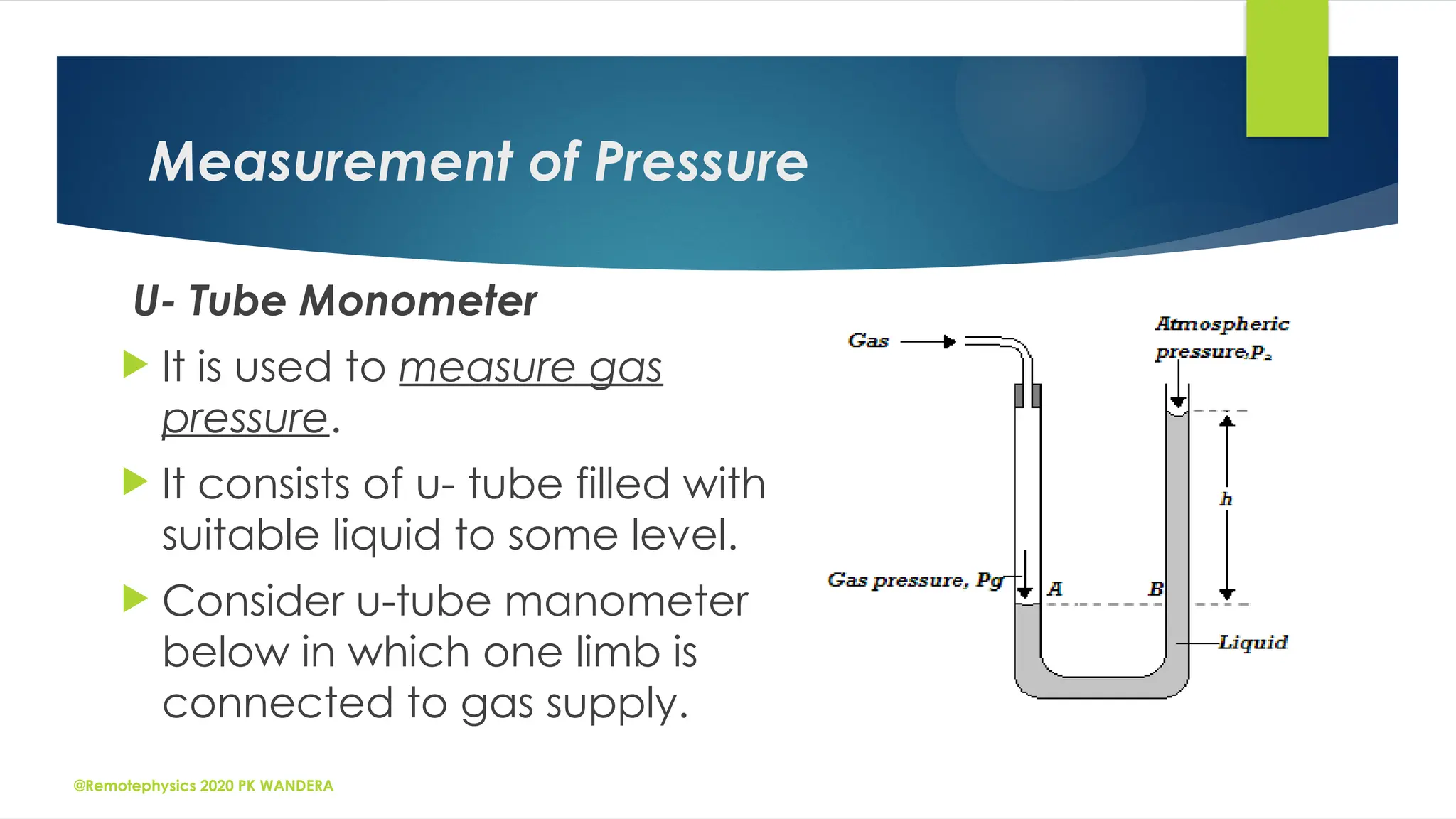
U- Tube Monometer
 It is used to measure gas
pressure.
 It consists of u- tube filled with
suitable liquid to some level.
 Consider u-tube manometer
below in which one limb is
connected to gas supply.
@Remotephysics 2020 PK WANDERA
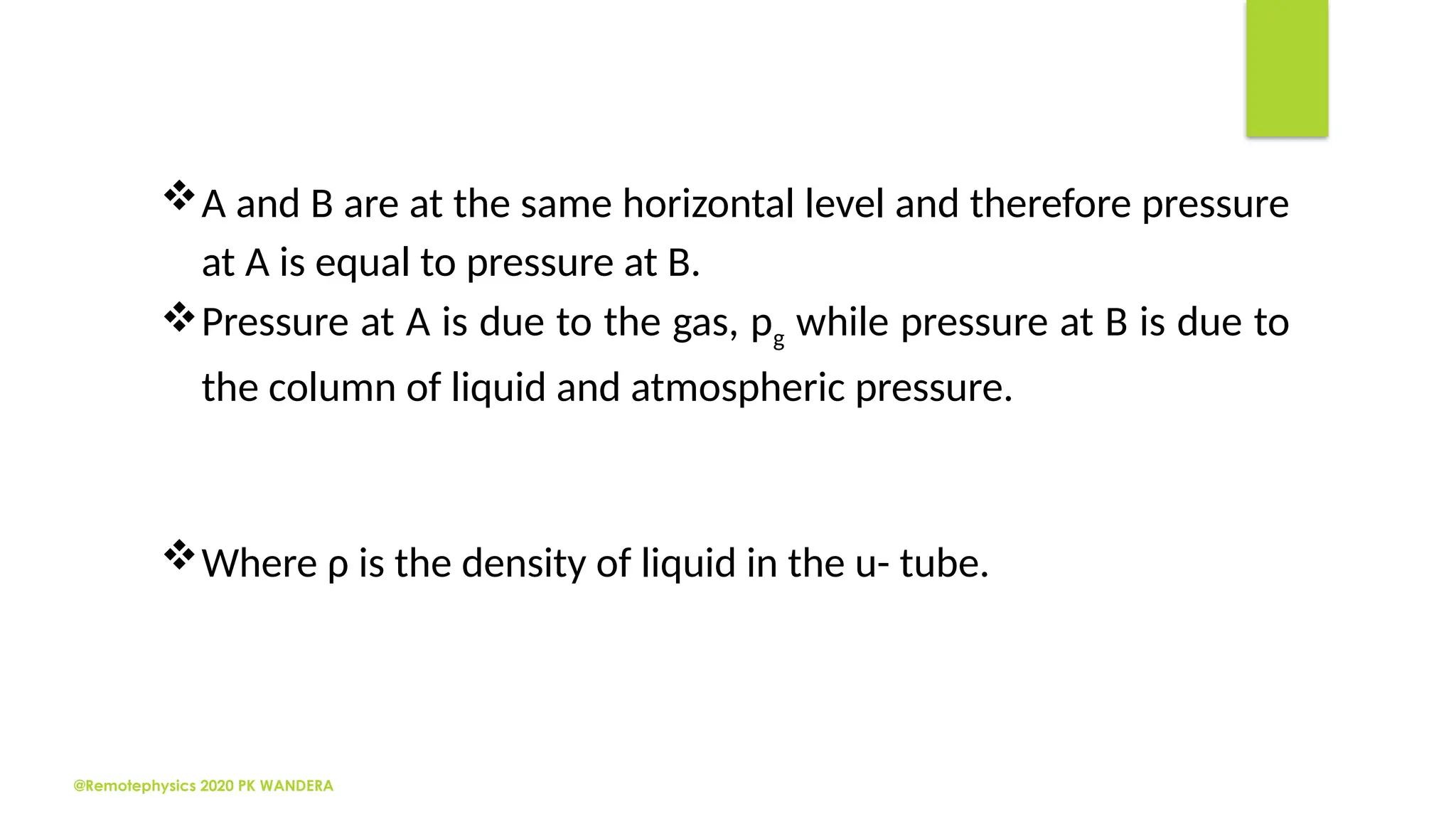
A and B are at the same horizontal level and therefore pressure
at A is equal to pressure at B.
Pressure at A is due to the gas, pg while pressure at B is due to
the column of liquid and atmospheric pressure.
Where ρ is the density of liquid in the u- tube.
@Remotephysics 2020 PK WANDERA
Examples
1)The height, h of a water manometer is 20 cm when used to
measure pressure of a gas.
a)Determine the pressure due to gas, If
atmospheric pressure is 103000N/m2
.
@Remotephysics 2020 PK WANDERA
b) What would be the height if the liquid used is
glycerin of density 1.26g/cm3
@Remotephysics 2020 PK WANDERA
2)The diagram below show a mercury manometer. Some dry gas is
present in the closed space. If the atmospheric pressure is
105000N/m2
and density of mercury 13600kg/m3
, determine
pressure of the gas (take g=10N/kg).
@Remotephysics 2020 PK WANDERA
Mercury Barometer
It is used to measure atmospheric pressure.
It employs the fact that atmospheric pressure supports a column of
liquid in a tube.
Construction of Mercury Barometer
It is made of a thick- walled glass tube of about 1m long sealed at one
end.
The tube is then filled carefully with mercury to the top.
 Any bubbles of air in the tube are removed by closing the open end
and inverting the tube severally.
The tube is then inverted into a dish filled with mercury.
Mercury is preferred in the construction of barometer to other liquids
because its very high density.
@Remotephysics 2020 PK WANDERA
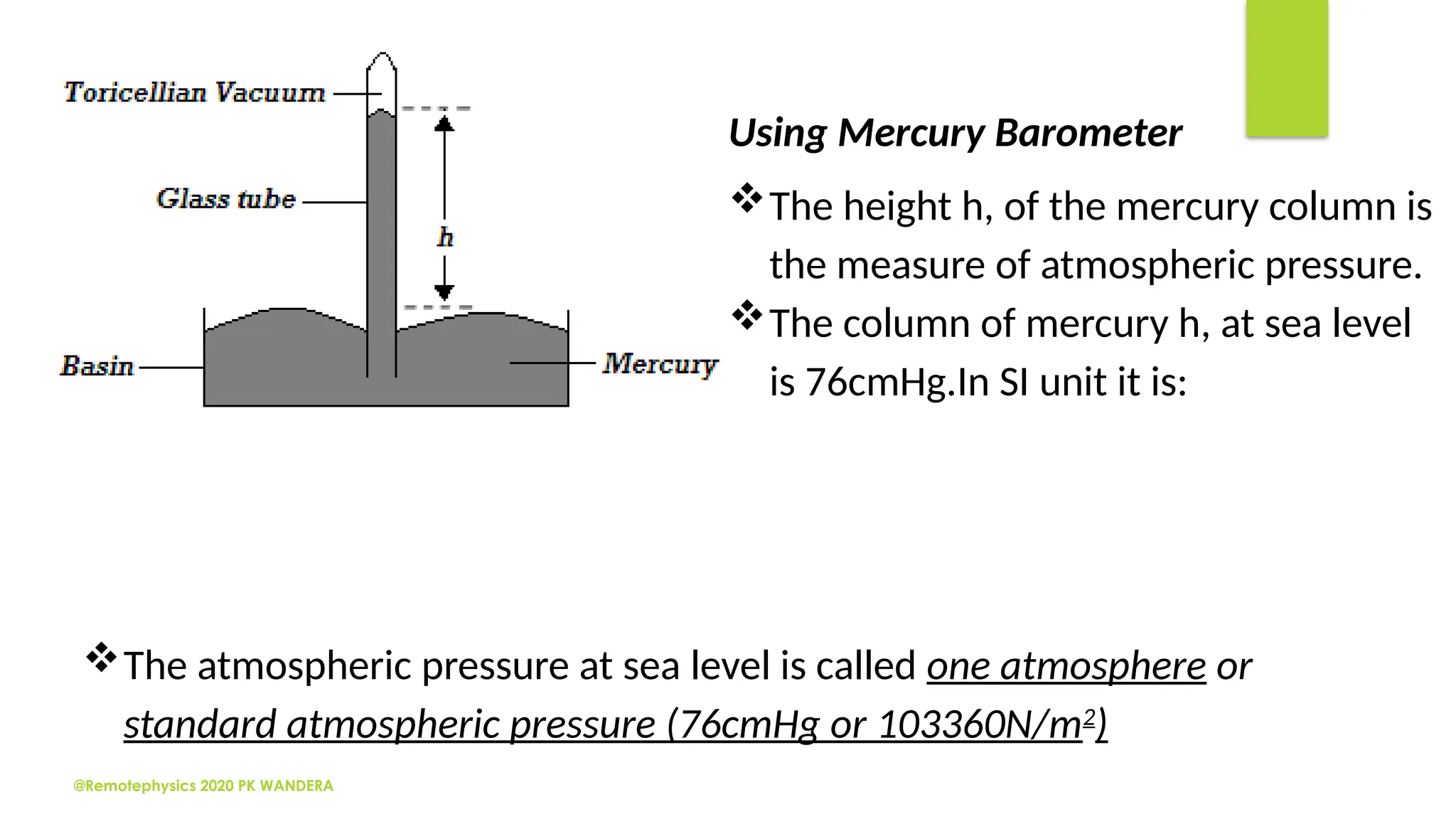
Using Mercury Barometer
The height h, of the mercury column is
the measure of atmospheric pressure.
The column of mercury h, at sea level
is 76cmHg.In SI unit it is:
The atmospheric pressure at sea level is called one atmosphere or
standard atmospheric pressure (76cmHg or 103360N/m2
)
@Remotephysics 2020 PK WANDERA
Examples
1)A student in a place where the mercury barometer reads 75cm
wanted to make an alcohol barometer. If alcohol has a density
of 800kg/m3
, what is the minimum length of the tube that
could be used?
@Remotephysics 2020 PK WANDERA
2)The barometric height in a town is 70cm mercury. Given that
the standard atmospheric pressure is 76cm mercury and the
density of mercury is 13600kg/m3
, determine the altitude of
the town. (Density of air is 1.25kg/m3
).
(Note: Standard pressure refers to the atmospheric pressure at
sea level).
@Remotephysics 2020 PK WANDERA
3. The figure below shows a person sucking water using a
straw. Explain how sucking is made possible
@Remotephysics 2020 PK WANDERA
Ans.
When one sucks pressure inside the straw reduces below the
atmospheric pressure. The pressure difference causes water to
going to the straw and rise up to the mouth.
Testing the Vacuum in the Barometer
The vacuum is tested by tilting the
tube. If the tube is fully filled then the
space is a vacuum but if the tube is not
fully filled then the space is not a
vacuum; it has some air occupying it
and therefore, the barometer is faulty.
@Remotephysics 2020 PK WANDERA
Siphon
Siphon is used to transfer liquid from one container to another.
The use of siphon to transfer liquid due to pressure difference is
called siphoning. Consider the siphoning arrangement shown
below.
@Remotephysics 2020 PK WANDERA
Pressure at A is equal to pressure at B and it is the atmospheric
pressure, Pa
Pressure at c is equal to pressure at B plus pressure due to water
column , h, i.e.
Pressure difference between B and C (i.e. is what makes the liquid
to flow from the upper container to the lower one.
@Remotephysics 2020 PK WANDERA
Conditions under which Siphon Works
a)The tube must be filled with the liquid first. This creates a pressure
difference.
b)There must be a difference in levels of liquid in the two containers.
c) The end of the tube must remain below the liquid surface of the upper
container.
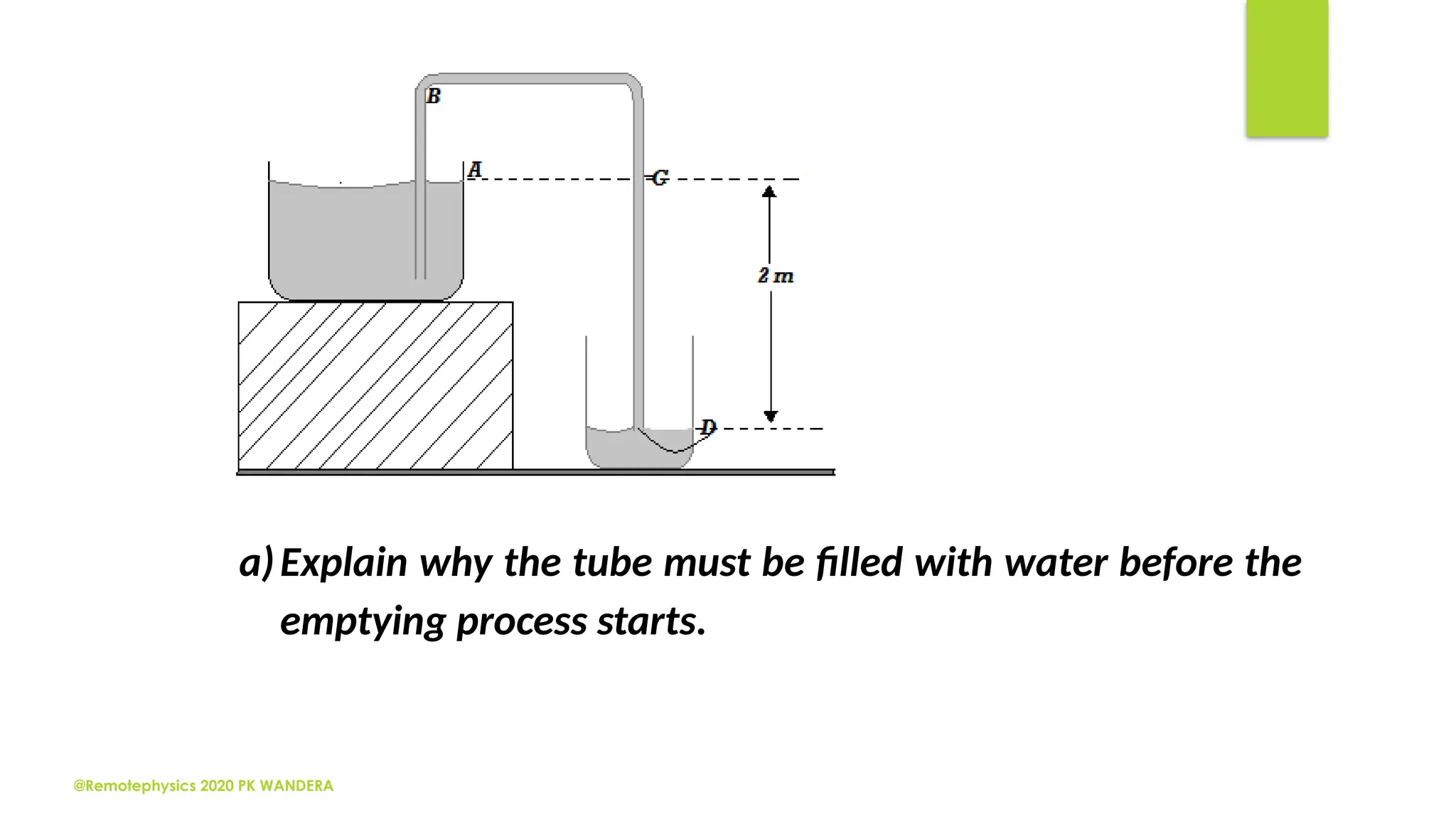
Example
The figure below shows how to empty water from a large tank into a low
lying tank using rubber tubing.
@Remotephysics 2020 PK WANDERA
a)Explain why the tube must be filled with water before the
emptying process starts.
@Remotephysics 2020 PK WANDERA
Ans.
To create pressure difference between C and D this will lead to
continuous flow of water from the upper tank to the lower
tank.
a)Soon after the tank begins to empty the lower end is
momentarily blocked by placing a finger at end D.
I. Determine pressure difference between point A and D.
@Remotephysics 2020 PK WANDERA
II. what will be the pressure experienced by the finger at point D.
(take density of water= 1000kg/m3
and pa= 100,000N/m2
@Remotephysics 2020 PK WANDERA
Applications of Pressure in Liquids and
Gases
A Syringe
 When the piston is pulled upwards
(during upstroke), space is created
in the barrel thus lowering the
pressure inside below atmospheric
pressure. The higher atmospheric
pressure acting on the liquid pushes
the liquid into the barrel.
During a down stroke, the pressure
inside increases above atmospheric
pressure and the liquid is expelled from
the barrel.
@Remotephysics 2020 PK WANDERA
The Bicycle Pump
 Air from outside the pump then flows past the leather washer into the barrel. At
the same time, the higher air pressure in the tyre closes the tyre valve.
When the pump handle is pushed in, the air is forced into the tyre through the tyre valve which
now opens.
Note: There is an increase in temperature of the pump barrel during pumping this is because of
the work done in compressing air.
 The leather washer acts as both a valve and
piston inside the pump barrel.
 When the pump handle is drawn out as shown,
air in the barrel expands and its pressure
reduces below the atmospheric pressure.
@Remotephysics 2020 PK WANDERA
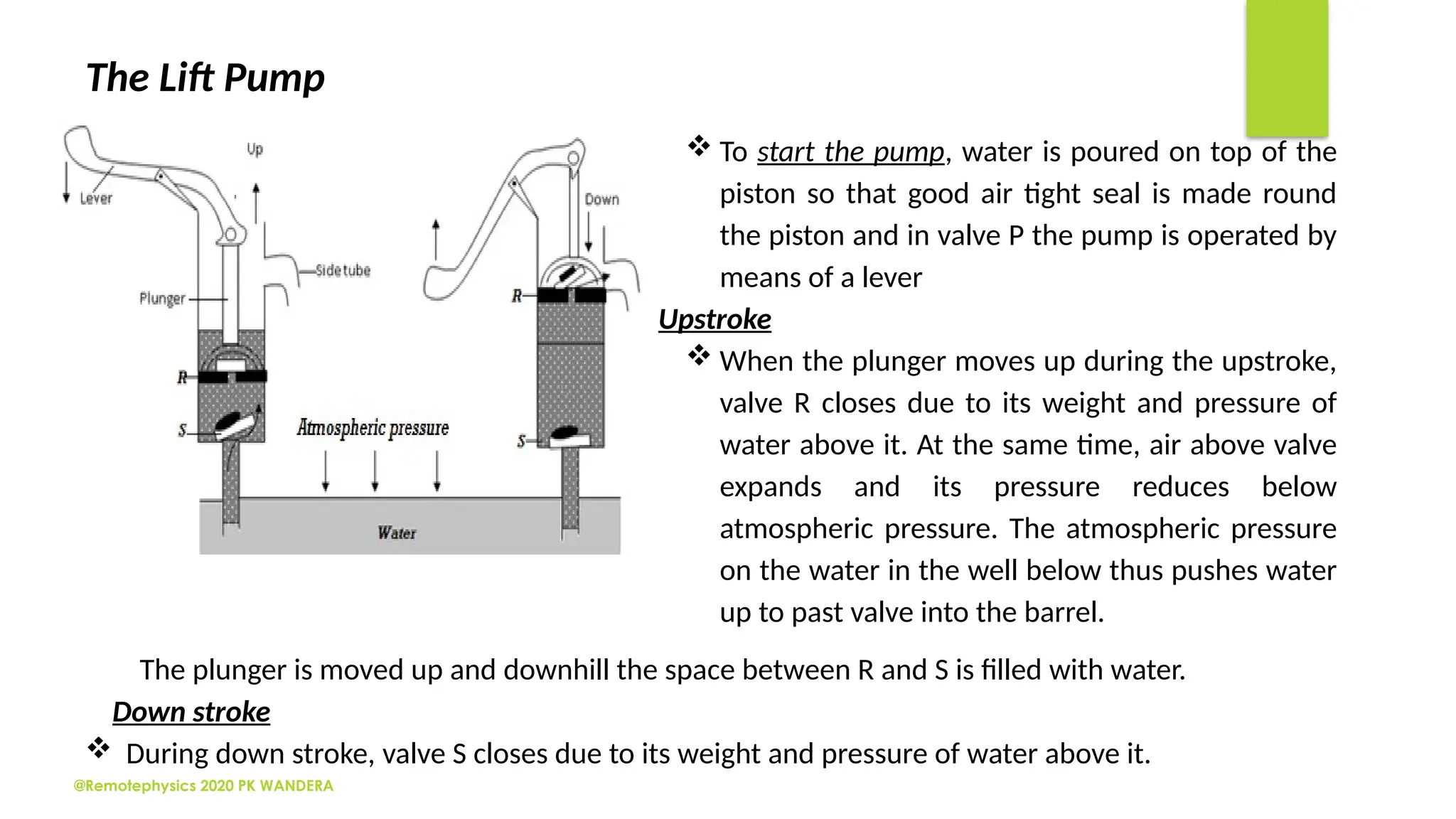
The Lift Pump
 To start the pump, water is poured on top of the
piston so that good air tight seal is made round
the piston and in valve P the pump is operated by
means of a lever
Upstroke
 When the plunger moves up during the upstroke,
valve R closes due to its weight and pressure of
water above it. At the same time, air above valve
expands and its pressure reduces below
atmospheric pressure. The atmospheric pressure
on the water in the well below thus pushes water
up to past valve into the barrel.
The plunger is moved up and downhill the space between R and S is filled with water.
Down stroke
 During down stroke, valve S closes due to its weight and pressure of water above it.
@Remotephysics 2020 PK WANDERA
Limitations of the Lift Pump
In practical, the possible height of water that can be raised by this pump
is less than 10m because of
i) Low atmospheric pressure in places high above sea level,
ii) Leakage at the valves and pistons
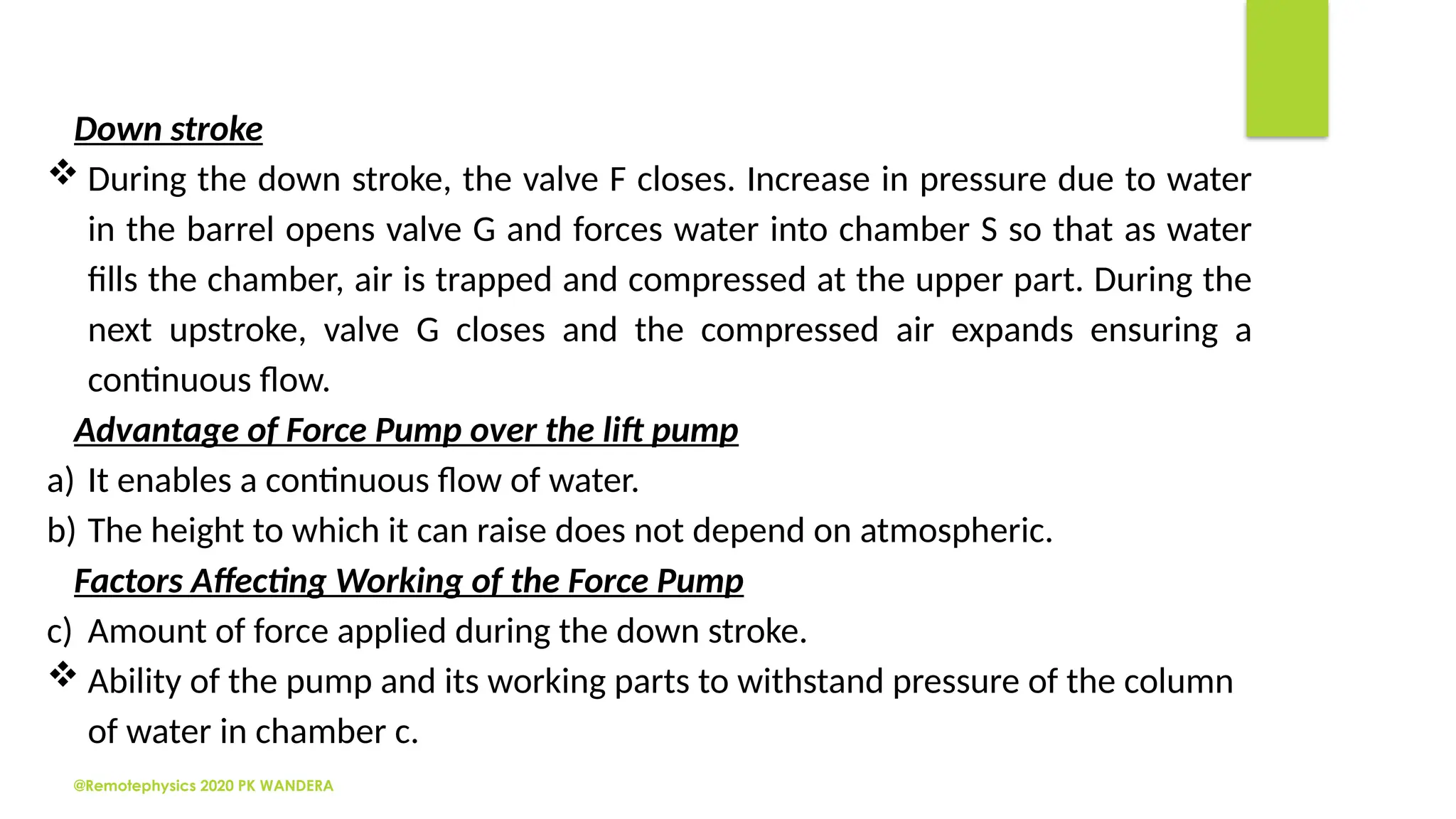
The Force Pump
This pump is used to raise water to heights of more than 10m.
Upstroke
 During upstroke, air above the valve F
expands and its pressure reduces below
atmospheric pressure. The atmospheric
pressure on water in the well pushes water
up past valve F into the barrel. Pressure
above valve G is atmospheric. Hence, this
valve does not open in this stroke.
@Remotephysics 2020 PK WANDERA
Down stroke
 During the down stroke, the valve F closes. Increase in pressure due to water
in the barrel opens valve G and forces water into chamber S so that as water
fills the chamber, air is trapped and compressed at the upper part. During the
next upstroke, valve G closes and the compressed air expands ensuring a
continuous flow.
Advantage of Force Pump over the lift pump
a) It enables a continuous flow of water.
b) The height to which it can raise does not depend on atmospheric.
Factors Affecting Working of the Force Pump
c) Amount of force applied during the down stroke.
 Ability of the pump and its working parts to withstand pressure of the column
of water in chamber c.
@Remotephysics 2020 PK WANDERA
Exercise on applications of pressure
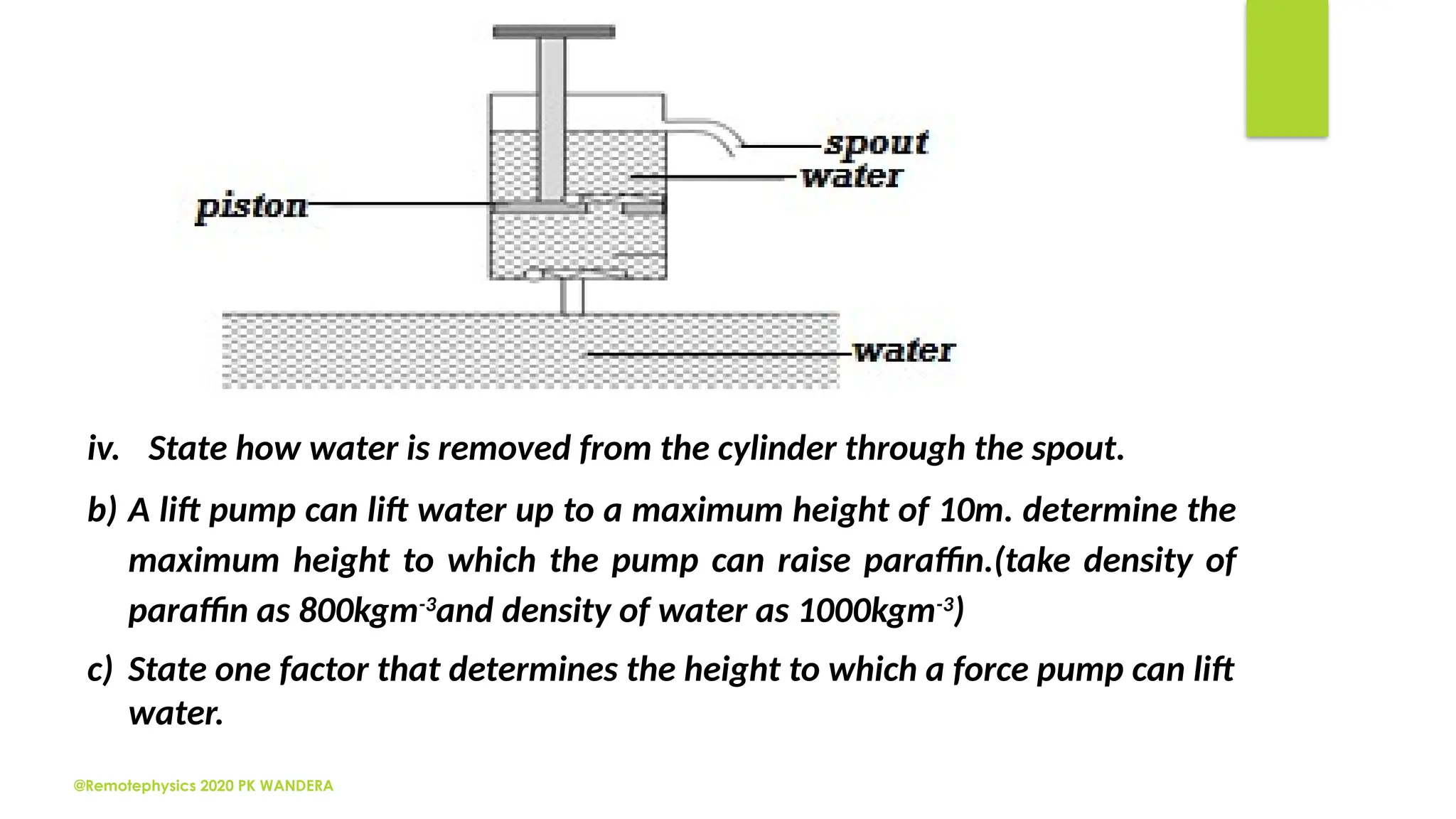
(a)The figure below shows a lift pump
Explain why, when the piston is;
i. Pulled upwards, valve A opens
while valve B closes.
ii. Pushed downwards, valve A closes
while valve B opens
iii. After several strokes, water rises
above the piston as shown below.
@Remotephysics 2020 PK WANDERA
iv. State how water is removed from the cylinder through the spout.
b) A lift pump can lift water up to a maximum height of 10m. determine the
maximum height to which the pump can raise paraffin.(take density of
paraffin as 800kgm-3
and density of water as 1000kgm-3
)
c) State one factor that determines the height to which a force pump can lift
water.
@Remotephysics 2020 PK WANDERA
Revision Exercise
1. A piston whose diameter is 1.4m is pushed into a cylinder containing a
fluid, If the pressure produced in the cylinder is 4.0 x 10⁵
pa, Calculate the
force applied on the piston.
2. An octopus is resting in the ocean. If the octopus is at a depth of 47m in
sea whose water has a density of 1200 kg/m3
, calculate the pressure
experienced by the octopus (Take atmospheric pressure = 1.0125 x 10⁵
Pa)
3. Explain why if air gets in the brake system would reduce the efficiency of
the brakes. (2marks)
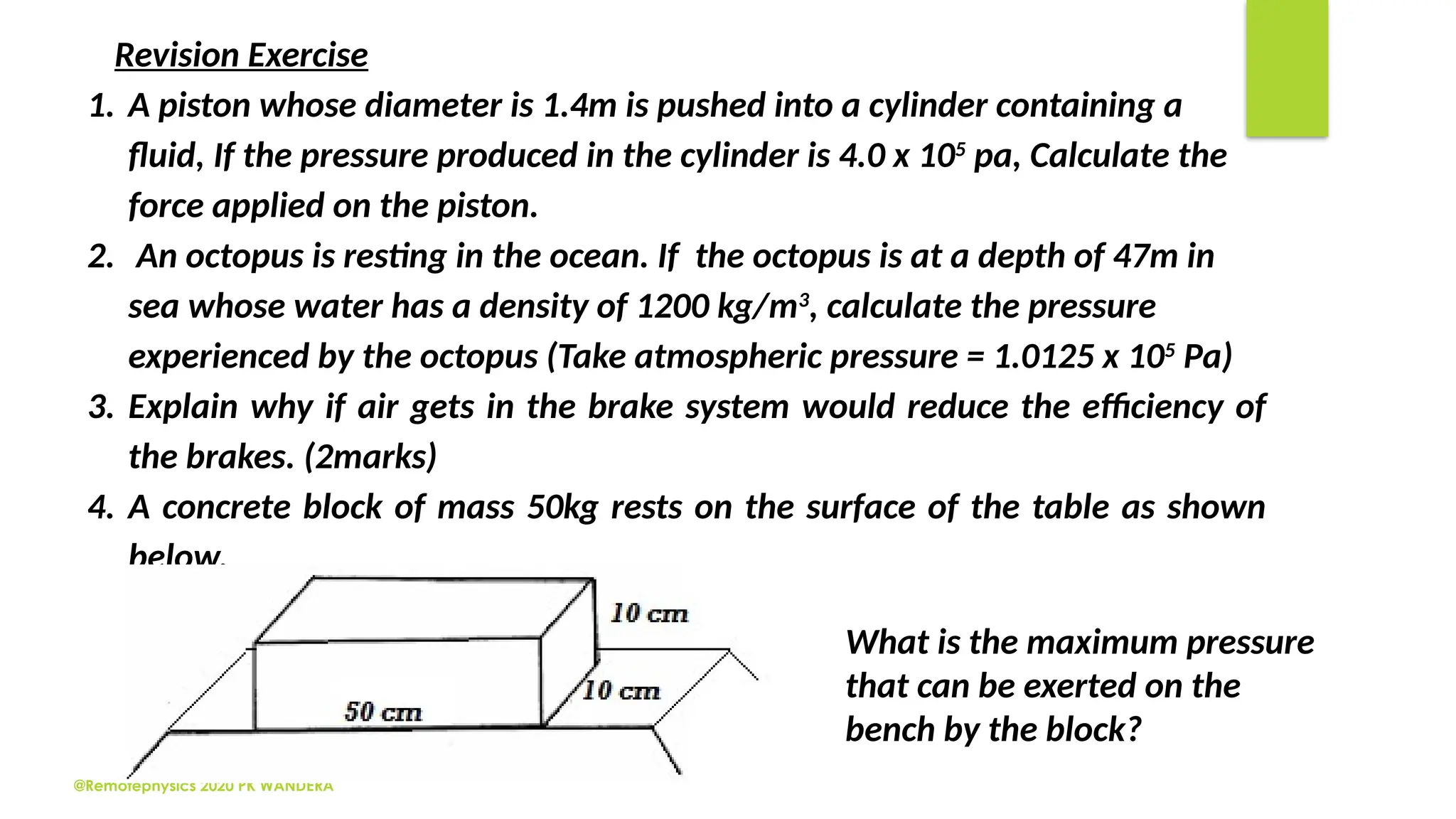
4. A concrete block of mass 50kg rests on the surface of the table as shown
below.
What is the maximum pressure
that can be exerted on the
bench by the block?
@Remotephysics 2020 PK WANDERA
5. A hole of area 4.0cm² at the bottom of a tank 5m deep is closed with a cork.
Determine the force on the cork when the tank is filled with water. (Take g =
10ms ² and density of water = 1000kgm ³).
ˉ ˉ
6. A measuring cylinder of height 25cm is filled to a height of 15cm with water
and the rest is occupied by kerosene. Determine the pressure acting on its
base (density of water = 1gcm ³ density of kerosene = 0.8gcm ³ and
ˉ ˉ
atmospheric pressure = 103,000pa).
7. State one advantage of hydraulic brakes over mechanical brakes.
8. Explain why a lady wearing sharp heeled shoes is not likely to skid on a
slippery muddy road.
9. Why does atmospheric pressure decrease towards higher altitude?
10. Show that Pressure in fluids is given by P= hρg
11. Give a reason why nose bleeding is likely to occur at the top of a mountain.
@Remotephysics 2020 PK WANDERA
12.A block of glass of density 2.5g/cm3
has dimensions 8 cm by 10cm by 15cm.
It is placed on one of its faces on a horizontal surface. Calculate:-
a) The weight of the block
b) The greatest pressure it can exert on the horizontal surface.
c) The least pressure it can exert on the horizontal surface.
13.The reading of a mercury barometer is 75.58 cm at the base of a mountain
and 66.37cm at the summit. Calculate the height of the mountain (Density
of mercury = 13.6g/m3
and density of air= 1.25kg/m3
14.In a hydraulic brake, the master piston has an area of4mm2
and the wheel
piston each has an area of 4 cm2
. Find the forces applied to the wheel when
a force of 10N is applied on the master piston.
@Remotephysics 2020 PK WANDERA
15. The figure below shows a hydraulic press
The two pistons are of areas10mm2
and 20mm2
respectively. A force of 100N is applied on the
smaller piston, find the load that can be lifted
on the larger piston if:
a. The piston has negligible weight and no
frictional forces exist.
b. The pistons have negligible weight and
frictional10N and 40N respectively.
The smaller piston has the weight 5N the larger
piston has a weight of 10N and the frictional
forces are negligible.

04 PRESSURE.pptx powerpoint pressure notes

  • 1.
  • 2.
    @Remotephysics 2020 PKWANDERA Definition of Pressure  Pressure refers to force acting perpendicularly per unit area.  Since force is measured in newtons and area in square meter, then the SI unit of pressure is the newton per square meter (N/m2 ) or the pascal (Pa). 1 newton per square meter (N/m2 ) = 1 pascal (Pa)
  • 3.
    @Remotephysics 2020 PKWANDERA Pressure in Solids Force exerted by a solid resting on a surface is equal to the weight the object.
  • 4.
    @Remotephysics 2020 PKWANDERA Pressure in Solids Force exerted by a solid resting on a surface is equal to the weight the object.
  • 5.
    @Remotephysics 2020 PKWANDERA Factors Affecting Pressure in Solids Weight of the solid (force) If the area of contact between solid and surface is constant, pressure increases with weight. Area of contact of the solid with surface. The smaller the area, the higher the pressure if same force is applied. Therefore pressure can be reduced by increasing the area of contact.
  • 6.
    @Remotephysics 2020 PKWANDERA Examples 1. A block of a soap stone of dimension 4m by 2m by 3m is 48kg and is made to rest on a smooth horizontal surface a. Calculate the minimum pressure it exerts on the surface. b. Calculate the maximum pressure it will exert on the surface
  • 7.
  • 8.
    @Remotephysics 2020 PKWANDERA 2. An object whose area of contact with the floor is 5m2 exerts a pressure of 900 pascal. Calculate its mass
  • 9.
    @Remotephysics 2020 PKWANDERA Solution
  • 10.
    @Remotephysics 2020 PKWANDERA 3. Tracks which carry heavy loads have many wheels. Explain.
  • 11.
    @Remotephysics 2020 PKWANDERA Ans. Many wheels increase the area of contact with the ground thereby reducing pressure exerted on the road. This prevents damage of the roads by tracks.
  • 12.
    @Remotephysics 2020 PKWANDERA 4. A block of copper of density 9g/cm3 measures 5cm by 3cm by 2cm. Given that g is 10N/kg, determine: a)The maximum pressure
  • 13.
  • 14.
    @Remotephysics 2020 PKWANDERA b)The minimum pressure that it can exert on a horizontal surface.
  • 15.
  • 16.
    @Remotephysics 2020 PKWANDERA 5. It is painful if one tries to lift a heavy load by a thin string
  • 17.
    @Remotephysics 2020 PKWANDERA Ans. There is a small area of contact with the fingers when a thin string is used. As a result, more pressure is generated and this is painful
  • 18.
    @Remotephysics 2020 PKWANDERA 1. A pick up carrying stones weighs 40,000N. The weight is evenly spread across the 4 types. The area of contact of each tire with the ground is 0.05m2 . Calculate the pressure exerted by each tire on the ground. 2. A thumb is used to push a thumb pin into a piece of wood. Explain in terms of pressure why the pressure on wood is greater than the pressure on the thumb. 3. An elephant of mass 2800kg has feet of average area of 200 cm2 . A vulture of mass 12 kg walks beside the elephant on a muddy area, the average area of the feet of the vulture is 2.0 cm2. Which one is likely to sink? Explain your answer showing any necessary calculations. Excercise
  • 19.
    @Remotephysics 2020 PKWANDERA 4. A girl standing upright exerts a pressure of 15000 N/m2 on the floor. Given that the total area of contact of shoes and the floor is 0.02m2. a)Determine the mass of the girl. b)Determine the pressure she would exert on the floor if she stood on one foot. 5. A block of copper of density 8.9 g/cm3 measures Given that the force of gravity is 10Nkg-1 , determine: a)The maximum pressure. b)The minimum pressure that it can exert on a horizontal surface.
  • 20.
    @Remotephysics 2020 PKWANDERA Pressure in Liquids Factors Affecting Pressure in Liquids  Depth of the Liquid • Pressure in liquids increases with depth. • This is the reason as to why walls of a dam are thicker at the bottom than at the top as shown below. Thick walls at the bottom of the dam withstand high pressure due to water at the bottom. • Pressure increasing with depth of liquid explains why a diver at the bottom of the sea experiences more pressure due to more weight of water above him than a diver near the top/ surface of the sea.
  • 21.
    @Remotephysics 2020 PKWANDERA 2. Density of the Liquid Pressure in liquids increases with density of the liquid. Consider two identical cylinders filled with water (of density 1000kg/m3 ) and glycerine (of density 1260kg/m3 ) respectively. Pressure at point B is greater than pressure at point A because glycerine is denser than water and therefore exerts more pressure than water.
  • 22.
    @Remotephysics 2020 PKWANDERA To Demonstrate Variation of Pressure with Depth of Liquids •Consider a tall tin with holes A, B and C equally spaced on one side along a vertical line as shown below. •When the tin is filled with water, the water jets out of the holes with that from hole A thrown farthest followed by that from hole B and lastly from hole C. •This means that pressure of water at A is greater than pressure at B and pressure at B is greater than pressure at C. Hence, Pressure in liquids increases with depth.
  • 23.
    @Remotephysics 2020 PKWANDERA To Demonstrate Variation of Pressure with Depth and Density of Liquids •Consider a transparent glass vessel filled with water and a thistle funnel connected to a u-tube filled with colored water to some level dipped into it. It is observed that the deeper the funnel goes below the surface of water, the greater the difference in levels of water in the two limbs of the u- tube, h. This is due to increase in pressure with depth.
  • 24.
    @Remotephysics 2020 PKWANDERA •When glycerine is used in place of water it is observed that at the same depth the difference in levels, h is greater than when water is used. This is because glycerin is denser than water and therefore it is pressure at same depth is higher than that of water.
  • 25.
    @Remotephysics 2020 PKWANDERA To Demonstrate that Pressure at Equal Depth, Acts Equally in All Directions •Consider a tin with two similar holes on its side at same height as shown alongside. •When the tin is filled with water, it is observed that water travels out of the holes equal horizontal distances from the can. Therefore pressure exerted at equal depth is same in all directions.
  • 26.
    @Remotephysics 2020 PKWANDERA Fluid Pressure Formula  Consider a container with cross- section area, A, filled with a liquid of density, ρ, to the height, h, as shown alongside
  • 27.
    @Remotephysics 2020 PKWANDERA The pressure p, exerted at the bottom (base) of the container by the weight of the liquid above it is given by: From the formula it is clear that pressure in fluids does not depend on cross- section area of the container holding the liquid
  • 28.
    @Remotephysics 2020 PKWANDERA Examples 1)A diver working under water is 15 m below the surface of the sea. Calculate the pressure due to water experienced by the diver (take g=10N/kg) and density of sea water to be equal to 1.03g/cm3 .
  • 29.
  • 30.
    @Remotephysics 2020 PKWANDERA 1)The figure below shows a liquid in a pail. If the liquid has a density of 0.79 g/cm3 , determine the pressure exerted at the bottom of the pail by the liquid.
  • 31.
  • 32.
    @Remotephysics 2020 PKWANDERA b) Suggest a reason why pail manufactures prefer the shape shown to other shapes
  • 33.
    @Remotephysics 2020 PKWANDERA To reduce the height of the pail but maintain the capacity. This reduces the pressure exerted by the liquid at the bottom of the pail.
  • 34.
    @Remotephysics 2020 PKWANDERA 1) Calculate the pressure exerted by 76 mm column of mercury given that its density is 13.6g/cm3
  • 35.
  • 36.
    @Remotephysics 2020 PKWANDERA 1) A column of glycerin 8.20m high, a column of sea water 10.08m high, a column of mercury 0.76m high and column of fresh water 10.34 m high exert the same pressure at the bottom of a container. Arrange these substances in decreasing order of their densities.
  • 37.
    @Remotephysics 2020 PKWANDERA Mercury, glycerine, sea water, fresh water
  • 38.
    @Remotephysics 2020 PKWANDERA Pascal’s Principle (The Principle of Transmission of Pressure in Liquids) Pascal’s principle states that pressure applied at one part in a liquid is transmitted equally to all other parts of the enlarged liquid. Demonstrating Pascal’s Principle  Consider a liquid under pressure due to force, F, acting on the plunger as shown below. Note: The holes are of equal diameter.
  • 39.
    @Remotephysics 2020 PKWANDERA When the plunger is pushed in, water squirts out of the holes with equal force. This shows that pressure generated by the piston on the water is transmitted equally to all other parts of the liquid.
  • 40.
    @Remotephysics 2020 PKWANDERA Applications of Pascal’s Principle Pascal’s Principle is applied in the working of the hydraulic machines. These machines include: a)Hydraulic press used to compress textile products like blankets for packing. b)Hydraulic lift used to hoist cars in garages. c) Hydraulic brake system used for braking in cars. Pressure Transmission in Hydraulic Machines Note that pressure at same level in the liquid is the same as seen earlier. Consider the hydraulic machine below consisting of a small piston, S, and a large piston, L,of cross- section as shown alongside.
  • 41.
    @Remotephysics 2020 PKWANDERA Pressure exerted on the liquid by piston, S due to force, FS, is PS. By Pascal’s principle this pressurePSis equal to pressure PLexerted by liquid on piston, L.
  • 42.
    @Remotephysics 2020 PKWANDERA Example 1. The figure below shows two masses placed on light pistons. The pistons are held stationary by the liquid whose density 0.8g/cm3 . Determine the force F.
  • 43.
  • 44.
    @Remotephysics 2020 PKWANDERA 2. The area of the large syringe in an experiment is 18cm2 and that of the smaller one is 3.0cm2 . A force of 2N is applied on the smaller piston. Find the force produced on the larger piston.
  • 45.
  • 46.
    @Remotephysics 2020 PKWANDERA 3. The diagram below shows a u- tube filled two liquids, x and y. If the density of liquid y is 1.00 g/cm3 , determine the density of liquid x.
  • 47.
    @Remotephysics 2020 PKWANDERA hρg = 0.40 m×ρx×10Nkg=0.30 m×1000kgm3×10 N/kg 4.0Nmkg× ρx=3000 Nm2 ρx=750kgm3
  • 48.
    @Remotephysics 2020 PKWANDERA Hydraulic Brake System  The hydraulic brake system uses the principle of transmission of pressure in liquids (Pascal’s principle) in its operation.
  • 49.
    @Remotephysics 2020 PKWANDERA Mode of Operation of Hydraulic Brake System When a small force is applied on the brake pedal, it pushes the piston of the master cylinder inwards. This produces a pressure that is equally transmitted to the pistons in the slave cylinders. The pressure generates a force which pushes the pistons of the slave cylinder outwards. The pistons then push the brake shoes and therefore the brake lining outwards. The brake lining touches and stops rotating wheel drum. The return spring returns the brake shoes into their original position after force on brake pedal has been removed.
  • 50.
    @Remotephysics 2020 PKWANDERA Properties of the Hydraulic Brake Fluid (a)It should not corrode parts of the system (b)It should be highly incompressible (c)It should have a low freezing point and high boiling point.
  • 51.
    @Remotephysics 2020 PKWANDERA Atmospheric Pressure  This is the pressure exerted on the earth’s surface by the column of air around it.  To Demonstrate Existence of AtmosphericPressure(Crushing Can Experiment)  Consider a tin container with some water in it. The container is heated for some time while open and closed after withdrawing heating. Cold water is then poured on it immediately.
  • 52.
    @Remotephysics 2020 PKWANDERA It is observed that the container crushes inwards when cold water is poured on it. This is because steam from boiling water drives out the air inside the container and a partial vacuum is created when the container is cooled. The higher atmospheric pressure from the outside crushes the container inwards.
  • 53.
    @Remotephysics 2020 PKWANDERA Example A sea diver is 18 m below the surface of sea water. If the density of sea water is 1.03g/cm3 and g is 10N/ kg, determine the total pressure on him. (Take atmospheric pressure pa = 103 000N/m2 ).
  • 54.
  • 55.
    @Remotephysics 2020 PKWANDERA Measurement of Pressure U- Tube Monometer  It is used to measure gas pressure.  It consists of u- tube filled with suitable liquid to some level.  Consider u-tube manometer below in which one limb is connected to gas supply.
  • 56.
    @Remotephysics 2020 PKWANDERA A and B are at the same horizontal level and therefore pressure at A is equal to pressure at B. Pressure at A is due to the gas, pg while pressure at B is due to the column of liquid and atmospheric pressure. Where ρ is the density of liquid in the u- tube.
  • 57.
    @Remotephysics 2020 PKWANDERA Examples 1)The height, h of a water manometer is 20 cm when used to measure pressure of a gas. a)Determine the pressure due to gas, If atmospheric pressure is 103000N/m2 .
  • 58.
    @Remotephysics 2020 PKWANDERA b) What would be the height if the liquid used is glycerin of density 1.26g/cm3
  • 59.
  • 60.
    @Remotephysics 2020 PKWANDERA 2)The diagram below show a mercury manometer. Some dry gas is present in the closed space. If the atmospheric pressure is 105000N/m2 and density of mercury 13600kg/m3 , determine pressure of the gas (take g=10N/kg).
  • 61.
  • 62.
    @Remotephysics 2020 PKWANDERA Mercury Barometer It is used to measure atmospheric pressure. It employs the fact that atmospheric pressure supports a column of liquid in a tube. Construction of Mercury Barometer It is made of a thick- walled glass tube of about 1m long sealed at one end. The tube is then filled carefully with mercury to the top.  Any bubbles of air in the tube are removed by closing the open end and inverting the tube severally. The tube is then inverted into a dish filled with mercury. Mercury is preferred in the construction of barometer to other liquids because its very high density.
  • 63.
    @Remotephysics 2020 PKWANDERA Using Mercury Barometer The height h, of the mercury column is the measure of atmospheric pressure. The column of mercury h, at sea level is 76cmHg.In SI unit it is: The atmospheric pressure at sea level is called one atmosphere or standard atmospheric pressure (76cmHg or 103360N/m2 )
  • 64.
    @Remotephysics 2020 PKWANDERA Examples 1)A student in a place where the mercury barometer reads 75cm wanted to make an alcohol barometer. If alcohol has a density of 800kg/m3 , what is the minimum length of the tube that could be used?
  • 65.
    @Remotephysics 2020 PKWANDERA 2)The barometric height in a town is 70cm mercury. Given that the standard atmospheric pressure is 76cm mercury and the density of mercury is 13600kg/m3 , determine the altitude of the town. (Density of air is 1.25kg/m3 ). (Note: Standard pressure refers to the atmospheric pressure at sea level).
  • 66.
    @Remotephysics 2020 PKWANDERA 3. The figure below shows a person sucking water using a straw. Explain how sucking is made possible
  • 67.
    @Remotephysics 2020 PKWANDERA Ans. When one sucks pressure inside the straw reduces below the atmospheric pressure. The pressure difference causes water to going to the straw and rise up to the mouth. Testing the Vacuum in the Barometer The vacuum is tested by tilting the tube. If the tube is fully filled then the space is a vacuum but if the tube is not fully filled then the space is not a vacuum; it has some air occupying it and therefore, the barometer is faulty.
  • 68.
    @Remotephysics 2020 PKWANDERA Siphon Siphon is used to transfer liquid from one container to another. The use of siphon to transfer liquid due to pressure difference is called siphoning. Consider the siphoning arrangement shown below.
  • 69.
    @Remotephysics 2020 PKWANDERA Pressure at A is equal to pressure at B and it is the atmospheric pressure, Pa Pressure at c is equal to pressure at B plus pressure due to water column , h, i.e. Pressure difference between B and C (i.e. is what makes the liquid to flow from the upper container to the lower one.
  • 70.
    @Remotephysics 2020 PKWANDERA Conditions under which Siphon Works a)The tube must be filled with the liquid first. This creates a pressure difference. b)There must be a difference in levels of liquid in the two containers. c) The end of the tube must remain below the liquid surface of the upper container. Example The figure below shows how to empty water from a large tank into a low lying tank using rubber tubing.
  • 71.
    @Remotephysics 2020 PKWANDERA a)Explain why the tube must be filled with water before the emptying process starts.
  • 72.
    @Remotephysics 2020 PKWANDERA Ans. To create pressure difference between C and D this will lead to continuous flow of water from the upper tank to the lower tank. a)Soon after the tank begins to empty the lower end is momentarily blocked by placing a finger at end D. I. Determine pressure difference between point A and D.
  • 73.
    @Remotephysics 2020 PKWANDERA II. what will be the pressure experienced by the finger at point D. (take density of water= 1000kg/m3 and pa= 100,000N/m2
  • 74.
  • 75.
    @Remotephysics 2020 PKWANDERA Applications of Pressure in Liquids and Gases A Syringe  When the piston is pulled upwards (during upstroke), space is created in the barrel thus lowering the pressure inside below atmospheric pressure. The higher atmospheric pressure acting on the liquid pushes the liquid into the barrel. During a down stroke, the pressure inside increases above atmospheric pressure and the liquid is expelled from the barrel.
  • 76.
    @Remotephysics 2020 PKWANDERA The Bicycle Pump  Air from outside the pump then flows past the leather washer into the barrel. At the same time, the higher air pressure in the tyre closes the tyre valve. When the pump handle is pushed in, the air is forced into the tyre through the tyre valve which now opens. Note: There is an increase in temperature of the pump barrel during pumping this is because of the work done in compressing air.  The leather washer acts as both a valve and piston inside the pump barrel.  When the pump handle is drawn out as shown, air in the barrel expands and its pressure reduces below the atmospheric pressure.
  • 77.
    @Remotephysics 2020 PKWANDERA The Lift Pump  To start the pump, water is poured on top of the piston so that good air tight seal is made round the piston and in valve P the pump is operated by means of a lever Upstroke  When the plunger moves up during the upstroke, valve R closes due to its weight and pressure of water above it. At the same time, air above valve expands and its pressure reduces below atmospheric pressure. The atmospheric pressure on the water in the well below thus pushes water up to past valve into the barrel. The plunger is moved up and downhill the space between R and S is filled with water. Down stroke  During down stroke, valve S closes due to its weight and pressure of water above it.
  • 78.
    @Remotephysics 2020 PKWANDERA Limitations of the Lift Pump In practical, the possible height of water that can be raised by this pump is less than 10m because of i) Low atmospheric pressure in places high above sea level, ii) Leakage at the valves and pistons The Force Pump This pump is used to raise water to heights of more than 10m. Upstroke  During upstroke, air above the valve F expands and its pressure reduces below atmospheric pressure. The atmospheric pressure on water in the well pushes water up past valve F into the barrel. Pressure above valve G is atmospheric. Hence, this valve does not open in this stroke.
  • 79.
    @Remotephysics 2020 PKWANDERA Down stroke  During the down stroke, the valve F closes. Increase in pressure due to water in the barrel opens valve G and forces water into chamber S so that as water fills the chamber, air is trapped and compressed at the upper part. During the next upstroke, valve G closes and the compressed air expands ensuring a continuous flow. Advantage of Force Pump over the lift pump a) It enables a continuous flow of water. b) The height to which it can raise does not depend on atmospheric. Factors Affecting Working of the Force Pump c) Amount of force applied during the down stroke.  Ability of the pump and its working parts to withstand pressure of the column of water in chamber c.
  • 80.
    @Remotephysics 2020 PKWANDERA Exercise on applications of pressure (a)The figure below shows a lift pump Explain why, when the piston is; i. Pulled upwards, valve A opens while valve B closes. ii. Pushed downwards, valve A closes while valve B opens iii. After several strokes, water rises above the piston as shown below.
  • 81.
    @Remotephysics 2020 PKWANDERA iv. State how water is removed from the cylinder through the spout. b) A lift pump can lift water up to a maximum height of 10m. determine the maximum height to which the pump can raise paraffin.(take density of paraffin as 800kgm-3 and density of water as 1000kgm-3 ) c) State one factor that determines the height to which a force pump can lift water.
  • 82.
    @Remotephysics 2020 PKWANDERA Revision Exercise 1. A piston whose diameter is 1.4m is pushed into a cylinder containing a fluid, If the pressure produced in the cylinder is 4.0 x 10⁵ pa, Calculate the force applied on the piston. 2. An octopus is resting in the ocean. If the octopus is at a depth of 47m in sea whose water has a density of 1200 kg/m3 , calculate the pressure experienced by the octopus (Take atmospheric pressure = 1.0125 x 10⁵ Pa) 3. Explain why if air gets in the brake system would reduce the efficiency of the brakes. (2marks) 4. A concrete block of mass 50kg rests on the surface of the table as shown below. What is the maximum pressure that can be exerted on the bench by the block?
  • 83.
    @Remotephysics 2020 PKWANDERA 5. A hole of area 4.0cm² at the bottom of a tank 5m deep is closed with a cork. Determine the force on the cork when the tank is filled with water. (Take g = 10ms ² and density of water = 1000kgm ³). ˉ ˉ 6. A measuring cylinder of height 25cm is filled to a height of 15cm with water and the rest is occupied by kerosene. Determine the pressure acting on its base (density of water = 1gcm ³ density of kerosene = 0.8gcm ³ and ˉ ˉ atmospheric pressure = 103,000pa). 7. State one advantage of hydraulic brakes over mechanical brakes. 8. Explain why a lady wearing sharp heeled shoes is not likely to skid on a slippery muddy road. 9. Why does atmospheric pressure decrease towards higher altitude? 10. Show that Pressure in fluids is given by P= hρg 11. Give a reason why nose bleeding is likely to occur at the top of a mountain.
  • 84.
    @Remotephysics 2020 PKWANDERA 12.A block of glass of density 2.5g/cm3 has dimensions 8 cm by 10cm by 15cm. It is placed on one of its faces on a horizontal surface. Calculate:- a) The weight of the block b) The greatest pressure it can exert on the horizontal surface. c) The least pressure it can exert on the horizontal surface. 13.The reading of a mercury barometer is 75.58 cm at the base of a mountain and 66.37cm at the summit. Calculate the height of the mountain (Density of mercury = 13.6g/m3 and density of air= 1.25kg/m3 14.In a hydraulic brake, the master piston has an area of4mm2 and the wheel piston each has an area of 4 cm2 . Find the forces applied to the wheel when a force of 10N is applied on the master piston.
  • 85.
    @Remotephysics 2020 PKWANDERA 15. The figure below shows a hydraulic press The two pistons are of areas10mm2 and 20mm2 respectively. A force of 100N is applied on the smaller piston, find the load that can be lifted on the larger piston if: a. The piston has negligible weight and no frictional forces exist. b. The pistons have negligible weight and frictional10N and 40N respectively. The smaller piston has the weight 5N the larger piston has a weight of 10N and the frictional forces are negligible.