© 2012 Cengage Learning. All Rights Reserved. May not be copied, scanned, or duplicated, in whole or in part, except for use as
permitted in a license distributed with a certain product or service or otherwise on a password-protected website for classroom use.
International Financial Management
11th Edition
by Jeff Madura
1
© 2012 Cengage Learning. All Rights Reserved. May not be copied, scanned, or duplicated, in whole or in part, except for use as
permitted in a license distributed with a certain product or service or otherwise on a password-protected website for classroom use.
2
4 Exchange Rate Determination
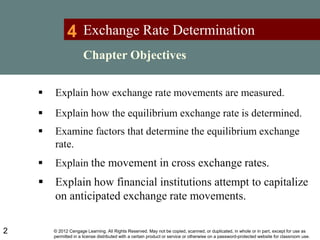
 Explain how exchange rate movements are measured.
 Explain how the equilibrium exchange rate is determined.
 Examine factors that determine the equilibrium exchange
rate.
 Explain the movement in cross exchange rates.
 Explain how financial institutions attempt to capitalize
on anticipated exchange rate movements.
2
Chapter Objectives
© 2012 Cengage Learning. All Rights Reserved. May not be copied, scanned, or duplicated, in whole or in part, except for use as
permitted in a license distributed with a certain product or service or otherwise on a password-protected website for classroom use.
3
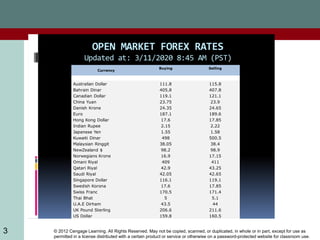
OPEN MARKET FOREX RATES
Updated at: 3/11/2020 8:45 AM (PST)
Currency
Buying Selling
Australian Dollar 111.8 115.8
Bahrain Dinar 405.8 407.8
Canadian Dollar 119.1 121.1
China Yuan 23.75 23.9
Danish Krone 24.35 24.65
Euro 187.1 189.6
Hong Kong Dollar 17.6 17.85
Indian Rupee 2.15 2.22
Japanese Yen 1.55 1.58
Kuwaiti Dinar 498 500.5
Malaysian Ringgit 38.05 38.4
NewZealand $ 98.2 98.9
Norwegians Krone 16.9 17.15
Omani Riyal 409 411
Qatari Riyal 42.9 43.25
Saudi Riyal 42.05 42.65
Singapore Dollar 116.1 119.1
Swedish Korona 17.6 17.85
Swiss Franc 170.5 171.4
Thai Bhat 5 5.1
U.A.E Dirham 43.5 44
UK Pound Sterling 206.6 211.6
US Dollar 159.8 160.5
© 2012 Cengage Learning. All Rights Reserved. May not be copied, scanned, or duplicated, in whole or in part, except for use as
permitted in a license distributed with a certain product or service or otherwise on a password-protected website for classroom use.
4
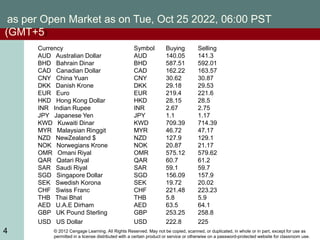
Currency Symbol Buying Selling
AUD Australian Dollar AUD 140.05 141.3
BHD Bahrain Dinar BHD 587.51 592.01
CAD Canadian Dollar CAD 162.22 163.57
CNY China Yuan CNY 30.62 30.87
DKK Danish Krone DKK 29.18 29.53
EUR Euro EUR 219.4 221.6
HKD Hong Kong Dollar HKD 28.15 28.5
INR Indian Rupee INR 2.67 2.75
JPY Japanese Yen JPY 1.1 1.17
KWD Kuwaiti Dinar KWD 709.39 714.39
MYR Malaysian Ringgit MYR 46.72 47.17
NZD NewZealand $ NZD 127.9 129.1
NOK Norwegians Krone NOK 20.87 21.17
OMR Omani Riyal OMR 575.12 579.62
QAR Qatari Riyal QAR 60.7 61.2
SAR Saudi Riyal SAR 59.1 59.7
SGD Singapore Dollar SGD 156.09 157.9
SEK Swedish Korona SEK 19.72 20.02
CHF Swiss Franc CHF 221.48 223.23
THB Thai Bhat THB 5.8 5.9
AED U.A.E Dirham AED 63.5 64.1
GBP UK Pound Sterling GBP 253.25 258.8
USD US Dollar USD 222.8 225
as per Open Market as on Tue, Oct 25 2022, 06:00 PST
(GMT+5)
© 2012 Cengage Learning. All Rights Reserved. May not be copied, scanned, or duplicated, in whole or in part, except for use as
permitted in a license distributed with a certain product or service or otherwise on a password-protected website for classroom use.
5
Measuring Exchange Rate Movements
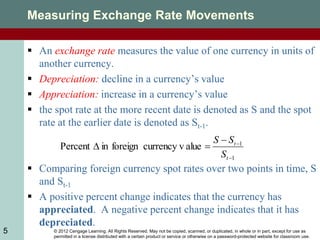
 An exchange rate measures the value of one currency in units of
another currency.
 Depreciation: decline in a currency’s value
 Appreciation: increase in a currency’s value
 the spot rate at the more recent date is denoted as S and the spot
rate at the earlier date is denoted as St-1.
 Comparing foreign currency spot rates over two points in time, S
and St-1
 A positive percent change indicates that the currency has
appreciated. A negative percent change indicates that it has
depreciated.
1
1
alue
currency v
foreign
in
Percent





t
t
S
S
S
© 2012 Cengage Learning. All Rights Reserved. May not be copied, scanned, or duplicated, in whole or in part, except for use as
permitted in a license distributed with a certain product or service or otherwise on a password-protected website for classroom use.
6
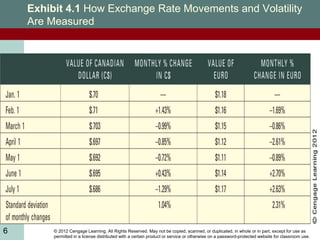
Exhibit 4.1 How Exchange Rate Movements and Volatility
Are Measured
© 2012 Cengage Learning. All Rights Reserved. May not be copied, scanned, or duplicated, in whole or in part, except for use as
permitted in a license distributed with a certain product or service or otherwise on a password-protected website for classroom use.
7
Exchange Rate Equilibrium
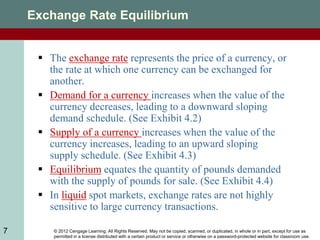
 The exchange rate represents the price of a currency, or
the rate at which one currency can be exchanged for
another.
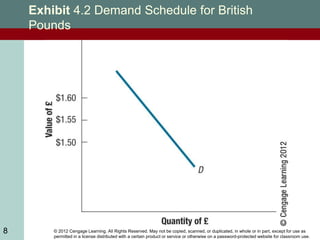
 Demand for a currency increases when the value of the
currency decreases, leading to a downward sloping
demand schedule. (See Exhibit 4.2)
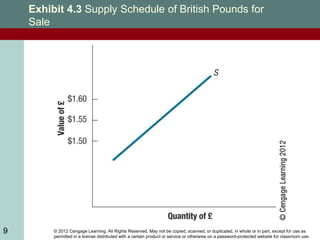
 Supply of a currency increases when the value of the
currency increases, leading to an upward sloping
supply schedule. (See Exhibit 4.3)
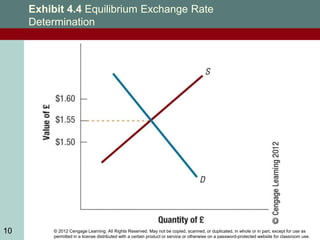
 Equilibrium equates the quantity of pounds demanded
with the supply of pounds for sale. (See Exhibit 4.4)
 In liquid spot markets, exchange rates are not highly
sensitive to large currency transactions.
© 2012 Cengage Learning. All Rights Reserved. May not be copied, scanned, or duplicated, in whole or in part, except for use as
permitted in a license distributed with a certain product or service or otherwise on a password-protected website for classroom use.
8
Exhibit 4.2 Demand Schedule for British
Pounds
8
© 2012 Cengage Learning. All Rights Reserved. May not be copied, scanned, or duplicated, in whole or in part, except for use as
permitted in a license distributed with a certain product or service or otherwise on a password-protected website for classroom use.
9
Exhibit 4.3 Supply Schedule of British Pounds for
Sale
9
© 2012 Cengage Learning. All Rights Reserved. May not be copied, scanned, or duplicated, in whole or in part, except for use as
permitted in a license distributed with a certain product or service or otherwise on a password-protected website for classroom use.
10
Exhibit 4.4 Equilibrium Exchange Rate
Determination
10
© 2012 Cengage Learning. All Rights Reserved. May not be copied, scanned, or duplicated, in whole or in part, except for use as
permitted in a license distributed with a certain product or service or otherwise on a password-protected website for classroom use.
11
Factors That Influence Exchange Rates
rates
exchange
future
of
ns
expectatio
in
change
controls
government
in
change
level
income
s
country'
foreign
the
and
level
income
U.S.
e
between th
al
differenti
in the
change
rate
interest
s
country'
foreign
the
and
rate
interest
U.S.
e
between th
al
differenti
in the
change
inflation
s
country'
foreign
the
and
inflation
S.
between U.
al
differenti
in the
change
rate
spot
in the
change
percentage
where
)
,
,
,
,
(

















EXP
GC
INC
INT
INF
e
EXP
GC
INC
INT
INF
f
e
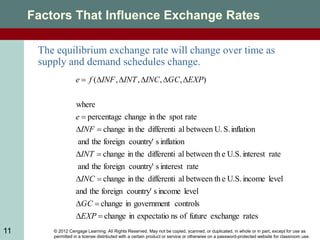
The equilibrium exchange rate will change over time as
supply and demand schedules change.
© 2012 Cengage Learning. All Rights Reserved. May not be copied, scanned, or duplicated, in whole or in part, except for use as
permitted in a license distributed with a certain product or service or otherwise on a password-protected website for classroom use.
12
Factors That Influence Exchange Rates
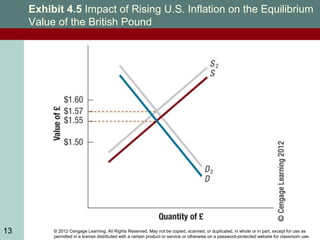
 Relative Inflation: Increase in U.S. inflation leads to increase in
U.S. demand for foreign goods, an increase in U.S. demand for
foreign currency, and an increase in the exchange rate for the
foreign currency. (See Exhibit 4.5)
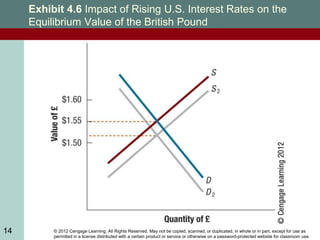
 Relative Interest Rates: Increase in U.S. rates leads to increase
in demand for U.S. deposits and a decrease in demand for
foreign deposits, leading to a increase in demand for dollars
and an increased exchange rate for the dollar. (See Exhibit 4.6)
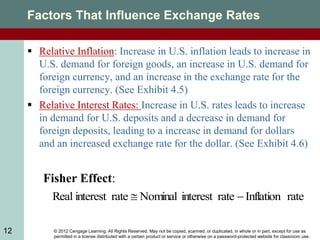
Fisher Effect:
rate
Inflation
rate
interest
Nominal
rate
interest
Real 

© 2012 Cengage Learning. All Rights Reserved. May not be copied, scanned, or duplicated, in whole or in part, except for use as
permitted in a license distributed with a certain product or service or otherwise on a password-protected website for classroom use.
13
Exhibit 4.5 Impact of Rising U.S. Inflation on the Equilibrium
Value of the British Pound
13
© 2012 Cengage Learning. All Rights Reserved. May not be copied, scanned, or duplicated, in whole or in part, except for use as
permitted in a license distributed with a certain product or service or otherwise on a password-protected website for classroom use.
14
Exhibit 4.6 Impact of Rising U.S. Interest Rates on the
Equilibrium Value of the British Pound
14
© 2012 Cengage Learning. All Rights Reserved. May not be copied, scanned, or duplicated, in whole or in part, except for use as
permitted in a license distributed with a certain product or service or otherwise on a password-protected website for classroom use.
15
Factors That Influence Exchange Rates
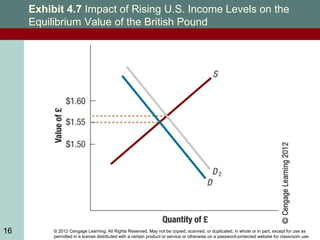
 Relative Income Levels: Increase in U.S. income leads to
increased in U.S. demand for foreign goods and increased
demand for foreign currency relative to the dollar and an
increase in the exchange rate for the foreign currency.
(See Exhibit 4.7)
 Government Controls via:
 Imposing foreign exchange barriers
 Imposing foreign trade barriers
 Intervening in foreign exchange markets
 Affecting macro variables such as inflation, interest rates, and
income levels.
© 2012 Cengage Learning. All Rights Reserved. May not be copied, scanned, or duplicated, in whole or in part, except for use as
permitted in a license distributed with a certain product or service or otherwise on a password-protected website for classroom use.
16
Exhibit 4.7 Impact of Rising U.S. Income Levels on the
Equilibrium Value of the British Pound
16
© 2012 Cengage Learning. All Rights Reserved. May not be copied, scanned, or duplicated, in whole or in part, except for use as
permitted in a license distributed with a certain product or service or otherwise on a password-protected website for classroom use.
17
Factors That Influence Exchange Rates
 Expectations: If investors expect interest rates
in one country to rise, they may invest in that
country leading to a rise in the demand for
foreign currency and an increase in the
exchange rate for foreign currency.
 Impact of signals on currency speculation.
Speculators may overreact to signals causing
currency to be temporarily overvalued or
undervalued.
© 2012 Cengage Learning. All Rights Reserved. May not be copied, scanned, or duplicated, in whole or in part, except for use as
permitted in a license distributed with a certain product or service or otherwise on a password-protected website for classroom use.
18
Factors that Influence Exchange Rates
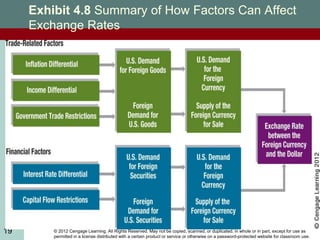
Interaction of Factors: some factors place
upward pressure while other factors place
downward pressure. (See Exhibit 4.8)
Influence of Factors across Multiple
Currency Markets: common for European
currencies to move in the same direction
against the dollar.
© 2012 Cengage Learning. All Rights Reserved. May not be copied, scanned, or duplicated, in whole or in part, except for use as
permitted in a license distributed with a certain product or service or otherwise on a password-protected website for classroom use.
19
Exhibit 4.8 Summary of How Factors Can Affect
Exchange Rates
19
© 2012 Cengage Learning. All Rights Reserved. May not be copied, scanned, or duplicated, in whole or in part, except for use as
permitted in a license distributed with a certain product or service or otherwise on a password-protected website for classroom use.
20
Movements in Cross Exchange Rates
 If currencies A and B move in same direction, there is
no change in the cross exchange rate.
 When currency A appreciates against the dollar by a
greater (smaller) degree than currency B, then currency
A appreciates (depreciates) against B.
 When currency A appreciates (depreciates) against the
dollar, while currency B is unchanged against the
dollar, currency A appreciates (depreciates) against
currency B by the same degree as it appreciates
(depreciates) against the dollar.
© 2012 Cengage Learning. All Rights Reserved. May not be copied, scanned, or duplicated, in whole or in part, except for use as
permitted in a license distributed with a certain product or service or otherwise on a password-protected website for classroom use.
21
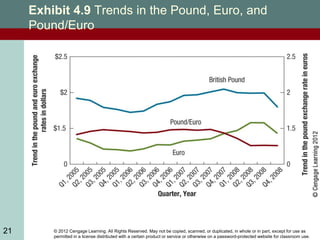
Exhibit 4.9 Trends in the Pound, Euro, and
Pound/Euro
21
© 2012 Cengage Learning. All Rights Reserved. May not be copied, scanned, or duplicated, in whole or in part, except for use as
permitted in a license distributed with a certain product or service or otherwise on a password-protected website for classroom use.
22
Anticipation of Exchange Rate Movements
 Institutional speculation based on expected appreciation - When
financial institutions believe that a currency is valued lower than
it should be in the foreign exchange market, they may invest in
that currency before it appreciates.
 Institutional speculation based on expected depreciation - If
financial institutions believe that a currency is valued higher than
it should be in the foreign exchange market, they may borrow
funds in that currency and convert it to their local currency now
before the currency’s value declines to its proper level.
 Speculation by individuals – Individuals can speculate in foreign
currencies.
 The “Carry Trade” – Where investors attempt to capitalize on the
differential in interest rates between two countries.
© 2012 Cengage Learning. All Rights Reserved. May not be copied, scanned, or duplicated, in whole or in part, except for use as
permitted in a license distributed with a certain product or service or otherwise on a password-protected website for classroom use.
23
SUMMARY
 Exchange rate movements are commonly measured by
the percentage change in their values over a specified
period, such as a month or a year. MNCs closely monitor
exchange rate movements over the period in which they
have cash flows denominated in the foreign currencies of
concern.
 The equilibrium exchange rate between two currencies at
any point in time is based on the demand and supply
conditions. Changes in the demand for a currency or the
supply of a currency for sale will affect the equilibrium
exchange rate.
© 2012 Cengage Learning. All Rights Reserved. May not be copied, scanned, or duplicated, in whole or in part, except for use as
permitted in a license distributed with a certain product or service or otherwise on a password-protected website for classroom use.
24
SUMMARY (Cont.)
 The key economic factors that can influence exchange rate
movements through their effects on demand and supply
conditions are relative inflation rates, interest rates, and income
levels, as well as government controls. As these factors cause a
change in international trade or financial flows, they affect the
demand for a currency or the supply of currency for sale and
therefore affect the equilibrium exchange rate.
 Unique international trade and financial flows between every
pair of countries dictate the unique supply and demand
conditions for the currencies of the two countries, which affect
the equilibrium cross exchange rate. The movement in the
exchange rate between two non-dollar currencies can be
determined by considering the movement in each currency
against the dollar and applying intuition.
© 2012 Cengage Learning. All Rights Reserved. May not be copied, scanned, or duplicated, in whole or in part, except for use as
permitted in a license distributed with a certain product or service or otherwise on a password-protected website for classroom use.
25
SUMMARY (Cont.)
 Financial institutions can attempt to benefit from expected
appreciation of a currency by purchasing that currency.
Conversely, they can attempt to benefit from expected
depreciation of a currency by borrowing that currency,
exchanging it for their home currency, and then buying that
currency back just before they repay the loan.

04. Exchange Rate Determination.pptx

  • 1.
    © 2012 CengageLearning. All Rights Reserved. May not be copied, scanned, or duplicated, in whole or in part, except for use as permitted in a license distributed with a certain product or service or otherwise on a password-protected website for classroom use. International Financial Management 11th Edition by Jeff Madura 1
  • 2.
    © 2012 CengageLearning. All Rights Reserved. May not be copied, scanned, or duplicated, in whole or in part, except for use as permitted in a license distributed with a certain product or service or otherwise on a password-protected website for classroom use. 2 4 Exchange Rate Determination  Explain how exchange rate movements are measured.  Explain how the equilibrium exchange rate is determined.  Examine factors that determine the equilibrium exchange rate.  Explain the movement in cross exchange rates.  Explain how financial institutions attempt to capitalize on anticipated exchange rate movements. 2 Chapter Objectives
  • 3.
    © 2012 CengageLearning. All Rights Reserved. May not be copied, scanned, or duplicated, in whole or in part, except for use as permitted in a license distributed with a certain product or service or otherwise on a password-protected website for classroom use. 3 OPEN MARKET FOREX RATES Updated at: 3/11/2020 8:45 AM (PST) Currency Buying Selling Australian Dollar 111.8 115.8 Bahrain Dinar 405.8 407.8 Canadian Dollar 119.1 121.1 China Yuan 23.75 23.9 Danish Krone 24.35 24.65 Euro 187.1 189.6 Hong Kong Dollar 17.6 17.85 Indian Rupee 2.15 2.22 Japanese Yen 1.55 1.58 Kuwaiti Dinar 498 500.5 Malaysian Ringgit 38.05 38.4 NewZealand $ 98.2 98.9 Norwegians Krone 16.9 17.15 Omani Riyal 409 411 Qatari Riyal 42.9 43.25 Saudi Riyal 42.05 42.65 Singapore Dollar 116.1 119.1 Swedish Korona 17.6 17.85 Swiss Franc 170.5 171.4 Thai Bhat 5 5.1 U.A.E Dirham 43.5 44 UK Pound Sterling 206.6 211.6 US Dollar 159.8 160.5
  • 4.
    © 2012 CengageLearning. All Rights Reserved. May not be copied, scanned, or duplicated, in whole or in part, except for use as permitted in a license distributed with a certain product or service or otherwise on a password-protected website for classroom use. 4 Currency Symbol Buying Selling AUD Australian Dollar AUD 140.05 141.3 BHD Bahrain Dinar BHD 587.51 592.01 CAD Canadian Dollar CAD 162.22 163.57 CNY China Yuan CNY 30.62 30.87 DKK Danish Krone DKK 29.18 29.53 EUR Euro EUR 219.4 221.6 HKD Hong Kong Dollar HKD 28.15 28.5 INR Indian Rupee INR 2.67 2.75 JPY Japanese Yen JPY 1.1 1.17 KWD Kuwaiti Dinar KWD 709.39 714.39 MYR Malaysian Ringgit MYR 46.72 47.17 NZD NewZealand $ NZD 127.9 129.1 NOK Norwegians Krone NOK 20.87 21.17 OMR Omani Riyal OMR 575.12 579.62 QAR Qatari Riyal QAR 60.7 61.2 SAR Saudi Riyal SAR 59.1 59.7 SGD Singapore Dollar SGD 156.09 157.9 SEK Swedish Korona SEK 19.72 20.02 CHF Swiss Franc CHF 221.48 223.23 THB Thai Bhat THB 5.8 5.9 AED U.A.E Dirham AED 63.5 64.1 GBP UK Pound Sterling GBP 253.25 258.8 USD US Dollar USD 222.8 225 as per Open Market as on Tue, Oct 25 2022, 06:00 PST (GMT+5)
  • 5.
    © 2012 CengageLearning. All Rights Reserved. May not be copied, scanned, or duplicated, in whole or in part, except for use as permitted in a license distributed with a certain product or service or otherwise on a password-protected website for classroom use. 5 Measuring Exchange Rate Movements  An exchange rate measures the value of one currency in units of another currency.  Depreciation: decline in a currency’s value  Appreciation: increase in a currency’s value  the spot rate at the more recent date is denoted as S and the spot rate at the earlier date is denoted as St-1.  Comparing foreign currency spot rates over two points in time, S and St-1  A positive percent change indicates that the currency has appreciated. A negative percent change indicates that it has depreciated. 1 1 alue currency v foreign in Percent      t t S S S
  • 6.
    © 2012 CengageLearning. All Rights Reserved. May not be copied, scanned, or duplicated, in whole or in part, except for use as permitted in a license distributed with a certain product or service or otherwise on a password-protected website for classroom use. 6 Exhibit 4.1 How Exchange Rate Movements and Volatility Are Measured
  • 7.
    © 2012 CengageLearning. All Rights Reserved. May not be copied, scanned, or duplicated, in whole or in part, except for use as permitted in a license distributed with a certain product or service or otherwise on a password-protected website for classroom use. 7 Exchange Rate Equilibrium  The exchange rate represents the price of a currency, or the rate at which one currency can be exchanged for another.  Demand for a currency increases when the value of the currency decreases, leading to a downward sloping demand schedule. (See Exhibit 4.2)  Supply of a currency increases when the value of the currency increases, leading to an upward sloping supply schedule. (See Exhibit 4.3)  Equilibrium equates the quantity of pounds demanded with the supply of pounds for sale. (See Exhibit 4.4)  In liquid spot markets, exchange rates are not highly sensitive to large currency transactions.
  • 8.
    © 2012 CengageLearning. All Rights Reserved. May not be copied, scanned, or duplicated, in whole or in part, except for use as permitted in a license distributed with a certain product or service or otherwise on a password-protected website for classroom use. 8 Exhibit 4.2 Demand Schedule for British Pounds 8
  • 9.
    © 2012 CengageLearning. All Rights Reserved. May not be copied, scanned, or duplicated, in whole or in part, except for use as permitted in a license distributed with a certain product or service or otherwise on a password-protected website for classroom use. 9 Exhibit 4.3 Supply Schedule of British Pounds for Sale 9
  • 10.
    © 2012 CengageLearning. All Rights Reserved. May not be copied, scanned, or duplicated, in whole or in part, except for use as permitted in a license distributed with a certain product or service or otherwise on a password-protected website for classroom use. 10 Exhibit 4.4 Equilibrium Exchange Rate Determination 10
  • 11.
    © 2012 CengageLearning. All Rights Reserved. May not be copied, scanned, or duplicated, in whole or in part, except for use as permitted in a license distributed with a certain product or service or otherwise on a password-protected website for classroom use. 11 Factors That Influence Exchange Rates rates exchange future of ns expectatio in change controls government in change level income s country' foreign the and level income U.S. e between th al differenti in the change rate interest s country' foreign the and rate interest U.S. e between th al differenti in the change inflation s country' foreign the and inflation S. between U. al differenti in the change rate spot in the change percentage where ) , , , , (                  EXP GC INC INT INF e EXP GC INC INT INF f e The equilibrium exchange rate will change over time as supply and demand schedules change.
  • 12.
    © 2012 CengageLearning. All Rights Reserved. May not be copied, scanned, or duplicated, in whole or in part, except for use as permitted in a license distributed with a certain product or service or otherwise on a password-protected website for classroom use. 12 Factors That Influence Exchange Rates  Relative Inflation: Increase in U.S. inflation leads to increase in U.S. demand for foreign goods, an increase in U.S. demand for foreign currency, and an increase in the exchange rate for the foreign currency. (See Exhibit 4.5)  Relative Interest Rates: Increase in U.S. rates leads to increase in demand for U.S. deposits and a decrease in demand for foreign deposits, leading to a increase in demand for dollars and an increased exchange rate for the dollar. (See Exhibit 4.6) Fisher Effect: rate Inflation rate interest Nominal rate interest Real  
  • 13.
    © 2012 CengageLearning. All Rights Reserved. May not be copied, scanned, or duplicated, in whole or in part, except for use as permitted in a license distributed with a certain product or service or otherwise on a password-protected website for classroom use. 13 Exhibit 4.5 Impact of Rising U.S. Inflation on the Equilibrium Value of the British Pound 13
  • 14.
    © 2012 CengageLearning. All Rights Reserved. May not be copied, scanned, or duplicated, in whole or in part, except for use as permitted in a license distributed with a certain product or service or otherwise on a password-protected website for classroom use. 14 Exhibit 4.6 Impact of Rising U.S. Interest Rates on the Equilibrium Value of the British Pound 14
  • 15.
    © 2012 CengageLearning. All Rights Reserved. May not be copied, scanned, or duplicated, in whole or in part, except for use as permitted in a license distributed with a certain product or service or otherwise on a password-protected website for classroom use. 15 Factors That Influence Exchange Rates  Relative Income Levels: Increase in U.S. income leads to increased in U.S. demand for foreign goods and increased demand for foreign currency relative to the dollar and an increase in the exchange rate for the foreign currency. (See Exhibit 4.7)  Government Controls via:  Imposing foreign exchange barriers  Imposing foreign trade barriers  Intervening in foreign exchange markets  Affecting macro variables such as inflation, interest rates, and income levels.
  • 16.
    © 2012 CengageLearning. All Rights Reserved. May not be copied, scanned, or duplicated, in whole or in part, except for use as permitted in a license distributed with a certain product or service or otherwise on a password-protected website for classroom use. 16 Exhibit 4.7 Impact of Rising U.S. Income Levels on the Equilibrium Value of the British Pound 16
  • 17.
    © 2012 CengageLearning. All Rights Reserved. May not be copied, scanned, or duplicated, in whole or in part, except for use as permitted in a license distributed with a certain product or service or otherwise on a password-protected website for classroom use. 17 Factors That Influence Exchange Rates  Expectations: If investors expect interest rates in one country to rise, they may invest in that country leading to a rise in the demand for foreign currency and an increase in the exchange rate for foreign currency.  Impact of signals on currency speculation. Speculators may overreact to signals causing currency to be temporarily overvalued or undervalued.
  • 18.
    © 2012 CengageLearning. All Rights Reserved. May not be copied, scanned, or duplicated, in whole or in part, except for use as permitted in a license distributed with a certain product or service or otherwise on a password-protected website for classroom use. 18 Factors that Influence Exchange Rates Interaction of Factors: some factors place upward pressure while other factors place downward pressure. (See Exhibit 4.8) Influence of Factors across Multiple Currency Markets: common for European currencies to move in the same direction against the dollar.
  • 19.
    © 2012 CengageLearning. All Rights Reserved. May not be copied, scanned, or duplicated, in whole or in part, except for use as permitted in a license distributed with a certain product or service or otherwise on a password-protected website for classroom use. 19 Exhibit 4.8 Summary of How Factors Can Affect Exchange Rates 19
  • 20.
    © 2012 CengageLearning. All Rights Reserved. May not be copied, scanned, or duplicated, in whole or in part, except for use as permitted in a license distributed with a certain product or service or otherwise on a password-protected website for classroom use. 20 Movements in Cross Exchange Rates  If currencies A and B move in same direction, there is no change in the cross exchange rate.  When currency A appreciates against the dollar by a greater (smaller) degree than currency B, then currency A appreciates (depreciates) against B.  When currency A appreciates (depreciates) against the dollar, while currency B is unchanged against the dollar, currency A appreciates (depreciates) against currency B by the same degree as it appreciates (depreciates) against the dollar.
  • 21.
    © 2012 CengageLearning. All Rights Reserved. May not be copied, scanned, or duplicated, in whole or in part, except for use as permitted in a license distributed with a certain product or service or otherwise on a password-protected website for classroom use. 21 Exhibit 4.9 Trends in the Pound, Euro, and Pound/Euro 21
  • 22.
    © 2012 CengageLearning. All Rights Reserved. May not be copied, scanned, or duplicated, in whole or in part, except for use as permitted in a license distributed with a certain product or service or otherwise on a password-protected website for classroom use. 22 Anticipation of Exchange Rate Movements  Institutional speculation based on expected appreciation - When financial institutions believe that a currency is valued lower than it should be in the foreign exchange market, they may invest in that currency before it appreciates.  Institutional speculation based on expected depreciation - If financial institutions believe that a currency is valued higher than it should be in the foreign exchange market, they may borrow funds in that currency and convert it to their local currency now before the currency’s value declines to its proper level.  Speculation by individuals – Individuals can speculate in foreign currencies.  The “Carry Trade” – Where investors attempt to capitalize on the differential in interest rates between two countries.
  • 23.
    © 2012 CengageLearning. All Rights Reserved. May not be copied, scanned, or duplicated, in whole or in part, except for use as permitted in a license distributed with a certain product or service or otherwise on a password-protected website for classroom use. 23 SUMMARY  Exchange rate movements are commonly measured by the percentage change in their values over a specified period, such as a month or a year. MNCs closely monitor exchange rate movements over the period in which they have cash flows denominated in the foreign currencies of concern.  The equilibrium exchange rate between two currencies at any point in time is based on the demand and supply conditions. Changes in the demand for a currency or the supply of a currency for sale will affect the equilibrium exchange rate.
  • 24.
    © 2012 CengageLearning. All Rights Reserved. May not be copied, scanned, or duplicated, in whole or in part, except for use as permitted in a license distributed with a certain product or service or otherwise on a password-protected website for classroom use. 24 SUMMARY (Cont.)  The key economic factors that can influence exchange rate movements through their effects on demand and supply conditions are relative inflation rates, interest rates, and income levels, as well as government controls. As these factors cause a change in international trade or financial flows, they affect the demand for a currency or the supply of currency for sale and therefore affect the equilibrium exchange rate.  Unique international trade and financial flows between every pair of countries dictate the unique supply and demand conditions for the currencies of the two countries, which affect the equilibrium cross exchange rate. The movement in the exchange rate between two non-dollar currencies can be determined by considering the movement in each currency against the dollar and applying intuition.
  • 25.
    © 2012 CengageLearning. All Rights Reserved. May not be copied, scanned, or duplicated, in whole or in part, except for use as permitted in a license distributed with a certain product or service or otherwise on a password-protected website for classroom use. 25 SUMMARY (Cont.)  Financial institutions can attempt to benefit from expected appreciation of a currency by purchasing that currency. Conversely, they can attempt to benefit from expected depreciation of a currency by borrowing that currency, exchanging it for their home currency, and then buying that currency back just before they repay the loan.