*Corresponding Author: Sharadha Kumar, Email: sharadhak12@gmail.com
RESEARCH ARTICLE
Available Online at www.ajms.in
Asian Journal of Mathematical Sciences 2018; 2(1):19-23
On Homogeneous Cubic Equation with Four Unknowns
   2
2
3
3
16zw
y
x
y
x
y
x 




S.Vidhyalakshmi1
, M.A.Gopalan2
, Sharadha Kumar3*
1,2
Professor, Department of Mathematics, Shrimati Indira Gandhi College, Trichy-620 002, Tamil Nadu,
India.
3*
M.Phil scholar, Department of Mathematics, Shrimati Indira Gandhi College, Trichy-620 002, Tamil Nadu,
India
Received on: 11/12/2017,Revised on: 30/12/2017,Accepted on: 15/01/2018
ABSTRACT
The cubic diophantine equation with four unknowns given by    2
2
3
3
16zw
y
x
y
x
y
x 



 is
analyzed for its non-zero distinct integer points on it. Different patterns of integer points for the equation
under consideration are obtained. A few interesting relations between the solutions and special number
patterns namely Polygonal number, Gnomonic number, Star number and Pronic number are presented.
Keywords: cubic equation with four unknowns, integral solutions
2010 Mathematics Subject Classification: 11D25
INTRODUCTION
The cubic diophantine equations offer an unlimited field for research due to their variety [1, 22]
. For an
extensive review of various problems, one may refer [2-21]
. This communication concerns with yet another
interesting cubic diophantine equation with four unknowns    2
2
3
3
16zw
y
x
y
x
y
x 



 for
determining its infinitely many non-zero integral points. Also, a few interesting relations between the
solutions and special numbers are presented.
Notations:
 Polygonal number of rank n with size m
  





 



2
2
1
1
,
m
n
n
t n
m
 Gnomonic number of rank n
1
2 
 n
GNOn
 Star number of rank n
1
6
6 2


 n
n
Sn
 Pronic number of rank n
 
1

 n
n
PRn
Method of analysis:
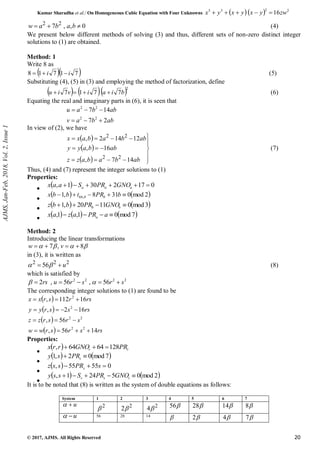
The homogeneous cubic equation with four unknowns to be solved is
   2
2
3
3
16zw
y
x
y
x
y
x 



 (1)
Introducing the linear transformations
u
z
v
u
y
v
u
x 



 ,
, (2)
in (1), it gives
2
2
2
8
7 w
v
u 
 (3)
Assume
Kumar Sharadha et al./ On Homogeneous Cubic Equation with Four Unknowns    2
2
3
3
16zw
y
x
y
x
y
x 




© 2017, AJMS. All Rights Reserved 20
0
,
,
7 2
2


 b
a
b
a
w (4)
We present below different methods of solving (3) and thus, different sets of non-zero distinct integer
solutions to (1) are obtained.
Method: 1
Write 8 as
  
7
1
7
1
8 i
i 

 (5)
Substituting (4), (5) in (3) and employing the method of factorization, define
    2
7
7
1
7 b
i
a
i
v
i
u 


 (6)
Equating the real and imaginary parts in (6), it is seen that
ab
b
a
v
ab
b
a
u
2
7
14
7
2
2
2
2






In view of (2), we have
 
 
  

















ab
b
a
b
a
z
z
ab
b
a
y
y
ab
b
a
b
a
x
x
14
7
,
16
,
12
14
2
,
2
2
2
2
(7)
Thus, (4) and (7) represent the integer solutions to (1)
Properties:

  0
17
2
30
1
, 




 a
a
a GNO
PR
S
a
a
x

   
2
mod
0
31
8
,
1 ,
66 



 b
PR
t
b
b
x b
b

   
3
mod
0
11
20
,
1 


 b
b GNO
PR
b
b
z

     
7
mod
0
1
,
1
, 


 a
PR
a
z
a
x a
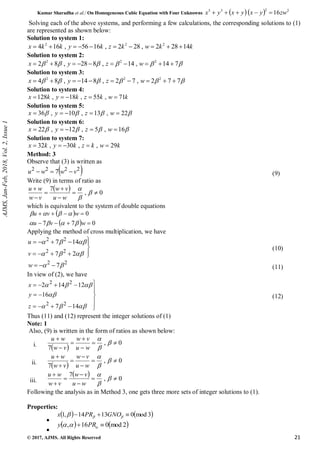
Method: 2
Introducing the linear transformations



 8
,
7 


 v
w
in (3), it is written as
2
2
2
56 u

 
 (8)
which is satisfied by
2
2
2
2
56
,
56
,
2 s
r
s
r
u
rs 



 

The corresponding integer solutions to (1) are found to be
 
 
 
  rs
s
r
s
r
w
w
s
r
s
r
z
z
rs
s
s
r
y
y
rs
r
s
r
x
x
14
56
,
56
,
16
2
,
16
112
,
2
2
2
2
2
2














Properties:

  r
r PR
GNO
r
r
x 128
64
64
, 



   
7
mod
0
2
,
1 
 s
PR
s
y

  0
55
55
, 

 s
PR
s
s
z s

   
2
mod
0
5
24
1
, 



 s
s
s GNO
PR
S
s
s
y
It is to be noted that (8) is written as the system of double equations as follows:
System 1 2 3 4 5 6 7
u

 2
 2
2 2
4 
56 
28 
14 
8
u

 56 28 14  
2 
4 
7
AJMS,
Jan-Feb,
2018,
Vol.
2,
Issue
1
Kumar Sharadha et al./ On Homogeneous Cubic Equation with Four Unknowns    2
2
3
3
16zw
y
x
y
x
y
x 




© 2017, AJMS. All Rights Reserved 21
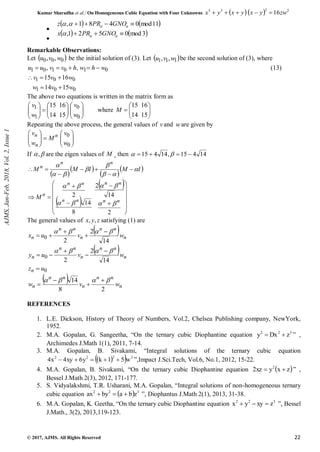
Solving each of the above systems, and performing a few calculations, the corresponding solutions to (1)
are represented as shown below:
Solution to system 1:
k
k
w
k
z
k
y
k
k
x 14
28
2
,
28
2
,
16
56
,
16
4 2
2
2










Solution to system 2:





 7
14
,
14
,
8
28
,
8
2 2
2
2









 w
z
y
x
Solution to system 3:





 7
7
2
,
7
2
,
8
14
,
8
4 2
2
2









 w
z
y
x
Solution to system 4:
k
w
k
z
k
y
k
x 71
,
55
,
18
,
128 




Solution to system 5:



 22
,
13
,
10
,
36 



 w
z
y
x
Solution to system 6:



 16
,
5
,
12
,
22 



 w
z
y
x
Solution to system 7:
k
w
k
z
k
y
k
x 29
,
,
30
,
32 




Method: 3
Observe that (3) is written as
 
2
2
2
2
7 v
w
w
u 

 (9)
Write (9) in terms of ratio as
  0
,
7










w
u
v
w
v
w
w
u
which is equivalent to the system of double equations
 
  0
7
7
0








w
v
u
w
v
u








Applying the method of cross multiplication, we have



















2
7
14
7
2
2
2
2
v
u
(10)
2
2
7
 


w (11)
In view of (2), we have
























14
7
16
12
14
2
2
2
2
2
z
y
x
(12)
Thus (11) and (12) represent the integer solutions of (1)
Note: 1
Also, (9) is written in the form of ratios as shown below:
i.  
0
,
7










w
u
v
w
v
w
w
u
ii.  
0
,
7










w
u
v
w
v
w
w
u
iii.
  0
,
7










w
u
v
w
v
w
w
u
Following the analysis as in Method 3, one gets three more sets of integer solutions to (1).
Properties:

   
3
mod
0
13
14
,
1 

 

 GNO
PR
x

   
2
mod
0
16
, 
 

 PR
y
AJMS,
Jan-Feb,
2018,
Vol.
2,
Issue
1
Kumar Sharadha et al./ On Homogeneous Cubic Equation with Four Unknowns    2
2
3
3
16zw
y
x
y
x
y
x 




© 2017, AJMS. All Rights Reserved 22

   
11
mod
0
4
8
1
, 


 


 GNO
PR
z

   
3
mod
0
5
2
1
, 

 

 GNO
PR
x
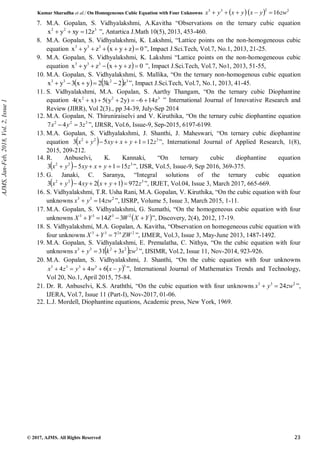
Remarkable Observations:
Let  
0
0
0 ,
, w
v
u be the initial solution of (3). Let  
1
1
1 ,
, w
v
u be the second solution of (3), where
0
1
0
1
0
1 ,
, w
h
w
h
v
v
u
u 



 (13)
0
0
1
0
0
1
15
14
16
15
w
v
w
w
v
v





The above two equations is written in the matrix form as

























0
0
1
1
15
16
14
15
w
v
w
v
where 








15
16
14
15
M
Repeating the above process, the general values of vand ware given by

















0
0
w
v
M
w
v n
n
n
If 
, are the eigen values of M , then 14
4
15
,
14
4
15 


 

 
 
 
 
I
M
I
M
M
n
n
n















 
 


















2
14
2
8
14
2
n
n
n
n
n
n
n
n
n
M








The general values of z
y
x ,
, satisfying (1) are
  n
n
n
n
n
n
n w
v
u
x
14
2
2
0



 




  n
n
n
n
n
n
n w
v
u
y
14
2
2
0



 




0
u
zn 
  n
n
n
n
n
n
n w
v
w
2
8
14 


 



REFERENCES
1. L.E. Dickson, History of Theory of Numbers, Vol.2, Chelsea Publishing company, NewYork,
1952.
2. M.A. Gopalan, G. Sangeetha, “On the ternary cubic Diophantine equation 3
2
2
z
Dx
y 
 ” ,
Archimedes J.Math 1(1), 2011, 7-14.
3. M.A. Gopalan, B. Sivakami, “Integral solutions of the ternary cubic equation
 
  3
2
2
2
w
5
1
k
y
6
xy
4
x
4 



 ”,Impact J.Sci.Tech, Vol.6, No.1, 2012, 15-22.
4. M.A. Gopalan, B. Sivakami, “On the ternary cubic Diophantine equation  
z
x
y
xz
2 2

 ” ,
Bessel J.Math 2(3), 2012, 171-177.
5. S. Vidyalakshmi, T.R. Usharani, M.A. Gopalan, “Integral solutions of non-homogeneous ternary
cubic equation   3
2
2
z
b
a
by
ax 

 ”, Diophantus J.Math 2(1), 2013, 31-38.
6. M.A. Gopalan, K. Geetha, “On the ternary cubic Diophantine equation 3
2
2
z
xy
y
x 

 ”, Bessel
J.Math., 3(2), 2013,119-123.
AJMS,
Jan-Feb,
2018,
Vol.
2,
Issue
1
Kumar Sharadha et al./ On Homogeneous Cubic Equation with Four Unknowns    2
2
3
3
16zw
y
x
y
x
y
x 




© 2017, AJMS. All Rights Reserved 23
7. M.A. Gopalan, S. Vidhyalakshmi, A.Kavitha “Observations on the ternary cubic equation
3
2
2
z
12
xy
y
x 

 ”, Antartica J.Math 10(5), 2013, 453-460.
8. M.A. Gopalan, S. Vidhyalakshmi, K. Lakshmi, “Lattice points on the non-homogeneous cubic
equation   0
z
y
x
z
y
x 3
3
3





 ”, Impact J.Sci.Tech, Vol.7, No.1, 2013, 21-25.
9. M.A. Gopalan, S. Vidhyalakshmi, K. Lakshmi “Lattice points on the non-homogeneous cubic
equation   0
z
y
x
z
y
x 3
3
3





 ”, Impact J.Sci.Tech, Vol.7, No1, 2013, 51-55,
10. M.A. Gopalan, S. Vidhyalakshmi, S. Mallika, “On the ternary non-homogenous cubic equation
    3
2
3
3
z
2
k
3
2
y
x
3
y
x 



 ”, Impact J.Sci.Tech, Vol.7, No.1, 2013, 41-45.
11. S. Vidhyalakshmi, M.A. Gopalan, S. Aarthy Thangam, “On the ternary cubic Diophantine
equation 3
2
2
z
14
6
)
y
2
y
(
5
)
x
x
(
4 




 ” International Journal of Innovative Research and
Review (JIRR), Vol 2(3)., pp 34-39, July-Sep 2014
12. M.A. Gopalan, N. Thiruniraiselvi and V. Kiruthika, “On the ternary cubic diophantine equation
3
2
2
3
4
7 z
y
x 
 ”, IJRSR, Vol.6, Issue-9, Sep-2015, 6197-6199.
13. M.A. Gopalan, S. Vidhyalakshmi, J. Shanthi, J. Maheswari, “On ternary cubic diophantine
equation   3
2
2
12
1
5
3 z
y
x
xy
y
x 




 ”, International Journal of Applied Research, 1(8),
2015, 209-212.
14. R. Anbuselvi, K. Kannaki, “On ternary cubic diophantine equation
  3
2
2
15
1
5
3 z
y
x
xy
y
x 




 ”, IJSR, Vol.5, Issue-9, Sep 2016, 369-375.
15. G. Janaki, C. Saranya, “Integral solutions of the ternary cubic equation
    3
2
2
972
1
2
4
3 z
y
x
xy
y
x 




 ”, IRJET, Vol.04, Issue 3, March 2017, 665-669.
16. S. Vidhyalakshmi, T.R. Usha Rani, M.A. Gopalan, V. Kiruthika, “On the cubic equation with four
unknowns 2
3
3
14zw
y
x 
 ”, IJSRP, Volume 5, Issue 3, March 2015, 1-11.
17. M.A. Gopalan, S. Vidhyalakshmi, G. Sumathi, “On the homogeneous cubic equation with four
unknowns  
Y
X
W
Z
Y
X 


 2
3
3
3
3
14 ”, Discovery, 2(4), 2012, 17-19.
18. S. Vidhyalakshmi, M.A. Gopalan, A. Kavitha, “Observation on homogeneous cubic equation with
four unknowns 2
2
3
3
7 ZW
Y
X n

 ”, IJMER, Vol.3, Issue 3, May-June 2013, 1487-1492.
19. M.A. Gopalan, S. Vidhyalakshmi, E. Premalatha, C. Nithya, “On the cubic equation with four
unknowns   2
2
2
3
3
3
31 zw
s
k
y
x 

 ”, IJSIMR, Vol.2, Issue 11, Nov-2014, 923-926.
20. M.A. Gopalan, S. Vidhyalakshmi, J. Shanthi, “On the cubic equation with four unknowns
 3
3
3
3
3
6
4
4 y
x
w
y
z
x 



 ”, International Journal of Mathematics Trends and Technology,
Vol 20, No.1, April 2015, 75-84.
21. Dr. R. Anbuselvi, K.S. Araththi, “On the cubic equation with four unknowns 2
3
3
24zw
y
x 
 ”,
IJERA, Vol.7, Issue 11 (Part-I), Nov-2017, 01-06.
22. L.J. Mordell, Diophantine equations, Academic press, New York, 1969.
AJMS,
Jan-Feb,
2018,
Vol.
2,
Issue
1

04. AJMS_05_18[Research].pdf

  • 1.
    *Corresponding Author: SharadhaKumar, Email: sharadhak12@gmail.com RESEARCH ARTICLE Available Online at www.ajms.in Asian Journal of Mathematical Sciences 2018; 2(1):19-23 On Homogeneous Cubic Equation with Four Unknowns    2 2 3 3 16zw y x y x y x      S.Vidhyalakshmi1 , M.A.Gopalan2 , Sharadha Kumar3* 1,2 Professor, Department of Mathematics, Shrimati Indira Gandhi College, Trichy-620 002, Tamil Nadu, India. 3* M.Phil scholar, Department of Mathematics, Shrimati Indira Gandhi College, Trichy-620 002, Tamil Nadu, India Received on: 11/12/2017,Revised on: 30/12/2017,Accepted on: 15/01/2018 ABSTRACT The cubic diophantine equation with four unknowns given by    2 2 3 3 16zw y x y x y x      is analyzed for its non-zero distinct integer points on it. Different patterns of integer points for the equation under consideration are obtained. A few interesting relations between the solutions and special number patterns namely Polygonal number, Gnomonic number, Star number and Pronic number are presented. Keywords: cubic equation with four unknowns, integral solutions 2010 Mathematics Subject Classification: 11D25 INTRODUCTION The cubic diophantine equations offer an unlimited field for research due to their variety [1, 22] . For an extensive review of various problems, one may refer [2-21] . This communication concerns with yet another interesting cubic diophantine equation with four unknowns    2 2 3 3 16zw y x y x y x      for determining its infinitely many non-zero integral points. Also, a few interesting relations between the solutions and special numbers are presented. Notations:  Polygonal number of rank n with size m              2 2 1 1 , m n n t n m  Gnomonic number of rank n 1 2   n GNOn  Star number of rank n 1 6 6 2    n n Sn  Pronic number of rank n   1   n n PRn Method of analysis: The homogeneous cubic equation with four unknowns to be solved is    2 2 3 3 16zw y x y x y x      (1) Introducing the linear transformations u z v u y v u x      , , (2) in (1), it gives 2 2 2 8 7 w v u   (3) Assume
  • 2.
    Kumar Sharadha etal./ On Homogeneous Cubic Equation with Four Unknowns    2 2 3 3 16zw y x y x y x      © 2017, AJMS. All Rights Reserved 20 0 , , 7 2 2    b a b a w (4) We present below different methods of solving (3) and thus, different sets of non-zero distinct integer solutions to (1) are obtained. Method: 1 Write 8 as    7 1 7 1 8 i i    (5) Substituting (4), (5) in (3) and employing the method of factorization, define     2 7 7 1 7 b i a i v i u     (6) Equating the real and imaginary parts in (6), it is seen that ab b a v ab b a u 2 7 14 7 2 2 2 2       In view of (2), we have                         ab b a b a z z ab b a y y ab b a b a x x 14 7 , 16 , 12 14 2 , 2 2 2 2 (7) Thus, (4) and (7) represent the integer solutions to (1) Properties:    0 17 2 30 1 ,       a a a GNO PR S a a x      2 mod 0 31 8 , 1 , 66      b PR t b b x b b      3 mod 0 11 20 , 1     b b GNO PR b b z        7 mod 0 1 , 1 ,     a PR a z a x a Method: 2 Introducing the linear transformations     8 , 7     v w in (3), it is written as 2 2 2 56 u     (8) which is satisfied by 2 2 2 2 56 , 56 , 2 s r s r u rs        The corresponding integer solutions to (1) are found to be         rs s r s r w w s r s r z z rs s s r y y rs r s r x x 14 56 , 56 , 16 2 , 16 112 , 2 2 2 2 2 2               Properties:    r r PR GNO r r x 128 64 64 ,         7 mod 0 2 , 1   s PR s y    0 55 55 ,    s PR s s z s      2 mod 0 5 24 1 ,      s s s GNO PR S s s y It is to be noted that (8) is written as the system of double equations as follows: System 1 2 3 4 5 6 7 u   2  2 2 2 4  56  28  14  8 u   56 28 14   2  4  7 AJMS, Jan-Feb, 2018, Vol. 2, Issue 1
  • 3.
    Kumar Sharadha etal./ On Homogeneous Cubic Equation with Four Unknowns    2 2 3 3 16zw y x y x y x      © 2017, AJMS. All Rights Reserved 21 Solving each of the above systems, and performing a few calculations, the corresponding solutions to (1) are represented as shown below: Solution to system 1: k k w k z k y k k x 14 28 2 , 28 2 , 16 56 , 16 4 2 2 2           Solution to system 2:       7 14 , 14 , 8 28 , 8 2 2 2 2           w z y x Solution to system 3:       7 7 2 , 7 2 , 8 14 , 8 4 2 2 2           w z y x Solution to system 4: k w k z k y k x 71 , 55 , 18 , 128      Solution to system 5:     22 , 13 , 10 , 36      w z y x Solution to system 6:     16 , 5 , 12 , 22      w z y x Solution to system 7: k w k z k y k x 29 , , 30 , 32      Method: 3 Observe that (3) is written as   2 2 2 2 7 v w w u    (9) Write (9) in terms of ratio as   0 , 7           w u v w v w w u which is equivalent to the system of double equations     0 7 7 0         w v u w v u         Applying the method of cross multiplication, we have                    2 7 14 7 2 2 2 2 v u (10) 2 2 7     w (11) In view of (2), we have                         14 7 16 12 14 2 2 2 2 2 z y x (12) Thus (11) and (12) represent the integer solutions of (1) Note: 1 Also, (9) is written in the form of ratios as shown below: i.   0 , 7           w u v w v w w u ii.   0 , 7           w u v w v w w u iii.   0 , 7           w u v w v w w u Following the analysis as in Method 3, one gets three more sets of integer solutions to (1). Properties:      3 mod 0 13 14 , 1       GNO PR x      2 mod 0 16 ,      PR y AJMS, Jan-Feb, 2018, Vol. 2, Issue 1
  • 4.
    Kumar Sharadha etal./ On Homogeneous Cubic Equation with Four Unknowns    2 2 3 3 16zw y x y x y x      © 2017, AJMS. All Rights Reserved 22      11 mod 0 4 8 1 ,         GNO PR z      3 mod 0 5 2 1 ,       GNO PR x Remarkable Observations: Let   0 0 0 , , w v u be the initial solution of (3). Let   1 1 1 , , w v u be the second solution of (3), where 0 1 0 1 0 1 , , w h w h v v u u      (13) 0 0 1 0 0 1 15 14 16 15 w v w w v v      The above two equations is written in the matrix form as                          0 0 1 1 15 16 14 15 w v w v where          15 16 14 15 M Repeating the above process, the general values of vand ware given by                  0 0 w v M w v n n n If  , are the eigen values of M , then 14 4 15 , 14 4 15               I M I M M n n n                                      2 14 2 8 14 2 n n n n n n n n n M         The general values of z y x , , satisfying (1) are   n n n n n n n w v u x 14 2 2 0            n n n n n n n w v u y 14 2 2 0          0 u zn    n n n n n n n w v w 2 8 14         REFERENCES 1. L.E. Dickson, History of Theory of Numbers, Vol.2, Chelsea Publishing company, NewYork, 1952. 2. M.A. Gopalan, G. Sangeetha, “On the ternary cubic Diophantine equation 3 2 2 z Dx y   ” , Archimedes J.Math 1(1), 2011, 7-14. 3. M.A. Gopalan, B. Sivakami, “Integral solutions of the ternary cubic equation     3 2 2 2 w 5 1 k y 6 xy 4 x 4      ”,Impact J.Sci.Tech, Vol.6, No.1, 2012, 15-22. 4. M.A. Gopalan, B. Sivakami, “On the ternary cubic Diophantine equation   z x y xz 2 2   ” , Bessel J.Math 2(3), 2012, 171-177. 5. S. Vidyalakshmi, T.R. Usharani, M.A. Gopalan, “Integral solutions of non-homogeneous ternary cubic equation   3 2 2 z b a by ax    ”, Diophantus J.Math 2(1), 2013, 31-38. 6. M.A. Gopalan, K. Geetha, “On the ternary cubic Diophantine equation 3 2 2 z xy y x    ”, Bessel J.Math., 3(2), 2013,119-123. AJMS, Jan-Feb, 2018, Vol. 2, Issue 1
  • 5.
    Kumar Sharadha etal./ On Homogeneous Cubic Equation with Four Unknowns    2 2 3 3 16zw y x y x y x      © 2017, AJMS. All Rights Reserved 23 7. M.A. Gopalan, S. Vidhyalakshmi, A.Kavitha “Observations on the ternary cubic equation 3 2 2 z 12 xy y x    ”, Antartica J.Math 10(5), 2013, 453-460. 8. M.A. Gopalan, S. Vidhyalakshmi, K. Lakshmi, “Lattice points on the non-homogeneous cubic equation   0 z y x z y x 3 3 3       ”, Impact J.Sci.Tech, Vol.7, No.1, 2013, 21-25. 9. M.A. Gopalan, S. Vidhyalakshmi, K. Lakshmi “Lattice points on the non-homogeneous cubic equation   0 z y x z y x 3 3 3       ”, Impact J.Sci.Tech, Vol.7, No1, 2013, 51-55, 10. M.A. Gopalan, S. Vidhyalakshmi, S. Mallika, “On the ternary non-homogenous cubic equation     3 2 3 3 z 2 k 3 2 y x 3 y x      ”, Impact J.Sci.Tech, Vol.7, No.1, 2013, 41-45. 11. S. Vidhyalakshmi, M.A. Gopalan, S. Aarthy Thangam, “On the ternary cubic Diophantine equation 3 2 2 z 14 6 ) y 2 y ( 5 ) x x ( 4       ” International Journal of Innovative Research and Review (JIRR), Vol 2(3)., pp 34-39, July-Sep 2014 12. M.A. Gopalan, N. Thiruniraiselvi and V. Kiruthika, “On the ternary cubic diophantine equation 3 2 2 3 4 7 z y x   ”, IJRSR, Vol.6, Issue-9, Sep-2015, 6197-6199. 13. M.A. Gopalan, S. Vidhyalakshmi, J. Shanthi, J. Maheswari, “On ternary cubic diophantine equation   3 2 2 12 1 5 3 z y x xy y x       ”, International Journal of Applied Research, 1(8), 2015, 209-212. 14. R. Anbuselvi, K. Kannaki, “On ternary cubic diophantine equation   3 2 2 15 1 5 3 z y x xy y x       ”, IJSR, Vol.5, Issue-9, Sep 2016, 369-375. 15. G. Janaki, C. Saranya, “Integral solutions of the ternary cubic equation     3 2 2 972 1 2 4 3 z y x xy y x       ”, IRJET, Vol.04, Issue 3, March 2017, 665-669. 16. S. Vidhyalakshmi, T.R. Usha Rani, M.A. Gopalan, V. Kiruthika, “On the cubic equation with four unknowns 2 3 3 14zw y x   ”, IJSRP, Volume 5, Issue 3, March 2015, 1-11. 17. M.A. Gopalan, S. Vidhyalakshmi, G. Sumathi, “On the homogeneous cubic equation with four unknowns   Y X W Z Y X     2 3 3 3 3 14 ”, Discovery, 2(4), 2012, 17-19. 18. S. Vidhyalakshmi, M.A. Gopalan, A. Kavitha, “Observation on homogeneous cubic equation with four unknowns 2 2 3 3 7 ZW Y X n   ”, IJMER, Vol.3, Issue 3, May-June 2013, 1487-1492. 19. M.A. Gopalan, S. Vidhyalakshmi, E. Premalatha, C. Nithya, “On the cubic equation with four unknowns   2 2 2 3 3 3 31 zw s k y x    ”, IJSIMR, Vol.2, Issue 11, Nov-2014, 923-926. 20. M.A. Gopalan, S. Vidhyalakshmi, J. Shanthi, “On the cubic equation with four unknowns  3 3 3 3 3 6 4 4 y x w y z x      ”, International Journal of Mathematics Trends and Technology, Vol 20, No.1, April 2015, 75-84. 21. Dr. R. Anbuselvi, K.S. Araththi, “On the cubic equation with four unknowns 2 3 3 24zw y x   ”, IJERA, Vol.7, Issue 11 (Part-I), Nov-2017, 01-06. 22. L.J. Mordell, Diophantine equations, Academic press, New York, 1969. AJMS, Jan-Feb, 2018, Vol. 2, Issue 1