International Research Journal of Engineering and Technology (IRJET) e-ISSN: 2395 -0056
Volume: 04 Issue: 03 | Mar -2017 www.irjet.net p-ISSN: 2395-0072
© 2017, IRJET | Impact Factor value: 5.181 | ISO 9001:2008 Certified Journal | Page 1239
OBSERVATIONS ON TERNARY QUADRATIC EQUATION 222
82 yxz 
G. Janaki1 and S. Vidhya2
1,2Assistant Professor, Department of Mathematics, Cauvery College for Women, Trichy-18, Tamilnadu, India.
-------------------------------------------------------------------------------------------------------------------------
Abstract-The Quadratic Diophantine Equation with three unknowns z2 = 82x2 + y2 is analyzed for its non-zero distinct integer
solutions. A few interesting relations among the solutions and some special polygonal, Octahedral and Four dimensional figurate numbers
are presented.
Keywords
Quadratic equation with three unknowns, Integral solutions, Polygonal Numbers, Four Dimensional Figurate
Numbers, Octahedral number.
1. Introduction
Ternary quadratic equations are rich in variety. For an extensive review of sizable literature and various problems
one may refer [1-7]. In [8], the ternary quadratic Diophantine equation of the form
2
)( zyxmkxy  has been studied
for its non-trivial integral solutions. In [9,10], A special Pythagorean triangle problem have been discussed for its integral
solutions. In [11], two parametric non-trivial integral solutions of the ternary quadratic homogeneous Diophantine equation
2 2 2
X PXY Y Z   , where P is a non-zero constant have been presented. In [12], the ternary quadratic homogeneous
equation
2 2 2 2
( ) 4k x y bxy k z    , (k, ,b  0) has been studied for its non-trivial integral solutions. In [13], the
ternary quadratic Diophantine equation of the form
2
( )( ) 0,x y x z y    is analyzed for its integral solutions at different
angles and their parametric representations are obtained.
In this communication, we consider yet another interesting ternary quadratic equation z2 = 82x2 + y2 and obtain
different patterns of non-trivial integral solutions. Also, a few interesting relations among the solutions and special polygonal,
Octahedral and Four dimensional numbers are presented.
2. Notations
Denoting the ranks of some special polygonal, Octahedral and Four dimensional figurate numbers.
  



 

2
21
1,
mn
nT nm = Polygonal Number with rank n and sides m .
3
)2( 3
nn
On

 = Octahedral Number of rank n.
12
)1(
4
22


nn
DFn = Four dimensional figurate Number whose generating polygon is a square.
3.Method of Analysis
The ternary quadratic Diophantine equation to be solved for its non-zero integral solution is
International Research Journal of Engineering and Technology (IRJET) e-ISSN: 2395 -0056
Volume: 04 Issue: 03 | Mar -2017 www.irjet.net p-ISSN: 2395-0072
© 2017, IRJET | Impact Factor value: 5.181 | ISO 9001:2008 Certified Journal | Page 1240
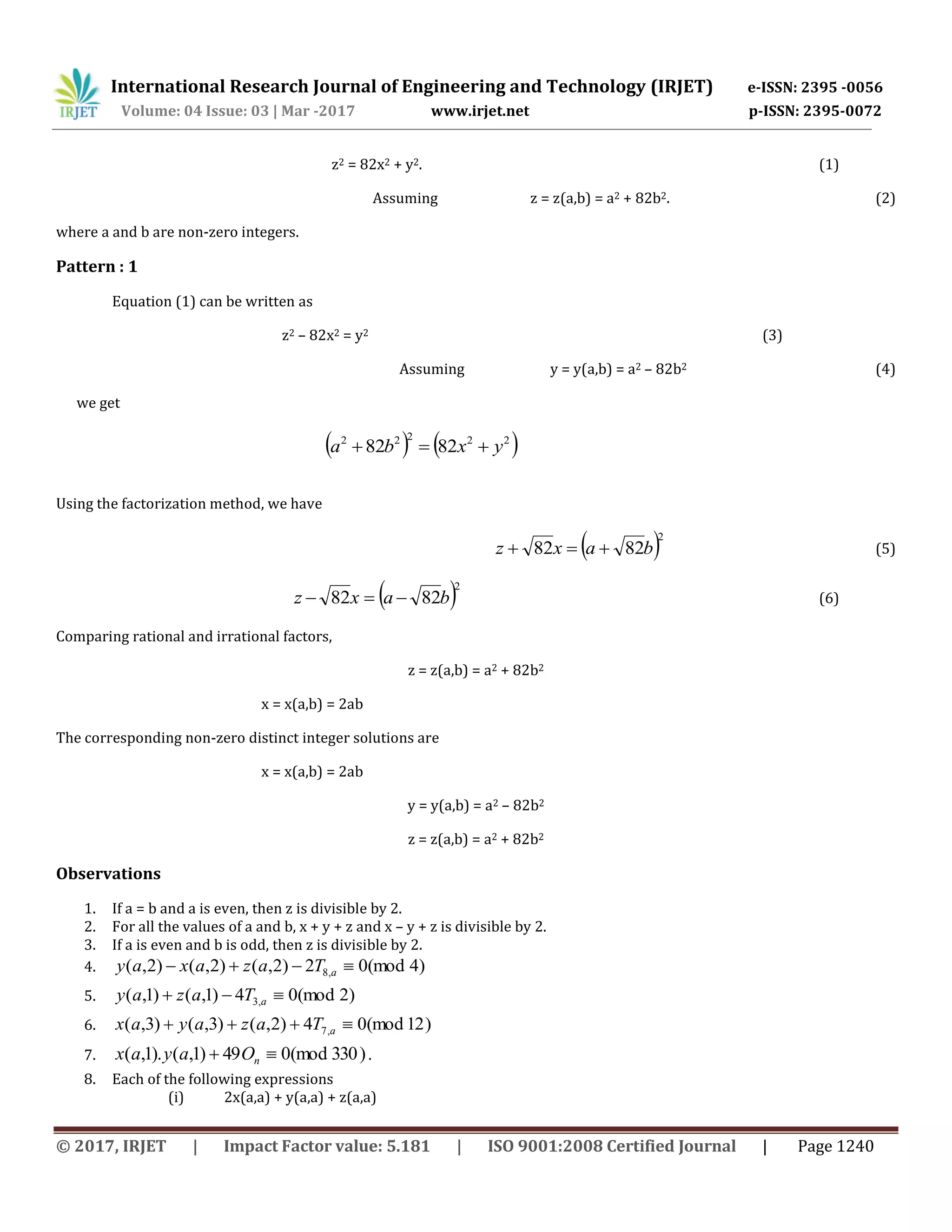
z2 = 82x2 + y2. (1)
Assuming z = z(a,b) = a2 + 82b2. (2)
where a and b are non-zero integers.
Pattern : 1
Equation (1) can be written as
z2 – 82x2 = y2 (3)
Assuming y = y(a,b) = a2 – 82b2 (4)
we get
Using the factorization method, we have
 2
8282 baxz  (5)
 2
8282 baxz  (6)
Comparing rational and irrational factors,
z = z(a,b) = a2 + 82b2
x = x(a,b) = 2ab
The corresponding non-zero distinct integer solutions are
x = x(a,b) = 2ab
y = y(a,b) = a2 – 82b2
z = z(a,b) = a2 + 82b2
Observations
1. If a = b and a is even, then z is divisible by 2.
2. For all the values of a and b, x + y + z and x – y + z is divisible by 2.
3. If a is even and b is odd, then z is divisible by 2.
4. )4(mod02)2,()2,()2,( ,8  aTazaxay
5. )2(mod04)1,()1,( ,3  aTazay
6. )12(mod04)2,()3,()3,( ,7  aTazayax
7. )330(mod049)1,().1,(  nOayax .
8. Each of the following expressions
(i) 2x(a,a) + y(a,a) + z(a,a)
   22222
8282 yxba 
International Research Journal of Engineering and Technology (IRJET) e-ISSN: 2395 -0056
Volume: 04 Issue: 03 | Mar -2017 www.irjet.net p-ISSN: 2395-0072
© 2017, IRJET | Impact Factor value: 5.181 | ISO 9001:2008 Certified Journal | Page 1241
(ii) aa TTax ,26,14)1,(3 
represents a Nasty number.
Pattern 2 :
Equation (1) can be written as
82x2 + y2 = z2 * 1 (7)
Assuming z = z(a,b) = a2 + 82b2.
and write
5329
)8289)(8289(
1
ii 
 (8)
Using factorization method, equation (7) can be written as
 22
)828()82(
73
8289
73
8289
)82)(82( biabia
ii
xiyxiy 




 





 

We get
2
)82)(8289(
73
1
)82( biaixiy  (9)
2
)82)(8289(
73
1
)82( biaixiy  (10)
Comparing real and imaginary parts, we get
x = [8a2 – 656b2 + 18ab]
y = [9a2 – 738b2 – 1312ab]
Since our interest is on finding integer solutions, we have choose a and b suitably so that ,x y and z are integers.
Let us take a = 73A and b = 73B
The integer solutions are
x = 584A2 – 47888B2 + 1314AB
y = 657A2 – 53874B2 – 95776AB
z = 5329A2 + 436978B2
International Research Journal of Engineering and Technology (IRJET) e-ISSN: 2395 -0056
Volume: 04 Issue: 03 | Mar -2017 www.irjet.net p-ISSN: 2395-0072
© 2017, IRJET | Impact Factor value: 5.181 | ISO 9001:2008 Certified Journal | Page 1242
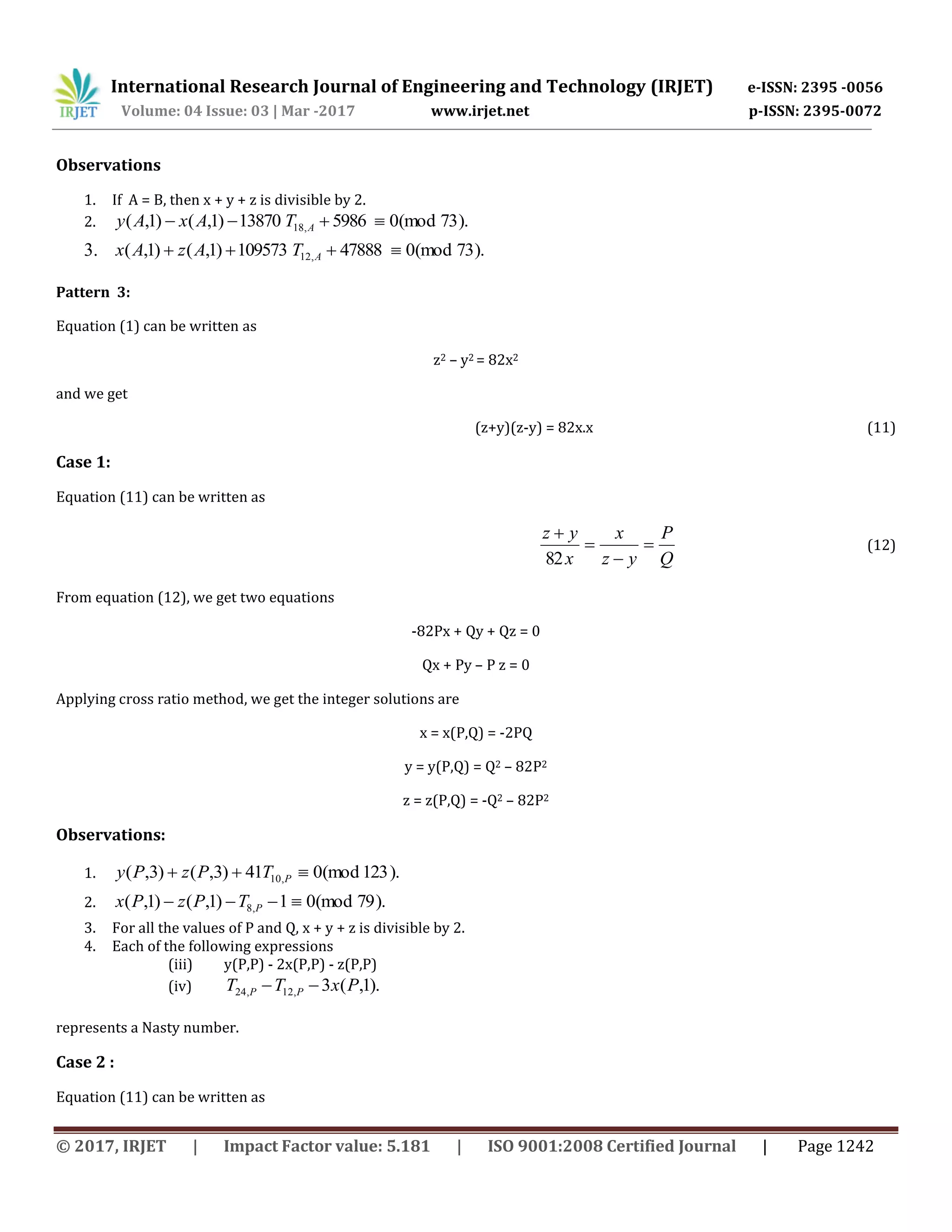
Observations
1. If A = B, then x + y + z is divisible by 2.
2. ).73(mod0598613870)1,()1,( ,18  ATAxAy
3. ).73(mod047888109573)1,()1,( ,12  ATAzAx
Pattern 3:
Equation (1) can be written as
z2 – y2 = 82x2
and we get
(z+y)(z-y) = 82x.x (11)
Case 1:
Equation (11) can be written as
Q
P
yz
x
x
yz




82
(12)
From equation (12), we get two equations
-82Px + Qy + Qz = 0
Qx + Py – P z = 0
Applying cross ratio method, we get the integer solutions are
x = x(P,Q) = -2PQ
y = y(P,Q) = Q2 – 82P2
z = z(P,Q) = -Q2 – 82P2
Observations:
1. ).123(mod041)3,()3,( ,10  PTPzPy
2. ).79(mod01)1,()1,( ,8  PTPzPx
3. For all the values of P and Q, x + y + z is divisible by 2.
4. Each of the following expressions
(iii) y(P,P) - 2x(P,P) - z(P,P)
(iv) ).1,(3,12,24 PxTT PP 
represents a Nasty number.
Case 2 :
Equation (11) can be written as
International Research Journal of Engineering and Technology (IRJET) e-ISSN: 2395 -0056
Volume: 04 Issue: 03 | Mar -2017 www.irjet.net p-ISSN: 2395-0072
© 2017, IRJET | Impact Factor value: 5.181 | ISO 9001:2008 Certified Journal | Page 1243
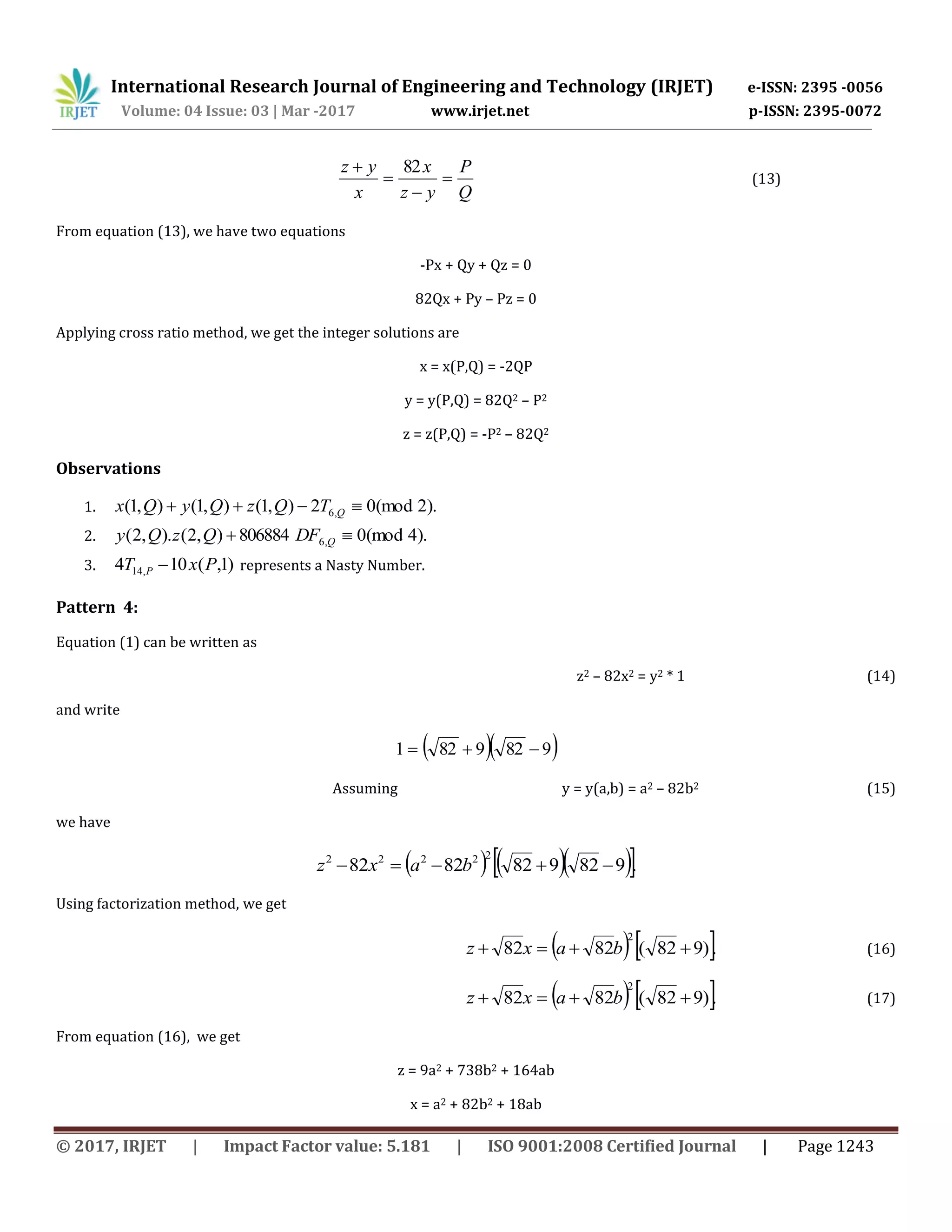
Q
P
yz
x
x
yz



 82
(13)
From equation (13), we have two equations
-Px + Qy + Qz = 0
82Qx + Py – Pz = 0
Applying cross ratio method, we get the integer solutions are
x = x(P,Q) = -2QP
y = y(P,Q) = 82Q2 – P2
z = z(P,Q) = -P2 – 82Q2
Observations
1. ).2(mod02),1(),1(),1( ,6  QTQzQyQx
2. ).4(mod0806884),2().,2( ,6  QDFQzQy
3. )1,(104 ,14 PxT P  represents a Nasty Number.
Pattern 4:
Equation (1) can be written as
z2 – 82x2 = y2 * 1 (14)
and write
  9829821 
Assuming y = y(a,b) = a2 – 82b2 (15)
we have
     .9829828282
22222
 baxz
Using factorization method, we get
   .)982(8282
2
 baxz (16)
   .)982(8282
2
 baxz (17)
From equation (16), we get
z = 9a2 + 738b2 + 164ab
x = a2 + 82b2 + 18ab
International Research Journal of Engineering and Technology (IRJET) e-ISSN: 2395 -0056
Volume: 04 Issue: 03 | Mar -2017 www.irjet.net p-ISSN: 2395-0072
© 2017, IRJET | Impact Factor value: 5.181 | ISO 9001:2008 Certified Journal | Page 1244
Thus, the corresponding non-zero distinct integer solutions are
x = x(a,b) = a2 + 82b2 + 18ab
y = y(a,b) = a2 – 82b2
z = 9a2 + 738b2 + 164ab
Observations
1. ).2(mod04),(3),(3 ,7  aTaayaax
2. ).5(mod052)1,()1,()1,( ,11  aTazayax
3. ).5(mod0),2(),2(9 ,12  bTbzbx
4. CONCLUSION
one may search for other patterns of non-zero integer solutions and relations among the solutions.
REFERENCES
[1] Batta.B and Singh.A.N, History of Hindu Mathematics, Asia Publishing House
1938.
[2] Carmichael, R.D., “The Theory of Numbers and Diophantine Analysis”, Dover
Publications, New York ,1959.
[3] Dickson,.L.E., “History of the theory of numbers”, Chelsia Publishing Co., Vol.II,
New York, 1952.
[4] Mollin.R.A., “All solutions of the Diophantine equation ,22
nDyx  ”, For East
J.Math. Sci., Social Volume, 1998, Part III, pages-257-293.
[5] Mordell.L.J., “Diophantine Equations”, Academic Press, London 1969.
[6] Telang.S.G., “Number Theory”, Tata McGraw-Hill Publishing Company, New
Delhi 1996.
[7] Nigel.P.Smart, “The Algorithmic Resolutions of Diophantine Equations”,Cambridge
University Press, London 1999.
[8] Gopalan.M.A., Manju Somanath, and Vanitha.N., “Integral Solutions of
2
)( zyxmkxy  ”, Acta Ciencia Indica, Volume 33;number 4, pages 1287-
1290, 2007.
[9] Gopalan.M.A., and Anbuselvi.R., “A special Pythagorean triangle”, Acta Ciencia
International Research Journal of Engineering and Technology (IRJET) e-ISSN: 2395 -0056
Volume: 04 Issue: 03 | Mar -2017 www.irjet.net p-ISSN: 2395-0072
© 2017, IRJET | Impact Factor value: 5.181 | ISO 9001:2008 Certified Journal | Page 1245
Indica, Volume 31, number 1, pages 53-54, 2005.
[10] Gopalan.M.A., and Devibala.S., “A special Pythagorean triangle”, Acta Ciencia
Indica, Volume 31, number 1, pages 39-40, 2005.
[11] Gopalan.M.A. and Anbuselvi.R, “On Ternary Quadratic Homogeneous Diophantine
Equation
2 2 2
X PXY Y Z   ”, Bulletin of Pure and Applied Science, Vol.24E,
No.2, Pp.405-408, 2005.
[12] Gopalan.M.A, Vidyalakshmi.S and Devibala.S, “Integral Solutions of
2 2 2 2
( ) 4k x y bxy k z    ”, Bulletin of Pure and Applied Science, Vol.25E,
No.2, Pp.401-406, 2006
[13] Gopalan.M.A., and Devibala.S, “On Ternary Quadtratic Homogeneous Equation
2
( )( ) 0,x y x z y    Bulletin of Pure and Applied Science, Vol.24E,
No.1, Pp.25-28, 2005.

Observations on Ternary Quadratic Equation z2 = 82x2 +y2

  • 1.
    International Research Journalof Engineering and Technology (IRJET) e-ISSN: 2395 -0056 Volume: 04 Issue: 03 | Mar -2017 www.irjet.net p-ISSN: 2395-0072 © 2017, IRJET | Impact Factor value: 5.181 | ISO 9001:2008 Certified Journal | Page 1239 OBSERVATIONS ON TERNARY QUADRATIC EQUATION 222 82 yxz  G. Janaki1 and S. Vidhya2 1,2Assistant Professor, Department of Mathematics, Cauvery College for Women, Trichy-18, Tamilnadu, India. ------------------------------------------------------------------------------------------------------------------------- Abstract-The Quadratic Diophantine Equation with three unknowns z2 = 82x2 + y2 is analyzed for its non-zero distinct integer solutions. A few interesting relations among the solutions and some special polygonal, Octahedral and Four dimensional figurate numbers are presented. Keywords Quadratic equation with three unknowns, Integral solutions, Polygonal Numbers, Four Dimensional Figurate Numbers, Octahedral number. 1. Introduction Ternary quadratic equations are rich in variety. For an extensive review of sizable literature and various problems one may refer [1-7]. In [8], the ternary quadratic Diophantine equation of the form 2 )( zyxmkxy  has been studied for its non-trivial integral solutions. In [9,10], A special Pythagorean triangle problem have been discussed for its integral solutions. In [11], two parametric non-trivial integral solutions of the ternary quadratic homogeneous Diophantine equation 2 2 2 X PXY Y Z   , where P is a non-zero constant have been presented. In [12], the ternary quadratic homogeneous equation 2 2 2 2 ( ) 4k x y bxy k z    , (k, ,b  0) has been studied for its non-trivial integral solutions. In [13], the ternary quadratic Diophantine equation of the form 2 ( )( ) 0,x y x z y    is analyzed for its integral solutions at different angles and their parametric representations are obtained. In this communication, we consider yet another interesting ternary quadratic equation z2 = 82x2 + y2 and obtain different patterns of non-trivial integral solutions. Also, a few interesting relations among the solutions and special polygonal, Octahedral and Four dimensional numbers are presented. 2. Notations Denoting the ranks of some special polygonal, Octahedral and Four dimensional figurate numbers.          2 21 1, mn nT nm = Polygonal Number with rank n and sides m . 3 )2( 3 nn On   = Octahedral Number of rank n. 12 )1( 4 22   nn DFn = Four dimensional figurate Number whose generating polygon is a square. 3.Method of Analysis The ternary quadratic Diophantine equation to be solved for its non-zero integral solution is
  • 2.
    International Research Journalof Engineering and Technology (IRJET) e-ISSN: 2395 -0056 Volume: 04 Issue: 03 | Mar -2017 www.irjet.net p-ISSN: 2395-0072 © 2017, IRJET | Impact Factor value: 5.181 | ISO 9001:2008 Certified Journal | Page 1240 z2 = 82x2 + y2. (1) Assuming z = z(a,b) = a2 + 82b2. (2) where a and b are non-zero integers. Pattern : 1 Equation (1) can be written as z2 – 82x2 = y2 (3) Assuming y = y(a,b) = a2 – 82b2 (4) we get Using the factorization method, we have  2 8282 baxz  (5)  2 8282 baxz  (6) Comparing rational and irrational factors, z = z(a,b) = a2 + 82b2 x = x(a,b) = 2ab The corresponding non-zero distinct integer solutions are x = x(a,b) = 2ab y = y(a,b) = a2 – 82b2 z = z(a,b) = a2 + 82b2 Observations 1. If a = b and a is even, then z is divisible by 2. 2. For all the values of a and b, x + y + z and x – y + z is divisible by 2. 3. If a is even and b is odd, then z is divisible by 2. 4. )4(mod02)2,()2,()2,( ,8  aTazaxay 5. )2(mod04)1,()1,( ,3  aTazay 6. )12(mod04)2,()3,()3,( ,7  aTazayax 7. )330(mod049)1,().1,(  nOayax . 8. Each of the following expressions (i) 2x(a,a) + y(a,a) + z(a,a)    22222 8282 yxba 
  • 3.
    International Research Journalof Engineering and Technology (IRJET) e-ISSN: 2395 -0056 Volume: 04 Issue: 03 | Mar -2017 www.irjet.net p-ISSN: 2395-0072 © 2017, IRJET | Impact Factor value: 5.181 | ISO 9001:2008 Certified Journal | Page 1241 (ii) aa TTax ,26,14)1,(3  represents a Nasty number. Pattern 2 : Equation (1) can be written as 82x2 + y2 = z2 * 1 (7) Assuming z = z(a,b) = a2 + 82b2. and write 5329 )8289)(8289( 1 ii   (8) Using factorization method, equation (7) can be written as  22 )828()82( 73 8289 73 8289 )82)(82( biabia ii xiyxiy                We get 2 )82)(8289( 73 1 )82( biaixiy  (9) 2 )82)(8289( 73 1 )82( biaixiy  (10) Comparing real and imaginary parts, we get x = [8a2 – 656b2 + 18ab] y = [9a2 – 738b2 – 1312ab] Since our interest is on finding integer solutions, we have choose a and b suitably so that ,x y and z are integers. Let us take a = 73A and b = 73B The integer solutions are x = 584A2 – 47888B2 + 1314AB y = 657A2 – 53874B2 – 95776AB z = 5329A2 + 436978B2
  • 4.
    International Research Journalof Engineering and Technology (IRJET) e-ISSN: 2395 -0056 Volume: 04 Issue: 03 | Mar -2017 www.irjet.net p-ISSN: 2395-0072 © 2017, IRJET | Impact Factor value: 5.181 | ISO 9001:2008 Certified Journal | Page 1242 Observations 1. If A = B, then x + y + z is divisible by 2. 2. ).73(mod0598613870)1,()1,( ,18  ATAxAy 3. ).73(mod047888109573)1,()1,( ,12  ATAzAx Pattern 3: Equation (1) can be written as z2 – y2 = 82x2 and we get (z+y)(z-y) = 82x.x (11) Case 1: Equation (11) can be written as Q P yz x x yz     82 (12) From equation (12), we get two equations -82Px + Qy + Qz = 0 Qx + Py – P z = 0 Applying cross ratio method, we get the integer solutions are x = x(P,Q) = -2PQ y = y(P,Q) = Q2 – 82P2 z = z(P,Q) = -Q2 – 82P2 Observations: 1. ).123(mod041)3,()3,( ,10  PTPzPy 2. ).79(mod01)1,()1,( ,8  PTPzPx 3. For all the values of P and Q, x + y + z is divisible by 2. 4. Each of the following expressions (iii) y(P,P) - 2x(P,P) - z(P,P) (iv) ).1,(3,12,24 PxTT PP  represents a Nasty number. Case 2 : Equation (11) can be written as
  • 5.
    International Research Journalof Engineering and Technology (IRJET) e-ISSN: 2395 -0056 Volume: 04 Issue: 03 | Mar -2017 www.irjet.net p-ISSN: 2395-0072 © 2017, IRJET | Impact Factor value: 5.181 | ISO 9001:2008 Certified Journal | Page 1243 Q P yz x x yz     82 (13) From equation (13), we have two equations -Px + Qy + Qz = 0 82Qx + Py – Pz = 0 Applying cross ratio method, we get the integer solutions are x = x(P,Q) = -2QP y = y(P,Q) = 82Q2 – P2 z = z(P,Q) = -P2 – 82Q2 Observations 1. ).2(mod02),1(),1(),1( ,6  QTQzQyQx 2. ).4(mod0806884),2().,2( ,6  QDFQzQy 3. )1,(104 ,14 PxT P  represents a Nasty Number. Pattern 4: Equation (1) can be written as z2 – 82x2 = y2 * 1 (14) and write   9829821  Assuming y = y(a,b) = a2 – 82b2 (15) we have      .9829828282 22222  baxz Using factorization method, we get    .)982(8282 2  baxz (16)    .)982(8282 2  baxz (17) From equation (16), we get z = 9a2 + 738b2 + 164ab x = a2 + 82b2 + 18ab
  • 6.
    International Research Journalof Engineering and Technology (IRJET) e-ISSN: 2395 -0056 Volume: 04 Issue: 03 | Mar -2017 www.irjet.net p-ISSN: 2395-0072 © 2017, IRJET | Impact Factor value: 5.181 | ISO 9001:2008 Certified Journal | Page 1244 Thus, the corresponding non-zero distinct integer solutions are x = x(a,b) = a2 + 82b2 + 18ab y = y(a,b) = a2 – 82b2 z = 9a2 + 738b2 + 164ab Observations 1. ).2(mod04),(3),(3 ,7  aTaayaax 2. ).5(mod052)1,()1,()1,( ,11  aTazayax 3. ).5(mod0),2(),2(9 ,12  bTbzbx 4. CONCLUSION one may search for other patterns of non-zero integer solutions and relations among the solutions. REFERENCES [1] Batta.B and Singh.A.N, History of Hindu Mathematics, Asia Publishing House 1938. [2] Carmichael, R.D., “The Theory of Numbers and Diophantine Analysis”, Dover Publications, New York ,1959. [3] Dickson,.L.E., “History of the theory of numbers”, Chelsia Publishing Co., Vol.II, New York, 1952. [4] Mollin.R.A., “All solutions of the Diophantine equation ,22 nDyx  ”, For East J.Math. Sci., Social Volume, 1998, Part III, pages-257-293. [5] Mordell.L.J., “Diophantine Equations”, Academic Press, London 1969. [6] Telang.S.G., “Number Theory”, Tata McGraw-Hill Publishing Company, New Delhi 1996. [7] Nigel.P.Smart, “The Algorithmic Resolutions of Diophantine Equations”,Cambridge University Press, London 1999. [8] Gopalan.M.A., Manju Somanath, and Vanitha.N., “Integral Solutions of 2 )( zyxmkxy  ”, Acta Ciencia Indica, Volume 33;number 4, pages 1287- 1290, 2007. [9] Gopalan.M.A., and Anbuselvi.R., “A special Pythagorean triangle”, Acta Ciencia
  • 7.
    International Research Journalof Engineering and Technology (IRJET) e-ISSN: 2395 -0056 Volume: 04 Issue: 03 | Mar -2017 www.irjet.net p-ISSN: 2395-0072 © 2017, IRJET | Impact Factor value: 5.181 | ISO 9001:2008 Certified Journal | Page 1245 Indica, Volume 31, number 1, pages 53-54, 2005. [10] Gopalan.M.A., and Devibala.S., “A special Pythagorean triangle”, Acta Ciencia Indica, Volume 31, number 1, pages 39-40, 2005. [11] Gopalan.M.A. and Anbuselvi.R, “On Ternary Quadratic Homogeneous Diophantine Equation 2 2 2 X PXY Y Z   ”, Bulletin of Pure and Applied Science, Vol.24E, No.2, Pp.405-408, 2005. [12] Gopalan.M.A, Vidyalakshmi.S and Devibala.S, “Integral Solutions of 2 2 2 2 ( ) 4k x y bxy k z    ”, Bulletin of Pure and Applied Science, Vol.25E, No.2, Pp.401-406, 2006 [13] Gopalan.M.A., and Devibala.S, “On Ternary Quadtratic Homogeneous Equation 2 ( )( ) 0,x y x z y    Bulletin of Pure and Applied Science, Vol.24E, No.1, Pp.25-28, 2005.