
God as Redeemer
     Lección # 3:
Key Text:

“ ‘Worthy is the Lamb who was
slain to receive power and
riches and wisdom, and
strength and honor and glory
and blessing!’ ” (Revelation 5:12, NKJV).


Key Thought: The Triune God is our Creator and
Redeemer.
Closely related to God as
Creator is His role as our
Redeemer. Sin is so bad,
so hostile to the created
world, that only the Crea-
tor Himself could solve
the problem.

“But now in Christ Jesus
you who once were far off
have been brought near
by the blood of Christ”
(Eph. 2:13, NKJV).

It is not through works, nor through anything we could ever
do, but it is through His grace, manifest at the Cross that we as
sinners can be redeemed by the Lord and be “brought near” to
Him. Christ bore God’s wrath so that none of us would ever,
ideally, have to.
Paul also tells the church
in Corinth that “the message
of the cross is foolishness to
those who are perishing, but
to us who are being saved it
is the power of God”
(1 Cor. 1:18, NKJV).


The scandal of the Cross is that it appears so absurd: God,
the infinite, holy Creator, becomes a sacrifice for the sake of
twisted human souls, even His avowed enemies, taking upon
Himself the penalty for their sins so that they wouldn’t have to
face that penalty themselves! The atonement is so deep, so
heavy, so profound, that we grasp only what we can. Beyond
that, thinking stops, and all we can do is worship.
1.-At the Cross                              “But God com-
                                                mendeth his
                                            love toward us,
                                           in that, while we
                                                    were yet
                                             sinners, Christ
                                                died for us”
                                                 (Rom. 5:8).
                                           What is this text
                                              saying to us?
At the cross, in the most humiliating, inconceivable manner
imaginable, God triumphs over and shames the enemy. Love,
justice, and compassion fuse in a singular dynamic act. God
forgives sinners by paying in Himself the price of sin and
absorbing into His own suffering Self the penalty of that sin.
On Calvary, God reveals how extremely costly forgiveness is.
Christ didn’t die in order to
create love in God’s heart for us.
No, Jesus insists that the
Father’s love is the source, not
the consequence, of the
atonement (John 3:16, 17). God
doesn’t love us because Christ
died for us; Christ died for us
because God loved us. The
atonement of Christ was not
offered to persuade the Father to
love those whom He otherwise
hated. The death of Christ did
not bring forth a love that was
not already in existence. Rather,
it was a manifestation of the love
that was eternally in God’s heart.
Jesus never had to persuade the
Father to love us. Notice how He
insists on this truth in John 3:16,
17; 16:26, 27.
The real tragedy is that we
have lost much of the
knowledge of God, against
whom we have sinned. We
do not even feel that we have
much to repent of, because
we’re not always sure about
just how much we have
offended God with our sins.
We can become dull to just
how bad sin really is. Modern
religious sentimentality often
minimizes repugnance
toward sin. And because sin
doesn’t anger us anymore,
perhaps it becomes harder
to realize that sin arouses
the wrath of a Holy God.
Paul is not
afraid to
discuss the
wrath of
God. How
does he
express it in
Romans
1:18?


This strong statement sets the tone for the
lengthy treatment of the universal sway of sin on
which Paul continues to elaborate for the next
two chapters (through Romans 3:20).
An astounding aspect of the gospel is the fact that God is both
  the victor over our sin and the victim of it. And, as a result of
 this dual role, our holy God can keep His covenant with sinful
     covenant breakers. God’s love does not lead to a bland
tolerance of sin and evil but to a triumphant victory over it. It is
precisely because God is love that He opposes sin and evil, for
  these realities corrupt and destroy His beloved children. The
death that God endured on the cross is the price His love pays
        for taking sin seriously while still loving sinners.
REFLECTION:


 How seriously do you
  take the sin in your
life? And what criteria
  do you use to justify
     your answer?
2.-The Gospel in
 the Old Testament

When is the first
promise of salvation
given, and what does
it mean? Gen. 3:15.

The language here is striking. Adam and Eve have sinned. Now
the great controversy is announced to them through the strong
  language of “enmity” between two opposing sides. This is a
  precious promise for human hearts now attracted to sin. We
 are also assured that this major conflict will not be eternal, for
the head of the enemy will one day be crushed. In these verses,
 not only is the great controversy first revealed, but we also are
                    told how it is going to end.
Paul took courage from
Genesis 3:15. How does
he express it in Romans
16:20? What point is he
making?
In Genesis 22:1–19, Moses
also narrates an amazingly
graphic atonement picture.
What can we learn about
the future atonement of
Christ from this narrative?
Note the many mentions of “father and son” and how the two
go to the mountain of sacrifice together. The son carries the
wood and the father the instruments of sacrifice (fire and
knife). Isaac, much younger than his father, could have
overpowered Abraham on the mountain of sacrifice. But,
instead, we see two miracles: the father yielding his son, and
the son yielding his life.
What a powerful representation
of the sacrificial death of Christ
on our behalf. The scene, howe-
ver powerful and moving, was
only a tiny foretaste of the time
when—centuries later—another
Father would offer His Son. This
time, however, there would be
no animal to die instead of the
son. The Son Himself would die
on the altar. The Father would
truly give up His Son, and the
Son would give His life.

There, on Mount Moriah, the world has been presented with
a very powerful picture (but still only a picture) of the plan of
salvation and what it cost to redeem fallen humanity from
the ruin of sin.
3.- Salvation in Isaiah          On the famous road to
                                Emmaus, Jesus taught
                                     the two despairing
                                    disciples about the
                               atonement from “Moses
                                  and all the prophets”
                                     (Luke 24:27). What
                                    prophetic materials
                                      might Jesus have
                               included in His study of
                                        the atonement?

It’s very likely that Isaiah was among the prophets to
whom Jesus would have referred. Read Isaiah 53, which
describes the “Suffering Servant.” Describe the details
included there that help you to more fully grasp the
amazing atonement of Christ.
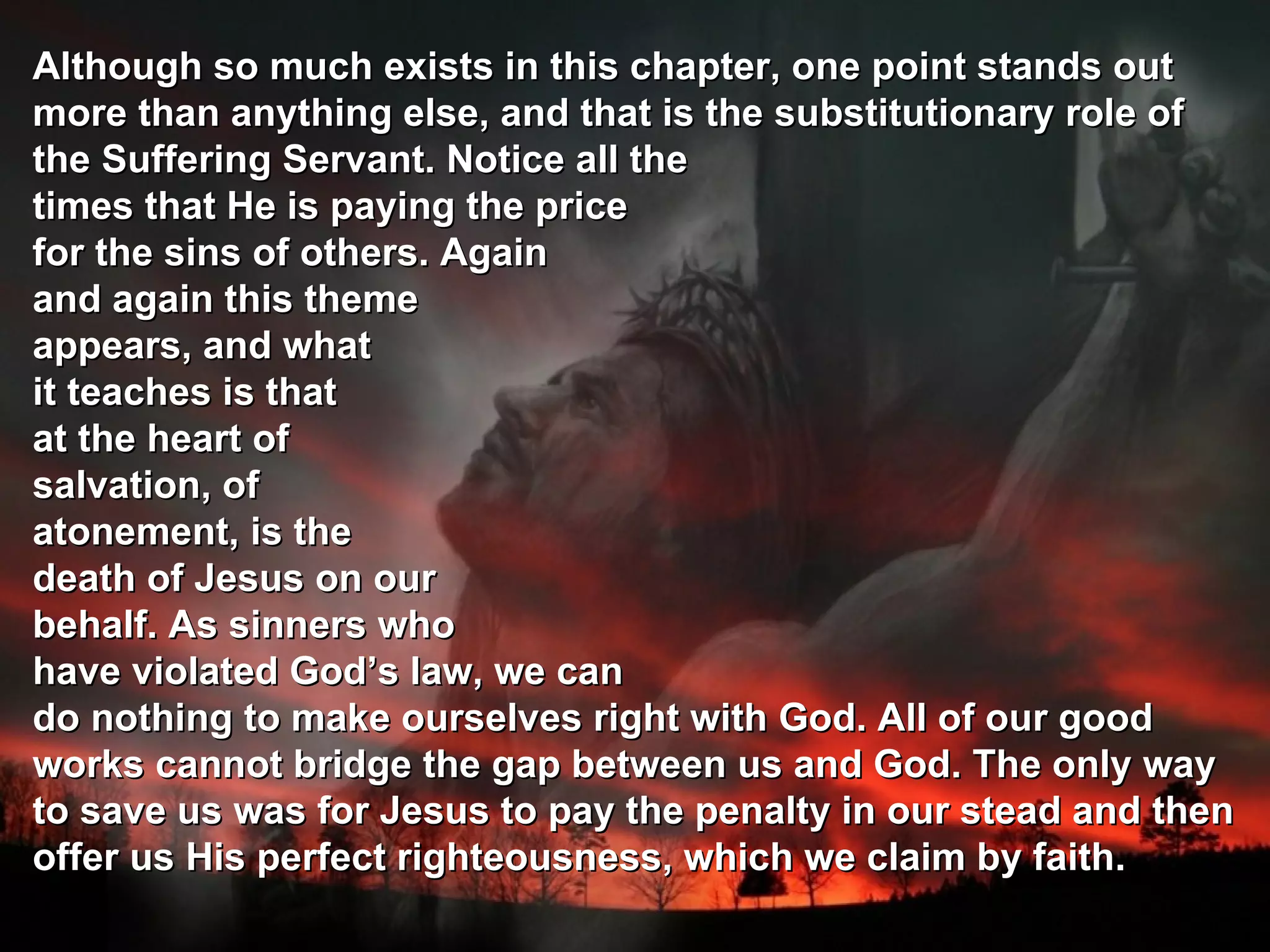
Although so much exists in this chapter, one point stands out
more than anything else, and that is the substitutionary role of
the Suffering Servant. Notice all the
times that He is paying the price
for the sins of others. Again
and again this theme
appears, and what
it teaches is that
at the heart of
salvation, of
atonement, is the
death of Jesus on our
behalf. As sinners who
have violated God’s law, we can
do nothing to make ourselves right with God. All of our good
works cannot bridge the gap between us and God. The only way
to save us was for Jesus to pay the penalty in our stead and then
offer us His perfect righteousness, which we claim by faith.
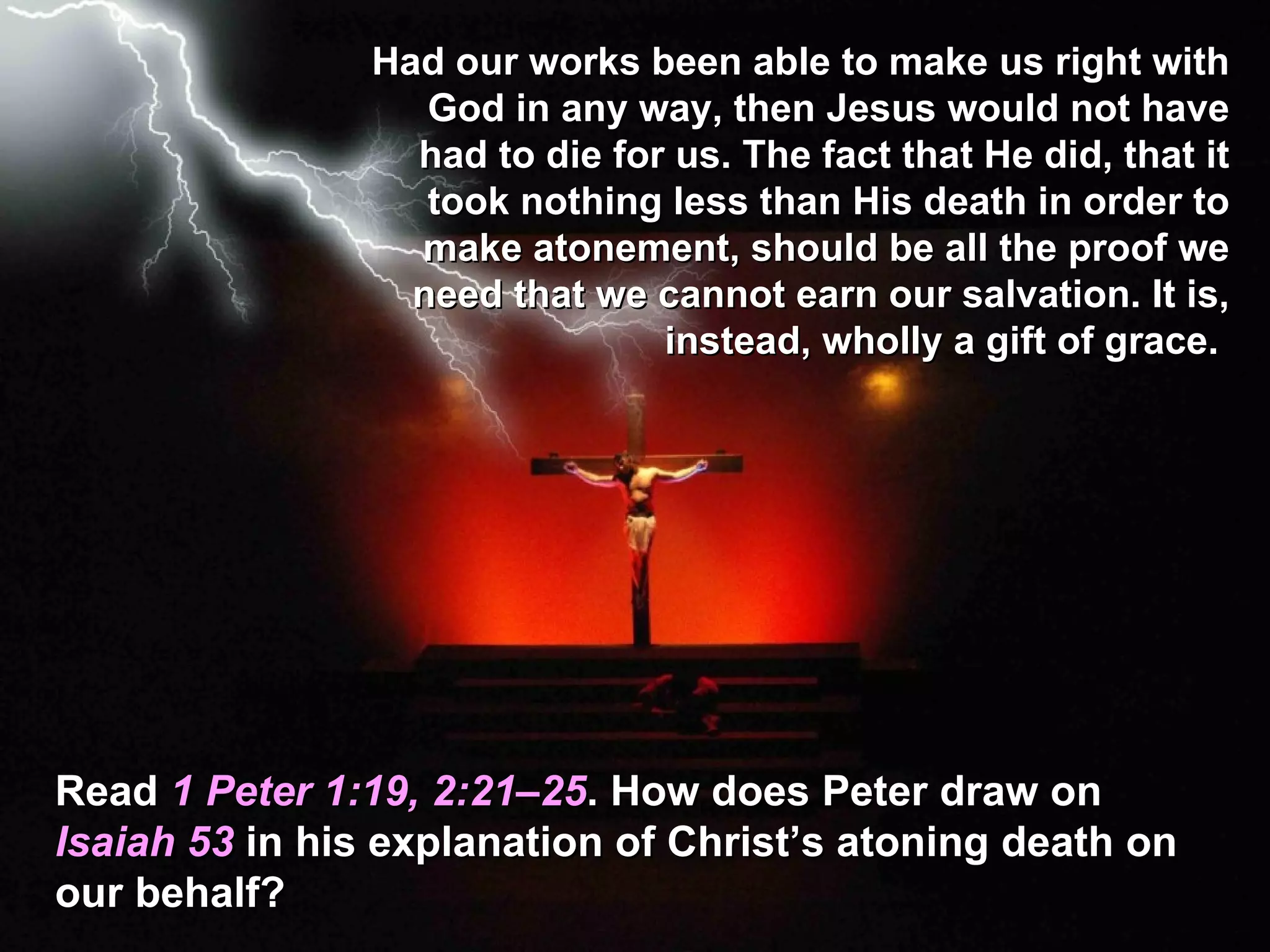
Had our works been able to make us right with
                   God in any way, then Jesus would not have
                  had to die for us. The fact that He did, that it
                   took nothing less than His death in order to
                  make atonement, should be all the proof we
                  need that we cannot earn our salvation. It is,
                                instead, wholly a gift of grace.


Read 1 Peter 1:19, 2:21–25. How does Peter draw on
Isaiah 53 in his explanation of Christ’s atoning death on
our behalf?
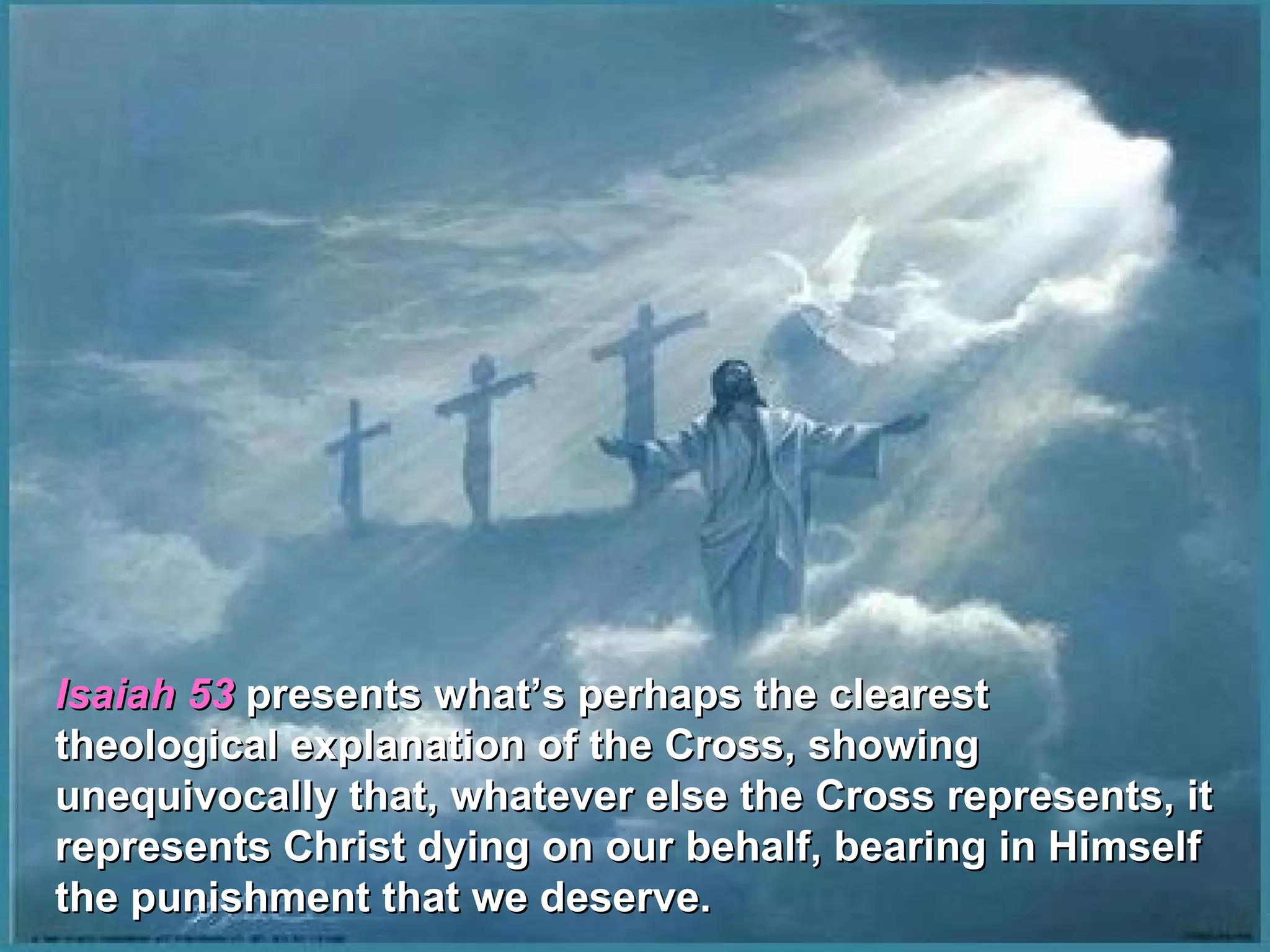
Isaiah 53 presents what’s perhaps the clearest
theological explanation of the Cross, showing
unequivocally that, whatever else the Cross represents, it
represents Christ dying on our behalf, bearing in Himself
the punishment that we deserve.
REFLECTION


Using Isaiah 53 as your text, think
about the final scenes of Christ’s
life. As you do, keep in mind that
 the person depicted there is our
God, our Creator, one part of the
Godhead Himself. How do we get
 our minds around this amazing
              truth?
4.- LOS EVANGELIOS YtheCRUZ
4.- The Gospel and LA Cross

                                    A pesar de la encarnación de
                                Cristo, su enseñanza profunda y
                                  los milagros que realizó, estos
                                   no son el centro de la vida de
                                        Cristo. En cambio, el pen-
                                   samiento dominante de Jesús
                                              es el de dar su vida.


Por más milagrosos que hayan sido su nacimiento y su ministerio,
la gran misión de la vida de Cristo fue su muerte. En los cuatro
evangelios, Jesús procura preparar a sus discípulos para su
muerte. Pero, su devoción por Jesús y la esperanza de un Mesías
político les impidieron comprender lo que Jesús les decía.
Read Mark 10:32–45. How did Jesus describe His coming execution?
Lee Marcos 10:32 al 45. ¿Cómo
(vss. 33, 34). What was wrong with the request of James and John?
(vss. 35–37). What was Jesus’tan
describió Jesús su ejecución pointed response? (vss. 42–45).
próxima? (vers. 33, 34). ¿Qué
había de malo en el pedido de
Santiago y de Juan? (vers. 35-37).
¿Cuál fue la aguda respuesta de
Jesús? (vers. 42-45).


The evening before He died, Jesus celebrated a Passover meal with His
disciples. He then gave instructions that this event should be observed
until He returned again. This ordinance of Communion, instituted by the
Lord Himself—and the only commemorative act He personally
authorized—is not a memorial of His incarnation, nor His miracles, nor
His parables, nor His preaching, but only of His death. Christ Himself
wished above all else to be remembered by His death.
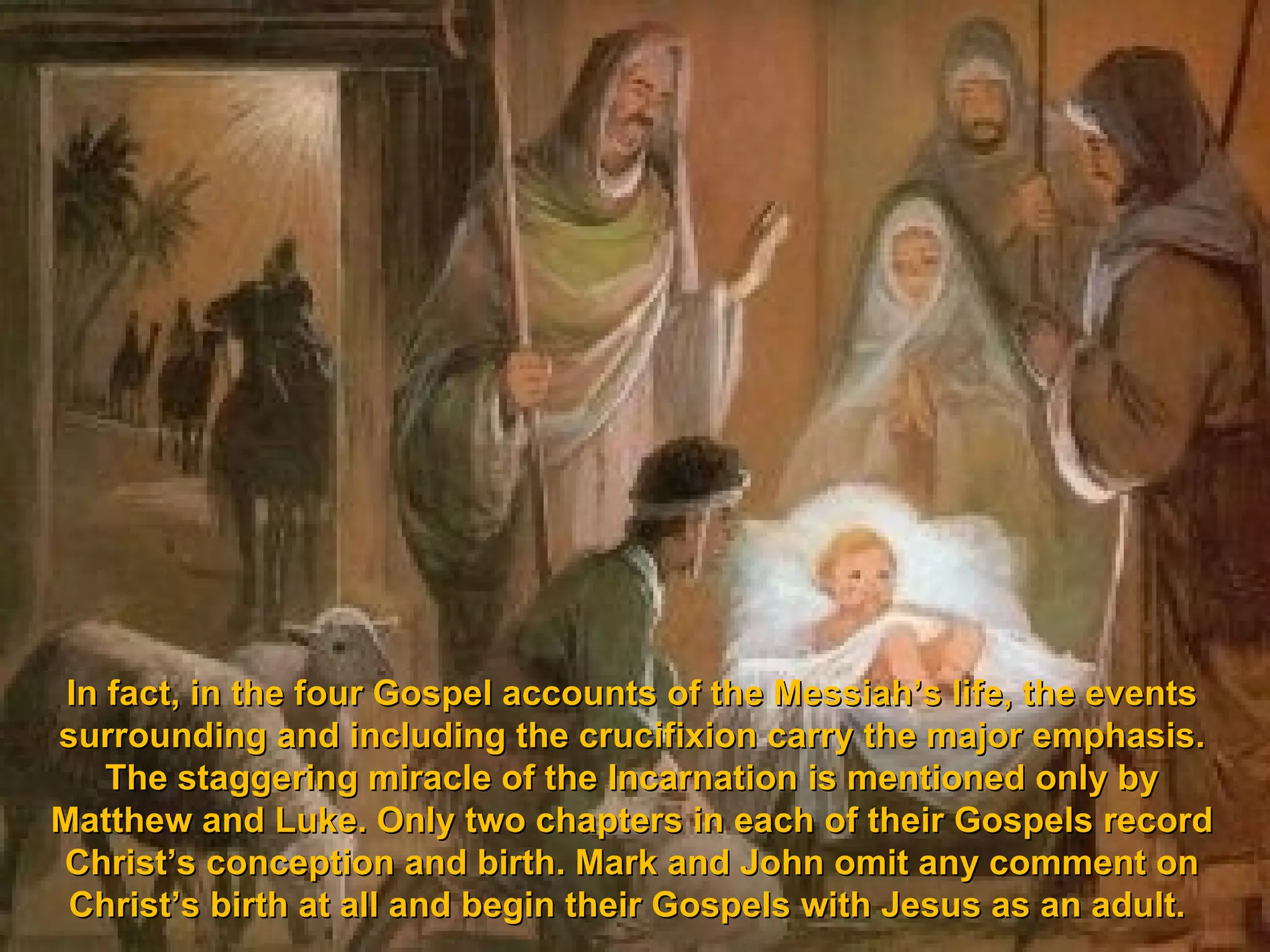
In fact, in the four Gospel accounts of the Messiah’s life, the events
surrounding and including the crucifixion carry the major emphasis.
    The staggering miracle of the Incarnation is mentioned only by
Matthew and Luke. Only two chapters in each of their Gospels record
Christ’s conception and birth. Mark and John omit any comment on
 Christ’s birth at all and begin their Gospels with Jesus as an adult.
All four Gospel writers, however, determinedly emphasize the last
  week of Christ’s life and, of course, His death. Glance through
them and notice this pointed focus on just a few days of Christ’s
 life. The last week of Jesus’ life, leading up to and including His
  death, takes up from one-third to almost one-half of all Gospel
 accounts. Each reader is “forced” to rivet attention on the great
                       redeeming act of God.
REFLECTION:

Look at your life, your past, your
    mistakes, your sins. Do you
honestly think anything you have
   done, or could do, could ever
    atone for them? Why, then,
should the death of Jesus on your
behalf be the central focus of your
 life? What hope would you have
            without it?
Nothing is more destructive to our
5.-The Cry on       grasp of the atonement of Christ
  the Cross       than the sentimentality that some-
                times passes for Christianity in our
                  day (all in the attempt to make the
                      gospel conform to modern thin-
                king). However, we must ever hum-
                  bly acknowledge that anything we
                    say about God can never do God
                     justice, especially when we con-
                        sider the atonement. We must
                       avoid the temptation to reduce
                          Jesus’ death on the cross to
                       merely an “example of selfless
                       love.” It was certainly that, but
                          considering our situation as
                     sinners, it would take more than
                      “an example of selfless love” to
                   redeem us. It would take, instead,
                 our God bearing in Himself the full
                brunt of His own wrath against sin.
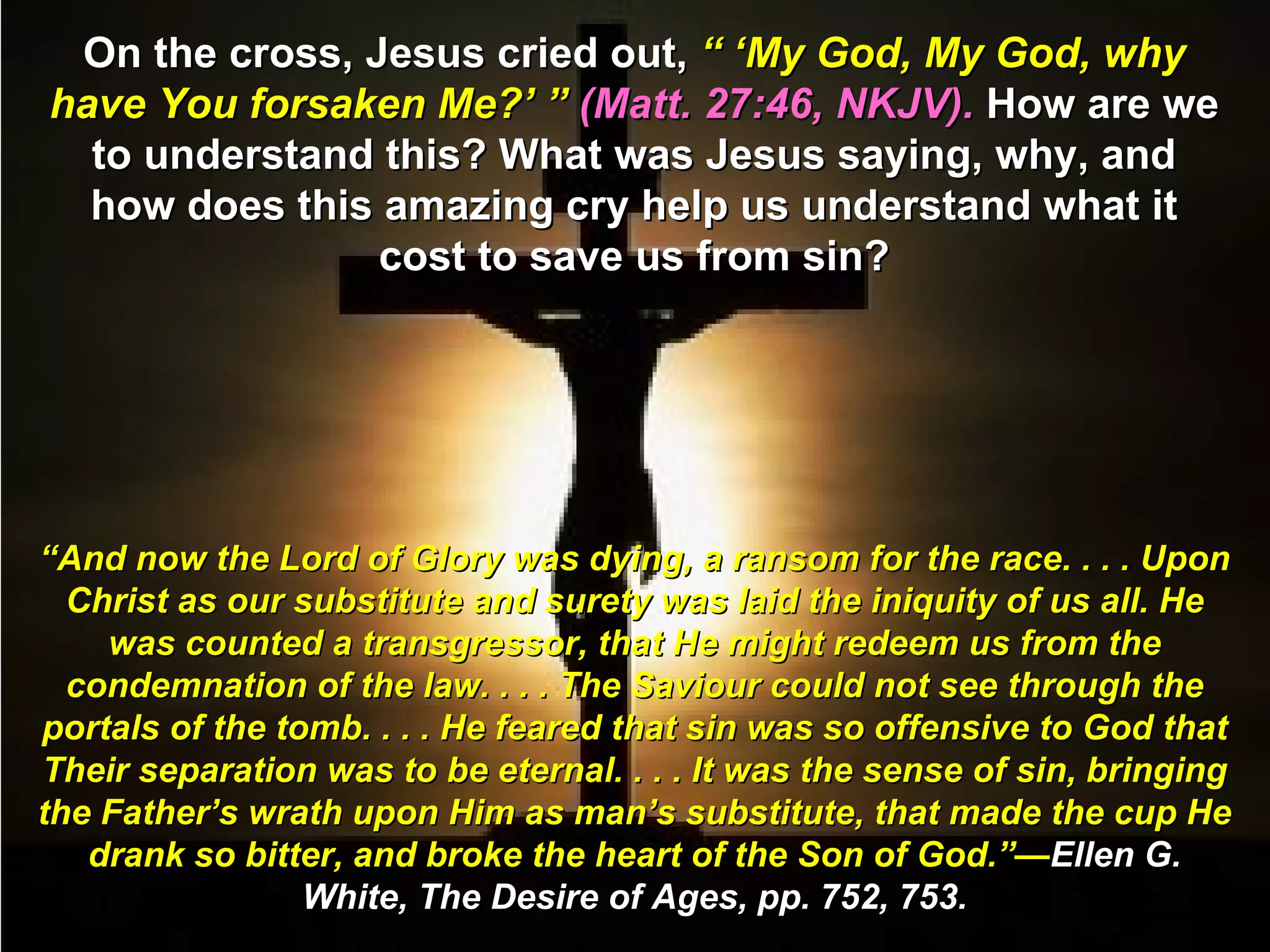
On the cross, Jesus cried out, “ ‘My God, My God, why
have You forsaken Me?’ ” (Matt. 27:46, NKJV). How are we
  to understand this? What was Jesus saying, why, and
  how does this amazing cry help us understand what it
                cost to save us from sin?


“And now the Lord of Glory was dying, a ransom for the race. . . . Upon
  Christ as our substitute and surety was laid the iniquity of us all. He
    was counted a transgressor, that He might redeem us from the
  condemnation of the law. . . . The Saviour could not see through the
portals of the tomb. . . . He feared that sin was so offensive to God that
Their separation was to be eternal. . . . It was the sense of sin, bringing
the Father’s wrath upon Him as man’s substitute, that made the cup He
   drank so bitter, and broke the heart of the Son of God.”—Ellen G.
                 White, The Desire of Ages, pp. 752, 753.
Jesus addresses this prayer to “God,” instead of to the “Father” as He
         always had done. Christ’s cries from the cross are not some
         exemplary display that He appears to go through in order to
                                  demonstrate that He loves us. No,
                                      this is God giving Himself over
                                   to death so that our destiny would
                                     not be determined by death. This
                                      is God Himself dying the death
                                   from which we can be spared, the
                                      death that sin would otherwise
                                                           bring us all.

Three Gospels record that Jesus cried out with a loud voice from the
cross as He was dying. These loud cries are even mentioned in the
book of Hebrews: “who, in the days of His flesh, when He had offered
up prayers and supplications, with vehement cries and tears to Him
who was able to save Him from death” (Heb. 5:7, NKJV). Jesus’ “cry of
dereliction” is the most piercing cry in the Bible. There is no statement
in all the Gospels to rival this one from Jesus on the cross, and in that
cry we get a glimpse of what the Lord Himself was willing to go
through in order to bring us salvation.
Further Study: “Oh, how
inefficient, how incapable I
am of expressing the things
which burn in my soul in
reference to the mission of
Christ! . . .
 I know not how to speak or
trace with pen the large
subject of the atoning
sacrifice.
I know not how to present
subjects in the living power in
which they stand before me.
I tremble for fear lest I shall
belittle the great plan of
salvation by cheap words.”—
Selected Messages, book 3, p.
115.
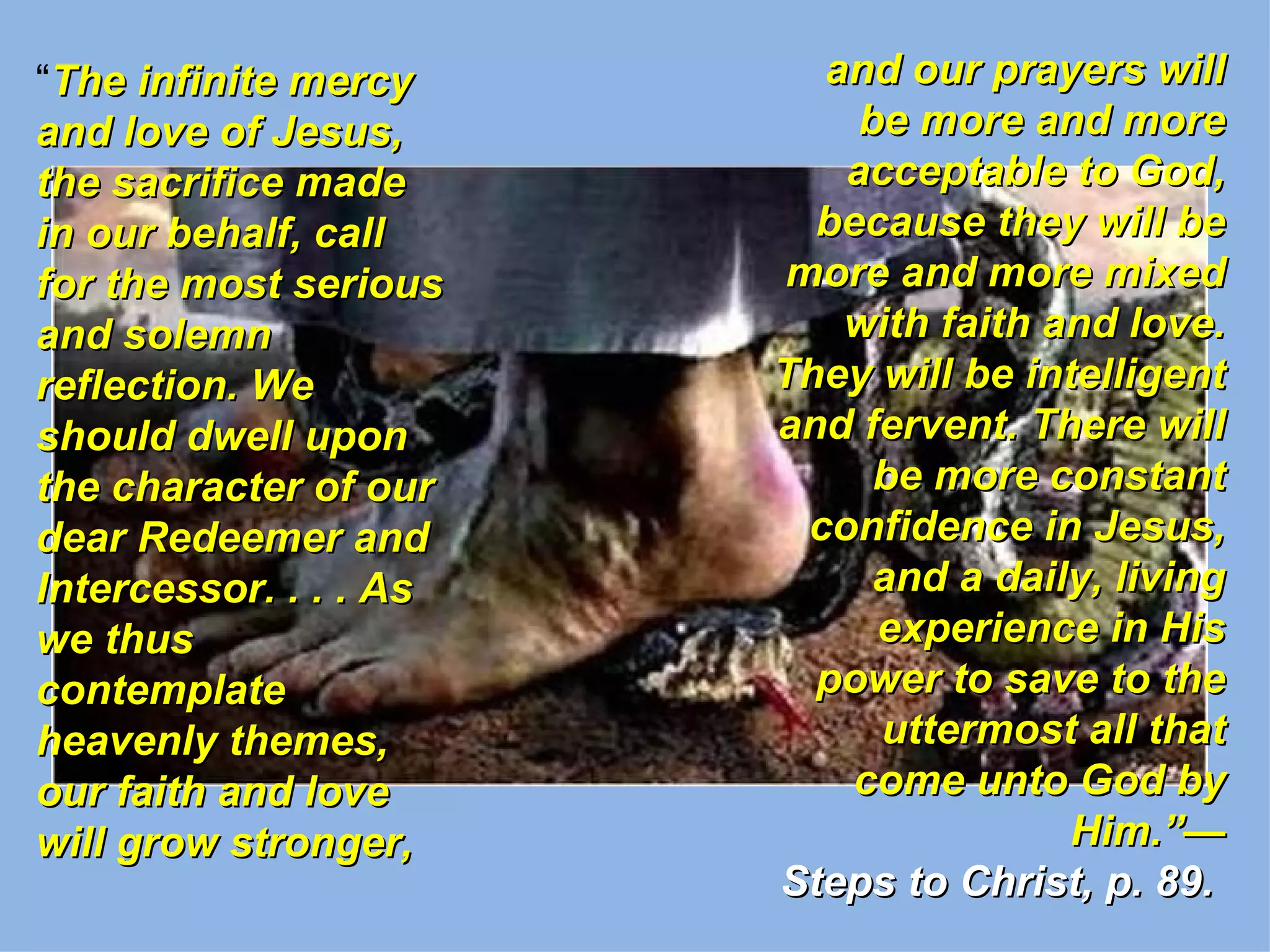
“The infinite mercy       and our prayers will
and love of Jesus,          be more and more
the sacrifice made         acceptable to God,
in our behalf, call       because they will be
for the most serious    more and more mixed
and solemn                 with faith and love.
reflection. We          They will be intelligent
should dwell upon       and fervent. There will
the character of our         be more constant
dear Redeemer and        confidence in Jesus,
Intercessor. . . . As        and a daily, living
we thus                      experience in His
contemplate               power to save to the
heavenly themes,             uttermost all that
our faith and love          come unto God by
will grow stronger,                     Him.”—
                        Steps to Christ, p. 89.
ADAPT it!                           Effective for
                                   SMALL GROUPS
      Teaching Approach


ASSOCIATE truth – Why should I study this lesson?
DISCOVER truth – What does the Bible say about this
truth?
APPLY truth – How can this truth affect my life today?
PLAN using the truth – How can I use this truth today?
TRANSFER truth to life – What changes do I need in my
life
  ?
                 We invite you to download and study
                  each one of the 13 lessons about
                         “Glimpses of God”
                     Slideshare.net/chucho1943

03 god as redeemer

  • 1.
    God as Redeemer Lección # 3:
  • 2.
    Key Text: “ ‘Worthyis the Lamb who was slain to receive power and riches and wisdom, and strength and honor and glory and blessing!’ ” (Revelation 5:12, NKJV). Key Thought: The Triune God is our Creator and Redeemer.
  • 3.
    Closely related toGod as Creator is His role as our Redeemer. Sin is so bad, so hostile to the created world, that only the Crea- tor Himself could solve the problem. “But now in Christ Jesus you who once were far off have been brought near by the blood of Christ” (Eph. 2:13, NKJV). It is not through works, nor through anything we could ever do, but it is through His grace, manifest at the Cross that we as sinners can be redeemed by the Lord and be “brought near” to Him. Christ bore God’s wrath so that none of us would ever, ideally, have to.
  • 4.
    Paul also tellsthe church in Corinth that “the message of the cross is foolishness to those who are perishing, but to us who are being saved it is the power of God” (1 Cor. 1:18, NKJV). The scandal of the Cross is that it appears so absurd: God, the infinite, holy Creator, becomes a sacrifice for the sake of twisted human souls, even His avowed enemies, taking upon Himself the penalty for their sins so that they wouldn’t have to face that penalty themselves! The atonement is so deep, so heavy, so profound, that we grasp only what we can. Beyond that, thinking stops, and all we can do is worship.
  • 5.
    1.-At the Cross “But God com- mendeth his love toward us, in that, while we were yet sinners, Christ died for us” (Rom. 5:8). What is this text saying to us? At the cross, in the most humiliating, inconceivable manner imaginable, God triumphs over and shames the enemy. Love, justice, and compassion fuse in a singular dynamic act. God forgives sinners by paying in Himself the price of sin and absorbing into His own suffering Self the penalty of that sin. On Calvary, God reveals how extremely costly forgiveness is.
  • 6.
    Christ didn’t diein order to create love in God’s heart for us. No, Jesus insists that the Father’s love is the source, not the consequence, of the atonement (John 3:16, 17). God doesn’t love us because Christ died for us; Christ died for us because God loved us. The atonement of Christ was not offered to persuade the Father to love those whom He otherwise hated. The death of Christ did not bring forth a love that was not already in existence. Rather, it was a manifestation of the love that was eternally in God’s heart. Jesus never had to persuade the Father to love us. Notice how He insists on this truth in John 3:16, 17; 16:26, 27.
  • 7.
    The real tragedyis that we have lost much of the knowledge of God, against whom we have sinned. We do not even feel that we have much to repent of, because we’re not always sure about just how much we have offended God with our sins. We can become dull to just how bad sin really is. Modern religious sentimentality often minimizes repugnance toward sin. And because sin doesn’t anger us anymore, perhaps it becomes harder to realize that sin arouses the wrath of a Holy God.
  • 8.
    Paul is not afraidto discuss the wrath of God. How does he express it in Romans 1:18? This strong statement sets the tone for the lengthy treatment of the universal sway of sin on which Paul continues to elaborate for the next two chapters (through Romans 3:20).
  • 9.
    An astounding aspectof the gospel is the fact that God is both the victor over our sin and the victim of it. And, as a result of this dual role, our holy God can keep His covenant with sinful covenant breakers. God’s love does not lead to a bland tolerance of sin and evil but to a triumphant victory over it. It is precisely because God is love that He opposes sin and evil, for these realities corrupt and destroy His beloved children. The death that God endured on the cross is the price His love pays for taking sin seriously while still loving sinners.
  • 10.
    REFLECTION: How seriouslydo you take the sin in your life? And what criteria do you use to justify your answer?
  • 11.
    2.-The Gospel in the Old Testament When is the first promise of salvation given, and what does it mean? Gen. 3:15. The language here is striking. Adam and Eve have sinned. Now the great controversy is announced to them through the strong language of “enmity” between two opposing sides. This is a precious promise for human hearts now attracted to sin. We are also assured that this major conflict will not be eternal, for the head of the enemy will one day be crushed. In these verses, not only is the great controversy first revealed, but we also are told how it is going to end.
  • 12.
    Paul took couragefrom Genesis 3:15. How does he express it in Romans 16:20? What point is he making? In Genesis 22:1–19, Moses also narrates an amazingly graphic atonement picture. What can we learn about the future atonement of Christ from this narrative? Note the many mentions of “father and son” and how the two go to the mountain of sacrifice together. The son carries the wood and the father the instruments of sacrifice (fire and knife). Isaac, much younger than his father, could have overpowered Abraham on the mountain of sacrifice. But, instead, we see two miracles: the father yielding his son, and the son yielding his life.
  • 13.
    What a powerfulrepresentation of the sacrificial death of Christ on our behalf. The scene, howe- ver powerful and moving, was only a tiny foretaste of the time when—centuries later—another Father would offer His Son. This time, however, there would be no animal to die instead of the son. The Son Himself would die on the altar. The Father would truly give up His Son, and the Son would give His life. There, on Mount Moriah, the world has been presented with a very powerful picture (but still only a picture) of the plan of salvation and what it cost to redeem fallen humanity from the ruin of sin.
  • 14.
    3.- Salvation inIsaiah On the famous road to Emmaus, Jesus taught the two despairing disciples about the atonement from “Moses and all the prophets” (Luke 24:27). What prophetic materials might Jesus have included in His study of the atonement? It’s very likely that Isaiah was among the prophets to whom Jesus would have referred. Read Isaiah 53, which describes the “Suffering Servant.” Describe the details included there that help you to more fully grasp the amazing atonement of Christ.
  • 15.
    Although so muchexists in this chapter, one point stands out more than anything else, and that is the substitutionary role of the Suffering Servant. Notice all the times that He is paying the price for the sins of others. Again and again this theme appears, and what it teaches is that at the heart of salvation, of atonement, is the death of Jesus on our behalf. As sinners who have violated God’s law, we can do nothing to make ourselves right with God. All of our good works cannot bridge the gap between us and God. The only way to save us was for Jesus to pay the penalty in our stead and then offer us His perfect righteousness, which we claim by faith.
  • 16.
    Had our worksbeen able to make us right with God in any way, then Jesus would not have had to die for us. The fact that He did, that it took nothing less than His death in order to make atonement, should be all the proof we need that we cannot earn our salvation. It is, instead, wholly a gift of grace. Read 1 Peter 1:19, 2:21–25. How does Peter draw on Isaiah 53 in his explanation of Christ’s atoning death on our behalf?
  • 17.
    Isaiah 53 presentswhat’s perhaps the clearest theological explanation of the Cross, showing unequivocally that, whatever else the Cross represents, it represents Christ dying on our behalf, bearing in Himself the punishment that we deserve.
  • 18.
    REFLECTION Using Isaiah 53as your text, think about the final scenes of Christ’s life. As you do, keep in mind that the person depicted there is our God, our Creator, one part of the Godhead Himself. How do we get our minds around this amazing truth?
  • 19.
    4.- LOS EVANGELIOSYtheCRUZ 4.- The Gospel and LA Cross A pesar de la encarnación de Cristo, su enseñanza profunda y los milagros que realizó, estos no son el centro de la vida de Cristo. En cambio, el pen- samiento dominante de Jesús es el de dar su vida. Por más milagrosos que hayan sido su nacimiento y su ministerio, la gran misión de la vida de Cristo fue su muerte. En los cuatro evangelios, Jesús procura preparar a sus discípulos para su muerte. Pero, su devoción por Jesús y la esperanza de un Mesías político les impidieron comprender lo que Jesús les decía.
  • 20.
    Read Mark 10:32–45.How did Jesus describe His coming execution? Lee Marcos 10:32 al 45. ¿Cómo (vss. 33, 34). What was wrong with the request of James and John? (vss. 35–37). What was Jesus’tan describió Jesús su ejecución pointed response? (vss. 42–45). próxima? (vers. 33, 34). ¿Qué había de malo en el pedido de Santiago y de Juan? (vers. 35-37). ¿Cuál fue la aguda respuesta de Jesús? (vers. 42-45). The evening before He died, Jesus celebrated a Passover meal with His disciples. He then gave instructions that this event should be observed until He returned again. This ordinance of Communion, instituted by the Lord Himself—and the only commemorative act He personally authorized—is not a memorial of His incarnation, nor His miracles, nor His parables, nor His preaching, but only of His death. Christ Himself wished above all else to be remembered by His death.
  • 21.
    In fact, inthe four Gospel accounts of the Messiah’s life, the events surrounding and including the crucifixion carry the major emphasis. The staggering miracle of the Incarnation is mentioned only by Matthew and Luke. Only two chapters in each of their Gospels record Christ’s conception and birth. Mark and John omit any comment on Christ’s birth at all and begin their Gospels with Jesus as an adult.
  • 22.
    All four Gospelwriters, however, determinedly emphasize the last week of Christ’s life and, of course, His death. Glance through them and notice this pointed focus on just a few days of Christ’s life. The last week of Jesus’ life, leading up to and including His death, takes up from one-third to almost one-half of all Gospel accounts. Each reader is “forced” to rivet attention on the great redeeming act of God.
  • 23.
    REFLECTION: Look at yourlife, your past, your mistakes, your sins. Do you honestly think anything you have done, or could do, could ever atone for them? Why, then, should the death of Jesus on your behalf be the central focus of your life? What hope would you have without it?
  • 24.
    Nothing is moredestructive to our 5.-The Cry on grasp of the atonement of Christ the Cross than the sentimentality that some- times passes for Christianity in our day (all in the attempt to make the gospel conform to modern thin- king). However, we must ever hum- bly acknowledge that anything we say about God can never do God justice, especially when we con- sider the atonement. We must avoid the temptation to reduce Jesus’ death on the cross to merely an “example of selfless love.” It was certainly that, but considering our situation as sinners, it would take more than “an example of selfless love” to redeem us. It would take, instead, our God bearing in Himself the full brunt of His own wrath against sin.
  • 25.
    On the cross,Jesus cried out, “ ‘My God, My God, why have You forsaken Me?’ ” (Matt. 27:46, NKJV). How are we to understand this? What was Jesus saying, why, and how does this amazing cry help us understand what it cost to save us from sin? “And now the Lord of Glory was dying, a ransom for the race. . . . Upon Christ as our substitute and surety was laid the iniquity of us all. He was counted a transgressor, that He might redeem us from the condemnation of the law. . . . The Saviour could not see through the portals of the tomb. . . . He feared that sin was so offensive to God that Their separation was to be eternal. . . . It was the sense of sin, bringing the Father’s wrath upon Him as man’s substitute, that made the cup He drank so bitter, and broke the heart of the Son of God.”—Ellen G. White, The Desire of Ages, pp. 752, 753.
  • 26.
    Jesus addresses thisprayer to “God,” instead of to the “Father” as He always had done. Christ’s cries from the cross are not some exemplary display that He appears to go through in order to demonstrate that He loves us. No, this is God giving Himself over to death so that our destiny would not be determined by death. This is God Himself dying the death from which we can be spared, the death that sin would otherwise bring us all. Three Gospels record that Jesus cried out with a loud voice from the cross as He was dying. These loud cries are even mentioned in the book of Hebrews: “who, in the days of His flesh, when He had offered up prayers and supplications, with vehement cries and tears to Him who was able to save Him from death” (Heb. 5:7, NKJV). Jesus’ “cry of dereliction” is the most piercing cry in the Bible. There is no statement in all the Gospels to rival this one from Jesus on the cross, and in that cry we get a glimpse of what the Lord Himself was willing to go through in order to bring us salvation.
  • 27.
    Further Study: “Oh,how inefficient, how incapable I am of expressing the things which burn in my soul in reference to the mission of Christ! . . . I know not how to speak or trace with pen the large subject of the atoning sacrifice. I know not how to present subjects in the living power in which they stand before me. I tremble for fear lest I shall belittle the great plan of salvation by cheap words.”— Selected Messages, book 3, p. 115.
  • 28.
    “The infinite mercy and our prayers will and love of Jesus, be more and more the sacrifice made acceptable to God, in our behalf, call because they will be for the most serious more and more mixed and solemn with faith and love. reflection. We They will be intelligent should dwell upon and fervent. There will the character of our be more constant dear Redeemer and confidence in Jesus, Intercessor. . . . As and a daily, living we thus experience in His contemplate power to save to the heavenly themes, uttermost all that our faith and love come unto God by will grow stronger, Him.”— Steps to Christ, p. 89.
  • 29.
    ADAPT it! Effective for SMALL GROUPS Teaching Approach ASSOCIATE truth – Why should I study this lesson? DISCOVER truth – What does the Bible say about this truth? APPLY truth – How can this truth affect my life today? PLAN using the truth – How can I use this truth today? TRANSFER truth to life – What changes do I need in my life ? We invite you to download and study each one of the 13 lessons about “Glimpses of God” Slideshare.net/chucho1943