i n tr o d u c t i o n
“Babylonian” refer to
those peoples who occupied the alluvial
plain between the
the Tigris and the Euphrates.
The Greeks called this land “Mesopotamia,”
meaning “the land between the rivers.”
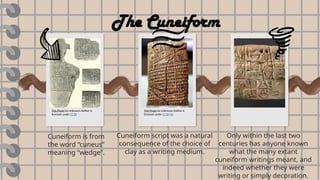
Cuneiform is from
theword “cuneus”
meaning “wedge”.
Cuneiform script was a natural
consequence of the choice of
clay as a writing medium.
Only within the last two
centuries has anyone known
what the many extant
cuneiform writings meant, and
indeed whether they were
writing or simply decoration.
The Cuneiform
This Photo by Unknown Author is
licensed under CC BY
This Photo by Unknown Author is
licensed under CC BY-SA
6.
Deciphering the
Cuneiform
• GeorgFriedrich Grotefend (1775-
1853) – took the initial step in
deciphering the Babylonian clay
tablets
• Champollion – won an international
reputation on deciphering cuneiform
7.
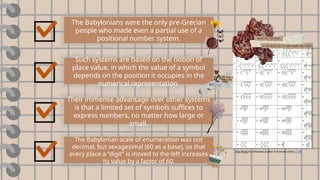
The Babylonians werethe only pre-Grecian
people who made even a partial use of a
positional number system.
Such systems are based on the notion of
place value, in which the value of a symbol
depends on the position it occupies in the
numerical representation.
Their immense advantage over other systems
is that a limited set of symbols suffices to
express numbers, no matter how large or
small.
The Babylonian scale of enumeration was not
decimal, but sexagesimal (60 as a base), so that
every place a “digit” is moved to the left increases
its value by a factor of 60.
This Photo by Unknown Author is licensed under CC BY
Notable Facts
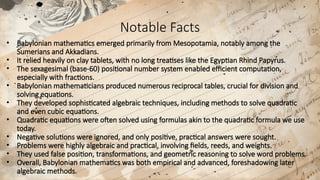
• Babylonianmathematics emerged primarily from Mesopotamia, notably among the
Sumerians and Akkadians.
• It relied heavily on clay tablets, with no long treatises like the Egyptian Rhind Papyrus.
• The sexagesimal (base-60) positional number system enabled efficient computation,
especially with fractions.
• Babylonian mathematicians produced numerous reciprocal tables, crucial for division and
solving equations.
• They developed sophisticated algebraic techniques, including methods to solve quadratic
and even cubic equations.
• Quadratic equations were often solved using formulas akin to the quadratic formula we use
today.
• Negative solutions were ignored, and only positive, practical answers were sought.
• Problems were highly algebraic and practical, involving fields, reeds, and weights.
• They used false position, transformations, and geometric reasoning to solve word problems.
• Overall, Babylonian mathematics was both empirical and advanced, foreshadowing later
algebraic methods.
10.
Plimpton 322
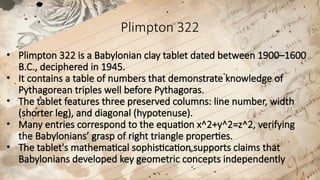
• Plimpton322 is a Babylonian clay tablet dated between 1900–1600
B.C., deciphered in 1945.
• It contains a table of numbers that demonstrate knowledge of
Pythagorean triples well before Pythagoras.
• The tablet features three preserved columns: line number, width
(shorter leg), and diagonal (hypotenuse).
• Many entries correspond to the equation x^2+y^2=z^2, verifying
the Babylonians’ grasp of right triangle properties.
• The tablet's mathematical sophistication supports claims that
Babylonians developed key geometric concepts independently
Editor's Notes
#2 Besides the Egyptian, another culture of antiquity
that exerted a marked influence on the
development of mathematics was the Babylonian.
Here the term “Babylonian” is used
without chronological restrictions to refer to
those peoples who, many thousands of years ago, occupied the alluvial plain between the
twin rivers, the Tigris and the Euphrates. The Greeks called this land “Mesopotamia,”
meaning “the land between the rivers.”
#3 Shortly after 3000 B.C., the Babylonians developed a system of writing from
“pictographs”—a kind of picture writing much like hieroglyphics. But the materials
chosen for writing imposed special limitations of their own, which soon robbed the pictographs
of any resemblance to the objects, they stood for.
#6 Because there were no colossal temples or monuments to capture the archeological
imagination (the land is practically devoid of building stone), excavation came later
to this part of the ancient world than to Egypt. It is estimated that today there are at
least 400,000 Babylonian clay tablets, generally the size of a hand, scattered among the
museums of various countries. Of these, some 400 tablets or tablet fragments have been
identified as having mathematical content. Their decipherment and interpretation have
gone slowly, owing to the variety of dialects and natural modifications in the language over the intervening several thousand years.
The initial step was taken by an obscure German schoolteacher, Georg Friedrich Grotefend (1775–1853), of Göttingen, who although well versed in classical Greek, was ignorant of Oriental languages. While drinking with friends, Grotefend wagered that he could decipher a certain cuneiform inscription from Persepolis if they would supply him with the previously published literature on the subject. By an inspired guess he found the key to reading Persian cuneiform. The prevailing arrangement of the characters was such that the points of the wedges headed either downward or to the right, and the angles formed by the broad wedges consistently opened to the right. He assumed that the language’s characters were alphabetic; he then began picking out those characters that occurred with the greatest frequency and postulated that these were vowels. The most recurrent sign group was assumed to represent the word for “king.” These suppositions allowed Grotefend to decipher the title “King of Kings” and the names Darius, Xerxes, and Hystapes.
Thereafter, he was able to isolate a great many
individual characters and to read 12 of them correctly. Grotefend thus produced a translation
that, although it contained numerous errors, gave an adequate idea of the contents.
In 1802, when Grotefend was only 27 years old, he had his investigations presented to
the Academy of Science in Gottingen (Grotefend was not allowed to read his own paper).
But the achievements of this little-known scholar, who neither belonged to the faculty
of the university nor was even an Orientalist by profession, only evoked ridicule from
the learned body. Buried in an obscure publication, Grotefend’s brilliant discovery fell
into oblivion, and decades later cuneiform script had to be deciphered anew. It is one of
the whims of history that Champollion, the original translator of hieroglyphics, won an
international reputation, while Georg Grotefend is almost entirely ignored.