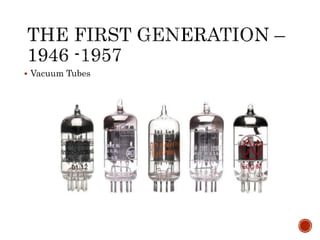
 Vacuum Tubes
 Electronic Numerical Integrator And Computer
 Eckert and Mauchly
 University of Pennsylvania
 Trajectory tables for weapons
 Started 1943
 Finished 1946
 Too late for war effort
 Used until 1955
 to help determine the feasibility of the hydrogen bomb
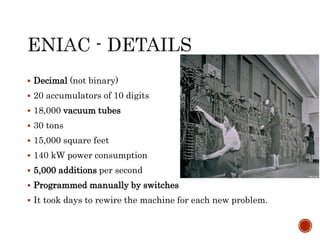
 Decimal (not binary)
 20 accumulators of 10 digits
 18,000 vacuum tubes
 30 tons
 15,000 square feet
 140 kW power consumption
 5,000 additions per second
 Programmed manually by switches
 It took days to rewire the machine for each new problem.
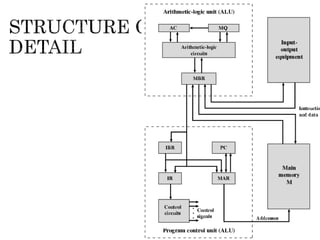
 Stored Program concept
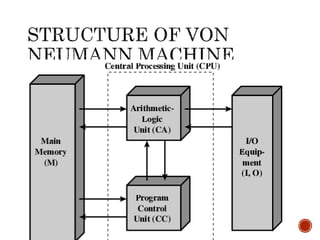
 Main memory storing programs and data
 ALU operating on binary data
 Control unit interpreting instructions from memory and
executing
 Input and output equipment operated by control unit
 Princeton Institute for Advanced Studies
 IAS
 Completed 1952
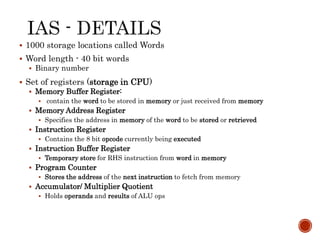
 1000 storage locations called Words
 Word length - 40 bit words
 Binary number
 Set of registers (storage in CPU)
 Memory Buffer Register:
 contain the word to be stored in memory or just received from memory
 Memory Address Register
 Specifies the address in memory of the word to be stored or retrieved
 Instruction Register
 Contains the 8 bit opcode currently being executed
 Instruction Buffer Register
 Temporary store for RHS instruction from word in memory
 Program Counter
 Stores the address of the next instruction to fetch from memory
 Accumulator/ Multiplier Quotient
 Holds operands and results of ALU ops
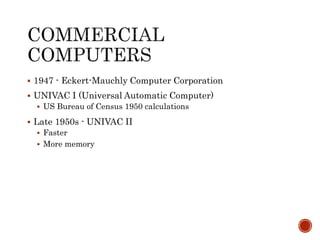
 1947 - Eckert-Mauchly Computer Corporation
 UNIVAC I (Universal Automatic Computer)
 US Bureau of Census 1950 calculations
 Late 1950s - UNIVAC II
 Faster
 More memory
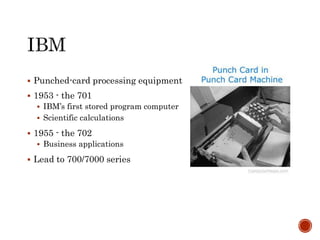
 Punched-card processing equipment
 1953 - the 701
 IBM’s first stored program computer
 Scientific calculations
 1955 - the 702
 Business applications
 Lead to 700/7000 series
 » The computers were very large in size.
» They consumed a large amount of energy.
» They heated very soon due to thousands of vacuum tubes.
» They were not very reliable.
» Air conditioning was required.
» Constant maintenance was required.
» Non-portable.
» Costly commercial production.
» Limited commercial use.
» Very slow speed - miliseconds.
» Limited programming capabilities.
» Used machine language only.
» Used magnetic drums which provide very less data storage.
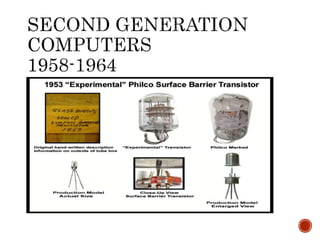
 Replaced vacuum tubes
 Smaller
 Cheaper
 Less heat dissipation
 Solid State device
 Made from Silicon (Sand)
 Invented 1947 at Bell Labs
 William Shockley et al.
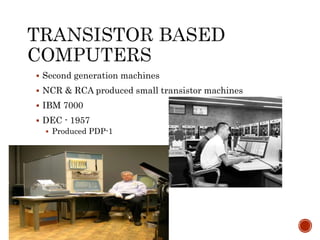
 Second generation machines
 NCR & RCA produced small transistor machines
 IBM 7000
 DEC - 1957
 Produced PDP-1
 Advantages
» Smaller in size compared to the first generation of computer.
» The second generations computers were more reliable.
» Used less energy and were not heated as much as the first one.
» Better speed and could calculate data in microseconds.
» Used faster peripherals.
» Better portability as compared to the first generation.
» Accuracy improved.
» Used assembly language as well.
Disadvantages
 Discrete components
 Manufacturing 10,000 transistors separately – difficult ->3rd Gen.
 Cooling system was required.
 Only used for specific purposes
 Constant maintenance was required
 Commercial production was difficult
 Costly and not versatile
 Punched cards were used for input.
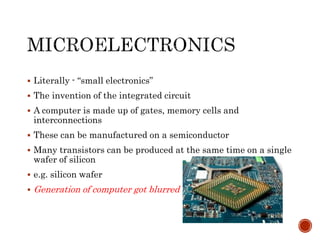
 Literally - “small electronics”
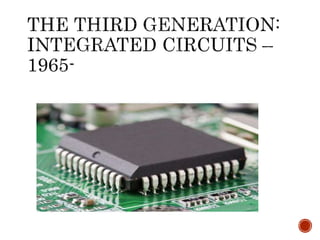
 The invention of the integrated circuit
 A computer is made up of gates, memory cells and
interconnections
 These can be manufactured on a semiconductor
 Many transistors can be produced at the same time on a single
wafer of silicon
 e.g. silicon wafer
 Generation of computer got blurred
 Vacuum tube - 1946-1957
 Transistor - 1958-1964
 Small scale integration - 1965 on
 Up to 100 devices on a chip
 Medium scale integration - to 1971
 100-3,000 devices on a chip
 Large scale integration - 1971-1977
 3,000 - 100,000 devices on a chip
 Very large scale integration - 1978 -1991
 100,000 - 100,000,000 devices on a chip
 Ultra large scale integration – 1991 -
 Over 100,000,000 devices on a chip
 Gordon Moore – co-founder of Intel
 Number of transistors on a chip will double every year
 Since 1970’s development has slowed a little
 Number of transistors doubles every 18 months
 Cost of a chip has remained almost unchanged
 Higher packing density means shorter electrical paths,
giving higher performance
 Smaller size gives increased flexibility
 Reduced power and cooling requirements
 Fewer interconnections increases reliability

02_Computer Evolution and Performance.ppt

  • 2.
  • 3.
     Electronic NumericalIntegrator And Computer  Eckert and Mauchly  University of Pennsylvania  Trajectory tables for weapons  Started 1943  Finished 1946  Too late for war effort  Used until 1955  to help determine the feasibility of the hydrogen bomb
  • 4.
     Decimal (notbinary)  20 accumulators of 10 digits  18,000 vacuum tubes  30 tons  15,000 square feet  140 kW power consumption  5,000 additions per second  Programmed manually by switches  It took days to rewire the machine for each new problem.
  • 5.
     Stored Programconcept  Main memory storing programs and data  ALU operating on binary data  Control unit interpreting instructions from memory and executing  Input and output equipment operated by control unit  Princeton Institute for Advanced Studies  IAS  Completed 1952
  • 7.
     1000 storagelocations called Words  Word length - 40 bit words  Binary number  Set of registers (storage in CPU)  Memory Buffer Register:  contain the word to be stored in memory or just received from memory  Memory Address Register  Specifies the address in memory of the word to be stored or retrieved  Instruction Register  Contains the 8 bit opcode currently being executed  Instruction Buffer Register  Temporary store for RHS instruction from word in memory  Program Counter  Stores the address of the next instruction to fetch from memory  Accumulator/ Multiplier Quotient  Holds operands and results of ALU ops
  • 9.
     1947 -Eckert-Mauchly Computer Corporation  UNIVAC I (Universal Automatic Computer)  US Bureau of Census 1950 calculations  Late 1950s - UNIVAC II  Faster  More memory
  • 10.
     Punched-card processingequipment  1953 - the 701  IBM’s first stored program computer  Scientific calculations  1955 - the 702  Business applications  Lead to 700/7000 series
  • 11.
     » Thecomputers were very large in size. » They consumed a large amount of energy. » They heated very soon due to thousands of vacuum tubes. » They were not very reliable. » Air conditioning was required. » Constant maintenance was required. » Non-portable. » Costly commercial production. » Limited commercial use. » Very slow speed - miliseconds. » Limited programming capabilities. » Used machine language only. » Used magnetic drums which provide very less data storage.
  • 13.
     Replaced vacuumtubes  Smaller  Cheaper  Less heat dissipation  Solid State device  Made from Silicon (Sand)  Invented 1947 at Bell Labs  William Shockley et al.
  • 14.
     Second generationmachines  NCR & RCA produced small transistor machines  IBM 7000  DEC - 1957  Produced PDP-1
  • 15.
     Advantages » Smallerin size compared to the first generation of computer. » The second generations computers were more reliable. » Used less energy and were not heated as much as the first one. » Better speed and could calculate data in microseconds. » Used faster peripherals. » Better portability as compared to the first generation. » Accuracy improved. » Used assembly language as well.
  • 16.
    Disadvantages  Discrete components Manufacturing 10,000 transistors separately – difficult ->3rd Gen.  Cooling system was required.  Only used for specific purposes  Constant maintenance was required  Commercial production was difficult  Costly and not versatile  Punched cards were used for input.
  • 18.
     Literally -“small electronics”  The invention of the integrated circuit  A computer is made up of gates, memory cells and interconnections  These can be manufactured on a semiconductor  Many transistors can be produced at the same time on a single wafer of silicon  e.g. silicon wafer  Generation of computer got blurred
  • 19.
     Vacuum tube- 1946-1957  Transistor - 1958-1964  Small scale integration - 1965 on  Up to 100 devices on a chip  Medium scale integration - to 1971  100-3,000 devices on a chip  Large scale integration - 1971-1977  3,000 - 100,000 devices on a chip  Very large scale integration - 1978 -1991  100,000 - 100,000,000 devices on a chip  Ultra large scale integration – 1991 -  Over 100,000,000 devices on a chip
  • 20.
     Gordon Moore– co-founder of Intel  Number of transistors on a chip will double every year  Since 1970’s development has slowed a little  Number of transistors doubles every 18 months  Cost of a chip has remained almost unchanged  Higher packing density means shorter electrical paths, giving higher performance  Smaller size gives increased flexibility  Reduced power and cooling requirements  Fewer interconnections increases reliability