Download free for 30 days
Sign in
Upload
Language (EN)
Support
Business
Mobile
Social Media
Marketing
Technology
Art & Photos
Career
Design
Education
Presentations & Public Speaking
Government & Nonprofit
Healthcare
Internet
Law
Leadership & Management
Automotive
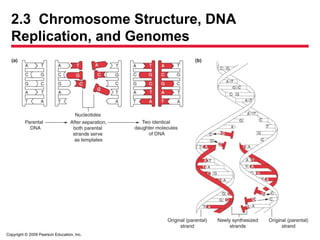
Engineering
Software
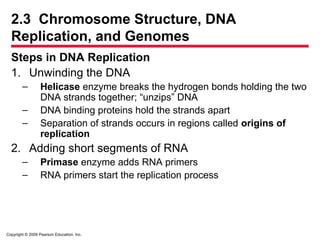
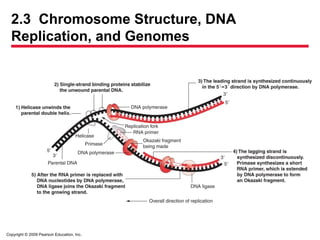
Recruiting & HR
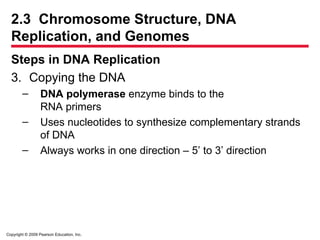
Retail
Sales
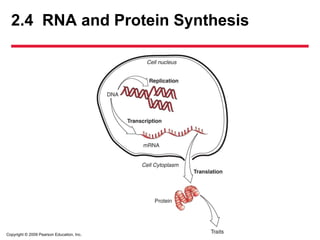
Services
Science
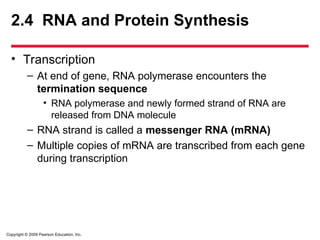
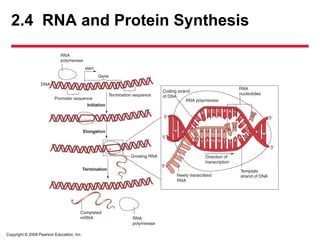
Small Business & Entrepreneurship
Food
Environment
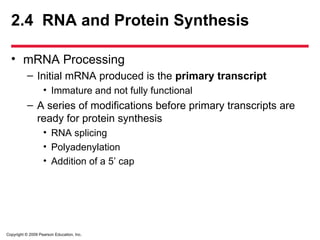
Economy & Finance
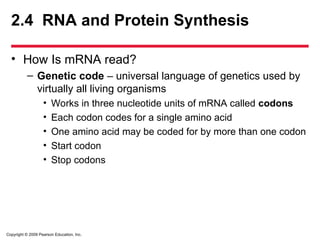
Data & Analytics
Investor Relations
Sports
Spiritual
News & Politics
Travel
Self Improvement
Real Estate
Entertainment & Humor
Health & Medicine
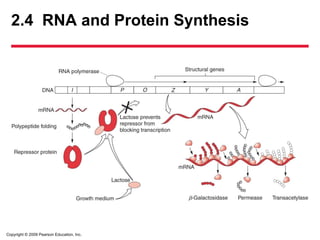
Devices & Hardware
Lifestyle
Change Language
Language
English
Español
Português
Français
Deutsche
Cancel
Save
EN
Uploaded by
nyarasanneh727
PPT, PDF
19 views
02_Lecture_Presentation.ppt on genes by prof lraymond
complete understanding on genetics
Marketing
◦
Read more
0
Save
Share
Embed
Embed presentation
Download
Download to read offline
1
/ 47
2
/ 47
3
/ 47
4
/ 47
5
/ 47
6
/ 47
7
/ 47
8
/ 47
9
/ 47
10
/ 47
11
/ 47
12
/ 47
13
/ 47
14
/ 47
15
/ 47
16
/ 47
17
/ 47
18
/ 47
19
/ 47
20
/ 47
21
/ 47
22
/ 47
23
/ 47
24
/ 47
25
/ 47
26
/ 47
27
/ 47
28
/ 47
29
/ 47
30
/ 47
31
/ 47
32
/ 47
33
/ 47
34
/ 47
35
/ 47
36
/ 47
37
/ 47
38
/ 47
39
/ 47
40
/ 47
41
/ 47
42
/ 47
43
/ 47
44
/ 47
45
/ 47
46
/ 47
47
/ 47
More Related Content
PPT
02_Lecture_Prnknlnlnlnlnlnlknnlnknklbjbjbjln
by
LatifahAuliaSariXIMI
PPTX
2-Introduction to genes and genomes.pptx
by
Rabah Al abdi
PPT
5 DNA and Genetic factors.ppthhhhhhgggggg
by
FarhanAliFarah
PPT
5 DNA and Genetic factorsnjjjjjjjhjj.ppt
by
FarhanAliFarah
PPT
10 Lecture Presentation
by
guest83e221c
PPTX
Lecture 2.2 Molecular and Cellular Biology (DNA Replication).pptx
by
SanaullahShovon
PPT
Biology - Chp 12 - DNA & RNA - PowerPoint
by
Mr. Walajtys
PPTX
The DNA
by
FrancescaDeMarzi
02_Lecture_Prnknlnlnlnlnlnlknnlnknklbjbjbjln
by
LatifahAuliaSariXIMI
2-Introduction to genes and genomes.pptx
by
Rabah Al abdi
5 DNA and Genetic factors.ppthhhhhhgggggg
by
FarhanAliFarah
5 DNA and Genetic factorsnjjjjjjjhjj.ppt
by
FarhanAliFarah
10 Lecture Presentation
by
guest83e221c
Lecture 2.2 Molecular and Cellular Biology (DNA Replication).pptx
by
SanaullahShovon
Biology - Chp 12 - DNA & RNA - PowerPoint
by
Mr. Walajtys
The DNA
by
FrancescaDeMarzi
Similar to 02_Lecture_Presentation.ppt on genes by prof lraymond
PDF
Introduction to Bioinformatics with Bioinformatics Algorithms
by
barunbhattacharjee16
PPT
Chapter 22 Nucleic acids and Protein synthesis [Autosaved].ppt
by
ShantolEdwards2
PPT
Biology - Chp 12 - DNA & RNA - PowerPoint
by
Mel Anthony Pepito
PPT
Nucleic acids
by
Pharmacy Universe
PPT
genetic_material-unit111.ppt
by
KomalMaan4
DOCX
104 Genetics and cellular functionLearning Objective.docx
by
aulasnilda
PPT
Dnapresentation
by
bionicteaching
PPT
Dna 2011 (2)
by
Des Cross
PPTX
Nucleic acid..biochem
by
dr nainika sharma
PPT
Basics of molecular biology
by
Ashfaq Ahmad
PPT
10 lecture presentation0
by
Uconn Stamford
PPT
Biotechnology and its fundamental final (1).ppt
by
breenaawan
PPT
biotech.ppt
by
breenaawan
PPT
dna and rna.ppt
by
SultanSalman6
PDF
Biochemistry lecture notes nucleic acids
by
Rengesh Balakrishnan
DOC
Biology - Chp 12 - DNA and RNA - Notes
by
Mr. Walajtys
PPTX
Dna
by
MartinGeraldine
PDF
Chapter 7.pdf
by
OsmanHassan35
PPT
Chapter 8 microbial genetics
by
BilalHoushaymi
PPTX
Nucleic Acids and Protein Synthesis.pptx
by
LittleGreen2
Introduction to Bioinformatics with Bioinformatics Algorithms
by
barunbhattacharjee16
Chapter 22 Nucleic acids and Protein synthesis [Autosaved].ppt
by
ShantolEdwards2
Biology - Chp 12 - DNA & RNA - PowerPoint
by
Mel Anthony Pepito
Nucleic acids
by
Pharmacy Universe
genetic_material-unit111.ppt
by
KomalMaan4
104 Genetics and cellular functionLearning Objective.docx
by
aulasnilda
Dnapresentation
by
bionicteaching
Dna 2011 (2)
by
Des Cross
Nucleic acid..biochem
by
dr nainika sharma
Basics of molecular biology
by
Ashfaq Ahmad
10 lecture presentation0
by
Uconn Stamford
Biotechnology and its fundamental final (1).ppt
by
breenaawan
biotech.ppt
by
breenaawan
dna and rna.ppt
by
SultanSalman6
Biochemistry lecture notes nucleic acids
by
Rengesh Balakrishnan
Biology - Chp 12 - DNA and RNA - Notes
by
Mr. Walajtys
Dna
by
MartinGeraldine
Chapter 7.pdf
by
OsmanHassan35
Chapter 8 microbial genetics
by
BilalHoushaymi
Nucleic Acids and Protein Synthesis.pptx
by
LittleGreen2
Recently uploaded
PDF
How To Buy Verified Wise Accounts – for a secure,& fully prepared profile.pdf
by
apasanilion108
PDF
Learn About Buying Verified Twitter (X) Accounts (Every User Needs to Learn).pdf
by
gsghhgf8
PDF
Lions Club Presentation on How to Use Facebook, Instagram and META products
by
Talking Finger, social media marketing agency
PPTX
SORTIQSOLUTIONS. pptx ppt on ppc a topic from digital marketing
by
sortiqsolutionss
PDF
biosecuritymeasuresinshrimpfarming-190830124902.pdf
by
Neospark
PDF
AI In Advertising 2026 - Optimization Expectation and Framework
by
Avinash Chandra
PDF
Rochester Homes Product Guide January 2026
by
JimWilliams206540
PPTX
Affiliate Summit West - Lily Ray Keynote 2026
by
Lily Ray
PDF
Purchase Twitter Accounts with Full Access and Secure Setup.pdf
by
topusapro.com
PDF
Latest SEO Trends Followed by Top SEO Agencies in Noida - Manojnegi.in.pdf
by
ManojNegi
DOCX
Top Factors That Make Old Gmail Accounts More Valuable
by
pvasmmpath
PDF
Your Website Is Invisible to 800 Million People: The ChatGPT Visibility Crisis
by
Udit Goenka
PDF
2026 Google Ads Playbook: 5 Strategies Behind $200M+ in Profitable Ad Spend
by
Search Engine Journal
PPTX
seo-complete-guide-2026-for-rankings-pro
by
prabhakarpandav2
PDF
TopMate ES11 3-Wheel Electric Scooter: A Compact Mobility Solution for Everyd...
by
Topmate
PDF
Karin Gargus' Marketing Portfolio - DSGN 253
by
Karin Gargus
PDF
What is the Difference Between Unacademy Referral Code and Promo Code
by
vayomeg600
PDF
Top 123 Place to USA Binance Accounts Online-Uk.pdf
by
bimif63078
PDF
SFMC User Group CPH - January 2026 - From Campaigns to Conversations
by
Lukas Lunow
PDF
ROAD safety SOLUTIONS brochure ltek NEW (1).pdf
by
dgtlmktlyncotek
How To Buy Verified Wise Accounts – for a secure,& fully prepared profile.pdf
by
apasanilion108
Learn About Buying Verified Twitter (X) Accounts (Every User Needs to Learn).pdf
by
gsghhgf8
Lions Club Presentation on How to Use Facebook, Instagram and META products
by
Talking Finger, social media marketing agency
SORTIQSOLUTIONS. pptx ppt on ppc a topic from digital marketing
by
sortiqsolutionss
biosecuritymeasuresinshrimpfarming-190830124902.pdf
by
Neospark
AI In Advertising 2026 - Optimization Expectation and Framework
by
Avinash Chandra
Rochester Homes Product Guide January 2026
by
JimWilliams206540
Affiliate Summit West - Lily Ray Keynote 2026
by
Lily Ray
Purchase Twitter Accounts with Full Access and Secure Setup.pdf
by
topusapro.com
Latest SEO Trends Followed by Top SEO Agencies in Noida - Manojnegi.in.pdf
by
ManojNegi
Top Factors That Make Old Gmail Accounts More Valuable
by
pvasmmpath
Your Website Is Invisible to 800 Million People: The ChatGPT Visibility Crisis
by
Udit Goenka
2026 Google Ads Playbook: 5 Strategies Behind $200M+ in Profitable Ad Spend
by
Search Engine Journal
seo-complete-guide-2026-for-rankings-pro
by
prabhakarpandav2
TopMate ES11 3-Wheel Electric Scooter: A Compact Mobility Solution for Everyd...
by
Topmate
Karin Gargus' Marketing Portfolio - DSGN 253
by
Karin Gargus
What is the Difference Between Unacademy Referral Code and Promo Code
by
vayomeg600
Top 123 Place to USA Binance Accounts Online-Uk.pdf
by
bimif63078
SFMC User Group CPH - January 2026 - From Campaigns to Conversations
by
Lukas Lunow
ROAD safety SOLUTIONS brochure ltek NEW (1).pdf
by
dgtlmktlyncotek
02_Lecture_Presentation.ppt on genes by prof lraymond
1.
Copyright © 2009
Pearson Education, Inc. PowerPoint Lectures for Introduction to Biotechnology, Second Edition William J.Thieman and Michael A.Palladino Lectures by Lara Dowland Chapter 2 An Introduction to Genes and Genomes Prof. Dr. Ekrem Gürel
2.
Copyright © 2009
Pearson Education, Inc. Chapter Contents • 2.1 A Review of Cell Structure • 2.2 The Molecule of Life • 2.3 Chromosome Structure, DNA Replication, and Genomes • 2.4 RNA and Protein Synthesis • 2.5 Mutations: Causes and Consequences
3.
Copyright © 2009
Pearson Education, Inc. 2.1 A Review of Cell Structure • Plasma Membrane – double-layer structure of lipids and proteins that surrounds the outer surface of cells • Cytoplasm – inner contents of a cell between the nucleus and plasma membrane • Organelles – structures in the cell that perform specific functions
4.
Copyright © 2009
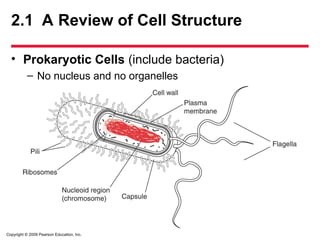
Pearson Education, Inc. • Prokaryotic Cells (include bacteria) – No nucleus and no organelles 2.1 A Review of Cell Structure
5.
Copyright © 2009
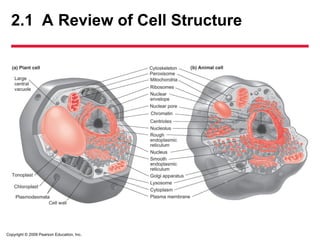
Pearson Education, Inc. 2.1 A Review of Cell Structure • Eukaryotic cells (plant cells, animal cells) – Have a nucleus and many organelles – Organelles • Nucleus • Mitochondria • Endoplasmic reticulum • Golgi apparatus
6.
Copyright © 2009
Pearson Education, Inc. 2.1 A Review of Cell Structure
7.
Copyright © 2009
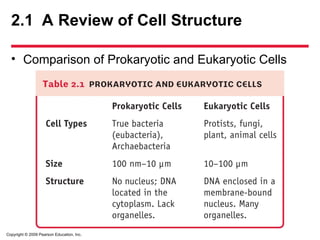
Pearson Education, Inc. 2.1 A Review of Cell Structure • Comparison of Prokaryotic and Eukaryotic Cells
8.
Copyright © 2009
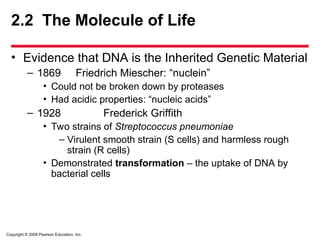
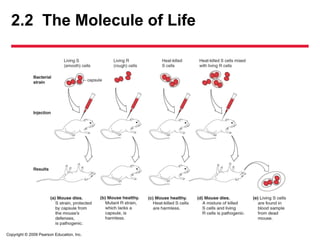
Pearson Education, Inc. 2.2 The Molecule of Life • Evidence that DNA is the Inherited Genetic Material – 1869 Friedrich Miescher: “nuclein” • Could not be broken down by proteases • Had acidic properties: “nucleic acids” – 1928 Frederick Griffith • Two strains of Streptococcus pneumoniae – Virulent smooth strain (S cells) and harmless rough strain (R cells) • Demonstrated transformation – the uptake of DNA by bacterial cells
9.
Copyright © 2009
Pearson Education, Inc. 2.2 The Molecule of Life
10.
Copyright © 2009
Pearson Education, Inc. 2.2 The Molecule of Life • Evidence that DNA Is the Inherited Genetic Material – 1944 Oswald Avery, Colin MacLeod, and Maclyn McCarty • Purified DNA from large batches of Streptococcus pneumoniae • Experiment proved that DNA was the transforming factor in the Griffith experiments
11.
Copyright © 2009
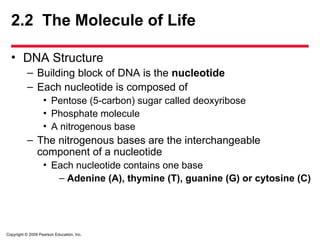
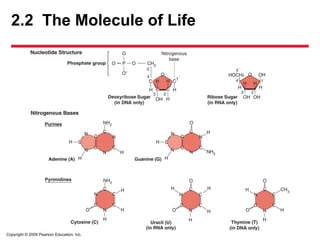
Pearson Education, Inc. 2.2 The Molecule of Life • DNA Structure – Building block of DNA is the nucleotide – Each nucleotide is composed of • Pentose (5-carbon) sugar called deoxyribose • Phosphate molecule • A nitrogenous base – The nitrogenous bases are the interchangeable component of a nucleotide • Each nucleotide contains one base – Adenine (A), thymine (T), guanine (G) or cytosine (C)
12.
Copyright © 2009
Pearson Education, Inc. 2.2 The Molecule of Life
13.
Copyright © 2009
Pearson Education, Inc. 2.2 The Molecule of Life • DNA Structure – James Watson and Francis Crick revealed the definitive structure of DNA – “The Molecular Structure of Nucleic Acids: A Structure for Deoxyribose Nucleic Acid” published in Nature on April 25, 1953
14.
Copyright © 2009
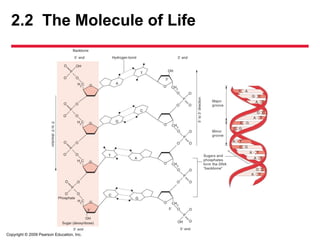
Pearson Education, Inc. 2.2 The Molecule of Life • DNA Structure – Nucleotides are joined together to form long strands of DNA and each DNA molecule consists of two strands that join together and wrap around each other to form a double helix – Nucleotides in a strand are held together by phosphodiester bonds – Each strand has a polarity – a 5 end and a 3 end
15.
Copyright © 2009
Pearson Education, Inc. 2.2 The Molecule of Life • DNA Structure – The two strands of a DNA molecule are held together by hydrogen bonds • Formed between complementary base pairs • Adenine (A) pairs with thymine (T) • Guanine (G) pairs with cytosine (C) – The two strands are antiparallel because their polarity is reversed relative to each other
16.
Copyright © 2009
Pearson Education, Inc. 2.2 The Molecule of Life
17.
Copyright © 2009
Pearson Education, Inc. 2.3 Chromosome Structure, DNA Replication, and Genomes • Chromosome Structure – Chromosomes – highly coiled and tightly condensed package of DNA and proteins • Occurs only during DNA replication – Chromatin – strings of DNA and DNA-binding proteins called histones • State of DNA inside the nucleus when the cell is NOT dividing
18.
Copyright © 2009
Pearson Education, Inc. 2.3 Chromosome Structure, DNA Replication, and Genomes • Most human cells have two sets (pairs) of 23 chromosomes, or 46 chromosomes total – Called homologous pairs – Autosomes – chromosomes 1-22 – Sex chromosomes – chromosome pair # 23 • X and Y chromosomes • Gametes (sex cells) contain a single set of 23 chromosomes (haploid number, n)
19.
Copyright © 2009
Pearson Education, Inc. 2.3 Chromosome Structure, DNA Replication, and Genomes • Chromosome consists of two thin, rodlike structures of DNA called sister chromatids – Exact replicas of each other copied during DNA replication – During cell division, each sister chromatid is separated
20.
Copyright © 2009
Pearson Education, Inc. 2.3 Chromosome Structure, DNA Replication, and Genomes • DNA Replication – Cells divide by a process called mitosis • Sex cells divide by a slightly different process called meiosis – Mitosis • One cell divides to form two daughter cells, each with an identical copy of the parent cell DNA • In order to accomplish this, the DNA of the parent cell must be copied prior to mitosis
21.
Copyright © 2009
Pearson Education, Inc. 2.3 Chromosome Structure, DNA Replication, and Genomes • Semiconservative Replication – Replication occurs in such a manner that, after replication, each helix contains one original (parental) DNA strand and one newly synthesized DNA strand
22.
Copyright © 2009
Pearson Education, Inc. 2.3 Chromosome Structure, DNA Replication, and Genomes
23.
Copyright © 2009
Pearson Education, Inc. 2.3 Chromosome Structure, DNA Replication, and Genomes Steps in DNA Replication 1. Unwinding the DNA – Helicase enzyme breaks the hydrogen bonds holding the two DNA strands together; “unzips” DNA – DNA binding proteins hold the strands apart – Separation of strands occurs in regions called origins of replication 2. Adding short segments of RNA – Primase enzyme adds RNA primers – RNA primers start the replication process
24.
Copyright © 2009
Pearson Education, Inc. 2.3 Chromosome Structure, DNA Replication, and Genomes Steps in DNA Replication 3. Copying the DNA – DNA polymerase enzyme binds to the RNA primers – Uses nucleotides to synthesize complementary strands of DNA – Always works in one direction – 5’ to 3’ direction
25.
Copyright © 2009
Pearson Education, Inc. 2.3 Chromosome Structure, DNA Replication, and Genomes
26.
Copyright © 2009
Pearson Education, Inc. 2.4 RNA and Protein Synthesis • Transcription – genes are copied (transcribed) from DNA code to RNA code • Translation – RNA code is read into a protein
27.
Copyright © 2009
Pearson Education, Inc. 2.4 RNA and Protein Synthesis
28.
Copyright © 2009
Pearson Education, Inc. 2.4 RNA and Protein Synthesis • Transcription – Occurs only in genes – RNA polymerase unwinds DNA helix and copies one strand of DNA into RNA • Binds to a promotor region • Copies DNA in a 5’ to 3’ direction into RNA • Uses nucleotides – Adenine, uracil, guanine, and cytosine – A-U, C-G
29.
Copyright © 2009
Pearson Education, Inc. 2.4 RNA and Protein Synthesis • Transcription – At end of gene, RNA polymerase encounters the termination sequence • RNA polymerase and newly formed strand of RNA are released from DNA molecule – RNA strand is called a messenger RNA (mRNA) – Multiple copies of mRNA are transcribed from each gene during transcription
30.
Copyright © 2009
Pearson Education, Inc. 2.4 RNA and Protein Synthesis
31.
Copyright © 2009
Pearson Education, Inc. 2.4 RNA and Protein Synthesis • mRNA Processing – Initial mRNA produced is the primary transcript • Immature and not fully functional – A series of modifications before primary transcripts are ready for protein synthesis • RNA splicing • Polyadenylation • Addition of a 5’ cap
32.
Copyright © 2009
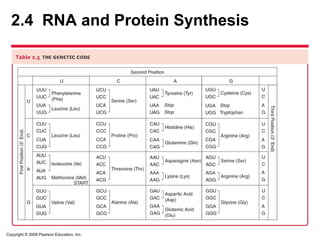
Pearson Education, Inc. 2.4 RNA and Protein Synthesis • How Is mRNA read? – Genetic code – universal language of genetics used by virtually all living organisms • Works in three nucleotide units of mRNA called codons • Each codon codes for a single amino acid • One amino acid may be coded for by more than one codon • Start codon • Stop codons
33.
Copyright © 2009
Pearson Education, Inc. 2.4 RNA and Protein Synthesis
34.
Copyright © 2009
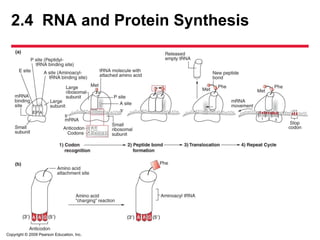
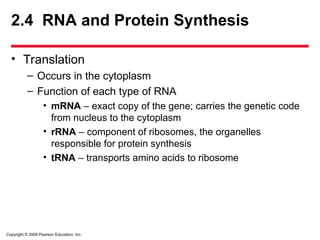
Pearson Education, Inc. 2.4 RNA and Protein Synthesis • Translation – Occurs in the cytoplasm – Function of each type of RNA • mRNA – exact copy of the gene; carries the genetic code from nucleus to the cytoplasm • rRNA – component of ribosomes, the organelles responsible for protein synthesis • tRNA – transports amino acids to ribosome
35.
Copyright © 2009
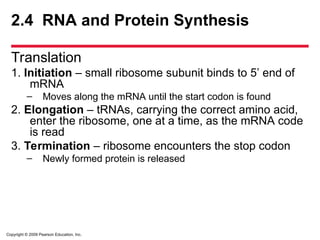
Pearson Education, Inc. 2.4 RNA and Protein Synthesis Translation 1. Initiation – small ribosome subunit binds to 5’ end of mRNA – Moves along the mRNA until the start codon is found 2. Elongation – tRNAs, carrying the correct amino acid, enter the ribosome, one at a time, as the mRNA code is read 3. Termination – ribosome encounters the stop codon – Newly formed protein is released
36.
Copyright © 2009
Pearson Education, Inc. 2.4 RNA and Protein Synthesis
37.
Copyright © 2009
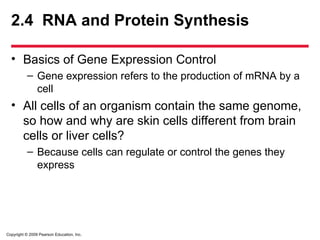
Pearson Education, Inc. 2.4 RNA and Protein Synthesis • Basics of Gene Expression Control – Gene expression refers to the production of mRNA by a cell • All cells of an organism contain the same genome, so how and why are skin cells different from brain cells or liver cells? – Because cells can regulate or control the genes they express
38.
Copyright © 2009
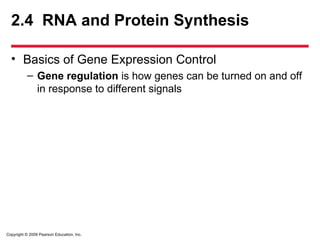
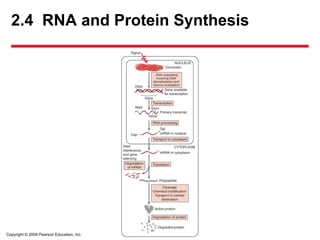
Pearson Education, Inc. 2.4 RNA and Protein Synthesis • Basics of Gene Expression Control – Gene regulation is how genes can be turned on and off in response to different signals
39.
Copyright © 2009
Pearson Education, Inc. 2.4 RNA and Protein Synthesis
40.
Copyright © 2009
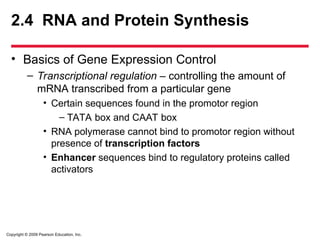
Pearson Education, Inc. 2.4 RNA and Protein Synthesis • Basics of Gene Expression Control – Transcriptional regulation – controlling the amount of mRNA transcribed from a particular gene • Certain sequences found in the promotor region – TATA box and CAAT box • RNA polymerase cannot bind to promotor region without presence of transcription factors • Enhancer sequences bind to regulatory proteins called activators
41.
Copyright © 2009
Pearson Education, Inc. 2.4 RNA and Protein Synthesis • Basics of Gene Expression Control – Micro RNA (miRNA) regulate gene expression by “silencing” gene expression through blocking translation of mRNA or by causing degradation of mRNA
42.
Copyright © 2009
Pearson Education, Inc. 2.4 RNA and Protein Synthesis • Basics of Gene Expression Control – Bacteria use operons to regulate gene expression • Organization of bacterial genes • Clusters of several related genes located together and controlled by a single promotor • Operator – region within promotor – Can use operons to regulate gene expression in response to their nutrient requirements • lac operon
43.
Copyright © 2009
Pearson Education, Inc. 2.4 RNA and Protein Synthesis
44.
Copyright © 2009
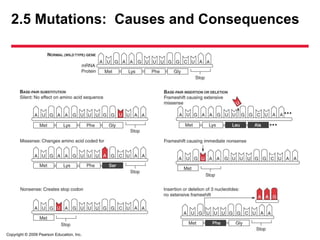
Pearson Education, Inc. 2.5 Mutations: Causes and Consequences • Mutation – change in the nucleotide sequence of DNA – Major cause of genetic diversity – Can also be detrimental • Types of Mutations – Point mutations • Silent mutations • Missense mutations • Nonsense mutations • Frameshift mutations
45.
Copyright © 2009
Pearson Education, Inc. 2.5 Mutations: Causes and Consequences
46.
Copyright © 2009
Pearson Education, Inc. 2.5 Mutations: Causes and Consequences • Gene mutations can be inherited or acquired – Inherited mutations are those passed on to offspring through gametes – Acquired mutations occur in the genome of somatic cells • Are not passed along to offspring
47.
Copyright © 2009
Pearson Education, Inc. 2.5 Mutations: Causes and Consequences • Mutations are a major cause of genetic diversity – Human genomes are approximately 99.9% identical • 0.1% differences in DNA between individuals, or one base out of every thousand – Roughly 3 million differences between different individuals • Most have no obvious effects; other mutations strongly influence cell functions, behavior, and susceptibility to genetic diseases
Download



![Chapter 22 Nucleic acids and Protein synthesis [Autosaved].ppt](https://cdn.slidesharecdn.com/ss_thumbnails/chapter22nucleicacidsandproteinsynthesisautosaved-250106233426-f24fcadb-thumbnail.jpg?width=640&height=640&fit=bounds)


