Using qualitative and quantitative
data: how to structure your research
Daniel Ratchford
Quality Health – Chief Executive
daniel.ratchford@quality-health.co.uk or @danielratchford
Quality Health
A specialist health and social care research organisation, working for public, private and
not-for profit sectors, in the UK and overseas
 We design innovative data collection mechanisms to gather insight from patients, service
users, staff and other stakeholders
 We use our unique expertise and experience to collect, process, analyse and present
information in the most meaningful ways
 We work collaboratively with our clients to support service improvements, inform change,
influence policy, and improve outcomes
25/10/2019 2
We help our clients achieve high quality and positive outcomes
in health, social care and other services
Key steps in generating data for Patient Advocacy
Work out what the problem is
 E.g. Do you have policy ideas you need to back up with evidence?
 E.g. Do you want to test a theory about patient experience?
Consider the bigger picture
 What is already known?
 Is there other relevant research?
 Are other Patient Advocacy organisations planning anything similar?
Have a clear analysis strategy
 Make sure you know from the start how you will analyse the data
 What exactly do you want to show, and to whom?
 Will qualitative findings (e.g. stories) be more powerful than quantitative (e.g. numbers)?
25/10/2019 3
Be clear from the start how you want to use the data
Good data can help your organisation to…
Predict an outcome
 E.g. If patients’ care is changed, how will this affect their overall wellbeing?
Explain a cause or consequence
 E.g. What has caused patients to report a drop in the standards of care?
Evaluate policy
 E.g. what has been the impact on patients of a change in policy or a new procedure?
Describe service provision
 E.g. What does high quality care look like from a patient perspective?
Develop good practice
 E.g. What do patients say would improve their care?
Empower patients
 E.g. What are the best ways to enhance patients’ lives, and the lives of patients in the future?
25/10/2019 4
Work out what your problem is: don’t just run a survey
for the sake of it!
Some good examples of focused patient advocacy
research
European Cancer Patient Coalition
Cancer Associated Thrombosis Awareness Survey
Aims:
 To understand – and compare across countries – patients’ awareness of
CAT
 To map where, and when, patients get their information
 To identify gaps of information and support during the patient pathway
25/10/2019 5
Some good examples of focused patient advocacy
research
Acute Leukemia Advocates Network
ALAN Quality of Life Survey
Aims:
 To understand the quality of life of acute leukaemia patients at different
points in the patient journey
25/10/2019 6
Some good examples of focused patient advocacy
research
All.Can International
Survey of Waste and Inefficiency in Cancer Care
Aims:
 To gather the views of cancer patients and carers into areas of waste and
inefficiency in cancer care
 To gather examples of good practice, and areas for improvement
25/10/2019 7
Some good examples of focused patient advocacy
research
CML Advocates Network
CML Treatment Free Remission Survey
Aims:
 To understand the experiences of CML patients considering and
undertaking Treatment Free Remission
 To compare different patient groups
 To consider the impact of different interventions and communications in
this process
25/10/2019 8
Main types of research to generate data
Literature review and desk research
 Reviewing the main ideas and research relating to your area of interest
 Accessing existing relevant data sets
Quantitative research
 Questionnaires delivered on paper, on-line, in person or by phone
 Structured interviewing
Qualitative research
 In-depth interviews, in person or by phone
 Focus groups
 Workshops
25/10/2019 9
Many of the most successful research programmes
use a combination of the above
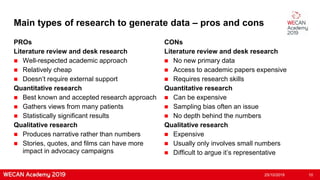
Main types of research to generate data – pros and cons
PROs
Literature review and desk research
 Well-respected academic approach
 Relatively cheap
 Doesn’t require external support
Quantitative research
 Best known and accepted research approach
 Gathers views from many patients
 Statistically significant results
Qualitative research
 Produces narrative rather than numbers
 Stories, quotes, and films can have more
impact in advocacy campaigns
25/10/2019 10
CONs
Literature review and desk research
 No new primary data
 Access to academic papers expensive
 Requires research skills
Quantitative research
 Can be expensive
 Sampling bias often an issue
 No depth behind the numbers
Qualitative research
 Expensive
 Usually only involves small numbers
 Difficult to argue it’s representative
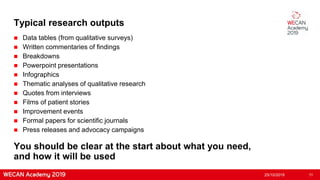
Typical research outputs
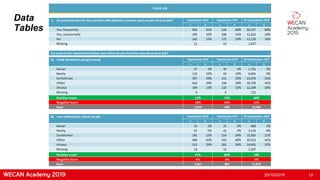
 Data tables (from qualitative surveys)
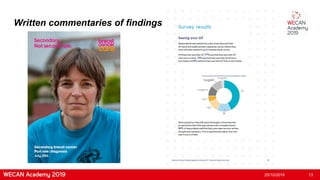
 Written commentaries of findings
 Breakdowns
 Powerpoint presentations
 Infographics
 Thematic analyses of qualitative research
 Quotes from interviews
 Films of patient stories
 Improvement events
 Formal papers for scientific journals
 Press releases and advocacy campaigns
25/10/2019 11
You should be clear at the start about what you need,
and how it will be used
25/10/2019 12
Data
Tables
25/10/2019 13
Written commentaries of findings
25/10/2019 14
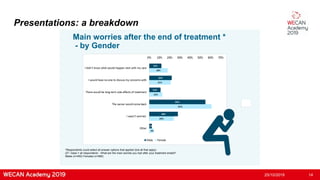
Main worries after the end of treatment *
- by Gender
*Respondents could select all answer options that applied (tick all that apply)
Q7 / base = all respondents - What are the main worries you had after your treatment ended?
Males (n=450) Females (n=560)
Presentations: a breakdown
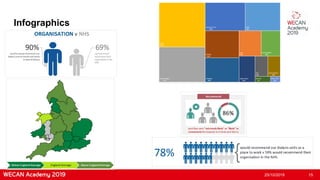
Infographics
25/10/2019 15
25/10/2019 16
Thematic
analysis
25/10/2019 17
Journal articles
25/10/2019 18https://vimeo.com/292669223/4f1e532e76
Interviews
25/10/2019 19https://www.youtube.com/watch?v=1pRtBtpPLTw
Films of patient stories
Some common problems…and how to avoid them
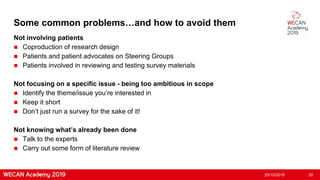
Not involving patients
 Coproduction of research design
 Patients and patient advocates on Steering Groups
 Patients involved in reviewing and testing survey materials
Not focusing on a specific issue - being too ambitious in scope
 Identify the theme/issue you’re interested in
 Keep it short
 Don’t just run a survey for the sake of it!
Not knowing what’s already been done
 Talk to the experts
 Carry out some form of literature review
25/10/2019 20
Some common problems…and how to avoid them
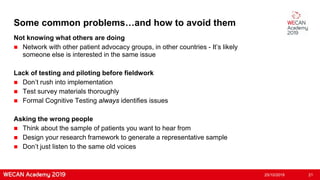
Not knowing what others are doing
 Network with other patient advocacy groups, in other countries - It’s likely
someone else is interested in the same issue
Lack of testing and piloting before fieldwork
 Don’t rush into implementation
 Test survey materials thoroughly
 Formal Cognitive Testing always identifies issues
Asking the wrong people
 Think about the sample of patients you want to hear from
 Design your research framework to generate a representative sample
 Don’t just listen to the same old voices
25/10/2019 21
Some common problems…and how to avoid them
Choosing the wrong delivery mechanism
 Using an external agency can be expensive and add complexity
 But carrying our research in-house risks lack of independence; and most
organisations don’t have the skills and capacity
 There will be times where both of these are right: consider carefully for each
piece of research
Not knowing how you’ll use the results
 Be clear at the start about what you need, and how it will be used
25/10/2019 22
Talk as much as possible to other Patient Advocacy
Groups about their experiences
0201b rachford   using qualitative and quantitative data how to structure your research

0201b rachford using qualitative and quantitative data how to structure your research

  • 1.
    Using qualitative andquantitative data: how to structure your research Daniel Ratchford Quality Health – Chief Executive daniel.ratchford@quality-health.co.uk or @danielratchford
  • 2.
    Quality Health A specialisthealth and social care research organisation, working for public, private and not-for profit sectors, in the UK and overseas  We design innovative data collection mechanisms to gather insight from patients, service users, staff and other stakeholders  We use our unique expertise and experience to collect, process, analyse and present information in the most meaningful ways  We work collaboratively with our clients to support service improvements, inform change, influence policy, and improve outcomes 25/10/2019 2 We help our clients achieve high quality and positive outcomes in health, social care and other services
  • 3.
    Key steps ingenerating data for Patient Advocacy Work out what the problem is  E.g. Do you have policy ideas you need to back up with evidence?  E.g. Do you want to test a theory about patient experience? Consider the bigger picture  What is already known?  Is there other relevant research?  Are other Patient Advocacy organisations planning anything similar? Have a clear analysis strategy  Make sure you know from the start how you will analyse the data  What exactly do you want to show, and to whom?  Will qualitative findings (e.g. stories) be more powerful than quantitative (e.g. numbers)? 25/10/2019 3 Be clear from the start how you want to use the data
  • 4.
    Good data canhelp your organisation to… Predict an outcome  E.g. If patients’ care is changed, how will this affect their overall wellbeing? Explain a cause or consequence  E.g. What has caused patients to report a drop in the standards of care? Evaluate policy  E.g. what has been the impact on patients of a change in policy or a new procedure? Describe service provision  E.g. What does high quality care look like from a patient perspective? Develop good practice  E.g. What do patients say would improve their care? Empower patients  E.g. What are the best ways to enhance patients’ lives, and the lives of patients in the future? 25/10/2019 4 Work out what your problem is: don’t just run a survey for the sake of it!
  • 5.
    Some good examplesof focused patient advocacy research European Cancer Patient Coalition Cancer Associated Thrombosis Awareness Survey Aims:  To understand – and compare across countries – patients’ awareness of CAT  To map where, and when, patients get their information  To identify gaps of information and support during the patient pathway 25/10/2019 5
  • 6.
    Some good examplesof focused patient advocacy research Acute Leukemia Advocates Network ALAN Quality of Life Survey Aims:  To understand the quality of life of acute leukaemia patients at different points in the patient journey 25/10/2019 6
  • 7.
    Some good examplesof focused patient advocacy research All.Can International Survey of Waste and Inefficiency in Cancer Care Aims:  To gather the views of cancer patients and carers into areas of waste and inefficiency in cancer care  To gather examples of good practice, and areas for improvement 25/10/2019 7
  • 8.
    Some good examplesof focused patient advocacy research CML Advocates Network CML Treatment Free Remission Survey Aims:  To understand the experiences of CML patients considering and undertaking Treatment Free Remission  To compare different patient groups  To consider the impact of different interventions and communications in this process 25/10/2019 8
  • 9.
    Main types ofresearch to generate data Literature review and desk research  Reviewing the main ideas and research relating to your area of interest  Accessing existing relevant data sets Quantitative research  Questionnaires delivered on paper, on-line, in person or by phone  Structured interviewing Qualitative research  In-depth interviews, in person or by phone  Focus groups  Workshops 25/10/2019 9 Many of the most successful research programmes use a combination of the above
  • 10.
    Main types ofresearch to generate data – pros and cons PROs Literature review and desk research  Well-respected academic approach  Relatively cheap  Doesn’t require external support Quantitative research  Best known and accepted research approach  Gathers views from many patients  Statistically significant results Qualitative research  Produces narrative rather than numbers  Stories, quotes, and films can have more impact in advocacy campaigns 25/10/2019 10 CONs Literature review and desk research  No new primary data  Access to academic papers expensive  Requires research skills Quantitative research  Can be expensive  Sampling bias often an issue  No depth behind the numbers Qualitative research  Expensive  Usually only involves small numbers  Difficult to argue it’s representative
  • 11.
    Typical research outputs Data tables (from qualitative surveys)  Written commentaries of findings  Breakdowns  Powerpoint presentations  Infographics  Thematic analyses of qualitative research  Quotes from interviews  Films of patient stories  Improvement events  Formal papers for scientific journals  Press releases and advocacy campaigns 25/10/2019 11 You should be clear at the start about what you need, and how it will be used
  • 12.
  • 13.
  • 14.
    25/10/2019 14 Main worriesafter the end of treatment * - by Gender *Respondents could select all answer options that applied (tick all that apply) Q7 / base = all respondents - What are the main worries you had after your treatment ended? Males (n=450) Females (n=560) Presentations: a breakdown
  • 15.
  • 16.
  • 17.
  • 18.
  • 19.
  • 20.
    Some common problems…andhow to avoid them Not involving patients  Coproduction of research design  Patients and patient advocates on Steering Groups  Patients involved in reviewing and testing survey materials Not focusing on a specific issue - being too ambitious in scope  Identify the theme/issue you’re interested in  Keep it short  Don’t just run a survey for the sake of it! Not knowing what’s already been done  Talk to the experts  Carry out some form of literature review 25/10/2019 20
  • 21.
    Some common problems…andhow to avoid them Not knowing what others are doing  Network with other patient advocacy groups, in other countries - It’s likely someone else is interested in the same issue Lack of testing and piloting before fieldwork  Don’t rush into implementation  Test survey materials thoroughly  Formal Cognitive Testing always identifies issues Asking the wrong people  Think about the sample of patients you want to hear from  Design your research framework to generate a representative sample  Don’t just listen to the same old voices 25/10/2019 21
  • 22.
    Some common problems…andhow to avoid them Choosing the wrong delivery mechanism  Using an external agency can be expensive and add complexity  But carrying our research in-house risks lack of independence; and most organisations don’t have the skills and capacity  There will be times where both of these are right: consider carefully for each piece of research Not knowing how you’ll use the results  Be clear at the start about what you need, and how it will be used 25/10/2019 22 Talk as much as possible to other Patient Advocacy Groups about their experiences