OPERATORS AND OPERANDS
Fundamental Programming Elements
Delroy A. Brinkerhoff
OPERATORS AND OPERANDS
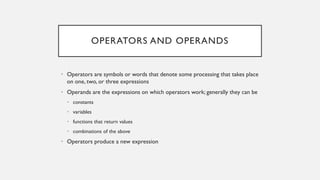
• Operators are symbols or words that denote some processing that takes place
on one, two, or three expressions
• Operands are the expressions on which operators work; generally they can be
• constants
• variables
• functions that return values
• combinations of the above
• Operators produce a new expression
NUMBER OF OPERANDS
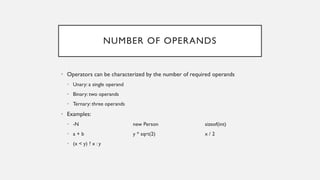
• Operators can be characterized by the number of required operands
• Unary: a single operand
• Binary: two operands
• Ternary: three operands
• Examples:
• -N new Person sizeof(int)
• a + b y * sqrt(2) x / 2
• (x < y) ? x : y
ORDER OF OPERATOR EVALUATION
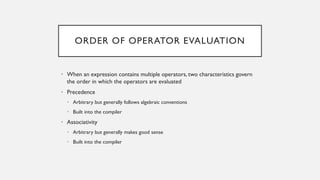
• When an expression contains multiple operators, two characteristics govern
the order in which the operators are evaluated
• Precedence
• Arbitrary but generally follows algebraic conventions
• Built into the compiler
• Associativity
• Arbitrary but generally makes good sense
• Built into the compiler
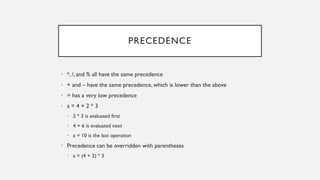
PRECEDENCE
• *, /, and % all have the same precedence
• + and – have the same precedence, which is lower than the above
• = has a very low precedence
• a = 4 + 2 * 3
• 2 * 3 is evaluated first
• 4 + 6 is evaluated next
• a = 10 is the last operation
• Precedence can be overridden with parentheses
• a = (4 + 2) * 3
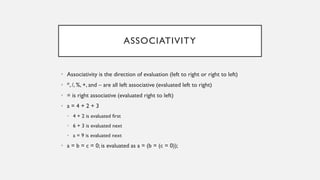
ASSOCIATIVITY
• Associativity is the direction of evaluation (left to right or right to left)
• *, /, %, +, and – are all left associative (evaluated left to right)
• = is right associative (evaluated right to left)
• a = 4 + 2 + 3
• 4 + 2 is evaluated first
• 6 + 3 is evaluated next
• a = 9 is evaluated next
• a = b = c = 0; is evaluated as a = (b = (c = 0));
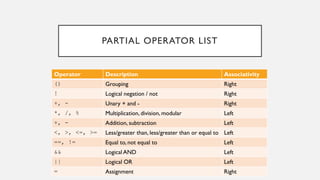
PARTIAL OPERATOR LIST
Operator Description Associativity
() Grouping Right
! Logical negation / not Right
+, - Unary + and - Right
*, /, % Multiplication, division, modular Left
+, - Addition, subtraction Left
<, >, <=, >= Less/greater than, less/greater than or equal to Left
==, != Equal to, not equal to Left
&& Logical AND Left
|| Logical OR Left
= Assignment Right

02-01-0-Operators and Operands.pdf

  • 1.
    OPERATORS AND OPERANDS FundamentalProgramming Elements Delroy A. Brinkerhoff
  • 2.
    OPERATORS AND OPERANDS •Operators are symbols or words that denote some processing that takes place on one, two, or three expressions • Operands are the expressions on which operators work; generally they can be • constants • variables • functions that return values • combinations of the above • Operators produce a new expression
  • 3.
    NUMBER OF OPERANDS •Operators can be characterized by the number of required operands • Unary: a single operand • Binary: two operands • Ternary: three operands • Examples: • -N new Person sizeof(int) • a + b y * sqrt(2) x / 2 • (x < y) ? x : y
  • 4.
    ORDER OF OPERATOREVALUATION • When an expression contains multiple operators, two characteristics govern the order in which the operators are evaluated • Precedence • Arbitrary but generally follows algebraic conventions • Built into the compiler • Associativity • Arbitrary but generally makes good sense • Built into the compiler
  • 5.
    PRECEDENCE • *, /,and % all have the same precedence • + and – have the same precedence, which is lower than the above • = has a very low precedence • a = 4 + 2 * 3 • 2 * 3 is evaluated first • 4 + 6 is evaluated next • a = 10 is the last operation • Precedence can be overridden with parentheses • a = (4 + 2) * 3
  • 6.
    ASSOCIATIVITY • Associativity isthe direction of evaluation (left to right or right to left) • *, /, %, +, and – are all left associative (evaluated left to right) • = is right associative (evaluated right to left) • a = 4 + 2 + 3 • 4 + 2 is evaluated first • 6 + 3 is evaluated next • a = 9 is evaluated next • a = b = c = 0; is evaluated as a = (b = (c = 0));
  • 7.
    PARTIAL OPERATOR LIST OperatorDescription Associativity () Grouping Right ! Logical negation / not Right +, - Unary + and - Right *, /, % Multiplication, division, modular Left +, - Addition, subtraction Left <, >, <=, >= Less/greater than, less/greater than or equal to Left ==, != Equal to, not equal to Left && Logical AND Left || Logical OR Left = Assignment Right