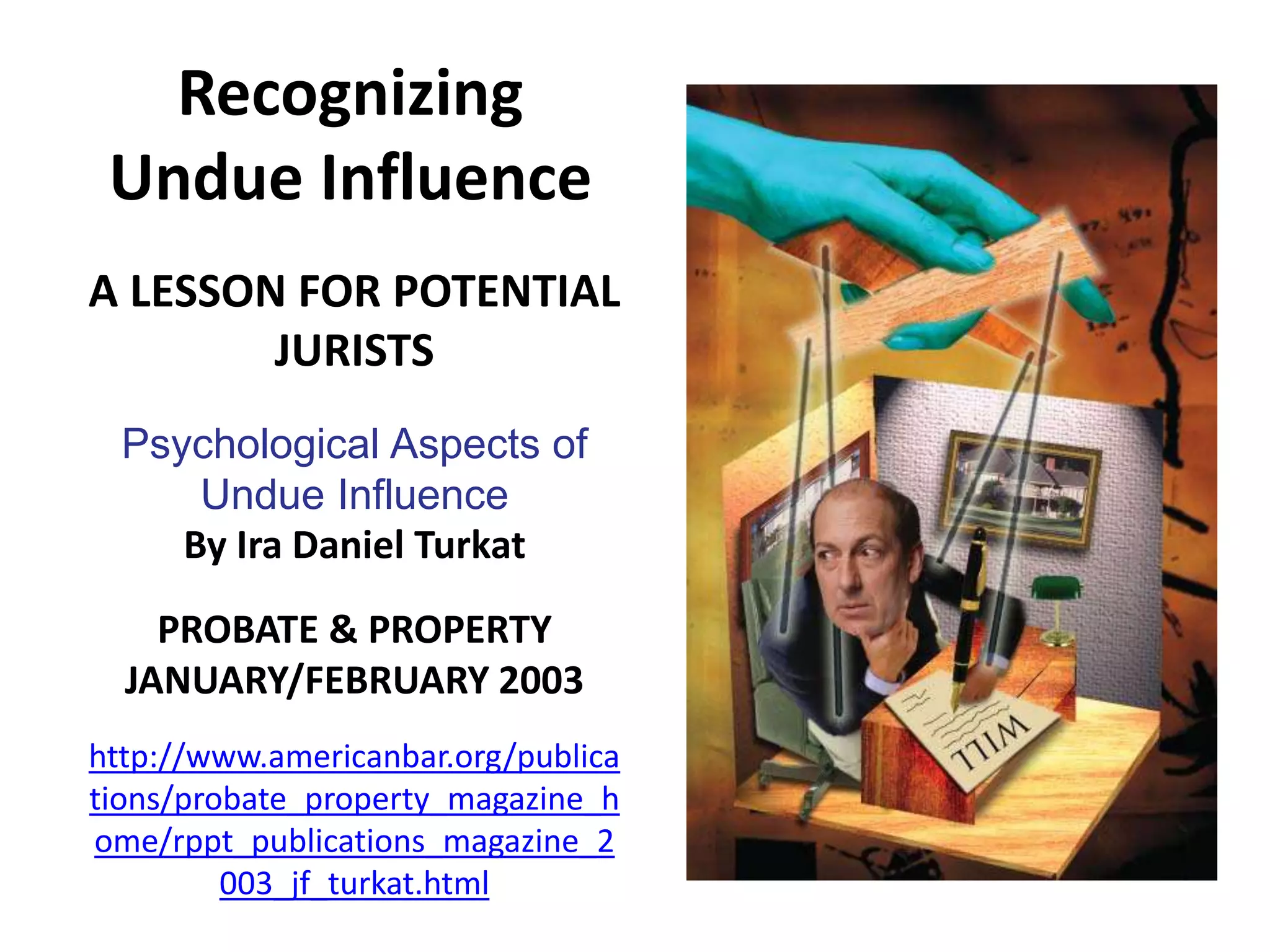
Recognizing
Undue Influence
A LESSON FOR POTENTIAL
JURISTS
Psychological Aspects of
Undue Influence
By Ira Daniel Turkat
PROBATE & PROPERTY
JANUARY/FEBRUARY 2003
http://www.americanbar.org/publica
tions/probate_property_magazine_h
ome/rppt_publications_magazine_2
003_jf_turkat.html
OVERVIEW
Because “preparation of an undue influence
case can require considerable psychological
sophistication”, this lesson is designed to
empower jurists to recognize typical tactics
employed by manipulative and devious
corporate and non-corporate “persons”
(expressed by Turkat in this article as
"caregivers") as they reroute another’s rights
and assets to themselves.
The purpose of this assignment is to:
1. Identify which of the three "caregiver" behaviors,
mentioned in the “Vulnerability Enhancers” section
of Turkat's article, best describes the common law
crimes of barratry, maintenance and champerty.
2. Draw parallels between manipulative and devious
“caregivers” and their legislative and judicial
equivalents, some of whom acquiesce to believing
they are promoting 'the general Welfare . . . to
ourselves and our Posterity'.
3. Develop a personal plan of action based on
historical and scriptural precedence.
An individual vulnerable to potential exploitation is
best protected when cared for by those with genuine
concern for that person’s well being and who have no
agenda to extract additional financial benefits from
the vulnerable individual. Unfortunately, those at risk
who are placed in the wrong hands may be
maneuvered to perform acts that at one time might
have seemed unimaginable. Generally speaking,
there are at least three types of individuals who will
take advantage of a vulnerable person.
Turkat's Vulnerability Enhancers
First is the con artist.
He or she knows there is a pot of gold
intended for someone else and sets out to steer
it elsewhere—into the con artist’s own hands.
This individual usually has prior experience
exploiting others.
Maintenance - n. Sustenance; sustentation; support by means of
supplies of food, clothing and other conveniences; . . .
4. In law, an officious intermeddling in a suit in which the person
has no interest, by assisting either party with money or means to
prosecute or defend it. This is a punishable offense. But to assist
a poor kinsman from compassion, is not maintenance.
The second type is the
psychologically damaged person who
seeks self gratification by manipulating
others. This may include disturbances such
as the need to feel power over others,
enjoying the suffering of others, or some
other psychopathology.
Barratry - n.
The practice of exciting and encouraging
lawsuits and quarrels.
The third type of perpetrator
is one who did not originally set out to
exploit the vulnerable person, but who over
time found the fruits of temptation too great to
resist. In the course of this “transformation,”
such individuals may develop self-satisfying
rationalizations for their manipulative activities
(e.g., “I deserve this for all I have done”).
Champerty - n. A species of maintenance, being a bargain
with a plaintiff or defendant, to divide the land or other
matter in suit, between them, if they prevail; whereupon
the champertor is to carry on the partys suit at his own
expense. The purchase of a suit, or of the right of suing.
IN CONGRESS, July 4, 1776.
The unanimous Declaration of the thirteen united States of America
When in the Course of human events, it becomes
necessary for one people to (1) dissolve the
political bands which have connected them with
another, and to (2) assume among the powers of
the earth, the separate and equal station to
which the Laws of Nature and of Nature's God
entitle them, a decent respect to the opinions of
mankind requires that they should (3) declare the
causes which impel them to the separation.
Identifying the Problem AND Solution
through the lens of history.
Because, We, "the people", have been given the
"keys of the reign"; i.e., the authority to "bind and loose", and;
NLA common law "jurists" - and others - have, over the years,
been diligently declaring "the causes which impel them to the
separation", and;
Now that you recognize the behaviors associated with the
common law crimes of barratry, maintenance and champerty;
How will you use the keys you've been given to 'assume
among the powers of the earth the separate and equal
station to which the Laws of Nature and of Nature's God
entitle you and dissolve the bands of your oppression?'
THE QUIZ

Overview and Critique of Ira Daniel Turkat's "Psychological Aspects of Undue Influence"

  • 1.
    Recognizing Undue Influence A LESSONFOR POTENTIAL JURISTS Psychological Aspects of Undue Influence By Ira Daniel Turkat PROBATE & PROPERTY JANUARY/FEBRUARY 2003 http://www.americanbar.org/publica tions/probate_property_magazine_h ome/rppt_publications_magazine_2 003_jf_turkat.html
  • 2.
    OVERVIEW Because “preparation ofan undue influence case can require considerable psychological sophistication”, this lesson is designed to empower jurists to recognize typical tactics employed by manipulative and devious corporate and non-corporate “persons” (expressed by Turkat in this article as "caregivers") as they reroute another’s rights and assets to themselves.
  • 3.
    The purpose ofthis assignment is to: 1. Identify which of the three "caregiver" behaviors, mentioned in the “Vulnerability Enhancers” section of Turkat's article, best describes the common law crimes of barratry, maintenance and champerty. 2. Draw parallels between manipulative and devious “caregivers” and their legislative and judicial equivalents, some of whom acquiesce to believing they are promoting 'the general Welfare . . . to ourselves and our Posterity'. 3. Develop a personal plan of action based on historical and scriptural precedence.
  • 4.
    An individual vulnerableto potential exploitation is best protected when cared for by those with genuine concern for that person’s well being and who have no agenda to extract additional financial benefits from the vulnerable individual. Unfortunately, those at risk who are placed in the wrong hands may be maneuvered to perform acts that at one time might have seemed unimaginable. Generally speaking, there are at least three types of individuals who will take advantage of a vulnerable person. Turkat's Vulnerability Enhancers
  • 5.
    First is thecon artist. He or she knows there is a pot of gold intended for someone else and sets out to steer it elsewhere—into the con artist’s own hands. This individual usually has prior experience exploiting others. Maintenance - n. Sustenance; sustentation; support by means of supplies of food, clothing and other conveniences; . . . 4. In law, an officious intermeddling in a suit in which the person has no interest, by assisting either party with money or means to prosecute or defend it. This is a punishable offense. But to assist a poor kinsman from compassion, is not maintenance.
  • 6.
    The second typeis the psychologically damaged person who seeks self gratification by manipulating others. This may include disturbances such as the need to feel power over others, enjoying the suffering of others, or some other psychopathology. Barratry - n. The practice of exciting and encouraging lawsuits and quarrels.
  • 7.
    The third typeof perpetrator is one who did not originally set out to exploit the vulnerable person, but who over time found the fruits of temptation too great to resist. In the course of this “transformation,” such individuals may develop self-satisfying rationalizations for their manipulative activities (e.g., “I deserve this for all I have done”). Champerty - n. A species of maintenance, being a bargain with a plaintiff or defendant, to divide the land or other matter in suit, between them, if they prevail; whereupon the champertor is to carry on the partys suit at his own expense. The purchase of a suit, or of the right of suing.
  • 8.
    IN CONGRESS, July4, 1776. The unanimous Declaration of the thirteen united States of America When in the Course of human events, it becomes necessary for one people to (1) dissolve the political bands which have connected them with another, and to (2) assume among the powers of the earth, the separate and equal station to which the Laws of Nature and of Nature's God entitle them, a decent respect to the opinions of mankind requires that they should (3) declare the causes which impel them to the separation. Identifying the Problem AND Solution through the lens of history.
  • 9.
    Because, We, "thepeople", have been given the "keys of the reign"; i.e., the authority to "bind and loose", and; NLA common law "jurists" - and others - have, over the years, been diligently declaring "the causes which impel them to the separation", and; Now that you recognize the behaviors associated with the common law crimes of barratry, maintenance and champerty; How will you use the keys you've been given to 'assume among the powers of the earth the separate and equal station to which the Laws of Nature and of Nature's God entitle you and dissolve the bands of your oppression?' THE QUIZ