Advance Computer Architecture
Introduction
Architecture & Organization 1
• Architecture is those attributes visible to
the programmer
—Instruction set, number of bits used for data
representation, I/O mechanisms, addressing
techniques.
—e.g. Is there a multiply instruction?
• Organization is how features are
implemented
—Control signals, interfaces, memory
technology.
Architecture & Organization 2
• All Intel x86 family share the same basic
architecture
• The IBM System/370 family share the
same basic architecture
• This gives code compatibility
—At least backwards
What is backward compatibility?
• Backward compatibility (also known as
backwards compatibility) is a property
of a system, product, or technology that
allows for interoperability with an older
legacy system.
What is the difference between a 32bit
and 64bit system/OS?
In computing, there exist two type processor i.e., 32-bit and 64-
bit. This type of processor tells us how much memory a
processor can have access from a CPU register. For instance,
A 32-bit system can access 232 memory addresses, i.e 4 GB of
RAM or physical memory ideally, it can access more than 4 GB
of RAM also.
A 64-bit system can access 264 memory addresses, i.e actually
18-Quintillion bytes of RAM. In short, any amount of memory
greater than 4 GB can be easily handled by it.
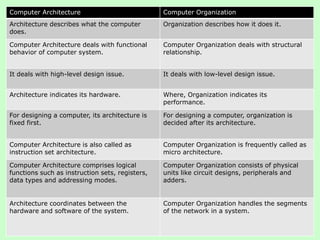
Computer Architecture Computer Organization
Architecture describes what the computer
does.
Organization describes how it does it.
Computer Architecture deals with functional
behavior of computer system.
Computer Organization deals with structural
relationship.
It deals with high-level design issue. It deals with low-level design issue.
Architecture indicates its hardware. Where, Organization indicates its
performance.
For designing a computer, its architecture is
fixed first.
For designing a computer, organization is
decided after its architecture.
Computer Architecture is also called as
instruction set architecture.
Computer Organization is frequently called as
micro architecture.
Computer Architecture comprises logical
functions such as instruction sets, registers,
data types and addressing modes.
Computer Organization consists of physical
units like circuit designs, peripherals and
adders.
Architecture coordinates between the
hardware and software of the system.
Computer Organization handles the segments
of the network in a system.
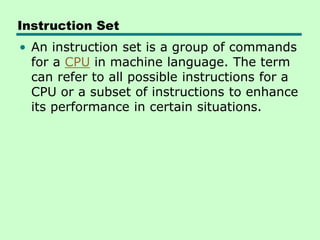
Instruction Set
• An instruction set is a group of commands
for a CPU in machine language. The term
can refer to all possible instructions for a
CPU or a subset of instructions to enhance
its performance in certain situations.
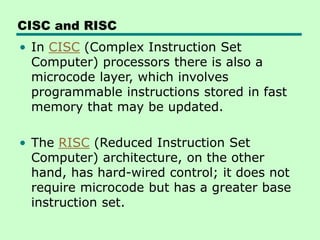
CISC and RISC
• In CISC (Complex Instruction Set
Computer) processors there is also a
microcode layer, which involves
programmable instructions stored in fast
memory that may be updated.
• The RISC (Reduced Instruction Set
Computer) architecture, on the other
hand, has hard-wired control; it does not
require microcode but has a greater base
instruction set.
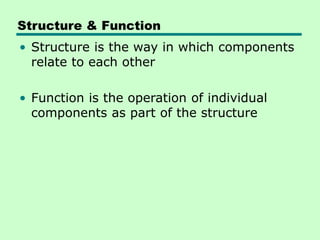
Structure & Function
• Structure is the way in which components
relate to each other
• Function is the operation of individual
components as part of the structure
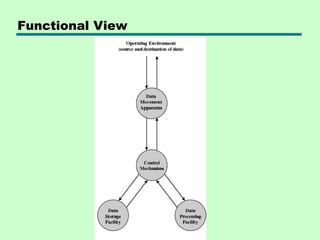
Function
• All computer functions are:
—Data processing
—Data storage
—Data movement
—Control
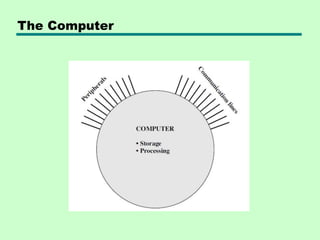
The Computer
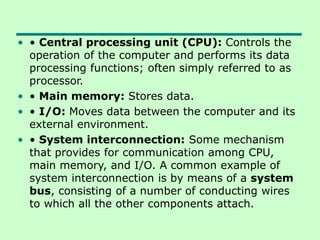
• • Central processing unit (CPU): Controls the
operation of the computer and performs its data
processing functions; often simply referred to as
processor.
• • Main memory: Stores data.
• • I/O: Moves data between the computer and its
external environment.
• • System interconnection: Some mechanism
that provides for communication among CPU,
main memory, and I/O. A common example of
system interconnection is by means of a system
bus, consisting of a number of conducting wires
to which all the other components attach.
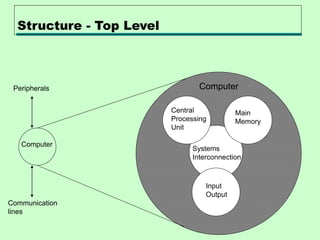
Structure - Top Level
Computer
Main
Memory
Input
Output
Systems
Interconnection
Peripherals
Communication
lines
Central
Processing
Unit
Computer
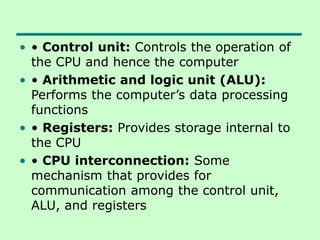
• • Control unit: Controls the operation of
the CPU and hence the computer
• • Arithmetic and logic unit (ALU):
Performs the computer’s data processing
functions
• • Registers: Provides storage internal to
the CPU
• • CPU interconnection: Some
mechanism that provides for
communication among the control unit,
ALU, and registers
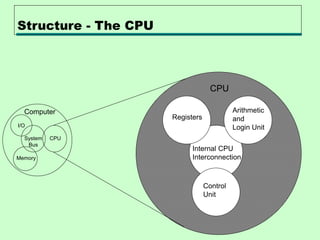
Structure - The CPU
Computer Arithmetic
and
Login Unit
Control
Unit
Internal CPU
Interconnection
Registers
CPU
I/O
Memory
System
Bus
CPU
Functional View

01_Introduction (1).ppt

  • 1.
  • 2.
  • 3.
    Architecture & Organization1 • Architecture is those attributes visible to the programmer —Instruction set, number of bits used for data representation, I/O mechanisms, addressing techniques. —e.g. Is there a multiply instruction? • Organization is how features are implemented —Control signals, interfaces, memory technology.
  • 4.
    Architecture & Organization2 • All Intel x86 family share the same basic architecture • The IBM System/370 family share the same basic architecture • This gives code compatibility —At least backwards What is backward compatibility?
  • 5.
    • Backward compatibility(also known as backwards compatibility) is a property of a system, product, or technology that allows for interoperability with an older legacy system.
  • 6.
    What is thedifference between a 32bit and 64bit system/OS?
  • 7.
    In computing, thereexist two type processor i.e., 32-bit and 64- bit. This type of processor tells us how much memory a processor can have access from a CPU register. For instance, A 32-bit system can access 232 memory addresses, i.e 4 GB of RAM or physical memory ideally, it can access more than 4 GB of RAM also. A 64-bit system can access 264 memory addresses, i.e actually 18-Quintillion bytes of RAM. In short, any amount of memory greater than 4 GB can be easily handled by it.
  • 8.
    Computer Architecture ComputerOrganization Architecture describes what the computer does. Organization describes how it does it. Computer Architecture deals with functional behavior of computer system. Computer Organization deals with structural relationship. It deals with high-level design issue. It deals with low-level design issue. Architecture indicates its hardware. Where, Organization indicates its performance. For designing a computer, its architecture is fixed first. For designing a computer, organization is decided after its architecture. Computer Architecture is also called as instruction set architecture. Computer Organization is frequently called as micro architecture. Computer Architecture comprises logical functions such as instruction sets, registers, data types and addressing modes. Computer Organization consists of physical units like circuit designs, peripherals and adders. Architecture coordinates between the hardware and software of the system. Computer Organization handles the segments of the network in a system.
  • 9.
    Instruction Set • Aninstruction set is a group of commands for a CPU in machine language. The term can refer to all possible instructions for a CPU or a subset of instructions to enhance its performance in certain situations.
  • 10.
    CISC and RISC •In CISC (Complex Instruction Set Computer) processors there is also a microcode layer, which involves programmable instructions stored in fast memory that may be updated. • The RISC (Reduced Instruction Set Computer) architecture, on the other hand, has hard-wired control; it does not require microcode but has a greater base instruction set.
  • 11.
    Structure & Function •Structure is the way in which components relate to each other • Function is the operation of individual components as part of the structure
  • 12.
    Function • All computerfunctions are: —Data processing —Data storage —Data movement —Control
  • 13.
  • 14.
    • • Centralprocessing unit (CPU): Controls the operation of the computer and performs its data processing functions; often simply referred to as processor. • • Main memory: Stores data. • • I/O: Moves data between the computer and its external environment. • • System interconnection: Some mechanism that provides for communication among CPU, main memory, and I/O. A common example of system interconnection is by means of a system bus, consisting of a number of conducting wires to which all the other components attach.
  • 15.
    Structure - TopLevel Computer Main Memory Input Output Systems Interconnection Peripherals Communication lines Central Processing Unit Computer
  • 16.
    • • Controlunit: Controls the operation of the CPU and hence the computer • • Arithmetic and logic unit (ALU): Performs the computer’s data processing functions • • Registers: Provides storage internal to the CPU • • CPU interconnection: Some mechanism that provides for communication among the control unit, ALU, and registers
  • 17.
    Structure - TheCPU Computer Arithmetic and Login Unit Control Unit Internal CPU Interconnection Registers CPU I/O Memory System Bus CPU
  • 18.