Horror Genre
I’m scared, so very scared!!!!!
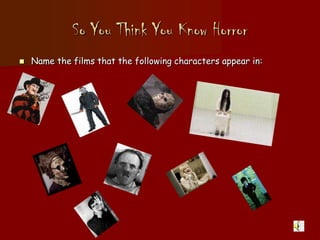
So You Think You Know Horror
 Name the films that the following characters appear in:
Horror Films you have watched
 List as many horror film that you have
seen.
 Share your list with the other people at
your table.
 You have five mins to do this.
Horror
 Horror is all about making us scared
 It is about FEAR
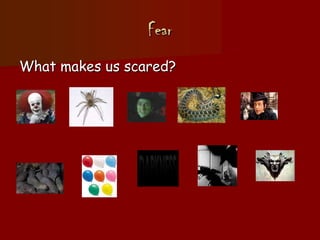
 What things frighten us? Consider the
photos on the next page
Fear
What makes us scared?
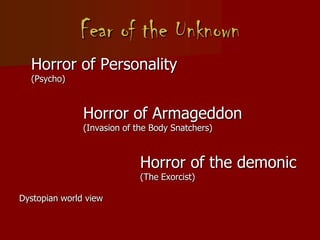
Fear of the Unknown
Horror of Personality
(Psycho)
Horror of Armageddon
(Invasion of the Body Snatchers)
Horror of the demonic
(The Exorcist)
Dystopian world view
Audiences of Horror
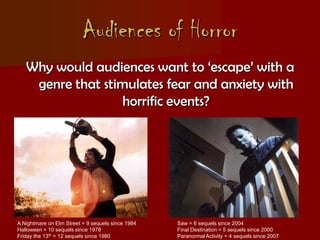
Why would audiences want to ‘escape’ with a
genre that stimulates fear and anxiety with
horrific events?
A Nightmare on Elm Street = 9 sequels since 1984 Saw = 6 sequels since 2004
Halloween = 10 sequels since 1978 Final Destination = 5 sequels since 2000
Friday the 13th = 12 sequels since 1980 Paranormal Activity = 4 sequels since 2007
Fear
 What are you afraid of now and why?
 What were you afraid when you were a
child? Why were you afraid? How did you
get over your fear?
 What do you do now when you are afraid?
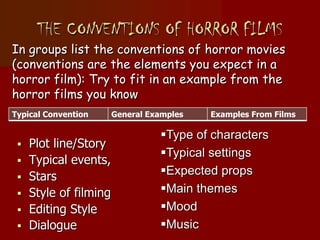
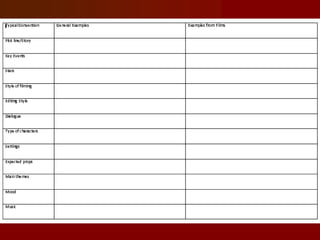
THE CONVENTIONS OF HORROR FILMS
 Plot line/Story
 Typical events,
 Stars
 Style of filming
 Editing Style
 Dialogue
Type of characters
Typical settings
Expected props
Main themes
Mood
Music
In groups list the conventions of horror movies
(conventions are the elements you expect in a
horror film): Try to fit in an example from the
horror films you know
Typical Convention General Examples Examples From Films
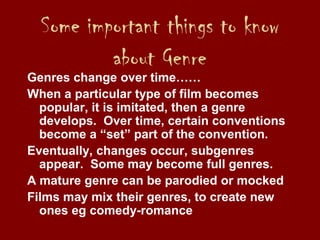
Some important things to know
about Genre
Genres change over time……
When a particular type of film becomes
popular, it is imitated, then a genre
develops. Over time, certain conventions
become a “set” part of the convention.
Eventually, changes occur, subgenres
appear. Some may become full genres.
A mature genre can be parodied or mocked
Films may mix their genres, to create new
ones eg comedy-romance
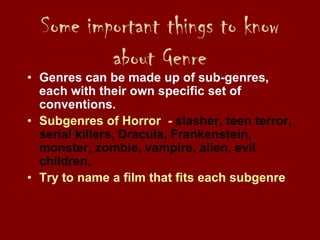
Some important things to know
about Genre
• Genres can be made up of sub-genres,
each with their own specific set of
conventions.
• Subgenres of Horror - slasher, teen terror,
serial killers, Dracula, Frankenstein,
monster, zombie, vampire, alien, evil
children,
• Try to name a film that fits each subgenre
Some important things to know
about Genre
• Genre movies tell us about the time in
which they are made, not set
• Genre movies reinforce ideas in society
– In The Ring, there is a fear of technology –
Samara can kill you through the television & a
phone call says you will die in 7 days.
• Genre movies often involve conflict
between accepted ideas and “the other”
“An opening sequence for a new film in the horror genre,
using original images. To include titles.”
Research [30]
 Genre Research (sub-genres,
conventions, opening sequences, etc.)
 Brainstorming (possible camera,
costumes, music, locations, narrative
ideas, etc. including sketches)
 Audience Research 1 (questionnaire –
min. 10 questions & 20 people surveyed)
An opening sequence for a new film in the horror genre,
using original images. To include titles.”
Initial Planning
 Treatment (an outline of your film)
 Character Profiles (details on your
characters and their background)
 Audience Research 2 (feedback once
you present your idea and info on how
that has impacted your film)
An opening sequence for a new film in the horror genre,
using original images. To include titles.”
Production Planning
 Storyboards (1 per group – these can be
colour drawings or photo storyboards)
 Production design pages (details and
reasons why you’ve chosen specific
locations, costumes, camera angles, etc.)
 Script (dialogue, sound choices, voice-
over)
 Shot Lists / Shooting Schedule
An opening sequence for a new film in the horror genre,
using original images. To include titles.”
Production & Editing [60]
Film your film. You can use school cameras or your own if they
are HD. You are encouraged to film outside of school.
No planning = no permission to film! Your research & planning
folder must be signed off before you can start the next phase.
You will be marked on…
 Holding a shot steady (so use a tripod where needed)
 Framing
 Variety of camera angles/shot distances
 Selecting mise-en-scene
 Continuity editing
 Sound
 Titles & appropriate transitions
An opening sequence for a new film in the horror genre,
using original images. To include titles.”
Written Evaluation [30]
Lets start analysing
 Darkness Falls
 Don’t be Afraid of the Dark
 Prom Night
 Scream
 Scream 2
 The Amityville Horror
 Wrong Turn
Watch and Write
‘Prom Night’ (2008), Nelson McCormick
‘Scream’ (1996), Wes Craven
‘Darkness Falls’ (2003), Jonathon Liebesman
‘The Ring’ (2002), Gore Verbinski
‘Saw’ (2004), James Wan
Fill in the Opening Sequence Analysis sheet

01.intro to horror (miss hill)

  • 1.
    Horror Genre I’m scared,so very scared!!!!!
  • 2.
    So You ThinkYou Know Horror  Name the films that the following characters appear in:
  • 3.
    Horror Films youhave watched  List as many horror film that you have seen.  Share your list with the other people at your table.  You have five mins to do this.
  • 4.
    Horror  Horror isall about making us scared  It is about FEAR  What things frighten us? Consider the photos on the next page
  • 5.
  • 6.
    Fear of theUnknown Horror of Personality (Psycho) Horror of Armageddon (Invasion of the Body Snatchers) Horror of the demonic (The Exorcist) Dystopian world view
  • 7.
    Audiences of Horror Whywould audiences want to ‘escape’ with a genre that stimulates fear and anxiety with horrific events? A Nightmare on Elm Street = 9 sequels since 1984 Saw = 6 sequels since 2004 Halloween = 10 sequels since 1978 Final Destination = 5 sequels since 2000 Friday the 13th = 12 sequels since 1980 Paranormal Activity = 4 sequels since 2007
  • 8.
    Fear  What areyou afraid of now and why?  What were you afraid when you were a child? Why were you afraid? How did you get over your fear?  What do you do now when you are afraid?
  • 9.
    THE CONVENTIONS OFHORROR FILMS  Plot line/Story  Typical events,  Stars  Style of filming  Editing Style  Dialogue Type of characters Typical settings Expected props Main themes Mood Music In groups list the conventions of horror movies (conventions are the elements you expect in a horror film): Try to fit in an example from the horror films you know Typical Convention General Examples Examples From Films
  • 11.
    Some important thingsto know about Genre Genres change over time…… When a particular type of film becomes popular, it is imitated, then a genre develops. Over time, certain conventions become a “set” part of the convention. Eventually, changes occur, subgenres appear. Some may become full genres. A mature genre can be parodied or mocked Films may mix their genres, to create new ones eg comedy-romance
  • 12.
    Some important thingsto know about Genre • Genres can be made up of sub-genres, each with their own specific set of conventions. • Subgenres of Horror - slasher, teen terror, serial killers, Dracula, Frankenstein, monster, zombie, vampire, alien, evil children, • Try to name a film that fits each subgenre
  • 13.
    Some important thingsto know about Genre • Genre movies tell us about the time in which they are made, not set • Genre movies reinforce ideas in society – In The Ring, there is a fear of technology – Samara can kill you through the television & a phone call says you will die in 7 days. • Genre movies often involve conflict between accepted ideas and “the other”
  • 14.
    “An opening sequencefor a new film in the horror genre, using original images. To include titles.” Research [30]  Genre Research (sub-genres, conventions, opening sequences, etc.)  Brainstorming (possible camera, costumes, music, locations, narrative ideas, etc. including sketches)  Audience Research 1 (questionnaire – min. 10 questions & 20 people surveyed)
  • 15.
    An opening sequencefor a new film in the horror genre, using original images. To include titles.” Initial Planning  Treatment (an outline of your film)  Character Profiles (details on your characters and their background)  Audience Research 2 (feedback once you present your idea and info on how that has impacted your film)
  • 16.
    An opening sequencefor a new film in the horror genre, using original images. To include titles.” Production Planning  Storyboards (1 per group – these can be colour drawings or photo storyboards)  Production design pages (details and reasons why you’ve chosen specific locations, costumes, camera angles, etc.)  Script (dialogue, sound choices, voice- over)  Shot Lists / Shooting Schedule
  • 17.
    An opening sequencefor a new film in the horror genre, using original images. To include titles.” Production & Editing [60] Film your film. You can use school cameras or your own if they are HD. You are encouraged to film outside of school. No planning = no permission to film! Your research & planning folder must be signed off before you can start the next phase. You will be marked on…  Holding a shot steady (so use a tripod where needed)  Framing  Variety of camera angles/shot distances  Selecting mise-en-scene  Continuity editing  Sound  Titles & appropriate transitions
  • 18.
    An opening sequencefor a new film in the horror genre, using original images. To include titles.” Written Evaluation [30]
  • 19.
    Lets start analysing Darkness Falls  Don’t be Afraid of the Dark  Prom Night  Scream  Scream 2  The Amityville Horror  Wrong Turn
  • 20.
    Watch and Write ‘PromNight’ (2008), Nelson McCormick ‘Scream’ (1996), Wes Craven ‘Darkness Falls’ (2003), Jonathon Liebesman ‘The Ring’ (2002), Gore Verbinski ‘Saw’ (2004), James Wan Fill in the Opening Sequence Analysis sheet

Editor's Notes

  • #7 These areas are the common ones that horror villains fall into. They’re either not right in the head and are just loony psycho killers, it’s the end of the world (like a zombie film) or there are demons or ghosts from ‘the other side’.