INTERF
ACEPYTHON WITH
MYSQL
Connecting Python application with
Introductio
n
 Every application required data to be stored for future
reference to manipulate data. Today every application
stores data in database for this purpose
 For example, reservation system stores passengers
details for reserving the seats and later on for sending
some messages or for printing tickets etc.
 In school student details are saved for many reasons
like attendance, fee collections, exams, report card etc.
 Python allows us to connect all types of database like
Oracle, SQLServer, MySQL.
 In our syllabus we have to understand how to connect
Python programs with MySQL
Pre-requisite to connect Python with
MySQL
 Before we connect python program with any database
like MySQL we need to build a bridge to connect
Python and MySQL.
 T
o build this bridge so that data can travel both ways
we need a connector called “mysql.connector”.
 We can install “mysql.connector” by using
following methods:
 At command prompt (Administrator login)
 Type “pip install mysql.connector” and press enter
 (internet connection in required)
 This connector will work only for MySQL 5.7.3 or later
 Or open
“https://dev.mysql.com/downloads/connector/python/”
And download connector as per OS and Python
version
Connecting to MySQL from
Python
 Once the connector is installed you are ready to
connect your python program to MySQL.
 The following steps to follow while connecting your
python program with MySQL
 Open python
 Import the package required (import
mysql.connector)
 Open the connection to database
 Create a cursor instance
 Execute the query and store it in resultset
 Extract data from resultset
 Clean up the environment
Importing
mysql.connector
import mysql.connector
Or
import mysql.connector as ms
Here “ms” is an alias, so every time we can use “ms” in
place of “mysql.connector”
Open a connection to MySQL
Database
 T
ocreate connection, connect() function is used
 Its syntax is:
 connect(host=<server_name>,user=<user_name>,
passwd=<password>[,database=<database>])
 Here server_name means database servername, generally
it is given as “localhost”
 User_name means user by which we connect with mysql
generally it is given as “root”
 Password is the password of user “root”
 Database is the name of database whose data(table) we
want to use
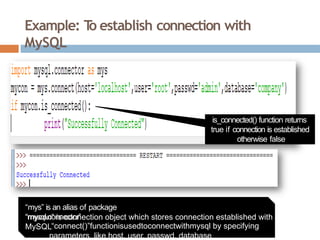
Example: T
o establish connection with
MySQL
is_connected() function returns
true if connection is established
otherwise false
“mys” is an alias of package
“mysql.connector”
“mycon” is connection object which stores connection established with
MySQL“connect()”functionisusedtoconnectwithmysql by specifying
parameters like host, user, passwd, database
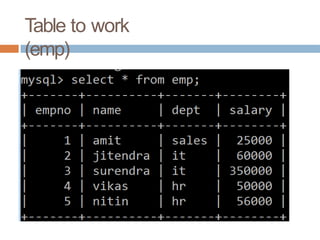
Table to work
(emp)
Creating
Cursor
 It is a useful control structure of database connectivity.
 When we fire a query to database, it is executed and
resultset (set of records) is sent over he connection in
one go.
 We may want to access data one row at a time, but
query processing cannot happens as one row at a time,
so cursor help us in performing this task. Cursor stores
all the data as a temporary container of returned data
and we can fetch data one row at a time from Cursor.
Creating Cursor and Executing
Query
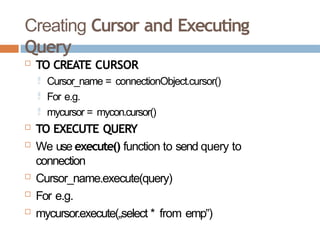
 TO CREATE CURSOR
 Cursor_name = connectionObject.cursor()
 For e.g.
 mycursor = mycon.cursor()
 TO EXECUTE QUERY
 We use execute() function to send query to
connection
 Cursor_name.execute(query)
 For e.g.
 mycursor.execute(„select * from emp )
‟
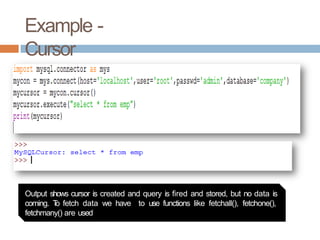
Example -
Cursor
Output shows cursor is created and query is fired and stored, but no data is
coming. T
o fetch data we have to use functions like fetchall(), fetchone(),
fetchmany() are used
Fetching(extracting) data from
ResultSet
 T
o extract data from cursor following functions are
used:
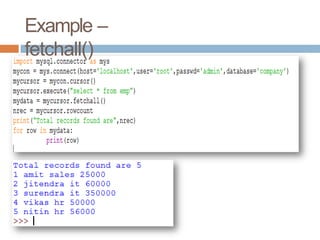
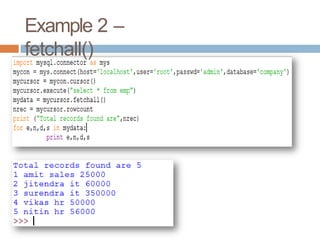
 fetchall() : it will return all the record in the form of
tuple.
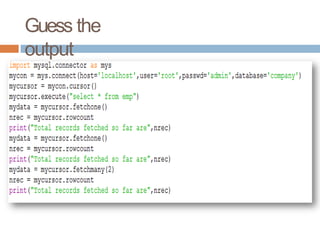
 fetchone() : it return one record from the result set. i.e.
first time it will return first record, next time it will return
second record and so on. If no more record it will
return None
 fetchmany(n) : it will return n number of records. It no
more record it will return an empty tuple.
 rowcount : it will return number of rows retrieved from
the cursor so far.
Example –
fetchall()
Example 2 –
fetchall()
Example 3 –
fetchall()
Example 4:
fetchone()
Example 5:
fetchmany(n)
Guess the
output
Parameterized
Query
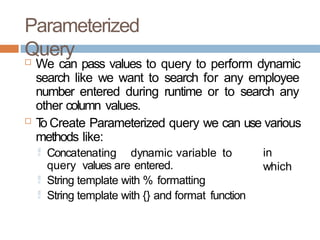
 We can pass values to query to perform dynamic
search like we want to search for any employee
number entered during runtime or to search any
other column values.
 T
o Create Parameterized query we can use various
methods like:
 Concatenating dynamic variable to
query values are entered.
 String template with % formatting
 String template with {} and format function
in
which
Concatenating variable with
query
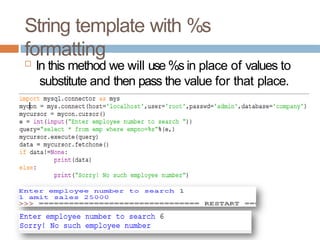
String template with %s
formatting
 In this method we will use %s in place of values to
substitute and then pass the value for that place.
String template with %s
formatting
String template with {} and
format()
 In this method in place of %s we will use {} and to
pass values for these placeholder format() is used.
Inside we can optionally give 0,1,2… values for e.g.
{0},{1} but its not mandatory. we can also optionally
pass named parameter inside {} so that while passing
we
need to
pass.
not
to
For
e.g.
values through format
function remember the
order of value
{roll},{name} etc.
String template with {} and
format()
String template with {} and
format()
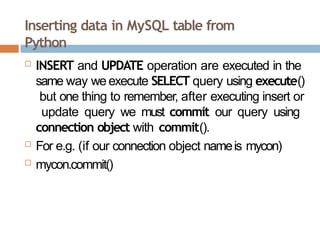
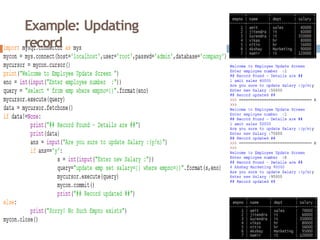
Inserting data in MySQL table from
Python
 INSERT and UPDATE operation are executed in the
same way we execute SELECT query using execute()
but one thing to remember, after executing insert or
update query we must commit our query using
connection object with commit().
 For e.g. (if our connection object nameis mycon)
 mycon.commit()
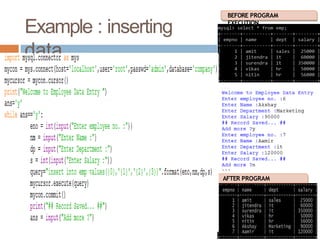
Example : inserting
data
BEFORE PROGRAM
EXECUTION
AFTER PROGRAM
EXECUTION
Example: Updating
record

015. Interface Python with sql interface ppt class 12

  • 1.
  • 2.
    Introductio n  Every applicationrequired data to be stored for future reference to manipulate data. Today every application stores data in database for this purpose  For example, reservation system stores passengers details for reserving the seats and later on for sending some messages or for printing tickets etc.  In school student details are saved for many reasons like attendance, fee collections, exams, report card etc.  Python allows us to connect all types of database like Oracle, SQLServer, MySQL.  In our syllabus we have to understand how to connect Python programs with MySQL
  • 3.
    Pre-requisite to connectPython with MySQL  Before we connect python program with any database like MySQL we need to build a bridge to connect Python and MySQL.  T o build this bridge so that data can travel both ways we need a connector called “mysql.connector”.  We can install “mysql.connector” by using following methods:  At command prompt (Administrator login)  Type “pip install mysql.connector” and press enter  (internet connection in required)  This connector will work only for MySQL 5.7.3 or later  Or open “https://dev.mysql.com/downloads/connector/python/” And download connector as per OS and Python version
  • 4.
    Connecting to MySQLfrom Python  Once the connector is installed you are ready to connect your python program to MySQL.  The following steps to follow while connecting your python program with MySQL  Open python  Import the package required (import mysql.connector)  Open the connection to database  Create a cursor instance  Execute the query and store it in resultset  Extract data from resultset  Clean up the environment
  • 5.
    Importing mysql.connector import mysql.connector Or import mysql.connectoras ms Here “ms” is an alias, so every time we can use “ms” in place of “mysql.connector”
  • 6.
    Open a connectionto MySQL Database  T ocreate connection, connect() function is used  Its syntax is:  connect(host=<server_name>,user=<user_name>, passwd=<password>[,database=<database>])  Here server_name means database servername, generally it is given as “localhost”  User_name means user by which we connect with mysql generally it is given as “root”  Password is the password of user “root”  Database is the name of database whose data(table) we want to use
  • 7.
    Example: T o establishconnection with MySQL is_connected() function returns true if connection is established otherwise false “mys” is an alias of package “mysql.connector” “mycon” is connection object which stores connection established with MySQL“connect()”functionisusedtoconnectwithmysql by specifying parameters like host, user, passwd, database
  • 8.
  • 9.
    Creating Cursor  It isa useful control structure of database connectivity.  When we fire a query to database, it is executed and resultset (set of records) is sent over he connection in one go.  We may want to access data one row at a time, but query processing cannot happens as one row at a time, so cursor help us in performing this task. Cursor stores all the data as a temporary container of returned data and we can fetch data one row at a time from Cursor.
  • 10.
    Creating Cursor andExecuting Query  TO CREATE CURSOR  Cursor_name = connectionObject.cursor()  For e.g.  mycursor = mycon.cursor()  TO EXECUTE QUERY  We use execute() function to send query to connection  Cursor_name.execute(query)  For e.g.  mycursor.execute(„select * from emp ) ‟
  • 11.
    Example - Cursor Output showscursor is created and query is fired and stored, but no data is coming. T o fetch data we have to use functions like fetchall(), fetchone(), fetchmany() are used
  • 12.
    Fetching(extracting) data from ResultSet T o extract data from cursor following functions are used:  fetchall() : it will return all the record in the form of tuple.  fetchone() : it return one record from the result set. i.e. first time it will return first record, next time it will return second record and so on. If no more record it will return None  fetchmany(n) : it will return n number of records. It no more record it will return an empty tuple.  rowcount : it will return number of rows retrieved from the cursor so far.
  • 13.
  • 14.
  • 15.
  • 16.
  • 17.
  • 18.
  • 19.
    Parameterized Query  We canpass values to query to perform dynamic search like we want to search for any employee number entered during runtime or to search any other column values.  T o Create Parameterized query we can use various methods like:  Concatenating dynamic variable to query values are entered.  String template with % formatting  String template with {} and format function in which
  • 20.
  • 21.
    String template with%s formatting  In this method we will use %s in place of values to substitute and then pass the value for that place.
  • 22.
    String template with%s formatting
  • 23.
    String template with{} and format()  In this method in place of %s we will use {} and to pass values for these placeholder format() is used. Inside we can optionally give 0,1,2… values for e.g. {0},{1} but its not mandatory. we can also optionally pass named parameter inside {} so that while passing we need to pass. not to For e.g. values through format function remember the order of value {roll},{name} etc.
  • 24.
    String template with{} and format()
  • 25.
    String template with{} and format()
  • 26.
    Inserting data inMySQL table from Python  INSERT and UPDATE operation are executed in the same way we execute SELECT query using execute() but one thing to remember, after executing insert or update query we must commit our query using connection object with commit().  For e.g. (if our connection object nameis mycon)  mycon.commit()
  • 27.
    Example : inserting data BEFOREPROGRAM EXECUTION AFTER PROGRAM EXECUTION
  • 28.