DEVELOPMENT OF MATHEMATICAL MODELS FOR
REMOVAL OF NITRATES FROM WASTE WATER
PROJECT REFERENCE NO.: 38S1286
COLLEGE : BAPUJI INSTITUTE OF ENGINEERING AND TECHNOLOGY, DAVANGERE
BRANCH : DEPARTMENT OF CHEMICAL ENGINEERING
GUIDE : DR.G.P.DESAI
DR.SURESH B
STUDENTS : MR. ANISH JACOB
MR. ARAVIND RAJAN
MR. SHOBANA RAJAN
Keywords used in the
synopsis
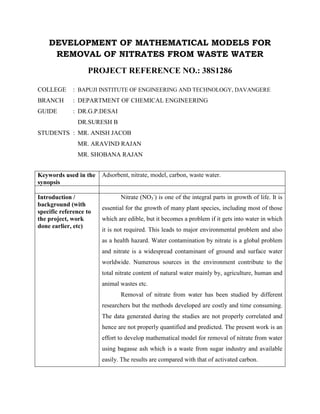
Adsorbent, nitrate, model, carbon, waste water.
Introduction /
background (with
specific reference to
the project, work
done earlier, etc)
Nitrate (NO3
-
) is one of the integral parts in growth of life. It is
essential for the growth of many plant species, including most of those
which are edible, but it becomes a problem if it gets into water in which
it is not required. This leads to major environmental problem and also
as a health hazard. Water contamination by nitrate is a global problem
and nitrate is a widespread contaminant of ground and surface water
worldwide. Numerous sources in the environment contribute to the
total nitrate content of natural water mainly by, agriculture, human and
animal wastes etc.
Removal of nitrate from water has been studied by different
researchers but the methods developed are costly and time consuming.
The data generated during the studies are not properly correlated and
hence are not properly quantified and predicted. The present work is an
effort to develop mathematical model for removal of nitrate from water
using bagasse ash which is a waste from sugar industry and available
easily. The results are compared with that of activated carbon.
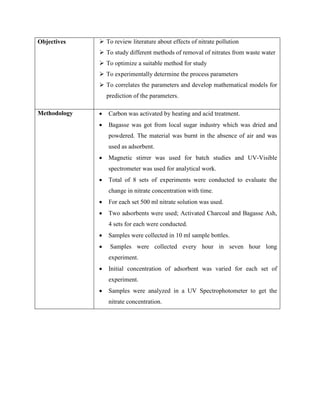
Objectives  To review literature about effects of nitrate pollution
 To study different methods of removal of nitrates from waste water
 To optimize a suitable method for study
 To experimentally determine the process parameters
 To correlates the parameters and develop mathematical models for
prediction of the parameters.
Methodology • Carbon was activated by heating and acid treatment.
• Bagasse was got from local sugar industry which was dried and
powdered. The material was burnt in the absence of air and was
used as adsorbent.
• Magnetic stirrer was used for batch studies and UV-Visible
spectrometer was used for analytical work.
• Total of 8 sets of experiments were conducted to evaluate the
change in nitrate concentration with time.
• For each set 500 ml nitrate solution was used.
• Two adsorbents were used; Activated Charcoal and Bagasse Ash,
4 sets for each were conducted.
• Samples were collected in 10 ml sample bottles.
• Samples were collected every hour in seven hour long
experiment.
• Initial concentration of adsorbent was varied for each set of
experiment.
• Samples were analyzed in a UV Spectrophotometer to get the
nitrate concentration.
Results and
Conclusions
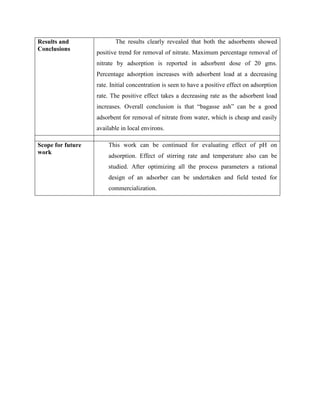
The results clearly revealed that both the adsorbents showed
positive trend for removal of nitrate. Maximum percentage removal of
nitrate by adsorption is reported in adsorbent dose of 20 gms.
Percentage adsorption increases with adsorbent load at a decreasing
rate. Initial concentration is seen to have a positive effect on adsorption
rate. The positive effect takes a decreasing rate as the adsorbent load
increases. Overall conclusion is that “bagasse ash” can be a good
adsorbent for removal of nitrate from water, which is cheap and easily
available in local environs.
Scope for future
work
This work can be continued for evaluating effect of pH on
adsorption. Effect of stirring rate and temperature also can be
studied. After optimizing all the process parameters a rational
design of an adsorber can be undertaken and field tested for
commercialization.

013_38S1286

  • 1.
    DEVELOPMENT OF MATHEMATICALMODELS FOR REMOVAL OF NITRATES FROM WASTE WATER PROJECT REFERENCE NO.: 38S1286 COLLEGE : BAPUJI INSTITUTE OF ENGINEERING AND TECHNOLOGY, DAVANGERE BRANCH : DEPARTMENT OF CHEMICAL ENGINEERING GUIDE : DR.G.P.DESAI DR.SURESH B STUDENTS : MR. ANISH JACOB MR. ARAVIND RAJAN MR. SHOBANA RAJAN Keywords used in the synopsis Adsorbent, nitrate, model, carbon, waste water. Introduction / background (with specific reference to the project, work done earlier, etc) Nitrate (NO3 - ) is one of the integral parts in growth of life. It is essential for the growth of many plant species, including most of those which are edible, but it becomes a problem if it gets into water in which it is not required. This leads to major environmental problem and also as a health hazard. Water contamination by nitrate is a global problem and nitrate is a widespread contaminant of ground and surface water worldwide. Numerous sources in the environment contribute to the total nitrate content of natural water mainly by, agriculture, human and animal wastes etc. Removal of nitrate from water has been studied by different researchers but the methods developed are costly and time consuming. The data generated during the studies are not properly correlated and hence are not properly quantified and predicted. The present work is an effort to develop mathematical model for removal of nitrate from water using bagasse ash which is a waste from sugar industry and available easily. The results are compared with that of activated carbon.
  • 2.
    Objectives  Toreview literature about effects of nitrate pollution  To study different methods of removal of nitrates from waste water  To optimize a suitable method for study  To experimentally determine the process parameters  To correlates the parameters and develop mathematical models for prediction of the parameters. Methodology • Carbon was activated by heating and acid treatment. • Bagasse was got from local sugar industry which was dried and powdered. The material was burnt in the absence of air and was used as adsorbent. • Magnetic stirrer was used for batch studies and UV-Visible spectrometer was used for analytical work. • Total of 8 sets of experiments were conducted to evaluate the change in nitrate concentration with time. • For each set 500 ml nitrate solution was used. • Two adsorbents were used; Activated Charcoal and Bagasse Ash, 4 sets for each were conducted. • Samples were collected in 10 ml sample bottles. • Samples were collected every hour in seven hour long experiment. • Initial concentration of adsorbent was varied for each set of experiment. • Samples were analyzed in a UV Spectrophotometer to get the nitrate concentration.
  • 3.
    Results and Conclusions The resultsclearly revealed that both the adsorbents showed positive trend for removal of nitrate. Maximum percentage removal of nitrate by adsorption is reported in adsorbent dose of 20 gms. Percentage adsorption increases with adsorbent load at a decreasing rate. Initial concentration is seen to have a positive effect on adsorption rate. The positive effect takes a decreasing rate as the adsorbent load increases. Overall conclusion is that “bagasse ash” can be a good adsorbent for removal of nitrate from water, which is cheap and easily available in local environs. Scope for future work This work can be continued for evaluating effect of pH on adsorption. Effect of stirring rate and temperature also can be studied. After optimizing all the process parameters a rational design of an adsorber can be undertaken and field tested for commercialization.